
In December 2015 I slipped off a stage onto my forehead, causing a concussion that kept me on medical leave for a year (and wrote about it here). Also in December 2015, Conor McGregor threw a counter left cross to knock out José Aldo in 13 seconds, kicking off my MMA fandom. What followed was a decade of streaming fights.
But I had never seen one in person. With the UFC coming to New York and China’s greatest female fighter Zhang Weili headlining, I got my hands on a press pass.
On Media Day, I walked into a midtown hotel conference room hoping to generate rooting interests by press conference personality. Expecting WWE trash talk, instead I saw reserved professionalism. They were calm, talked about their young kids and Jesus. An older fighter Beneil Dariush, when asked about his legacy, said “My legacy is Christ!”
Dagestani (a Muslim ethnic minority in Russia) champion Islam Machachev was the only one relaxed enough to make jokes, while Carlos Prates, Brazilian fighter famous for smoking half a pack a day, talked some shit about his opponent being washed and fans wanting blood.
Zhang Weili, former champion, is a feminist hero in China for pushing back against gender norms around aesthetics and marriage. I asked her a few questions in my extra-bad-because-I-was-nervous Chinese.
Jordan: You’ve spoken in the past about how Chinese culture influences your fighting, but MMA is a famously international sport. Can you expand on how your Chinese roots influence your fighting style? And what would you want the fighting world to better understand about China?
The translator started summarizing what I said but Zhang Weili cut her off saying ‘I pretty much got it’ (我大概明白了), in so doing saving me a ton of face
Zhang Weili: Roots are really important and make me more confident. The most important thing is how it opens up my thinking to integrate more things. Chinese culture is very inclusive, as is MMA culture.
Jordan: Sorry, but this question isn’t super professional, but I have a daughter that just turned 1. What do you want to say to the next generation of women?
Zhang: Bravely be yourself, as long as you’re the best version of yourself you’ll be great.
(video timestamped below)
The person I was most hoping to dislike was Zhang Weili’s opponent, longtime champ and boring fighter Valentina Shevchenko. One reporter politely called her out for fighting the same fight for years, asking: “You have been so dominant for so long, and sometimes fans or critics say they want to see a ‘war,’ they want to see you get into a crazy exchange. When you hear that, does it annoy you?” Her response:
I hear sometimes people say, ‘Oh, we want to see crazy exchange, we want to see blood.’ But this is not... this is not smart. My goal is always to win and to show perfect technique.
You want to show not only fight—like what everyone can do, like [a] street fight or whatever—you want to show the art of martial arts, the beauty of fighting. And this is my mindset.
I asked a follow up, hoping to get her to expand on “what does the artistry of martial arts mean to you?” Said Valentina:
We now live in a dream of great athletes—to be able to fight a universal martial art that contains all techniques. It’s all together now—the martial art technique that includes karate, tae kwon do, boxing, jiu jitsu, all kinds of wrestling. I’m very happy I’m living at the right time to show the skills I’ve developed over 32 years of practicing. This is the art and beauty of fighting.
After that, I couldn’t bring myself to hope Zhang dished her out real brain damage.
But did the fight live up to Valentina’s vision? And does anyone in a UFC crowd want artistry over blood?
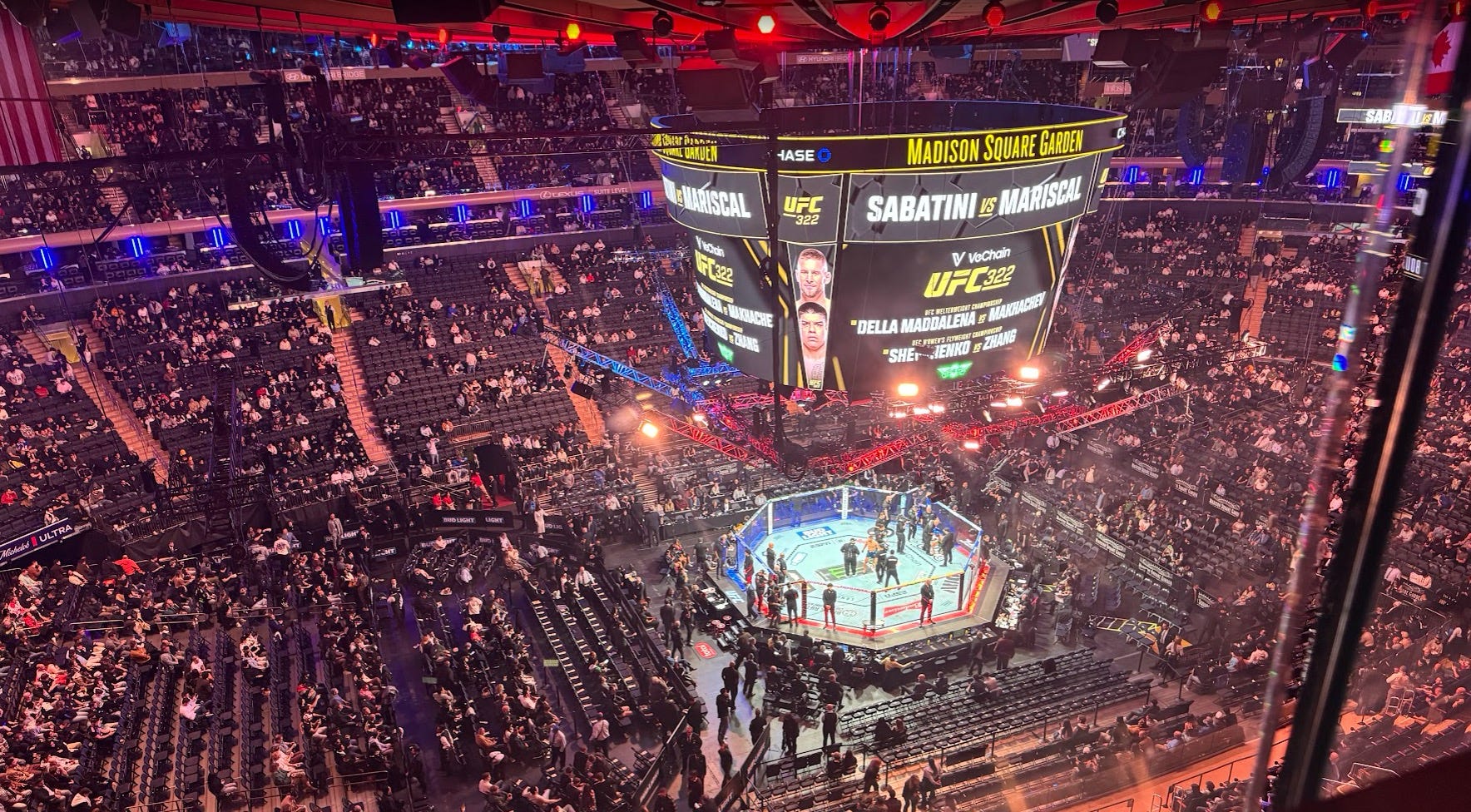
My parents first took me to Madison Square Garden when I was five to see the circus. Fast forward thirty years and I’m walking in the media entrance feeling like I’m somebody. Up three levels, I drop my bag in a cramped media room, where reporters barely watching eat on folding tables MSG-provided sad penne vodka, less sad Italian cookies, and mini water bottles. The press box they sent me to was on the sky bridge.
I sat down next to two Chinese reporters for the fights. One was taking video, a recent graduate of Columbia’s architecture MA program who works for my old employer Kuaishou part time, mainly to get into Knicks games for free.1
A fit Chinese guy and his wife sat next to us. I introduced myself and asked him what outlet they worked for. My new friend, embarrassed for me, told me he was The Leetch, one of China’s biggest MMA stars. “Jordan you really need to take a 功课, do your homework…” My credibility shot, I wandered out of the press box and into the nosebleeds, where CTE poster child Giants RB Cam Skattebo got the biggest cheer as the jumbotron panned across celebrity row.
Fights are too exciting and too boring. Minutes-long grappling exchanges require training in jiu jitsu to make any sense of. They’re also illegible from distance, leading the entire arena to stare at the jumbotron.
But when the fighters are standing, you are always half a second from a spectacular knockout. That tension commands attention like watching the Olympic hockey 3v3 overtime, but when taken in over six hours of fights it begins to numb.
Watching UFC feels oddly more comfortable than the NFL from a concussion perspective. Here concussions are the point, and everyone who signs up for the sport has no illusions about what it will do to their brain. Watching so many knock outs in succession makes it seem like a less big deal once they start moving afterwards. I felt for the concussees less on account of brain damage than twenty thousand fans thrilled at them losing the worst way there is to lose a sport.
Take Bo Nickal, who threw a leg kick that left his opponent unresponsive for minutes.
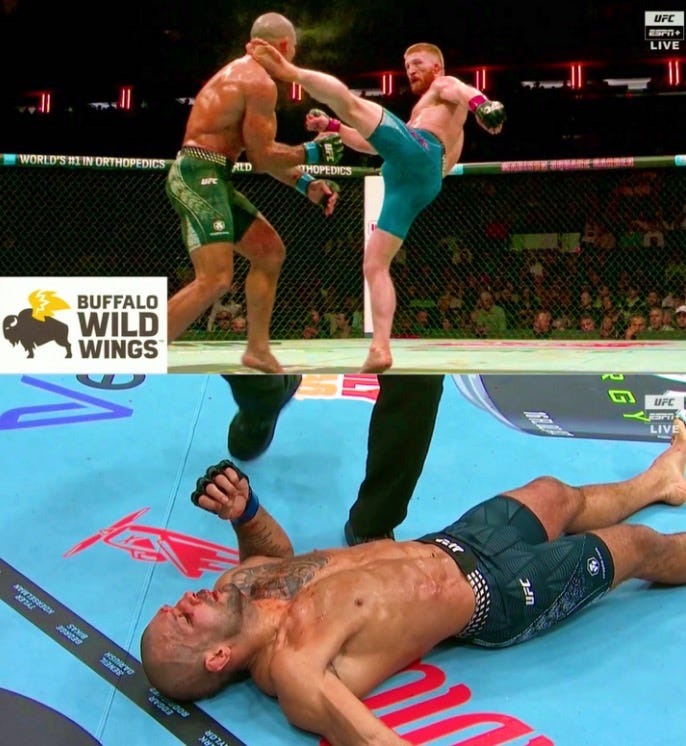
Once Bo turned around, he stopped preening and looked genuinely concerned at what he’d done.
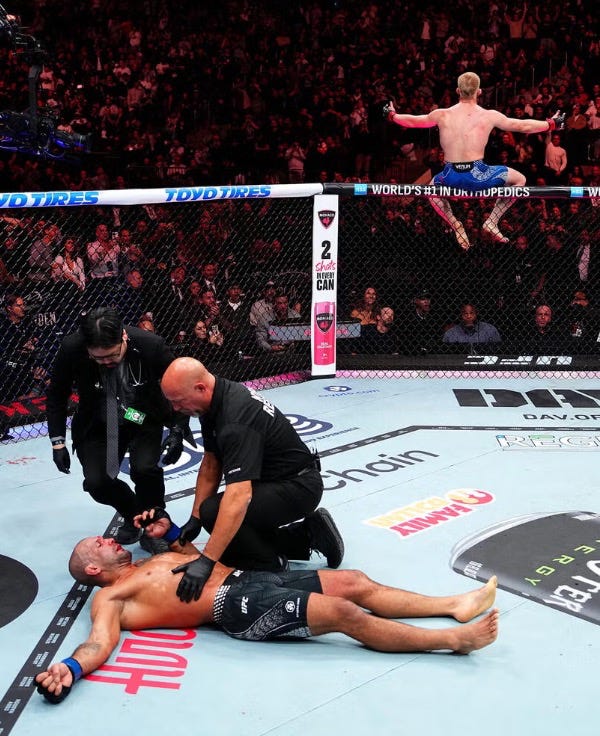
Said Bo afterwards, “That’s honestly to me one of the worst parts about what we do — having to hurt other people, do damage to people. We’re taking years off each other’s lives. It’s sad, but it’s part of it. For me, it’s the strategy, the discipline, the commitment — that’s why I love this sport, and how difficult it is to be the best in the world. Hurting other people is one of the downsides of this sport. I know people like it, but in my mind it’s not very fun. It’s sad, but it is what we signed up for.”
In contrast there are a handful of fighters who play up the violence. Said Carlos Prates, famous for his boozing and cigarette habit, “you guys pay to watch violence, to watch blood!” But even he acknowledged after his win, “I don’t really like hitting a guy like that when he falls, but he fell while still conscious, in guard. So I thought, ‘I’m going to have to finish him.’ But that’s it, it happens. I hope he’s okay.”
Shevchenko spent 25 minutes on top of Zhang Weili, showing that the beauty of fighting sometimes looks a lot like getting sat on. Twenty thousand people booed. Valentina didn’t care. And at least Zhang didn’t get concussed.2
I hoped to continue ChinaTalk’s UFC coverage next week from the White House, but unfortunately…

“They maxed capacity!” apologized the comms person. I really hope Caity Weaver or George Saunders got the slot instead of me.
We exchanged WeChats and he saw my very amateur Chinese landscapes. He said he used to paint growing up as well, and the second friend was like “oh is Jordan any good?” He respected me enough not to glaze me…
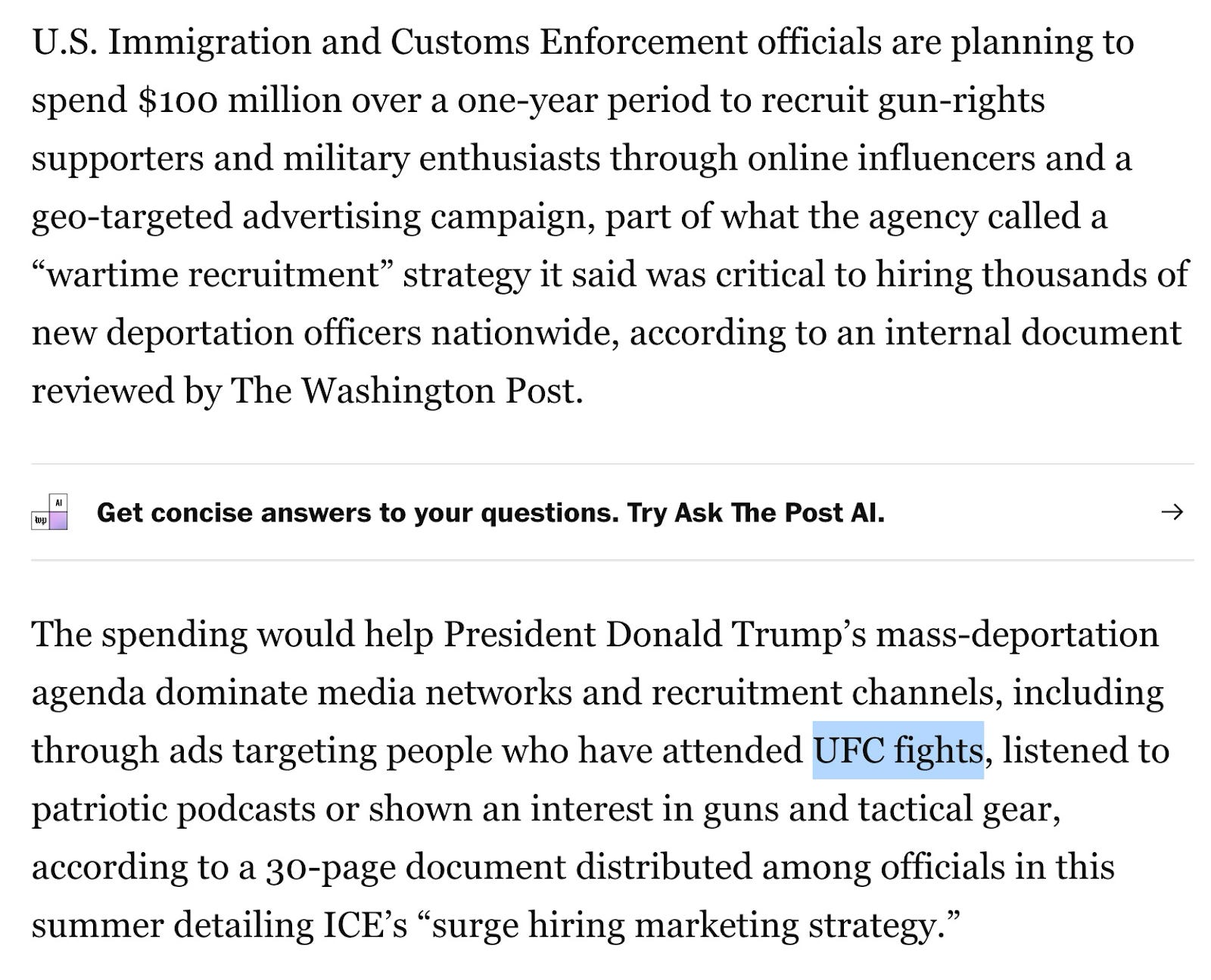
ICE is targeting UFC fans to hire.
其实去年ufc在上海的训练场就已经获得了很多媒体的注意力,ufc试图迎合中国体育的趋势,打造一个中国军团,你懂的,就是出征美国喽,但是不行啊,在澳门被打得不成样子。
与训练体系相比,我觉得中国人真的基因方面有点落后,不抗打,攻击性也少。
不过好像也不对,日本的拳击就非常厉害。还有泰拳。
这些格斗运动都是拿命来换取的。
我一直在想,除了世界比赛之外,如果严肃的看待中国格斗的发展会有哪些topic?
伤病和医疗体系的落后;类似石铭的爱好和职业的平衡;中国家长的一窝蜂报名拳击;中国运动员训练体系的落后;民族主义的脚踢欧美(嘻嘻);中国用户的流媒体付费习惯。
--------------------------------------------------------
看了两年,最后我放弃了,拳击比赛格斗比赛,是最残酷的。特别是日本的两个拳击手在同一晚上倒下,不治身亡,太难了。
很意外这里还能看到ufc相关的报道,感谢
The fact that everyone loses in the end is what ended my own MMA fandom. TBI treatment is still in the relative dark ages, but GLP-1 drugs show promise here: https://pmc.ncbi.nlm.nih.gov/articles/PMC11510130/