
With pretty much no news out of this Xi-Trump trip, how about checking out another economic security contest winner? This one comes from Guy Ward-Jackson, a Senior Policy Analyst at the Tony Blair Institute. You can reach him at Guy.Ward-Jackson@institute.global or read more of his writing on his Substack. Views are his own.
Economic Deterrence Without Autarky
The Cold War sparked an entire academic and policy discipline on nuclear deterrence and statecraft. It is time that the sphere of economic security received its fair share of attention. But we do not have to start entirely from scratch; there is much to learn from our “Cold War Warrior” predecessors. This essay suggests borrowing from the theory of “nuclear latency” — the notion not of having a bomb, but of having the capacity to build it in a coercive or crisis context — and applying it to vulnerable but non-critical elements of U.S. economic security.
The combination of rapidly emerging dual-use technologies like AI and quantum, the hyper-interdependence produced by globalisation, and U.S.-China geopolitical rivalry all mean that economic security is having a moment. However, as the lines between technology, economic and national security blur the likelihood of confused policymaking increases dramatically.1 The question for the United States then becomes not ‘should we prioritise economic security?’ but ‘how do we prioritise within economic security?’.
Prioritisation matters for two reasons. First, because economic security — even for the United States — is not free. Attempting to insure against every vulnerability produces familiar pathologies: blanket “re-shoring” agendas, misallocated capital, political capture, and opportunity costs2 in other areas. If the United States started treating every economic risk as an existential security threat — shielding industries from competition and innovation — it would undermine the very market dynamics that make the U.S. economy the strongest in the world.3
Second, because the most powerful economic security card that the United States has is not isolation but network dominance.4 It derives leverage from scale and openness — the conditions which produced interdependence in the first place. The strategic task is therefore to preserve the United States’ strategic gains from interdependence, while reducing the most coercible points of dependence — and, crucially, to do so efficiently.
In light of this, the United States’ current economic security policy repertoire is incomplete. Most U.S. economic security tools are either negative instruments — sanctions, tariffs, export controls — or vital but blunt supply-side interventions aimed at a narrow set of indispensable (‘Tier 1’) capabilities such as chip fabrication. The mixed historical record of economic deterrence should caution against overconfidence in coercive tools alone.5 Meanwhile, full-scale domestic re-shoring is fiscally unsustainable once it extends beyond a small number of genuinely existential sectors or capabilities (e.g., fabs). The missing gap is what to do about the wide middle: supply-chain bottlenecks that are strategically consequential, vulnerable to coercion, yet not important enough to justify full-scale CHIPS Act-scale reshoring.
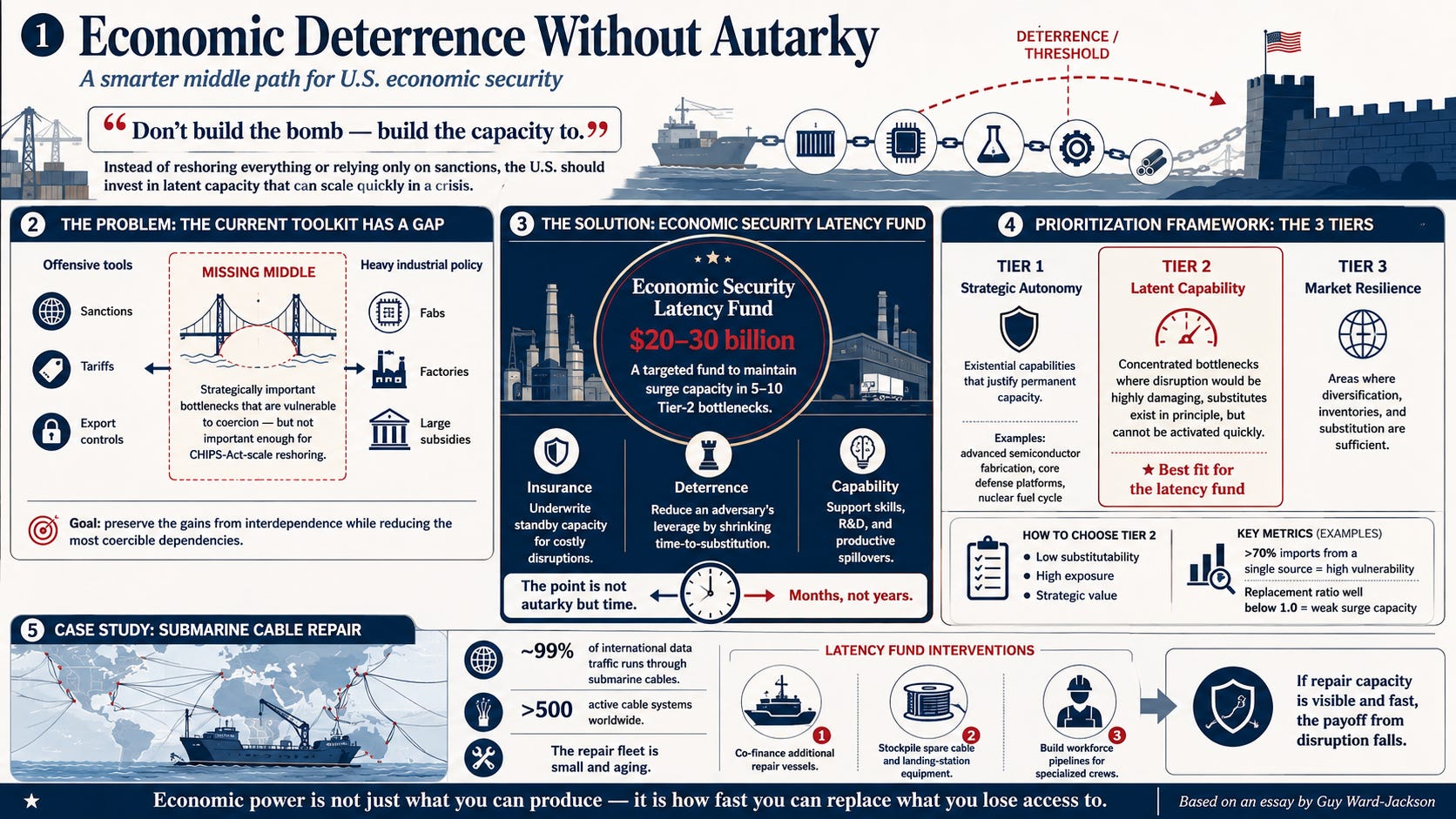
This essay proposes a way to manage that middle category: an Economic Security Latency Fund, on the order of $20-30 billion, explicitly designed to build resilience and as a form of ‘deterrence by denial’. The organising idea comes from nuclear strategy. Japan and South Korea have debated “nuclear latency” — maintaining the industrial and institutional capacity to build a weapon quickly without actually doing so — because full armament is destabilising, but zero option value is risky when alliances and threats are uncertain.6 Applied to economic security, latency means preserving the ability to scale production rapidly in a crisis without trying to on-shore everything in peacetime.
The point is not autarky but time. Economic coercion works when it can impose politically salient pain faster than the target can adapt. Latency reduces that coercive leverage by shrinking time-to-substitution and scale-up bottlenecks, ensuring that the capacity to ramp-up takes months rather than years. By building latent capacity, the United States can build resilience in areas where it is vulnerable and not currently critical — but could become critical in a crisis scenario.
The rest of the essay does three things. First, it sets out a disciplined hierarchy for U.S. economic security: distinguishing Tier 1 capabilities that justify permanent capacity, Tier 3 areas where markets and diversification are sufficient, and Tier 2 bottlenecks where latent capacity is the efficient middle path. Second, it operationalises what “latency” means in practice: how to choose select target areas, what instruments actually buy rapid scale-up, and what credible “thresholds” look like: economic equivalents of red lines. Third, it stress-tests the approach through an illustrative scenario, showing how latency can build resilience and deter coercion against the United States.
The core wager is this: disciplined latency can deliver a higher deterrence-per-dollar ratio than either blanket reshoring or reliance on coercive tools alone, while preserving the very interdependence that makes the United States powerful in the first place
Proposal: An American Economic Security Latency Fund
Countries like Japan and South Korea have long debated nuclear “latency”: the ability to acquire nuclear weapons quickly without actually building them. Latency is a hedge against uncertainty. As well as capability-building, it offers deterrence through credible potential — the knowledge that, within months rather than years, a state could cross the nuclear threshold if it chose to.7
Full nuclear armament for such countries is costly and destabilising: it invites sanctions, diplomatic isolation, and potential arms races. But zero capability is also dangerous if allies waver or geopolitics worsens. Latency is the middle ground: a strategy for building the capacity to act — stockpiling materials, maintaining expertise, investing in civilian nuclear research — so that, if the world darkens, options do exist.
The American economic security toolkit needs an analogue to nuclear latency. The United States should establish an Economic Security Latency Fund — on the order of $20-30 billion — to maintain latent capacity in a bounded set of ‘Tier-2 Critical’ supply chains or capabilities. The fund would not aim to permanently replicate entire industries. Rather, its purpose would be threefold:
Insurance: The fund would underwrite surge capacity in selected bottleneck capabilities where disruption would be costly but not existential, and where markets alone are unlikely to maintain redundant capacity. It would act as an insurance policy against long-duration coercion or repeated medium-sized shocks.
Deterrence: Properly designed, the fund would enable deterrence by denial, rather than deterrence by punishment. The aim is not to threaten retaliation through sanctions or counter-coercion (although these tools will also be necessary as part of a wider U.S. arsenal), but to reduce an adversary’s expectation that weaponising a particular dependency will generate lasting leverage. Economic coercion works when the target lacks credible alternatives within the timeframe that matters politically. Latency shortens that window.
Capability: Latent capacity is not dead capital. If structured well, the fund could generate present-day economic benefits: supporting R&D in critical but under-funded technologies, sustaining specialised skills and engineering expertise. Done right, it is therefore also an economic policy: a targeted bet on capabilities that have both security and productivity spillovers.
To make this work, the United States needs to have a hierarchy of prioritisation to understand where and what type of intervention is justifiable:
Tier 1: Strategic Autonomy. These are capabilities whose loss would be existential or fundamentally compromise national power: advanced semiconductor fabrication, core defence platforms, key elements of the nuclear fuel cycle. They justify permanent domestic or closely allied control and large-scale, long-term investment, as seen in the CHIPS Act and related measures. Strategic autonomy does not mean full on-shoring but it does mean having significant capability and thereby large upfront investment.
Tier 3: Market Resilience. These are goods and services where normal market mechanisms — diversified suppliers, inventories, substitution, redundancy — can provide adequate resilience, give or take some R&D tax credits here and there. Permanent subsidy or reshoring would be an inefficient use of scarce resources.
Tier 2: Latent Capability. Between these poles sits the layer we are interested in: concentrated nodes within critical supply chains where disruption would be highly damaging; substitutes exist in principle but cannot be activated quickly and yet full on-shoring would be economically inefficient.
The Economic Security Latency Fund would operate strictly at this Tier-2 level. Its remit would be limited to a small number of bottleneck capabilities that meet three tests:
Low substitutability: few alternative suppliers, long time-lines, or alternatives that are geopolitically misaligned. Substitution would take years, not months.
High exposure: the United States imports far more than it exports, meaning limited domestic surge capacity — a replacement ratio or exports to imports well below 1.0.8
Strategic value: the good is a dual-use input or systematically important across multiple sectors. High dependence on garlic9 or ball-point pens does not justify latency investments; a severe lack of advanced packaging facilities might.
These criteria allow for a more disciplined approach to the latency fund: rather than asking if this is a “critical sector” (i.e. where payment machines that use AI end up getting caught in the net), policymakers can ask “is this a bottleneck where dependence is both high and hard to substitute, and where latent capacity would materially change the coercive calculus or level of resilience?”
Operationalisation: How The Latency Fund Would Work
A $20–30 billion Economic Security Latency Fund would, by design, be modest compared to the scale of Tier-1 programmes such as CHIPS, but large enough to matter in a defined set of Tier-2 domains. Rather than sprinkling money across every vulnerable supply chain, it would concentrate resources on perhaps five to ten bottleneck capabilities that clearly meet the Tier-2 criteria. For the purposes of this essay, I later provide one illustrative example. The operating would have to vary on a case-by-case basis, but should have some common features.
First, selection and metrics. Two quantitative indicators stand out for identifying potential areas.
Dependence threshold: where more than 70 per cent of imports of a specific input come from a single source, vulnerability is high. Below that, market diversification provides meaningful resilience; above it, the risk of weaponisation rises sharply.10
Replacement ratio: The second is the replacement ratio: the value of exports of a given good divided by imports. A ratio well below 1.0 signals that a country lacks the industrial base to replace lost imports quickly; a ratio closer to parity suggests some latent capacity already exists.
Superimposed on these metrics would also be a qualitative risk assessment across exposure, strategic importance, and substitutability — where a judgement has to be made as to whether this falls into the remit of the latency fund (i.e. Tier 2 priority) or Tier 1 or 3.
Second, instruments. Given that the fund’s job is to ensure enough capacity exists for preparedness and a rapid surge — rather than to outright build — a portfolio of tools would be needed. This might include contingent “latency contracts” that pay firms to maintain standby production lines, tooling, workforce capacity, and stockpiles — which would be scaled up on request within an agreed timeline. It could also include investment in modular or scalable facilities, R&D grants for industrial capacity where private returns are uncertain, investment in specialised talent pipelines, and fast-tracked regulation. Realistically, the tools will have to vary in a case-by-case instance.
Third, triggers and thresholds. These are necessary for both domestic and international reasons. Domestically, because tools like “latency contracts” would require pre-determined threshold lines. Internationally, because for economic security latency to have a desired deterrent effect, there would need to be clear conditions under which it is activated — although perhaps with some room for ‘strategic ambiguity’.
These thresholds might be framed in terms of duration (“if access to advanced packaging is cut for more than six months, we will activate domestic surge capacity”), concentration (“if import dependence on a single source exceeds 80% specified inputs, we will invest to reduce it”), or explicit coercive acts (“if we are subject to economic coercion in sector X, we will ramp up production within this timeframe”).
Fourth, if a U.S. latency fund were initially successful, allied cooperation might be considered further down the line. For example, in strategic areas like copper, where the U.S. only controls 5.5% of global reserves but the US, Australia, and Canada combined have more like 17%,1112 it may make sense to build international “latency pool” models: where allied countries with different specialisations and resources can each maintain partial surge capacity that becomes effective in a NATO Article 5 equivalent for economic security (though this is an entirely separate essay in itself).
Finally, there are obviously limitations and necessary further thinking. The first is mission-creep: for the latency fund to work it has to be targeted at between five and ten areas of capacity. Much more than this and it becomes spread so thin so as to become meaningless. Second, on the deterrence side, more serious thinking would need to be done on how transparent the United States should be: too opaque about where the U.S. is investing in latent capacity and the fund does not perform its deterrence function; too much openness and adversaries simply factor those latent capabilities into their calculations and find other gaps to squeeze.
Case Study: Submarine Cable Repair Capacity
Submarine cables carry almost all international data traffic, roughly 99% by most estimates, and underpin global finance, cloud computing, communications, and everyday internet use. The network itself is large and geographically dispersed, with more than 500 active cable systems worldwide.13 The United States sits at the centre of the network, and American firms own or co-own much of the world’s subsea infrastructure.14
Cables are damaged regularly by fishing activity, anchors, earthquakes, wear, and grey zone attacks. The system is built to reroute around single failures, but the real vulnerability is not the cables themselves so much as how long they take to fix. Fixing a deep-sea cable requires a specialised ship, trained crew, and often diplomatic clearance to operate in territorial waters. The global repair fleet is small and ageing. Industry analysis suggests that maintaining current service levels — even without a major geopolitical shock — will require significant additional vessels over the coming decade.15
In an Indo-Pacific conflict scenario, for example, cables serving Guam or linking the U.S. to Asian allies would be obvious pressure points. The current repair system is very much built for one-off breaks not sustained disruption.
In this context, the Latency Fund would focus on shortening repair timelines and building surge capacity in case of a conflict. It could co-finance additional repair vessels alongside industry, structured as surge capacity. It could fund stockpiles of spare cable and landing-station equipment at major U.S. hubs. And it would also invest in workforce pipelines for the specialised crews these ships require. This fits firmly into “market failure” territory, given that private operators generally build for commercial uptime and only recently have begun factoring in geopolitical externalities.
Not only does this act as insurance, it also strengthens the United States’ real-time capability: with more repair vessels and specialised crews the U.S. strengthens its hold over the global cable network. And this also changes incentives. The leverage gained from cutting cables lies mostly in delay. So if restoration is slow, disruption is an attractive option for an adversary. But if repair capacity is visible and actively invested in, then the payoff falls. In other words, the deterrent side is that latent capacity in cable repair makes it less likely that a surge will be needed in the first place.
This fits into the case for latency because it is not clear-cut, top priority “industrial strategy” — but nor is this an area that can be left solely to private actors. Private operators won’t finance idle repair capacity for low-probability shocks. Public policy can, and should.
Conclusion: Don’t build the bomb, have the capacity to
The United States is at risk of fighting the wrong economic security war. Endless sanctions, tariffs, and export controls dominate the toolkit on the offensive end; and heavy-handed, and often counterproductive,16 industrial strategies are creeping in at the defensive end. Both may experience a backlash. Indeed, the former already has.17 The reason why these tools dominate is that they are easy; not in the sense that they are cheap, but they are levers that are easy to pull, and often easier to sell politically. But that is also why they are often wrong. This proposal is less expensive, but it is harder: because it is more nuanced, requires more technical ability, flexibility, and does not make headlines.
The measure of economic power in the coming decade won’t just be how much a country produces, but how quickly it can replace what it loses access to. Speed, in this case, is sovereignty.
Sometimes the best move is not to build the bomb, but to be able to.
More from Guy:

And the movie poster:

The Tier 2 framing is the most useful contribution here. Most economic-security conversation jumps straight from full reshoring (Tier 1, CHIPS Act sized) to laissez-faire (Tier 3), and the middle is where actual money goes to die in practice. A $20 to $30 billion Latency Fund explicitly priced for option value rather than steady-state production is the kind of instrument that could survive a transition between administrations because the deliverable is months-to-substitution, not jobs-by-state. The nuclear-latency analog also disciplines the strategic question: which Tier 2 bottlenecks would you rather have priced into Beijing's calculus, and which would you rather have priced into yours?
China has been running this playbook for almost a decade through 自主可控 (autonomous and controllable) -- specifically targeting the Tier 2 middle band you describe. Loongson CPUs, Huawei's Kunpeng/Ascend, CXMT DRAM: none are competitive with TSMC/Nvidia benchmarks in peacetime, but each preserves the capacity to substitute at scale under pressure.
The mechanism isn't autarky -- it's optionality. China's new supply chain security regulations (April 2026) operationalize exactly this: Article 9 creates a formal inter-ministerial review process for foreign supply dependencies in critical sectors. The H200 non-delivery this week is that logic running in real time. Chips US-approved, companies Beijing-approved, but the 25%-transit-through-US arrangement triggered the review. 75,000 chips per approved buyer, undelivered.
Your Tier 2 framework maps cleanly onto what China calls 补链 (fill chain gaps) vs 强链 (strengthen the chain) in 十五五 policy. 补链 = latency plays. 强链 = permanent capacity. The 15th Five-Year Plan allocates separate instruments to each.
The implicit lesson for a latency fund: credibility requires a small-enough gap between latent and active capacity. China's domestic compute isn't competitive today, but it's close enough that the optionality is real and Beijing uses it. The US version needs a similar time-to-activate benchmark to function as deterrence rather than just insurance.