
Last week, congressmembers amplified a claim that Chinese propaganda is driving anti-datacenter sentiment in the United States. And recently OpenAI exposed a Chinese influence operation that used ChatGPT to make anti-datacenter AI slop.
Someone in China’s deep state clearly thought it was a good idea to push narratives that throw sand in the gears of America’s domestic AI buildout. But blaming the United Front for datacenter resistance is cope that overlooks all the ways labs and hyperscalers could get communities onboard.
As actual Chinese influence expert Bethany Allen tweeted in a thread you should read arguing reports like the one coming out of the ‘Bitcoin Policy Institute’ “delegitimize what are very obviously organic US movements…and are also a form of disinformation and propaganda, very similar to how China paints Hong Kong pro-democracy protesters as stooges of America.”
Just as voters had legitimate reasons not to vote for Hillary in 2016 beyond Putin buying some ads on Facebook, citizens today have plenty of acute reasons to be wary of a datacenter popping up in their neighborhood. See below for my taxonomy of complaints and how much credibility I’d give them.
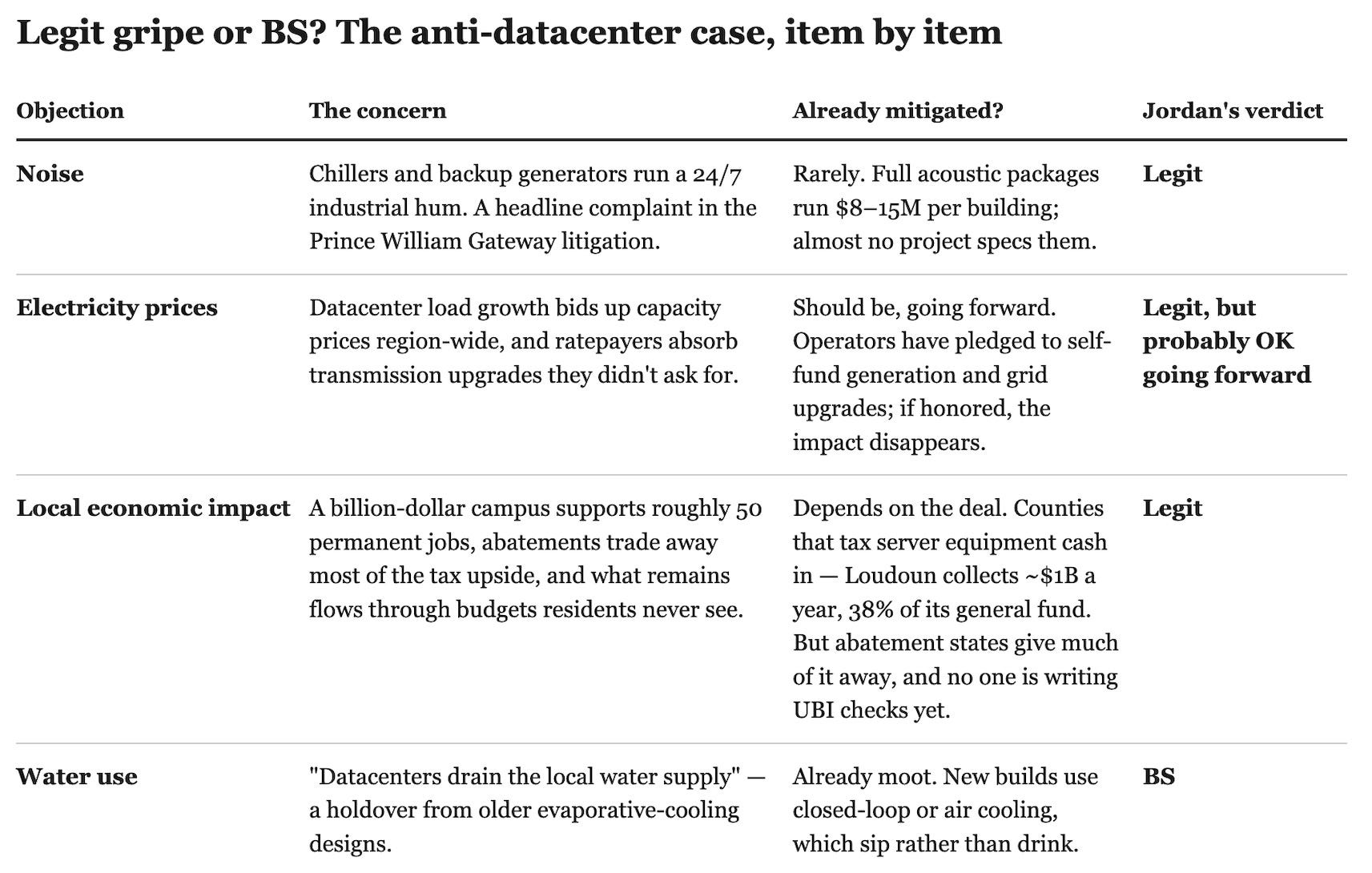
Fueling all of this, of course, we have a generalized dislike of big tech and anxiety about how AI is going to make life worse.
But here’s the good news: money can solve pretty much all of this!
As Kevin Xu has pointed out, AI gains are diffuse, while the perceived pain associated with living near a datacenter is concentrated. A core advantage America has over China is just how well capitalized our AI ecosystem is. While ByteDance, Ali, Tencent, and Baidu will spend around $70 billion in capex this year, Microsoft, Google, Amazon, and Meta are set to drop $725 billion in 2026, with $500bn landing domestically. Putting a tiny slice of that into communities next to new builds will turn towns from fighting datacenters to scrambling to attract them.
As Ben Thompson proposed, the simplest fix is to just create datacenter UBI: pipe a share of the revenue directly to nearby residents:
The most obvious solution is the most crass: simply start giving people money. If data centers are a resource for our AI future, then start paying people for that resource. If that data center up the road weren’t sold to my neighbors based on amorphous tax benefits that my local government may or may not spend appropriately, but rather were to result in a check in the mailbox every year, I suspect you could get a lot more people on board!
Just to put some numbers on this, the data center up the road was expected to be 1.6 GW, which could generate around $3 billion in annual operator revenue. DeForest, the village it was to be built in, has around 11,500 people. You could pay every person in DeForest $10,000 a year for 3.8% of annual revenue grossed by the data center — I bet that proposal would have been approved, and I bet that the operator could very easily pass those costs on to the actual data center users (it also highlights how relatively pathetic QTS’s $50 million commitment was).
Or if that’s too crass for you, how about investing in education? DeForest’s school district budget was $45 million this year. Doubling it would turn every parent into an advocate for 1.5% of revenue and ensure locals’ kids don’t join the permanent underclass.
It would also not be that expensive to make data centers a beloved part of civic fabric. Fable tells me it would cost $2 billion to make the stalled Virginia PW Digital Gateway silent and another $500 million to get Maya Lin to turn it into Storm Kng Wavefield 2.0. To really win people over, why not put the largest pickleball site on top of the site for a measly $100 million. The people who pack zoning board meetings and play pickleball are the same human beings. Give them courts and watch the public comment period empty out.
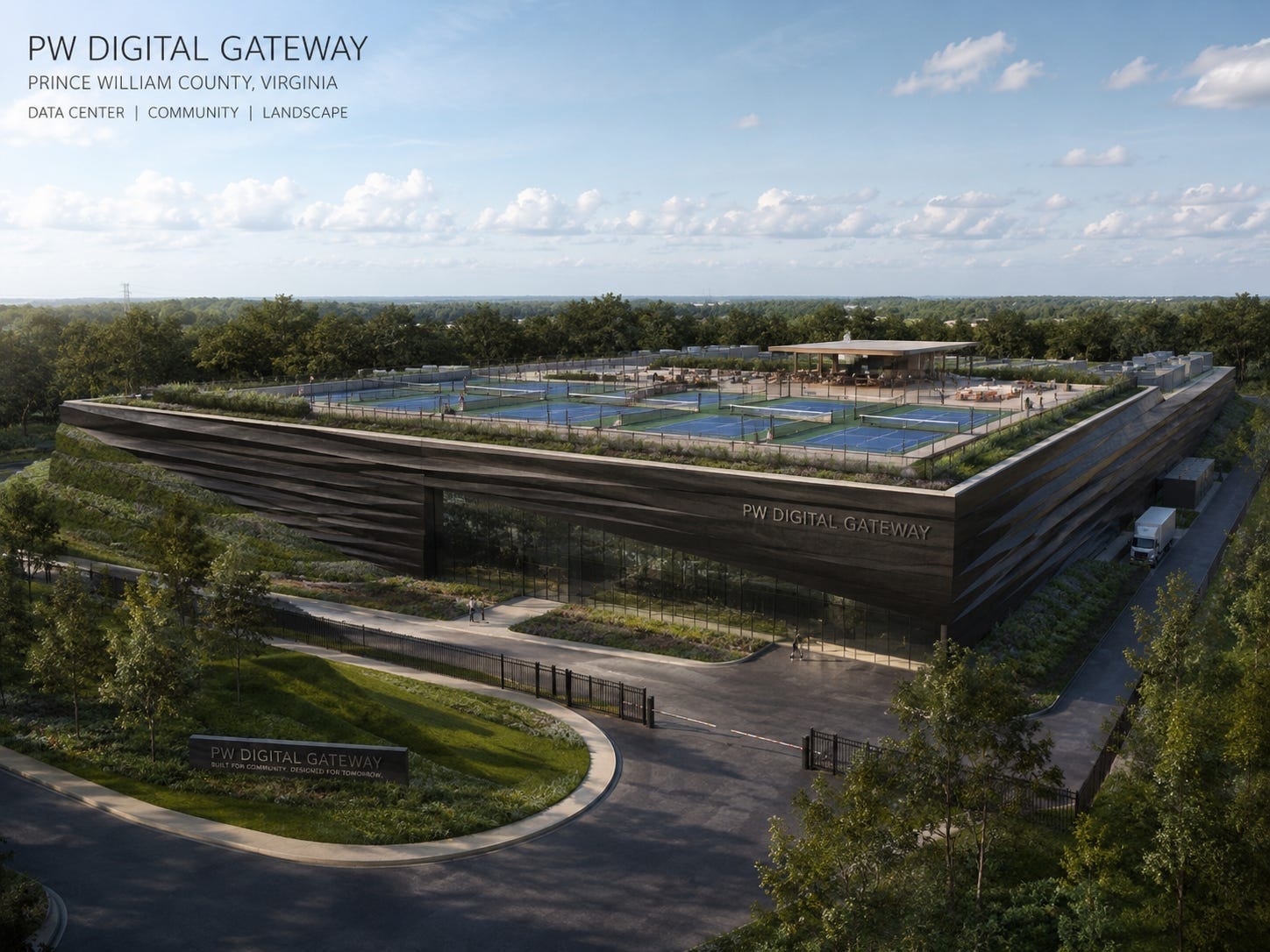
Let’s contrast this with what OpenAI put on the table for the town hosting Stargate.
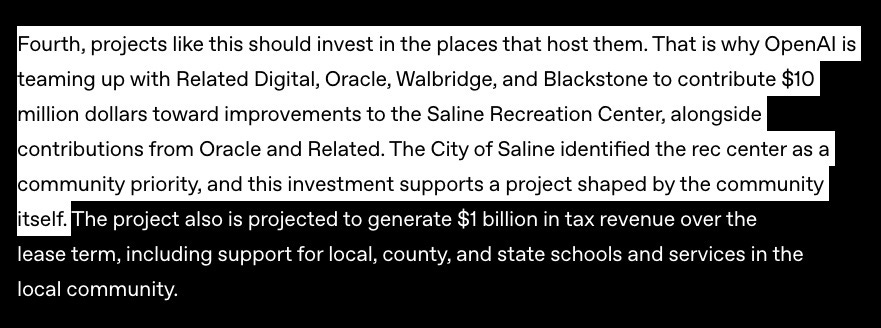
That’s a $10m community benefit check from three firms collectively worth $1.5tn today on a project that’s receiving over $50bn in capex (OpenAI confirmed to me that they’d be contributing $2m).1 How sweet that Jeff Blao, the CEO of Related, at an event attended by Gov. Whitmer and Sama, was proud to announce that the scope of work would “expand the aquatic center, update the locker rooms, rehab the pool deck, and more.” The mayor later elaborated that the project would include even a “lazy river and waterfall,” and that “the tech companies involved in the data center will contribute some of their engineering, construction and design expertise to the city as it moves forward with specific projects on site at the recreation center.” I really hope the lazy river gets to be part of the cooling loop.
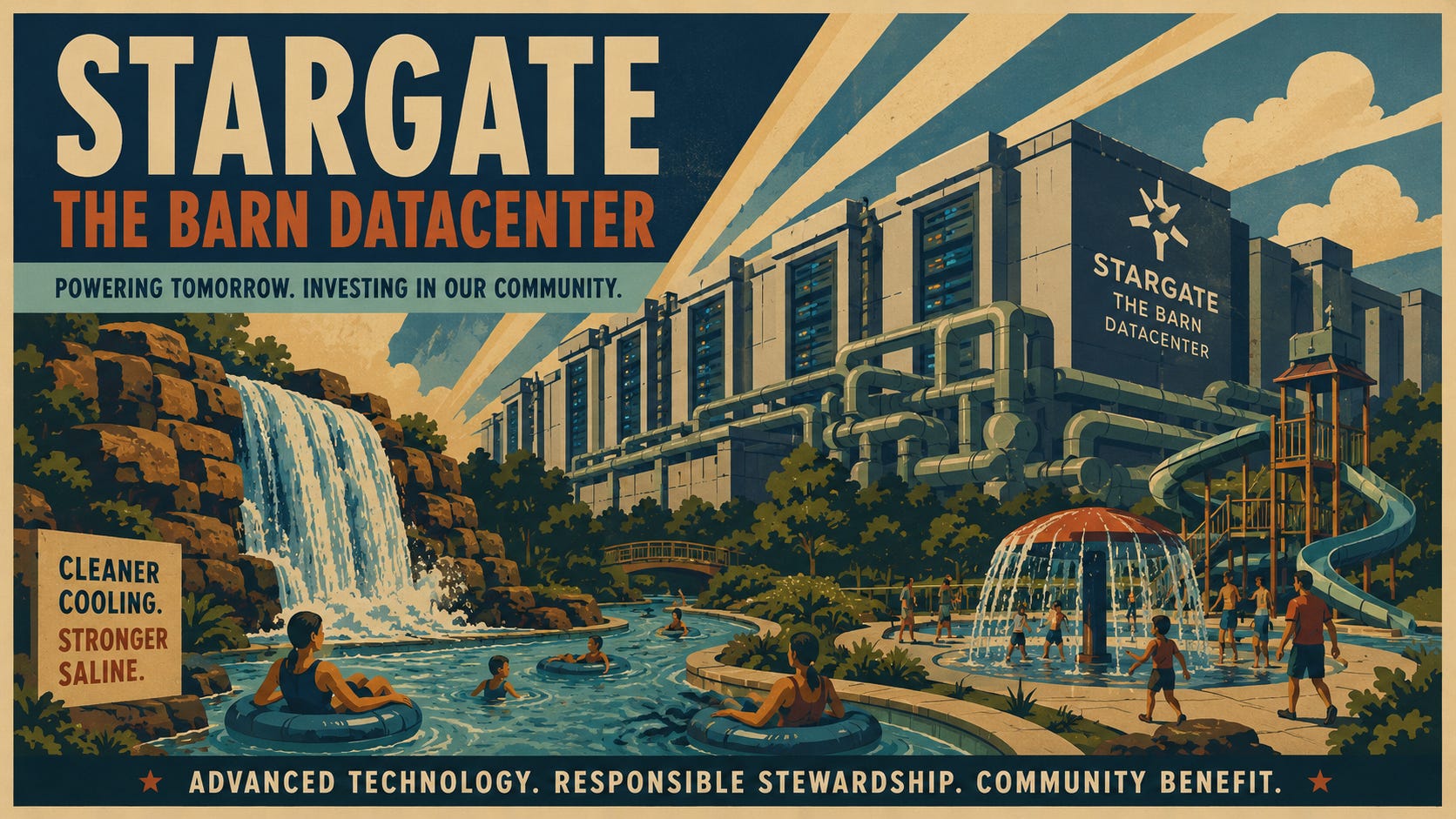
Even if there is legislative action, Chinese propaganda will be sloshing around the American political system for a long time to come. But datacenter UBI, Maya Lin, and world-class pickleball can easily drown out anti-datacenter NIMBY advocacy.2
Will influence operations get any better in the future?
In 2020 I wrote a report called ‘China’s hopeless twitter influence operations’, which analyzed reams of tweets that Twitter identified as state-backed.3 The tweets were bad and got basically zero engagement. I concluded by saying that “China has no idea how to run a Twitter network but new technology like GPT3, however, could potentially change the game. Of course, today’s AI isn’t able to create compelling posters and video content. To do more research into what this would look like, I’d need a GPT-3 key…”
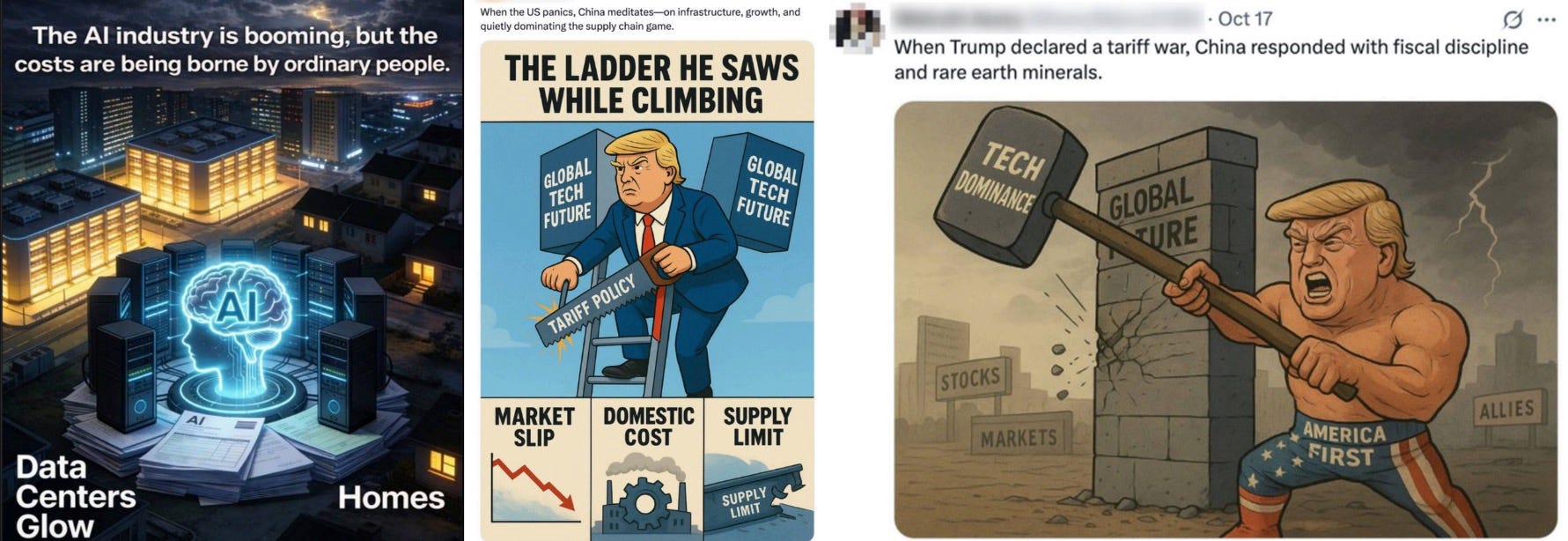
Judging by this OpenAI report, even with access to western frontier models they are still hopeless. I mean, just look at this mailed in garbage:
To be fair to the Chinese state-backed propaganda ecosystem, OpenAI probably caught one of the laziest subcontractors in the business. Chinese models are as good if not better for making video content and writing quips (I have Kimi help write my satire songs, I think it’s funnier than Claude). Working with replacement-level local Chinese talent to make content for the US even with today’s AI tools doesn’t give enough uplift to be effective. Far more impactful seems to be the strategy of partnering with foreign influencers, or taking a cue from Iran to partner with slop-providers who have already proven themselves to have the viral touch.
That is not to say you should write off Chinese influence operations as useless! Things the Chinese state does do that are really obnoxious and impactful include:
Harassment of dissidents and ethnic minorities abroad (start with the 2022 Freedom House report on transnational repression)
United Front elite co-option and political interference (Alex Joske’s Spies and Lies is a comprehensive introduction)
And check out Peter Mattis’ 2025 Congressional testimony for an overall framework with policy suggestions to combat.
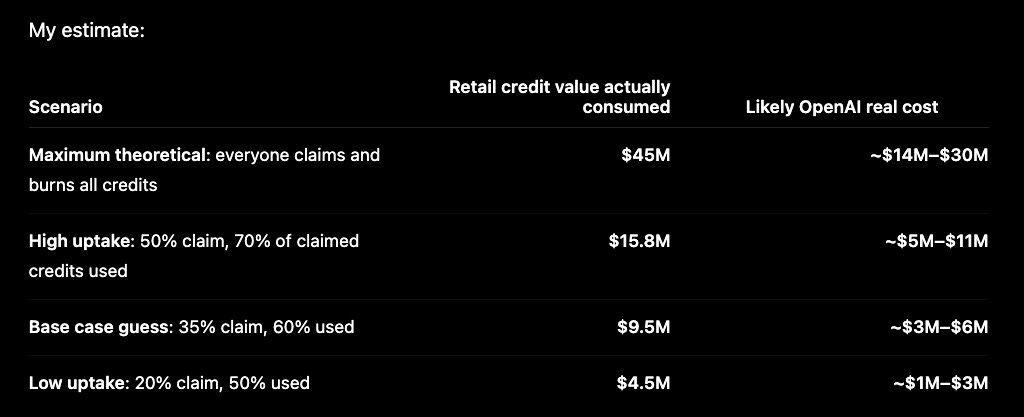
They’re also donating $45m in Codex credits to Michigan students. Here’s what ChatGPT tells me the effective cost to OpenAI is likely to be:
Dumping on OpenAI is illustrative here—this is not to let Anthropic and Google off the hook at all! Anthropic hasn’t announced any special community benefits for their new builds. I want “dumplings on Dario” every Friday for every town with an Ant datacenter.
Elon fired everyone who used to do this sort of work to fight state propaganda botnets.
I totally agree with this. In my on the ground reporting in four different communities across the US over the past six months (Arizona, Texas, Michigan and Louisiana) I have been so surprised that AI data center developers don't consider throwing more money -- maybe a LOT more money -- at their problem of getting towns on board with their projects. treat these communities as the valuable resources they are, not a group to take advantage of with legal wrangling. It may not always work, but I think there would be a lot more support if the share were more valuable and fair.
I broadly respect the power of political pork, but (A) you'd need to be careful to not fall afoul of vote-buying laws with direct cash (B) village bribes may not circumvent larger state-level movements (C) presumably labs are cautious about starting a race to hell on welfare when they have S-1s to keep clean.
Maybe pinning the blame of anti-datacenter discourse on China will backfire. Or maybe it will be the only practical political lever remaining in 2027 to keep datacenters around. Exponential growth applies to populist movements too.