
Zern Hee Chua is a research intern at the Global TechnoPolitics Forum and an editor at the Brown Political Review. His research focuses on Chinese economic growth.
For all its technological feats, China’s push for high-quality innovation has not made the economy that much more productive. This lends greater urgency to other productivity drivers such as firm efficiency — an exigency that Beijing is hardly unaware of. In recent months, the central government has outlined a series of regulatory measures to discourage local officials from propping up inefficient firms. But nothing stops local leaders from circumventing those regulations. The Chinese bureaucracy continues to reward officials who hit GDP growth targets, minimize unemployment and social unrest, and defer to the dynastic mandates of President Xi Jinping. Until the underlying incentive to keep inefficient firms afloat is recast, China’s tireless pursuit of productivity-led growth will continue to bear little fruit.
The Elusive Quest for Productivity 强弩之末
(Bonus points for guessing which book this header is inspired by!)
As an economy matures — like China over the last decade, growth increasingly moves away from capital accumulation. Because there is only so much equipment that one can “fit” a worker with, additional capital will eventually begin to yield smaller increases in GDP. More formally known as “diminishing returns to capital”, this phenomenon in part explains China’s decelerating growth in recent decades. Adding fuel to the fire is the country’s protracted fertility decline, which reforms to the one-child policy in 2015 and 2021 have failed to reverse. Economists predict that shrinkages in China’s working-age population will reduce per-capita GDP growth by 10 percent over the coming decade.
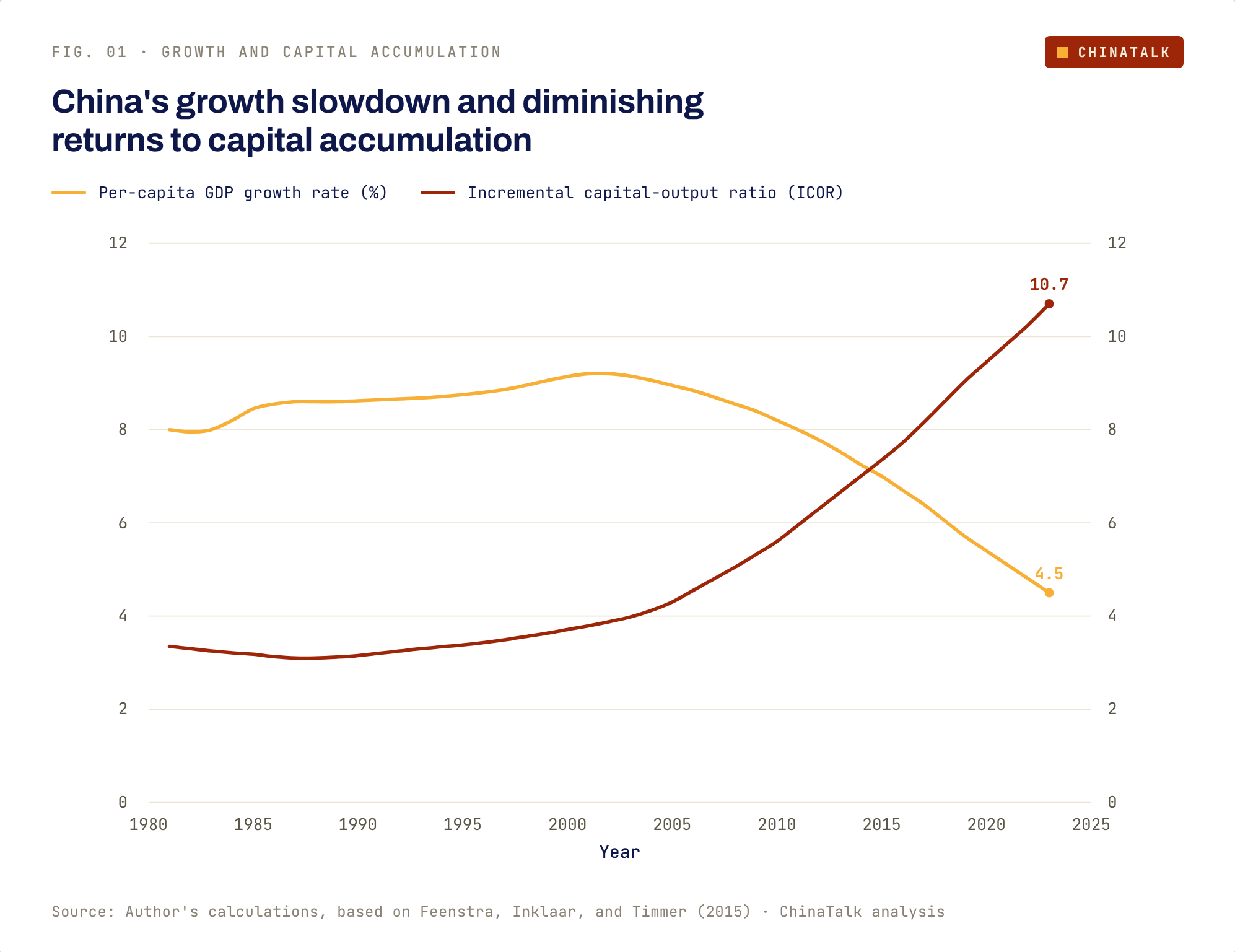
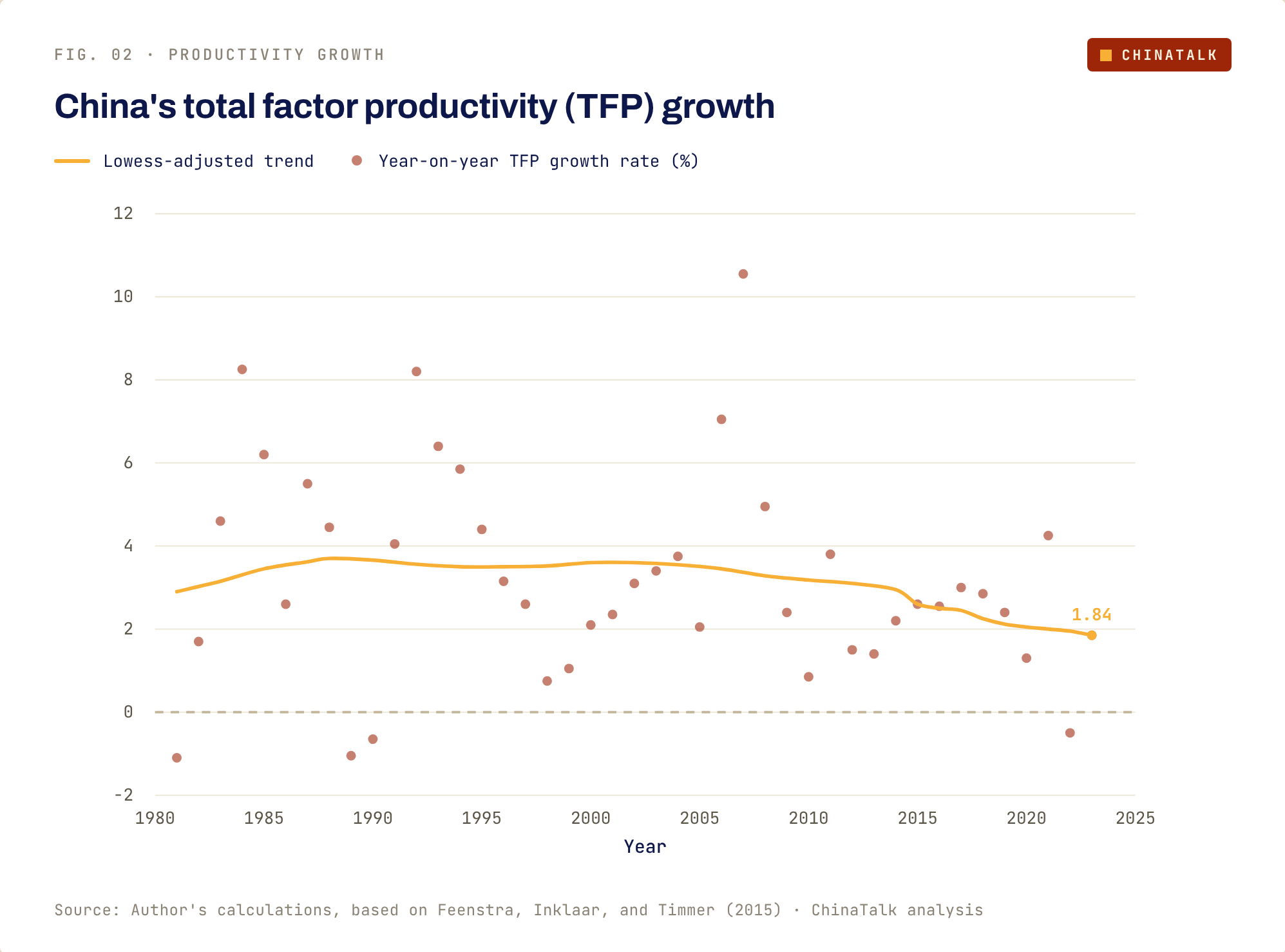
These unenviable economic circumstances necessitate a shift toward productivity-led growth. And who would be more aware of such a need than the Chinese Communist Party (CCP)? The CCP’s latest Five-Year Plan reemphasizes what have long been cornerstones of China’s broader economic agenda: innovation and technology upgrading. From 2015 to 2023, government spending on R&D in strategic sectors increased nearly fourfold under industrial policy guidance like Made in China 2025. While such lavish spending has given rise to the likes of BYD’s blade batteries and Huawei’s commercial 5G leadership, there have not been improvements in year-on-year productivity growth. The reasons for this discrepancy are manifold — R&D outcomes are inherently uncertain; making new discoveries becomes more difficult as technical fields mature; novel-product innovations do not necessarily make industry processes more efficient; and subsidies may have adversely encouraged low-quality patents over productive innovation. Or it could also be that innovation did bear sizable productivity gains, but they were ultimately offset by the expansion of inefficient firms. Either way, China’s push for high-quality innovation has not made the economy substantially more productive.
Granted, China does not rely solely on domestic innovation for technological progress — it also adopts frontier technologies from advanced economies. But rival powers have imposed lasting technology blockades that stifle this approach. Washington continues to restrict Tokyo and the Hague from exporting semiconductor manufacturing equipment and computer chips made using US technology. Restrictions on US investment in Chinese or Chinese-owned enterprises working on sensitive technologies — such as quantum information systems and AI — have similarly stiffened over the years. And even if there were no trade restrictions, it is unlikely that importing technologies would translate into significant productivity gains, given that China has already caught up to the global technology frontier in many industries.
Overcoming this productivity lassitude requires going beyond technological progress. China needs to become more efficient by dismantling its sprawling constellation of inefficient firms, the worst-performing of which are known as “zombie firms”. What defines a zombie firm is not exactly clear, however. The State Council considers a zombie firm to be a company that has been consistently unprofitable, belongs to an industry with overcapacity, and violated national environmental and quality standards. And so are firms that made three consecutive years of losses and failed to adhere to guidelines on structural reform.1 The International Monetary Fund (IMF), by comparison, defines zombie firms to be loss-making companies that enjoy below-market interest rates, often given by state-owned banks.2
Since zombie firms — and inefficient firms in general — enjoy subsidized credit and tax breaks from local governments, they are shielded from market forces that would otherwise compel them to become more efficient or shut down. Scaling back these financial benefits would thus pressure inefficient firms to restructure themselves or exit altogether. This reduces “wastage” of scarce credit. Instead, credit would be redirected to more efficient firms, allowing them to make greater investments. Eventually, as these firms make up a larger share of their respective sectors, the economy as a whole becomes more productive. In 2017, the IMF estimated that such productivity gains would raise China’s growth rate by 0.7 to 1.2 percentage points, nearly a fifth of the current GDP growth target of 4.5 to 5 percent.3
Feeding the Walking Dead 苟延残喘
But the widening footprint of inefficient firms also reflects the CCP’s difficulty in tackling the problem. Local officials’ promotions and financial rewards are linked to performance indicators established by senior officials. These indicators have undergone significant changes. In the first two decades of post-Mao China, local leaders competed against one another on hard growth targets, such as the annual gross value of industrial output in their respective jurisdictions. Such tournament-style competition backstopped astronomical investments in physical capital, resulting in miraculous economic growth. However, as income inequality and unemployment fuelled popular discontent in the 1990s, the CCP elite began expanding cadre evaluation metrics to include social development indicators like urban employment. Hitting GDP targets alone is no longer sufficient to protect one’s political career; one must also stave off the layoffs that follow firm closures. This provided another reason for local officials to prop up underperforming firms, at great cost to the economy writ large.
Take photovoltaic company LDK Solar (赛维LDK太阳能), for example. In addition to being the biggest taxpayer in Xinyu (新余市), a prefecture in Jiangxi, LDK Solar was a crucial employer in China’s politically favored solar industry. As of 2013, the firm had an estimated total of 10,000 workers despite having accrued $2.8 billion in debt. Unsurprisingly, the company had enjoyed generous state support even after making losses for nine consecutive quarters, including assistance from the local government to obtain a $327 million loan from national banks. According to one insider of the Jiangxi banking industry, the negotiation was “a coordination meeting on paper, but coercive in reality”, with threats from the local government to “terminate all relevant business and sever all relations with any bank that refuses”. The gravity of an LDK Solar collapse — to citizens and thus officials alike — was evident. A year earlier, Zhao Hongming (赵鸿鸣), then spokesperson for the Standing Committee of the Xinyu Municipal People’s Congress, said that the firm was an “industry vanguard” that “employs more than 20,000 workers”, and that “support [for a troubled LDK Solar] from all parties would bring about great benefit to the thousands of employees and local residents of Xinyu”.
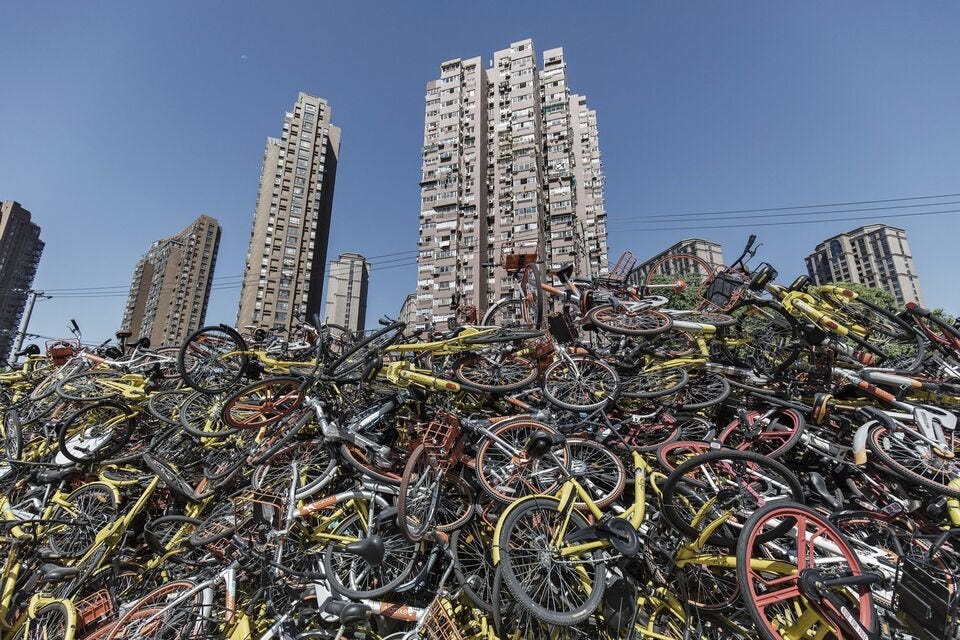
To make matters worse, there has been mounting pressure on local officials to align themselves with central priorities in recent years. Xi — in line with his predilection for “top-level design” (顶层设计) — has significantly narrowed the latitude in which local governments decide how to meet central policy objectives. Fearing demotion or punishment, many bureaucrats have erred on the side of excess, plowing even more subsidies into priority sectors. Aside from serving as lifebuoys for inefficient firms like LDK Solar, these subsidies have resulted in underused facilities and infrastructure. Think the ghost-like fabs of the now-defunct Dehuai Semiconductor (德淮半导体), the idle furnaces of Shandong’s steel mills, the graveyards of EVs and shared bicycles in Hangzhou. Xi, too, recognizes the perils of the subsidy glut. In his February address on cultivating sound conceptions of bureaucratic performance, he urged local officials to abandon “deviant or misplaced views” (偏差错位的政绩观), which have led to wasteful expenditure, formalism, and performative projects.

That Xi’s imperial decrees have also contributed to bureaucratic inertia — a well-known phenomenon among contemporary observers — is not actually contradictory. Officials often describe Xi’s directives as edicts undergirded by the wishful logic of “not only, but also, and also.” For example, local governments must not only promote innovation in priority industries, but also minimize financial risks inherent in funding experimentation, and also strictly conform to centrally established standards for achieving both goals, however vague they may seem. Faced with conflicting priorities, local leaders avoid risky or innovative policies, which are needed for furthering domestic R&D through greater private capital involvement. In an almost compensatory fashion, they default to conventional approaches that also suggest alignment with Xi’s mandates — such as pouring subsidies into semiconductor companies — with excessive zeal. This explains why it is often difficult for central directives to inspire downstream policy change. In 2018, for example, the Ministry of Finance called on local governments to submit a list of zombie firms in three months’ time; complete all restructuring, deregistration, and liquidation works by 2020; and impose restrictions on loan extensions and corporate subsidy payouts. One need not look far to know that the above remains a huge work in progress.
The Arrow Misses the Head 扬汤止沸
The productivity costs posed by inefficient firms have not been lost on the CCP elite. As early as three decades ago, former premier Zhu Rongji launched a landmark campaign to reform inefficient state-owned enterprises (SOEs) by transferring their responsibilities in home ownership and public insurance to the civil service. Yet, while efforts to combat firm inefficiency have only intensified in the years since, they often run into an incentive constraint.
To see why, it helps to begin with the basic understanding that local officials have functionally inexhaustible options for supporting inefficient firms. As long as the underlying incentive remains in place, local officials would sidestep regulatory measures by providing new kinds of financial lifelines. Earlier in March, the State Council announced its plans to restrict local governments’ discretion in giving out fiscal subsidies. While the specific prohibitions are not yet known, there remains little stopping officials from taking actions like pressuring local banks to initiate loan rollovers or creating purchase arrangements with loss-making firms.
Consider the vast array of financial benefits that Dayun Automobile Co. (大运汽车) enjoyed. The brainchild of who was once an enterprising 18-year-old grain trader, Dayun Auto has long been the largest heavy-duty truck manufacturer in Shanxi. Its dominance, however, belies a checkered history. Following peak sales in 2017, the automobile behemoth made a misguided hop onto the EV bandwagon. Unremitting competition in the EV industry eventually left an indelible dent in its cash flows, causing payment failures that pushed its suppliers to file a restructuring application against it in November 2024. The firm slashed its headcount by half as a result, and it focused on cranking out heavy-load trucks again. What is most concerning, however, is not its downfall; if anything, it did recover a little since the court-ordered restructuring began. Rather, it is the fact that it still buckled despite the many pillars of state support underneath. The EV subsidies Dayun Auto received in 2017 and 2018, which alone equaled 20 percent of its earnings then, were just the tip of the iceberg. It also enjoyed tax benefits that made up more than a tenth of its profits, purchase arrangements with a Yuncheng (运城市) state-owned firm that guaranteed the sale of one-third of its trucks, and even a highway toll exemption for its trucks to boost sales. In part, the wide variety of preferential deals reflects the limitless ingenuity of local officials, one that specific regulations alone would be unable to constrain. Indeed, as a former Dayun salesman by the name of Zhao Xinzheng remarked to Bloomberg, “It’s impossible for Dayun to go bankrupt. The government would never allow it.”
In addition to regulatory measures, the CCP has set up specialized bankruptcy courts. Since 2007, the number of specialized bankruptcy tribunals and courts has steadily grown to more than 100 across different prefectures. As judges in specialized courts are often better-educated and newly appointed, they are less susceptible to political interference than their counterparts in traditional civil courts. Expectedly, these specialized courts have expedited bankruptcy proceedings and thus the restructuring or liquidation of inefficient firms, raising productivity in their respective local economies.
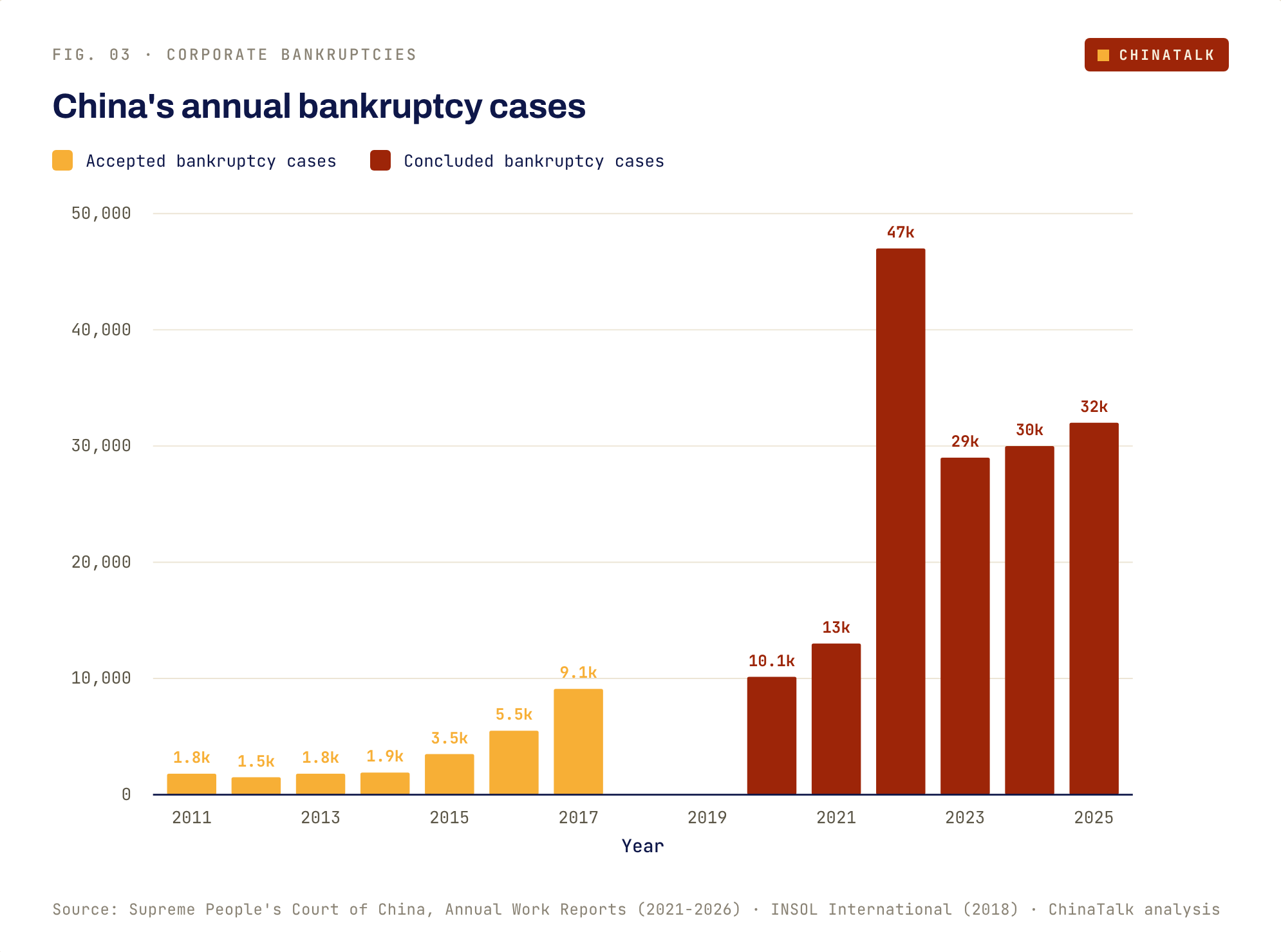
But like regulatory measures, such judicial specialization still skirts the root incentive for local governments to keep inefficient firms alive. Political interference can also occur before adjudication, where officials intervene through financial lifelines or direct court-government negotiations to prevent — or at least, slow — enterprises from entering a bankruptcy proceeding in the first place. As in the case of Dayun Auto, it was not until several years into its financial decline that non-state entities filed for compulsory reorganization against the Shanxi giant. Only then was it legally required to restructure itself (though restructuring had already been underway in Yuanhang Auto, the EV group of Dayun Auto).
In that case, why not involve the central government in initiating bankruptcy proceedings? Most recently, Beijing announced a pilot amendment to China’s Company Law in seven economic hubs. The amendment would empower central authorities to petition for the court-mandated liquidation of zombie firms that have not voluntarily dissolved, bypassing local-level resistance. While this legislative amendment is a step in the right direction, its effectiveness is ultimately contingent on the identification and processing capacity of central authorities. Politically favored zombie firms may remain under the radar as they continue to operate with generous financing from local governments, making it difficult for central authorities to identify entities for judicial liquidation.
Once Bitten, Twice Shy 入土为安
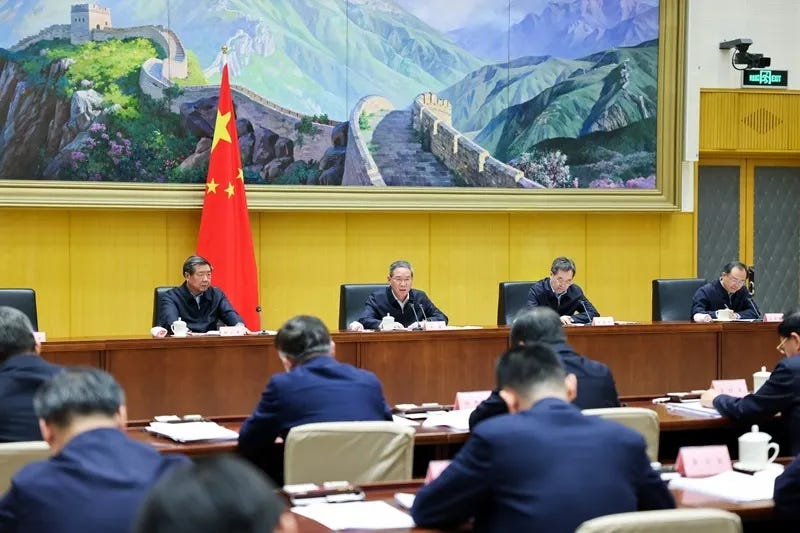
Of the deluge of central interventions, fiscal auditing most directly addresses the incentive constraint by penalizing local officials for racking up debt, which sustaining inefficient firms invariably leads to. Over the last decade, the fiscal adequacy of local governments has come under heightened scrutiny. In the 2017 National Financial Work Conference, Xi emphasized the need for local governments to “adopt just views on bureaucratic performance, strictly control the rise in local-government debt, and ensure a culture of lifetime accountability and retrospective responsibility”. Also underscoring the urgency of debt control is Premier Li Qiang, who warned local officials to limit debt risks and husband state coffers in a State Council video conference two years ago.
Would fiscal audits alone be sufficient, though? It is unlikely. While Xi’s debt-slashing mandates would most certainly curb reckless subsidy disbursements, they could also discourage local officials from accepting the short-term financial consequences of firm closures, such as the loss of corporate tax revenues and lower land prices. In fact, value-added tax and corporate income tax are the two biggest sources of revenue for local governments, accounting for a total of 56 percent in 2021. Declining land revenues since then have only magnified the importance of enterprise survival to state coffers. Deepening this fiscal predicament is also the fact that most local governments already face fiscal deficits. Aggregate local deficits, as a percentage of GDP, has risen steadily from less than one percent before 2015 to roughly five percent today. When it comes to debt, the situation is far worse: Only one provincial-level region, Tibet, has an adjusted debt burden below 100 percent,4 inclusive of on-lending debt. Saddled with recurring deficits and climbing debt, local officials are likely even more averse to drastic subsidy reductions that would mar balance sheets in the short run.
To actually embolden local officials to bury China’s corporate zombies, locally established debt reduction targets could be incorporated into the fiscal auditing approach. While the selection of specific indicators — such as adjusted debt burden and the debt-to-GDP ratio — would remain the preserve of the central government, local governments would have the autonomy to set appropriate quantitative targets for each indicator and the timelines for meeting them. Officials would be assessed on not just the extent to which the targets have been met, but also how ambitious the targets are; the latter is necessary to encourage bolder strategies to topple inefficient firms and slash debt. Moreover, recent developments in central policy favor such an initiative. Unveiled in November 2024, China’s 10 trillion yuan ($1.5 trillion) debt refinancing plan has allowed local governments to borrow an additional 6 trillion yuan through special-purpose bonds until 2027, and a further 800 billion per year over the following five years. In effect, local governments would be replacing their “hidden debt” — accrued from decades of borrowing through local government financing vehicles — with more transparent forms of debt, assisting central authorities in their assessment of local performance in debt reduction. And as officials in high-debt provinces are more likely to fear the loss of tax and future land revenues, the weightage of debt reduction performance in bureaucratic evaluation could be made higher in debt-laden localities.
Ideally, Beijing should also introduce bureaucratic incentives that encourage market-led allocation of financial capital, which would reduce inefficient state intervention in the survival of firms. Researcher Shengyu Wang remarked to me that many local governments have recently begun to report on private capital mobilization, measured as the amount of private investment attracted for each public dollar of venture capital. He believes this to be indicative of high-level commitment to liberalizing capital allocation for greater efficiency. How much further such commitment translates into incentive reforms will ultimately depend on political will.
China’s bureaucratic incentives are currently stuck in limbo. Once an investment dynamo, they helped transform a backwater into a global economic heavyweight. But as the Chinese economy matures and transitions from investment-driven to productivity-led growth, the cost of sustaining inefficient firms — the woeful byproducts of China’s bureaucratic incentives — would only continue to rise. Whether local officials stop doing so depends on more than just what they cannot do. It is also about what they stand to gain from consigning the corporate undead to the grave.
The use of “and” requires that both criteria — and all three criteria in the preceding sentence — be met. Furthermore, local governments have often introduced additional criteria, from asset-liability ratios that exceed 85% to production stoppages lasting more than half a year.
The IMF actually uses a variety of definitions. For example, Albuquerque and Iyer (2024) classify a firm as a zombie if it has an interest coverage ratio (ICR) below one, an above-median leverage ratio in the industry, and negative real sales growth for at least two successive years. That said, the difference in definitions is not a huge concern.
The IMF estimates productivity gains of 0.7 to 1.2 percent by assuming China catches up in revenue productivity to economies in the 75th-percentile and 90-percentile (of a sample of 57 other countries). Readers may refer to Hsieh and Klenow (2009) for the mathematical derivation of revenue productivity (TFPR) and the efficient-actual output ratio, which are used to estimate output gains from resource reallocation.
Adjusted debt burden, as defined in the source study, is the percentage of direct debt and (estimated) “hidden debt” from local government financing vehicles (LGFVs) relative to that of the local government’s consolidated operating revenue.

Your strongest point may be that the problem is not a shortage of rules but an excess of reasons not to obey them. For a local official, closing a zombie firm means layoffs, lost tax revenue, lower land values, and political risk; keeping it alive disperses the cost across banks and the future. Under those incentives, every new prohibition simply invites a new form of support. Productivity reform therefore depends less on telling officials what not to do than on changing who bears the visible cost of letting a firm die.
Interesting piece