
Elias X. Huber, author of the China ∩ Quantum blog, is a researcher at Fraunhofer Singapore and Singapore’s Centre for Quantum Technologies, where he works on security assurance for quantum cryptography. He previously was a Yenching Scholar at Peking University and holds an MSc from ETH Zürich. Today, he presents an incredible deep dive on the state of Chinese quantum, specifically how the Party’s future industry machinery is mobilizing quantum commercialization in the first half of 2026. We hope you enjoy it.
The Chinese quantum sector evolved rapidly over the first six months of this year. The many Western think tank reports written on China’s quantum ecosystem in 2025 already feel extremely dated.
The structure of Zhongnanhai’s mandates for China’s quantum sector have been clarified by the 15th Five-Year Plan in March 2026 — where quantum technologies are listed first among the future industries — as well as Xi Jinping’s Future Industry speech delivered to the Politburo in a 2026 study session, the associated essay in Qiushi 求是 (the Party’s official theoretical journal, literally, “Seeking Truth”) and countless articles and study sessions in response (such as by MOST and MIIT ministers, local cadres and quantum start-ups).
Emerging initiatives are implementing abstract, high-level instructions from the party, translating loaded policy jargon into concrete actions that we’ll analyze today.
It truly feels like a new industry is being willed into existence. Like a flywheel slowly picking up speed.
Today’s deep dive will catch you up on how much changed in just half a year, covering…
The scale of raw commercial expansion, with skyrocketing investments through over 40 H1 investment rounds analyzed for this article, a (neutral atom) quantum computing boom approaching 30 quantum computing hardware companies, and a multitude of new quantum funds.
The implementation and scaling of existing policy tools and platforms — jiebang guashuai, scenario cultivation, concept-verification and pilot-testing centers — in the quantum tech sector.
How China’s domestic “patient capital” has evolved and stepped up since the US outbound investment controls covered by the author’s last ChinaTalk contribution.
The Quantum Mandate and its Scaffolding
The bottom line is not new: The CCP is betting big on innovation- and tech-driven development, with quantum technologies specifically singled out as a future industry of strategic importance for China’s development and security. I have written about this in more detail here.
But what does this mean specifically for China’s quantum sector?
Reading only translations of Chinese future industry discourse, I find the high-level mandates full of tensions and even outright contradictions.
Take, for example, the tension between self-reliance, controllability, and breaking through chokepoints while actively promoting international collaboration and going global. Another one that leaves me scratching my head is the constant call for stronger overall planning and a unified national approach with clear priority areas, while demanding differentiated local development and avoidance of “blindly following the trend” (盲目“跟风”).
Or take the role of basic research: Be bold, exploratory and original — but also target bottleneck technologies… right.
Basic research should be bold in exploration and emphasize originality, but it should also be driven by application to break through bottlenecks and thoroughly understand the basic theories and technical principles of ’bottleneck’ technologies.
With my limited Chinese and lack of schooling in Marxist dialectics, I feel unqualified to give a detailed interpretation of these tensions and the loaded expressions in official commentary.
Anyway, these big-picture documents mention quantum only marginally. What I find more productive is to map out connections between policy jargon and concrete quantum examples. The rest of the article will follow such a format: I pick some quotes from a Qiushi editorial and use them as the structure to tie together various Chinese quantum news from H1 2026.
Xi’s first point on future industries was to strengthen overall planning and coordination. If nothing else, this article will give you a glimpse at just how vigorously and comprehensively the Chinese system has taken up this mundane sentence:
Point 1: Strengthen Overall Planning and Coordination (第一,加强统筹谋划)
National S&T Innovation Platforms
In point one, Xi declares his desire for a plan. The concepts of the plan begin to emerge in point two:
Point 2: Insist on Science and Technology Innovation as the Guide (第二,坚持以科技创新为引领)
To understand what that means concretely, we turn to a Qiushi editorial on future industries (covered in English by Manoj Kewalramani here). We’ll take a look at several Qiushi excerpts throughout this story, which I’ll present as block quotes:
In accordance with the requirements of General Secretary Xi Jinping’s important speech, it is necessary to strengthen the role of the national strategic scientific and technological forces (guójiā zhànlüè kējí lìliàng / 国家战略科技力量), adhere to the principle that “industry sets the questions, science and technology provides the answers,” and use mechanisms such as revealing the list and appointing the commander (jiē bǎng guà shuài / “揭榜挂帅”) to achieve breakthroughs in chokepoint (kǎ bǐzi / “卡脖子”) problems as quickly as possible.
The principle of “industry sets the questions, science and technology provides the answers” was one of the key themes that emerged for me from the first draft of the 15th Five-Year Plan: No longer “Science Push,” the dominant theory of change is now “Industry Pull.” This is exemplified in Hefei’s “Thousand Scenarios” action plan, where the local government acts as a matchmaker between quantum tech companies and industry players to serve the needs and questions of the latter.
Zhejiang Province issued a similar action plan for the promotion of new “scenarios”, with quantum technologies one of the focus areas, specifically: Quantum cryptography applications in government, finance, health care and power sectors, the product industrialization of quantum gravimeters, magnetometers and atomic clocks, and medical applications.
In a similar vein, “matchmaking quantum conferences” were recently held in Suzhou, with the explicit goal to align supply and demand between local companies and the Quantum Technology Yangtze River Delta Industrial Innovation Center (量子科技长三角产业创新中心). This first session was focussed on cryogenics, a second session was held shortly thereafter, focussing on chip design and manufacturing, and a third was scheduled on quantum software and applications.
This push for developing demonstration scenarios is made explicit in another part of the editorial:
In terms of application scenarios, it is necessary to build demonstration scenarios (shìfàn chǎngjǐng / 示范场景 ) around key fields such as raw materials and consumer goods, support the promotion and application of first-set (shǒutái tào / 首台(套)) and first-batch (shǒupīcì / 首批次) products, and drive the large-scale implementation of new technologies and new products.
But apart from demonstration scenarios, what else is in the toolbox?
One key mechanism is challenge-based open bidding: The jiebang guashuai 揭榜挂帅 strategy (literally, “exposing the list and assuming control”) provides a format for industry players and the government to post public challenges and chokepoints (“exposing the list”), which can be taken on by multiple teams (“assuming control”) with outcome-based carrots. Successful bidders receive funding to pursue their proposed solution and cash out on good results. For example, China’s Ministry of Industry and Information Technology (MIIT) issued 17 quantum challenges in early 2025, with clearly benchmarked tasks such as for the development of control electronics, dilution refrigerators and quantum error correction. Local governments have likewise issued challenge lists.
The jiebang guashuai umbrella has also been used in hackathon-like competitions. CETC’s quantum arm (国基量子) published challenges aimed at quantum computing algorithms and compilation to quantum hardware. Students from junior college to PhD can register teams and submit solutions over the course of a few months, with generous prize money for the winners (100,000 RMB for the overall champion).
The Quishi quote stresses the need to achieve breakthroughs in chokepoint problems. The chokepoint framing — literally, “stuck neck” (卡脖子) — is often invoked in the context of Western export restrictions (Western quantum export controls have been in place since the early 2020s and escalated in 2024). To this end, the jiebang guashuai mechanism is just one tool to break through well-specified system-level achievements or enabling components such as cryogenics or control systems.
Breakthroughs and product launches are often framed in the language of chokepoint problems, such as domestic silicon production of purity required for silicon-based quantum computing,1 a portable rubidium clock claimed to be the world’s first,2 or domestic dilution refrigerators claimed to surpass international competitors.3
National Lab, Concept-Verification Centers, and Pilot Lines
It is necessary to fully bring into play the role of innovation platforms such as national laboratories (guójiā shíyànshì / 国家实验室) and national key laboratories (quánguó zhòngdiǎn shíyànshì / 全国重点实验室), strengthen the supply of foundational generic technologies, and strive to fundamentally solve theoretical and foundational problems. It is necessary to accelerate the transformation and industrialization of scientific and technological achievements, plan and establish concept-verification centers (gàiniàn yànzhèng zhōngxīn / 概念验证中心) and pilot-testing platforms (zhōngshì píngtái / 中试平台), and open up the last mile (zuìhòu yī gōnglǐ / “最后一公里”) from the laboratory to the production line.
The Hefei National Quantum Lab 合肥国家实验室 — one of the first or even the first of a “new batch” of national laboratories — is nearly always connected to quantum tech breakthroughs that come from China. It combines foundational research, applied technology development, and national ecosystem leadership. It manages China’s flagship quantum program and has established a national platform with facilities in Shanghai, Beijing, Jinan, and Guangdong.4
The Hefei national quantum lab and (national) key quantum laboratories represent platforms established and reorganized in the previous 2016-2025 five-year plans. While critical to China’s quantum “national strategic S&T forces,” their existence is not new. More interestingly, the Qiushi editorial mentions two other platform types that deserve a closer look:
Concept-verification centers: These centers focus on the “first mile” of technology transfer from research into application, while pilot-testing platforms (below) focus on the “last mile.” They aim to provide various administrative and information services as well as facilities to ease commercialization for researchers.
The Zhongguancun Quantum Technology Incubator (中关村量子科技孵化器) appears to have established itself as a key industrialization entry point for quantum technologies in Beijing. Operated by a market intelligence company, it claims to perform comprehensive tracking of 79 quantum research teams and to have provided recruitment and incubation services to 24 companies, of which 10 settled in the incubator. Beyond various services, it hosts shared integrated testing and micro/nano fabrication platforms for small-batch prototyping.
In April, a concept-verification center specifically focused on quantum navigation was established in Hunan (Hunan Provincial Quantum Trusted Navigation Cross-Concept Verification Center, 湖南省量子可信导航交叉概念验证中心).
Pilot-testing platforms: Up the maturity ladder, pilot-testing manufacturing platforms aim to help the transition from prototypes into full production, offering benchmarking and testing services alongside physical pilot production lines. Quantum technology has been singled out on the national level among priority areas for pilot-testing platforms. Alongside government-invested and university/research institute-invested platforms, national guidelines encourage leading enterprises to build pilot platforms for their own proprietary products. However, the single-vendor platforms are explicitly encouraged to be moderately open to use by other stakeholders.
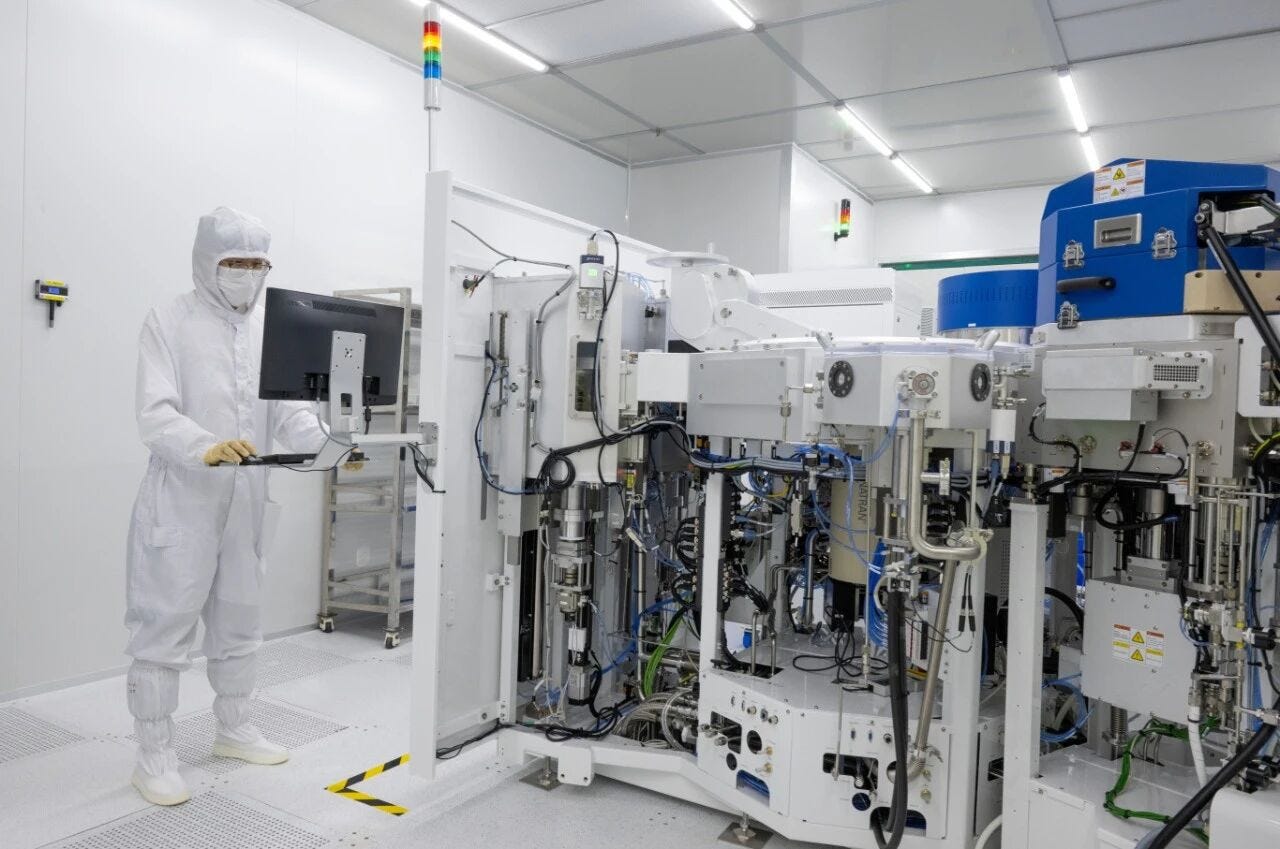
In Wuxi, Turing Quantum (图灵量子) and Shanghai Jiao Tong Wuxi Photonic Chip Research Institute (CHIPX) operate China’s first photonic quantum chip5 pilot line. Construction began in 2022, and the 650 million RMB production line began operation in 2025, reportedly shortening R&D cycles from 10 months to just 2 weeks.
Origin Quantum (本源量子) recently raised 3 billion RMB in pre-IPO funds, earmarked for 10,000-qubit superconducting quantum chip pilot lines amongst others.
All this reminds me of the current “quantum factory buildout” among US-based quantum companies, backed by hundreds of millions of USD for dedicated quantum chip manufacturing lines.

Enterprises: the Main Body of Quantum Innovation
Point 3: Fully Leverage the Principal Role of Enterprises (第三,发挥企业主体作用)
For a while, I have criticized online analysis belittling the role of the private sector in China’s quantum ambitions, which I believe is a short-sighted view that overlooks broader trendlines. The quotes below, and the action we’ve seen in 2026 so far, show that commercial companies increasingly undergird China’s quantum ecosystem.
In all this enterprise action covered below, it is important to maintain perspective: China’s commercial quantum sector started from a relatively small baseline in 2025, and investment rounds in Q1 and Q2 of 2026, still pale in comparison to massive Western quantum IPOs (Quantinuum, Xanadu) and Government commitments (e.g. the 2 billion USD announced under US CHIPS or the 2 billion pounds UK ProQure program).
Therefore, some activity may be seen as a temporal lag rather than a sprint to leadership.
Taking the lead, or just showing the lag?
In H1 of 2026, Photon Box (光子盒) Research Institute — a leading Chinese quantum market intelligence company — reports 76 global financing deals, of which the majority (44) are in China. In aggregate dollar terms, China still trails the US, with at least 1.536 billion USD invested in China compared to nearly 2 billion in the US. Still, the increase in Chinese activity is dizzying. The figure below drives home how much things have changed: Chinese quantum enterprise financing increased 30x from H1 2025 (when only 8 deals were recorded) and surpassed funding in the rest of the World, excluding the US, by about a factor of three.
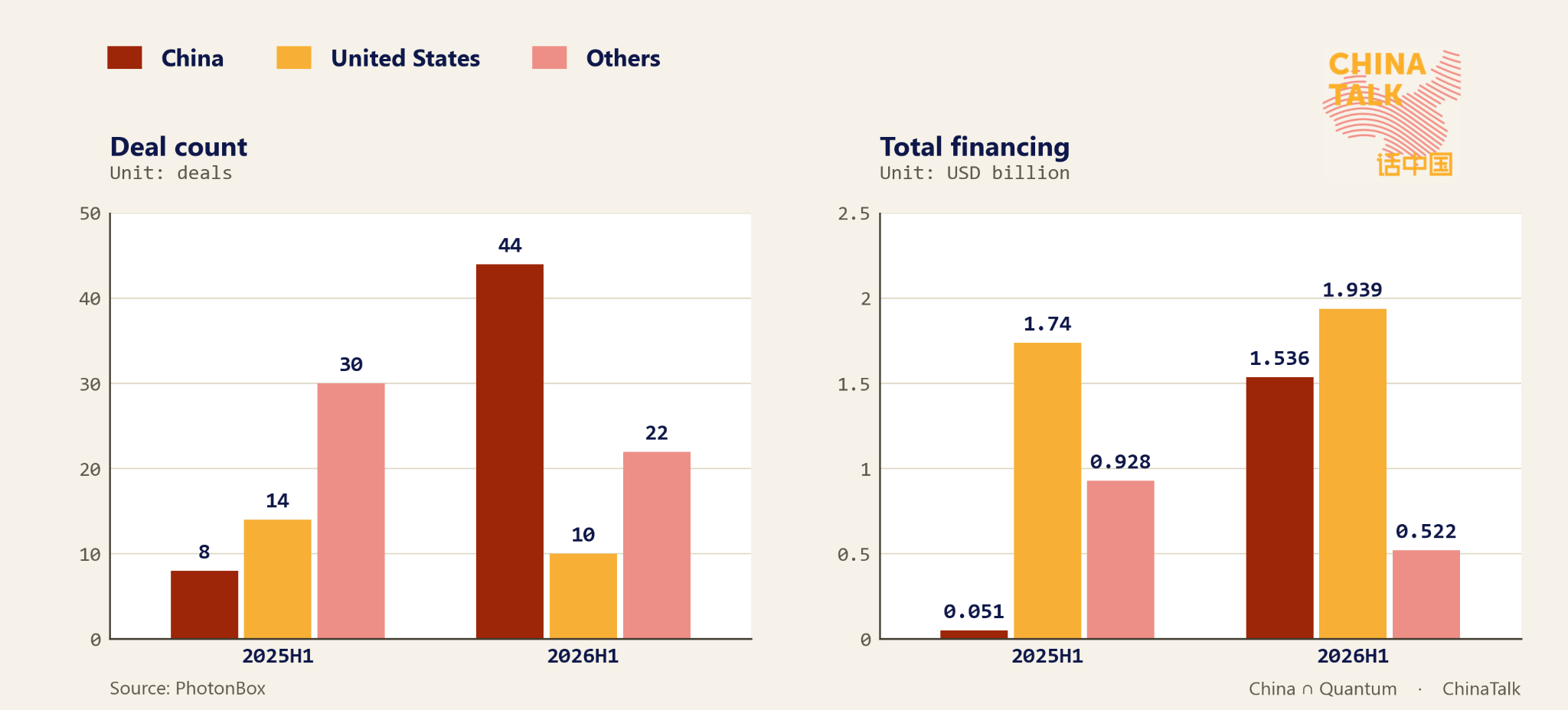
Are we witnessing a rapid Chinese overtaking? Based on Q1 data, Chinese analysts take a more differentiated view, arguing that the current Chinese funding boom should not simply be contrasted with current international funding because of a 2-3 year lag in ecosystem maturity between China and the US. A more apt comparison is the 2022-2023 period in the US (with quantum VC averaging around 300 million USD per quarter) prior to the IPOs and consolidation that followed.
As we will see below, this funding is spread over two different tracks of companies:
Established incumbents — often with full-stack ambitions, high vertical integration, and over 5+ years since their establishment — make up the largest rounds and in some cases are preparing IPOs.
The largest share of rounds (number of rounds rather than funding amount) goes to very young start-ups founded since 2022, with many new ones appearing in 2025 and even 2026. By my own incomplete count, at least four quantum companies had their first funding round ever within just the month of July 2026 (not H1, hence not reflected in the table below). This goes counter to the consolidation trend seen in the Western commercial quantum sector. Therefore, despite outliers both by field (take Quantum Key Distribution for example) and company, I believe the framing of a relative lag in commercial ecosystem maturity is a very useful one.
Does the gap in commercial maturity cause a technological gap? A priori, a gap in commercial maturity is not necessarily a bad thing from a Chinese perspective; I remember a conversation with a Chinese professor who insisted that the relative later stage at which quantum technologies are spun out from public research institutes in China is a much more efficient process for immature technologies than private-led R&D.
Personally, I believe a lack of commercial ecosystem maturity has in fact been responsible for Chinese entities still lagging Western counterparts in quantum computing cloud platforms and (software) application environments, and until recently hindered quantum talent development and retention.
Another indication of a remaining technological gap is the notable absence of below-threshold quantum error correction announcements from China. Other than the USTC/National Lab team (zuchongzhi-3.2), which followed Google’s Willow chip by around one year, notable announcements have been scarce,* while Western companies demonstrated error correction achievements on various qubit modalities.
(*That is not to say notable quantum error correction achievements were absent among Chinese research groups and companies, but I cannot name any additional Chinese below-threshold QEC result on an actual quantum computer comparable to the likes of Quantinuum, QuEra or IonQ.)
Regardless of the remaining gap in commercial and technological maturity, the Chinese government is determined to position enterprises as the main driver of future industries. In quantum, the ground is rapidly shifting. Let’s have a closer look at H1 2026 through 36 quantum companies with H1 funding rounds researched for this article.
The Enterprise-designation Zoo
This is how the Qiushi editorial envisions the role of enterprises for future industries:
In terms of bringing into play the principal role of enterprises, it is necessary to promote the clustering of various innovation resources toward enterprises. Enterprises are the main body of innovation, as well as the carriers that turn industrial blueprints into reality; the rise of many future industries is driven by step-by-step breakthroughs made by enterprises. … At the same time, it must also be seen that quite a few technology enterprises still face problems such as scattered resources, talent shortages, and unsmooth industry-university-research collaboration mechanisms. In response to this, General Secretary Xi Jinping has made targeted deployments across multiple aspects. First, through policy guidance, institutional innovation, and ecosystem optimization, it is necessary to vigorously cultivate technology-leading enterprises (kējì lǐngjūn qǐyè / 科技领军企业) and high-tech enterprises (gāo xīn jìshù qǐyè / 高新技术企业) that possess leading core technologies and strong innovation capabilities. Second, it is necessary to support central state-owned enterprises in developing future industries in conjunction with their primary responsibilities and principal businesses (zhǔzé zhǔyè / 主责主业), enabling them to serve both as the national team for scientific and technological innovation and as the main force in future industries. Third, it is necessary to strengthen the supply of public services and cultivate a large number of technology-based small and medium-sized enterprises (kējì xíng zhōngxiǎo qǐyè / 科技型中小企业), specialized, refined, distinctive, and innovative enterprises (zhuānjīngtèxīn qǐyè / 专精特新企业), single-product champion enterprises (dānxiàng guànjūn qǐyè / 单项冠军企业), and unicorn enterprises.
Quite a mouthful. In many cases, these enterprise designations map to official definitions and certification processes for enterprises in China. Let’s go through them (+ some missing ones) one-by-one:
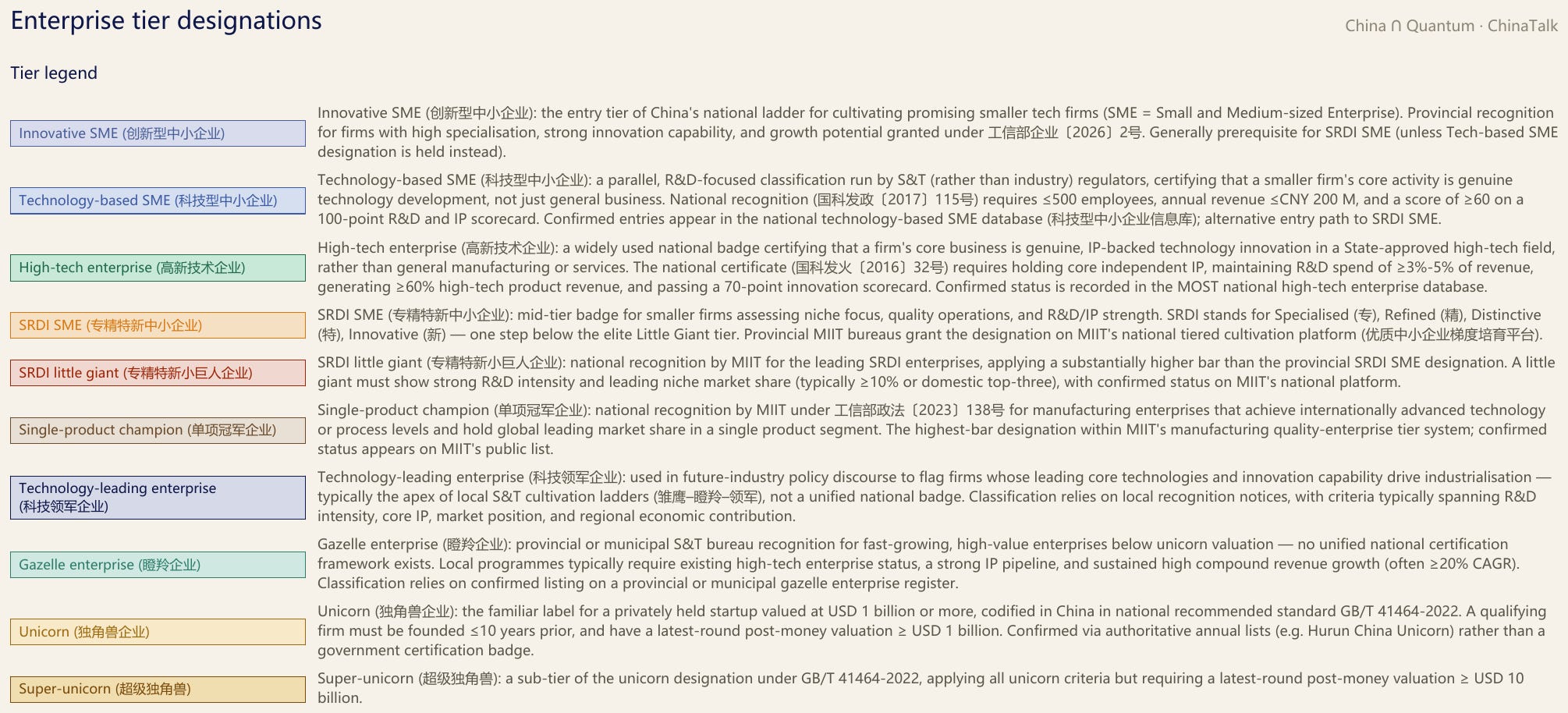
The enterprise designations are helpful not just to understand how much heft a given quantum start-up really has in China, but also imply different access to support policies such as direct subsidies, tax credits, access to credit and grants, backing for facility usage and construction, or procurement opportunities.
H1 Funding Rounds
To make these designations more concrete, I mapped the tiers for all quantum companies for which I am aware of funding rounds in H1 2026 (cutoff: June 30).
The result can be seen in the table below:
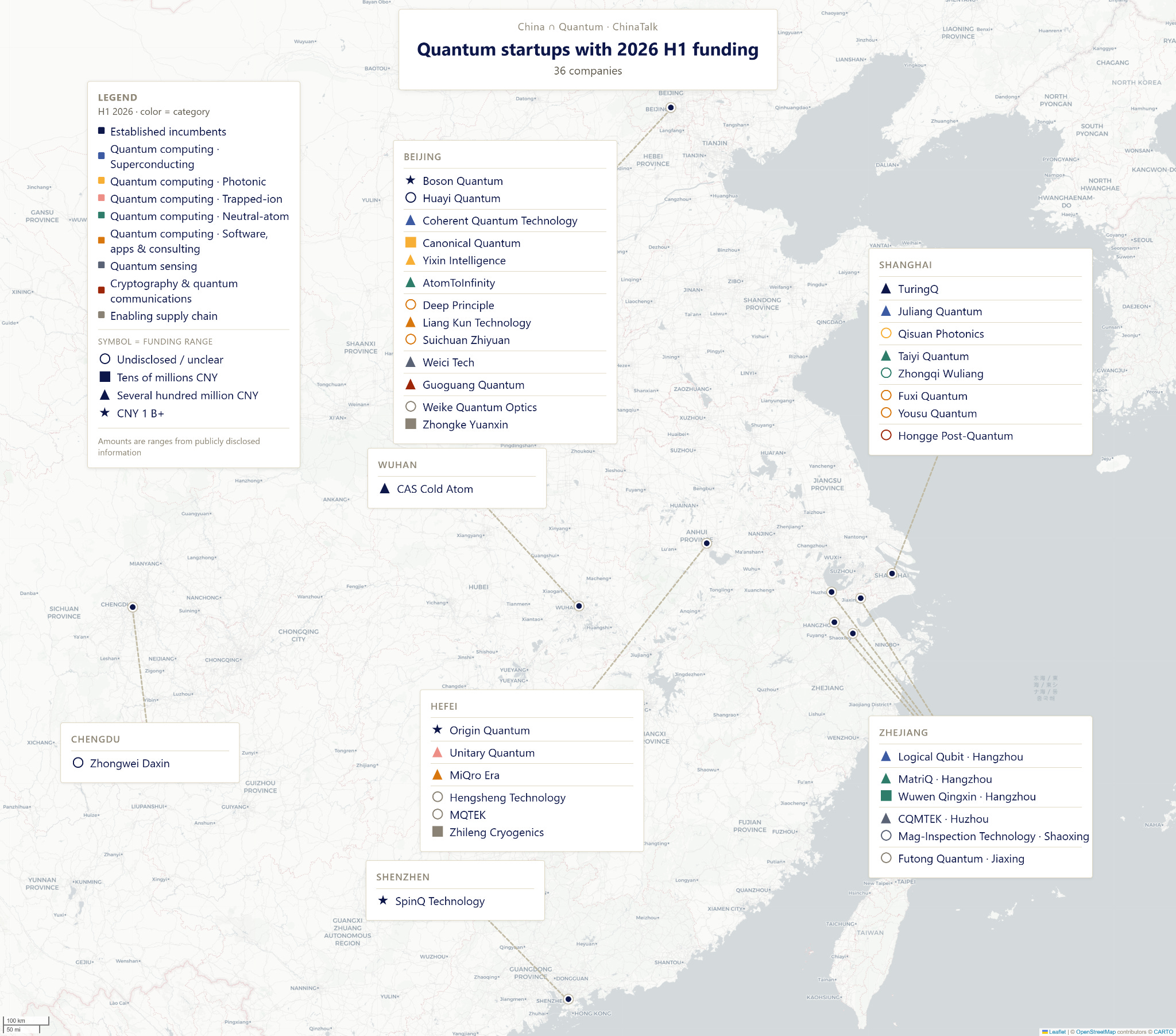
The investment activity is regionally clustered and less Hefei-dominated6 than one may have expected in the past. Most companies with funding rounds (13) were in Beijing, followed by Shanghai (8), Zhejiang (6), and Hefei (6). Chengdu, Wuhan, and Shenzhen each only contributed a single company to the list.
In the number of deals, this puts China on track to rack up a yearly figure comparable to global yearly numbers in the 2022-2024 time span (e.g., this Crunchbase deal count for quantum computing).
Distinctive regional specialization is appearing, even if not entirely obvious from the H1 funding rounds alone. Within just the last year, Beijing has ventured significantly into quantum software and algorithms, and Shanghai has established itself as a hub for neutral atoms (and photonic) quantum computing. In the big picture, Hefei, Beijing and Shanghai remain the national R&D and talent backbone, while coastal regions in Shanghai, Zhejiang and the Greater Bay Area (Shenzhen, Guangzhou, Hong Kong – I would expect to see more activity here going into the second half of 2026 and 2027) are rapidly moving into commercial applications.
Local specialization is partially set by dominant local incumbents, companies like Hefei’s Origin Quantum / QuantumCTek / CIQTEK trio, Beijing’s Boson and Huayi Quantum, Shanghai’s TuringQ (for photonics, the neutral atoms bet appears more local policy-driven), Shenzhen’s SpinQ or Chengdu’s Zhongwei Daxin. These companies have the academic attachments — and political and technological heft — to take leading roles in coordinating local supply chains, industrial consortia and research labs. The tier labels confirm this pecking order: Origin Quantum, SpinQ, TuringQ, Boson Quantum, Huayi Quantum, CAS Cold Atom, and Zhongwei Daxin collect the most prestigious designations, and most have unicorn valuations.
In the table below, most of the large (100s of millions of RMB) funding rounds of H1 have been collected by such “established incumbents” (vibe-based selection by the author). Some of these companies — e.g., Origin Quantum, Boson Quantum, or SpinQ — are exploring public listings (IPOs) in the near future.
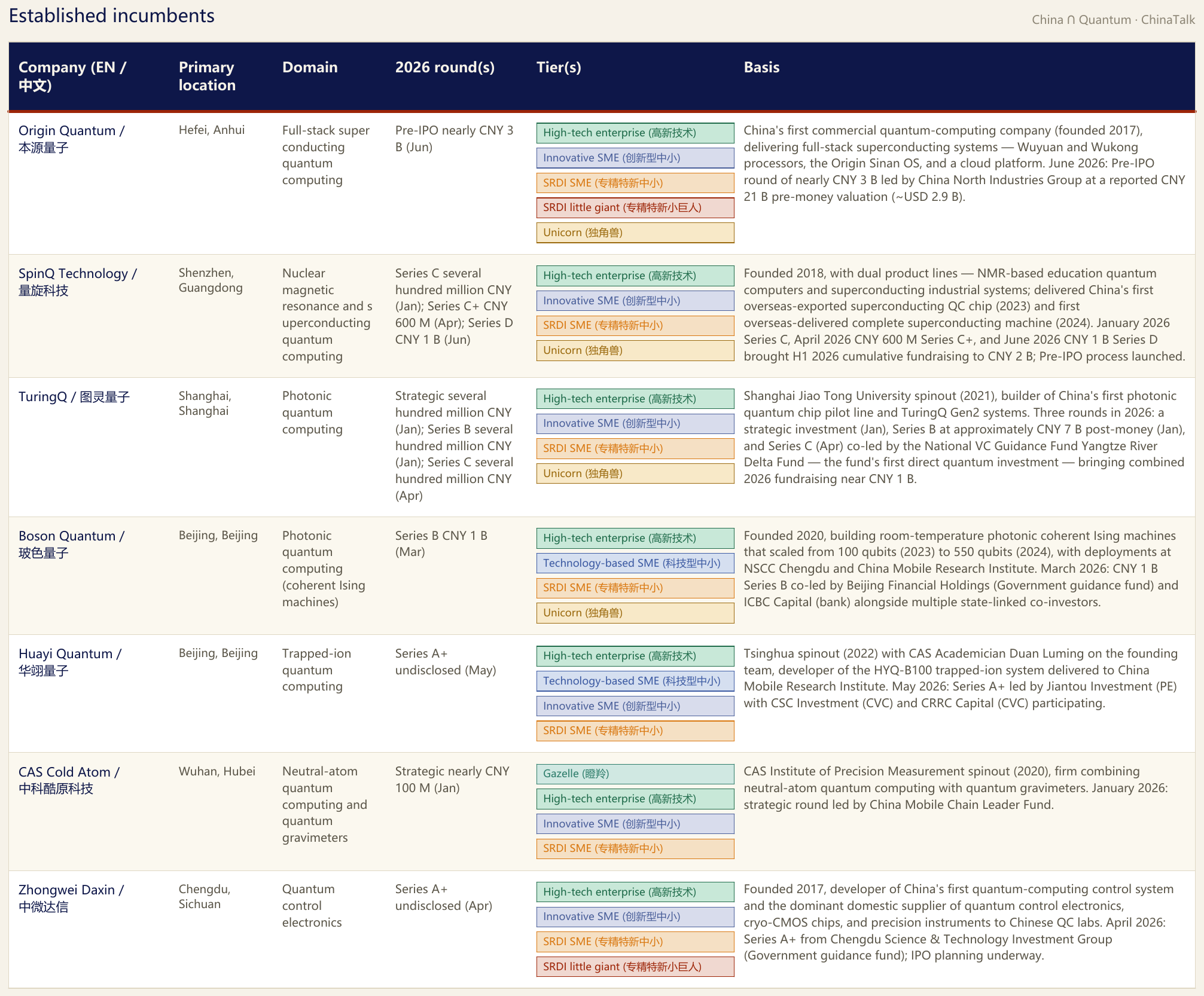
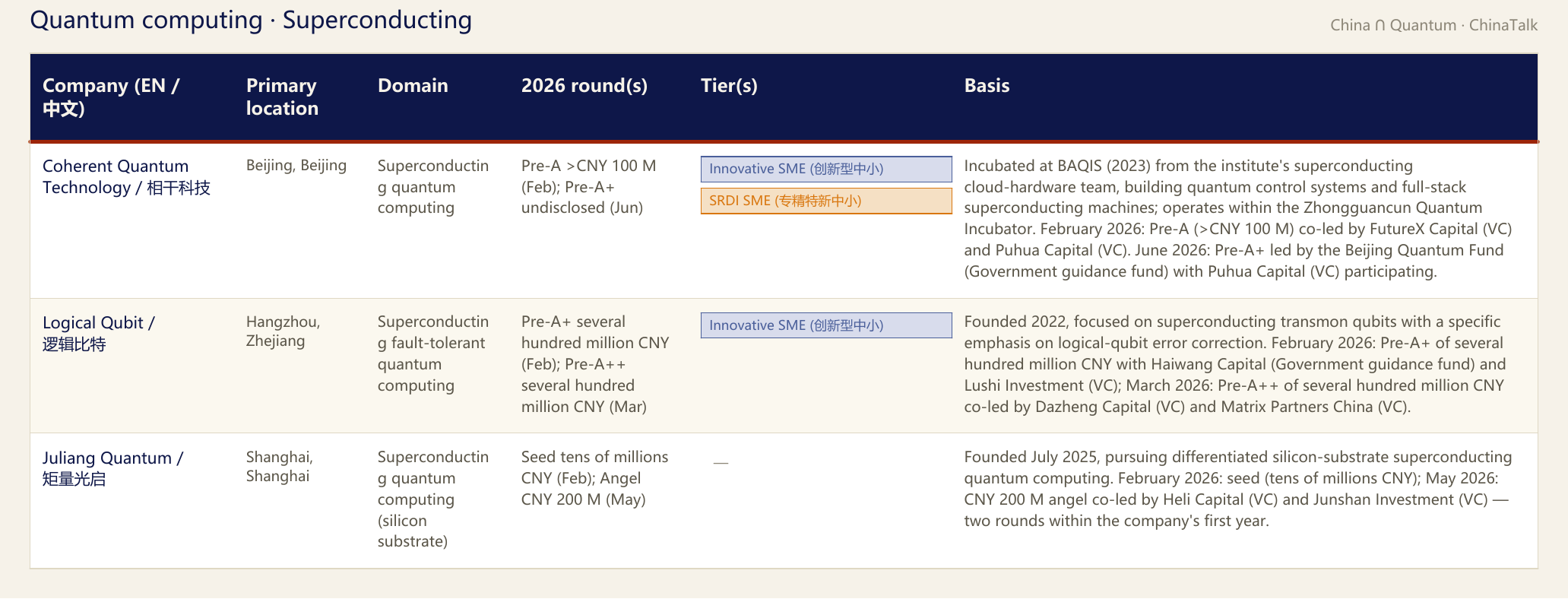
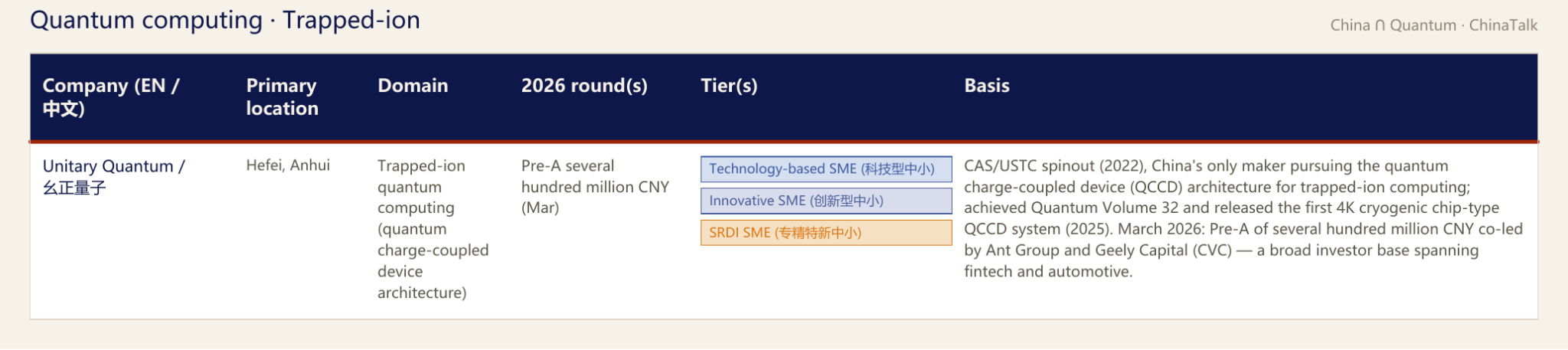
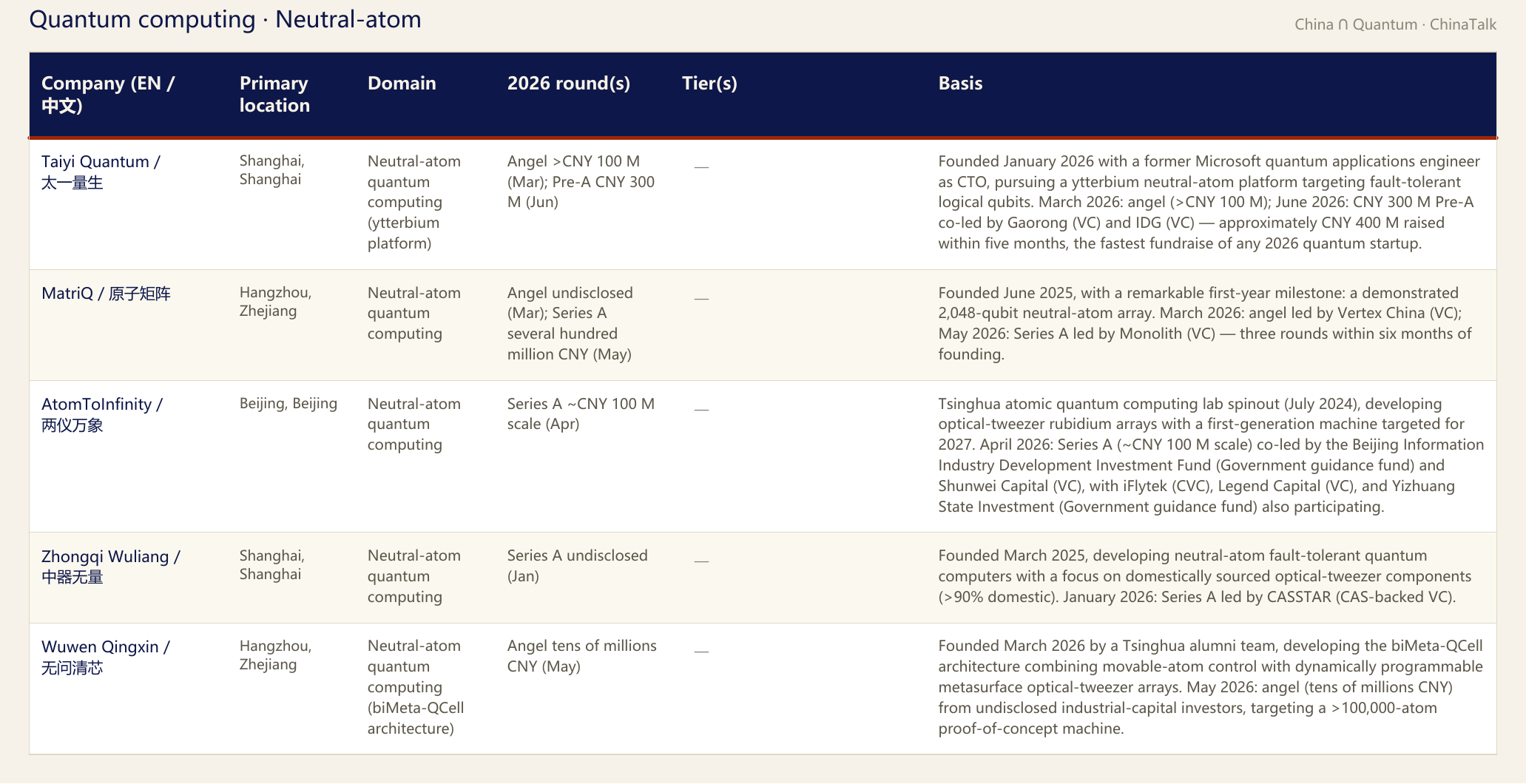
Beyond these incumbents, new funding rounds are dominated by quantum computing, with many young entrants (especially in Shanghai) on the neutral-atom front. By now, there are at least 28 quantum computing hardware startups in China across superconducting (9), neutral atoms (9), ion traps (4), and photonics (6) (but to my knowledge, only one company, Origin Quantum, is active in semiconductor-based quantum computing). There is some genuine differentiation among the companies, pursuing different technological paths and some appearing to focus on special-purpose machines or education products rather than fault-tolerant quantum computing.
In the superconducting modality, Logical Qubit raised multiple large rounds in 2026 and is shaping the quantum computing ecosystem in Hangzhou, launching a quantum cloud and defining concrete logical qubit milestones.
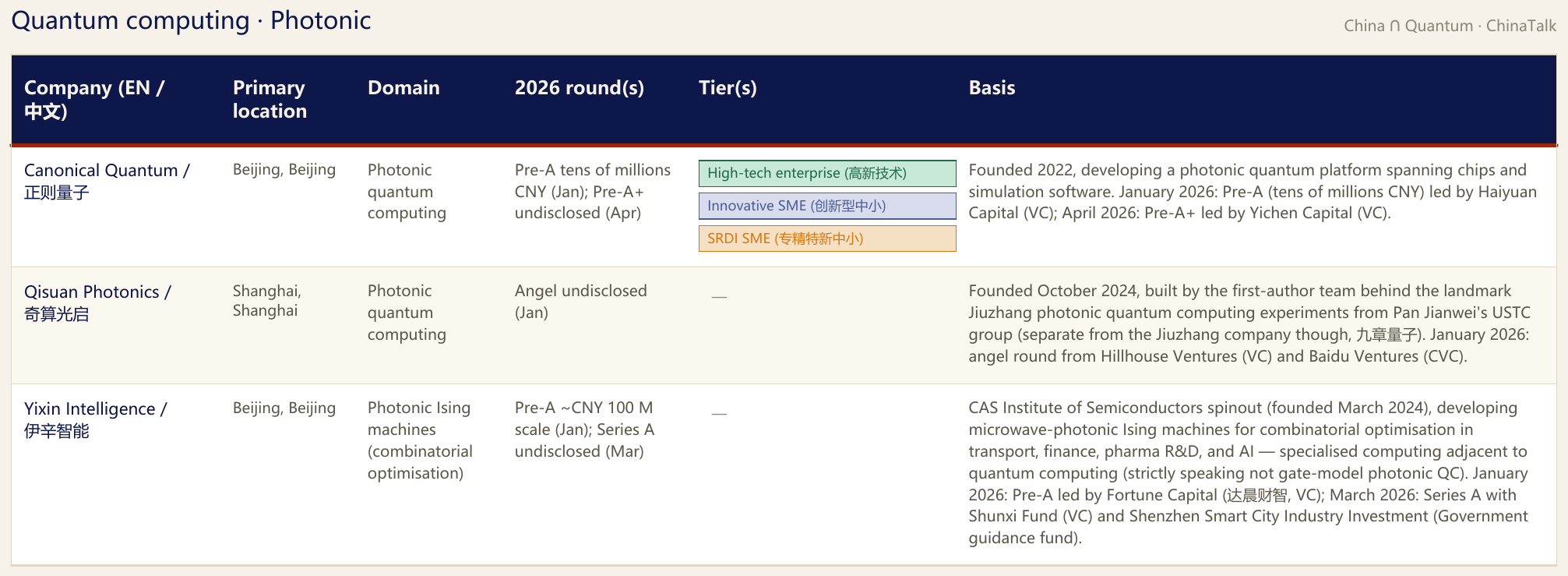
Neutral atoms are one of the big stories of 2025 and 2026. This is true globally (take Oratomic’s paper on running Shor with 10’000 physical qubits or Google’s branching into neutral atoms) but especially so for China. The table below shows how activity exploded in the field. Alone in Shanghai, four new neutral atoms quantum computing companies have been founded since 2025 (Taiyi Quantum (太一量生), Atom Core Photonics / Atomqubic (原子芯光), Zhongqi Wuliang (中器无量), Buchou Quantum (不筹量子)), not including neutral atom supply chain players such as Xuanxiang Technology (璇相科技).
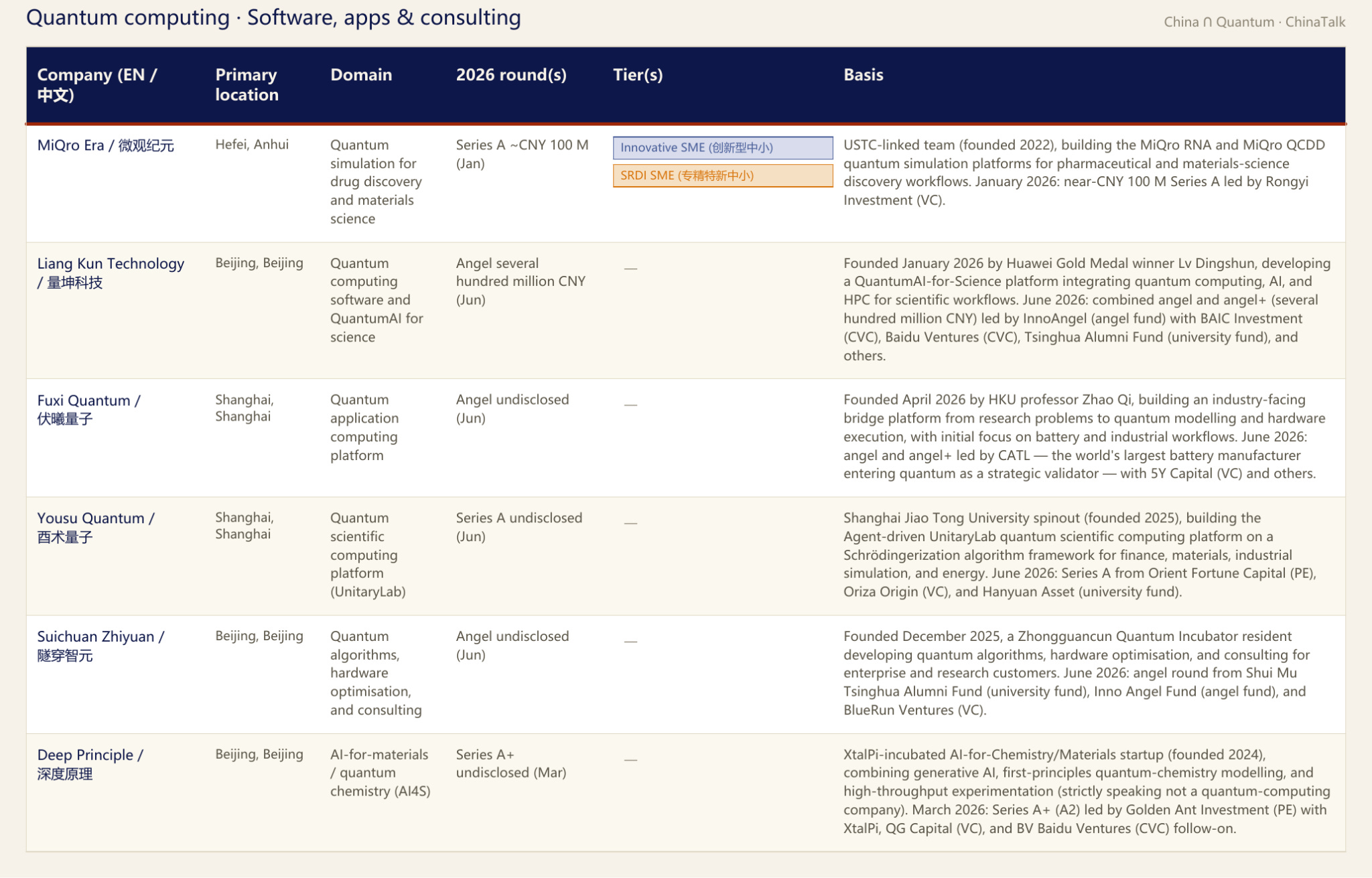
The emergence of more Chinese quantum software/algorithm start-ups is also a significant development in H1 2026. Past investments overwhelmingly favoured hardware companies, yet six quantum computing software and application companies, all but one founded since 2025, secured investments in H1 2026.
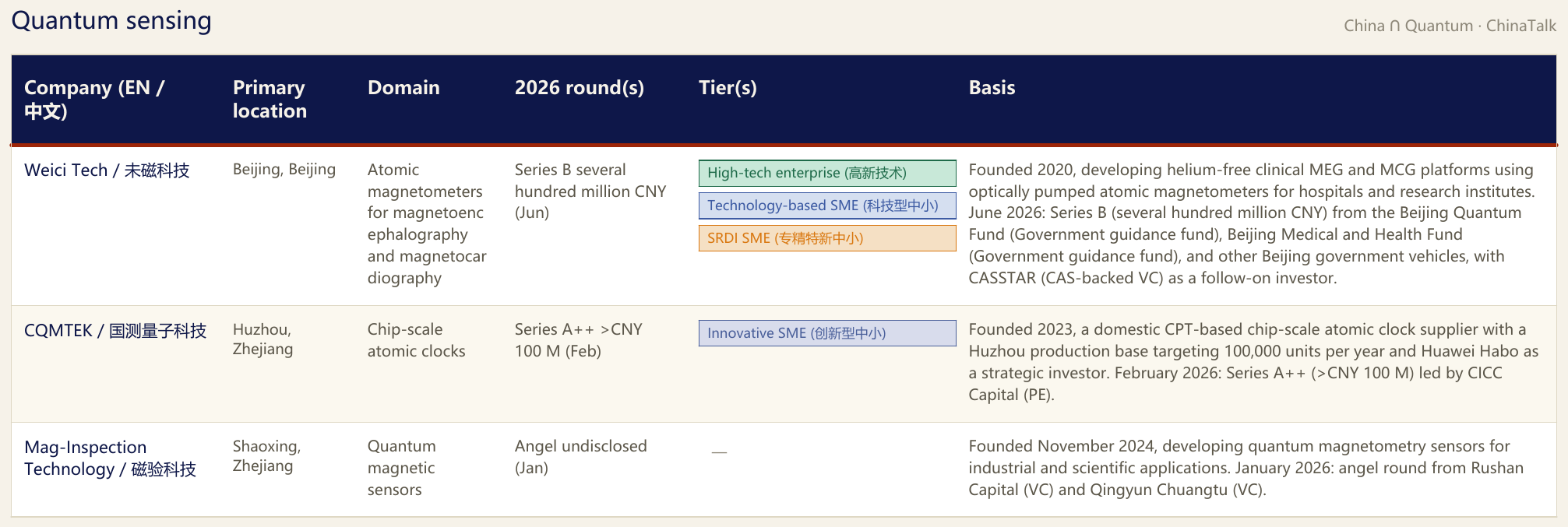
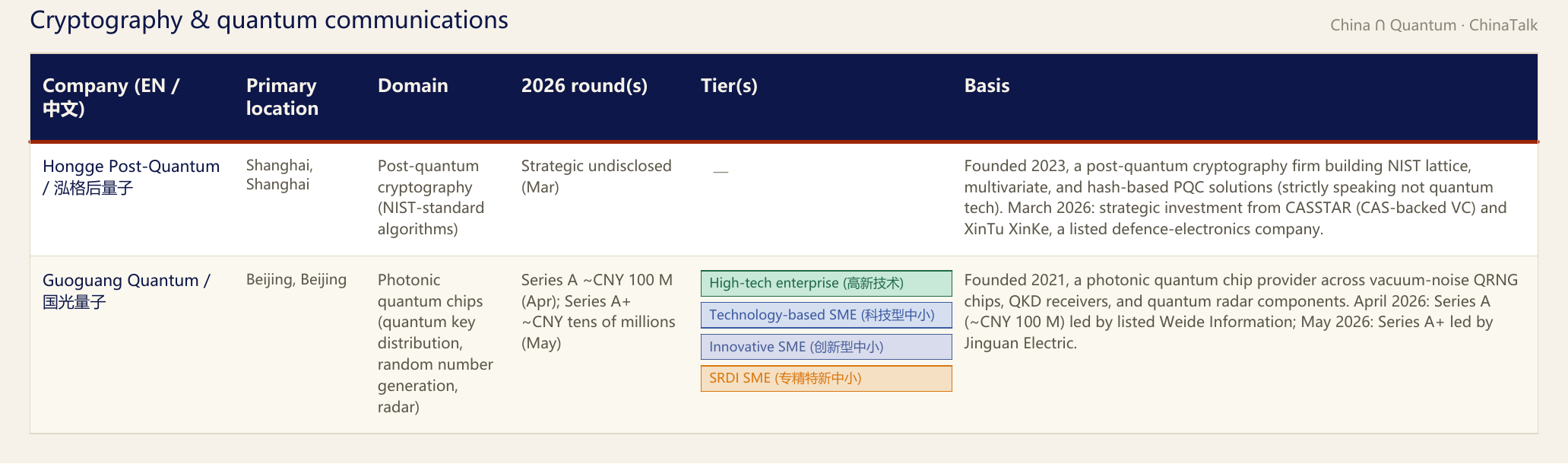
Quantum sensing and quantum cryptography/communications have seen comparatively less funding activity. However, this partially masks the fact that these sectors are technologically more mature and in some cases have already moved towards partnerships and large-scale deployments with and within SOEs, such as China Telecom or State Grid.
Finally, little of this flurry of activity would be possible without a rapidly emerging domestic supply chain. While often with a lower profile than their downstream users, H1 of 2026 saw funding for dilution refrigerators (Zhileng Cryogenics), superconducting nanowire single-photon detectors (Futong Quantum), photonic interconnects (Zhongke Yuanxin), and control and measurement equipment for cold-atom and trapped-ion labs (MQTEK).
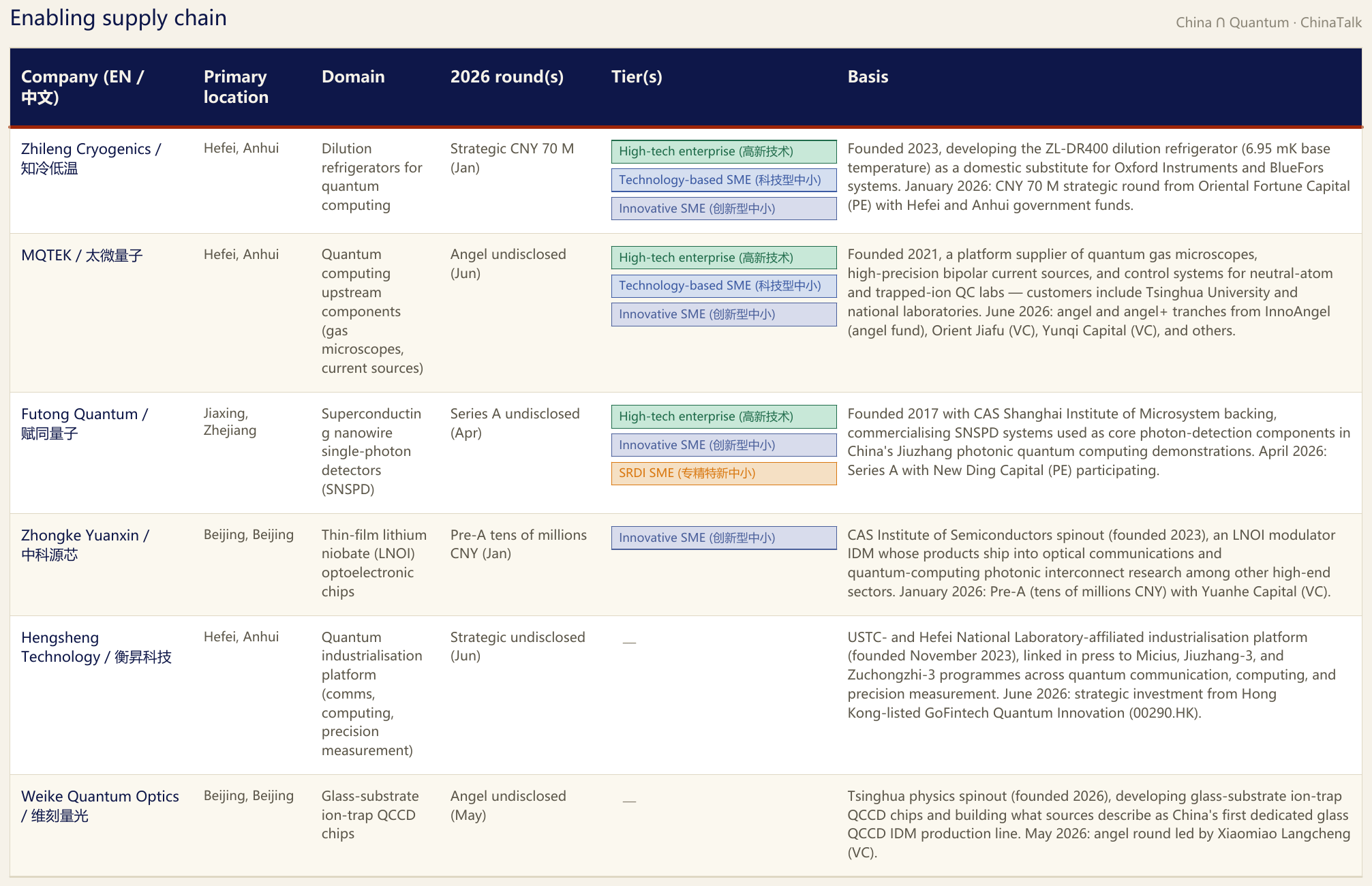
Where is the money coming from? From a rough screening of the investors, it appears that:
The largest rounds are dominated by state capital (SOEs, State-linked financial institutions and funds),
Local government guidance funds were especially active in Beijing and Shanghai and included cross-regional investments,
The National VC Guidance Fund made its first direct quantum investment (in Turing quantum),
VC / PE was very active, but primarily in early-stage rounds (further note, that even VC investments often include government LPs),
Industry giants — from CATL to Ant and Geely — actively (co-)led some of the rounds.
It has been a bit over 1.5 years since the US implemented sweeping outbound investment controls on quantum technologies. China’s domestic “patient capital” has stepped up — and in a more diverse fashion than I anticipated in my last piece for ChinaTalk, where I stressed local government involvement but largely glossed over SOEs, large industry and tech giants, and the national-level guidance funds.

In the same piece, I concluded that the impact of US outbound investment restrictions is less about the availability of money than the manner in which money is deployed. So then, what guides quantum patient capital in China?
In terms of financial support, it is necessary to guide patient capital (nàixīn zīběn / 耐心资本) to invest in future industries, promote investment models such as combining grants with investment (bō tóu jiéhé / “拨投结合”) and invest first, take equity later (xiān tóu hòu gǔ / “先投后股”), build a financial-services system suited to the financing needs of future industries across their entire life cycle, and support long-term capital in investing early, investing small, investing for the long term, and investing in hard technology (tóu zǎo, tóu xiǎo, tóu chángqī, tóu yìng kējì / “投早、投小、投长期、投硬科技”).
Earlier, I compared the current Chinese boom in quantum startup financing to the 2022 period of likewise broad and plentiful investments in the West. However, unlike the 2023 “quantum financing winter” in the West, no near-term downturn is in sight for the Chinese quantum sector. The supply of patient capital continually expanded in H1 2026 by newly announced initiatives like these:
National-level: The National VC Guidance Fund (国家创业投资引导基金) — with a massive 100 billion RMB fiscal anchor, 20-year horizon, and a 1 trillion RMB mobilization target (made big news some time ago) — made its first quantum investment in April 2026 through its Yangtze River Delta sub-fund (TuringQ, see table above).
A range of new dedicated quantum industry funds (incomplete overview, from here):
In January 2026, Anhui announced the Guoyuan Quantum Xingdongneng Fund (安徽国元量子星动能股权投资合伙企业), a ~RMB 207-million vehicle in Hefei focused on early-stage quantum communication and quantum computing.
In April 2026, Sichuan’s first provincial quantum equity fund — the Zhengxing Xingjin Quantum Fund (四川振兴兴锦量子股权投资基金) — completed registration and began operations at a 1 billion-RMB scale, targeting photonic chips, photonic and superconducting quantum computing, and quantum communication and precision measurement.
In May 2026, Hubei registered the Yangtze Quantum Tech Investment Fund (湖北长江量子科技投资基金) with RMB 100 million in Wuhan for quantum science and technology investment.
Also in May 2026, Beijing launched the Jinggong Quantum Ecology Fund (京工量子生态基金) with a scale of RMB 100 million targeting the optical quantum computing supply chain.
In early June 2026, the China Telecom Quantum Industry VC Fund (中电信量子产业创业投资基金) was established at RMB 1.5 billion as a national telecom–quantum industry vehicle, focused on quantum communication, computing, and precision measurement, with most capital directed to pre-A and earlier stages.
On 16 June 2026, Beijing launched the Beigong Future Quantum Equity Fund (北京北工未来量子科技股权投资基金) at RMB 500 million.
While most announced funds are dominated by local governments and (non-quantum) SOEs, I found it very interesting to see that QuantumCTek — a leading quantum company — and QBoson — a major player in photonic quantum computing — participate in the management and even contribute investments of their own (into the China Telecom fund and the Beijing Jinggong Quantum fund, respectively). This seems very aligned with the Chinese industrial policy concept that chain leader (链主) enterprises should coordinate and build up their respective supply chains, mentoring new entrants and guiding capital into the relevant bottlenecks and dependencies. I expect similar roles for some of the other companies listed among the established incumbents above.
Another piece of news that stood out to me in the patient capital story was iFlytek’s establishment of a Quantum-AI integration research venture (Intelligent Quantum Inception, 量智开物), while explicitly adopting a “no KPI” approach: “iFlytek’s role is defined as “patient capital,” providing funding, AI technology, and industry export experience, but not interfering with the direction of scientific research.” The venture was established jointly with Tsinghua’s Zhai Hui, whose team recently trapped 11,000 neutral atoms. iFlytek also participated as an investor in the respective neutral atoms Tsinghua spin-off AtomToInfinity.
It is well known that the previous quantum escapades of Chinese tech giants (Baidu, Alibaba, JD) didn’t fly. One credible explanation for the subsequent closure of these labs is that their focus on near-term payoffs was simply incompatible with the immaturity of quantum computing. The chairman of iFlytek is upfront that, while they do not see a clear industrialization path, they are playing the long game and predict that quantum computing will become key to the next generation of computing power in five to ten years.
Of course, all this could be marketing to align with the government’s call for “patient capital” — or it could be the kind of vision that produces an all-star team for future quantum sprints.
An Environment to Thrive In
Government Services, Defined Broadly
Point 4: Foster a Favorable Policy Environment (第四,营造良好政策环境)
~ Xi Jinping
In terms of the policy environment, it is necessary to provide proper support and services, creating a fertile soil for the rapid growth of future industries. Future industries generally possess characteristics such as long cultivation cycles, fast technological iterations, and high market risks; moving from basic research to industrialization generally requires ten years or even longer, and relying solely on spontaneous market forces often makes it difficult to cross the valley of death. For this reason, General Secretary Xi Jinping explicitly required that “there must be strong policy support, and the government must provide good services.”
Emphasizing that the government must provide good services is important for two reasons: First, the government services in question go way beyond what is generally seen as the role of (local) governments in the West. Second, they partially make up for structural disadvantages in the Chinese economy, namely an underdeveloped professional data and information economy.
I have written before about the extensive all-hands-on-deck efforts Chinese local governments put into investment promotion. Above, I also mentioned local government-led supply-demand matching activities for quantum technologies, incubation services, benchmarking and pilot manufacturing services.
In April 2026, Anhui went one step further, with the local IP center launching the “Quantum Industry Public Service Package” (量子产业公益服务包). Concretely, the center provides a dedicated quantum patent database, various services related to patenting, IP protection, (overseas) trademark strategies, and a Quantum Industry Patent Navigation Report (量子产业专利导航报告) — largely free of charge to quantum enterprises in Anhui as far as I can tell.
Together with the scenario discovery/matching services, these sector-specific information and IP services mean that local government agencies fill a need addressed by consultancies and specialized law firms in the West. A market which, in China, is underdeveloped due to trust deficits, walled gardens, and a general unwillingness to pay for professional data services.
Beyond Angels and A-Rounds
One step up the financing maturity ladder, it is about much more than initial venture funding: “Build a financial-services system suited to the financing needs of future industries across their entire life cycle.”
In May, Anhui launched an initiative calling for exactly this — a comprehensive financial service system matched to the full lifecycle financing needs of future industries. It explicitly encourages financial innovation for supporting application scenarios, including for Quantum+. A quantum tech insurance consortium has been established to provide customized insurance solutions for quantum enterprises with exposure shared among multiple providers. Quantum hardware deployments also need insurance, prompting “the nation’s first insurance policy for environmental anomaly losses of quantum equipment” to be recently signed in Guangzhou.
The mobilization and structure taking shape for the whole funding pipeline is fascinating — and the story is much more complex than a simple juxtaposition between VC and markets in the US versus local governments and SOEs in China. To birth quantum as a future industry, much more than initial patient capital injections is needed: financial services, loans and risk-sharing products, procurement support for first products, equity investments and exit opportunities through M&As and public listings. (The financial intricacies of the Chinese future industry construction aren’t my strong suit, so please reach out if you know about any good pieces that dissect the financial pipeline being built here.)
Where does this leave us?
The listing of quantum as the #1 future industry in the recent five-year plan is dead serious. It has kicked off a transformation of concrete actions that, in a country as massive as China, add up to a mobilization that will shape this sector globally.
Point 5: Improve the Governance System (第五,健全治理体系)
I don’t believe this is some genius master plan playing out in perfect coordination. Some of the sources I read to write this article overhyped the near-term usefulness of quantum technologies and the relevance of individual initiatives. There is a slippery slope between ecosystem mobilization and wishful thinking that leads to wasteful spending. In China, domestic H1 coverage saw some healthy dehyping. China’s most prominent public quantum figure, Pan Jianwei, described the current situation as an investment “carnival” (狂欢), calling out speculation and commercial promises not backed by actual technology, and suggesting the state establish a “professional third-party quantum technology evaluation center.”
In the meantime, funding rounds and government initiatives continue. While some measures may be premature and corrections needed, in the big picture, it seems to me that the overall direction and tools outlined in this article thoughtfully address every dependency needed to turn this future industry into a real industry within the coming decade. Let sheer scale and mobilization, local experimentation and provincial competition sort out the details and consolidate winners a few years from now.
To me, this feels like a flywheel starting to accelerate. If the timing is broadly right, and the primary challenges of quantum technologies are engineering, supply chain scaling, and application scenarios, then this may well work — it wouldn’t be the first time (think EVs, batteries, or photovoltaics).
In some ways, the Chinese quantum sector is increasingly decoupled from the West. Due to Western export controls, companies have to make do with domestic suppliers who are rapidly stepping up.7 Announcements frequently highlight the large fraction of domestic components; new entrants appear enabled by breakthroughs from domestic suppliers (this article is very much worth a read) — take the four new Shanghai-based neutral atoms start-ups mentioned above that went barely noticed on the English internet.
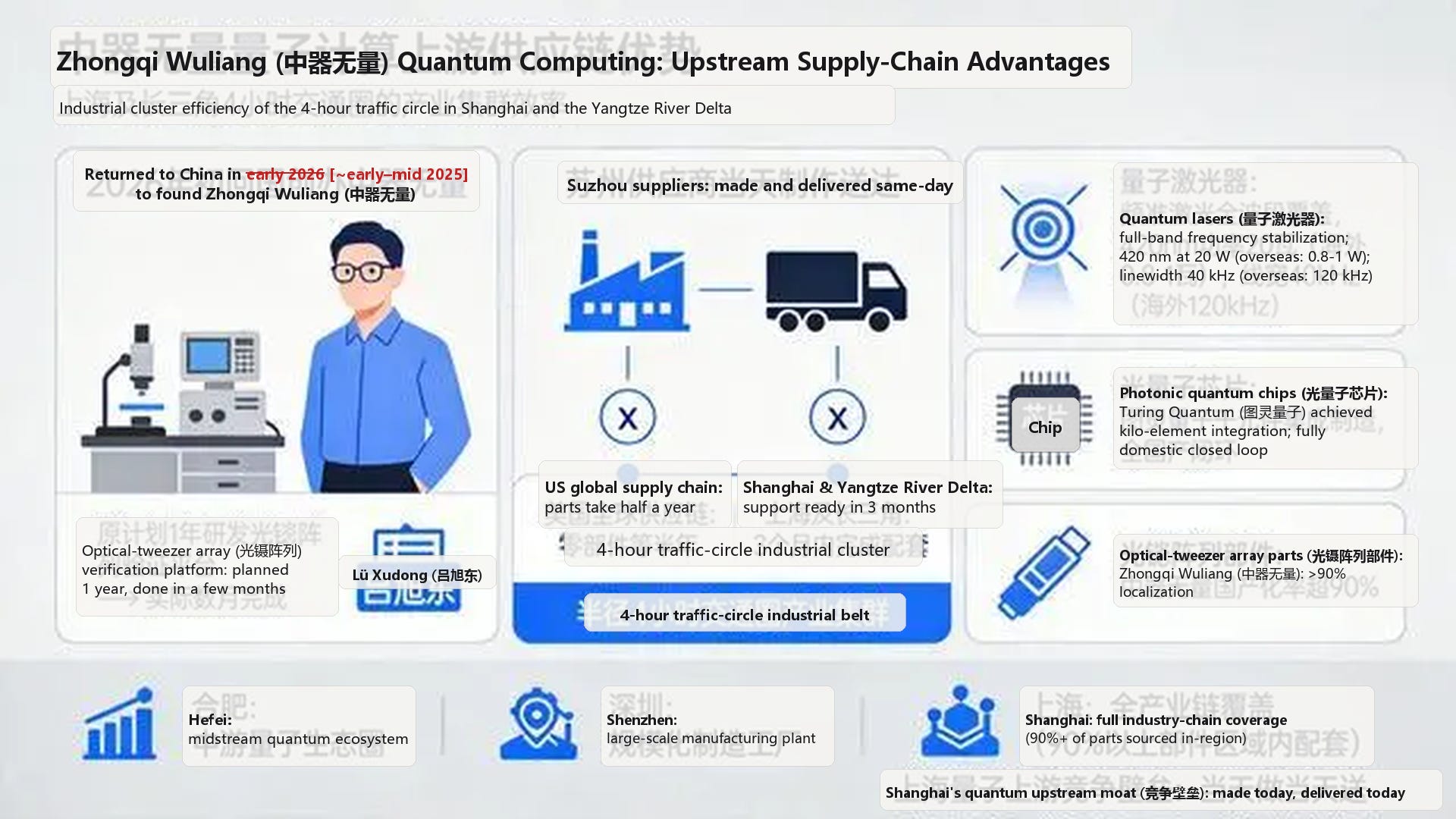
In other ways, the Chinese quantum sector feels very global. Sticking with the Shanghai example, all four of the new neutral atoms companies have overseas-linked co-founders. Chinese WeChat analysis of Western quantum research and industry news is extensive and often excellent. And, as I stressed previously, China is clearly not taking a strategy of full isolationism:
Future industries require the international community to innovate, cooperate, and move forward hand in hand. It is necessary to actively participate in global governance, strive for discourse power (huàyǔquán / 话语权) in the formulation of relevant international rules and standards, and work hard to promote co-building of standards, co-consultation on rules, and co-promotion of industries (biāozhǔn gòngjiàn, guīzé gòngshāng, chǎnyè gòngcù / 标准共建、规则共商、产业共促) among all parties.
From a Western perspective, I believe it is critical to realize that simply shutting all doors and ears to the Chinese quantum sector is not a smart option.
Interesting and world-leading stuff is bound to come out of this Chinese quantum industrialization effort, with genuine upsides to engagement: Collaboration in foundational research, coordination on standards, and dialogue to govern quantum computers that can break encryption (increasingly plausible within the next five years) are promising areas for mutually-beneficial cooperation. Engagement is valuable, if for no other reason, to help Western players anticipate competition in the global market — and to open viable diffusion and talent pathways that run from China to the West.
At the same time, export controls and research security measures have expedited a path that cannot simply be walked back: The Chinese push to eliminate foreign chokepoints wherever possible will not reverse even if quantum export controls were lifted today. Likewise, Chinese talent that already left Western institutions and companies — be it due to investigations, burdensome immigration processes, career uncertainty and job terminations or Chinese talent incentives — will not simply return overseas even if research security initiatives were scaled down today.
On export controls and research security, compromises are hard. Still, I believe there are individual steps where a reasonable middle ground of engagement, competition and security is viable.
An example would be clarifying conditions and forums under which engagement is politically safe or even encouraged, and conversely delineating the truly security-relevant areas in the vast field of quantum science and technologies. Another could be improving incentives (and alleviating career fears) for Western researchers to work in Chinese quantum labs and companies — a necessary move to reduce concerning asymmetries in the flow of talent and knowledge.
Whether one likes it or not, China is in the quantum industry for the long game. People-to-people exchanges, learning that goes in both directions, and a baseline of trust will be critical when setting the standards for future economic competition and responsible governance of cryptographically relevant quantum computers.
China’s quantum flywheel is starting to crank. Navigating the resulting landscape of competition, security, and engagement requires political choices. Not to take notice isn’t a choice — it’s negligence
To make text extraction easier, all of Elias’ tables are available in this appendix alongside additional source information.
The breakthrough in high-purity silicon production was described as a key breakthrough in establishing a domestic supply chain for silicon-based quantum computing (China is barred from importing Western high-purity silicon since at least the 2024 US export controls on quantum computing).
The development of a portable rubidium clock was described as breaking through a long-standing technological bottleneck, allowing mobile deployment of high-precision timekeeping with applications in space, defense and communication benchmarking.
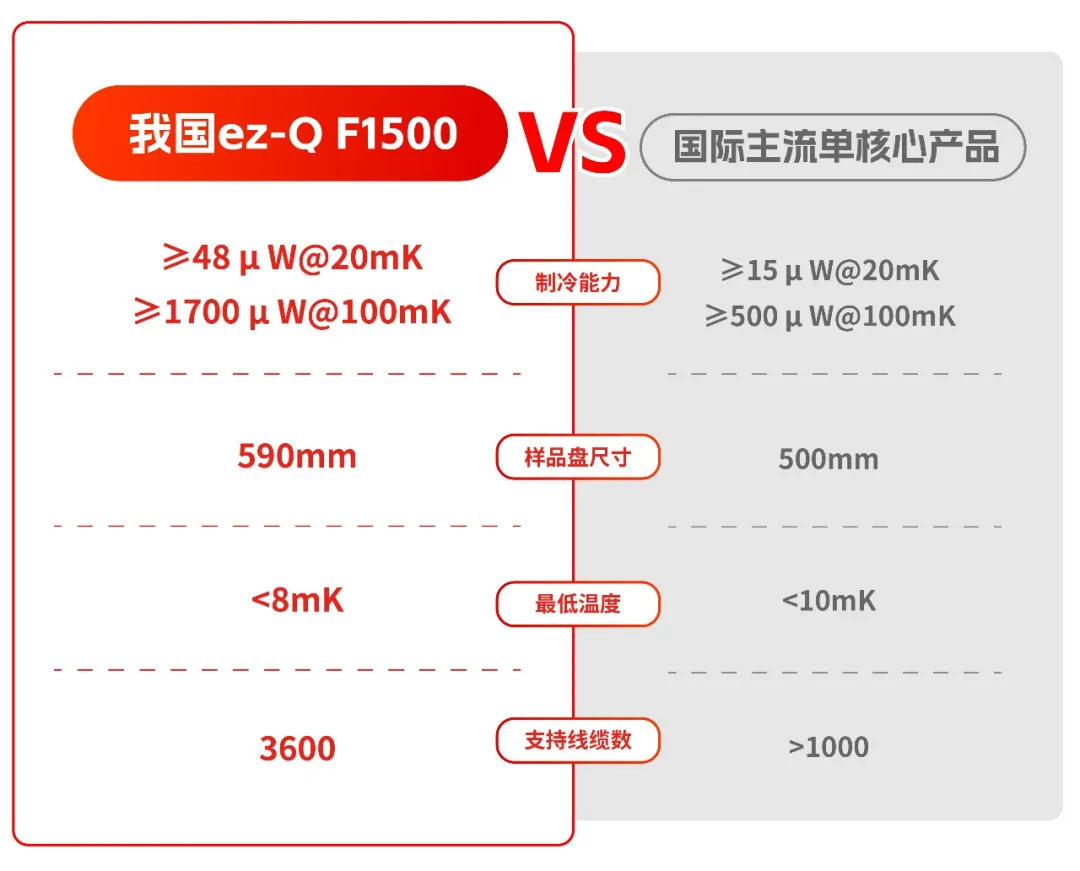
The development of the ez-Q F1500 dilution refrigerator by QuantumCTek was hailed as “China’s first commercially viable and mass-producible dilution refrigerator for superconducting quantum computers, successfully breaking through this “bottleneck” area.” As seen in the figure below, it claims to exceed international alternatives in key specifications (to be taken with the same scepticism as any vendor’s promotion of their own product).
The Sci-Tech Innovation 2030 Quantum megaproject (科技创新2030—量子通信与量子计算机重大项目), China’s flagship national quantum research megaproject, is managed by the Hefei National Lab. One level down in the hierarchy and more specialized, multiple National Key Labs exist working on quantum technologies (e.g., on Quantum Optics at Shanxi University). However, I have to admit that I am frequently unsure about the exact administrative status given recent reorganizations, unclear names, and differences in local and central government designations (for example, the recently established Beijing Key Laboratory of Cold Atom Quantum Computing is only a municipal Key Lab).
Referring to quantum computing prototypes that encode information in states of light, as opposed to excitations of atoms (neutral atoms and trapped ion quantum computing) or superconducting circuits. A similar approach is pursued by Western companies such as PsiQuantum and Quandela.
Both the Hefei National Quantum Lab and the University of Science and Technology of China (USTC) are located in Hefei, and the city has dominated China’s quantum research landscape over the last decade.
Take, for example, the atomic optical tweezers array recently announced by Xuanxiang Technology (璇相科技), reportedly enabling future neutral atom platforms with more than a million controlled atoms.
This is a fascinating account of how deliberately China is trying to build a quantum industry rather than just fund scattered research projects. The “flywheel” idea is useful because it shows how national priorities, laboratories, local governments, startups, patient capital, pilot lines and procurement are all being pulled into the same effort.
One question I’m left with is how much of that flywheel is being built from China’s own research, and how much comes from quickly absorbing knowledge developed elsewhere. You point out the commercial and technological lag with the West, the overseas links of several new neutral-atom founders, the close attention paid to Western research, and the effort to eliminate foreign chokepoints. None of that proves improper technology transfer, of course, but Western governments are clearly worried about where normal scientific exchange ends and strategic technology transfer begins.
What I’d be especially interested in knowing is where the knowledge feeding this flywheel actually comes from: domestic research, returning talent, international collaboration, reverse engineering, or, in some cases, illicit transfer. That seems especially worth following now that quantum is beginning to move from research into commercial competition.
Elias, you make the path from laboratory breakthrough to industrial scale unusually clear. The 15th Five-Year Plan does more than list quantum as a priority. Across future industries, it calls for shared risk, demonstration projects and proof-of-concept centres, while allowing several technical paths. That is a serious effort to turn research into an industry.
The harder question is what China counts as progress. A USTC-led Nature paper in February 2026 reported a building block for scalable quantum repeaters. Its finite-data security test covered about 10 kilometres. The positive result at 101 kilometres used an idealized, unlimited-data case. That distinction matters. More companies, financing and pilot sites show activity, but not whether the technology works. Should continued support depend on results that other laboratories can repeat over longer distances? And what result should make the state stop backing a route?