
Aqib will be in D.C. from September 7-11! If you’d like to chat rare earths, semiconductors, and open model security, reach out to aqib@chinatalk.media.
If you know anything about rare earths, you know China is great at digging them up and refining them, while America sucks at both. Unfortunately, this is where most analyses end. To go one step further requires understanding the entities leading China’s rare earth juggernaut, and how they built Beijing’s rare earth weapon. That’s exactly what we’ll explore in today’s deep dive. This story revolves around China’s two creatively-named state-owned giants, China Northern Rare Earth 中国北方稀土 and China Rare-Earths Group 中国稀土 (CREG). We’re going to call them “China Northern” and “China Southern” from here on out; CREG doesn’t have Southern in its name, but it’s in the South, and we think it’s a lot catchier.
The fact that these two companies reign over the rare earths world cannot be boiled down to a single factor. These things are messy. To pick it apart, we (Aqib and Nick) look at China’s duopoly from multiple angles, covering the firms’ history, industrial processes, and, on the human level, their workforce.
In our efforts to unpack it all, we pull on several threads, including:
Why the industry is divided sharply between North and South, and what each region is in charge of,
The ownership politics beneath that structure, such as which parts of the state own each company and why the South is so much harder to control,
What rare earths smuggling reveals about China’s state capacity,
The technical reasons these companies are ahead,
And what it’s like to work at a Chinese rare earths company.
North vs. South
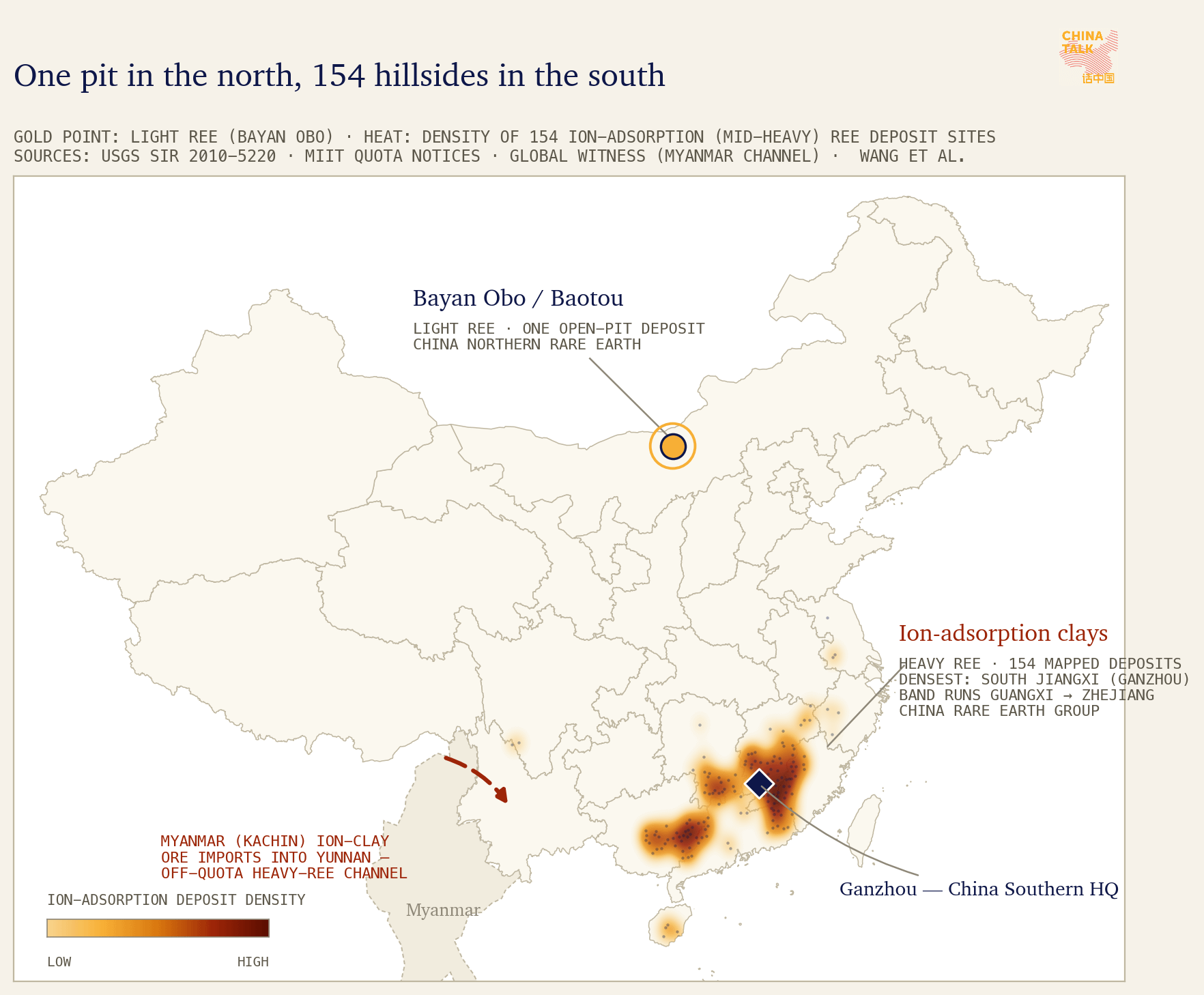
Nearly all of China’s rare earth production runs through two companies. China Northern Rare Earth, headquartered in Baotou 包头, Inner Mongolia, is the world’s largest producer of light rare earths, the volume elements that go into permanent magnets. China Rare Earth Group (hereafter “China Southern”), headquartered in Ganzhou 赣州, Jiangxi, controls the heavy rare earths — the scarcer and more important elements that give Beijing its chokehold on defense supply chains. Since 2024, the national production quotas have gone to these two firms and no one else.
Why two companies, and why those two places?
Rare earths split into light elements, including the magnet workhorses neodymium and praseodymium, and heavy elements like dysprosium and terbium, the additives that let a permanent magnet keep working inside a hot EV motor or a missile’s guidance systems. The two groups sit in different kinds of ground. China’s light rare earths come overwhelmingly from one place, the Bayan Obo 白云鄂博 deposit in Inner Mongolia, a single colossal open pit where they occur alongside iron ore. The heavies sit in ion-adsorption clays spread across the hillsides of Jiangxi, Guangdong, Fujian, and Hunan, where rare earth ions cling loosely to weathered soil and can be flushed out with ammonium sulfate solution.
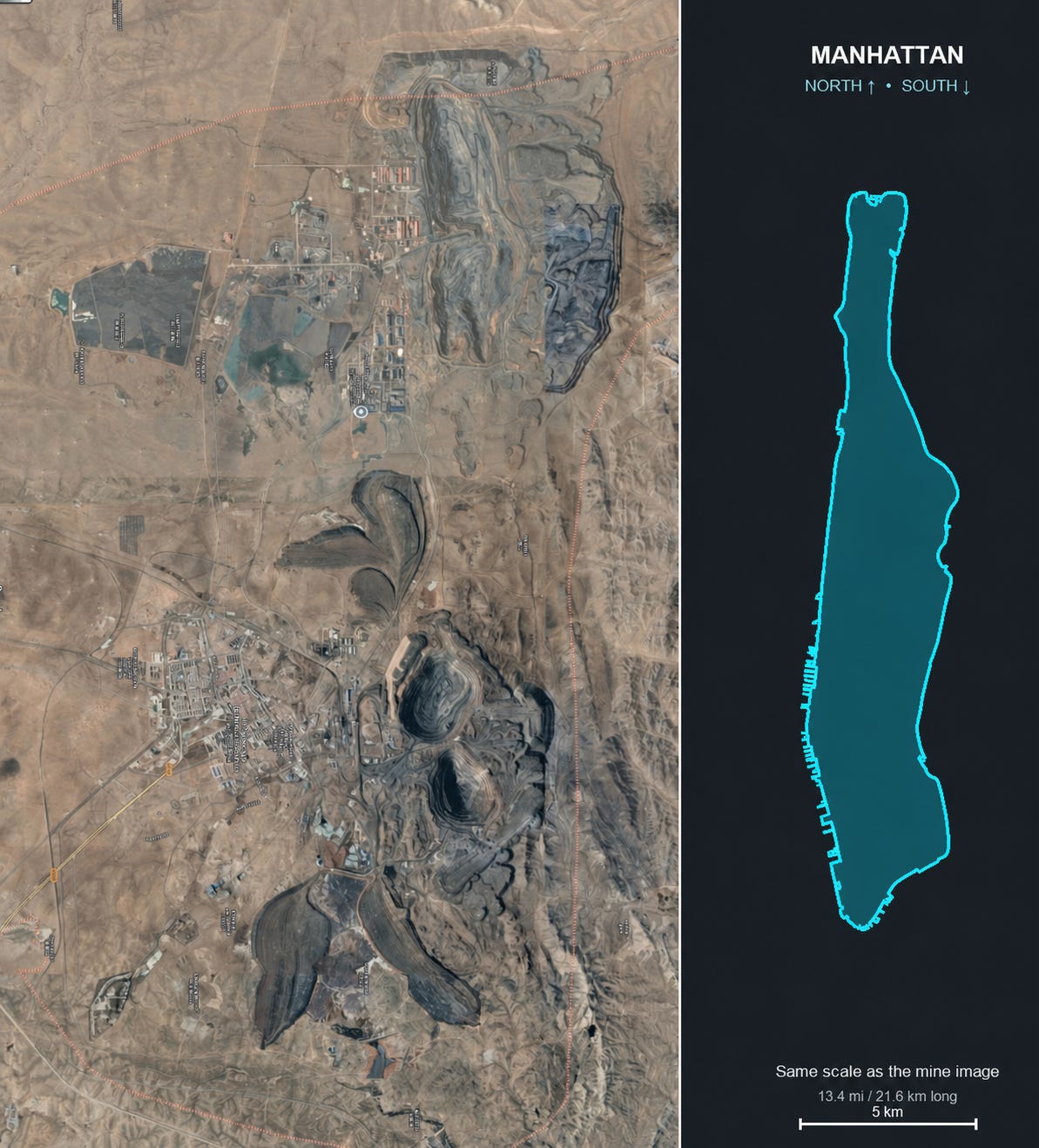
In the North, because the ore was all in one place, rare earths were a byproduct of state steel from the beginning. Consolidation in the North was finished by 2015 because of this simplicity.
The South was harder for both physical and political reasons. Ion-adsorption deposits are diffused throughout the provinces, so the region bred hundreds of small operations, chronic illegal mining, and smuggling routes through Myanmar, which has deposits of its own. On top of that sat a crowd of champions backed by provincial and municipal governments, each with revenue and jobs at stake and varied interest in handing its assets up the chain. When Beijing forced the industry into the “Big Six” 六大稀土集团 structure in the mid-2010s, the North got one group and the South got five. The original plan had been exactly two groups, one North and one South, but Southern resistance stalled it at six.
Beijing finally completed the plan in December 2021, fusing the rare earth assets of Chinalco 中铝, Minmetals 五矿, and Ganzhou’s municipal champion into China Rare Earth Group. Guangdong’s assets were not folded in until 2024; the two-firm quota structure dates only to 2024, and Beijing stopped publishing the quota numbers altogether in 2025.
The consolidated structure was in place for barely a year before the 2025 export restrictions, and running those restrictions through dozens of quarreling producers instead of two compliant groups would have been a far messier proposition. The weapon was finished just in time to be fired, which ought to remind us how this arrangement is still settling, still being improvised in places, and still discovering what its own workforce will tolerate.
How much are these companies worth?
The messy consolidation of the South also shows in the obscurity of these companies’ financials. China Northern generated about ¥32.97 billion (roughly $4.6 billion) in 2024 revenue, employs just under 10,000 people, and by April 2026 had a market cap of about ¥177.9 billion ($25 billion), making it the most valuable rare earth company in the world. Revenue jumped to ¥42.56 billion in 2025, with net profit more than doubling to ¥2.25 billion, as export-control-driven prices flowed through.
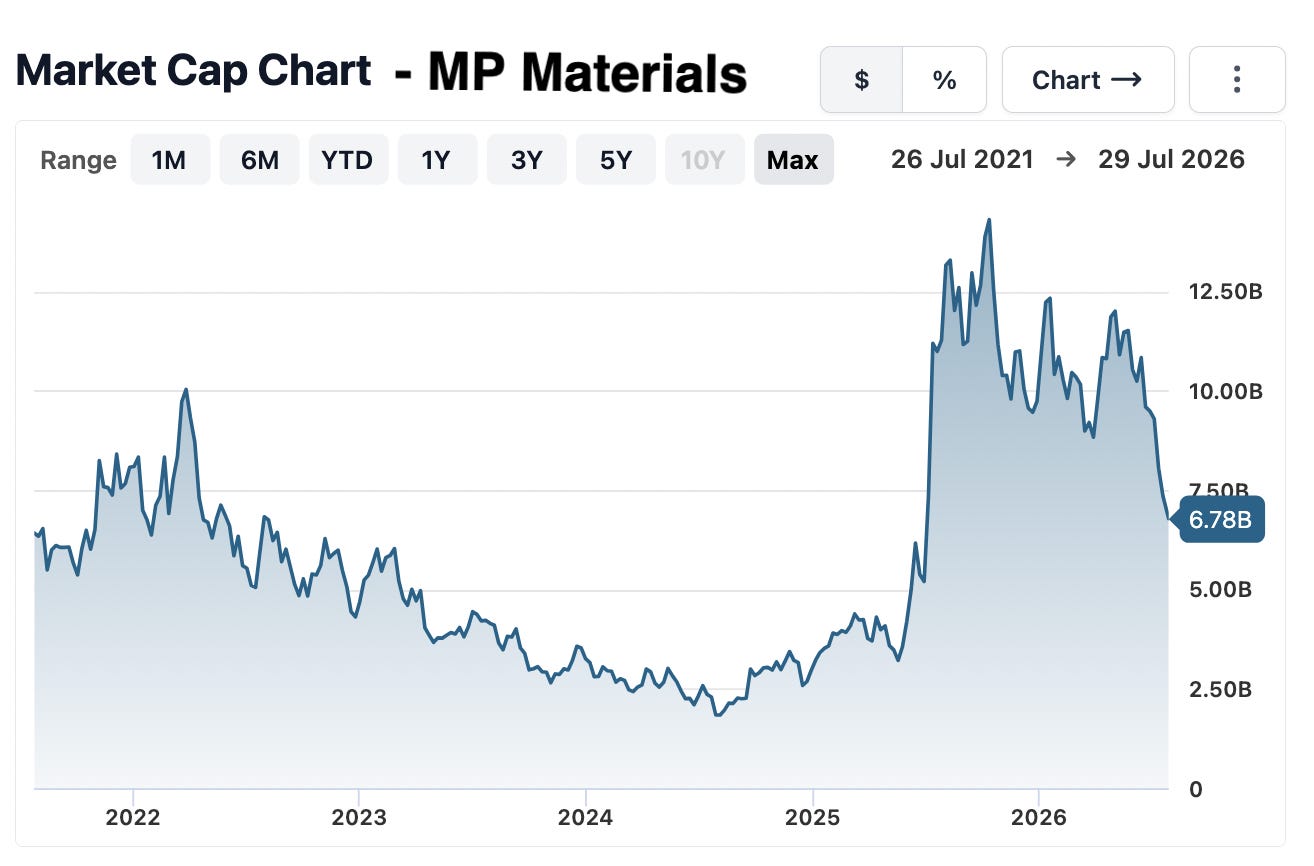
China Southern, on the other hand, posted about ¥3.03 billion in 2024 revenue, down 24 percent, and a net loss of roughly ¥287 million, less than a tenth of Northern's revenue. But this figure is probably misleading, since it describes only a slice of the group, its heavy rare earth processing and separation assets, not the full mining base or the unlisted parent "China Rare Earths Group" itself, whose total consolidated revenue and profit Beijing has never disclosed. For context, MP Materials brought in just $204 million in revenue in 2024, less than a twentieth of Northern's, and employs fewer than a thousand people. Even after a year of Washington deal-making pushed its valuation up, MP's market cap is around $10 billion (on a good day), well under half of China Northern's.1
The Southern Smuggling Snafu
The South also has to deal with smuggling from Myanmar, bypassing China’s set quotas. The production quota system was predominantly designed as a response to environmental concerns, as unregulated mining, particularly in the South, led to acid and ammonia leaking into streams irrigating rice fields as well as landslides.
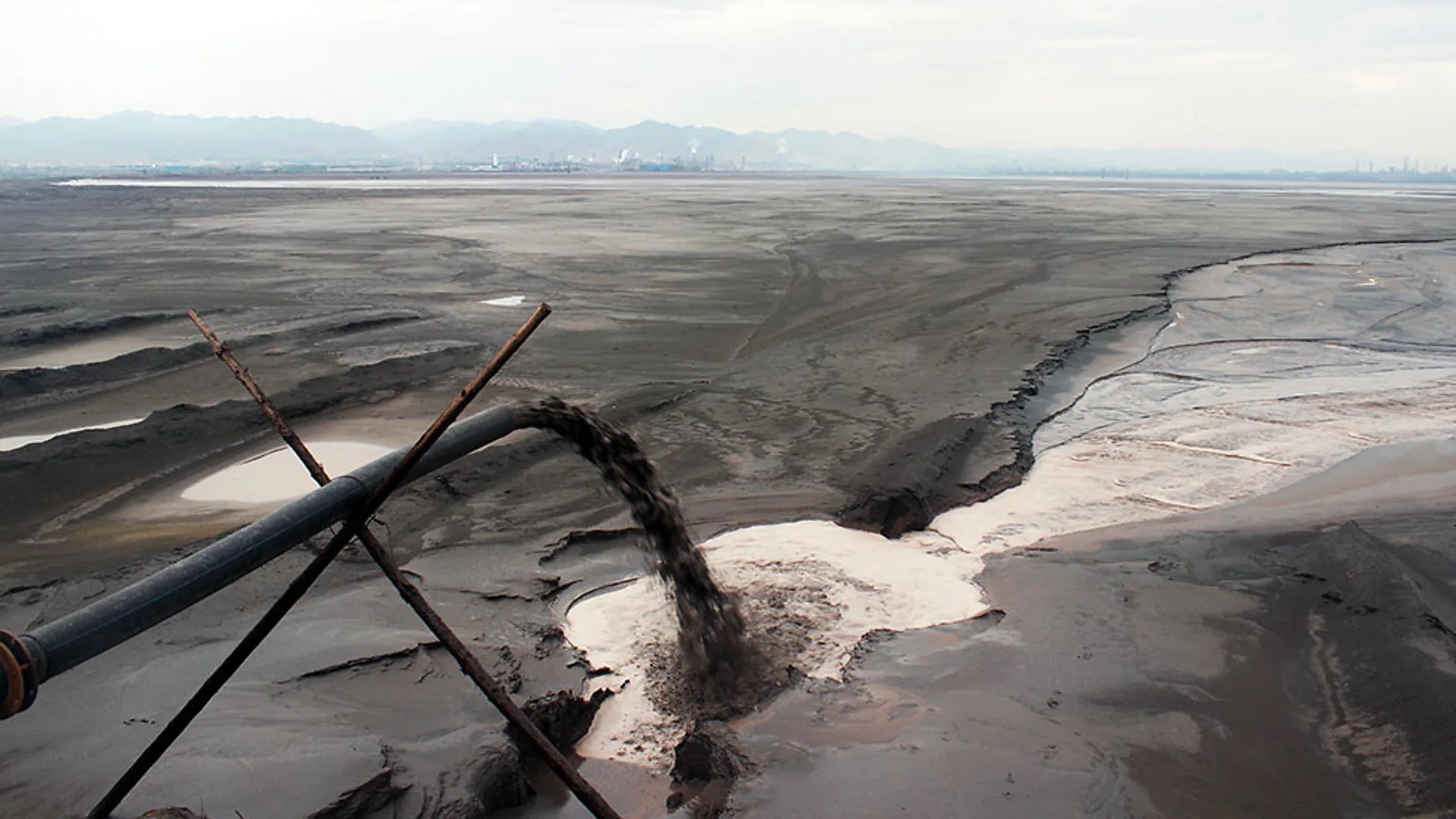
Many of the small-time private mine operators that were running dirty mines in the South left for dirtier pastures in conflict-plagued Myanmar. Now, much of China’s heavy rare earth mining comes from Chinese firms operating in Myanmar. The pollution and environmental cost wrought upon Burma is extensive. But the larger thorn for Beijing is that smuggling indicates a lack of state capacity to enforce quotas and secure self-sufficiency.
We can gauge the scope of smuggling by looking at China’s production quotas before they became hidden. The quotas for light rare earths from the North and heavy rare earths from the South have some correlation, as both are used for making NdFeB permanent magnets, which are ubiquitous in EVs, smartphones, wind turbines, and every sort of consumer electronic. NdFeB magnets mainly require light rare earths, but they are often sprinkled with a bit of heavy rare earth to make them heat resistant.2
Given China manufactured about 260,000 tons of NdFeB magnets in 2024, China would need about 1,750 tons of dysprosium, the heavy rare earth, for its dusting of heat resistance.3 The problem is the national production quotas for dysprosium in 2024 were less than nine hundred tons. The gap of almost a thousand tons of dysprosium must be made up by a combination of hidden overproduction from China Southern and smuggling from Burmese mines.
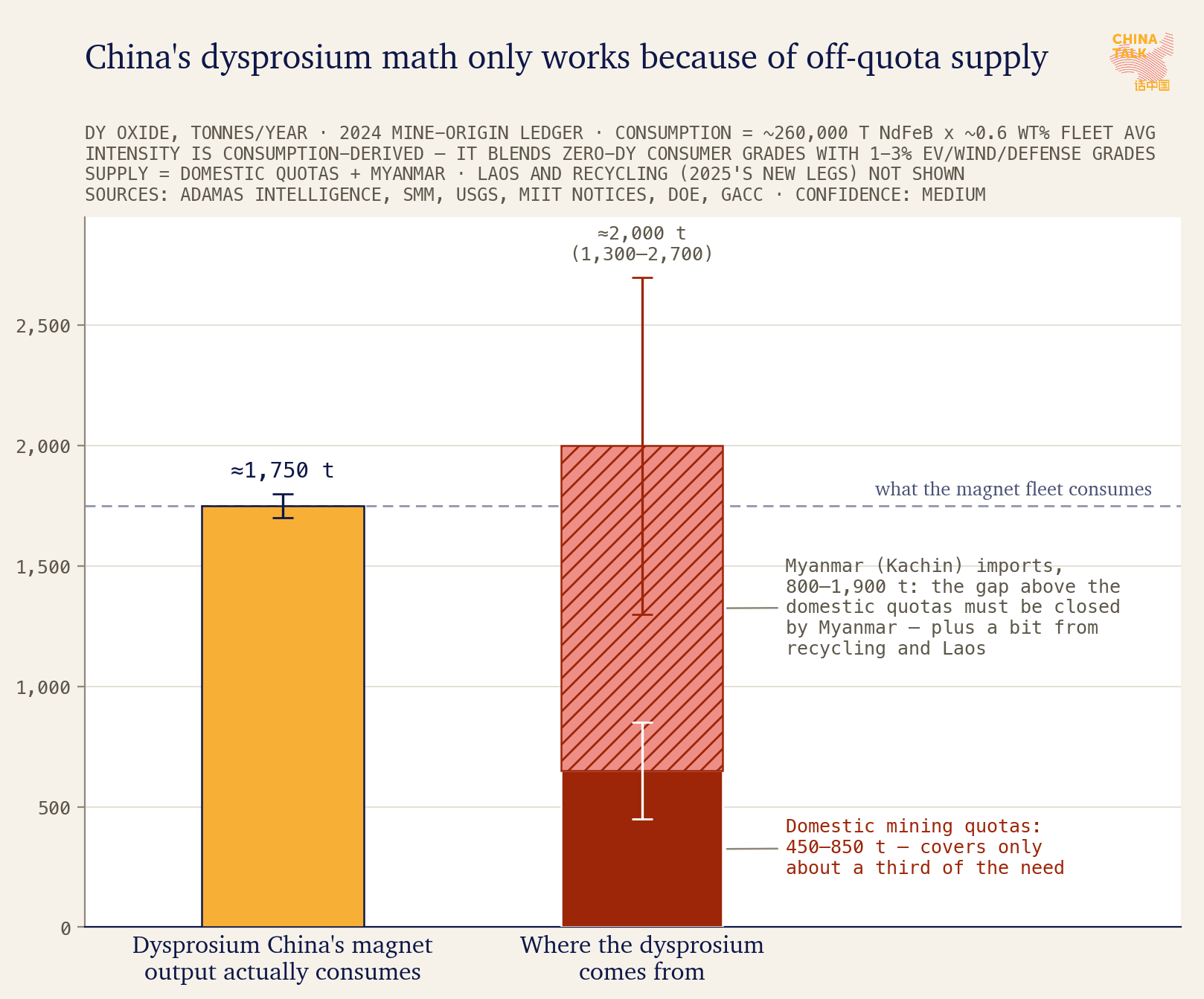
This smuggling epidemic perhaps played a role in China keeping its quotas out of public scrutiny in 2025, and it demonstrates the reality that the central government is not a panopticon. China has its own rare earths issues, and the tug-of-war between Beijing and local interests in the South reveals a governance problem for the central government.
Who Owns What?
The two firms also answer to different levels of the state. Both are state-owned, but China Northern is a local SOE 地方国企 whereas China Southern is a central SOE 央企. The difference is basically who primarily owns and controls the company: the central government or a provincial/municipal government.
Beijing steers Northern through quotas and party discipline, but a lot of the direction is happening in Inner Mongolia. Southern, by contrast, is a central SOE supervised by the State Council’s State-owned Assets Supervision and Administration Commission (SASAC, 国务院国资委), and its shareholding shows the fight it took to build it. SASAC holds 31% directly, a rare arrangement almost like a referee’s seat above three parents — Chinalco, Minmetals, and Ganzhou — who did not particularly want to be merged. The merger supposedly took months of haggling between the center and the localities, with Ganzhou fighting to keep equity for the sake of municipal finances.
Put the pieces together and the idea of “China’s rare earth duopoly” describes a specific and somewhat lopsided settlement. The strategically scarcer resource, the heavies, sits under direct central ownership in part because the South was where Beijing’s regulatory control kept failing. The North remains under provincial supervision because the center didn’t need to do much to corral it.
What Makes These Companies So Good
China Northern and China Southern are the umbrella organizations through which the rare earths flow, but a whole ecosystem lives under the hood to make the system work. The know-how for mining, refining, smelting, and magnet making is one of China’s key advantages over other countries; these kinds of know-how are the crown jewels that Beijing export controlled in October 2025.
It’s Not the Equipment
The equipment ecosystem differs slightly for China Northern and China Southern. The process for mining rare earths changes depending on the ore being harvested. The light rare earths from China Northern are primarily from bastnäsite, whereas the heavy rare earths from China Southern are primarily from ionic clays. We’ll be publishing more on the details of turning an ore into a permanent magnet soon, but the key idea here is that each ore requires slightly different equipment and processes.
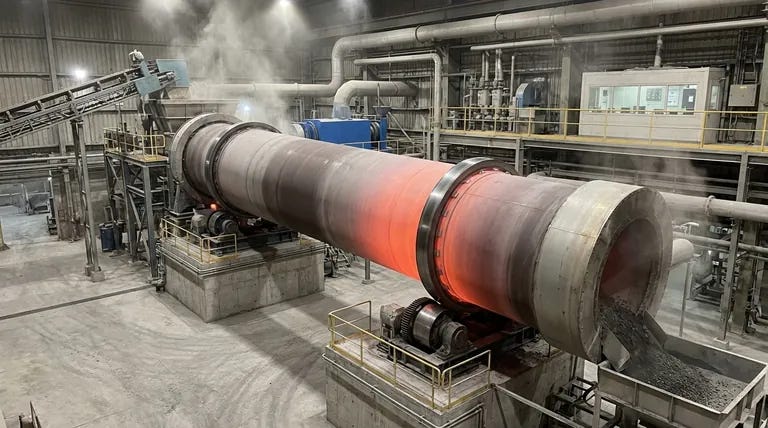
For China Northern, the process requires equipment to crush hard ore, froth flotation cells to skim off gangue, and rotary kilns to prepare the concentrate for chemical separation. Meanwhile, China Southern just needs leach tanks and precipitation tanks, as ionic clays are easier to process, though they contain less rare earth by volume.
Regardless of the ore, though, China possesses a deep ecosystem of companies providing all sorts of equipment for mining and refining. Interestingly, these companies aren’t clustered near Inner Mongolia or Ganzhou, but rather spread throughout China. Companies include BGRIMM in Beijing, Naipu Mining in Jiangxi, CITIC and TIEI Extraction in Henan, and so many more.
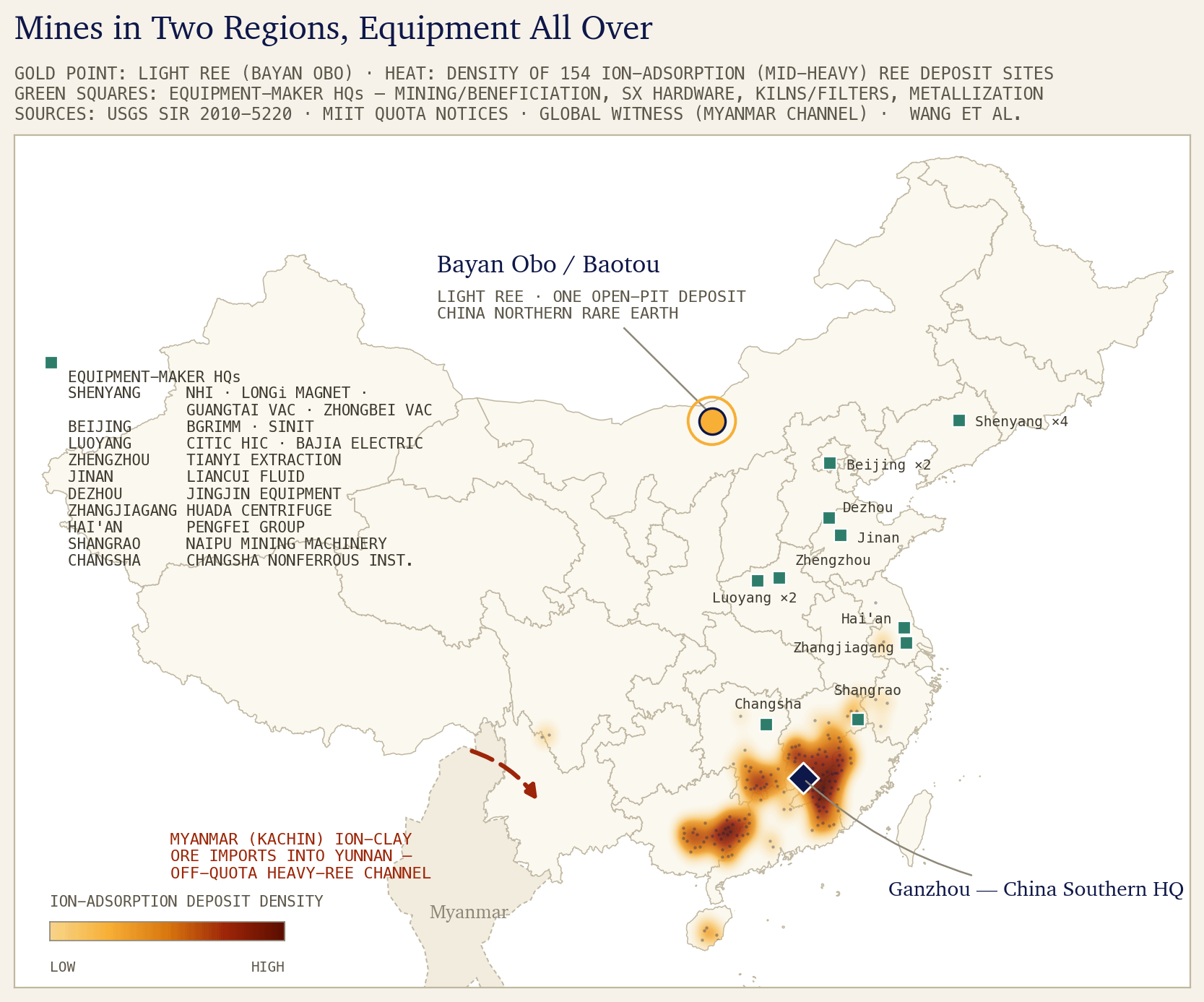
For most of the rare earth supply chain, the equipment is not specialized.4 Machines used for rare earths mining and refining can be used for almost all mining and refining. These tools have been commoditized globally, meaning that the secret sauce for getting from ore to oxide isn’t in the equipment.
Know-How Is China’s Edge
But equipment is only one piece of the puzzle. The U.S. has its own supply chain for rare earths equipment, and the basic processes for mining, refining, metallization, and magnet making are common knowledge. But there is room for process knowledge to pull China’s industry into a different league.
Decades of dominance over the industry allowed China’s duopoly to develop process knowledge and discover trade secrets that allow them to squeeze every last drop of juice from the earth. This know-how allows China greater efficiency, extracting more rare earths from ore. Everyone in the industry knows you need a rotary kiln, but the roasting recipe is secret. Everyone knows you need mixer-settler banks, but the way China sets theirs up minimizes stages while reaching near-perfect purity.
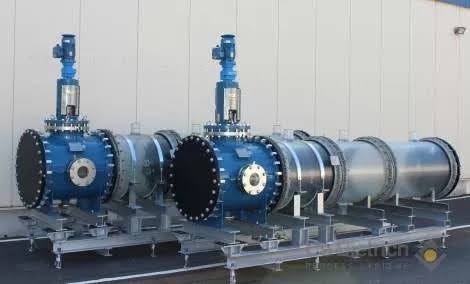
“The Father of Chinese Rare Earths Chemistry,” Xu Guangxian 徐光宪 developed the process of countercurrent extraction (SX) in the 1970s. This process greatly enhanced the industry’s ability to separate neodymium and praseodymium in the last step of the refining process before smelting into metal. Given it is the final step, both the North and the South needed SX for optimizing their workflows.
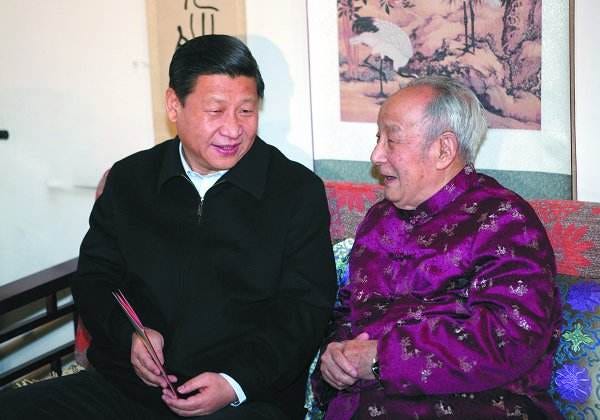
If Xu is the common patriarch of China’s rare earth industry, then his intellectual descendants from Peking University are the ones who carried on his legacy, improved upon it, and carried new aspects separately to the North and South. Both regions maintain their own R&D institutes: the North has the Baotou Research Institute of Rare Earths 包头稀土研究院 (BRIRE) while the South has the China General Research Institute for Nonferrous Metals 中国有研 (GRINM). For a sense of scale, BRIRE alone boasts seven hundred staff, with at least two hundred engineers. By contrast, the U.S.’s closest equivalent, the Department of Energy’s Critical Materials Innovation (CMI) Hub, has “more than 300 people in leadership and research roles.” Both BRIRE and GRINM institutes predated Xu’s discovery, but they both separately undertook the task of commercializing and applying his discoveries for commercial purposes. The people at China Northern and Southern, BRIRE, GRINM, and other organizations like the Chinese Academy of Sciences (CAS) are the ones with the know-how.5 China also has the pipeline that feeds talent into these organizations. About eighty mineral processing schools and mining engineering programs collectively graduate thousands of students a year. These students can work at over forty rare earths specialist labs, alongside research institutions and the big two mining companies. The U.S. has only five hundred students graduating from similar programs annually.
Despite that seemingly grim number, the problem for the U.S. isn’t the talent pipeline but rather the destinations for those pipelines. The U.S. doesn’t need rare earths degree programs; they are nearly equivalent to chemical engineering programs. The problem is that chemical engineering graduates go to strike gold in oil fields instead of rare earths facilities. As the U.S. resurrects its rare earths facilities, more and more graduates will enter those companies; over time, the know-how will grow as the processes become perfect. Jack Lifton, Co-Chair of the CMI, conducting an autopsy of the death of America’s mineral capabilities, diagnosed “The West exported not merely factories. It exported an apprenticeship.” By creating capacity, we can funnel graduates into these apprenticeships, and build capability.
Wanting to skip the wait for know-how, we may be tempted to poach talent from China. But poaching wouldn’t be a silver bullet for Americans wanting to one-shot the rare earths problem because, unfortunately, Adam Smith dreamt up the division of labor. People are often siloed to one specific task within SX design, reagent chemistry, or electrolysis furnace operation, and poaching one person does not allow you to replicate the process.
American companies would need to poach entire teams to extract sufficient know-how, though even that may not be enough. The teams at China Northern and CREG are trained and specialized at perfecting the infrastructure for their specific process flow. Each facility is working with a different ore with different impurities, chemistries, and idiosyncrasies, meaning a worker cannot simply plug the process flow for Baotou into the process flow for Mountain Pass.
Is It a Good Life Working in China Rare Earths?
As policy analysts, we spend most of our time thinking about rare earths at the altitude of geopolitics and great power competition. Most people are not like us. The industry is made up of people who went to school, learned separation chemistry, moved to Baotou or Ganzhou, and would prefer to be paid well, enjoy their work, and not spend much time thinking about U.S.-China competition. So how is it going for them?
Let’s start with the numbers, which are public because China Northern is a listed company. In 2024, Northern’s average employee compensation was about ¥183,400 — roughly $25,000 — across a workforce of nearly ten thousand. Solid pay for industrial work in Inner Mongolia, but these workers can also scroll through international job postings on their lunch break and see that they could be making a lot more money overseas.
MP Materials, the company operating America’s lone rare earth mine at Mountain Pass, disclosed a median employee compensation of $92,576 for 2025. The median American mine worker in this industry makes nearly four times Northern’s average employee. And the median software engineer at OpenAI clears somewhere between $555,000 and $800,000!
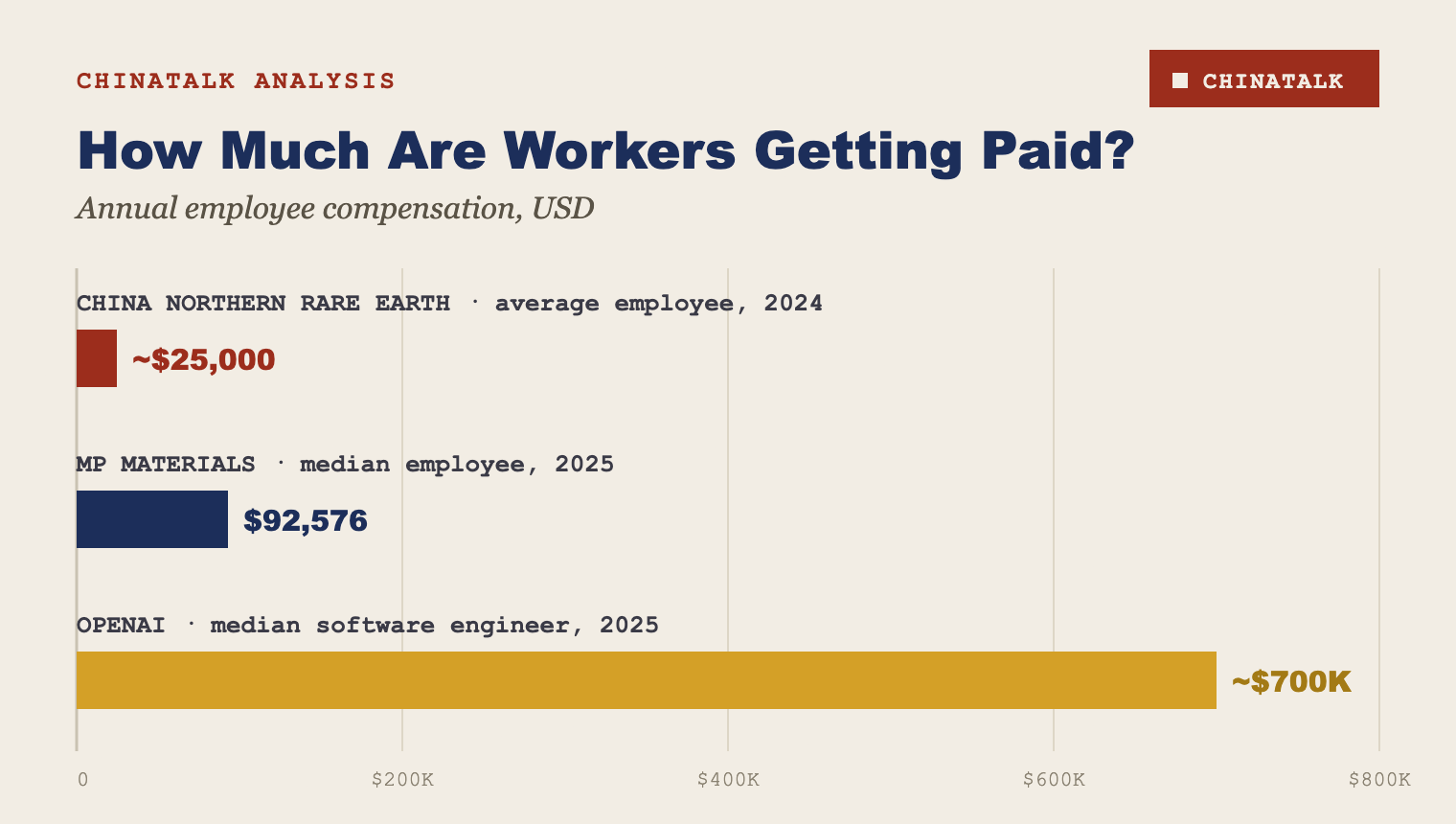
At the top, general manager Qu Yedong 瞿业栋’s compensation peaked around ¥2.22 million ($310,000), with his 2024 cash pay reported closer to ¥808,000. CEO of MP Materials James Litinsky, on the other hand, made $6 million in 2024 and $28 million in 2025, 303 times his median worker, while personally holding a stake in the company worth north of $700 million. To be fair, we imagine the rent in San Francisco might be a smidge higher than in Inner Mongolia; and Qu’s real career currency is less money and more party rank, a seat on the parent group’s standing committee and a shot at political elevation.6
The business model China has constructed for its rare earth industry is far more experimental and internally divisive than many assume.
In March 2021, Xiao Yaqing 肖亚庆, then minister of the Ministry of Industry and Information Technology 工信部 (MIIT), the industrial regulator that among other things sets the annual mining and smelting quotas under which the two rare earth groups operate, complained publicly that China’s rare earths were selling at the price of “earths” rather than the price of “rare” because of “vicious competition and competitive price-cutting, wasting this precious resource.” (目前稀土没卖出“稀”的价格,卖出了“土”的价格,是因为恶性竞争、竞相压价,使得这种宝贵的资源浪费掉了。) Xiao was actually expelled from the CCP in 2022 for suspected “violation of discipline and law,” whatever that means.
There have recently been some high-profile exits. In the first half of 2025, China Southern’s listed arm lost its chairman, general manager, a deputy general manager, its CFO, and its supervisory board chief, officially for work reasons, but conspicuous enough that the group had to publicly deny rumors of defections.
Claims have circulated that rare earth researchers average under ¥300,000 a year against tech packages of a million or more. One departed research institute employee vented that ten years of work there did not match what a peer gained from a single job hop.
Beyond the limited pay, the work might also come with other drawbacks. In June 2025, the Wall Street Journal reported that MOFCOM 商务部 began demanding rare earth firms submit detailed rosters of their technical personnel, education, research background, roles, and — in some cases — collect their passports to prevent unauthorized travel and the leakage of process know-how. This touches a broader theme about what Beijing asks of its national champions. In March 2025, it was reported that some of DeepSeek’s employees also had their passports taken. By 2026, the practice had spread beyond DeepSeek to researchers across China’s frontier AI labs, making it more difficult for their employees to leave.
For perspective, the people doing the mining and refining of the most consequential resources for the fate of the world are not rockstars. They aren’t wunderkinds that America failed to produce. They are talented chemistry and engineering nerds, and the U.S. has those too.
We might be tempted to think that the rare earths duopoly are organizations of China’s geniuses, whereas the U.S. funneled its geniuses into consulting and finance. That is not the case. China’s duopoly is on top because of their circumstances. Their advantages are in scale, experience, proper organization, and government aid. It’s not magic; it’s just hard work.
Claude’s reasoning for why its harder to get numbers on China Southern: “China Rare Earth Group Co., Ltd. is the actual operating and holding company, the one with the SASAC-Chinalco-Minmetals-Ganzhou cap table, and it is privately held, answerable to state regulators and its shareholders but under no obligation to file the quarterly and annual disclosures a stock exchange requires. Publicly listed subsidiaries exist underneath it, most relevantly China Rare Earth Resources & Technology (000831.SZ), but that listed company is only one piece of China Rare Earth Group’s empire, essentially the trading and heavy rare earth processing business inherited from the old Guangdong/Ganzhou assets. The mining licenses, the quota allocations, a lot of the smelting and separation capacity, and the group’s overall financials sit at the China Rare Earths Group parent level and are never filed anywhere public.”
“Sprinkled” is doing a lot of heavy lifting in this sentence, but it’s a close colloquial approximation for the process. If you’d like to learn more, look into grain boundary diffusion.
This calculation baked in the fact that all NdFeB magnets require heat resistance.
The equipment for making permanent magnets is specialized, however, and it is a pressing problem for American indigenization efforts.
By know-how, we mean knowing how to best design an SX cascade system at a facility, and knowing how to fix it when something goes wrong. For clarity, separation requires hundreds of tanks extracting the rare earths! It is a logistical nightmare to design these hundreds of tanks with the right planning and chemistry, and China’s decades of experience in doing it is where the know-how resides.
For instance, Guo Shengkun 郭声琨 rose from Jiangxi’s nonferrous metals mines to run Chinalco, now one of China Southern’s parent companies, then became Guangxi party secretary and Minister of Public Security, ultimately rising to a Politburo seat as one of China’s top security officials.
The gap between mining share (71%) and refining share (91%) is the real story here, and it's the same pattern chips followed — raw material access matters far less than who controls the specific industrial capability to turn it into something usable. The US and Japan actually invented rare earth magnet production last century and let the capability migrate to China anyway, because building it was expensive and unprofitable in the short term. That's a strategic choice with a decades-long bill attached, not bad luck. Leverage built this way is durable precisely because it was never really about the raw resource, it was about who kept investing in the unglamorous, low-margin refining infrastructure everyone else abandoned.
Hopefully we are getting away from the media-generated hype re., the US vs China for the number one spot in the RE sector. China isn't going to budge. However, there's certainly competition this decade for the US in terms of building out within-border (and friendly) RE chains that are responsive to the offtake needs of N. American endline manufacture. Nor have we heard publicly of new niche RE chains (e.g., MP, Energy Fuels, USARE, REalloys and Lynas) complaining of growth restriction due to lack of workforce access. Lynas, yes recently in terms of equipment cost and we saw legal action between the likes of MP, Ramaco and USARE over employee moves, but severe shortage not apparently for these RE prime movers. This issue may become more impactful for those few RE wannabees that might still emerge the next decade but those will be very few, IOHO. GLTA Rare Earths Investor (REI). Thanks for the article.