
Welcome to the world of Chinese peptides, where American consumers inject themselves with research chemicals in pursuit of weight loss, muscle recovery, and the elusive promise of optimization.
Today on ChinaTalk, we’re trying out a new narrative podcast format to investigate the explosive rise of gray market peptides and the Chinese pharmaceutical ecosystem that turned this biohacking trend into a market worth hundreds of millions of dollars. Please let us know if you want more episodes like this.
Listen now on your favorite podcast app or on YouTube.
ChinaTalk is launching a series of merch for Chinese New Year.
Check out our wares at chinatalk.printful.me to help us make more content like this and celebrate ChinaTalk’s 500th episode!

What are Peptides?
Jasmine Sun: People are getting so into this trend in Silicon Valley that they’re even hosting parties — peptide raves, for example — sponsored by suppliers, where they teach you how to mix and inject your own peptides and then throw a rave with loud techno and organic chemistry structures projected behind the DJ.
I went to one in December just to check out the underground peptide scene, and it was actually pretty fun. It was really just a party with a high school chemistry lab beforehand.
Lily Ottinger: That was Jasmine Sun, author of the New York Times article about peptides that inspired this podcast. Before we go further, we need to understand what we’re actually talking about when we say “Chinese peptides.” We talked to Hamilton Morris, the science journalist and chemist known for his Vice series on psychoactive drugs, and learned that the word “peptide” is almost meaninglessly broad.
Hamilton Morris: A peptide is a string of amino acids — more than two amino acids joined together and fewer than fifty, at which point it becomes a polypeptide. Within that umbrella, you have a borderline infinite number of potential pharmacologies. It’s almost like saying, “What do you think of pills?”
There are opioid peptides, dissociative peptides, all kinds of hormonally modulating peptides, and peptides that have potential performance-enhancing effects in an athletic context.
Lily Ottinger: To put this in perspective, insulin is a peptide (actually, it’s two peptides). Ozempic’s active ingredient, semaglutide, is a peptide. The growth hormones in your body are peptides. When we talk about Chinese peptides, we’re talking about a vast universe of different substances with wildly different effects — from FDA-approved weight loss drugs that cost $1,000 a month to experimental compounds that have only been tested on rats.
Hundreds of amino acids exist in nature, so the total number of possible peptide compounds is truly enormous. Even if we only consider compounds containing the twenty or so amino acids that make up proteins in the human body, the number of possible peptides is around 1065.
Hamilton Morris: There is not a single peptide that is a controlled substance, so there aren’t any illegal peptides. Historically, they haven’t been considered drugs of abuse that were of interest to law enforcement. They are also, by conventional drug manufacturing standards, difficult to produce. The traditional law enforcement concern was people gathering chemicals to make drugs, and you can’t really make peptides easily at home. Someone could do it, but it’s more difficult than typical small-molecule synthesis of the type that law enforcement has historically been interested in.
Another reason is that peptides feel natural to some people, maybe because they’re made of amino acids, and that’s somehow conceptually less threatening than a synthetic anabolic steroid.
The Supply Chain
Lily Ottinger: Peptide sellers on the Chinese internet are very, very eager to hook you up. China Talk analyst Irene Zhang went undercover on Xiaohongshu to scope things out.
Irene Zhang: I channeled my inner peptide-curious American consumer and followed the accounts of ten different self-proclaimed peptide factories in one go. Within one day, all ten followed me back. Their export operations were very efficiently streamlined. The sellers sent me price lists, videos of production and storage facilities, and lab reports — sometimes even without prompting.
A seller we’ll call Alice was the first to get back to me. She caught my eye because her account featured many videos of Christmas trees, seemingly in an effort to appeal to Western customers. We messaged first on Xiaohongshu, or RedNote, but once I asked for a price list, she insisted on moving the conversation to TikTok, Instagram, or WhatsApp.
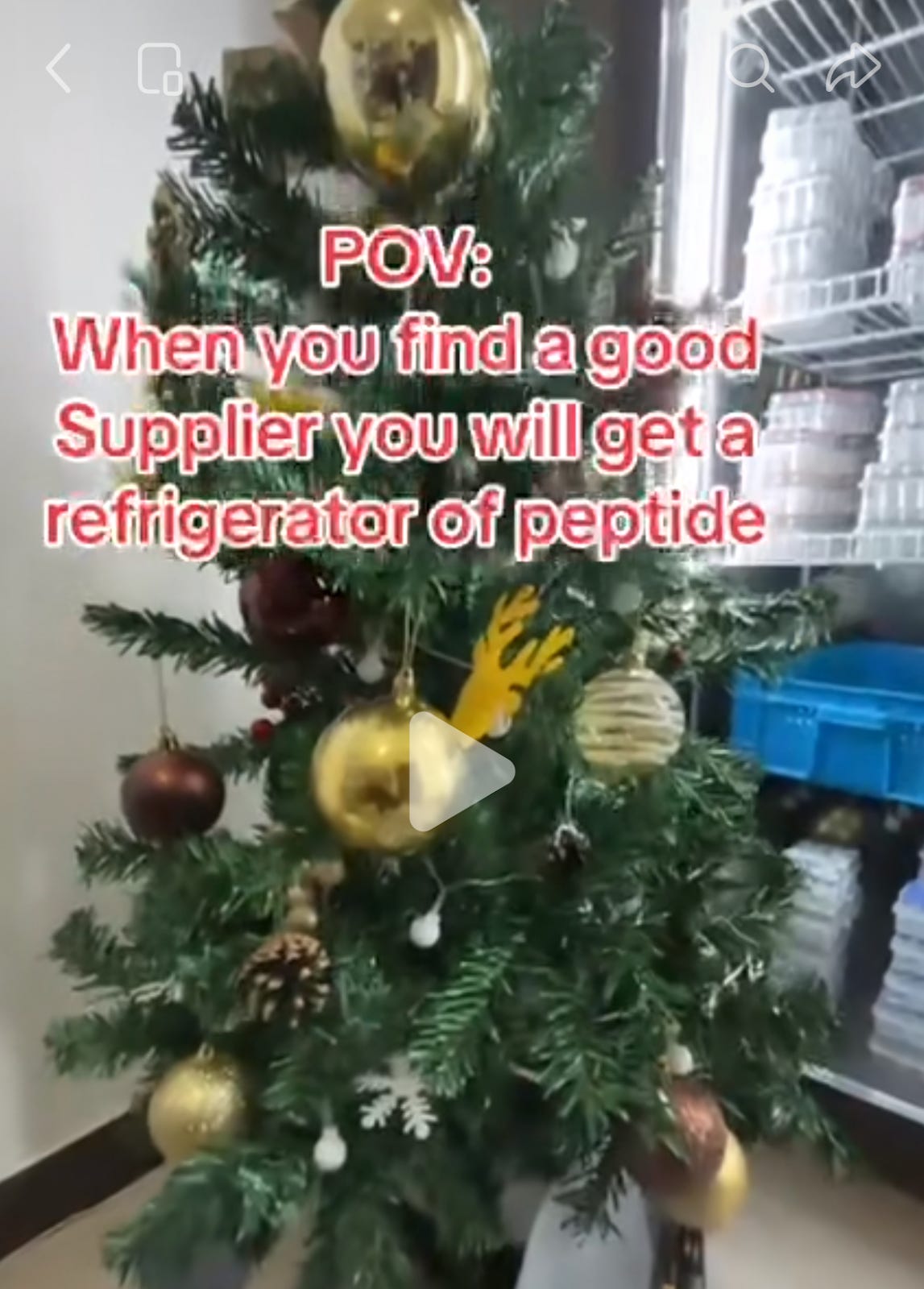
Via WhatsApp, I received a series of videos featuring more Christmas trees, purposefully situated next to fridges full of color-coded vials. Her company, she told me, has factories in Guangzhou and Beijing, and she can ship any quantity of at least ten vials to a U.S. address in around ten days. U.S.-bound orders have to hit this ten-vial minimum to justify the $60 shipping cost and $20 customs fees, so bulk buying is incentivized from the beginning.
Lily Ottinger: But what kinds of peptides are on the menu?
Tirzepatide is a GLP-1 medication used to treat diabetes and assist with weight loss. It’s FDA-approved and sold under brand names like Mounjaro and Zepbound. If you order from Alice, ten 5mg vials of tirzepatide will set you back $48 — ten vials is about 2 and a half months’ worth, so this works out to about $50 a month once shipping and customs fees are factored in. By comparison, Eli Lilly, the pharmaceutical company that invented Zepbound, charges $399 a month for the same 5mg dosage.
Alice also offers more exotic peptides: GHK-Cu, a copper-based peptide recently profiled in Vogue for skincare and anti-aging, Epithalon for “longevity”, injectable Vitamin B12, and good ol’ bacteriostatic water to keep things sanitary.
For Zepbound, the maximum recommended dosage for weight loss is 15 mg once a week, with most patients starting at 2.5 mg, but Alice will sell you vials containing up to 60 mg. GLP-1 dosing errors can lead to nausea, vomiting, abdominal pain, fainting, headache, migraine, dehydration, acute pancreatitis, and gallstones, per the Food and Drug Administration. To confirm the quality of her products, Alice sent Irene a photo of a lab report produced by Janoshik, a major testing laboratory located in the Czech Republic named after a Robin Hood-like character from Slovak folklore. Janoshik maintains a public database of its tests, but Alice’s company had the test done anonymously, so there is no way for ChinaTalk to find out if the report, produced back in November 2025, was real.
Irene Zhang: I told Alice I would think about it. She noticed my WhatsApp profile picture, asked if I was ethnically Chinese — I am — and invited me to go eat Peking duck with her if I’m ever in Beijing.
Lily Ottinger: Retail sales of peptides are technically illegal inside China, since they are supposed to be regulated as medical products and sold only with government licenses. In 2024, China’s National Medical Products Administration announced that it had busted three illicit distributors of injectable semaglutide, better known as the active ingredient in Ozempic and Wegovy. These operations allegedly made millions of dollars illegally selling injectable GLP-1s for weight loss, and the two largest cases have been escalated to criminal prosecution. Beijing’s Anti-Doping Agency warned in a 2025 social media post that injecting BPC-157, a peptide popular among some athletes, is not permitted in official sports. This domestic scrutiny explains why most of the sellers unsubtly plying their trade on Xiaohongshu are targeting foreign clientele.
Chance (also a pseudonym) is an advertising consultant in Shandong who specializes in helping Chinese companies advertise on Western platforms. Starting in 2024, he began receiving a large wave of inquiries from peptide manufacturers who smelled business opportunities abroad. Most of these factories are located either in heartland regions like Shandong, Shanxi, and Henan, or in Guangdong. Chance mostly helps them promote on Facebook, but also works through TikTok and Google Ads. He says his job is getting harder, as Western platforms increasingly scrutinize this type of content and accounts easily get banned; nevertheless, business is booming. The largest buyer base is the US, followed by Canada, Australia, and Latin America.
Irene Zhang: When I asked him if factories know that most Western customers are using their products for DIY wellness rather than research, he replied immediately — “Yes.”
Lily Ottinger: According to U.S. Customs data, imports of hormone and peptide compounds from China roughly doubled to $328 million in the first three quarters of 2025, up from $164 million in the same period of 2024. Most of these factories are located in Guangdong Province, which is home to about 70% of China’s manufacturers of peptides for cosmetic purposes. Shandong, Shaanxi, and Henan are also major hubs.
To be clear, going undercover was not our first choice as far as reporting methods go, but no one working at these peptide factories was interested in doing a recorded interview with us. Hamilton ran into a similar dilemma when he reported on China-manufactured cannabinoids for Vice.
Hamilton Morris: I’m not surprised you’ve had difficulty, because anyone manufacturing these sorts of things would have very little to gain by talking to you about it and potentially a lot to lose. It’s also conceivable that they don’t know all that much about these compounds. That was something that struck me in my own visits to China to meet with the chemists and people who work in these gray market labs — they often have very little understanding of what they’re selling, because they don’t need to. They see that there’s demand for something, and that’s enough.
There’s a tremendous demand for GLP-1 agonists right now. Enormous numbers of people have heard good things about Ozempic. Even many thin people take Ozempic to become even thinner, or because there’s some idea that it may have an anti-addictive effect, or maybe some kind of benefit for longevity — who knows. The reality is that tons of people who wouldn’t qualify for a prescription for a GLP-1 agonist still want to take them and want to access them as inexpensively as possible. If you’re running a gray market chemical supply company, that’s all that matters: people want semaglutide, or whatever semaglutide-like GLP-1 agonists are out there.
I’ve been very interested in the Chinese gray market for most of my life because I’m interested in the history of underground drug chemistry. There was such an enormous effort to prevent domestic synthesis of psychoactive drugs in the United States that a lot of the market shifted to China and India. It became cheaper, easier, and less legally risky to contract the synthesis of a psychoactive drug in a foreign country than to produce it domestically.
I wanted to learn more about this because most of the reporting I’d seen was very negative. It would paint the people who own these labs in a very negative light — talking about how dirty the labs were or suggesting that what they were doing was toxic or dangerous. In my experience, having analyzed a lot of samples that came from these labs in China, I was typically impressed by the purity. Of course there were instances of dangerous misrepresentation or impure products being sold, but for the most part, the quality was very high and every bit as good as anything you’d expect to be produced domestically.
This idea that diabolical Chinese chemists were making dangerous drugs to destroy the United States — which even appears in some more recent reporting — carries a specific kind of fearmongering tone about this being some bizarre Opium War revenge. That’s an idea you sometimes encounter. I thought all of this was ridiculous and wanted to sympathetically document and analyze exactly what was going on, with an emphasis on how interesting the chemistry was.
It was very difficult. Even though I was entirely sympathetic and nonjudgmental about everything that was going on, even if they did trust me, there was nothing for them to gain. I thought I could get into one of these labs if I worked with a buyer who had poured millions of dollars into the synthetic cannabinoid industry — this guy Matt Bowden. Even he was unable to arrange it.
Then I had this idea — maybe they would allow us to film inside the labs if we reframed what we were doing as using the labs as a location to film a rock opera. Surprisingly, this actually worked. We brought in costumes, instruments, amplifiers, and all this stuff into one of these Chinese cannabinoid labs and filmed a rock opera inside it — but then also used the opportunity to document some of the chemistry. It worked. On top of that, they really liked it. They loved his music. They were big fans and thought the entire thing was great.
Lily Ottinger: That was a bit of a tangent, but I also love the rock opera, so I wanted to include the story in full.
The Wolverine Stack
Lily Ottinger: Anyway, of all the peptides flooding into America, one has captured the imagination of biohackers perhaps more than any other — BPC-157, sometimes called the Wolverine peptide for its purported ability to heal injuries at superhuman speed.
Jasmine Sun: The other really popular one I heard a lot about was BPC-157, which is often taken with TB-500. These are for muscle healing. They were actually pioneered by the bodybuilding and fitness community, because if you have a really hard workout and want to recover, people would inject this to supposedly make cells regenerate faster. Or if you sprain your ankle or have a bum knee, people would use BPC to spot-treat sports injuries. Again, this has not been tested in human trials — only in rats. But people report positive anecdotal effects.
Lily Ottinger: I talked to two people who are putting BPC-157 to the test in pretty extreme ways. Marcus is a former molecular biology student who was paralyzed from the waist down after being shot in the spine in 2022. David is attempting to use BPC-157 to regrow flesh he lost to a brown recluse spider bite.
Dave Merrill: I moved up to Charlotte, North Carolina about a year ago. I got stung in the back by a baby brown recluse and ended up in the ICU for about three weeks with a tube in my mouth. About four pounds of flesh were liquefied on my back — it was nearly a limb-loser. Six months later, after being on high doses of BPC-157, I’ve probably regained about 80% of that flesh. The nerve damage is completely gone. I went through four surgeries to correct the injury, but to be honest, the BPC-157 did most of the work.
Marcus Pinson: BPC-157 is effectively a miracle drug. I’ve started to experience some sensory recovery in the lower half of my body, as well as involuntary motor function that should not have existed.
Lily Ottinger: My conversation with Marcus and David left me feeling conflicted. Their claims about BPC-157 are incredible, but without clinical trials, we really can’t say for sure whether peptide injections deserve the credit — and we certainly don’t know what risks are involved. But the reality is that the pharmaceutical industry doesn’t seem interested in researching this compound, let alone bringing it to market. Can you really blame people suffering from life-altering injuries for turning to the gray market?
What does the actual science say? The BPC in BPC-157 stands for Body Protection Compound. It’s a synthetic 15-amino acid peptide originally isolated from human gastric juice by researchers in Croatia. A 2025 systematic review examined 36 studies on BPC-157 published from 1993 to 2024. Of those, 35 were animal studies and only one was a clinical study in humans. The animal studies did show promising results: accelerated tendon healing, improved ligament repair, and faster muscle fiber regeneration.
But here’s the catch — over 80% of all BPC-157 studies originate from or are linked to a single research group at the University of Zagreb. The Phase 1 clinical trial that began in 2015 in humans was mysteriously canceled the following year, and the results were never published. The FDA classifies BPC-157 as a Category 2 bulk drug substance, meaning it cannot be legally compounded by pharmacies, and there’s insufficient evidence on whether it would cause harm to humans. The World Anti-Doping Agency banned it in 2022.
For pharmaceutical companies, there are structural factors that make it difficult to justify investment in BPC-157. A compound that generally boosts healing sounds great, but it’s a nightmare for clinical trial design. The widespread availability of BPC-157 on the gray market would also make it harder to recoup R&D costs.
Finally, impurities are uniquely problematic in peptide synthesis — but to understand why, we have to take a look at how peptides are made.
Peptide Synthesis 101
Peptide synthesis plays to China’s strengths. The technology that made all of this possible was invented by an American scientist named Bruce Merrifield in 1963, a discovery that would earn him the Nobel Prize. Before Merrifield, synthesizing peptides was agonizingly slow. When American biochemist Vincent du Vigneaud synthesized oxytocin, a hormone with just nine amino acids, in 1953, it was considered such an unprecedented accomplishment that he won the Nobel Prize in 1955.
Merrifield’s innovation was something called solid-phase peptide synthesis, or SPPS. Imagine building a chain one link at a time, but instead of holding the chain in your hands, you’ve anchored one end to a workbench. Each amino acid has a protective cap that prevents it from sticking to the wrong things. You remove the cap, attach the next link in the chain, wash away the excess reagents that drive the reaction, and repeat. When you’re done, you release the whole chain from the base. This method increased efficiency from a fraction of a percent to over 99.5% per step, reducing what previously took years to a matter of days.
BPC-157 is a chain of 15 amino acids, so you need to perform 15 sequential reactions. If each step is 99.5% efficient, over 15 reactions you end up with an overall purity of 92.7%. The remaining 7.3% is mostly made up of similar peptides that are off by one link. Because they are so chemically similar to the desired product, they are hard to separate out afterward. This is a nightmare from a regulatory perspective, because the impurities are biologically active lookalike molecules with unexpected pharmacological effects. Even if we managed to get our final product to 99% purity, that would be a difficult pill to swallow for the FDA. Manufacturers of small-molecule drugs have to report any impurities present in concentrations at or above 0.1% of the final product to the FDA, and injectables are held to even stricter standards.
You might be wondering how peptide medications like Ozempic and insulin were brought to market. How did they overcome the challenge of impurities? The answer is that they were produced in part through biological processes, not solid-phase peptide synthesis alone. For insulin specifically, scientists genetically engineered bacteria to churn out the peptide when fed specific chemical inputs. The manufacturing process for semaglutide involves fermentation with yeast cells as well as SPPS.
But purity concerns have not stopped Chinese manufacturers from churning out peptides using SPPS. Today, companies like GenScript, founded in 2002 and headquartered in Nanjing, can synthesize custom peptides in as little as five days with a 95% synthesis success rate, compared to the industrial average of 75%. In 2023, the Chinese pharmaceutical contracting giant WuXi AppTec synthesized more than 15 metric tons of peptide-based active pharmaceutical ingredients and intermediates. In 2024, the company tripled its total SPPS reactor volume to 32,000 liters.
As a side note, you might know WuXi AppTec as the company initially targeted by the BIOSECURE Act, which sought to prevent the weaponization of American genetic data by foreign pharmaceutical companies. The BIOSECURE Act became law in late 2025, but WuXi AppTec managed to avoid being listed as a company of concern — for now.
The point is that peptide synthesis technology has become so widespread that every university has an automated peptide synthesizer, and peptides that once required Nobel Prize–winning work are now manufactured at an industrial scale. That alone isn’t enough to make peptide-based therapies economically viable treatments for diseases — it’s doable, but these complications would cost money to deal with.
Why is Silicon Valley ground zero for this trend? Part of it is economics — tech workers can afford to experiment. But there’s something deeper going on.
Jasmine Sun: A lot of people are proud of it. When I’d ask, “Aren’t you worried about the risks?” they’d say, “Not really. I know it’s risky, but I’m a risk-taker. I’m starting companies, I’m doing all sorts of other risky stuff. Anything for an edge — if there’s an upside I might be able to get, I’m going to try anything to get it.”
Lily Ottinger: Hamilton Morris thinks there’s another factor. Ozempic has fundamentally changed how Americans think about injecting drugs.
Hamilton Morris: In the past, the idea of injecting a drug was considered very extreme in pretty much every context. If you were working in pharmaceutical drug development, any type of drug that had to be injected was a last resort when you had no other options. It was really considered very undesirable. I’ve seen this personally in my own interactions working with pharmaceutical companies — injection was considered unacceptable.
That’s changed dramatically as a result of Ozempic, but also biologic drugs like Humira, Skyrizi, and Bimzelx, which have become immensely popular. The idea of administering a drug via injection has become unobjectionable, even somewhat commonplace. In the past, you only injected drugs if it was a life-or-death scenario, and that’s changed.
The Role of the FDA
Lily Ottinger: The next section of this podcast will be presented by China Talk’s Tarbell Fellow, Nick Corvino. Nick wanted to speak to someone who knew how the FDA worked from the inside to understand why peptides are in such a strange regulatory space.
Nick Corvino: Where is the FDA in all of this? We spoke to Aaron Kesselheim, a professor of medicine at Harvard Medical School who has served on the FDA Advisory Committee.
Aaron Kesselheim: The FDA has for many decades taken an approach regarding personal importation of unapproved products — individuals can import unapproved products for their own personal use, and the FDA will exercise enforcement discretion with respect to those kinds of individual actions. But what the FDA will not allow is for companies to advertise and sell those products for health-related purposes in the U.S. without FDA approval. That’s been the law of the land for 60-plus years.
Nick Corvino: When a Chinese seller puts “research use only” on their products, it’s meant to exploit this gray area. But this didn’t fool the Biden-era FDA. In a December 2024 warning letter to a company called Summit Research Peptides, the FDA wrote: “Despite statements on your product labeling marketing your products as ’research use only,’ evidence obtained from your website establishes that your products are intended to be drugs for human use.” The FDA has called these kinds of disclaimers “a ruse” to avoid regulatory scrutiny.
Aaron Kesselheim: The manufacturers are labeling these things as “research use only” as a way of trying to cover themselves from the possibility of regulatory enforcement. If they don’t do that, they open themselves up to the possibility that the FDA will say: you’re importing these drugs and intending them for people to use for health-related purposes, which is not allowed.
Nick Corvino: But a lot of what we’re talking about here is the Biden-era FDA, which is very different from Trump 2.0. Health Secretary Robert F. Kennedy Jr. is a case in point, calling for what he describes as ending the war at the FDA against alternative medicine — and this includes peptides.
Jasmine Sun: A lot of peptide enthusiasts were really optimistic about the new administration because RFK has talked — or at least tweeted — about ending the Biden administration’s “war on peptides.” There are also a lot of rumors around peptide use within the administration. Multiple people tipped me off on background that members of the administration are big peptide enthusiasts. Two different people, when I asked straight up whether JD Vance is on peptides, told me “no comment.”
It seems like they are a pro-peptide administration. In practice, what that really looks like is a laissez-faire approach to enforcement. I was going through the logs of FDA enforcement actions against peptide suppliers and pharmacies, and in 2024, under the Biden FDA, they actually did send warning letters to a bunch of peptide pharmacies for things like mislabeling — for instance, if you’re selling research chemicals but including claims on your website about improving your skin or boosting your productivity, those are claims about human use. The Biden FDA shut down a number of these suppliers. As far as I can see from the FDA logs, the Trump administration under RFK has stopped enforcing it.
Aaron Kesselheim: When RFK came in, he talked about “unburdening sunlight” and “unburdening peptides,” as if the FDA was regulating peptides in some particularly onerous way that it wasn’t doing for anything else. I don’t think that was really true. I don’t know that the FDA was singling out peptides in any particular way before the current administration.
Lily Ottinger: What are the actual risks of injecting gray market peptides? The honest answer is we don’t fully know. The FDA has received over 600 adverse event reports associated with semaglutide alone. More than 15,000 vials of compounded semaglutide and tirzepatide were recalled in August 2024 due to an inability to assure that they were sterile.
Jasmine Sun: One of the sources I talked to accidentally doubled her dose one day — just her own mistake — but then her hair started falling out and she couldn’t eat food for two weeks. There was another instance I found through a ProPublica article about two women who took a bunch of peptides at some longevity festival in Las Vegas. They didn’t know what was in them — it was a weird blend of stuff — and they ended up being hospitalized for breathing difficulties.
Hamilton Morris: If I were in a position of having to inject a drug regularly, I would certainly prefer to acquire it through some kind of regulated supply channel where there’s an assumption that it’s been tested and is pure. These things are also a little bit harder to test. Most of the analytical work I’ve done — in fact, pretty much all of it — has been with small molecules. You can inject a small molecule into a mass spectrometer and it’s usually pretty fast to get a sense of whether or not something is what it’s supposed to be. You need more specialized instrumentation to do analysis on some of these peptides.
Lily Ottinger: There is almost something poetic about the fact that America’s risk-tolerant biohackers are relying on factories in China for their miracle drugs.
Jasmine Sun: The peptides being Chinese makes it funnier and more memetic — people love saying the phrase “Chinese peptides.” But it is somewhat representative of a broader idea: Silicon Valley, like everybody else, is getting China-pilled. They all have China envy.
There’s this thing right now where so many people went to Shenzhen over the holidays to see the robots and visit Huaqiangbei. Silicon Valley has woken up over the past year to the idea that China is not just a copycat but is doing a lot of technological innovation, competing on the frontier, and surging ahead of the U.S. in a lot of areas.
When you ask, “Why are the peptides Chinese?” people will say, “They’re beating us at everything right now. I would love to have American peptides, but we just don’t have the ecosystem. We don’t have the talent. Our labor’s too expensive. We don’t have the manufacturing network effects. It’s all over there.” There’s definitely a China envy angle to it.
Lily Ottinger: Until the mid-1990s, the West, including Japan, produced 90% of the world’s active pharmaceutical ingredients. Today, China alone produces approximately 40% of all APIs. The government’s five-year plans consistently prioritized pharmaceutical manufacturing as a strategic industry. They created dedicated chemical industrial zones, provided export incentives, and trained a massive workforce of chemists.
Aaron Kesselheim: The prescription drug supply chain in the United States is very complicated. We get a large number of our prescription drug active ingredients from China, and an even larger number of the original compounds on which those prescription drugs are based are imported from China and other countries. China is a major supplier.
This speaks to the importance of the FDA — the importance of its being adequately funded, adequately staffed, and having the resources and expertise at its disposal to make sure that supply chain continues to function at a very high level. The U.S. has one of the safest, if not the safest, pharmaceutical markets in the world because of the FDA. Part of the concern about the undermining of the FDA’s scientific integrity, resources, and staffing in the last year relates to the FDA’s ability to maintain that level of quality control.
Lily Ottinger: Marcus and David don’t want the FDA to approve BPC-157. They worry it would just end up behind a paywall at Pfizer.
Marcus Pinson: I don’t want the FDA to certify anything. I don’t want them to touch it, because currently we have a really robust infrastructure in place with a lot of people making a living packaging, selling, and certifying their own products. It’s like right before weed started getting legalized everywhere — a lot of people were saying, “No, don’t legalize it, just decriminalize it. We already have infrastructure, we already have entrepreneurs in the space. Just decriminalize, don’t legalize, because then we’re going to get pushed out by Walmart.”
Lily Ottinger: Hamilton isn’t so sure self-regulation is the answer when it comes to injectable drugs.
Hamilton Morris: When it comes to injecting substances, I do think the bar for purity is a little bit higher than with some other things, like cannabis. I’m not somebody who necessarily thinks everything should be regulated and go through some kind of government-approved framework — unless that’s a way of preventing people from getting arrested for using the drug, in which case I’m very much in favor of regulation. But when it comes to things that are being injected, I think regulation is warranted.
Lily Ottinger: Aaron Kesselheim reminds us that there’s a reason we have drug regulation in the first place.
Aaron Kesselheim: If I were an ethical drug company, I would want a strong FDA. If I really believed in my drug and had an important new product, the FDA is not going to stand in the way of selling it. In fact, having an independent regulator like the FDA confirm that your drug is very effective is a really strong signal that it’s useful. It means more people will take it, you’ll sell more product, and you’ll help more people. If I were an ethical pharmaceutical company with a really great invention, I would want a strong FDA, because the FDA has no problem approving really great new drugs.
Lily Ottinger: There are success stories as far as FDA approval for peptides is concerned. One example is PT-141.
Hamilton Morris: That’s an interesting one that actually had this trajectory of initially being an experimental scientific compound — then people were so interested in it that it became a gray market commodity.
Around 2005 or 2006, I remember reading about it when I was a freshman in college because there was a chemist, William Leonard Pickard, who had a very big LSD lab at one time. When he was arrested and sent to prison, he became very interested in pharmacovigilance issues related to gray market substances. He was really convinced that PT-141 would be very dangerous. There were some scaremongering stories about how it would raise all these bioethical issues, because the idea was that this was the first real aphrodisiac. Drugs like Viagra or Cialis had a hemodynamic effect, but they weren’t affecting the psychology of arousal — they were purely physiological. PT-141, by contrast, was causing actual arousal. What does it mean if you have a drug that can make anyone aroused at any time? Will this create all kinds of bioethical issues relating to consent? These were interesting, valid questions to ask around 2006.
But then people started using it, and as is typically the case, all of these bioethical concerns were not really the issue that emerged. It was more that people who had moles found their moles were darkening, because PT-141 was initially being developed as a sunless tanning agent. As is the case with so many of these things, it was a serendipitous discovery. Researchers thought this sunless tanning agent would help people at risk for skin cancer, and then it turned out to have an unanticipated aphrodisiac effect via an interaction with melanocortin receptors, which I don’t think anyone at that time had implicated in sexual arousal.
Because, as I was saying earlier, up until somewhat recently — maybe the last five or so years — injecting drugs was pretty taboo. PT-141 initially caught on in the bodybuilding community, where injecting drugs is normalized because it’s actually the safest way to administer a lot of anabolic steroids in terms of potentially avoiding hepatotoxicity. On bodybuilding forums, PT-141 became very popular — and then it actually did get approved by the FDA under the name bremelanotide. It is now approved for female hypoactive sexual desire disorder.
Lily Ottinger: For now, the gray market continues to grow. Factories in Guangzhou keep churning out vials of these compounds, and tech workers in San Francisco keep injecting. The question of whether these miracle drugs actually work — or whether they’re slowly doing harm — remains unanswered.
Hamilton Morris: If you create a drug that is sufficiently interesting, sometimes a market will emerge for it before it’s even passed through a formal regulatory process. There are enough people interested in longevity, athletic performance enhancement, cognitive enhancement, or weight loss that they don’t even want to wait for a drug to be approved by the FDA. They’ll just start using it as a gray market compound.
Most responsible medical professionals would tell you that’s dangerous and should be avoided. There certainly is danger associated with taking drugs that are insufficiently tested. But there’s also danger in taking drugs that have been approved. People sometimes have a tendency to overestimate the safety of things that have gone through a formal regulatory process and underestimate the safety of things that haven’t been studied in that same way. Just because something hasn’t been approved doesn’t necessarily mean it’s dangerous. There are all kinds of financial incentives that are part of the drug development world. Someone may discontinue pharmaceutical development of a substance simply because they think it’s not economically viable, as opposed to being concerned about toxicity.
Lily Ottinger: In other words, maybe these peptides are working miracles. Maybe they’re nothing. Maybe they’re dangerous. The only way to know for sure is to run clinical trials that no one has bothered to fund. Until then, America’s biohackers are all just subjects in an enormous, uncontrolled experiment.
I realise there are big differences, but the going undercover part immediately reminded me of a 2017 ChinaTalk episode where someone went undercover to buy fentanyl from Wuhan, which at the time was nothing more than "an industrial city in China that nobody knows about".
How do I find more information about Marcus Pinson (bpc-157 / paralyzed) ?!?!