
Richard Gray is an analyst who works for a foreign policy think tank in Washington, D.C.
After decades of trade liberalization, the United States is reverting to a policy of economic containment towards China.
Until recently, the U.S.-China bilateral relationship was defined by a tacit exchange of American market access and Chinese industrial development. As Secretary of State John Kerry tellingly put it in 2015: “On a level playing field, our growth contributes to yours, and your growth in China contributes to ours. Your nation has opened up to the world and you have lifted 500 million people out of poverty, one of the most remarkable occurrences in human history.”
This arrangement of economic integration was by no means inevitable. At the height of the Korean War, the United States maintained a ‘China differential’ — trade restrictions more severe than those applied to the Soviet Union, enforced in concert with European and Asian partners.
Both China and the United States are vastly different actors today than they were in 1952, their divergences illustrative of transitions in the trading system, export control bodies, and alliance architectures. How U.S. economic statecraft evolved throughout the Cold War illustrates the conditions under which American economic influence shaped alignment decisions — and how the foundations that facilitated policy achievements have since unraveled.
As the curtains began to fall on the Chinese Civil War, President Truman’s National Security Council drafted NSC/41. A report on the nation’s trade strategy with the nascent People’s Republic of China, the document attempted to balance a posture of restrictive trade and economic engagement.
NSC/41 reaffirmed previous proclamations that the primary objective of American policy toward China was to prevent China from “becoming an adjunct of Soviet power.” The document’s unnamed authors proposed a strategic network of trade relationships between China, Japan, and the West to germinate Sino-Soviet friction.
The Truman administration predicted that China’s fear of economic exploitation at the hands of the Soviet Union and desire to establish a wider range of economic partners would seed resentment between the two communist states. At this time, tensions persisted over Soviet occupation in Manchuria, and Soviet support for China’s economic plans remained uncertain. To encourage a Sino-Soviet fracture and induce a Westward China pivot, the NSC recommended a small category of export controls on “essential security restrictions,” allowing for flexibility in the face of potential conflict or cooperation.
The document argued against “severe economic restrictions” against China for four primary reasons. First, collective buy-in from Western allies was unlikely to be successful, with British support being “essential to the effectiveness of United States controls.” Second, a maximum pressure approach was feared to heighten domestic support for the Chinese regime, allowing it to consolidate its grip on power rather than weakening it. Third, overly regulating China-Japan trade would increase Japan’s economic dependence on the United States. Finally, and most importantly, such a policy would be inflexible, leaving little room for negotiation and pushing China into the arms of the Soviets.
In the months that followed, Secretary of State Dean Acheson provided further recommendations for implementing NSC/41. Negotiations with the British were impeded by the United States’ unilateral controls on trade with China. As Acheson describes, British negotiators were staunchly opposed to regulating the trade in strategic non-military goods, arguing that such measures would not achieve their desired objectives, would be perceived as economic sanctions, and would jeopardize Hong Kong’s status and British investment in China.
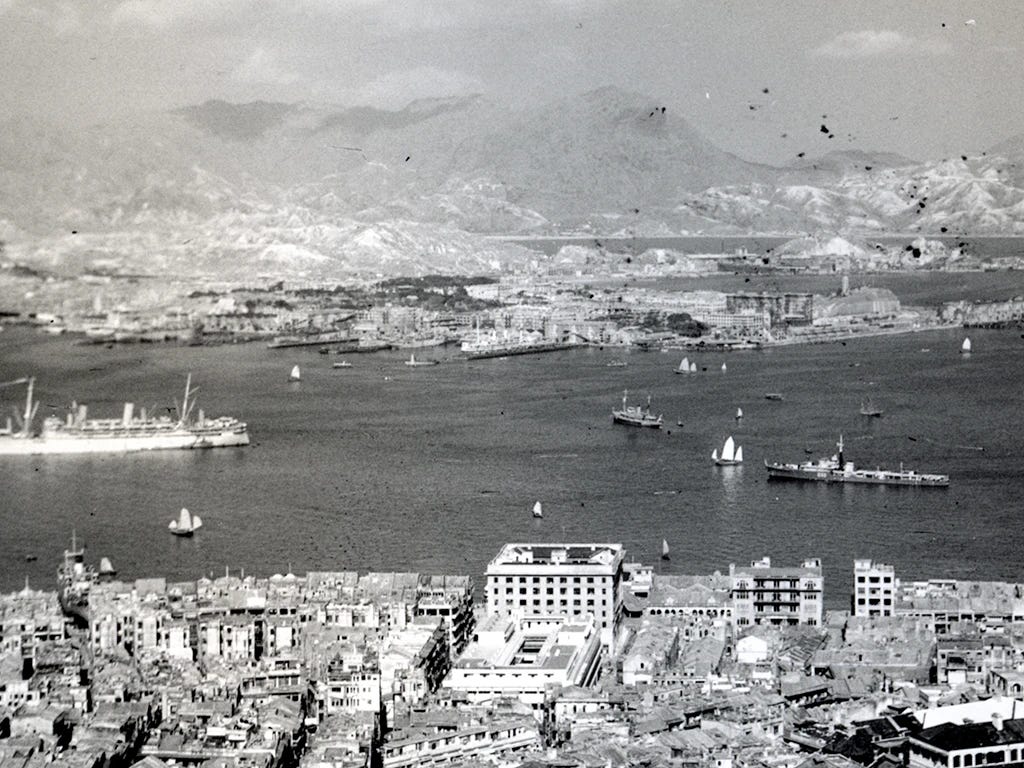
Conditional on collective buy-in with France, the Netherlands, Belgium, the Philippines, and Japan, the British offered to restrict the trade of “high military value” exports from the British Isles, Hong Kong, Malaya, and Singapore. They would also exchange information on the movement of “strategic non-military goods” and accede to a consultative body if China-related trade was “excessive or injurious to common interests.”
This left the United States as the unilateral enforcer of export controls on select non-military goods through a licensing regime that selectively rejected applications based on the risk of transshipment of dual-use capabilities to the Soviet Union. Reinforcing NSC/41, Acheson cautioned against greater restrictions on China due to the limited nature of U.S.-China trade and the ease with which China could find alternate suppliers for imports from Europe. Thereafter, NSC 48/2 would advise unfettered trade with China in “non-strategic commodities.”
These documents served as the frontier for America’s nascent engagement with the People’s Republic of China. Economics would continue to play a role in the strategic separation between the two actors. Reducing the Soviet Union’s influence in Asia and deterring “Communist aggression” was viewed as requiring measures that were overt and covert and applied through methods of economic statecraft, as well as political and military tools.
As George Kennan’s vision for Japan as an anti-communist bulwark in East Asia had only been articulated seven months before NSC/41, concern about Japan’s overreliance on the United States was critical at the time. As the United States sought to weaken Japan’s dependence on “food and critical raw material” imports from China, this occupation gave the United States significant influence over Japan’s trade with China — an influence it would leverage to great effect over Sino-Japanese relations and trade.
Following World War 2, the European colonial footholds in Asia regained their saliency, complicating American efforts for a unified, trans-Atlantic approach to export controls against China.
With this backdrop of an emerging split and allied discontinuity, the Cold War’s economic statecraft began. Throughout the period of Eurasian tension, points of consensus among American allies on export controls were few and fleeting. Allies diverged on the tradeoffs between national security and commercial interests as well as their preferences for how controls were designed and where they were applied.
U.S. leverage rested on allied trust in security guarantees, institutional legitimacy, and Chinese economic vulnerability. That leverage let Washington deter adversaries, convert rivals into partners, and build consensus among allies. Despite grievances and shifts in U.S. China policy throughout the Cold War, the United States maintained allied consensus — an accomplishment contrasted by the current fraying of alliances.
The Korean War and a Maximalist Approach
The Korean War temporarily upended the cautious approach outlined in NSC/41.
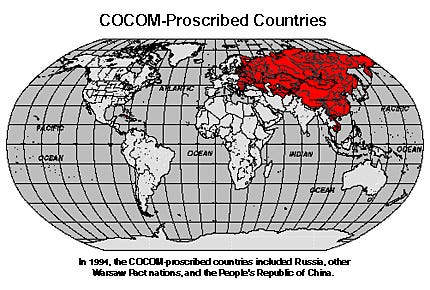
In January 1950, the Coordinating Committee for Multilateral Export Controls (COCOM) came into effect as a plurilateral grouping of American allies to restrict trade with the Communist bloc. By June, China was incorporated into COCOM’s scope; by December, the United States had deployed a complete embargo on transshipments to China.
More on COCOM in this piece:

In November of 1950, Troy Perkins, U.S. Deputy Director of the Office of Chinese Affairs, wrote that controls at the level of the Soviet Union and embargoes on petroleum did not “add up to a program of all-out American economic warfare.”Economic warfare, he argued — without fully endorsing — required a carte blanche embargo on Chinese goods, while unilateral approaches would have a “marginal effect” on the People’s Republic. Like Acheson, Perkins was concerned about “strains” on Europe’s strategic and commercial positions, particularly for Britain in Hong Kong and France in Vietnam (i.e., Indo-China).
Contrary to Perkins’ prescriptions, ‘economic warfare’ would be adopted. In January 1952, COCOM members raised their controls on China to be more restrictive than controls on the Soviet Union, thus dubbed the ‘China differential.’ Through the Mutual Defense Assistance Control Act, U.S. aid assistance would be conditional on following American embargoes on strategic commodities to “nations threatening the security of the United States.” On January 5, 1951, the CCP Central Commission on Finance Economy wrote in a report that the United States and Japan had seized $27 million worth of goods, while France and Belgium had restricted the export of steel and aluminum, and more than $100 million worth of goods from Western Europe were in limbo.
Towards the end of the Truman administration, they attempted to institutionalize this fleeting consensus. In August of 1952, Canada, France, and Britain opposed American efforts to establish a ‘Far East’ organization distinct from COCOM. Instead, in a compromise, a China Committee (CHINCOM) was established under the auspices of COCOM, with Japan ascending as a member of both COCOM and CHINCOM in September.
However, concerns remained that Japan would reduce its own controls to the baseline set by CHINCOM. Under the “intense pressure” of Secretary of Defense Robert Lovett, Ryuji Takeuchi, then Chief of the Japanese Government Overseas Agency in the United States, conceded that Japan would follow American embargoes, as already identified and determined in the future.
Japan had other economic concerns. Unlike other COCOM’s European members, Japan was more dependent on access to Chinese raw materials and less capable of transshipping goods to China through the Eastern bloc. In NSC 125/5, the Council stated that Japan’s historic trade reliance on contemporary adversaries was a “long-run economic problem.” By their estimates, 18 percent of Japanese exports went to China, and 25 percent of its imports originated in China — trade flows which were not easy to replace. As the Korean War and Taiwan Strait tensions limited Japan-Korea and Japan-Taiwan trade, economic growth, and new trade patterns with “free world” South and Southeast Asia countries were determined as a “necessity” to achieve Japanese self-reliance.

Japanese self-reliance also served as justification for U.S. military involvement in Southeast Asia, as the NSC posed that the “loss of Southeast Asia, especially of Malaya and Indonesia” could result in subversive pressures on Japan to accommodate communism and “imperil retention of Japan as a key element in the off-shore island chain.”
As the Korean War subsided, allied support of maximalist trade restrictions on China withered (see a timeline in Table 1 below).
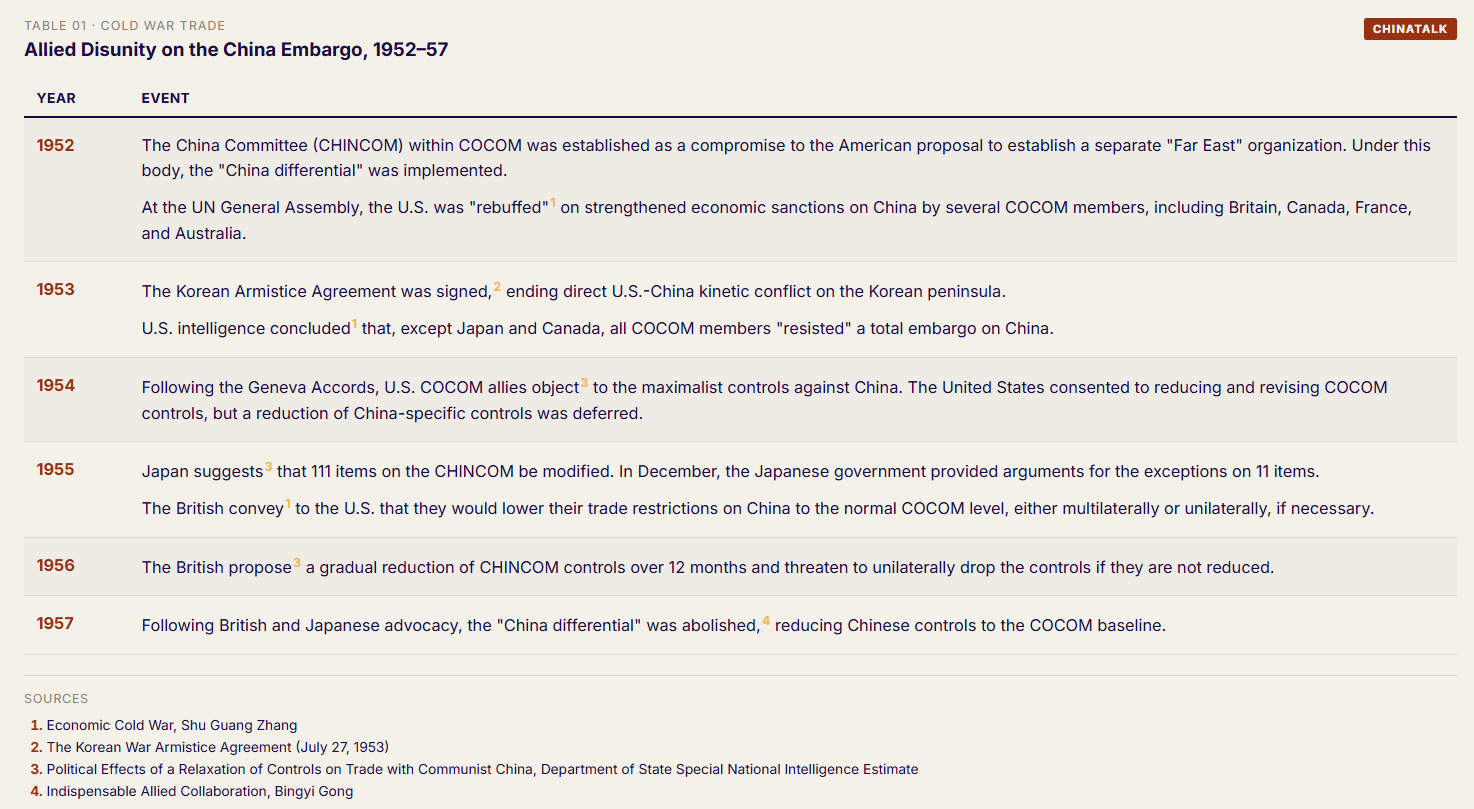
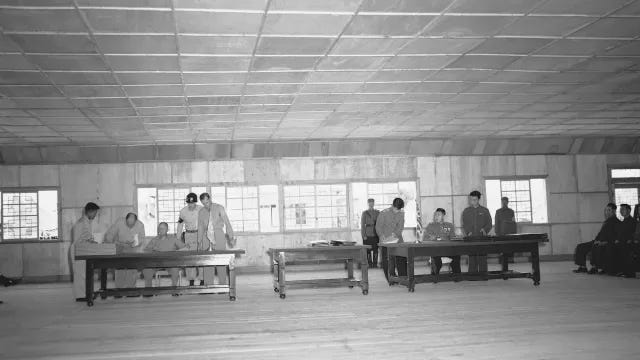
The American foreign policy establishment was disturbed by the undoing of a comprehensive, collectively enforced embargo on China. Following the armistice in Korea, Secretary of State John Foster Dulles wrote to 26 U.S. embassies that the settlement was not indicative of reduced aggression by China in Asia, with particular concern about threat escalation in Southeast Asia. In noting that “major allies … would be increasingly unwilling to support the US in maintaining … economic pressures against Communist China,” he urged that the total embargo on China remain, and allies be persuaded to retain their controls.
U.S. intelligence had chronicled the break between allies. In Special National Intelligence Estimate 100-56, these directional transitions were surmised as “a growing belief among the allies … that there were substantial prospects for a relaxation of tensions.” While Japan and the European allies opposed the ‘China differential’, South Korea, Taiwan, South Vietnam, and the Philippines supported the controls, and the intelligence community cautioned that U.S. prestige would suffer in these countries if the differential was removed.
The Joint Chiefs of Staff, meanwhile, expressed “grave concern” that questions of collective security were being presented as commercial issues. They were perturbed that the relaxation of trade restrictions of China could lead to negotiated settlements on similar relaxations with the Soviet Union and its satellites.
This memo by the Joint Chiefs, dated June 13, 1957, diverged from NSC/41 in two important ways. First, on the question of Japan, the memorandum signaled that Japanese self-reliance was a peripheral concern and that an increase in China-Japan trade would incur Communist influence upon the archipelago. Second, it describes the ‘China differential’ as serving “to retard [China’s] industrial growth and the ability to translate this growth into military action.” This explicit endorsement of diminishing China’s industrial growth marked a clear departure from the pre-Korea War logic.
As allies questioned the efficacy of economic strangulation, the Sino-Soviet alignment was developing fractures of its own. As Shu Guang Zhang elucidates in his book Economic Cold War, China had limited alternatives to heavy reliance on the Soviet Union — a dependency which the Soviets underdelivered and subverted.
In China’s first Five-Year Plan, Stalin was concerned about the burden China’s construction would have on the Soviet Union, urging China to lower its growth projections from 20 to 15 percent. The Soviet Union also leveraged these investments in China, with the expectation that China would purchase Soviet goods in U.S. dollars and fulfil Moscow’s export quotas for rubber and critical minerals. Alongside these Soviet demands, Moscow had delayed military equipment orders and vetoed assistance with several industrial projects, including an aluminum factory in Guizhou and a steel plant in Wuhan.
Soviet underperformance as an economic partner weighed heavily on Chinese decision-making. According to a 1966 CIA report, China’s “lean-to-one-side” strategy initially led to economic relations with Communist states, an approach reinforced by the ‘China differential.’ Soviet support remained significant, totaling 166 industrial enterprises from 1953-57 and ten loan payments of 1.274 billion rubles. Noting the importance of Soviet support, Zhou Enlai commented during a state council meeting on October 11, 1956: “Although [we] will continue trying to obtain Soviet aid, we just get rid of the illusion of relying [on them].”
This changed in 1960. With the ‘China differential’ abolished three years prior, greater access to Western markets coexisted with a strained relationship with the Soviet Union. On July 16, 1960, the Soviet Union withdrew all advisors and technicians working in China. In an “emergency meeting” with Soviet ambassador Stepan Chervonenko, Chinese Vice Premier and Foreign Minister Chen Yi described the act as “hurting the friendship between the two countries.”
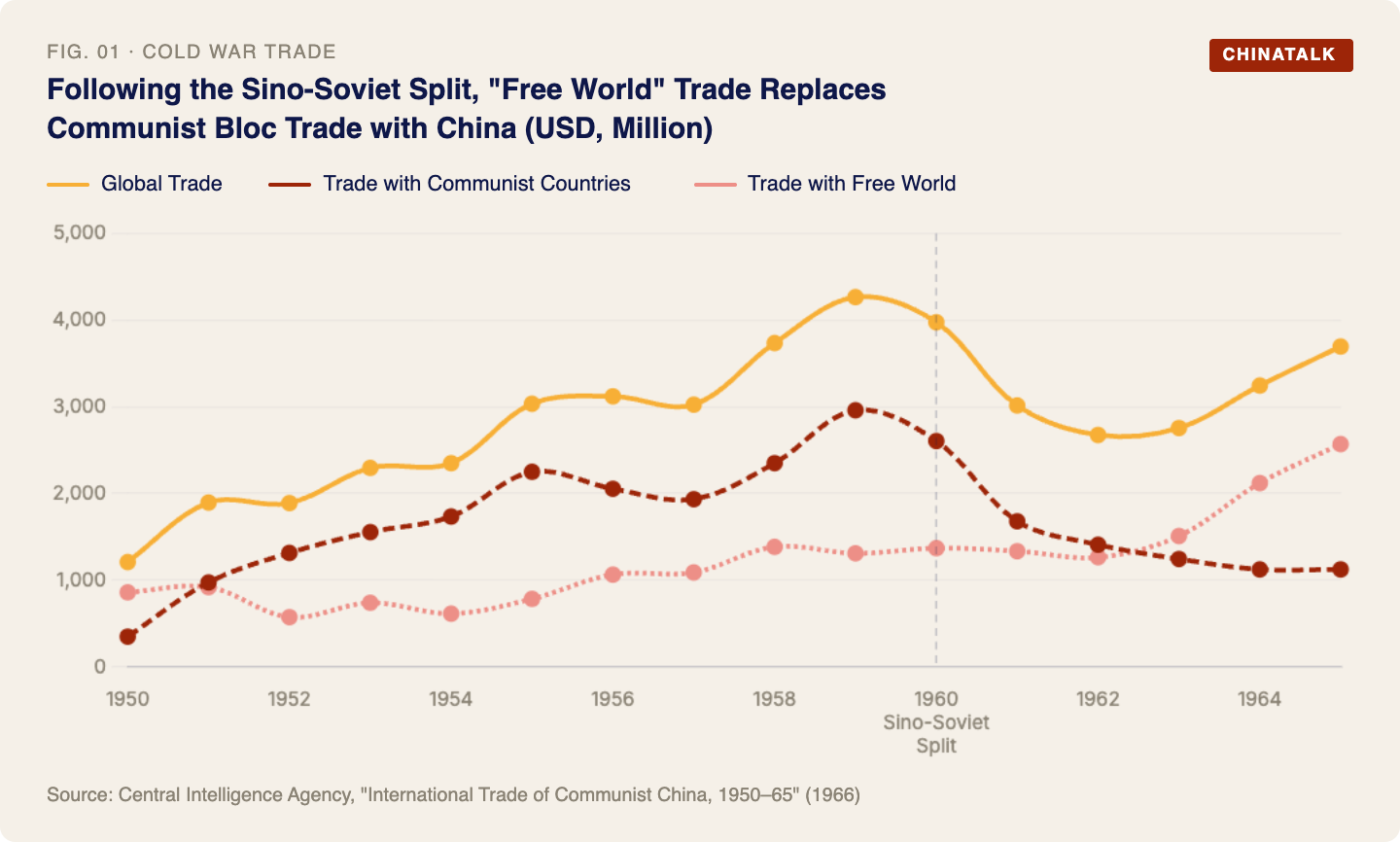
The CIA identified this incident — along with a need for grain imports and the rundown of the Great Leap Forward — as sharply altering the composition of China’s global trade flows. Transshipments aside, China’s trade with the “Free World” (as categorized by the CIA) had dropped from 1950 to 1954, dropping from 71 to 26 percent of China’s total trade. The weakening relationship with the Soviet Union meant that China’s global trade volume declined precipitously, down to $2.7 billion in 1962 from its $4.3 billion peak in 1959. Since 1960, however, China’s trade had begun to recover, with trade with the “Free World” offsetting a downturn in trade with “Communist Countries.”
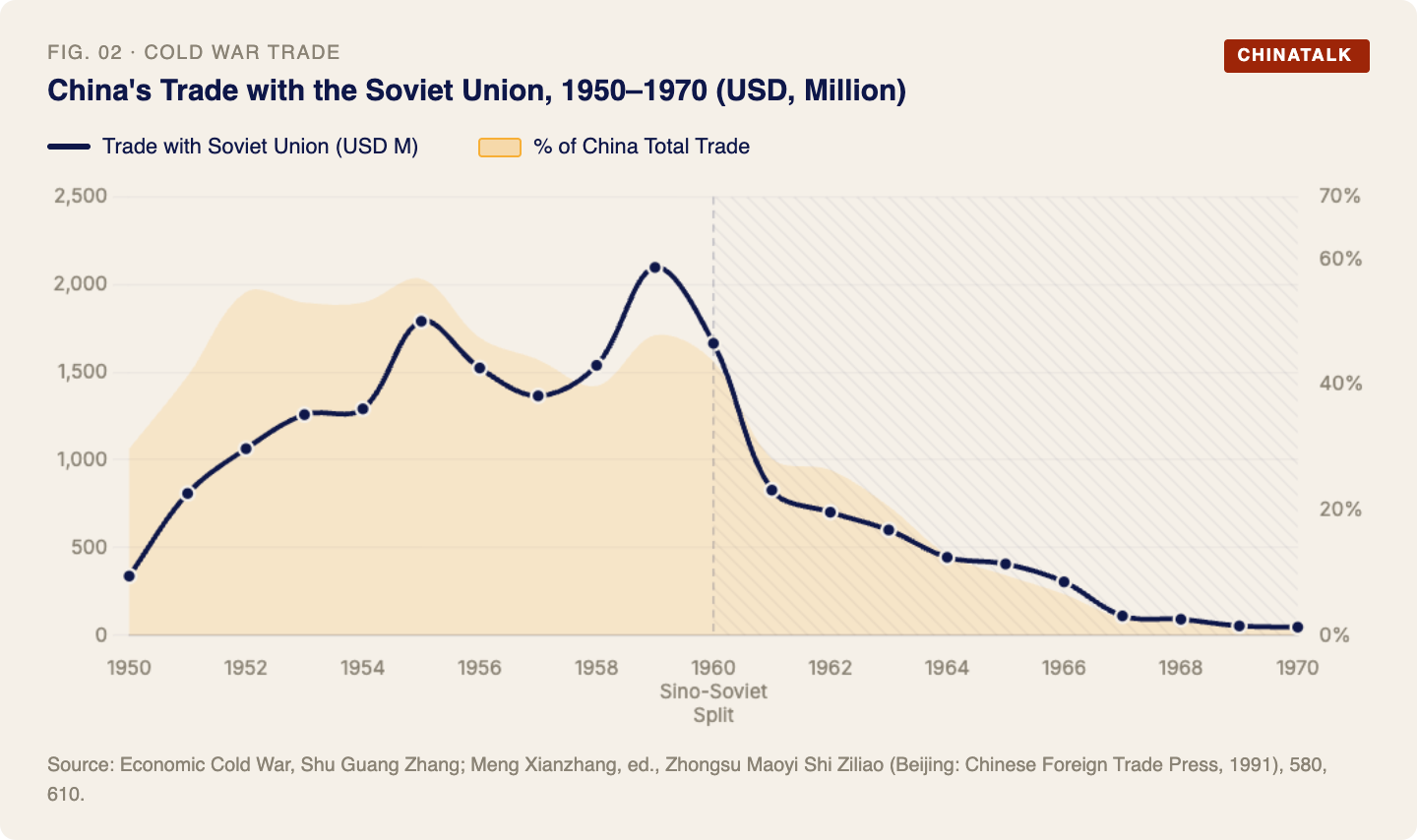
Reductions in Sino-Soviet trade never recovered. Chinese estimates documented by Zhang show that the Soviet share of China’s total trade dropped from 54.8 percent in 1952 — the height of the ‘China differential’ and U.S.-led embargo — to 1.03 percent in 1970.
While the United States would retain its embargo until 1971, by the mid-to-late 1960s, American economic partners had significantly increased their trade with China. From 1950 to 1970, British trade with China grew from $73.5 million to $1.1 billion. By 1965, countries across Europe and the Pacific Rim had universally increased their trade with China at an exponential rate.
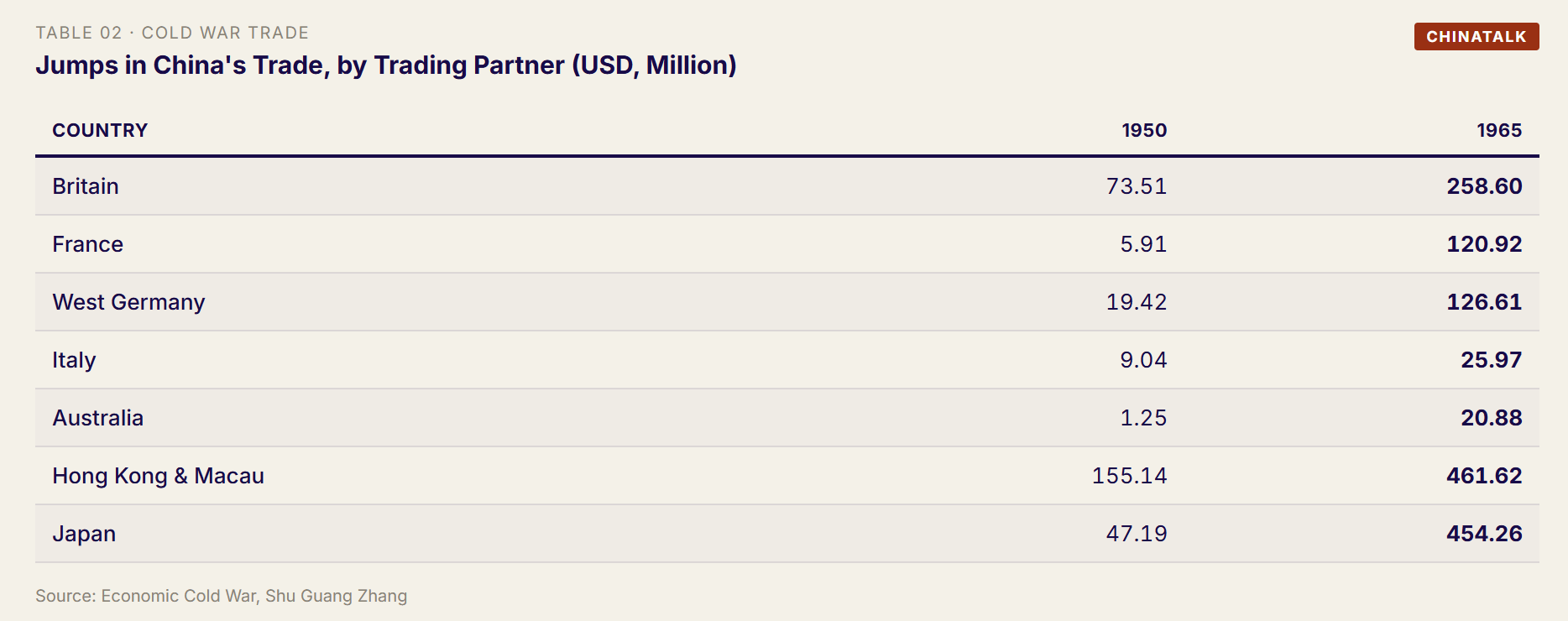
Japan, however, was more complicated. Trade leapt from $4.4 million in 1952 to $454.3 million by 1965, but this was not a continuous upward climb. Japanese Prime Minister Nobusuke Kishi — overseer of the occupation of Manchuria — entered a diplomatic row with Beijing after visiting Taiwan in June 1957. Tensions escalated after a Chinese flag was trampled in an exhibition in Nagasaki, with trade relations suspended before recovering to previous levels in 1963.
Despite being at the height of American power, the United States’ ability to maintain a multilateral embargo waned. Allies tolerated maximalist controls when the threat felt immediate, but when it receded, commercial interests reasserted themselves. To current economic security vulnerabilities, the United States has responded with crisis-driven coalitions on critical minerals and AI supply chains — efforts that will be tested on their ability to align commercial incentives and sustain shared costs between allies.
Oscillating Approaches
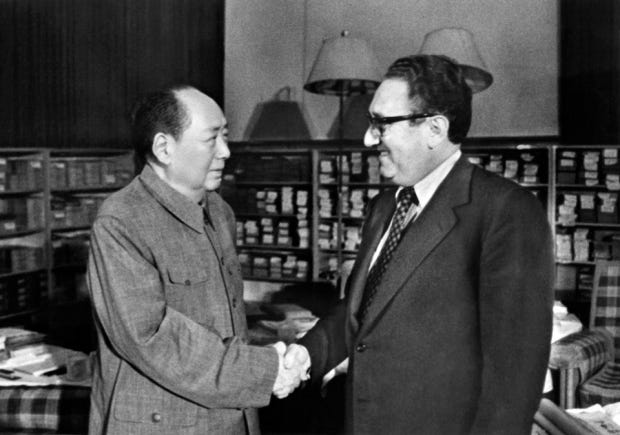
Alongside the U.S.-China detente, the Nixon administration removed the embargo and began to draw down its export controls. As Kissinger wrote to Nixon, the removal of restrictions furthered the administration’s policy of “broadening communications between the U.S. and the People’s Republic of China by removing obstacles to personal and commercial contacts.”
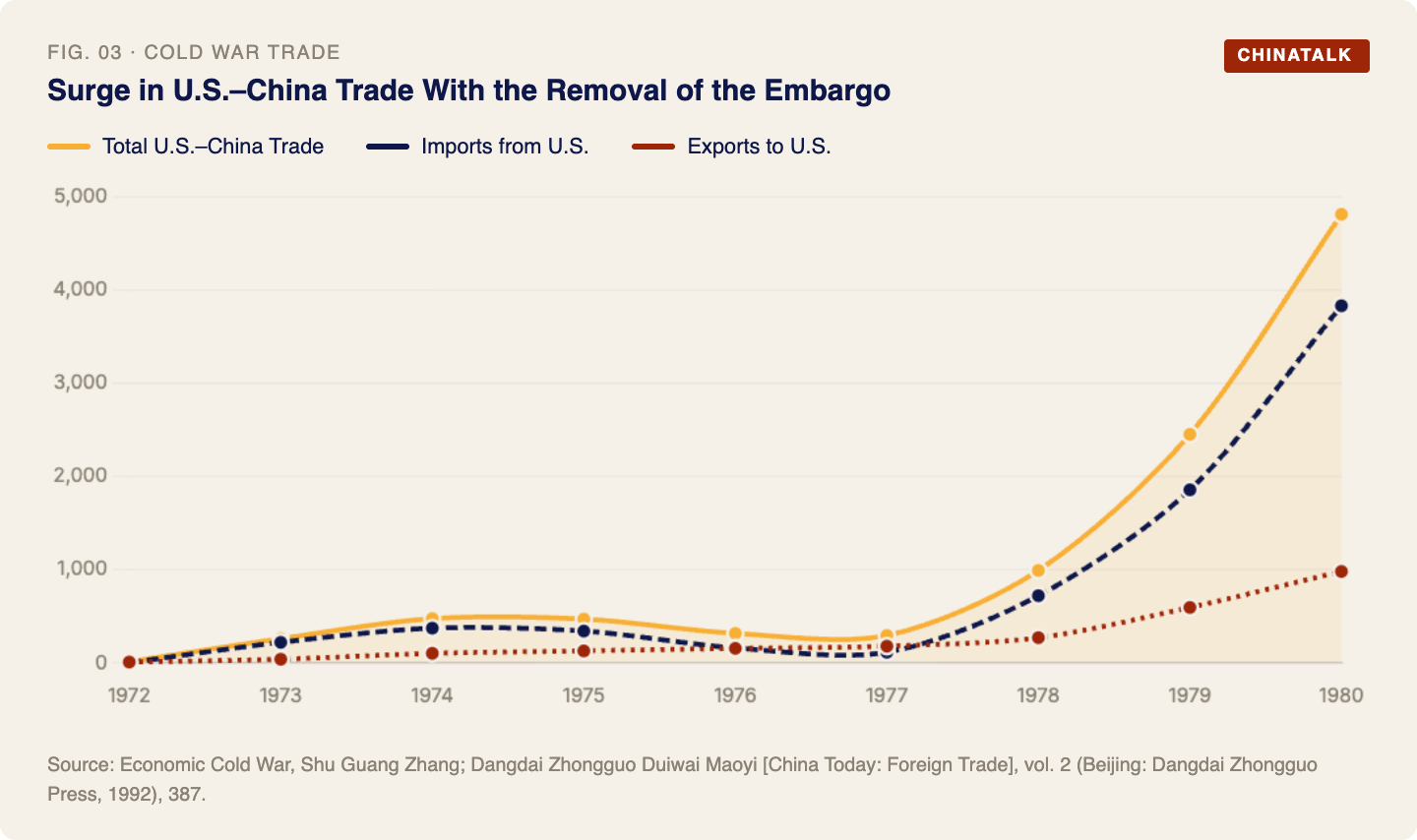
The removal of the U.S. embargo transformed the Chinese economy. From 1972 to 1980, U.S.-China trade increased 37 thousand percent, rising from $12.9 million to $4.8 billion. In the decade following the embargo removal (1972 to 1982), China’s trade increased from six to twenty percent of its GDP.
By opening trade as an incentive for dialogue, Nixon paved the way for a new Eurasian geopolitic: a theater turned on its head by China’s split from the Soviet Union, putting dual pressure on Hanoi and Moscow as the Nixon administration sought an end to the Vietnam War. When Nixon began drawing down controls, China’s trade restrictions transitioned from differential to even-handed to preferential. As the control regimes on China began to diminish relative to the Soviet Union, polities like West Germany feared that this new China policy would erode the position that “all Communist countries must be treated equally.”
The U.S. treatment of China and the Soviet Union would adjust once again with the U.S.-Soviet detente. The detente served as a justification to minimize U.S.-China military cooperation during this period, which would resume in full force following the Soviet Union’s invasion of Afghanistan in 1979.
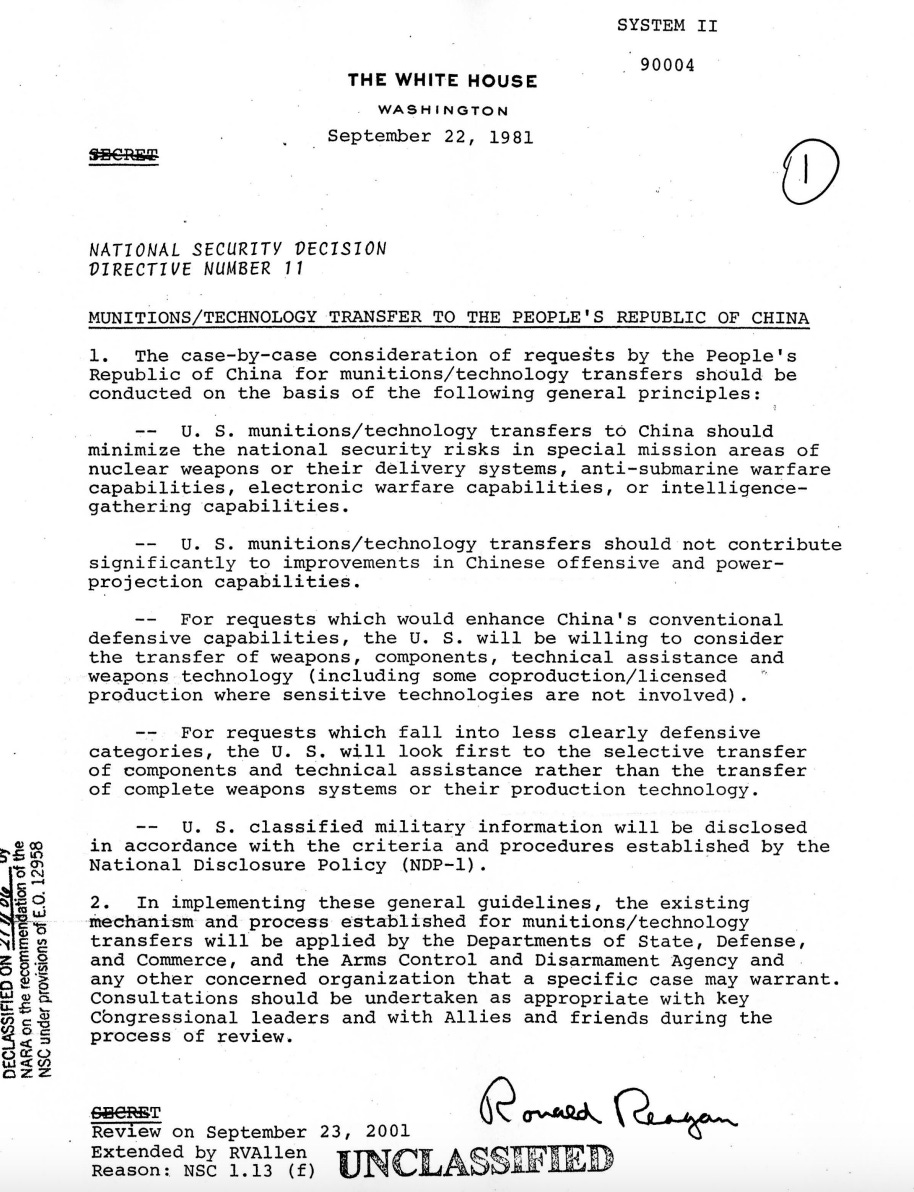
From the Soviet foray into Central Asia to Tiananmen, the United States removed prohibitions on arms sales and allowed the transfer of technology “twice as high” as levels exported to the Soviet Union. By 1983, China had moved to “Country Group V,” a category with relaxed trade limitations, of which members included U.S. treaty allies like Japan, Australia, and Western Europe.
As Hugo Meijer writes, despite these unilateral reforms, China remained on COCOM due to concerns that plurilateral liberalization would encourage U.S. allies to attempt to weaken controls on the Soviet Union. However, as U.S.-China trade, technology transfer, and military cooperation enhanced, American unilateral efforts gave way to plurilateral liberalization. To illustrate the scale, 95 percent of U.S. license applications to COCOM in 1985 were related to China.
These efforts meaningfully translated to military-to-military cooperation. In 1984, there were six U.S. government arms deliveries to China. By 1989, that number rose to 89,800. Prior to Tiananmen, there was a similar increase in advanced technology exports and export license approvals. But, eventually, the music stopped, with arm deliveries zeroing out in 1990.
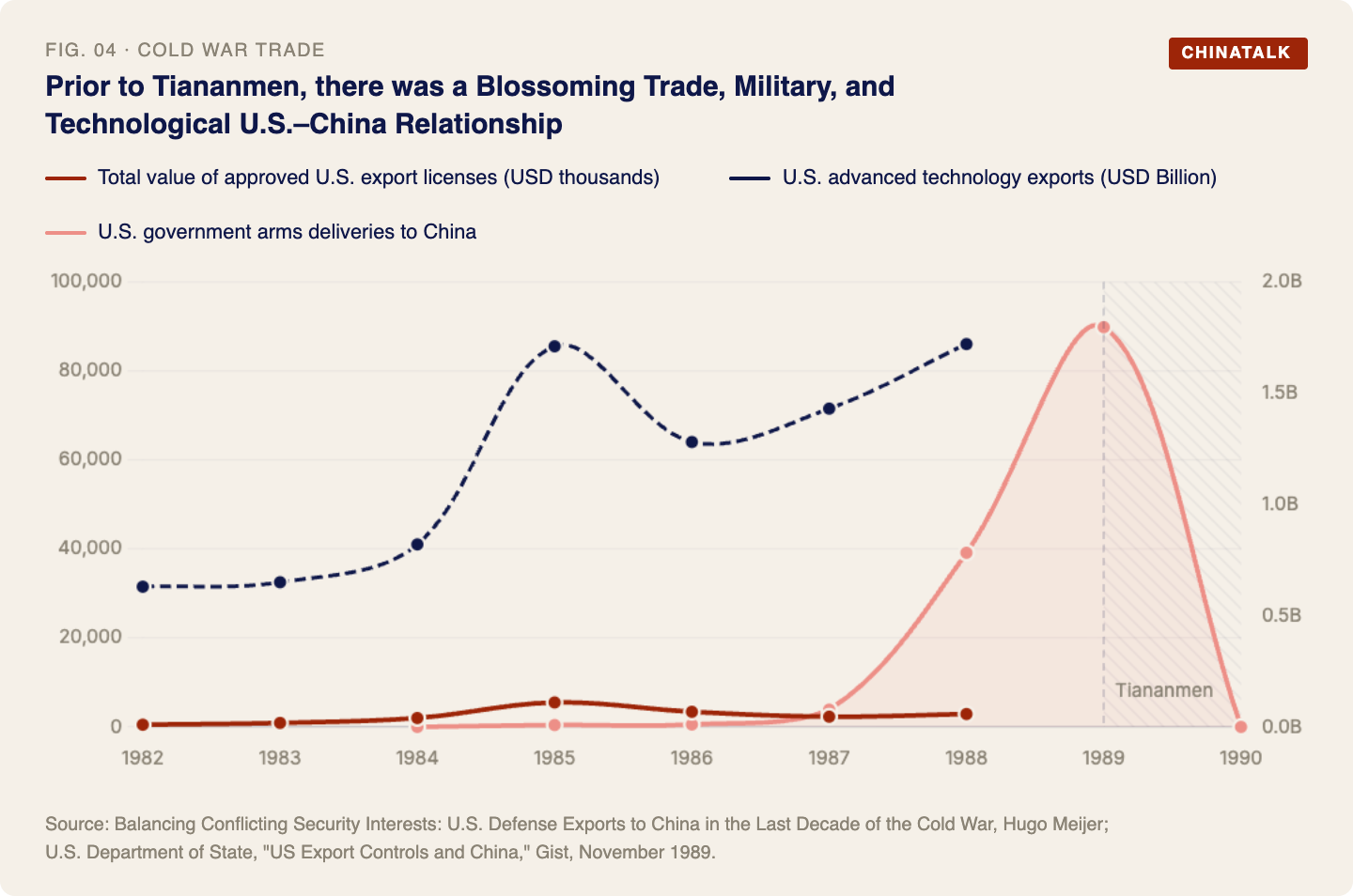
Following Tiananmen, the HW Bush administration ceased arms transfers to China. The United States suspended its military exchanges and export licenses for dual-use items such as satellites, and withdrew support for China’s access to development bank loans and crime-control equipment. Multilaterally, the relaxation of controls within COCOM was postponed. However, corresponding with the fall of the Berlin Wall, Bush proposed reductions to the COCOM control lists, eliminating 30 industrial items, and reducing the core list of dual-use items. The result was a paradox of iced military-to-military exchanges but wide availability of defense-related products.
In spite of these bilateral disputes, commercial trade maintained its exponential growth. In 1990, the year-on-year increase in the value of U.S.-China trade increased 74 percent — a trend which would continue for the decades to follow. Arguing in favor of maintaining commercial relations with China, U.S. Ambassador James Lilley wrote in an embassy cable: “Not only do we help the good guys, and there are a lot of them in China, but we also help ourselves financially.”
Throughout the Clinton administration, these commercial linkages grew, and trade barriers fell — developments that paved the way for China’s accession to the World Trade Organization, acquisition of Most-Favored-Nation status, and the broader growth foundations of the contemporary global economy.
Beginning in 1991, COCOM progressively reduced its control lists, eliminated licensing requirements for “low-level items”, civilian-use computers, and “certain cryptographic items”, and eased “restrictions on advanced telecommunications and fiber optics.” In a catalogue of U.S. sanctions on China, the Congressional Review Service highlighted a “controversial” $2 billion shipment of gas turbine engines in 1994, which only required a “general export license.” That same year, COCOM member states agreed to phase out the organization.
The Wassenaar Arrangement was intentionally designed to be a looser coalition of states with fewer obligations. Wassenaar did not — and does not — require states to submit export control licenses for review, instead opting for national discretion and biannual reporting of sensitive shipments. China is neither a member nor a target for Wassenaar, while Russia’s membership in the forum has restricted the possibility of expanding Wassenaar’s control list.
In hindsight, it is easy to view the period of the ‘China preferential’ as a series of decisions that were tactically sound but strategically flawed. From Nixon to Clinton, administrations had clear justifications for relaxing controls, rewarding behaviors that aligned China with the United States politically and militarily. But U.S. administrations in this period had starkly divergent views on the U.S.-China relationship, and turmoil from Tiananmen animated disputes. The United States would swing from an all-out embargo until 1972 to selling weapons to the Chinese military by the 1980s — a resounding reinterpretation of China as a destabilizing force in East Asia to a key pillar of Eurasian containment.
At the same time, the fall of the Soviet Union gave way to an eroded institutional architecture, now selectively being rebuilt primarily on a bilateral basis and with the looming threat of American sanctions. These dynamics bring into question how future oscillations may materialize and the feasibility of reconstructing binding and consensus-driven allied trade bodies.
American Power and Coalitional Capacity
American economic statecraft toward China can be defined through repeated reversals. These sequenced oscillations between coercive containment and strategic accommodation were catalyzed by differences in administrations, shifting international environments, and evolutions in China’s domestic political regime. During the Cold War, these shifts were partly sustainable because allies heavily depended on U.S. security, and China remained economically vulnerable due to its domestic foundations and its ties to the Soviet Union. In the contemporary era, weakened allied dependence, diminished trust in U.S. consistency, and China’s greater self-resilience make similar strategies harder to coordinate and less likely to succeed.
One of the most stark contrasts between the Cold War and our current moment is China’s capacity for and political commitment to self-resiliency. In sequence, China alternated between trade, investment, and technological dependence on the Soviet Union, the United States, and the broader Western bloc. Made in China 2025 was meant to meet the perceived challenge of these dependencies, with the State Council acknowledging in 2015 that “The capacity for independent innovation is weak, and key and core technologies and high-end equipment are highly dependent on foreign countries.”
In the decade that followed, China pursued what was referred to as an “independent opening up,” engaging with the world on its own terms to strengthen its industrial foundations and resiliency. By 2025, the 15th Five-Year Plan transitioned towards “independent controllability” of global supply chains, weaving development and security concerns to safeguard the new pattern of development — a pattern of dual circulation. In a State Council Meeting on May 15, 2025, Premier Li Qiang described the dual circulation approach as follows: “Efforts should be made to leverage the inherent stability and long-term growth potential of domestic circulation to offset the uncertainties in the international market.”
China’s policy of dual circulation, therefore, represents more than sustaining economic growth. It positions China to strengthen internal capabilities, exert influence on other national actors, and insulate itself from global volatility and American belligerence.
Throughout the Cold War, one point of continuity was Britain’s moderated approach to China due to its commercial interests in Hong Kong. While British leadership made compromises with the United States regarding embargoes during the Korean War, it consistently looked to maintain its trade relationship with China and investment position in Hong Kong.
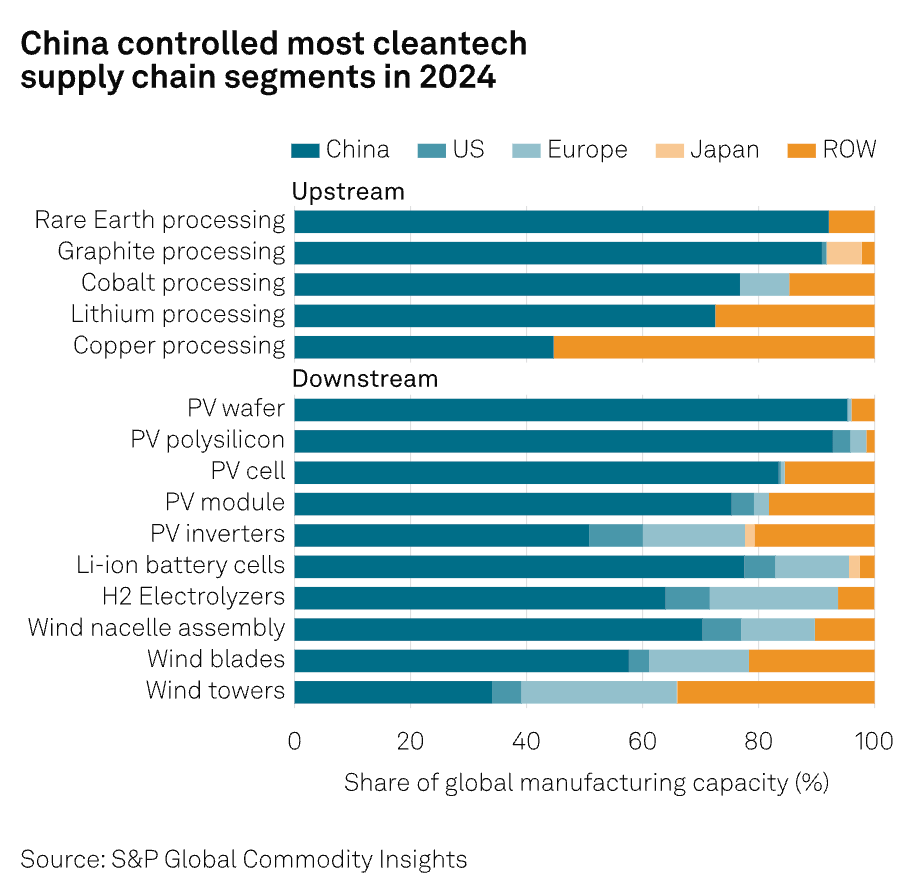
While British interest in Hong Kong was not exclusively economic in nature, all countries today have a similar — and scaled — vested interest in economic interaction with China. The same capabilities that have allowed China to pursue self-resiliency have bound other nations to Chinese technology, supply chains, and capital. While China’s strength itself can serve as an impetus for collective action on the part of the United States and some of its allies, this reality may be the cause for inaction in equal measure. Every country has its Hong Kong — their reason for resisting economic decoupling. If concerns over economic consequences were apparent in 1949, they are paramount in 2026.
In 1949, Dean Acheson warned that American unilateral actions against China would “demonstrate the impotence and disunity rather than the power and solidarity of Western governments.” The days of Dean Acheson at the helm are long gone. In the current moment, the United States is less capable of convincing allies to act alongside it and exerts less influence on Chinese decision-making.
This challenge of collective action is furthered by the degraded credibility of the United States, which has, in turn, separated itself from its historic position as a global actor. During the Cold War, American strategy in general benefited from institutional legitimacy with COCOM and allied confidence, even as U.S. export control policies were fluid in light of a dynamic Sino-American relationship. And access to the U.S. market, both for allies and for China, provided a crucial incentive for alignment on non-economic domains of technology controls, military cooperation, and diplomatic posturing.
Recent American administrations have grappled with how to define and implement a China strategy. Under the Biden administration, Sullivan described the bilateral relationship as “managed competition,” where a floor would inform the nature of competition in critical domains. In the 2017 National Security Strategy, the Trump 1.0 administration characterized China as a “challenge [to] American power, influence, and interests, attempting to erode American security and prosperity.” In the second Trump administration, the 2025 National Security merely refers to China as an economic variable — a country with an imbalance of trade, whose economic prosperity, as opposed to ideological threat, is the justification for forward deterrence.
Japanese interests were a key factor in American involvement in Korea, Southeast Asia, and economic engagement with China. This whole-of-region approach — where allies are a system of integrated parts — is wholly missing in contemporary policymaking. While the Truman and Eisenhower administrations calibrated Japan into their China and Southeast Asian strategies, contemporary American actions have imposed costs without consultation. With the war in Iran, the United States has unleashed an energy crisis upon the Asia-Pacific, without consulting with allies or concern for how their economies would be affected by a closed Strait of Hormuz. As a result, across economic and security vectors, the United States’s actions have vastly diminished the logic of cooperation, with commitments less reputable and offerings less desirable.
When Ryuji Takeuchi conceded to U.S. demands that Japan would follow the American embargo on China, this coercive act was successful because of structural dependencies. Across allied actors, these same dependencies no longer exist to the same degree. Coercive leverage diminishes over time, as threat credibility weakens and interlocutors can recalibrate and prepare for future acts of coercion.
The United States has exhausted its coercive leverage — against allies, not adversaries. Against Denmark and Europe writ large over Greenland. Threatening economic sanctions against Spain due to its denial of access to military bases for the war in Iran. Continued contestation over Canada’s territorial integrity. These actions have not only diminished allied goodwill towards the United States but also wasted its leverage on strategically peripheral issues — issues that the Trump administration had no intention of following through on. Chinese growth and American disrepute, taken together, have made the costs of compliance high and the reward unclear.
The United States’ precedent of embargoing China casts a wide shadow on contemporary U.S.-China relations. China’s actions reflect an assumption that if China loses a ‘competition,’ the United States would be in a position to leverage its tools to pressure the country economically, just as had been done during the Korean War. China would not maintain its status as an adjunct of Soviet power, nor would it accede to being an adjunct of American power.
These diverging threat perceptions compound the pathway to a bilateral settlement. While the United States might intermittently pause its deployment of economic tools, there is no institutional incentive to reduce its underlying capacity. Tactical pauses in tool deployment do little to alleviate this structural uncertainty. For China, this sustains a threat perception and deepens unpredictability about when and why the United States might mobilize its economic toolkit — ultimately reinforcing Beijing’s drive for indigenization.
The Cold War logic yielded outsized returns due to asymmetric dependencies, confidence among coalitional partners, and China’s economic vulnerabilities — conditions dislodged from the present status of Chinese resilience and America’s trust deficit.
What this history suggests for future policymaking is the need for more modest objectives and lower expectations for coalition cohesion. On a strategic level, it is incumbent on the United States to devise a durable strategic objective. NSC 41 is illustrative, as the goal of preventing China from becoming an adjunct of Soviet power brought coherence to decades of oscillating policy decisions. However Washington intends to pursue its foreign policy with China and third countries, its position will be diminished without such clarity.


This is a realist strategic memorandum written for the American policy community—and an excellent one.
I find its central argument very insightful and persuasive. The course most consistent with American interests would be to abandon an excessively costly attempt at comprehensive containment and shift toward a narrower strategy with clearer objectives, tighter technological boundaries, and measures that allies are more willing to support.
China today possesses the world’s largest manufacturing system, world-class infrastructure, a deep pool of engineering talent, an enormous domestic market, and rapidly strengthening scientific and technological capabilities. The United States cannot isolate China as it did in the 1950s.
China’s strategic response has also been remarkably sophisticated: use technological self-reliance to compress whatever time advantage American controls can create; maintain economic openness to weaken Washington’s ability to assemble a durable containment coalition; and practise restrained economic diplomacy so that commercial partners are not unnecessarily turned into security adversaries.
The June Anthropic shutdown is this thesis in miniature. One secret letter switched off a frontier model worldwide, and within days the EU was talking technological independence and Canada's PM was warning against reliance on American providers. Every unilateral flip of the off switch makes the next coalition harder to build.