
Want to do big things? Today we’re providing a guide of sorts. Joining me is Remco Zwetsloot of the Horizon Institute for Public Service and Kumar Garg of Renaissance Philanthropy.
We discuss:
Why achieving goals in policy is more possible than most people think and that the real bottleneck is ambitious, mission-driven talent,
How successful policymakers think differently — how they focus on outcomes over “portfolios,” learn the system deeply, and work backwards from impact,
Why policymaking rewards immersion, sensemaking, and coalition-building more than raw technical or academic brilliance,
The importance of peers, persistence, and “water on stone” stamina in sustaining long-term policy and public service careers,
How writing, public ideas, and the “posting-to-policy” pipeline are democratizing access to influence in Washington.
Horizon recently launched Launchpad, a Substack on working in emerging tech policy with advice, explainers, and conversations like this one. If you enjoyed this conversation, you’ll probably like their other stuff as well.

Optimizing for Impact
Jordan Schneider: Kumar, what is RenPhil, and Remco, what is Horizon?
Kumar Garg: We help donors bet big on science and technology.
Remco Zwetsloot: And Horizon builds pipelines into public service for people working on emerging tech.
Jordan Schneider: Kumar, what do you want to tell the kids?
Kumar Garg: There’s a Tyler Cowen line about raising people’s ambitions that I love. The practical thing when I’m giving career advice is that people are very narrow in what they think career paths look like. They say, “Hey, I was looking around and I saw these jobs being listed. Which one should I apply for?” And I tell them, “I have never applied for a job that I have actually worked at.” I’m this far along, and I have invented some version of every job I’ve had. I got a fellowship by going to the government and saying, “If you gave me this fellowship, I could sit here. Do you want to hire me?” I’ve taken something where I was working for somebody and converted it into a job. I’ve started organizations. There are many ways to work out in the world.
The second part is what you actually want to work on. People worry about the burden of knowledge — how do you get to the frontier? That has not been my experience. You can get obsessed with a very technical topic, and pretty soon after talking to all the people and trying to figure out why that topic is stuck or what’s not getting worked on, you can be on the edge where the experts on that topic are saying, “That person’s really onto something. We should be doing more of that.” Your ability to go from not knowing something to the edge is actually quite high.
The real magic is whether you actually want to devote part of your career to working on that and trying to make progress. That takes time — learning how to get something into the National Defense Authorization Act, or how to get good at raising money around your ideas. These things take time. But doing big things is a lot more possible than people realize.
Jordan Schneider: How much latent capacity for big-thing-doing is out there, both from a “the world needs things” perspective and from a “there’s talent that just hasn’t had their horizons raised” perspective?
Kumar Garg: We’re always talent-blocked. We’re bottlenecked on talent on basically everything. The reason isn’t that we have an infinite set of problems. One of the conversations I have with donors goes like this — somebody might say, “Let’s do a white space analysis. Where’s the white space?” By that they mean there’s some space where everybody’s working, and another place where no one is working. The sad joke is it’s all white space. You get into these problems, and as you dig in, you very quickly figure out there’s a bunch of stuff that’s quite important and not getting worked on.
A recent example — in the past five years, there’s been a huge increase in the number of people who realize lead pollution is a really big deal. Maybe a quarter to a third of the global learning gap between rich countries and poor countries can be explained by lead pollution. When I started talking about this five or seven years ago, I’d get a nodding head — “Yeah, pollution’s a problem.” Then I’d ask, “How much money is being spent on this really big problem?” Eventually people looked into it. Globally, $10 million was being spent on lead remediation. How many people work on lead remediation globally full-time? Maybe 100. We’re talking about something that might have a trillion-dollar-plus lifetime impact. We underestimate how many really important things don’t have enough talented people working on them.
When the Lead Elimination Project came to Parth and I with their idea, I could tell they were onto something. They said, “We flew to a country, bought lead paint on the market, applied paint to paper and let it dry, took a sample, tested it for lead, and took it to the regulatory authorities saying, ‘Did you know paint is being sold with lead in it?’” The authorities were shocked. The paint suppliers were shocked. In multiple countries, that alone caused them to change the law. They were getting off plane flights, buying paint, and changing whether lead was being sold in the public market. This happened in 2023.
A week ago, I’m trying to buy fishing supplies for my son. I go to the tackle shop. I cannot find any weights that aren’t lead weights. I’m thinking, “I’ll have to order these on Amazon.” Even today, you cannot find non-leaded fishing weights in most places in the United States. The shop owners say, “They’re heavier and more useful.” Do I really want my kid using lead weights on fish he’s going to catch? We have blind spots everywhere. There’s lots of interesting stuff to be done. You just have to be a nerd about it and figure it out.
Remco Zwetsloot: There’s a funny story related to this. For the Policy Entrepreneurship Network conference — a community Kumar organizes along with Parth — there was swag, including a bag. The bag had lead in it. The label said there could be small residual amounts of lead in this bag.
Kumar Garg: Embarrassing.
Jordan Schneider: How else do people get stuck or blocked? Let’s get another story out of you.
Kumar Garg: Another way people get stuck is through who their peers are. I had a college friend call me up. I was working in policy, working in the White House. He said, “That’s all very impressive, but how much do you get paid?” He worked in finance. I said, “I’m on a fellowship salary. I’m clearing $40K, but I’m getting to do all this incredible work as a fellow in the government.” He said, “But why? If the work is important, why don’t they pay you? I don’t understand.” It did not compute to him. Eventually, I moved off the fellowship to a government salary, but it’s still not comparable. He was surrounded by a peer group where that’s how you kept score.
One of the important things if you’re going to do interesting, ambitious things is having people around you who value the striving, even when you haven’t gotten the win yet. We used to call this “water on stone.” What’s a thing you’ve been working on for many years where it looks like you’re not making progress? I still get emails from people saying, “I accomplished my water-on-stone. Finally, the crazy person in my way died or left government, and we’re going to get the win.” They email me because they know I appreciate how sometimes these things take time.


Whatever you want to do, if you’re not surrounding yourself with at least some other people who value that work, it’s very hard. Part of the reason for the Policy Entrepreneurship Network is that we celebrate nerds who say, “I’ve been obsessively working on how to make the organ donation system work. Here are the 17 different ways we’re trying to reform OPOs, and here are the 14 ways the lobbyists killed us. Then we made a comeback and found the right person in the government to get this rule changed.” All the back and forth, the Erin Brockovich of it all. That person is also saying, “I can’t get anyone to fund this work. It’s crazy.” But the ROI on their effort is so high.
The work requires stamina and engagement. Surround yourself with people who can feel the win and feel the work alongside you. People sometimes make the mistake of not finding peers to do it with.
Jordan Schneider: Remco, why don’t you introduce the Horizon Fellowship? I’m curious what have been the indicators of success, impact, and failure from a selection, personality, or mindset perspective, and how that’s changed how you think about filling your slots.
Remco Zwetsloot: The Horizon Institute for Public Service exists to build government capacity in emerging tech. We focus on AI first and foremost, and also on biotech and other areas. We run several programs to build that capacity, all meant to create communities of people who understand the technology deeply and want to work in careers of public service thinking about policy problems.
The fellowship is our first and biggest program. It places people in government for up to two years, or in think tanks, in placements focused on emerging tech issues. Similar to the way Kumar mentioned getting into government, these fellowships are a pretty common model. We were the first to focus on AI and emerging tech specifically.
It’s interdisciplinary. We have machine learning PhDs and deep technical experts, but these are interdisciplinary problems, so we also have lawyers and others who bring relevant expertise. We really try to select for public service motivation and ambition. AI and other fields will have widespread impacts, and we need people in government who understand the technology, are thinking deeply about where it might go, and try to do something good for the public and work effectively for the offices in which they serve.
What’s really required is a combination of ambition and humility — a thing many people in the Policy Entrepreneurship Network have. We need to do big things, and there are many big wins to pursue. At the same time, you’re working with people who think differently from you, working on behalf of elected representatives who set the direction. That’s what we should aim for in a democratic society. Your role as a staffer or fellow isn’t necessarily to make the world the way you want it to be, even if you pick an office whose mission you care about. Selecting for that combination of ambition and humility is something we’ve iterated on over the years.
Kumar Garg: One thing I felt working in government — I worked in a science office, and there was no good correlation between how good of a scientist you were and how good you were at policymaking. You can get pretty far being dictatorial in science — “I run this lab, I’ve got this system.” But being successful in government is sensemaking. Why is this person not going to go along with this idea? What are their incentives? What’s their blocker? Why do they want to show up? You have to develop that extra sense of perception over time. How do you bring people along?
What’s smart about the fellowship model is that some of this is just easier through immersion. Two months after somebody has started a fellowship, they sound totally different about the questions they’re asking me than in the summer before they went in. Once you’re in there, you realize nobody knows anything, but you have to create this document in two hours. Then the document comes out of somebody very important’s mouth as what they think. That two hours of work really matters. You start to realize how compressed people’s time and attention are. You realize how much you have to figure out why people may or may not be into an idea. You have to understand how things actually get to the finish line.
If you’re a researcher and you spend a year in policymaking roles, you’ll become a totally different researcher when you go back to academia. Immersion is very powerful. You understand much more intuitively the incentives of these systems.
Jordan Schneider: How does that track onto the humility-versus-ambition axis?
Kumar Garg: It gets at what Remco was saying. You have to be obsessed with winning — with thinking, “This is really important and I really want it to happen.” A lot of times, people in government fall into this idea of “I own this portfolio.” I don’t like the word “portfolio.” A portfolio is a fancy way of saying this is the range of topics whatever seat I’m in has equities in. It’s better to have goals — “I want to move from here to here.”
Being ambitious about things you want to move is important. The catch is that to pull that off, you have to be a student of the system. When an executive order came out, or the budget came out, I would ask people, “How did this idea make it into the budget?” They’d say, “There’s this budget examiner within OMB. They write the first draft.” I’d say, “Let me go get coffee with the budget examiner.” That budget examiner would tell me something interesting — “I start in the spring building out what’s going to be in the initial budget I send to the agency.” I’d ask, “You’re starting now?” They’d say, “Yes. Are there any questions you’d like me to ask the agency?” Understanding that the budget process starts the day after — or even before — the president’s budget came out for the next year is not obvious because you might think the budget happens in November when it goes up to the president’s desk. Curiosity, and then putting that curiosity to work, is very important.
Remco Zwetsloot: The focus on results and outcomes in the world distinguishes some people in policy and government from others. There was a guy we were advising at Horizon, a tech entrepreneur interested in making the jump into public service and policy work. We told him, “Someone with your background has relevant skill sets. You should consider doing this. You could add a ton of value.” We sent him some of the RenPhil writings on policy entrepreneurship as a mindset to deploy. He said, “Why is this a concept? This is just the way of doing things. You have an outcome you want in the world, then you work backward to what’s needed. You can call it policy entrepreneurship, but that’s just the way you do business. It doesn’t need this terminology or specialness.”
Three months after he made the jump to DC, he came back and said, “I get it. I’m in so many meetings here in DC, or I talk to people, and they have a portfolio or things they’re working on, but they don’t have an outcome in mind. They don’t have a way they’re actively trying to change the world. They’re not working backward from that to what’s needed.” That’s fundamentally a different mindset. A lot of people on the outside — especially folks who have that outcome-oriented mindset — don’t realize it’s a choice, that it’s not true across the board.
Jordan Schneider: It’s that word “entrepreneurship.” If you’re in a market economy and your business isn’t doing novel or differentiated things, you’ll lose market share, make less money, fire people, and eventually shut down. There’s a whole universe of media, books, and podcasts that talk you through different ways to grow a business or make more money. As you were saying, Kumar, in academia, think tankdom, and stafferdom, there’s no P&L. There’s no way to keep score the way your college frenemy could look at his bonus at the end of the year and say, “I did a good job because I did this many deals.”
Most people go into government or policy because they want to make a difference. But it seems really easy to go from making a difference to treading water, just because of the way the system is set up and the fact that these are giant organizations where one CEO can’t call the shots.
Kumar Garg: I used to play this game with my team. I’d name all the White House offices and ask them to tell me what each does and what winning looks like for them. Most of my people came from a research background. “What do you think the Office of Presidential Correspondence does?” Millions of Americans write letters to the president, and the office writes responses. They pick out a set of letters every day for the president to read. They consider their job really important, and sometimes policy comes out of that.

What does speechwriting do? What does the advance team do? What does the Office of Public Engagement do? What about comms? Each is its own little tribe with its own internal logic and KPIs.
The Office of Public Engagement does something called a fly-in. Sixty mayors from around the country are flown in to the White House to interact with White House aides. I’d ask, “What’s your goal with this fly-in?” They’d say, “The goal is the fly-in. We’re bringing these mayors to the White House. That’s the goal.” Then I’d be the policy entrepreneur and say, “There are a bunch of important mayors who are going to be here. Can I pitch them on things?” They’d say, “We need people to talk to them. We need them to have a good day at the White House.” I’d get the list of who was coming and set up what we were going to pitch them on. Or CEOs were coming through the building. Their KPI was just whether important people who want a relationship with the president had a successful visit.
Same thing with speechwriting. Tom taught me speechwriters don’t want you to edit their words — that’s their job, the words. What do they want from us policy nerds? The factoid. What’s the amazing fact you can stick into the speech that sells the point? I’d create lists of amazing factoids, and speechwriting would say, “You got any more of those?” When the State of the Union came around, I’d get an email — “You’re always good with those factoids. Got any interesting ones for us?”
With comms, what do they think about? The visual. I’d be the crazy person who walked into the meeting with the comms team, and before I showed them the policy idea, I’d show them the photo. “The president is going to stand in front of this massive wind turbine.” They’d say, ”Whatever it is, that’s a good idea. Let’s do that.”
Everyone has their own structure. The social media team, others — they all have their own. Different players in the system have different KPIs. As the person trying to get policy work done, you have to think about how to get those other teams to be into what you’re trying to advance, versus expecting them to nerd out with you on why we should change the organ procurement system or some energy policy.
Remco Zwetsloot: One interesting tension when we teach fellows or talk about whether someone is a good fit for DC — different people need to hear almost the opposite thing.
Some people are so attached to a certain outcome and think it’s so obvious that when you get into a room and explain your idea, the other person is going to get on board. As Kumar said, you have to spend time understanding people’s incentives and worldviews to bring them along. To that person, you have to say, “You’ve got the ambition right, but you’ve got to learn how the system works. Be patient. Be humble about things you don’t yet know about how things work. You might want to iterate on your idea and compromise.”
Other people have the exact opposite problem. They come in saying, “I want to be a public servant. I’m here to do good. Other people might tell me what that is. I expect to come into the office, be assigned a thing, and do it.” Often they come into a space where there’s no clear agenda. You can spend two years in DC just responding to incoming, doing a thing here and a thing there. At the end, maybe you’ve contributed, but you haven’t really changed anything. For that person, you have to push much harder on what is the thing you want to be different two years from now? What does success look like if you look back on your experience in two or five years? You should think hard about that. Two people drawn to policy or public service, but they need to hear almost the exact opposite message about what they’ll need to do once they get to DC.
Kumar Garg: One other dynamic — there are a bunch of jobs in government that are firefighting jobs. You can be in a national security role and you’re the person who has to get up to speed on something that happened in the world in the middle of the night so everyone else can be briefed on it. The more proximate you are — especially to the president — the more the things of the day dominate your incoming. You have to get really good at thinking about goal development before being in a role, so you can drive on it.
I always got the question: “Why not move to the National Economic Council, the National Security Council, or another White House office, in a more premier spot with more daily interaction with the president?” I’d tell people that’s a double-edged sword. The people who get daily interaction with the president are getting handed, “We’re about to have a strike and the airports might close. Your job is to make sure that doesn’t happen today.” You might have other goals for the day, but that’s not your goal anymore.
The people who are able to be more proximate while still retaining some agency are underrated. That’s the role of the policy entrepreneur outside government. But also realize that some principals you’re staffing are spending 1% of their time on their passion project to fix the agency, even though if you’d interviewed them before they took the job, they would have said that’s their main thing. Understanding how much firefighting happens, and how to put that to work to advance your ideas in well-formed proposals, is a big part of what to navigate.
Jordan Schneider: I remember having this fantasy. This is how embarrassing I am. My fantasy was that — I think this was Jeremy Pollack or someone — just got assigned the Iraq brief in 1999. I was thinking it would be really nice if I just showed up at the CIA and they said, “All right, Jordan. Bulgarian tanks. You’re going to be the Bulgarian tank guy.” Then the whole world falls away and you can focus on your one thing. You’ll get really good at your one thing. It’s like doing a PhD — you’re just sort of focused, and you can own it. Maybe it’ll blow up and be the most important thing in the world, but at least you’ll be the master of your domain.

There are people for whom that works. But you don’t stumble upon the lead poisoning that’s getting half the planet dumber than it should be without the ability and mindset to do more of the explore as opposed to just the exploit. That’s a hard thing, especially when you’re young and what you’re reading are history books about secretaries of state, national security advisers, presidents, and generals. There aren’t movies and there’s not a cultural universe for someone who’s going to find this nice thing and fix it for everyone, or do some policy entrepreneurship dirty work that’s actually 100x impact.
And by the way, the value over replacement — whoever else would have been in that Bulgarian tanks job probably could have done a better job than me, or 90% as good. There’s so much impact alpha in finding which topic is going to be your hobby horse, even if you do end up in one of those more firefighting, reactionary “the senator needs to learn about this thing” roles. Learning how to pick your spots, and then picking them, is important.
Kumar Garg: The important part about how taxed senior people are, and how much the jobs feel like firefighting — Tim Geithner had this great line. He’d ask his team before a meeting started, “Is this a ’we care’ meeting or a ’we decide’ meeting?” There are things in government where nobody has a good answer, but you do the meeting to show you’re on it. You assemble and signal you’re thinking about it. Then there are actual decisions — are we going to spend the money on this or that? Are we partnering or not? A decent number of meetings are “we care” — just signaling engagement. One of your jobs is to tell the difference, because they look the same.
The value of doing the exploratory work — the explore-exploit, going out to find ideas — whether you’re an outside policy entrepreneur or the young fellow in the office who can do the work, mature the idea, and hand it to the right person, is very high. It’s why people say, “Why is DC run with all these 20-somethings? The chief of staff is 30. How does that happen?” There’s a huge amount of leveling up you can do if you use those roles to find those things and do them. It also means you can build a network of those people on the outside. When you only have a fraction of your time, you can call them and say, “I might be able to push on this, but I need you to do all the thinking and send me a document without much context.”
Remco Zwetsloot: There’s a certain type of person, especially folks coming from academia, who think, “I really want to work in policy and public service. I want to contribute, but I need to understand my area just a little bit better before I make the jump.” This is a blocker for people. “I need to know the full answer to what should happen with China policy before I go and try to get a job where my task is to say what China policy should be.”
People often don’t realize, first, that it’s very hard to study that question from the outside. As Kumar said, you sometimes need to be in the system to even know what the relevant research and questions are. Second — I’m a PhD dropout, a former political scientist, and I still love my 2x2s. One of my favorite 2x2s — on one axis, unconscious versus conscious and on the other, incompetence versus competence. Most people start out unconsciously incompetent. The first part of the learning journey is becoming consciously incompetent. Then you become consciously competent. The journey culminates in being unconsciously competent.
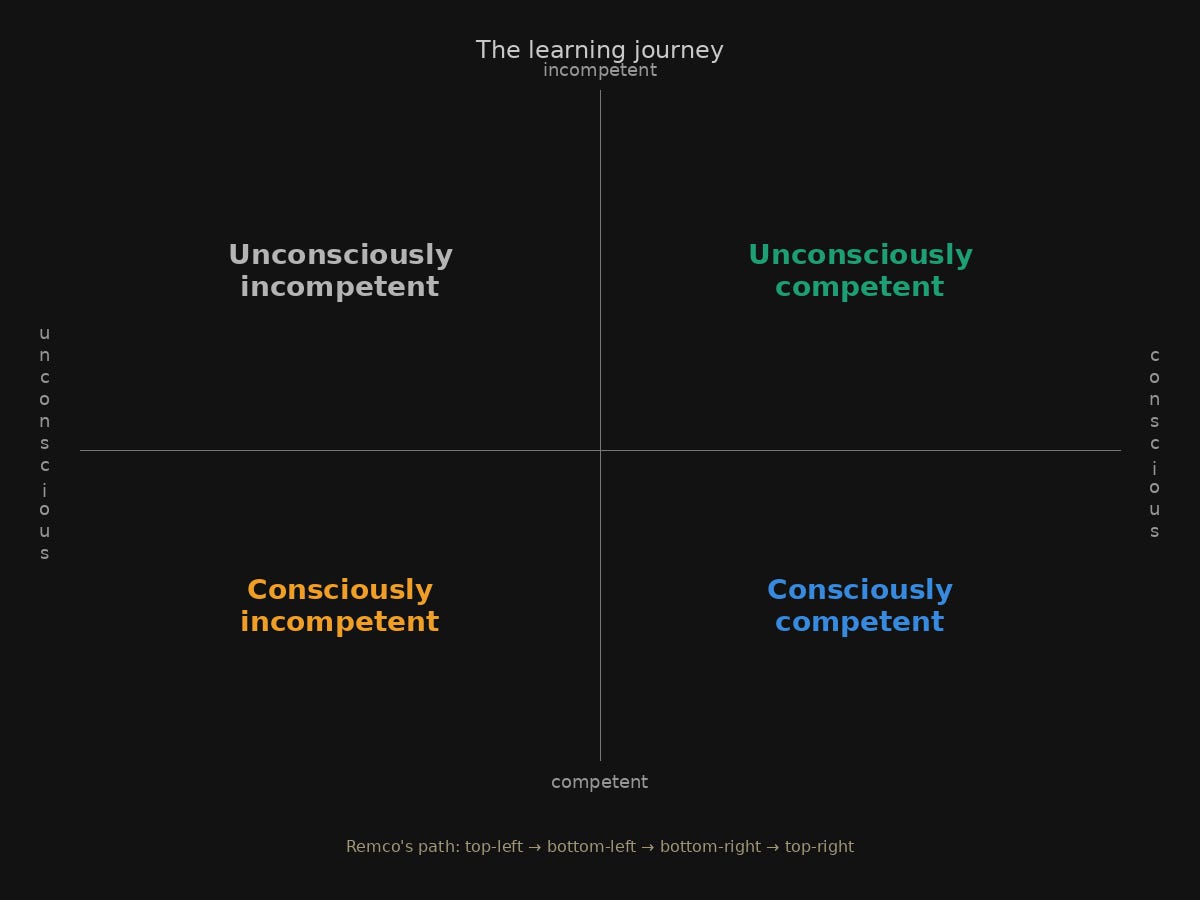
People really neglect the importance of being consciously incompetent. A lot of experts don’t know all the different things they need to know to have the solution for AI policy, for example. It’s just too complicated. If you’re not in DC yet, you don’t know all the ways you need to think about it. But you can know enough about AI to very quickly know what knowledge gaps you need to fill to say something about open-source versus closed-source AI models, or what China is doing in AI.
One of my colleagues, who was a fellow on the Hill, had a nice saying: “Your job is not to be the expert. Your job is to mobilize expertise.” That is your job as a staffer. To do that well, you need to be consciously incompetent — humble enough to know where your gaps are, then entrepreneurial enough to fill them, sometimes on two hours’ notice, sometimes on two days’. That’s a really neglected skill set. It lowers the bar for where someone needs to be to make a contribution in DC. Someone who wants to be the world’s expert on Bulgarian tanks might think, “I just need to read that extra book before I can really conclude something or jump into this field.” Lower your standards. You probably can contribute so much more than you think just by being aware of the gaps and leaning in early.
Kumar Garg: One question I have is — Jordan, you’ve talked about the posting-to-policy pipeline. How ideas now make it into policymakers’ heads is changing. How does that intersect with the “you have to be in there learning all the internal mechanisms” model? That system was certainly not as present when I first showed up in government in 2009. It’s become way more present.
One thing it shows is that we still live in a real deficit of clean ideas. I always used to say, when we were sitting around trying to come up with State of the Union ideas, “Why don’t I have a book from each think tank that says, ‘Here’s everything we wrote in the last year, formulated as a State of the Union idea. Here’s the sentence the president would say. Here’s the logic model of the policy proposal. Here’s a link to all the appendices so you can make it bigger or smaller. Here are the phone numbers of the experts you’d call.’” Instead, I’d be hunting around, “Has anyone written on this? Is there a paper?” The president gives this speech every year, and the fact sheets already exist.
So part of it is understanding the clarity of what a good idea is, and answering the questions of here’s what needs to happen, here’s why it needs to happen, here’s the button. Whether it’s eliminating the double staircase requirement, which would allow more construction — that’s a policy change a state or city could pass if they care about more housing. The policy entrepreneurship of people going in and serving, and just reminding everybody — there are a lot of documents that get created in policy and not that many ideas.
Remco Zwetsloot: Jordan, you’ve also talked about writing as a way to figure out what you actually believe. Say more about that?
Jordan Schneider: We’ve talked a lot in this show about the staffer path, where you have to subordinate a lot of your work to what the principal is doing — an elected representative, an assistant secretary, whoever. There’s a lot of power and influence you can have from that. But there’s an aspect that turns into Office Space, where you are not wholly yourself. You’re a vessel for someone else’s ideas and ambitions. You’re constrained by their pressures.
For some people, there’s something both intimidating and liberating about being forced to put on paper — or a Substack draft — what change you actually want to see in the world. Remco, earlier you talked about folks who applied to your program saying, “I want to be a public servant. I want to work on the NSC.” That’s something I’ve heard from a ton of highly educated 20-year-olds. It’s a failure state. But it’s very hard to look at a piece of paper, fill it with 2,000 words of your thoughts, and not get to something past “I want to be a public servant” or “I want to work on the NSC.”
That act of self-reflection that comes through writing is really important. There’s a whole second part about to what extent writing in public is important to get things done in the world. But the introspection that goes along with the writing process is almost the right place to start, and why having writing you’re only doing for yourself is important. Kumar?
Kumar Garg: I agree. One interesting trend that I’ve seen is the individual doer is getting a lot more traction in different formats. In media, you’d think about this as the individual writer. It used to be that what made you important as a writer was who you wrote for — “I write for Time magazine, I work for this.” The idea of the individual writer having their own brand, voice, and analysis — from Ben Thompson on — became much more of a thing.
At Renaissance, we try to think about it as the fund leader. You don’t need to go work for a foundation as a program officer. You can lead a fund, raise the capital, and deploy the work. Similarly, the idea of a public intellectual had this imprecision — a public intellectual writes books, is an expert, writes essays, sometimes writes a New York Times op-ed, is an authority. That too is getting democratized. You can start obsessing about a topic and writing about it consistently and cleanly. Other people who are experts on that topic can say, “This is actually pretty good. There’s a lot here.” They can validate it. Then you can be encouraged to keep working on it. That can open up other career paths, including terms of service in government and the opportunity to affect things.
Writing has an agenda-setting quality if you want it to. You’re starting to see that democratization happen.
The piece I’d push on is one of my favorite conversations to have with folks who have become really excellent writers — what role do they want to play in taking their insights and converting them into insights policymakers can use? I said this to Niko at Asimov: “You’ve got a bunch of interesting stuff. Some of these ideas would be really interesting if you or someone else then said, ‘Here’s the way NIH should be operationalizing these insights in their grant-making.’” That doesn’t have to be Niko’s job, but the writer can have a big role in operationalizing those ideas. They might do that themselves, or they could be aware that there’s an opportunity.
Remco Zwetsloot: One of my favorite examples is Thomas Hochman. For anyone interested in energy policy, you may have read his stuff. He’s at the Foundation for American Innovation and wrote a great Substack about one year in policy — what he learned. The public writing is a big piece of it. He did an impressive job building his profile.
Then there’s the follow-on work. Public writing is almost lead generation. It gets you into a meeting, gets you outreach or interest from folks, and then you need to do follow-on work. That follow-on work often ends up not being public and gets more into the traditional policy entrepreneur method. It democratizes this kind of work, and I think it’s super exciting. People who feel naturally drawn to posting-to-policy work should absolutely lean into it.
Kumar Garg: That second part is super important. Some people get so wedded to the public persona side that they don’t want to take the hit of doing the secret-Congress work — where policymakers call you up, ask you for ideas, you give them input, but you don’t get to talk about it. Some people are wedded to “everything has to be brand-enhancing.” Ideally you can do it in a way that allows your ideas to travel, and you’re smart enough to realize that to get the idea to the finish point, you’ll have to have different ways of interacting with decision-makers. People leave alpha on the floor when everything has to be public.
One question for Remco — you guys have been putting out a bunch of guides on how people navigate this. I get lots of referrals — “This person is thinking about philanthropy or policy. They’re very technical, very smart. They should figure this out.” If you’ve built a startup, know a lot about a particular technical area, and are curious about larger systems-level knobs you want to turn, what would be on your list of resources to check out? Certainly, I’d get on the phone with them, but what would you direct them to?
Remco Zwetsloot: For us, we created a website called emergingtechpolicy.org for people interested in emerging tech policy. Anyone listening interested in that field — highly recommend it.
It was a starting place because we kept finding ourselves repeating the same things in conversation. As Jordan would say, if you find yourself repeating something three or five times, write it down and put it on the internet. You can reach so many more people that way. The people who get connected to us aren’t a representative sample of everyone who should be in DC and in policy conversations. So emergingtechpolicy.org has guides — if you’re new to policy, what’s a think tank? What’s it like to work in Congress? What are different federal agencies doing on AI?
If you’re new and not sure which type of institution or job is good for you — a question a lot of people face — “I want to have an impact. I think government’s important, but I love reading and writing, or this kind of work. I don’t know where I’d plug in because I don’t understand DC enough” — that’s a great starting point.
Very soon after that, you want to meet peers and chat with people similar to you who have made the jump into policy or are thinking about the same problems. Start with reading, but very soon after, come to DC for a weekend visit. We have a guide on making the most of a weekend trip if you have the resources. We host events — people can monitor our website. A weekend workshop is one format we offer. You don’t have to feel ready for a fellowship, but you can come and check it out briefly.
The human element of seeing other people like you in this world matters. We try to get fancy speakers, but often the most important people to talk to are those just one or two years ahead of you in the journey. They can be the most useful. Senior people often have the curse of knowledge — the unconsciously competent quadrant. They don’t remember what it was like to be in your shoes and might give advice that’s no longer actionable or relevant. People just a year or two ahead are often the best mentors and guides.
We try to serve as many people as possible. You can sign up for career advice on our website. We get more applications than we can process, so we can’t do one-on-one calls with everyone, but the events are more scalable. There’s also a list of fellowships other than the Horizon Fellowship on the website. Hopefully soon, Jordan, we’ll have a China-focused workshop. We have AI and national security workshops, bio workshops. People listening with those interests will find something that suits them.
Jordan Schneider: Amazing. Kumar, what do you want to shout out, besides taking lead out of the planet? What should people give their billions to or work on next?
Kumar Garg: Technical people trying to figure out where to have the most impact can benefit a lot from seeing what’s out there. At Renaissance Philanthropy, we’re putting out lots of interesting, different ways to have impact. We’re building programs all the time. Click around and read — us, Convergent Research, Horizon. There’s a bunch of new organizations that have appeared in the past five to ten years pushing on how to take technical expertise and use it to agenda-set on really important outcomes. Read around. It’s both inspiring and — what all these organizations would tell you — we need more help. Reach out and raise your hand to either help build a program or support one.
We can coach you up on how to talk to the money side. That’s just a stepladder. Using your passion, ambition, and technical depth against these hard problems that aren’t just “what’s the next startup” can be a really powerful way to contribute.
Remco Zwetsloot: If listeners take one thing away from this conversation, I hope it’s Kumar’s earlier message — this is fundamentally talent-constrained work. I could not name you a problem where I don’t think part of the solution is “many, many more people should work on it.” There are complicated “how” questions depending on your personality and personal constraints. But I can guarantee that for someone trying to do good and thinking about science, technology, and China-related topics, there’s so much impact you can have. People in jobs that don’t feel aligned with their ultimate mission in life should think strongly about how to make the pivot in the next couple of years. A lot is changing in the world, and there’s so much need.
Jordan Schneider: Remco, Kumar, thanks so much for coming on ChinaTalk.