
The full Second Breakfast cohort of Eric Robinson, Tony Stark, and Justin Mc join today.
We cover:
• A downed F-15 in Iran — Why Combat Search and Rescue missions have suddenly become America’s most dangerous operation, and what happens when Iran captures U.S. aircrews.
• Ukraine lessons ignored — From exposed aircraft on Saudi runways to artillery units refusing to use drones for fire adjustment, CENTCOM is operating like it’s still 2003 while cheap drones turn warfare upside down.
• Pete Hegseth’s purges — Three generals relieved, Black and female officers targeted, and Apache pilots doing flyovers for Kid Rock while the Secretary of Defense rewrites what “readiness” means.
• The War of 1812 parallels — How America’s current military hubris mirrors both sides’ catastrophic miscalculations in our first major military blunder.
Plus, double-tap strikes on civilian bridges, the death of the Asymmetric Warfare Group, and why having a “peace disease” might not be unique to the PLA after all.
Listen now on your favorite podcast app.
Search and Rescue
Eric Robinson: Good morning. It’s April 3rd, 2026. As we record this week’s Second Breakfast, we understand that United States Air Force combat search and rescue assets are in southern Iran looking for a downed F-15E pilot. We’re trying to scrape together information just like everybody else, but we figured this is an interesting opportunity to talk about what is CSAR — what does that mean, how is it done, how do you plan for it? And just how grim are the fortunes of this Eagle driver?
Tony Stark: We should probably go back and talk about when the United States last did combat search and rescue, which off the top of my head was Libya in 2011.
Eric Robinson: It’s something that happens not often, but enough that the Air Force, Marines, and segments of the Army rehearse and train for it. When an aircraft goes down in a dangerous area, if a pilot is separated from the aircraft, they’re dedicated to immediately get the air crews out. In gentler circumstances, like in the war in Afghanistan, you’d try to get the aircraft out too.
Justin Mc: The good news is it’s in a relatively uninhabited part of Iran. The bad news is it’s in a relatively uninhabited part of Iran, which means if you’re a pilot, it’s desert, hot, not a lot of water potentially, and obviously you don’t want to be near the wreckage or the crew.
This is a big thing. A lot of pilots go through SERE training for exactly this reason if you’re down behind enemy lines, you’re in a position where you’re having to evade, you’re in a position where you’re having to get somewhere where you can be recovered, and then hopeful that the recovery package gets there before the bad guys, who obviously have a big signal to follow to where you are. It’s tough. That’s one of the hardest missions the US Air Force undertakes the recovery of downed pilots.
Eric Robinson: This is a relatively new part of warfare that you needed aviation in order to strand pilots or individual soldiers behind enemy lines. If you look back to 1914, 1915 on the Western Front, a German pilot would often land and the French would come out and shake his hand and treat him as a fellow gentleman. It was very prim and proper.
In the Second World War, that started to erode pretty rapidly. If you were a Soviet aviator captured by the Germans, there was no particular kindness extended. In East Asia, the same principle was upheld. There are jarring moments in American history with aviators, both Navy and Air Force, captured in North Vietnam who were subjected to extraordinary stress, torture, and psychological abuse during their captivity.
The Air Force and Navy treat this exceptionally seriously, and it’s an extraordinarily dangerous mission. Some of the most well-trained special operations forces the United States has are Pararescue in Air Force special operations, and they’re designed to get aviators out of these difficult environments.
Tony Stark: The impact depends on how the F-15s went down. F-15s are old aircraft if it was mechanical failure, that’s one thing (which might explain why there’s no video of pilot ejection). The F-15s have been handling a lot of drone intercepts under high mission tempo.
If the Iranians did shoot them down, we need to know the method. A SAM system would mean Iranian air defenses aren’t completely destroyed as claimed. A lucky SHORAD or MANPADS shot would highlight that you’re never truly safe in the air due to the proliferation of man-portable air defense systems (shoulder-fired missiles).
Statistically, if MANPADS are proliferating in a conflict, something will eventually go down. We’re a month into this war if this is the Air Force’s first aircraft loss, that’s actually a fair success rate.
Eric Robinson: Regardless of how the aircraft went down, if the Iranians have this pilot in custody, the chance of a special operations mission to recover that pilot is exceptionally high. CSAR (Combat Search and Rescue) turns into hostage rescue quite rapidly.
If special operations can locate and maintain visibility on the pilot, the powers that be will send Rangers, SEALs, or Army Special Missions units to pull that pilot out. That means “boots on the ground” — the threshold we’ve been dancing around since the war began a month ago — will almost certainly be crossed.
Eric Robinson: Towards the end of the Obama presidency when there was a Navy patrol boat that drifted into Iranian waters and the Iranian Navy picked them up and captured the sailors, made them all take off their boots, made them look like goofballs, and then repatriated them? Is it going to be that gentle? I don’t think it would be.
It’s going to probably be something closer to the coalition aviators in the 1991 Gulf War, where the Iraqis put them on TV and showed that these guys had had the shit kicked out of them. It’s going to be grim.
Jordan Schneider: On the special forces retrieving the pilot thing, we had Israel running around Gaza for two years, unable to find hostages. I, for one, am pretty skeptical that if they can’t find this person in the next 12 hours, Iran wouldn’t be able to make that sort of thing near impossible.
Which leaves you in a really tricky situation. We have a president who gave a speech two days ago, which was fascinating because on the one hand, it’s clear he wants this war to end. He’s over it. He’s sick of it. He started to fire people. He’s cranky. He even acknowledged that gas prices were going up. His polls have been as low as they’ve ever been in both of his two presidencies.
But this is war, right? Shit happens and you get stuck, and it’s easy to start them and very hard to end them. We’re just in this the pack up your bags and go home play, which we’ve talked about in prior episodes. Even leaving Iran with the Strait of Hormuz is a whole lot trickier when there’s a hostage.
Eric Robinson: He wants to do Fourth of July parties. He is gearing up to be the center of attention around the 250th anniversary. That is supposed to be the capstone. And now he doesn’t get to have his parties. No treats. He is frustrated.
Tony Stark: I don’t think there’s a world where they just walk away from it. People got mad at me when I said this online, but you can’t just throw your tantrum and leave. There are actual security consequences to that.
If there’s a hostage or hostages, it’s even more. I will also say that capture is not necessarily the automatic result. You can look at the Bravo Two Zero escape in ’91. You have several other cases where aviators and special operations forces are able to find or fight their way out.
Justin Mc: Let’s just caveat that real quick. Some people in the SAS have some very different opinions of what happened in Bravo Two Zero.
Tony Stark: The narrative fights everything they’ve put out. You don’t get your happy highlight reels of bridges blowing up. From an operations standpoint not that we have a national security infrastructure anymore I’d have some questions if they said, “There’s no targets left. Let’s go after the civilian bridges.” And then that happens.
Shooting the Messenger
Justin Mc: You have to weigh this with the fact that Kharazi was wounded and his wife was killed in a strike a day or two ago either US or Israeli, we’re unsure. Kharazi was supposedly one of the Iranians dealing through Pakistan for the negotiations. While trying to bring this to a close, we’re also striking potentially...
Eric Robinson: Shooting the messengers.
Tony Stark: Do they really think that’s a negotiating tactic you should take? I mean the United States government that you should kill your negotiators? Or are the Israelis killing the negotiators? I’m very curious about that, because I don’t think Israel is particularly interested in this conflict ending right now based upon what Netanyahu said publicly, which is that you have to do more.
Justin Mc: For all we know his wife was a teacher.
Jordan Schneider: Maybe they lived near a girls school.
Eric Robinson: Was he in an ambulance racing to help people on a bridge and they were killed in a double tap strike?
Tony Stark: Can we talk about that first? That’s horrific if that’s what we’re doing now, waiting for aid workers to show up.
Eric Robinson: There’s a somewhat famous civilian bridge in Greater Tehran that was struck by the United States. Bridges aren’t necessarily protected in war. Sometimes you go after bridges, but you have to have a reason for it. There has to be military necessity. You don’t just go after infrastructure because it’s on your target deck. That would make it a criminal action.
Reporting in the aftermath of the strike this happened Thursday morning indicates there was an initial strike that dropped the span. Then Iranian sources indicate there was a second strike that hit first responders who were helping people who were stranded on the bridge or otherwise injured or incapacitated. That would be objectively a criminal action if the reporting is correct.
If the United States is doing that right now, then up through Adm. Cooper and down, you have people with criminal culpability.
Tony Stark: I really hope that’s bullshit. Beyond everything else that has happened so far, most military commands could find one way or another to justify the strikes that have happened. That stuff is crossing a line that’s hard for the United States military to culturally walk back if it becomes real.
Eric Robinson The secretary of defense likes war crimes. He thinks they’re necessary conditions to battlefield victory. If we want to hover for a moment over international law, international law or law of armed conflict typically breaks into two phases. There’s jus ad bellum the question of when can countries use military force. Can you defend yourselves? Are there authorized reasons to do it? This has been developed for ten centuries of human experience. It’s been codified in the UN Charter, which is reflected in the American Constitution. You go to war for certain reasons and countries can defend themselves, and there’s a large body of law over when that happens.
Then there’s jus in bello over how do you conduct yourself during the war itself. There are few sober forms of analysis to say the United States and Israel’s war in this case is justified. It’s probably a war of aggression that there’s no international law sheen over that. But once you breach that threshold, then there’s: are you conducting yourselves responsibly during the fighting?
To Tony’s point, if we are hitting aid workers, it is prima facie evidence of violations of laws of armed conflict. We also know, based on decades of public advocacy, writing, legal activity, and behavior on the podium, that the Secretary of Defense likes war crimes. He thinks they are necessary conditions to battlefield victory.
For people in a position of analysis like ours, who are observers after the fact, it is a responsible set of assumptions to say that the chain of command is effectively pro-war crime, and that they see war crimes and the willingness to conduct this kind of violence as necessary conditions of their version of victory. It is criminal, top to bottom.
Hegseth’s Purges
It’s quite clear that Pete wants to reshape the Pentagon and the military in his image in addition to making Dan Driscoll’s life hell. This will have a long-standing impact on the officer corps if they believe that certain behaviors, certain politics get rewarded and others get punished.
Eric Robinson: In Pete Hegseth’s vision, it is an overtly partisan act to exist as a Black woman. It is overtly partisan act to be a Black officer. He does not see those identities as being part of the America that he respects, and he behaves accordingly.
One of the more interesting reveals from the ongoing purge and whether or not it’s accurate is difficult to determine is that General George, who was the Army Chief of Staff and the Secretary of the Army, Dan Driscoll, were fighting to keep two women and two Black men on a promotion list from Colonel to Brigadier General. The Secretary of Defense was trying to get them off the list for reasons that he doesn’t care to articulate, but we can operate under a fair assumption.
To Tony’s original summary, Secretary Driscoll is well-liked. He is a close friend of the vice president. His military experience is vastly more impressive than that of the Secretary of Defense. He was in a cavalry squadron in the 10th Mountain Division, but went to Ranger school, did all the junior officer stuff, then went to Yale Law. He went after hard targets. He committed himself to being a decent junior officer, and that’s to be commended. Pete did none of that. Pete literally tattooed a regimental crest of a unit in which he did not technically serve on his body to borrow somebody else’s valor. Everybody knows it.
When he walks the halls, people know this about him. Beyond the stink of gin, it’s the stink of desperation.
Justin Mc: This also goes towards the very beginning of this version of Trump’s desire to strip away bureaucracy. Jordan, you had a good interview with Kevin where you guys talked about how the military bureaucracy, the profession of arms is a bureaucracy, kind of laid the groundwork for what a professional civil bureaucracy actually looks like and the capabilities.
In some ways, there is a leveling out effect of capabilities as officers rise up through the ranks of the military, and we can make fun of it. It’s like you don’t actually get the best of the best. You get the best of the ones who stayed or the best of the rest is kind of the way people pejoratively talk about officers. But really what you get is the solid 70 percenters the people who score in the 70 to 80 percent that don’t necessarily want to go out and get involved in business or really love being in the military, and it’s part of their family tradition.
I think about the Van Antwerps. Two men who could probably do anything who decided to stay and serve in the military, and both of them are going to end up reaching echelons of power within the military. They grew up in the bureaucracy that exists where there are certain things that you do and you don’t do. There are certain things that you say and you don’t say because no matter what your personal beliefs are, there’s a non-partisanship that’s expected of a military commander.
You start throwing cold water on that when you start making decisions that are reflective of the decisions we’ve seen Secretary Hegseth make over the last few months.
When you’ve got a flight of Apaches violating FAA rules to go salute Kid Rock, and then the Army has to discipline these pilots the Squadron Commander of the 217th, a beloved unit in my personal history that has pulled me out of gunfights multiple times their Squadron Commander goes and celebrates this overtly partisan actor. They tell him it’s coming, we can have his camera put up as an express violation of the Hatch Act. It’s dangerous, it wastes jet fuel, wastes maintenance time. The commander should have been relieved immediately.
Then Pete’s like, “Actually, no, this is awesome.” It’s a direct attack on order and discipline. It’s permitting certain unethical behaviors and penalizing people based on their demographics outside of whether or not they’re performing to expectations. It’s a deliberate partisan reshaping of the military top to bottom and the Senate’s allowing it to happen.
Justin Mc: There’s zero chance that the inverse of that Kid Rock’s post directly made fun of Gavin Newsom and talked about the amount of respect... He knew it was coming because the camera was set up, but he also basically said these Apache pilots are showing him an amount of respect they would never show Gavin Newsom. That’s potentially problematic.
It goes back to Eisenhower and potentially even before then there were officers in past centuries who held to the belief (and I was raised on this tradition in my own family) where officers actually didn’t vote. Not because they couldn’t vote they didn’t vote because if you were the kind of person who would vote for someone who didn’t win the presidency, you’ve already had to separate your personal self from your professional self. To not even have that dichotomy and conflict of interest, they just removed themselves from it. They never took the step of actually voting because they never wanted to have that personal conflict of interest with the elected official.
That becomes really hard. Now you’re seeing in the span of a couple generations going from that being a norm to being as openly partisan as it can be.
Recent Losses and Outdated Infrastructure
Tony Stark: In addition to what seems to be an F-15 shot down at some point this morning, we lost an AWACS last week on the ground in Saudi Arabia. Why is that significant? One, because it seems to be in the same place where the Iranians had previously hit targets. Two, there’s only 16 E-3s in the US fleet. Now the Saudis and some NATO members have others, so we’re down to 15.
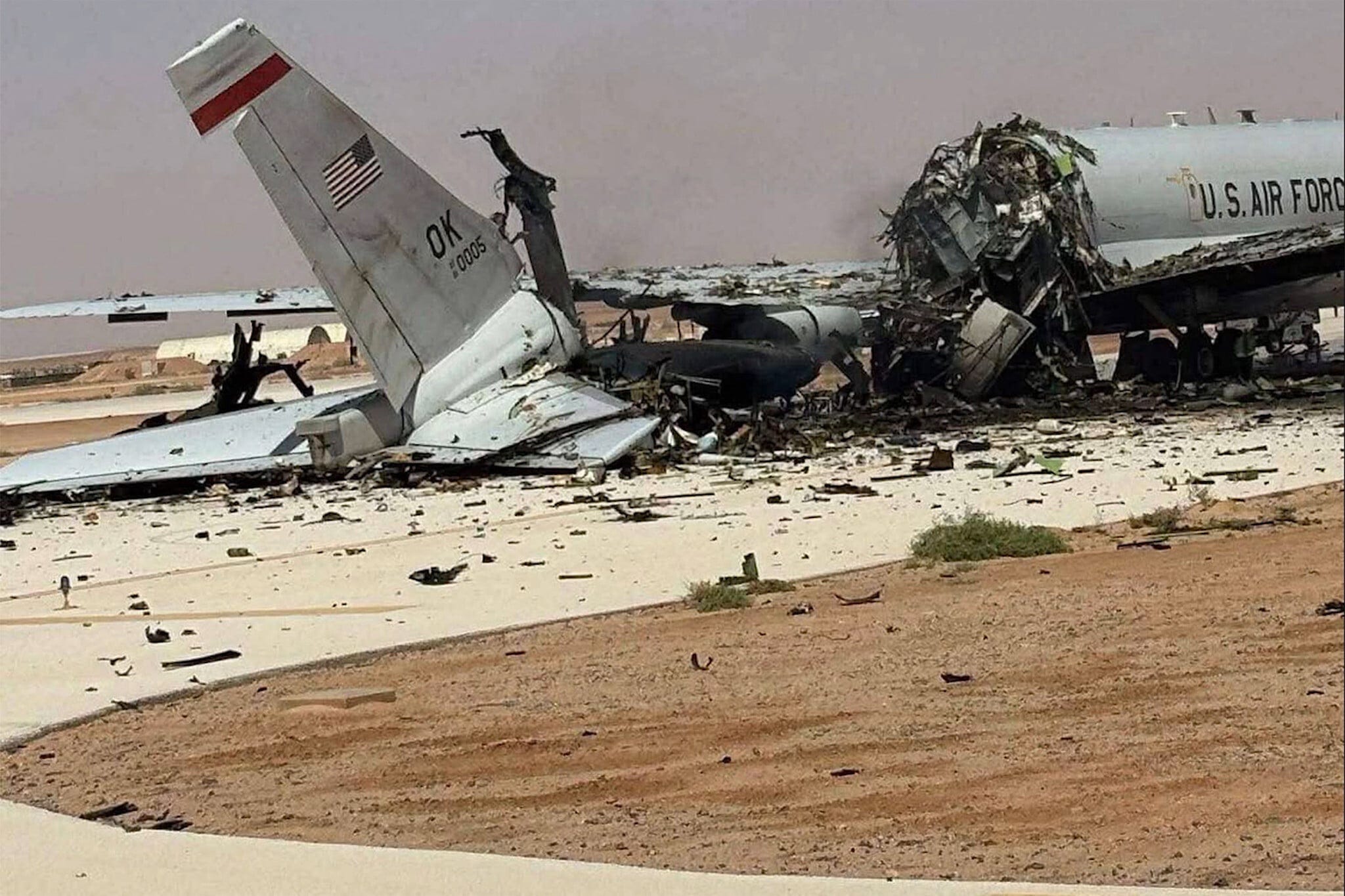
The DOD said it was only damaged, and if you look at it, it’s only two-thirds remaining. E-3s are critical to sensing and early warning they are early warning aircraft. The maintenance rate on them is pretty high from what I understand because they’re mostly old.
Justin Mc: The damaged bit was the important bit.
Eric Robinson: It’ll buff out. Just need a fresh coat of paint.
Tony Stark: Their replacement, the E-7 Wedgetail, is so expensive that the budget only allows replacing two of them. The Air Force is caught between having to modernize seven different things at once.
This is significant if you don’t have that plane and have to deploy to other theaters, you’re down one aircraft. That has a substantial impact. I wrote an article about this last week: CENTCOM didn’t learn anything from the last 10 years. They still think it’s 2003. There’s that meme about “it’s forever CENTCOM,” but there are plenty of lessons learned from Ukraine. Even within the DOD, the way they train for the Pacific is significantly different from how CENTCOM is behaving operationally. That’s terrifying.

Eric Robinson: According to their chief innovation officer, they were using AI to defeat the Houthis. Who are we to question MacDill or CENTCOM Forward? It’s ridiculous. They’ve got this entire disposition of “we were appointed to lead, not to read.”
Justin Mc: When you go to Qatar or Saudi Arabia and spend time on those bases, there are these massive buildups they’re of a bygone era. I remember landing in a small plane and seeing lines of refuelers, C-17s, and all manner of aircraft just lined up on tarmac.
I posted that photo that Al-Monitor published in June when they noticed through OSINT that CENTCOM was clearly getting ready to do something. We had gone from having 40 exposed aircraft to three exposed aircraft at any time.
The lessons learned from Operation Spiderweb show how vulnerable your bases will be. In an actual shooting war where the enemy can range you, you have to invest more in security and hardening targets. It makes everything more expensive. The logistics tail gets longer. The forward edge has to be able to operate further away from their logistics base, and you have to bring supplies forward. That’s one of the things we’ve lost.
Tony Stark: In the last 10 years, INDOPACOM has spent time building new expeditionary airfields, lengthening runways, and rebuilding islands. That probably should have been one of the first things CENTCOM was doing building expeditionary airfields to distribute their forces, knowing they would have more capacity than they could handle in theater for a sustained ground campaign.
Jordan Schneider: Even if you want to give them the benefit of the doubt and start the clock in 2023 which is pretty late for all of this you get to see a year of Ukraine and drones really becoming a big deal. How much would you have expected the US. performance in March 2026 to be different?
Justin Mc: We suffer from the exact same American exceptionalism as the Europeans. I wrote a little bit about this. Look at the Russo-Japanese War, even if you set aside the Civil War. The Europeans watched a European power, the Russians (the least modernized, but still the Russians), take on an emerging Japan, which obviously bested them at sea.
But then they watched the Japanese get absolutely chewed up running into barbed wire and machine guns. Pre-World War I, they looked at the Russo-Japanese War and said, “Well, that won’t happen to us. We’ll be fine. We got it.”
Tony Stark: I believe their exact framing was, “the Russians are lesser whites.”
Justin Mc: Yes, “the Russians are lesser whites and we’re better than the Japanese. Our élan will overcome the machine guns.” I think that’s a direct quote from one of the French leaders. This is absolutely the type of hubris that people write books about. “We’re different. Yes, the Russians got hit by Ukraine, and yes, drones have been terrible to their stuff. But obviously, it’s not gonna happen to us.”
You can only say that because as a base commander, if you have a highly vulnerable and highly important aircraft sitting out on a runway not about to take off, not taxiing to take off, just sitting there where a Lancet or Shahed can strike it you’ve made a deliberate choice to deny reality.
Lessons Not Learned
Tony Stark: I go back to this New York Times article from 2023-24 that basically says Americans were training Ukrainian forces in Western Europe. You can complain all you want about the Ukrainians not understanding why we can’t use DJI drones.
But largely the arrogance of American trainers is on display. The Ukrainians were saying, “Half of what you’re teaching us is not relevant to our fight. You guys have no idea how to handle drones.” It’s still largely true.
There were questions about how true that was, and it’s quite clear that for the DOD supposedly a learning institution with all these lessons learned manuals nobody reads them, apparently. Or it’s down to commander by commander. Clearly there are no standards set for how to train against these threats, because we’re still doing this.
I get it commanders and soldiers will behave based on convenience if not enforced through discipline. Clearly there is no enforcement of how to handle these sorts of threats.
Justin Mc: Last week there was an interview — I can’t remember the commander’s name but he was discussing Ukraine’s use of the air defense systems we’ve provided them. He said, “You know, at first I really thought the Ukrainians wouldn’t be able to master it, but they’re kind of better than us now.” Well, no shit. They’ve been using it for two years in actual combat. Of course they’re better than you. That’s how this works.
Jordan Schneider: It’s like you’re going home at 4:30 every day.
Justin Mc: They’re doing this all the time. They’ve figured it out. The ones that are still alive are really, really good. You should be bringing them over here to train you.
We saw the exact same resistance when Special Forces and SOCOM pushed through Syria. We were already using drones both MQ-9s, Ravens, Pumas, all the drones the US Army had in supply. We used them to do forward observation, call for fire, identify targets, and spot rounds from mortars and indirect fire to walk them onto targets.
The US Army did not care.
We tried to tell them, “This is how you should be operating. You all need to be using ATAK. You need to be marrying these systems together and training like this.” This was 2016, 2017 basically a version of what you have now in Ukraine where drones serve as spotters for indirect fire, plus armed drones flying overhead.
Nobody even wanted to learn from our own lessons because it wasn’t a threat to them. They could keep doing things the way they’d always done them, and everything was cool. We have the inertia of the way things have always been, and that’s very hard to overcome.
Eric Robinson: Can I make that worse?
Justin Mc: Yeah, please.
Eric Robinson: Recently, here in my humble office you can see books, but the other wall is my game collection, almost exclusively military issues I had an active-duty brigade commander visit to discuss the ebb and flow of contemporary war. Sharp person who’s spent substantial time focused on Ukraine issues.
He recently took his brigade to a training rotation at one of the major centers and told me he had to spend an inordinate amount of time coaching the artillerymen embedded with his infantry to accept the fact that UAS could spot and adjust fire.
He said there was a baseline cultural rejection if it wasn’t a 13-series soldier embedded looking through their own binoculars, using their own optics, using their own laser designators, it didn’t count. If they had Air Force aircraft or Army embedded UAS, or their own workshop stuff floating over the unit that could spot, assess, and adjust fire, the artillerymen wouldn’t do it.
This is 2024, and the Army has had these tools at its immediate disposal for two decades.
Tony Stark: One of the fundamental problems here and I say this because this is all in China policy is there’s peace disease among the PLA. They haven’t fought since ’79. Let’s go through by branch of just the US Army. We won’t even get to the Navy.
The Army hasn’t had an armor-on-armor engagement since 2003, and that certainly wasn’t against a peer threat. If you look at aviation, they haven’t dealt with heavily contested airspace in a very long time. If you look at the infantry, counterinsurgency is not the same as living in a trench 24 hours a day or living under constant threat of drone attack on maneuver.
It’s significantly different. Every GWOT veteran who has gone to Ukraine has said, “My experience is irrelevant.” Yet the US Army still says, “Well, we’re the most combat experienced force on the planet.” No, you’re not. You might still be very good at logistics I have some questions about that. But combat experience? No, it’s the Ukrainians and the Russians. You can choose to learn their lessons, and it’s clear that we’re just not.
Eric Robinson: There’s another layer I want to add. I recommend everybody in the military read The Smartest Guys in the Room if you’re interested in risk management. It’s the classic history of Enron. Fundamentally, it’s a story of hubris in business in Houston.
At Enron, they had this robust risk management division. They hired extraordinarily well-regarded financial planners, geopolitical risk analysis experts, people who did oil and gas. They really went out of their way to hire expert risk management and advertised it. Ron went out for fundraising, and when they went into definitive agreements, they would say, “Hey, we’ve got this risk management division. We know what we’re doing. Trust us.”
That risk management division, in terms of the investment committees that were making decisions to enter into these agreements or making these investments or deciding which accounting principles to employ, was never consulted. They had this ornamental risk management division that did not exist inside the core decision-making cycle of Enron’s management. What they had was like an expensive, great-looking bauble that shifted responsibility for thinking about risk to an institution that then could not prevent bad choices. They got the worst of both worlds — an extraordinarily expensive program that they were not able to actually rely upon.
That model has me thinking about a bugaboo of mine, something that I bring up in our broadcasts or writing or in advocacy. We’re talking through this problem of identifying lessons from Ukraine or from previous military conflicts in the Middle East and applying it and learning from it and adapting. That is what innovation is supposed to be. Innovation is bottom-up refinement. It is learning lessons that are immediately available. It’s discarding lessons that aren’t necessarily applicable and adjusting your behavior accordingly.
We are in a Department of Defense, a military structure right now that has created innovation as its own separate vertical. That separate vertical is the Defense Innovation Unit. It’s the Marine Corps Innovation Unit. It is AFWERX, SOFWERX, SpaceWERX, or Navy Rapid Capabilities Office — this host of external organizations whose job it is to figure it out and then come back to us with a solution.
That innovation often devolves to, “Well, we’re going to buy a product from Silicon Valley. Innovation is a product we buy and we’re going to then integrate it. We’re just going to go out to the true disruptors, buy it, and bring it into the slow Department of Defense.”
What I’m afraid of is beyond bringing in shit copters into the Department of Defense that don’t work or embedding yourself with tech fascists, which is another challenge is that falling back on the anecdote that I elevated 15 minutes ago, if you are an artillery commander and you are responding to a brigade commander and you are in some sort of a training exercise, innovation is somebody else’s job. Just like at Enron “Hey, we’ve got this risk management division. We don’t have to think about risk. They’re going to catch the ball.”
I’m curious, and I think I know the answer, and I really want to be wrong, that the concept of observing what’s happening in the world and applying it internally has been brushed off as somebody else’s mission. That’s why we’re seeing a reluctance to adapt to cold realities.
Jordan Schneider: How do you respond to that concern?
Tony Stark: Well, there’s a couple things here, one of which is just for fun trivia for everyone. When was the last time US artillery took counter battery fire? I don’t know the answer to that. I’m pretty sure it was 1973.
Eric Robinson: In Iraq, we would take indirect fire, like counter battery.
Justin Mc: I’d imagine it had to have happened.
Tony Stark: More like directed counter battery from large artillery.
Jordan Schneider: Grenada couldn’t pull this off? Did FARC have mortars, Justin?
Eric Robinson: It’s a good question.
Justin Mc: Korea, obviously, and the North I’m sure they had mortars, but with all that triple canopy jungle they’re trying to shoot through, it’s not super conducive to firing mortars.
Tony Stark: You’ve got to clear the hole first.
Jordan Schneider: If you do it from your tree house...
Justin Mc: You fire it, it falls through. Counter battery, where you have to fire and then move — that’s the other thing. Lessons of shoot and scoot. Korea, Vietnam.
Tony Stark: Shoot and scoot is really what I’m talking about.
Eric Robinson: That would have had to have been Korea.
Tony Stark: Something I’ve seen in my day-to-day I forget if I brought this up on another episode on the government side, there’s all this new technology. How do you innovate? The government is not developing TTPs fast enough for the new technology it’s buying.
This is a fundamental problem because it means that knowledge is not being shared. You’re not sharing the lessons learned that other people have. You’re not sharing the knowledge on new systems. If you don’t get that back to companies, if you don’t get that back to the acquisitions folks, they can’t fire and adjust on what they should be doing.
Our cycle for learning is not as fast as we need it to be. I understand that it takes time to learn, but we also have all these case studies from Ukraine on which we can start to build. Every time I have meetings, I hear people talk about things as if it’s still 2010. It’s not. There are a lot of people who’ve really adapted, but they haven’t kicked those voices out of the room. That is the fundamental problem.
Let’s put politics aside for a second being objectively right about what’s happening on battlefields is not something that is being solidified in the US Army. That is scary to me.
Justin Mc: I had a commander, Joe Wortham, who used to always say, “The person closest to the problem is best suited to solve it.” A lot of times he was right. What he’s literally saying is exactly what you’re saying. He’s not saying they should be the one coding the software. He’s saying they’re going to be the ones who can actually tell you what the problem is and define what needs to be solved.
The problem Eric has highlighted is that when you create these units of action that are stratospherically removed from the warfighter no matter what they say, no matter how much they talk about it if you’re wearing a $2,000 suit to briefings with industry, you are not a warfighter. You’re not. It has ended at some point in your career. You have elevated yourself to the point that you’re no longer there. I’m a retiree; I’m no longer there. I’m far enough removed now that I can’t say that I am.
Eric Robinson: One early point of genius that Palantir embraced beyond selling software to the government was embedding their engineers at the unit level. They’d have their technicians operate alongside intelligence analysts for immediate customer feedback. They were at that exact point Justin described: articulating the problem with precision and sending it back into larger organizations who could solve it.
I’d be much more of a booster of the Defense Innovation Unit if it operated like the late great Asymmetric Warfare Group, which embedded subject matter experts in teams of one and two at the front. They’d observe operations, collect lessons learned, conduct on-the-spot interviews with soldiers, review equipment, and send information back to the larger Army for problem solving. Instead, DIU has become this interface with Silicon Valley. They’re not sending individuals to the front in the Iran war — they’re sending people to CES, and that’s misplaced.
Jordan Schneider: I guess we’ll have to save our discussion of the biggest blunders in American military history and my War of 1812 comparisons to the Iran war for next time. Any other closing remarks?
Blunders and the War of 1812
Eric Robinson: We should talk about what a blunder is. A blunder is an unforced error. Pearl Harbor was not necessarily a blunder, because it was inflicted on the United States. There was some stupidity around it. But a blunder is something that you enter into with eyes wide open. You step on a rake, and then you back up. You step on a second rake, and then it becomes the meme of Sideshow Bob walking around with his giant floppy shoes. The case study is the War of 1812.
Eric Robinson: Regrettably, it is not limited to that. Jordan, why don’t you close us out with a study of the war in the Great Lakes.
Jordan Schneider: I’ve got two quotes for us here. One from Henry Clay talking about how cool it was to have won in January 1816: “Let any man look at the degraded condition of this country before the war, the scorn of the universe, the contempt of ourselves, and tell me if we have gained nothing by the war. What is our present situation? Respectability and character, broad security and confidence at home.”
Then we have a letter to the Naval Chronicle, which is a British newspaper talking about how they’re feeling after losing in New Orleans and the whole thing wrapping up: “...has ended in defeat all our attempts on the American coast and thus have the measures and inadequate force provided by our government brought disgrace for assuredly we have now done the worst against this infant enemy. Lamenting the fallen fortunes of my country and the availing loss of so many brave men, I now take leave of the American Contest. It is to all appearance over, but history will record our defeats and posterity will see and appreciate their consequences. Sic transit gloria mundi.” I don’t think it’s gonna be that bad, but...
Tony Stark: The reason we are talking about the War of 1812 is that there was this hubris before it. There was a lot of discontent for the American government as it was trying to figure itself out. We got too big for our britches and thought that we could liberate Canada again, because we didn’t learn that the first time. There were rightful grievances, just as there were rightful grievances against the Iranian regime.
Yet we did not properly assess how we should conduct that war, if we could conduct that war, if we had the wherewithal to do it. You end up with this world in which the War of 1812 ends after like two and a half years. It’s basically a stalemate. The British are distracted with fighting what you might consider one of the earlier world wars against Napoleon. The White House burned down.
Somehow, the United States government and the American people were ecstatic after we supposedly fought this great empire and won. It was like, no, I mean, we basically, nothing was resolved.
Jordan Schneider: Oh, Tony, I think the analogy is the inverse. This is the British not recognizing that, oh, these Americans, they can make frigates too, and they know how to shoot cannons. Maybe if we rush their trenches in New Orleans, they have a lawn as well. I see that side. Yes, the War of 1812 could have ended the American Republic for literally no good fucking reason. But
Jordan Schneider: I see a lot more parallels with America picking on Iran today than with the UK who already had Napoleon to deal with deciding to teach the Americans a lesson because they were being difficult about impressment.
Tony Stark: I’ll grant that point 100%.
Justin Mc: The Economist cover this week shows Xi with Trump in the foreground, slightly blurry, with a Napoleon quote about never interrupting an enemy when he’s making a mistake. Even Jefferson, who was famously pro-French and anti-British, characterized 1812 as “an unprofitable contest of two sides trying to do each other the most harm.” That’s somebody who was pro-war describing it that way.
Eric Robinson: It did give the United States an industrial base. If you want to put a W on the board, especially around upstate New York the combat around the Great Lakes was oriented around Sackets Harbor. There was an arms foundry outside of Albany, the Watervliet Arsenal, and the cornerstone of that armory that was building cannons for the United States Army at the time is still in place at that arsenal that makes howitzer tubes.
The concept of the American industrial base dates back to that. It was a panic to arm the forces to fight that war, just like it will be a panic to rearm our Air Force and Navy to fight a future war after our recent escapades in Iran.
Tony Stark: To close out on lessons learned it wasn’t until Teddy Roosevelt wrote his Harvard thesis in the late 1800s, his undergraduate thesis, which became The Naval War of 1812, still considered one of the preeminent texts on the war today, that you get actual analysis of the battles.
The British historian who came before him was more interested in spreading British propaganda than taking the United States seriously. There’s no mechanism by which you automatically learn lessons. You have to actively pursue it.
Justin Mc: That’s the perfect closeout because it’s exactly what happened with every unit that rotated through CENTCOM during the Global War on Terror they repeated the errors of their prior unit because they came in ready to change the world. There wasn’t a strong mechanism to ensure learning.
Units deploying in nine months need to be reading everything the current unit is saying today. They need to be in on every conversation so when they arrive, they actually know what’s been happening. Instead, they’d do their left seat, right seat, and when the other unit left, they’d say, “Well, those guys were obviously screwed up. We’re gonna do this the right way.”
Eric Robinson: Same as it ever was.
Good news: second crew member from the downed F-15 rescued!
fantastic interview