
The FCC has spent the past year quietly rewiring the American import market, first routers, then drones, next undersea cables, and as of last week, robots. A 1934 statute plus two overwhelmingly bipartisan bills from 2020 and 2021 have turned what many thought was a sleepy spectrum regulator into one of Washington’s most aggressive national security agencies.
Adam Chan is national security counsel and senior advisor to FCC Chairman Brendan Carr, and directs the agency’s new Council on National Security. He previously clerked on the Second Circuit and served as a national security legal fellow for the House Select Committee on China. ChinaTalk’s Aqib Zakaria co-hosts.
We discuss…
How the covered list works
The case for “simple and stupid” rules over big-brained ones with endless carve-outs
Onshoring plans, allied carve-outs, and the 65% domestic content test
Why robot vacuums got swept in alongside humanoids
How AGI-pilled you have to be for the robot rule to make sense
Listen now on your favorite podcast app.
GovAI was founded ten years ago on the belief that AI would end up transforming our world. Ten years later, the organization is at the forefront of trying to help decision-makers in government and industry navigate the transition to advanced AI.
GovAI is now hiring for its next cohort of Research Scholars and Research Fellows. Scholars are one-year positions that provide an intellectual home for ambitious researchers and policy professionals looking to advance their careers or transition into AI policy. Fellows are longer-term positions for experienced researchers with an established track-record looking for a place that supports their most impactful work.
Both roles offer significant freedom to pursue policy research, advise decision-makers, or launch new initiatives.
Applications close 16 August 2026. Learn more and apply at https://www.governance.ai/opportunities
Jordan Schneider: This national security FCC energy dates back to its founding, no?
Adam Chan: The Communications Act of 1934, section one, establishes the FCC. One of two purposes is for the purpose of national defense. Right there, from the beginning, there was a national security focus in the FCC’s mandate. That mandate is still there, and you’ve seen over the last decade a growing role for the FCC in national security.
For Chairman Carr, national security has been his priority for years, and he’s brought that focus to the chairmanship for the first time. He brought me on as a kind of unique person within the chairman’s office to focus on and coordinate the national security side of things. We’ve set up this new Council on National Security within the FCC to coordinate a lot of the national security work the Commission is doing across multiple different bureaus and offices.
Jordan Schneider: It’s cool, because in the 1930s it was very much a forward-looking thing to see that radios are the future of warfare. And of course World War II comes, you get the Battle of the Beams, you have war radio that enables battlefield operations at a wide scale, which weren’t necessarily possible over the course of World War I. And here we are in 2026 with the FCC on the bleeding edge of technology talking to us about robots and drones.
Let’s start with robots, since this was the latest thing you guys did. Maybe walk through the timeline of how something like this gets on the FCC’s radar as a topic that may need more aggressive regulation, and how something like this evolves, before we talk through the specifics of what’s actually in the regulation.

Adam Chan: I guess I’ll wind the clock back probably further than you want me to wind the clock back —
Jordan Schneider: Hey, I just brought us back to World War I. You can go as far back as you want.
Adam Chan: Fair! So 2020 and 2021 are two important years. Congress passed two standalone pieces of legislation. For the good-governance folks out there who are constantly saying Congress has to do more, why isn’t Congress doing its job — FCC authorities represent an example where Congress, in overwhelmingly bipartisan fashion, with just a handful of no votes in the House, passed the Secure and Trusted Communications Networks Act in 2020 and then the Secure Equipment Act in 2021, which established this new regulatory framework known as the FCC’s covered list.
The way that works is we have a covered list of equipment and services, established under the Secure and Trusted Communications Networks Act. In that mechanism, the FCC can’t actually update our own covered list. This is different than, say, OFAC sanctions lists, or BIS and their entity list, or the 1260H list of military companies at the Department of War. Instead, we require another national security agency or interagency body to make a determination that is the legal predicate by which the FCC then updates the covered list and enforces the rules.
One of the primary implications of a device being on the covered list is that it can’t get authorized for import or sale in the United States. A lot of people know the FCC for its regulation of spectrum, or maybe broadcast media, but also virtually all electronic devices — any device that emits radio frequency, which is pretty much all electronic devices, needs to get FCC authorization before being imported, marketed, or sold in the United States. You’ve probably seen a little FCC logo on a lot of your devices, but that also gives us the tool to shut off new models of devices from coming into the country.
So that’s the broad overview of the FCC’s covered list and what the tools are. You’ve seen the covered list used a lot over the last few years. The most recent action, just last week, was on advanced robotic devices — think mobile robots generally — and power inverters. On the mobile robots determination in particular, this is an interesting scenario, because this is a pretty nascent industry. There’s a pretty good justification that we’re getting ahead of where things might be, say, five years down the line.
The covered list arose back in 2019, 2020, where the FCC was confronting a problem in domestic telecom networks. We were almost entirely reliant on Huawei or ZTE equipment in this radio access network telecom equipment, and had to do this big rip-and-replace to swap untrusted for trusted vendors in our telecom networks. There’s a lot of thinking in the US government about how we can avoid that situation playing out in critical industries like robotics — which, I mean, you guys know better than I do, but I think a lot of people think will be a pretty major industry in the coming years and decades.
Getting Ahead of the Humanoids
Jordan Schneider: Look, we’ve done stuff on undersea cables — established, very big deal. Telecom, obviously, a known big quantity for a while. Drones also, something which has a clear, demonstrated industry and impact. The type of robotics you guys are targeting, people think it’s the future, but it’s much more of a forward-looking speculative bet than the ones you ran through over the past six years. So what drove the impetus to try to restrict the sort of robots that the US is going to be able to import in the coming years?
Adam Chan: First, as mentioned, ultimately we implemented a determination that was made by the broader executive branch. The FCC did not write the national security determination — we’re not the ones who, as a legal matter, chose this. But if you look at the determination, there are two national security risks that are highlighted.
One relates to remote access, cybersecurity, surveillance, and the ability to remotely manipulate a device such that it poses threats. You guys have probably seen videos of robots behaving badly, but more seriously, I think the national security threats here are kind of obvious.
The other is that this is something where the US has a nascent industry but is overwhelmingly reliant on foreign imports of devices. There’s a real risk of a supply chain dependence that, as these devices become critical to the industries of the future, we could end up in a situation where we are very dependent on foreign sources. Maybe these devices are critical to military applications, maybe to manufacturing and other industrial sectors, in which case it is very important for the US to have its own supply.
The covered list automatically means we ban new models getting approved for import or sale. So the covered list works best in fast-evolving industries, where probably the robot of today is not really going to be on the market in five years. There’s a pretty fast obsolescence cycle relative to many other industries, just because the cutting edge is evolving so quickly.
Jordan Schneider: You mentioned the national security risk of someone you don’t like taking control of the robot and, I don’t know, using it to whack people or power plants. What’s up with the two-kilogram exception? I’ve seen some really scary demos of little DARPA insect robots. Why should we not be worried about those coming in from China?
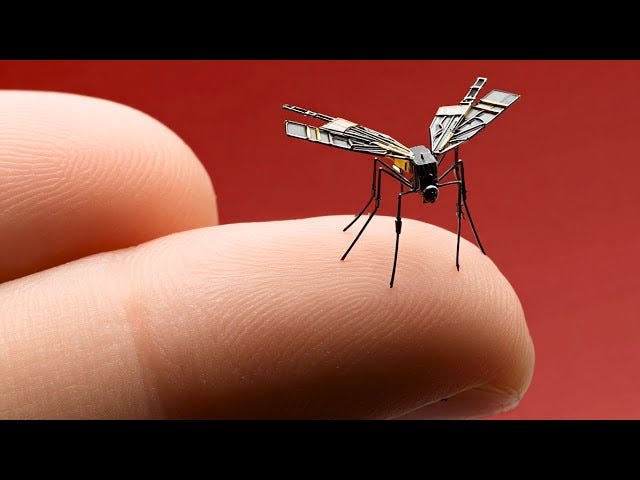
Adam Chan: No comment on the specific DARPA insect robots. I think, looking at what the main market segments are, and what poses the most acute national security risks — I would also note, a good thing about the covered list is that people often complain, hey, this is a blunt instrument, there wasn’t a long comment cycle period, there are more nuanced ways to go about things. There’s actually a strong argument, in this case and in other examples of FCC policy, that the simple and stupid policy is the best policy. It allows for fast action, we avoid the whack-a-mole problem of naming specific entities or coming up with complex definitions and long transition periods, and we send a very strong market signal that gets the attention of industry, to hopefully crowd in capital and investment.
To your point that maybe DARPA-like insect robots become a big thing at some point in the future — it’s actually possible to quickly evolve what’s on the covered list through new determinations. There is a conditional approval process built into the robot determination, so the Department of War can review applications from robotics companies saying, hey, my robot’s produced abroad but doesn’t pose national security risks, I’m planning to bring production to the United States. But it’s also possible that further exceptions or expansions can be built in later.
I know we’re going to talk more about drones later, but for example, on drones there was a drone determination with a pretty broad definition of what a drone was. Later there was a new determination that basically exempted toy drones — a certain definition based on especially small drones that can’t really fly very far, designed to fly around in a home, like a wooden drone that a kid plays with. That was able to be actioned pretty quickly.
This potentially could evolve in the future if there are new national security threats, or we realize there’s actually a segment of the market that was not intended to be included. But here, the executive branch thought about the definition a lot and engaged with industry and other experts in the field, and this seemed to be a definition that would be well understood by industry while addressing the most acute problem.
Aqib Zakaria: That’s an interesting point about the blunt instrument. We’ve seen BIS deal with this whack-a-mole situation, especially with chips. I wonder how the FCC is handling it in terms of who actually decides this one’s okay, that one’s not okay. And is there a staffing problem that we’ve usually seen in the agencies, where there’s so much to handle and there’s not enough people to actually go through it? The policy works, it’s just hard to actually implement in practice.
Adam Chan: So far, at least, we took similar action — the broad-based ban on new models getting authorized for import or sale — for both drones and drone components as well as routers, and those have been ongoing for several months now. As of now, the Department of War has been taking the lead in reviewing applications for conditional approval. There is a guidance document there. Right now they have a pretty well-honed process where conditional approvals come out in just a few weeks, so it’s much faster than many other kinds of national security reviews in the interagency process. They have, to my knowledge, hired some people. They have a budget to handle this. So far it seems to be going quite well on that front. Obviously we assume we’ll get a bunch more applications based on last week’s action, but I’m optimistic things will continue to move smoothly.
Industrial Policy Is National Security?
Jordan Schneider: You mentioned things like market signal, and concerns about building a domestic ecosystem to replace these imports. What is the balance of motivation here between “we’re worried about a foreign actor turning on my robot to blow something up” versus “this is an industrial policy for an industry of the future we want to have a foothold in”?
Adam Chan: I really see that as a false dichotomy. It’s not necessarily the case that there’s a bucket of national security concerns and then a bucket of industrial policy concerns. Industrial policy really is critical to national security. Obviously there are real national security concerns on, as you say, the remote control of a robot, or other cybersecurity and data collection issues that are traditional national security concerns. But it also seems pretty obvious that in critical industries, especially industries of the future, the US needs to be able to produce them domestically and have a strong domestic industry.
To take drones, which is the most obvious and has been ongoing the longest of the recent FCC covered list actions — we have actually seen a lot of investment into drones. Over $5 billion since we’ve done it, over a million square feet of manufacturing capacity, thousands of jobs. It seems very obvious to me, watching current dynamics in ongoing military conflicts and the growing use of drones in the commercial economy, that if we want to be secure as a national security matter, we need to be able to produce drones and not be entirely dependent on foreign countries — often highly concentrated in one or several foreign countries — for all of our drone capacity.
Jordan Schneider: On robots and drones — Ukraine has not been able to create an industry that is isolated from Chinese parts, and they have had as much incentive as a nation could possibly have to do so. There are similar questions in the US with, maybe you can make them, but not particularly at scale. We’ve done plenty of coverage on ChinaTalk over the past few years about all of these rare earth dependencies and magnet dependencies and particular parts in the robot ecosystem, which basically are 99% from China, and they already have a giant-scale business.
So as you guys are making a call like this — there are worlds in which it turns out the choice is not between imported Chinese robots and domestic US robots, but between imported Chinese robots and basically not having a functional or competitive domestic robot ecosystem. How are you weighing the availability and supply compared to what the risks are on the other side, both from a national security and an industrial policy perspective?
Adam Chan: I would answer that in two ways. One is that the least expensive and easiest time to address a supply chain dependency is right now. It’s only going to get harder as these industries grow and as all the basic commercial incentives are to continue to entrench the dependency.
One reason the covered list is a good tool is that while we recently passed regulations to allow us to ban the import and sale of certain already-authorized models on the covered list, as a general rule it only affects new models — which means there is this transition period where it’s not a sudden shutoff, but rather a transition over several years that allows industry to adapt.
We’ve actually seen lessons that industry is pretty adaptable. Oil prices haven’t spiked to $500 a barrel because of the Strait of Hormuz. Markets tend to clear. I’ve been talking with any number of interesting startups in the drone space that are building out capacity to produce brushless motors, batteries, magnets at scale — that again didn’t come online one month after we took the action, but two, three years after we took the action, I think the US parts industry, a lot of these electronic parts that are critical to things like drones, things like robots, will really come alive.
We’ve seen something like routers. There were zero entities that produce routers in America, but as of now there are dozens of companies that have committed to expanding production of routers in this country. Some are going to break ground even later this year on new factories. So I do think this is something industry can adapt to when the market signal is there. And right now there is obviously demand for robots. We’re optimistic industry will be able to meet the demand and that US industrial supply lines will be more secure afterwards.
Jordan Schneider: My only take on this is that the political economy is such that you hear a lot more from the Boston Dynamics of the world, who released a positive press release saying, yeah, of course we don’t want Chinese competition — and the VC-backed startups who are trying to make a thing — as opposed to the long-tail consumer class. Anyway, maybe it’ll change, but —
Adam Chan: Right. Although I will say on that — let’s say you’re a company that uses foreign imported robots or drones. Would you rather have a gradual transition period where maybe your drones or robots cost a little bit more, and in exchange you get secure supply chains going forward? Or would you rather always have that risk of a potential total shutoff, which could cripple your business — especially as you become more and more dependent on things like drones and robots for the business model?
Jordan Schneider: And I guess there’s a collective action problem where no one’s going to do it unless everyone does.
Carve-Outs, Onshoring, and Allies
Aqib Zakaria: I’m curious about the industrial policy calculus, especially for the robot rule. My understanding is that there’s some level of carve-out for researchers there — unfortunately, the best robots right now for research are cheap Unitree ones. Maybe you can still buy those under the current rule, but then how do you wean off later? There’s some needle you have to thread there, where you’re trying to get an American domestic robot industry off the ground but also not crippling robotics research while we’re in that transition.
Adam Chan: It is the case under FCC rules that there are some built-in exceptions to the general ban on import or authorization for import or sale. One, it does not affect imports or sales to the US for use by the US government, which makes a lot of sense. But to your point, there’s also a measure for imports for product development. If you’re importing in small quantities to develop your product, that is something you can continue to do. So if there’s a foreign robot that maybe is not going to be able to be authorized for widespread commercial sale — if you are a US robot company looking to train some AI model or build your own robot, you can continue to do that.
We were in a situation with drones where, interestingly, we clarified there were some US counter-UAS, or counter-drone, companies that were importing foreign drones to practice on. Even something like that is still permissible, again, if it complies with other FCC regulations and doesn’t exceed the quantity limit.
Jordan Schneider: So wait — Adam, you got an email saying, “Hey Adam, can we import some Chinese drones as long as we promise to blow them up?”
Adam Chan: Right. Well, listen, if a defense contractor wants to import any product in order to develop their systems, they are permitted to do so in small quantities. We have not affected that.
Jordan Schneider: On the industrial policy question, there was another line somewhere deep in these regs saying we’re more likely to give you an exemption if you promise to build a plant in America. Can you talk a little bit about the thought process behind that — what that equation is?
Adam Chan: This goes to the conditional approval process. We have put out guidance documents compiled by the executive branch for each of drones, routers, robots, and power inverters that have been added to the covered list. As part of the conditional approval process in that guidance document, there is a requirement to submit an onshoring plan — where you describe, all right, how are we going to actually onshore production?
Everyone recognizes the realism here that we’re not looking for 100% of production for every company to be onshore tomorrow, so we have allowed for a phased transition period. But my understanding is the executive branch is not interested in just granting broad exemptions to companies to continue to produce abroad, even if the company itself, from an ownership or cybersecurity standpoint, doesn’t pose any major national security risks.
Jordan Schneider: Is there any hashtag allied scale in there?
Adam Chan: The emphasis so far of these actions has been on domestic production. Obviously the actions are country neutral, but certainly there’s no prohibition on companies in allied countries applying for conditional approval. I would also note, for example, on the robots one or drones — if you meet the domestic end product definition, which is basically assembled in the US, 65% components by value produced in the US, that’s sufficient, which also obviously leaves some components that can continue to be imported. I would note on the drone side, there’s also an exemption for any drone or drone component that has been cleared on the Department of War’s Blue UAS list. So this is their list of drones that are cleared for sale to the military. And many of those —
Aqib Zakaria: Do allied companies or allied countries get this impression when the FCC releases the rule that this rule is really not for us, we’re definitely going to get an exemption? Or is there this sense of — I think sometimes there’s regulation and there’s a mild panic from allies where we’re not sure how this rule is going to apply to us. How does that process become clear to allies and companies operating in those jurisdictions?
Adam Chan: We have some engagement directly with embassies, that kind of thing. We’ve also been coordinating with the State Department to brief other countries on these measures. Our message generally to foreign governments and foreign countries, across the board, is: apply for conditional approvals. There’s not really a downside, and again, I think we’re interested in hearing —
Jordan Schneider: Are there fees, Adam?
Adam Chan: What’d you say?
Jordan Schneider: Is this a revenue game? What are the fees here?
Adam Chan: There are no fees. So it’s a pretty easy process. Any company from any country can apply to be considered.
Robot Vacuums + How AGI-Pilled is the FCC?
Jordan Schneider: Well, what does cost money is DJI suing you guys. Robots has only been out a week, so we haven’t had any lawsuits yet. The one I could see coming would be from a Roborock, who is saying, Adam, give me a break, your robot vacuum cleaner is not going to kill you.
This is also where the consumer harms start to become a little more apparent. I have not bought one of these yet — not because they are Chinese made, but because they’re just still kind of dumb. But hopefully in the next year or two they will no longer be. I’m going to need Adam or some friend in the Pentagon to approve the new model so that I can still get them.
What was the thought process on the robot vacuums versus the humanoids or more broadly capable robots?
Adam Chan: Once again, ultimately the determinations are made by the executive branch and not the FCC directly. But I can point to — there was recently a story, and I may get the exact details wrong, so forgive me, but someone was actually playing with their DJI drone and somehow managed to gain access to a whole suite of robot vacuums. Once again, there’s this question of cybersecurity, data, surveillance access. Obviously you get a ton of data from inside people’s homes, so there are, I imagine, concerns with remote access there. That kind of thing was likely at the core of what went into the determination extending to something like robot vacuums — where, once again, by broadly scoping in mobile robots generally, it avoids the whack-a-mole problem, especially for such a nascent industry.
Jordan Schneider: So you guys had thought about Unitree just selling every Unitree with a dustpan and a broom saying, come on, we’re a robot vacuum, why are you regulating us?
Adam Chan: Right. I guess no comment on that specific hypothetical.
Jordan Schneider: Okay.
Aqib Zakaria: One interesting assumption latent in this early rule is the idea that this is going to be highly relevant for consumer security, but also national security and industrial policy. When we think of these things, it’s like — humanoid robots, these are going to blow up because of AI, right? These are going to become a major national security issue, a major industrial policy issue. But I would still say that’s not a really mainstream way of thinking about it. So I guess, how AGI-pilled do you have to be to believe in this rule? Or is there a version of believing this rule is really important if you’re not AGI-pilled?
Adam Chan: I think the rule is important no matter how AGI-pilled you are — but especially because I personally, and probably most people, should be uncertain about how AGI-pilled they should be. Maybe something like humanoid robots is a total dud and no one ever gets a humanoid robot after 2027, in which case, okay, then this doesn’t matter one way or the other. Maybe we all should be super AGI-pilled and these robots are going to be critical in the near term, in which case this is all the more important.
I’d also note there are some things — obviously you talk about the robot vacuums, but even some of the mobile robots in, say, a warehouse, or some of the public safety type quadruped mobile dog robots. You don’t need to have the sort of AI models that we can only dream of for those to play a significant role in the economy — and again, there are potential concerns with being reliant on potentially dangerous foreign-sourced mobile robots there as well.
Jordan Schneider: The Chinese Ministry of Commerce said that the FCC measures:
fly the banner of non-discrimination, but in substance discriminate and suppress Chinese enterprises and products… protectionism does not make the US more competitive and will only hurt the interests of US companies and consumers.
Adam Chan: I would point out that there is nothing targeted at any specific country in this most recent action. It is obviously country neutral. Like you mentioned Unitree — if Unitree wants to set up a factory in the United States and produce robots, nothing is stopping them under the FCC action. I don’t think it is fair to suggest that this action is targeted at specific countries.
Simple but Dumb Beats Big-Brained
Jordan Schneider: I want to come back to the simple, dumb rule as opposed to the super-lawyered-out carve-out version that this could have been. Is there something about the FCC’s authorities that makes it easier to do option A as opposed to option B? Or what else drove you guys down that path?
Adam Chan: I do think the covered list as a tool is inherently the blunt instrument, and not necessarily the more nuanced one. You have seen us do some of the more nuanced rulemakings — for example, a recent action on submarine cables, which is not actually a covered list action but uses other FCC authorities. So there is sometimes a place for the more nuanced rules.
Here, and especially when you’re talking about broad national security threats that aren’t easily namable as threat A, threat B, and threat C, as well as the need to send this strong market signal, I think it’s all the more important to have the blunt, maybe dumb — like, simple but dumb — kind of policy, rather than this big-brained, nuanced policy that maybe takes years to implement and then years more to amend. Maybe at the end of it you could say, well, we more directly addressed precisely the problem we were interested in, but in the meantime we’ve lost years and maybe have just confused the public and industry as to what we want to do and what we’re thinking. Oftentimes it makes a lot more sense to go the former route.
Aqib Zakaria: We were talking earlier about how if Unitree opened up a factory in the US, it’d be totally kosher under this rule. Do you have any preference in terms of how domestic capacity is created in this space? Does the FCC care, or do you care, if it’s a homegrown company funded by domestic capital that rises to compete in humanoid robotics, versus if it’s a foreign JV — like Unitree robots, but they’re just made in America? Do you see those equally as a win?
Adam Chan: Maybe not comment on what I personally think, but under the FCC action there is not a distinction between American company invests and foreign company invests. There are potentially other national security concerns with inbound investment — that’s what we have CFIUS and other tools for. If there’s some inbound investment that does raise concerns, there are other existing tools to handle that.
We see, at least in the near term, given the need to have 65% or more components by value produced in the United States, it’s going to be hard for certain foreign companies to just all of a sudden overnight onshore all production to the United States. So we suspect most foreign companies interested in getting new approvals will go through the conditional approval process in order to build up over time. That’s how at least the FCC is thinking about it.
Jordan Schneider: Can you tell us what’s next? Are you guys going to stay busy, or are you just waiting for giant new markets to unlock? What’s on the release calendar for the FCC?
Adam Chan: I won’t comment directly on any potential future FCC actions, but it’s definitely fair to say the FCC will be busy. We talked about a few things the FCC’s been doing. We also have open dockets for rulemakings on a whole wide range of other issues, whether it’s submarine cable security, or we have this proceeding that we’ve dubbed “bad labs,” about the test labs that actually test equipment for the FCC. We definitely foresee staying busy on the rulemaking side. It would not surprise me if there are further updates to the covered list, big or small, to come.
As well as on the enforcement side, right? The FCC has implemented a bunch of rules, and we’re increasingly looking at enforcing them. Even on the issues we’re talking about — on drones, we just discovered there’s one company that lied, or apparently lied, on its application form to get authorization, saying it was producing in the United States, where it turned out it was not. The manufacturer listed in the application form confirmed they’d never heard of the company. We are looking at potentially taking action there. We’re taking action related to certain drone companies that are not complying with FCC investigations, that maybe are white labeling covered equipment to try to get around restrictions. So we’re looking at all of that. Expect enforcement and rulemaking to both remain busy going forward. Obviously there are a lot of national security threats out there, so we’re going to keep moving to protect American communications networks.
Aqib Zakaria: Is it just like a list where you’re like, okay, we got the drones, now to the robots, we got the robots, now to the next thing? And it just never ends?
Adam Chan: I’ll say two things. One, there’s still plenty of work to do on that front. We have a dozen separate drone actions going still, so a lot more follow-ups there. But on the to-do list — my to-do list is definitely very long, I will say that.
Jordan Schneider: How does the response function from academia and industry feed back to you guys if something is too tight or too loose? What is that information stream that flows into this policymaking process like?
Adam Chan: My inbox is always open. Feel free to shoot me an email — questions, concerns, suggestions, recommendations. We also have, for at least the covered list actions, points of contact at the FCC, and we have an FAQ page. We’ve been updating the FAQs as we get more queries from those on the outside.
A lot of what the FCC does, for example on the rulemaking side, we do get public comments. Those are often very helpful, especially because we’re often dealing with very technical areas where there’s not a lot written, and often it’s actual stakeholders or companies within an industry that have a lot of the best information.
We have an open docket now — since we’re talking about drones, new models of foreign-made drones are automatically prohibited, but we have an open docket where we’re seeking public comment for 30 days about whether we should ban the import and sale of certain categories of already-authorized drones that we’ve dubbed “military grade” drones. Think things like swarming drones, or big aerosol spray drones, or thermal imaging and LIDAR type drones. That’s an opportunity where any member of the public, from individual hobbyists to big-name drone companies, can do public comment and give us feedback. In this case I think we actually have pretty good dialogue with outside parties, in addition to people within other agencies or the White House, to get a lot of input from all sides.
Telecom Prom
Jordan Schneider: Do you think you’re the national security lawyer having the most fun in the executive branch currently?
Adam Chan: I’m definitely having a lot of fun. There’s not another job I’d want to have. I get to work on super interesting issues every day, have an impact. It’s a ton of fun. If you’re listening, the FCC is hiring — we welcome applications, feel free to reach out.
Aqib Zakaria: Do you want to make the pitch for the FCC? Your average guy who wants to go to DC — the FCC is usually not the top of their list. It’s not on people’s radar.
Adam Chan: One, the FCC has a lot of broad statutory tools. Especially if you’re a lawyer or just a creative policymaker, there are a lot of opportunities to get stuff done there. The FCC is at the cutting edge of a whole range of issues, whether it’s spectrum allocations and the interesting developments in 6G and new uses for 6G space. We license all commercial satellites. We do all sorts of connected devices. Obviously I’ve talked a lot about the national security side and only scratched the surface there.
Also, just institutionally, the FCC is interesting. We’re very small — I think we have like 1,200 total employees and a $400 million budget — which compared to other big-name agencies in the government, Department of War, Department of Justice, Commerce, Treasury, are all much, much bigger, which makes us nimbler and kind of fun.
Another thing — the FCC actually is interesting, we haven’t talked about this, but for all my time here we’ve had one or two Democratic commissioners in addition to the Republican chair. All the national security rules and the enforcement action, penalty, fine type things that we’ve brought have all been bipartisan, unanimous. A lot of the work we do is going to endure beyond just this administration, and that’s potentially another reason the FCC is interesting and also makes our national security work impactful.
Jordan Schneider: Give us the anthropology. What’s the energy, the vibe about the FCC relative to other agencies or the Hill that you’ve spent time at before?
Adam Chan: People are very busy, for sure. People are also very smart. The FCC is small but has a pretty high percentage of either lawyers or engineers, people with advanced degrees. Because it’s small, we have a lot of expertise — or expertise is at least highly concentrated at the FCC. A lot of nerds at the FCC, just given the technical nature of what the FCC does.
Jordan Schneider: Have you been to the FCBA chairman’s dinner?
Adam Chan: I did go last December. It’s an annual gathering — I’ve heard it described as telecom prom. It was a good time. Chairman Carr gave a very, very funny speech last December, and I think he’s preparing another good one for this upcoming December. For those who don’t know, it’s all the telecom lawyers, it’s like a charity dinner. It’s a lot of fun.
Aqib Zakaria: I have an offer to go to law school next year and I really like doing national security policy. Should I go? What’s the landscape for a lawyer doing this sort of work, and should people enter that field, versus just going straight to DC directly?
Adam Chan: I strongly support law school. I personally loved law school. If you’re a nerd who likes learning, you’ll like law school. It is very helpful, because ultimately a lot of this stuff is legal, right? We’re relying on laws passed by Congress, or issuing new rules, or doing some sort of enforcement adjudication, or dealing with weird questions of the Administrative Procedure Act.
I would also note that even if you don’t want to directly practice law and be in a general counsel’s office, there’s tremendous value even for policymakers in having the legal degree. You can actually understand what is within scope, what we can do legally, what are some creative legal options, what’s the litigation risk. Too often it’s a problem in Washington when there’s a complete dichotomy between the policymakers and the lawyers — the policymakers say, we really want to do this, and then the lawyers say, no, you can’t, and there’s not really communication between them. From my perspective, being a lawyer but right now not going into court every day and being able to shape policy allows us to do things without a breakdown of communication between the policy and the legal.
Jordan Schneider: I’m trying to keep Aqib here. This is not helpful.
Adam Chan: Listen, I’m sure you can continue doing great work on ChinaTalk…
Aqib Zakaria: We’ll see, we’ll see.
Jordan Schneider: We will call it here. Adam, thank you so much for being a part of ChinaTalk.
the mirror image of this is already playing out in china's own chip market. nvidia's share of chinese ai compute fell from about 95 percent to 55 percent over the past year as domestic silicon, mostly huawei's ascend line, climbed to roughly 41 percent from near zero. same industrial policy logic, just running in the other direction, china decided rip and replace was worth the near term cost years before the fcc did. and on the export side china shipped roughly 97 of every 100 humanoid robots sold worldwide in h1, agibot around 8,400 units and unitree about 5,900. a 65 percent domestic content bar on the us side is aimed almost entirely at that one supply base since there isn't much of a second source yet.
The "simple but dumb" defense is the most interesting part of this — it's essentially an admission that precise, well-targeted policy is often slower than blunt policy, because precision requires naming every threat in advance, and threats in fast-moving tech evolve faster than rulemaking can. That's a real tradeoff, not just bureaucratic laziness: a rule vague enough to adapt might actually govern better than one specific enough to become obsolete the moment it's finalized. Weber would have recognized this as the core tension in any bureaucracy — the same procedural rigidity that makes rules legitimate and predictable is exactly what makes them slow to respond to genuinely new threats.