
Goodbye, Taiwan
A diary
Three and a half years ago, I moved to Taiwan to teach policy debate at a cram school. I had just graduated with a math degree and three semesters of Mandarin, and I had no idea that my incoming adventures would land me a Taiwanese husband and a job at ChinaTalk. But as of this week, my time in Taiwan has come to an end.
Taiwan is so much more than just a disputed territory, a chess piece, or a flashpoint for great power war. That seems obvious, yet my conversations with friends back home always end up centered on invasion timelines and ADIZ violations. Today, I’d like to share some vignettes from my time living on this beautiful island as I tearfully say goodbye. I hope they make you smile.
Bumming Cigs—A Glitch for Infinite Mandarin Practice
I often meet foreigners who lament the difficulty of making Taiwanese friends. In America, bars are an acceptable place to talk to strangers, whereas, in my experience, Taiwanese people prefer to go to bars with a group of people they already know and socialize with that group. This is why I’ve started teaching my foreign friends a magical friend-making Mandarin phrase:
我可以白嫖一根煙嗎?
“Can I bum a cigarette?”
This sentence is your ticket to infinite free Mandarin conversation practice and endless opportunities to make Taiwanese friends. The verb 白嫖 (báipiáo) means “to bum” or “to freeload,” but the literal meaning is something like “to have a free appointment with a sex worker.” Predictably, Taiwanese people laugh out loud when a random foreigner walks up and uses this word correctly in a sentence, making it the perfect way to break the ice.
If you don’t smoke, simply tuck the cigarette behind your ear, and then, later in the evening, walk up to a different group and declare you need to give away your last cigarette because you’ve just decided to quit. Bam! You’ve just doubled your opportunities for socializing.
I used to teach people how to say, “Can I freeload off your vape?” — but Taiwan has since made it illegal to buy, sell, or import e-cigarettes. People still have them and can use them in public, but asking to 白嫖 such a rare commodity is in poor taste.
Non-Tariff Barriers
I didn’t crave hamburgers or pizza after I moved to Taipei. That would have been too easy. Instead, I craved Honey Nut Cheerios (or HNCs for short).
Cereal is not popular in Taiwan. Pretty much every neighborhood has a shop serving hot breakfast items, so the convenience of cereal isn’t a strong selling point the way it is in America. Some cereals are available at Carrefour 家樂福, but they somehow never stock my beloved HNCs. I set out on a mission to find out why.
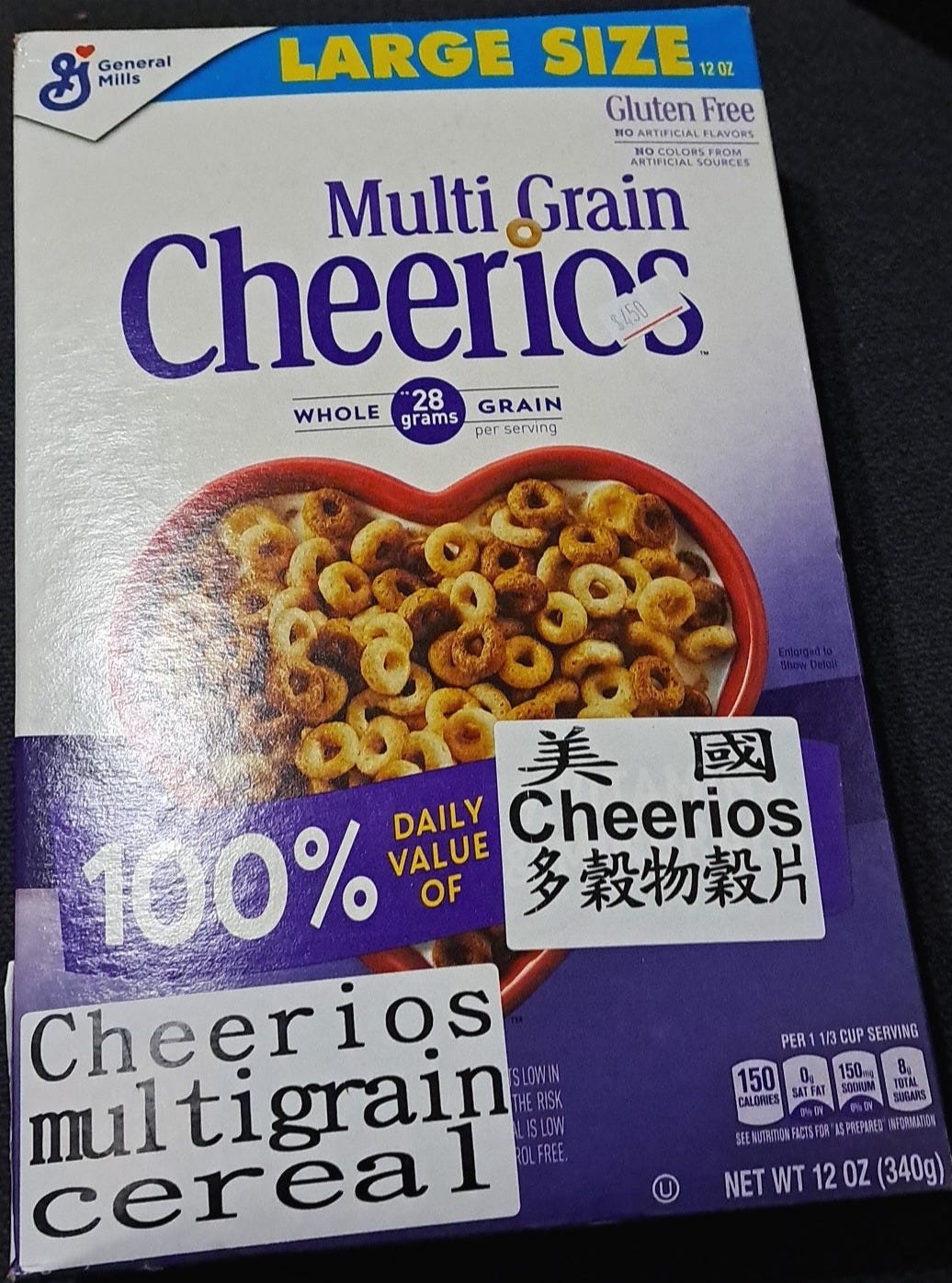
I discovered Costco 好市多 used to sell HNCs, until it became clear that Cheerios are even less profitable than other cereals due to the quirks of Taiwanese advertising law. You see, every box of Cheerios is plastered with slogans like “can help lower cholesterol” and “may reduce the risk of heart disease.” In Taiwan, it’s illegal to make claims like that in food advertising, so if Costco wants to sell Cheerios, an employee first has to take a marker and strike out all the illegal claims on every box before the product can be put on the shelves. You can see why they switched to Froot Loops.
I did eventually find a small imported snack store selling exorbitantly priced Cheerios with stickers covering the offending text. I bought a box, but discovered my tolerance for sugar had changed since leaving America, and my beloved HNCs were now way too sweet for me. I guess that’s why it’s illegal to imply this cereal is healthy.
Taiwanese-Style Cute
I’m standing in line to pay a bill at 7-Eleven (a.k.a. “Seven”). I feel truly ashamed at how much I want to adopt this piece of plastic.
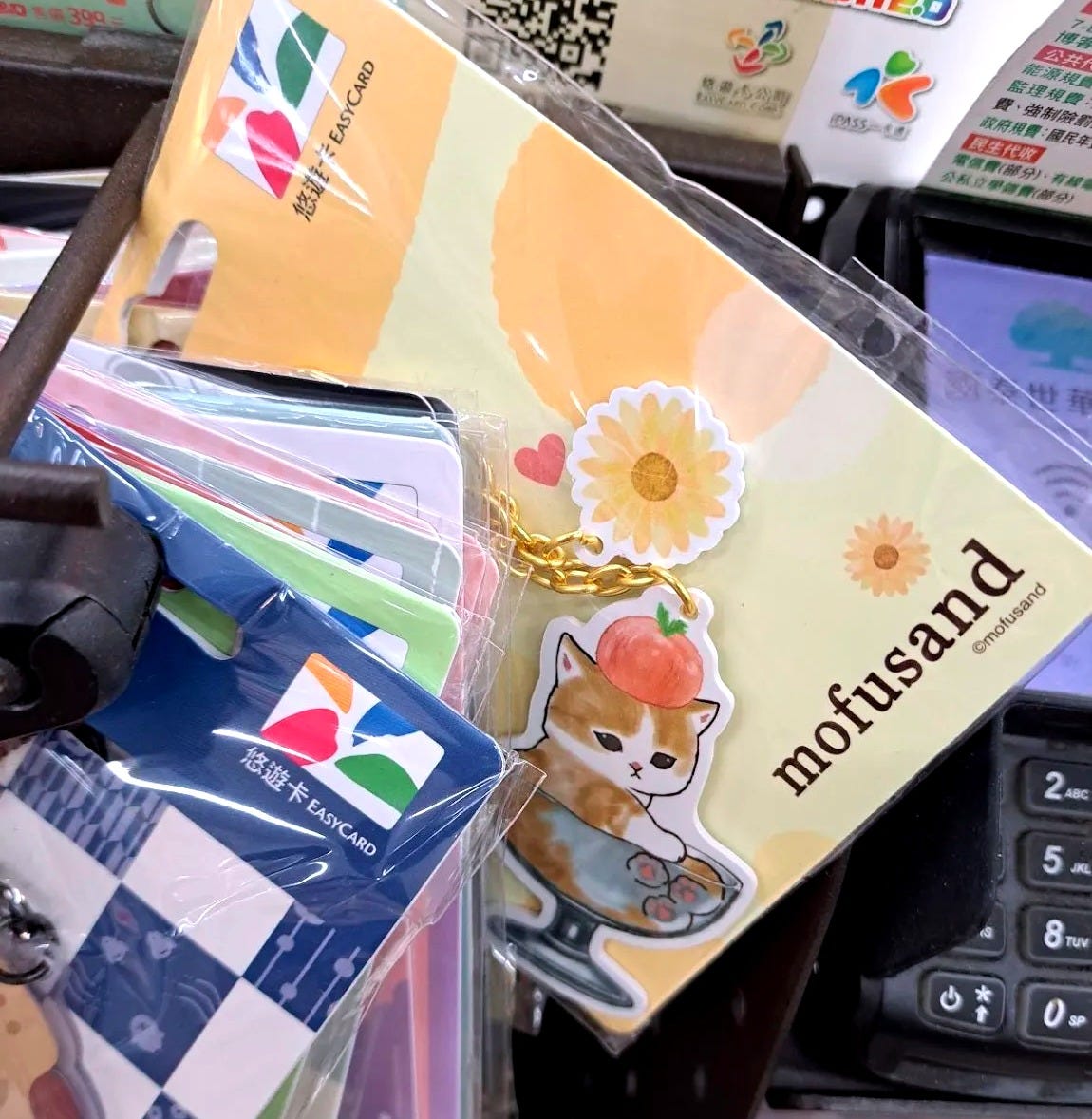
It’s a metro card. I already have a metro card. But this one has a sad Japanese kitten on it. What is so appealing about the combination of kittens and fruit? Is this what drives people to cat cafés? Luckily, I reach the front of the line before I can talk myself into buying it.
Elements of cuteness are sprinkled all over Taiwan. Some argue that cute culture is widespread because it blunts the impact of low wages and long hours. Others argue that Taiwan is drawing inspiration from Japan, the island’s former colonizer, but Taiwanese-style kě’ài 可愛 (literally, “lovability”) has clear differences from Japanese kawaii culture.
For example, these are the mascots of the consular affairs bureau:


I would have enjoyed the DMV in America way more if they had fun little mascots like these.
Japanese government offices mostly don’t use kawaii tactics in their PR campaigns, so why does Taiwan? My theory is that cuteness in Taiwanese society is a knock-on effect from spending decades under martial law, which was only lifted in 1987. Perhaps friendly mascots were a low-cost way to increase trust in government services post-democratization. Here are some more examples:


Likewise, the Taipei metro uses little anthropomorphic Shiba dogs to deliver polite reminders to passengers:

Compare with the markedly not adorable mascots on the Singapore metro:


Cute branding has even become central to political campaigns in Taiwan. Line, the most popular messaging app on the island, hosts a sticker pack featuring President Lai Ching-te:
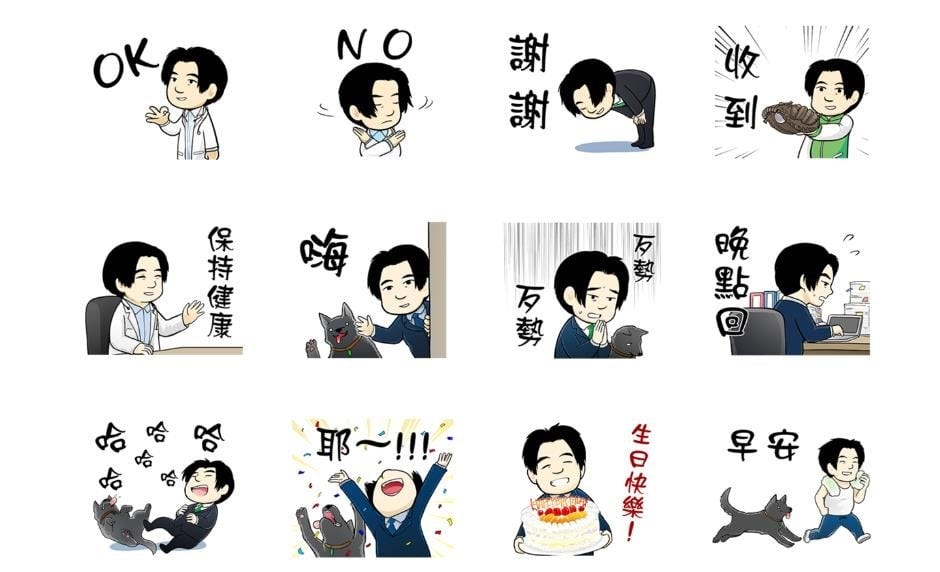
This tradition began with Chen Shui-bian, who sold a commemorative doll of himself named A-bian 阿扁 during the 2000 presidential campaign. Chen was later imprisoned on corruption charges.
The Meerkats
My Taiwanese friends and I decided to take a weekend trip to Chiayi 嘉義, a city in central Taiwan. We were walking around the old Japanese train station when I spotted a middle-aged Taiwanese uncle walking his two pet meerkats.
I found this to be incredibly delightful — the meerkats wore tiny little harnesses hooked up to a retractable leash. They were scrambling around, taking in the excitement of the bustling train station, while their owner just stood there scrolling on his phone.
I burst out laughing and turned around to ask my friends how to say “meerkat” in Mandarin (they’re called 狐獴, “fox mongooses”). When I looked back a second later, the meerkats had found a super wrinkly obese dog to play with.
I turned back to my friends, wheezing from laughter with tears in my eyes,1 and asked, “Is it common to keep meerkats as pets in Taiwan? How am I the only one being affected by this?”
They looked at each other with blank expressions and shrugged. “This is just how we react to stuff.”
I thought back to this moment in April 2024, when the 7.4-magnitude earthquake centered in Hualien rippled across the entire island. Once the shaking had stopped, I looked out the window of my Taipei apartment onto the market below. No one was screaming or panicking — the aunties just picked up their wheeled grocery carriers and continued walking. “This is just how we react to stuff.”
New Year’s in the Countryside
For Lunar New Year, we always go to visit my husband’s paternal grandparents. They live in a little farming community called Lukang 鹿港, “The Deer Port,” so called because deer skin and meat were shipped out of this settlement during the Dutch colonial period. Lukang was once the largest city in central Taiwan, but has depopulated in large part because it doesn’t have a rail station. But this sleepy town roars to life during the New Year, when the children and grandchildren who migrated to larger cities for work come back to Lukang to celebrate.


My husband’s grandparents live on a small farm granted to them by Chiang Kai-Shek’s land redistribution policy (耕者有其田, literally “the tiller has his own land”). Their names are Japanese, since they were born during the colonial period, and they mostly cannot speak Mandarin or read Chinese characters. Other family members are kind enough to help translate from Hokkien so I can communicate with them. I once asked Grandpa what he and his wife liked to do for fun in the countryside. “We love to go out and vote!” he said proudly.
Grandma’s teeth aren’t great, so one year I brought American-style mashed potatoes and gravy to LNYE dinner for her, and we’ve been friends ever since. This year, when we were saying goodbye, I asked if I could hug her for the first time. “My coat is all dirty…” I told her I didn’t mind and hugged her anyway. We both started tearing up. “When will you be back?”
Green Island
Taiwanese people don’t really collect sea glass — and that lack of competition makes beachcombing here super rewarding. But when my husband and I took a family trip to Green Island 綠島 off Taiwan’s southeastern coast, my mother-in-law cautioned me against bringing any sea glass back to the mainland. Green Island, she explained, housed a political prison during the martial law years (which is now an excellent museum), and she was worried a tormented spirit might be attached to the glass I picked up on the beach.
We spent the weekend wading through Green Island’s tide pools, eating freshly butchered young tuna we caught ourselves, and enjoying one of the world’s only saltwater hot springs. And of course, when we went to the beach, there was tons of beautiful sea glass.
I wasn’t sure about bringing the sea glass home (it’s better to just do what my mother-in-law says), but I was still picking it up since the hunt is half the fun. But that changed when we found a piece of sea glass with a Chinese character embossed on the front.

This character is 維 (wéi). It’s my husband’s name. There was no wei I wasn’t taking it home.
There is no special subset of characters used only for names — those same characters appear in words too (my Chinese name, for example, means surplus flowers 盈莉). So out of all the tens of thousands of Chinese characters, this piece of sea glass happened to have exactly the right one. It’s probably a fragment of an old bottle of liquid vitamin B12 (vitamin in Mandarin is 維他命).
While Americans often have a room in their house dedicated to tools for their hobby of choice, Taiwanese people rent tools at maker spaces and create things there. Back in Taipei, I made an appointment at a metalworking studio and soldered a silver bezel for my Green Island treasure.
Dogs
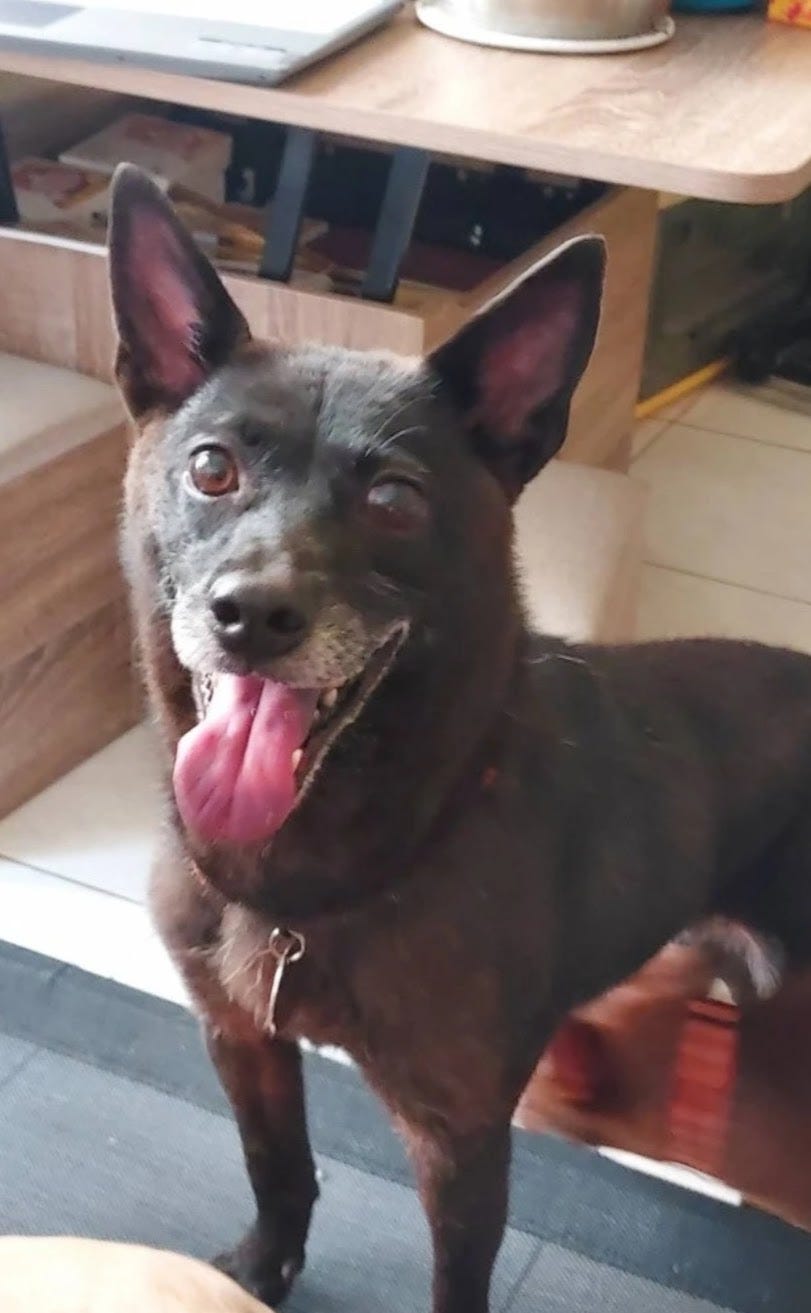
Nearly all of the strays here are mixed Formosan mountain dogs (台灣犬). They’re wicked smart — not surprising when their ancestors helped Taiwan’s Indigenous people hunt wild boars in the jungle. I considered adopting a shelter dog after I got my bearings in Taiwan, but it felt wrong to take an animal that’s basically smart enough to do algebra and force it to live in an apartment. Since then, I settled for just petting dogs on the street instead. Enjoy this picture of the dog I almost adopted:
Leaving Taiwan
Right before Lunar New Year 2026, Alex Colville of CMP and I decided to do some coworking near Jingmei Station. Taipei was rapidly depopulating as the holiday approached, but we managed to find a cafe still operating. We ate strawberry macarons and drank milk tea with dried flowers until it was time to pack up and eat vegan Vietnamese food for lunch. When it was time to head home, I missed the bus and decided to walk back to my apartment in the perfect February weather. This was a Friday evening just before sunset, and my husband and I would leave for America in two weeks. As I walked home, I thought about all the late-night running I had done along the Jingmei River, and all the tuna rice balls I had eaten at 7-Elevens all over the island, and all the times I played passenger princess on the back of a scooter. I thought about the lovely people who worked at the restaurants I frequented — who knew my order and my country of origin and my favorite things about Taiwan — and all the times I’d talked politics with taxi drivers, learning new words to describe corruption and the housing crisis and martial law, and, and, and…
and I started to cry. I had joyful experiences interacting with Taiwanese people pretty much every time I left my house — and it felt meaningful to represent my country positively. I felt guilty for all the times I had worked from home instead of in a cafe.
The people of Taiwan have taught me so much, and I’ll always be grateful that Taiwanese society embraced me wholeheartedly even when I was just a lowly cram school teacher. And that’s why it feels so tragic when my life in Taiwan gets reduced to ominous news headlines by people who don’t live here.
If you haven’t been to Taiwan yet, I sincerely hope you have the opportunity to go soon.


