
A DeepSeek researcher’s personal blog post recently went viral. On September 13, after DeepSeek V4.1-Flash was released, researcher Liu Shengyu 刘胜与 reflected on how humans might live alongside AI systems with superhuman abilities:
As AI develops, future society may trend toward one of two extremes: communism, or Cyberpunk 2077. In the former, the productive forces are enormously liberated and people’s standards of living improve markedly (let’s stop here; I’m worried this won’t clear the censors otherwise). In the latter, a few tech companies control the bulk of resources; only a tiny minority can access the most advanced AI and assorted technologies, achieving something close to “machine ascension,” while everyone else makes do with feeble AI.
Liu specializes in kernels and is passionate about the craft. He remarks with frank resignation that, “give it another six months or a year, and AI-written kernels will most likely be just as good as mine, if not surpass my work.” So why does he keep working on this? Simply put: the race dynamic.
If I were to slack off at this point, or even deliberately throw sand in the gears to hold up model training, other companies’ models would develop all the same and would kill off my career in the exact same manner in the end. … When everyone is this fixated on destroying themselves, I have no choice but to join the cruel arms race, too.
Liu deeply mourns losing his edge over AI on the kernel optimization work that he’s spent years perfecting. He says that in the near future, he expects to have to pivot to working as a kind of “mecha pilot” 机甲驾驶员 for agents in order to remain employed.1 In the meantime, he has a shockingly forthright warning for everyone else:
If Anthropic controlled the world’s most advanced AI forever, care to guess whether future society would turn out communist or 2077? Go on, guess.
So I still believe that the most frontier intelligence should be supplied to everyone, in an open and cheap way. I don’t trust Anthropic or OpenAI to do that. I especially don’t want Anthropic controlling the most advanced artificial intelligence or AGI. To put it dramatically, the severity of that would be no less than letting Hitler get the atomic bomb before the Allies. This is also why I chose DeepSeek and have stayed: we research powerful, fast, universally accessible AI and open-source it, and perhaps that can pull the world back a little from the 2077 end.
It’s obviously abhorrent to liken anyone not guilty of crimes against humanity — let alone someone with a Jewish mother — to Adolf Hitler. Liu, however, probably sees his comparison as a fair rebuke, given Amodei’s maximalist accusations against the Chinese system. As of September 18, his article remains available on his WeChat blog and has received sympathetic coverage in prominent Chinese media outlets like Huxiu, 36Kr, and state-owned Yicai. DeepSeek has not commented in support of its researcher, but neither has the lab asked him to take it down.
On Zhihu and Xiaohongshu, where China’s tech communities gather online, as well as in the blog’s own comment section, the tone is overwhelmingly supportive. People say that DeepSeek has shown the most commitment to “an inclusive vision”; that Dario Amodei’s talk of major AI risks is an alarmist dead horse; that OpenAI and Anthropic are “wantonly destroying all that is beautiful” to “undermine the foundation of Babel”;2 and that Anthropic, in particular, is “techno-fascist” and “barely human.”
The very group that has the closest — and, arguably, the most humanizing and nuanced — contact with the American AI community is starting to conclude that the latter is motivated by nothing more than anti-Chinese ideology.

How did we get here?
Before AI governance seemingly reached a boiling point, on the sidelines of ICML this summer in Seoul, I had a casual exchange with a Chinese attendee. My interlocutor, while not a technical expert, has had a career in the vicinity of AI for years. He reads machine learning papers, travels extensively, and works closely with researchers.
When the conversation moved to geopolitics and I explained Dario Amodei’s worldview to him, he was completely baffled. I told him that as far as I understood it, the CEO of Anthropic is deeply committed to liberal democracy as a preferred system to authoritarianism; therefore, since AI is possibly a technology that increases productivity and national power at exponential scale, democracies should do everything possible to ensure dominance in this technology. One (democracy) plus one (AGI) equals two (export controls against China). “It’s this straightforward? Then … nothing else?” He found the simplicity of this idea almost too implausible to entertain.
If you live in the Bay Area, DC, or simply learn about AI and geopolitics from the American angle, you probably do not find it difficult to imagine that Dario Amodei holds these two beliefs sincerely. The earnestness of this discourse is first rooted in effective altruism (EA), a movement dedicated to the pursuit of objective good through rationality.3 And on the East Coast, AI has now opened up an opportunity for DC politicos to realize ideological ambitions: the idea of a technology that secures America’s place in the liberal international order is simply too tempting. EAs and hawks may see each other as strange bedfellows, but two elite pillars of America have united around some profound convictions.
Chinese interpreters of this discourse, by and large, struggle with the depth of American belief. As I’ll discuss later in this article, political analysts in Beijing look to balance sheets and polls to understand why American corporate leaders, technologists, and politicians act the way they do. They marinate in the same discursive environment as American tech policy thinkers — Twitter feeds, blogs, papers, and competing narratives — but they filter that same information through a distrustful lens. Long accustomed to a conspiratorial worldview (which originated from the Maoist decades), they look for evidence of a well-coordinated, anti-China plot. Their methodologies aren’t wrong, but they often miss the wholehearted convictions and internecine conflicts behind American dogma.
Chinese technologists, on the other hand, were raised in an internationalist milieu. Until recently, they believed that techno-utopian aspirations and business pragmatism united them with their US counterparts. They are discovering now that some Americans truly see themselves as fighting a new Cold War. As we’ll cover later, their response to this realization is furious — and, increasingly, radical.
I am not suggesting that Chinese thinkers lack ideological convictions, whether about AI or other social and political topics.4 Nor am I arguing that American AI policy is led entirely by ideology; no trillion-dollar business builds itself without leveraging the pragmatics of capitalism and quotidian stakeholder interests. But over the past two weeks, we have seen Jacob Coxon’s resignation from Anthropic inject actual fear into the heart of mainstream American society, while China regarded the events skeptically from afar. It’s worth understanding why.
I wrote in our previous coverage of the Hugging Face incident that China is seeking to re-narrate AI safety. Leaving the definition of safety to Washington and Berkeley, in its view, gives up a competitive edge in the realm of ideas at a time when the technology is still in its adolescence.
On September 12, Chen Yixin 陈一新, Secretary of the Party Committee and Minister of State Security, published a major article in China Cyberspace 中国网信, a magazine run by the Cyberspace Administration of China. Many other analyses have emphasized the core message of the piece, one that hasn’t changed since the Chinese state began articulating its stance on AI but that should now be uncontroversial: the regime’s political security reigns absolutely paramount, and threats to any aspect of China’s economy, society, and people will be viewed through that lens.
Early on in the piece, he articulates the “good AI future” that the Party aspires toward:
We must keep the welfare of all humanity in mind, promote the healthy and orderly development of artificial intelligence towards a beneficial, safe, and fair direction, make the satisfaction of people’s aspirations for a better life the landing base of scientific and technological innovation, push forward with closely integrating AI with safeguarding and improving people’s livelihoods, and address pain points and difficult problems in areas like education, healthcare, elder care and transportation.
The CCP roots its political success in the mass line. The idea emphasizes real-world conditions: theory becomes policy only when refracted through sufficient collection of people’s experiences and centralized by the Party apparatus. If AI proliferation is theory, then the next step is to bring it to the people and have it ripple through society under the supervision of the Party. The Party, through its prerogative of interpretation, will finally reach policy decisions after the fact. Beijing is certainly aware of potential risks, but will also not sacrifice the opportunity to direct AI proliferation on its own terms. So China will not refrain from deploying a potentially useful technology simply because another country, pacing the frontier, fears hypotheticals.
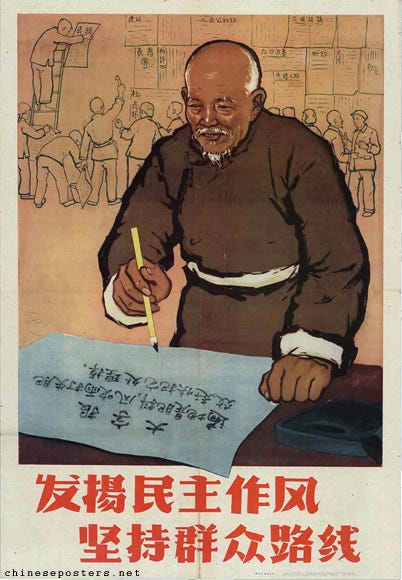
Chen, instead, takes the United States to task over Washington’s prioritization of its own interest:
Certain countries are exploiting the advantages they have accumulated in areas such as basic AI theory, model architectures and core computing power. In the name of “protecting national security,” they use methods such as creating entity lists, applying technology controls, monopolizing industry standards, and establishing closed-source ecosystems to strictly restrict relevant countries from importing cutting-edge technology and equipment and improving their scientific and technological innovation capabilities. This severs global AI industrial and supply chains and worsens imbalances in the development of the global intelligence industry.
Pay attention to the rhetorical device of “in the name of” 以 … 之名. It recurs frequently in Chinese policy writings, when discussing what Beijing casts as the ultimate motives of US actors. Beijing pushes the same grand-conspiracy narrative on many topics. Covid-19 was a Western alarmist narrative before it was a real pandemic.5 Forced labor in Xinjiang was the product of Western media and governments conspiring to push out Chinese textile exports.6 The Hong Kong protests were a United States-led conspiracy to turn Hong Kongers’ grievances into separatism such that China would be weakened. EU trade measures were a conspiracy to discriminate against Chinese goods in the name of balancing trade deficits.
Chinese Communist leaders since Mao have used the same rhetorical practice to criticize enemies. Born from complex early-20th-century internal struggles and isolated on the global stage until the 1970s, Beijing has frequently rested its analysis of international conditions on the assumption that there are covert interests behind what Western powers openly articulate. For instance, in September 1939, after the signing of the Nazi-Soviet pact, Mao argued in an interview that the United States was staying out of the war “in the name of neutrality,” while planning to eventually install itself as leader of the capitalist world. Deng Xiaoping, criticizing the Soviet Union in 1974, called its system “socialism in words and imperialism in deeds.” The pursuit of unspoken ulterior motives remains a powerful impulse in Chinese analyses of international affairs today.
Most of the time, Beijing wins in storytelling to its domestic audience. Nationalists see China as unfairly targeted wherever it goes, held to impossible standards simply because the West cannot tolerate its rise. But other voices in China have consistently worked to complicate that narrative at home. Pandemic controls ended with people on the streets, demanding that China rejoin the world. Recently, a group of young Chinese workers leveraged European supply chain labor regulations, tightened in the wake of Xinjiang revelations, to complain to Volkswagen and Mercedes-Benz about unfair dismissal practices by their Chinese employer, an auto parts supplier. A small, courageous minority of mainlanders openly backed Hong Kong in 2019; since then, many more Chinese have been deeply disappointed in the financial hub’s trajectory, as economic malaise became the real domestic story of post-Covid China.7

Previous state-led conspiracy narratives have relied on conjuring tenuous partnerships: that between Western journalists and their home countries’ governments, between Hong Kong’s democracy advocates and foreign organizations, and between European companies and the European Union. In reality, these relationships were far less substantial than what Beijing argued. But this time, Washington and Silicon Valley have publicized their relationship from the beginning. Dario Amodei has posted six times on his own blog, and every single one advocates for export controls to China.8 Most of the national security community’s evidence for Chinese distillation was supplied by Anthropic itself, rather than the result of FBI investigations or Congressional inquiries. American AI labs may see these disclosures as profoundly progressive moves by a new generation of industry leaders who care about accountability. To China, however, they look like coordinated plots between Washington and Silicon Valley.
Back in June, the People’s Daily (the CCP Central Committee’s official newspaper) published an op-ed by Beijing Institute of Technology law professor Xiao Junyong 肖君拥. Xiao researches national security, technology governance, and the concept of human rights in the Chinese context. The piece is a stock example of applying the aforementioned conspiratorial worldview to AI safety discourse:
On close examination, the operating logic behind this “Build American AI” push is directly inherited from the “China threat” theory playbook of the past.
First, set up a target. Standardized talking-point templates are distributed, casting Chinese AI as the “principal external threat,” claiming it will harvest the public’s information and squeeze Americans out of their jobs.
Second, deflect internal contradictions. America’s leading AI firms are facing real pressures — high energy-consumption costs, controversies over job displacement — and by hyping up an external threat they steer the focus of domestic public opinion toward China.
Third, secure resources. These companies are priming the atmosphere ahead of upcoming elections and pushing Congress to increase federal subsidies and loosen regulation of the sector. This is cut from exactly the same cloth as the old drumbeating about the “China military threat” to drive up defense spending, or politicians hyping the “China Shock” to push through trade protectionism.
Xiao is conflating the techno-accelerationists with the safetyists. Dario Amodei certainly hasn’t been asking for federal subsidies, while David Sacks was tweeting about the “AI JOB LOSS HOAX” as of December 2025. Of course, the distinction matters to those inside the Chinese system whose job it is to actually negotiate with the Americans: they’ve followed Anthropic’s uneasy dynamic with the Department of War, and they will want to understand the subtleties of p(doom), “woke AI,” and lobbying. But for Beijing’s overall messaging, the distinction doesn’t matter at all. To quote China Daily’s September 14 editorial, the American “corporate ‘alliance’” is in the midst of a “coordinated play,” and the call to pace the frontier “sounds rather like a club whose membership rules have been drafted before the guest list is announced.”910
In the Party’s eyes, everyone from MIRI to Marc Andreessen is in cahoots to keep China down.
In a Zhihu thread discussing Jacob Coxon’s claim that frontier labs are “gambling with our lives,” the top-voted reply said, “Then I hope they do it faster and stop talking such a big game. Have they cured diabetes? Parkinson’s? … Is fusion energy ready?” Another goes, “It’s the same old act. Every time Anthropic releases a new model, they have to threaten humanity. Every time OpenAI releases one, they say they feel like they’ve just watched a nuclear bomb detonate.”
A few responses express genuine fear about AI’s trajectory, but see individual actions like Coxon’s as meaningless in the face of toxic competition dynamics.11 I find it difficult to imagine Chinese observers warming to his position. Nationalist tabloids and influencers interpret this newest round of safetyist media campaigns as yet another overplayed trap by Americans, aiming to trick China into giving up.
More sober reporting by specialist tech media, as well as a minority of Chinese commentators sympathetic to Coxon, entertain the premise that AI could bring about unprecedented harms. But they don’t take themselves as Coxon’s constituency. Rather, they assume that China’s AI labs are still operating under comprehensible levels of human control, because the government simply would not permit the proliferation of any capability beyond what it can keep leashed. They deduce, therefore, that any sci-fi dystopia will come from the American side — and Americans keep saying that exact thing. What is there to do other than poke fun at the circus?
Coxon, in other words, is turning into the boy who cried wolf. This is hard to stomach for effective altruists and liberal internationalists alike. But excessive belief in the power of sincerity, in part, brought us here: as Coxon’s tweet above (and responses to it) demonstrates, many still seem to think that if only they discuss AI risks with enough candidness and incur sufficient personal costs, they will bring unbelievers to the table. Costly sincerity, however, doesn’t negate the basic condition of US-China competition. To those already deeply skeptical of American motivations, simultaneous resignations, antitrust loopholes, and OpenAI fundraising rounds are just more evidence in favor of the existence of a grand conspiracy.
State media is replicating its familiar playbook to address the AI race. They’ve been extraordinarily successful inside China. The public, of course, is on the side of its own fast-following labs, and the self-evidently virtuous narrative of open source doesn’t hurt either.
There is something more alarming, however. Chinese researchers, on the frontlines of building dangerous capabilities, are finding their own way to even more radical conclusions than what the Party is suggesting. Liu Shengyu’s essay is a case in point. So are calls to boycott Anthropic and dismissive interpretations of AI safety warnings.
Are the youngest of China’s AI researchers radicalizing themselves against cooperation with the United States — and against the Western-led enterprise of AI safety altogether? It may seem weird to suggest that a highly educated, internationally connected group of elites could coalesce around extreme ideas completely disparate from their stateside counterparts — but Liu’s essay and its reception should trouble anyone who believes that Chinese actors are essential to navigating the transition to a world with much more powerful AI systems. Not only do they seem to find a race to the bottom inevitable, but they have also internalized Western discussions of authoritarian AI threats as a coordinated attack on their right to technological advancement. Their trepidations around becoming footsoldiers of the national project are dissipating. The Party’s conspiracy is now the technologist’s own.
Liu received PhD offers from Carnegie Mellon University and UC Berkeley when he graduated from Peking University in 2025, but decided not to attend due to financial circumstances. In another life — perhaps if he were born a few years earlier, had applied to graduate school before US visa policies became drastically more restrictive, and his family hadn’t yet experienced hardship due to China’s housing crash — he might be here in the United States, maybe even working at OpenAI or Anthropic over the summer. That’s not the world we live in anymore. For folks like him, American labs are now humanity’s Goliath.
China’s views on American AI have grown more cynical as it has taken center stage. That doesn’t need to make us pessimists about AI safety coordination. In fact, being honest about the nature of the bilateral relationship might make useful actions easier to pursue. Concordia AI’s newsletter recently featured a press readout from Wang Lihong 王丽宏, a senior official at the Cyberspace Administration of China (CAC). Gabriel Wagner reminded me that, apart from “technological hegemony,” all the other AI governance challenges Wang highlighted — inherent unreliability, misuse in biology and cyber, and increasing autonomy — are echoed exactly by Amodei himself in his blog post titled, “The Urgency of Interpretability.”
Someone at the CAC is reading his essays; export controls aside, they want to learn how to win in safety as well. That competitive instinct shows up in the Chinese foreign ministry’s 2023 Global AI Governance Initiative communiqué, which called for improvements to “explainability and predictability” so that “AI always remains under human control.” The pro-global framing of the document was not merely lip service to China’s developing-world partners. Xi Jinping himself said so back in July at the World AI Conference: China, in his mind, is a “responsible major country” that’s taking a lead by organizing around multilateral institutions. Beijing wants to be seen as the more conscientious actor, and it is willing to take material actions — not just finger-pointing at Washington — to achieve that. These announcements are a warning to China’s own AI industry as well: let out a loss-of-control incident, and you’re not just burying your own futures — you’re tainting the nation’s all-important reputation.
The first time Dario Amodei publicly discussed his China views was probably on the Dwarkesh Podcast in 2023. He told Dwarkesh that Baidu’s Silicon Valley AI Lab, where he was from November 2014 to October 2015, was a “mostly Americanized lab” and that he never went to China.12 When Dwarkesh asked how China thinks of AI safety, Amodei said that if China sees AI “as a source of national power,” they’re going to strive for optimization in a way that “could lead them in the direction of AGI.” Then, he said there was an internal Anthropic joke that if they really were on track to AGI, they would build it in an underground bunker disconnected from the Internet. “Los Alamos-ing it.”
Races aren’t always aimed at the bottom. What does a truly grounded strategy to engage China look like? What would it mean to take competition as an ongoing, evolving fact, rather than thought-terminating cliché? Because it’s too late for the bunker now.
Thanks to Nathan Lambert, Julian Gewirtz, Afra Wang, Helen Li, Nicholas Welch, and the ChinaTalk team for thoughtful feedback!
“Mecha” is a science-fiction concept, describing giant walking robots which may be sentient to different degrees. While its origins and manifestations vary, the concept most prominently proliferates in Japanese manga. A mecha pilot rides a mecha. Liu himself is known to be an anime convention attendee.
I took some liberties to translate 焚琴煮鹤, a Chinese idiom which literally means “burning the zither and stewing the crane,” as “wantonly destroying all that is beautiful.” The phrase, while of uncertain origin, has been in use since the 12th century.
As its ideas spread, it has even reclaimed manosphere slang to demonstrate sincere belief among a younger audience raised on internet cynicism, with people describing themselves as “pilled” on subjects like AI alignment or animal welfare.
Lest we forget two facts: China is run by a Communist Party whose court thinkers work day and night to marry the intellectual heritage of Marx, Lenin, Stalin, and Mao with the world today, and generations of Chinese people have been moved by nothing other than ideas to liberate, oppress, depart, return, and create.
From Hua Chunying 华春莹, then-Chinese foreign ministry spokesperson (and now Vice Minister of Foreign Affairs), on February 3, 2020: “To date the US government has not provided China with any substantive assistance. Instead, it was the first to pull its consular staff out of Wuhan, the first to propose withdrawing some of its embassy personnel, and the first to announce a blanket entry ban on Chinese nationals — continually manufacturing and spreading panic, and setting a very bad example. Even American media outlets and experts have questioned the US government's measures, noting that ‘the restrictions the US has imposed on China are precisely what the WHO opposes, and the US is swinging from overconfidence to panic and overreaction.’”
Also from a Hua Chunying press conference, on June 24, 2021: “[The United States and the West] are trying to fabricate lies like ‘forced labor’ to create ‘forced industrial decoupling’ and ‘forced unemployment’ in Xinjiang to suppress Chinese companies and industries to serve their malicious agenda to mess up Xinjiang and contain China. There is no ‘forced labor’ in Xinjiang, only voluntary employment and free choice in the labor market.”
In 2023, Chinese social media users made a meme out of visiting Hong Kong post-Covid, calling it “touring the ruins of a former international financial center.” More personal reflections by mainlanders on what Hong Kong means/meant to them: by veteran LGBTQ rights journalist Lu Ruihai 路瑞海 here, and by Chow Hang-tung’s Guangzhou-based partner Ye Du 野渡 here.
China Daily is an English-first state-run newspaper, and the editorial has yet to be published in Chinese as of September 15. That means the intended audience is explicitly foreign.
A quick note: I wrote the above section before listening to Matt Sheehan’s episode on The Ezra Klein Show, in which Matt makes the same point about the PRC’s conspiratorial thinking. Hopefully this provides more evidence in favor of Matt’s argument!
Coxon himself would disagree. In fact, he says one of his biggest points of disagreement with Anthropic’s leadership is over its pessimism about the prospects of a US-China détente.
While at Baidu, Amodei was first author of a paper that was presented at ICML 2016. The work showed that an end-to-end deep learning approach for speech recognition models worked on English as well as Mandarin, without the need to develop custom pronunciation models or other specific adaptations for each language.