
Frank Kendall served as the 26th Secretary of the Air Force from 2021 to 2025. Before that he was Under Secretary of Defense for Acquisition, Technology and Logistics under Obama. His new book, Lethal Autonomy: The Future of Warfare, comes out in June. He joined Second Breakfast on March 6th, six days into the US-Israel campaign against Iran.
This transcript has been edited for length and clarity.
In this conversation:
Why the Iran campaign has already hit the limits of air power — and what the Scud hunt of 1991 tells us about mobile missile hunting today
Interceptor stockpiles, shot doctrine, and the Patriot/THAAD production crunch
Why this conflict is the wrong war to learn lessons from for a China fight
The third offset strategy, range-quantity-autonomy, and what we still haven’t built
Why defense tech hype keeps failing: “Nothing is fielded in the United States military until a service wants to buy it. Period.”
Sunk costs, the JROC as parochial protection racket, and what breaking up AT&L actually cost
The Anthropic-DOD standoff: what the contract dispute is really about, and why the supply chain risk designation is an abuse of power
Listen now on your favorite podcast app.
Iran as a DIB Stress Test
Jordan: What themes has the first week of this conflict illustrated about the state and potential future of the defense industrial base?
Frank Kendall: Ages ago, Don Rumsfeld said you go to war with the force you have — something to that effect. That’s generally the case. You stockpile ahead of time. If you’re in a long conflict, of course, you can order things. Ukraine has been dealing with a situation where they’ve had to adapt to very significant changes in warfare very quickly.
Basically, the situation we have is a force that’s spread around the world. It’s very large and has an enormous amount of capability, but it does have finite stocks of some things. The war has gone pretty much as I would have expected. We achieved some degree of surprise. We were able to take out a lot of the higher-value targets, including, of course, the leadership immediately. In the first few days, we prosecuted targets that were generally fixed targets that we knew about ahead of time and could plan for.
We’re moving into a very different phase right now. The leadership has been alerted, the country’s been alerted. They’ve distributed their assets as much as they can. Some of them are hardened, some are just concealed. There may be decoys out there. We’re now in a more difficult phase where we’re going to be focusing more on tactical targets.
There’s an open question in my mind as to how much we should or will go after economic targets — things that are part of the infrastructure. It looks like we’re doing some of that now too. We’re certainly going after the industrial base that supports their military.
The things that we would worry a little bit about in terms of quantities are, first of all, the precision longer-range standoff munitions, which are pretty expensive. They’re pretty exquisite devices — very specialized, built by our industrial primes that have a lot of experience doing exactly that kind of product because that’s what we’ve demanded of them.
As we get into this, using those against a target you think is a truck that might be carrying a missile or an individual shelter gets kind of expensive. You want to shift to the shorter-range, less sophisticated, and much less expensive weapons like JDAMs — Joint Direct Attack Munitions. It’s a GPS-guided bomb. We have a lot of those and they’re relatively cheap, so we can keep this up for quite a long time.
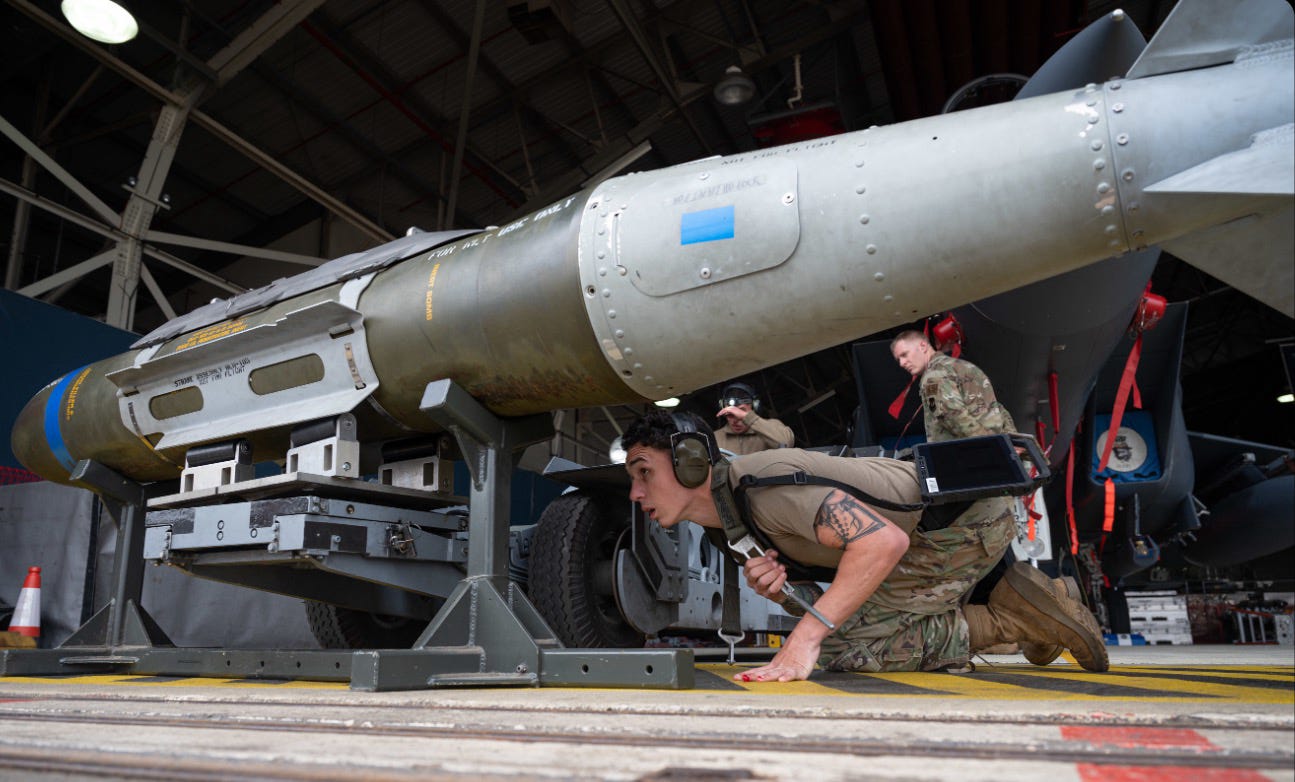
But the target set is now distributed into much less valuable items. If we have great intelligence, we may be able to find out where some of the leadership is and still go after that. But we’re going to be dependent upon really good intelligence to be able to do that.
Anyway, we’re now in a situation which could endure. It depends a lot on what the political situation is in Iran. How prepared they are to cut a deal that Donald Trump will accept. My guess is he would accept a deal that basically he can state, at least, meets some of his objectives. He does not want a long war here. He campaigned on not getting us into or having long wars. Both sides are highly motivated to bring this to an end. But the Iranians can keep this going for a while if they choose to. There could also be a popular uprising, and we could have an issue there.
I don’t see our industrial base having a big problem with that. The president’s going to have a meeting with CEOs today, as a matter of fact, and he’ll encourage them to go faster. There’s only so much they can do. Some of the new entrants have claimed a lot of flexibility and ability to do things very agilely. I don’t think that’s on the kind of time scale we’re talking about here. We’re talking about months, at least, and for the major, more sophisticated weapons, it’s a couple of years lead time.
For less expensive ones, we can cut that down to a few months probably, assuming the supply chain can support you. It’s not just the primes, of course. It’s all the things that go into a weapon that have to be built and assembled to put it together.
Jordan: I want to come back to the idea of going from more strategic to tactical targets because you’ve run out of the most juicy stuff to blow up. Even if things go great, we’re going to hit the limits of air power pretty soon.
Frank Kendall: We’re hitting them.
I was in the Pentagon. I was a deputy director of defense research and engineering for tactical warfare programs 30-odd years ago for the first Gulf War. We couldn’t find Scuds. I don’t know that there’s a single engagement where we successfully found a Scud on a mobile launcher and killed it before it was able to launch.

The fundamentals of that really haven’t changed. A truck’s a truck, right? And you can keep it so it’s not observable. Bring it out when you think there’s no airplanes around, when you have some confidence because your own sensors show there’s no airplanes around. Get a launch off and then hide it again.
We’re going to suppress this threat, and we are. I haven’t seen any good numbers on how many launches per day, but they’re still getting off a mix of ballistic missiles and UASs and maybe some cruise missiles even. The volume of fire they can generate is not decisive. I refer to it more as harassing fire, and that’s kind of what it is. It’s going to inflict some casualties, it’s going to do some damage, but it’s not militarily significant.
We’re doing something on the other side of that coin, which is hunting things and killing relatively low-value targets. That’s not necessarily going to break the back of the Iranian military.
The economy, on the other hand — we can bring their economy down pretty effectively. We can stop some of the services. Internet’s off, I think, already. I’m not sure where power is in general. Transportation networks, things like that. That’s going to hurt the Iranian people. And it may be another impetus for them to rise up and do something about the government. I don’t know how much appetite the country has to absorb that kind of punishment. It’s not a popular government, and we just saw that, but it’s also a ruthless one. They have the weapons and the will to put down any kind of unrest.
The other side of the coin is hard to predict too, because nobody in the Persian Gulf right now is enjoying the fact that weapons are coming into their country and attacking them. It’s in everybody’s interest to get this over with and finish it somehow. But both sides have the capacity and capability to continue for quite a long period of time.
Justin: The Iranians proved from 1980 to 1988 that they would persist. Qatar has already announced they’re shutting off production because they can’t ship oil out. There are substantial economic impacts that Iran can inflict on the Arab states just by continuing the fight.
Frank Kendall: That’s a hugely important part of the political question on our side. If the Straits are effectively closed and production is going down in general, gas prices are going to rise very quickly. That’s a pretty responsive market when things change. Donald Trump campaigned on gas prices and was just bragging about them, so he’d better be careful about what he says here. That will put a lot of pressure on the administration to bring this to a conclusion as well.
Interceptor Stocks and Shot Doctrine
Justin: When you’re talking about the defense industrial base and the interceptors we’re using against Shahed drones and ballistic missiles — given lead times, do you think the primes are going to start increasing production? Or are we going to get down close to zero?
Frank Kendall: That would be our biggest concern, I think. Interceptors like Patriot and THAAD, for example, or even Standard missiles — there’s a pretty significant lead time to build those. I used to be the chief engineer for Raytheon, so I know exactly what that’s like.
They will ramp up, but we’re going to pay them to do that, obviously. However, there’s a lot of lead time. It goes back to the entire supply chain — the people building elements of the sensors, the sensors themselves, specific components, solid rocket motors, all the things that go into those missiles.
We’ve got a reasonable stockpile of those. We can do this for a while, but we’ve already been maximizing those production lines to support Ukraine. Those are some of the same systems that Ukraine needs as much as they can get. We’ve tried to field some lower-cost alternatives. We’ve brought in our allies and partners to support Ukraine as well with some of their systems, particularly some of the shorter-range systems.
I don’t see any kind of crisis here, but I think at some point not too far down the road, we’ll have to change our shot doctrine. We’ll take one shot instead of two. We’ll watch where things seem to be headed, and if they’re going somewhere we don’t care about very much, we’ll let them go. It’s called preferential defense.
We’ll do some things tactically to try to adjust. As we’re suppressing the numbers of threats, that helps too, of course. We’ve got to work this entire equation — the whole kill chain, all parts of it — to try to get the threats down as much as we can.
One thing we can perhaps accelerate is some electronic warfare capability, which is relatively inexpensive and potentially allows us to more quickly field some prototype capabilities that can help deal with some of these threats. But it depends a lot on whether there’s even a vulnerability there. Is there a seeker that’s vulnerable that emits radiation?
This can go on for a while — that’s really my point. Both sides are going to be stressed and have difficulties delivering or defending as it goes on further.
The China Problem: Are We Learning the Wrong Lessons?
Bryan: Do we risk learning the wrong lessons from this confrontation? We’re up against a country with no air defenses and no industrial base. The takeaway could be: we just need to build up more mass, a larger stockpile of the same old stuff. Then we go up against China, they’ve got countermeasures, and now we’ve built up a stockpile of stuff that turns out, like Excalibur, to be obsolescent.
Frank Kendall: Great point, Bryan. I have watched over the last 20 or 30 years the US try to focus on the Pacific multiple times, and every single time we get pulled into the Middle East and some mess in the Middle East. There’s more violence there ongoing year after year than anywhere else in the world. We also, of course, have Ukraine, which has been an aberration, right? It’s the first time Russia’s invaded anybody since Afghanistan.
You’re right. We talk a lot about our combat experience. It’s largely been counterterrorism and things like this. We can put together an air package. We did this 30-some years ago. We can do it very well. We can go in and service all the fixed targets that we can identify that we think matter.
That’s not the China problem. The China problem is a fleet and an air force basically that’s supporting it, and a lot of long-range rockets coming out of China, coming against our bases, coming against our adversaries, and a much, much more formidable air-to-air set of capabilities than Iran or anybody else has, quite frankly.
This is not — this is another diversion. It is another type of conflict which we’re very good at. We have enormous capability to do this sort of thing, but it’s not the fight we can expect in the future. We’re waging it, interestingly — the F-35 is very much an element here and so on. But most of the forces we’re employing are the types of forces we’ve had forever.
The point of my book that was mentioned earlier is that we’re moving to an age in which automated forces, automated weapon systems are going to be the norm. We’ve got to win a race with China to make that transition as quickly as we can. I couldn’t say we were winning right now.
We’re close. We’re close to each other. It’s going to be as much about culture change and will as it is about the technology and the ability to exploit the technology. I’m nervous about that. I’m afraid that China will be more open-minded than we are, more willing to make more significant changes. As a result of that, they’ll make commitments to move faster and steal a march on us.
Bryan: There’s no way we’re going to outmass China. We’re going to be the away team up against the world’s largest manufacturing power. We’ve got to think about how we would circumvent what they do, and that’s going to require an industrial base that’s able to adapt rather than just stockpile stuff.
Frank Kendall: We have to make good decisions about what we buy. Going fast in the wrong direction doesn’t get you anywhere you want to go — and it wastes time and money. Time is probably our most precious asset. We need to take the time upfront to think carefully about what we should be buying and then go get that. That’s the point of my book, actually.
The book is about fulfilling what Bob Work, when he was Deputy Secretary of Defense, tried to do with what he called the third offset strategy. He felt that what we needed to do was another round of modernization — a dramatic improvement, a generational improvement over what we had, as opposed to just an evolutionary approach of getting the next thing that’s better than the one you already have, which has been our traditional route for the last few decades.
When I worked with Bob on that, we never finished the job. He basically came out and said, “It’s going to be about robots. It’s going to be about robotics.” And I said, “Well, that’s fine, but that doesn’t tell you what to build. It just gives you an idea.”
The team that he had working on it — myself, Steve Welby, Arati Prabhakar from DARPA, Craig Fields from the Defense Science Board, and Jimmy MacStravic from my Acquisition Office — came up with a formulation that was range, quantity at cost, and autonomy. That mix of things: the ability to operate further away, field things that weren’t exquisitely expensive that you can only afford in small numbers, and introduce automation. I still think that’s true, and I think it’s true in all domains generally.
The book lays all that out. It talks about what we would actually do in each of those areas. I know it’s not the final answer. I’m sure there are a lot of things that are wrong in there, but at least it gives us something to think about moving in that direction.
We’re in a race. I’ve been worried about China since 2010 when I came back in after being out of government for 15 years and saw what they were doing to modernize. They’re a formidable opponent — much more formidable, I think, than even the Soviet Union was. And now we’re off dropping JDAMs in the Middle East again.
Why Defense Tech Hype Keeps Failing
Justin: There’s a lot of talk about the Luckeys and the success that Anduril is having. Why are we not hearing about our defense tech companies that are going to revolutionize warfare and their contributions in this fight?
Frank Kendall: I don’t know. There’s been a lot of hype there. There’s also a lot of bashing of the traditional industrial base, which I think is not warranted. The point is that we get the products we ask for. The problem isn’t the industrial base; it’s the customer. If you tell the suppliers, “I want an F-47,” they’re going to build you an F-47. If you tell them you want a CCA, they’re going to build that. They can build different kinds of products — you just have to tell them what you want. It’s not like the commercial world where the industry comes up with products on their own and says, “Hey, do you want one of these?” It doesn’t work that way. The bottom line is if we want things that are cheaper, simpler, and easier to build, we’ve got to demand that. We’ve got to tell people exactly what we want.
Some companies have been building their own prototypes with the idea that “I’ll build it and you’ll see how wonderful it is, then you’ll buy it.” That has not worked very well so far. And it’s not the first time. I used to do venture capital work in this area where you’d have what you thought was a great, interesting thing operationally, but it never made it onto the priority list.
The reality is the services don’t have enough money for the things they already know they want. They’ve got a long list of unfunded priorities that they’d love to have money for. Buying something that’s not even on that list is hard. Getting them to do that is really hard.
The most important thing I tell people on the Hill — and I tell people in OSD this — is that nothing is fielded in the United States military until a service wants to buy it. Period. Even if you have political control for a while and you can force things on a service for a while, as soon as you’re gone, if they don’t want it, they’re not going to buy it. I’ve had this happen to me personally more times than I can count, going back to the 80s and 90s.
The services are enduring institutions. They have enduring priorities. You really have to bring them along. If they’re not fully involved at the senior level, and they don’t culturally accept what you’re trying to do, it’s not going to happen. You’re going to spend money on it and then it’s going to die.
People have to be much more aware of that. Trying to circumvent that system doesn’t work.
The DIU has been around for about 12 years or so now. I’m not aware of a lot that’s come out of DIU that’s gotten fielded. But yet there are a lot of people very enamored of that idea that if we give them another billion dollars a year, miracles will happen.
Eric: What’s actually the mission of DIU as opposed to DARPA, AFWERX, Spacewerx, DefenseWerx, SOFWerx? At some point does somebody’s heart have to get broken? Right now we just have a series of false pretenders to the throne — everybody with a billion-dollar budget claiming to lead technological development for the department, not necessarily leading to superior results on the battlefield.
Frank Kendall: They’ve pretty much done away with the OSD reviews of new programs — things we used to do routinely, which I thought had a lot of benefit. What shocked me when I came back in 2010, among other things, was the amount of major decisions about new concepts, new designs, and new programs we were making by the seat of our pants. A four-star would say, “I want that,” and off we’d go. We’d spend billions of dollars. I was shocked to see that. It didn’t mean we were going in a terrible direction, but we weren’t necessarily going in the best direction.
When I was running the Air Force, one of the things I did for the Department of the Air Force was try to create — this is part of the set of initiatives I called Reoptimizing for Great Power Competition — create an ecosystem, if you will. Get the technologists and the operators to work together in partnership. Force the analyst into the room so they can do the operational analysis of different options and lay out the data that would help people decide whether it’s the right idea to do something or not.
I had done an awful lot of that in an ad hoc way when I was Secretary because I didn’t have that institutional structure in place to do it, and people didn’t have the missions necessary to do it as inherent missions. We were fragmented. And frankly, we’d been superior for 30-some years. We had assumed dominance ever since the first Gulf War. I was watching it slip away as China was trying to modernize very effectively and very aggressively.
What I’m seeing all of our services do is figure out how to take the stuff they already have and add unmanned systems to it as an adjunct. I did that in a way with the CCAs in the Air Force too, but I shifted the mass to the CCAs. The concept there is a fighter is going to control several CCAs, not that I’m going to have a fighter with one CCA that is his buddy and helps him. We’re going to have to be much more open-minded about how significant the changes these new systems are going to enable and eventually require on the battlefield. But we’re not there yet.
The Ukrainians have a dashboard for their UAS brigades. Basically, they’re keeping score of how they’re all doing at killing Russians — they post fairly often how many Russians they killed last week, and they’re in competition with each other. What fascinated me about that wasn’t the competition aspect. It was that they’re talking about UAS brigades. Is the US Army talking about a UAS brigade? It is not.
Eric: The Army is shutting down its division cavalry squadrons — rather than converting from attack aviation to UAS, they’re just unflagging them.
Frank Kendall: There you go.
Acquisition Dysfunction: Sunk Costs, JROC, and the Goldwater-Nichols Deal
Justin: How much of an issue is the sunk cost fallacy — with appropriators, legislators, and within leadership?
Frank Kendall: A lot of the appropriators really hate change. They hate disruption. I’m thinking of some in particular — I may be generalizing too much here — but what they don’t like is having to go back to the people they work for and say, “This thing I got you to fund last year isn’t gonna happen now; we’re doing something else.” They really don’t like to do that.
Because of that, they tend to want to force the services to continue doing things they were doing. There’s also political support for things. Once a program gets established, it’s got a constituency, even before there’s a downside.
I had a conversation with the CEO about a month ago about a program that I had tried to cancel. They were able to go around behind me and go to the Hill and keep it funded. It’s a political system — that’s part of the political system, I guess — but it’s not what the nation needs. It’s a diversion of resources to something that shouldn’t be as high a priority as some contractor wants it to be.
There’s a reluctance to admit you made a mistake. I’ve seen political leaders come in who are really happy to kill somebody else’s program that somebody else started. They don’t want to kill the one they started. Dick Cheney killed the A-12 a long time ago. Gates killed a few programs — cut back the new bomber for the Air Force, for example. Cheney killed a few once upon a time when he came in. It was the end of the Cold War.
The JROC, the Joint Requirements Oversight Council — for all of my experience with it, and a lot of people tried very hard to make it effective — was largely a collection of people from the different services there to defend their services’ interests. It’s a committee of people who are in the room not to figure out the best answer, but to make sure that nothing bad happens to their service. Essentially, all those services agree with each other’s requirements all the time.
We started out with a fairly short process to do that, but after 10 or 15 years, it became a year-and-a-half process. People had to go through this enormous bureaucracy to get approval of a requirement that was going to be approved no matter what.
That’s gone now, and I’m not sure what’s going to replace it. The Joint Staff should be focusing on things that have joint impact. It should have people who are independent enough of the services to look at them objectively without just trying to protect parochial service interests.
This is an idea of some kind of general staff — people who are joint. They start in a service, and then at some point they transition and become joint for life. They’re no longer tied to their original service; they’re allowed to think independently and to be more creative and open-minded. That idea has never gotten any traction for reasons that are pretty obvious.
Congress made a big mistake when it broke up AT&L. That’s generally perceived to be the case right now. You don’t have a single person in charge of the entire lifecycle of products and thinking about the planning for the entire lifecycle — from the beginning all the way through.
The ability to have open dialogue with industry has largely been pushed aside by ethics rules. It’s much harder to do that now. People are nervous about talking to industry, when we should be talking to industry all the time. When problems came up in the early 1980s at the height of the Cold War, we would get a room full of the smartest people we could find, regardless of where they came from — from industry, national labs, service laboratories, and operational commands. You put those people with that mix of expertise in the room and try to figure out what you should do, what options you should consider, and then analyze them. The ability to have those kinds of communications and open dialogue has largely been pushed aside by ethics rules. It really slows us down and prevents us from getting good ideas as quickly as we can.
Now, with all the newer technologies coming in — automation in particular, and various forms of AI — it’s particularly important to bring that in because it’s changing so dynamically. We need some fairly significant reforms, but they’re not the types of things that people are generally talking about. Redoing 5000.02 is not going to solve the problem.
Bryan: The point you’re making argues against the traditional model of needing to do some long analytic process to figure out what we need 15 or 20 years out. If the technology is widely available and changing rapidly, that doesn’t make sense anymore.
Frank Kendall: You’re right, but technology tends to come in waves. You get a surge for a while with a breakthrough technology — the semiconductor, for example. Large language models might be in that category too. You get a breakthrough technology, and then you get a period of adaptation. The people who have very deep understanding of a specific area — PhD level understanding — will come up with some breakthrough new thing. Then all the people who may not have that depth, but are creative in other ways and have broad knowledge, start to apply it in very creative ways. That’s what’s happening now with LLMs.
There are waves like that you have to catch, and then you have to figure out how to ride them. You need mechanisms that can effectively react to change quickly.
But just doing something fast isn’t the answer. You can have models, simulations, and tools available, and you can have teams of people available who do this for a living. One of the major changes I was trying to make in the Department of the Air Force was to create those teams. When I arrived, I found that I had a number of operational problems I wanted to solve — operational imperatives, as I called them. There were seven of them. I laid those out and said, “Okay, I need teams to go address each of these problems.” There was no organization in the Department of the Air Force that I could turn to and say, “You have to go solve this — that’s your mission.”
I had to create ad hoc teams. I brought Tim Grayson in from DARPA and found smart people in uniform — technology people as well as operational people who were relevant to the problem. These included general officers at the one-star and two-star level. I put them in charge of each of the seven teams as co-leads, and they formed groups and off we went.
It was very ad hoc and not something the establishment knew how to do or was prepared to do. I also took the Operations Analysis Shop that had been sitting in the A9 under the Chief of Staff of the Air Force — basically as part of the Air Staff — and elevated it up to the Secretary level. I said, “You are now the Department of the Air Force Studies and Analysis shop. You’re going to own all this analysis, but you also own developing capability to do this analysis — creating the models, creating the simulations, and bringing up the career field.”
I spent the first couple of years in the job putting together all the different pieces. Then I said, “Okay, we need to institutionalize this. We’re in a long-term strategic competition with China. We need to set up the structure of the Air Force so that we can do this all the time.”
What I was trying to create was a structure that would facilitate the type of agility we’re talking about. It has to be as cutting-edge as possible. You need people who are steeped in the technology and thinking carefully about its application to operations from both sides of the house. They can educate each other, learn from each other, and explore things together. They try things, and you get much better solutions out of that.
They also need to be open-minded. They need to be able to accept that things may change very fundamentally now — not just incrementally, but very fundamentally. I don’t think we’re quite ready for that yet.
The Anthropic Situation
Jordan: Do you have any broader takeaways on the Anthropic drama of the past few weeks?
Frank Kendall: No, what I’ve been trying to tell people — there’s a tendency to look at these things and see them as a morality play. It’s not that simple. Anthropic wants to do business with the DOD. They’ve got a pretty good product. OpenAI wants to do business with the DOD. They’re both nervous about how the government might use their technology, justifiably so. And frankly, from my point of view, particularly for this administration.
They have concerns. Anthropic was trying to address those concerns through contract language that would have bound the government. The government didn’t want to do that, and I’m sympathetic to that point of view. The two sticking points were broad area surveillance of Americans and completely autonomous lethality with no human in the loop.
Preventing those things from happening is good. But there are already laws and policies that prohibit them. The way for us as a country to address these issues isn’t through contracts with individual firms. From the government side, you can’t have terms like that in every contract you write. It would be a nightmare trying to administer it. How do you stay compliant with all that? The government does try to fulfill its contracts, for the most part.
That’s just not the right approach. If you think your customer is going to use your product maliciously, you shouldn’t sell it to them. You put safety warnings on things all the time. That’s closer conceptually to the approach OpenAI is taking. They want a list of things that the government is agreeing not to do, but they don’t want it as a contractually binding requirement of the contract.
I should be very careful about that because I haven’t read all the language — some of it is available. OpenAI put out some of theirs. But unless you sit down with the actual contract and read it, you don’t know what’s in it and you don’t know exactly what the constraint is. I reserve judgment on how big a difference there is between the two.
I’ve heard about personality conflicts that might be a factor here, where people just don’t like each other and don’t want to work with each other. I don’t know if that’s true or not. What we should be doing is figuring out how to regulate AI in a meaningful way that doesn’t slow us down dramatically or create a huge amount of meaningless bureaucracy. That’s a tricky thing to do.
That ball needs to get set in motion by Congress. Congress can’t do it itself — as I mentioned earlier, the expertise isn’t there and it’s too complicated. We’re going to need some kind of regulatory framework and people who really understand it. Hopefully, we can work cooperatively with industry to do things that we all should want to have happen. Right now, the administration is taking a position of no regulation at all, and it’s attacking states that are trying to implement some regulations at the state level. That’s not the answer either.
We need something in between. We may need a new agency dedicated to this kind of expertise, or we could do it through some existing agencies or some combination. Doing nothing is not the right answer, and trying to do it through individual contracts isn’t the right answer either.
The one point I do want to make — and I should end with this — is that what the government is doing to Anthropic is outrageous. It is trying to destroy a company because it couldn’t get a contract agreement with them. That is not the way the government should operate. It’s an abuse of power.
The supply chain risk designation has nothing to do with what Anthropic is doing. It’s just a way to punish them for not agreeing to what the government wants. That’s not how Americans should want our government to operate.
Unfortunately, it’s a feature of this administration that it uses whatever tools in the toolbox to attack those who disagree or won’t do what it wants, whether it’s a law firm, a university, or a corporation. We shouldn’t tolerate that. That’s not the way we want our government to work.
Frank Kendall’s book Lethal Autonomy: The Future of Warfare comes out in June.