
Two weeks into the US-Iran war, CENTCOM has struck 6,000 targets, Hormuz is closed, oil is at $100 a barrel, the regime hasn’t fallen, and 400 kilograms of highly enriched uranium sit somewhere under rubble.
Shashank Joshi of The Economist, Justin Mc, and Tony Stark drop in to Second Breakfast for week two of the Iran war.
We discuss…
Why CENTCOM’s 6,000-target tally sounds like a Vietnam body count
The staggering failure to prepare for mine and drone countermeasures for the one strait CENTCOM exists to keep open
The prospect of a special forces raid to seize Iran’s HEU
How AI targeting machines like Maven can generate industrial-scale target banks without a theory of victory
Listen now on your favorite podcast app.
Hegseth: “The only thing prohibiting transit in the straits right now is Iran shooting at shipping. It is open for transit should Iran not do that.”
No Save Point
Shashank Joshi: The beaches of Normandy are open for full transit. The only thing stopping them is if the Germans would just stop shooting at us, the beaches would be fully open again.
I had a vision of Churchill declaring the Dardanelles to be completely fine, were it not for the Ottomans firing at it.
Justin: That’s pretty close to what Churchill actually said about the Dardanelles. “If they would just push the ships through, we would be in Istanbul.”
Shashank: Just give it a go. What could go wrong?
Tony Stark: Welcome everyone to Second Breakfast, covering week two of the Battlefield 3 campaign.
Jordan Schneider: Can we load the save, Tony?
Tony Stark: To quote a famous rap duo — there’s no save point. We’ve now learned that life is not a video game. When you make an oopsie — or several oopsies — you don’t get to return to the prior mission and try again. You went in with the loadout you have. There are no loot drops from which you can upgrade — although technically the Lucas is a loot drop.
We did not plan for the IRGC being able to operate like the IRGC — in small groups, under mission command. That’s the whole point of the IRGC. You cut the head off the snake and the snake’s still there. And it seems like we just didn’t care or didn’t plan for that.
Justin: Eleven MQ-9s have been shot down as of two days ago — subject to change. There’s also the fueler that crashed yesterday. I was seeing reports that the administration was shocked. And yet we know the Houthis shot down five MQ-9s over a couple of years using Iranian surface-to-air missiles. Who do you think taught the Houthis to do that? The idea that this was going to be “we’ll be fine, we got this” — the planning continues to blow my mind.
Jordan Schneider: This administration — and really the first Trump administration — has rolled snake eyes every time they’ve used military power. Soleimani worked great. The 12-day war, no real blowback. Venezuela, a triple snake eyes perhaps. When you get on a roll like that, you keep doubling down, and all of a sudden those downside scenarios you were briefed on with the Soleimani strike, the 12-day war, the Venezuela stuff — they stop resonating. Now we’re in a scenario where all of these second-order impacts are totally predictable and presumably were predicted for decades. Same thing with critical minerals in China. But if you think everyone else has it wrong and you’ve got the hot hand, why not? Except here we are in this total mess.
Jordan Schneider: Shashank, how are we doing strategically?
Shashank: I think we’re doing terribly. This reminds me of entering a gigantic trade war with China and failing to anticipate the way the adversary gets a vote — they have leverage of their own, they have rare-earth export controls — and then being humbled by that because of a failure to think in terms of real net assessment. We’re seeing a repeat of that.
I see almost daily updates from CENTCOM, from Dan Caine, from Pete Hegseth, telling me how many thousands of targets have been struck — 6,000 as of Thursday, March 12th — as if I’m supposed to infer something from that, as if the jump from 3,000 to 6,000 is twice the winning. James Acton of the Carnegie Endowment put it well: this sounds very MACV, very Vietnam body count. It’s not about effects — free navigation, steady erosion of the regime’s grip on power, inability to conduct salvos. It’s about inputs. The number of bombs you’ve dropped, the number of people you’ve killed. Not what you’re achieving, even if you knew what that was.
On one specific count we have to give clear credit: suppression of missiles, left of launch. The Iranian launch cadence has dropped substantially. They’re having enormous trouble putting launchers out without being hit. This is not a repeat of 1991 Scud hunting — this is much, much more successful. The revolution in ISR, precision strike, and response time is real.
But two other things stand out. First, it’s the Shaheeds causing a huge problem, and suppressing those launches is much harder. We’ve seen them fired from Lebanon toward Cyprus — a niche UK angle, since they hit the hangar where I think you housed your U-2s. The launch cadence remains very high, they’re still causing chaos, and they’ve hit some things with real precision. On ballistic missiles, the numbers have dropped substantially. On everything else, this is a mess. I see little indication the regime is close to dissolving. If the bombs fell silent tomorrow, the Iranian people would not have the wherewithal to go back onto the streets without being massacred.
And finally — while missile production capacity has surely been degraded, the political incentives have changed. If you are a wounded, grieving Iranian regime left in power at the end of this — which I think they will be — and you have a supreme leader whose family has been killed and who is thought to have opposed the fatwa imposed by his predecessor, you have a powerful incentive to double down on your nuclear ambitions. If that is the legacy of this conflict, all while oil heads toward $150 and cripples the economies of Asia and Europe while America sits comfortably behind its domestic reserves — that’s a complete catastrophe. And that’s before the second-order effects on America’s position in the Pacific.
Justin: We’re already seeing economic impacts in Asia — potential drops to a four-day work week in some countries. Even in the United States, there’s a fracturing of belief in military power, because we’ve handed the Iranians an economic weapon. What constrained Iran from closing Hormuz in the past was the threat of US military power to force it back open. We have two carrier strike groups in the CENTCOM area right now, and we’re not forcing open the strait. What happens when we don’t have two carriers there and Iran decides to close it again?
Tony Stark: This raises a bigger question: what has CENTCOM been doing for the last 40 years? The whole point of their existence — why they have two headquarters — is to keep that strait open. Yes, they had their GWOT adventures for 20 years and were very upset when those ended. But from a strategic standpoint, the point of CENTCOM is to keep Hormuz open. Either this was not the con-op they wanted — they may have wanted an overland run to Tehran — or they just took a backseat and said, “We can do this with minimal forces.” Given that the last time we fought a war with minimal forces, it seems like nobody has been held accountable for planning that region in 20 years.
Mines, Mines, Mines
Shashank: Let me give you an example of that lack of preparation: mining capabilities. We just heard Hegseth say there’s no clear intelligence the Iranians have mined Hormuz, although John Healey, the British Defence Secretary, has suggested they have. Whether or not they have yet, look at the state of mine-clearing capacity in the Persian Gulf. The Avenger-class mine countermeasure ships were removed from the region in January. That mission flowed to the LCS [Littoral Combat Ship] — and I’m sure many people are aware of the complicated history of that ship, which was supposed to be fitted with mine countermeasure modules and uncrewed craft. Those assets have been exercised, but they haven’t been deployed in that context.
Someone who served in Fifth Fleet told me that if the strait were saturated with mines right now, current assets wouldn’t be enough to clear it. You’d need additional Sea Stallion helicopters — multiple squadrons, all reserve components. They haven’t been mobilized, and they’d take about a month to arrive in theater. The last major minesweeping operation at real scale was Vietnam. If you’re planning to topple the Iranian regime and kill its leader, you’d think you might spare a thought for having enough mine countermeasures in the region.
Justin: Especially since this is a regime that has mined the strait before. They’ve routinely floated mines down the strait when aggrieved — not in large numbers, but they’ve done it. Oman has suffered from it. I can’t imagine there’s a war game in CENTCOM where they plan for what Iran does on day two and mining the strait doesn’t come up. Suicide boats, mines, something. It seems feckless.
Tony Stark: I have to assume CENTCOM assumed they’d get more time to build up and more forces to do this right. After the Cold War, a lot of the strategic support elements needed for these fights were moved to the reserves — which means you need more time to mobilize. Readiness is much lower, equipment is old. On the Army side, something like two-thirds of medical and engineer support exists in the reserves. On the Navy side, they used to keep watercraft in the reserves and then just got rid of them entirely. It’s quite clear we tried to fight an unmobilized war with active-duty forces only.
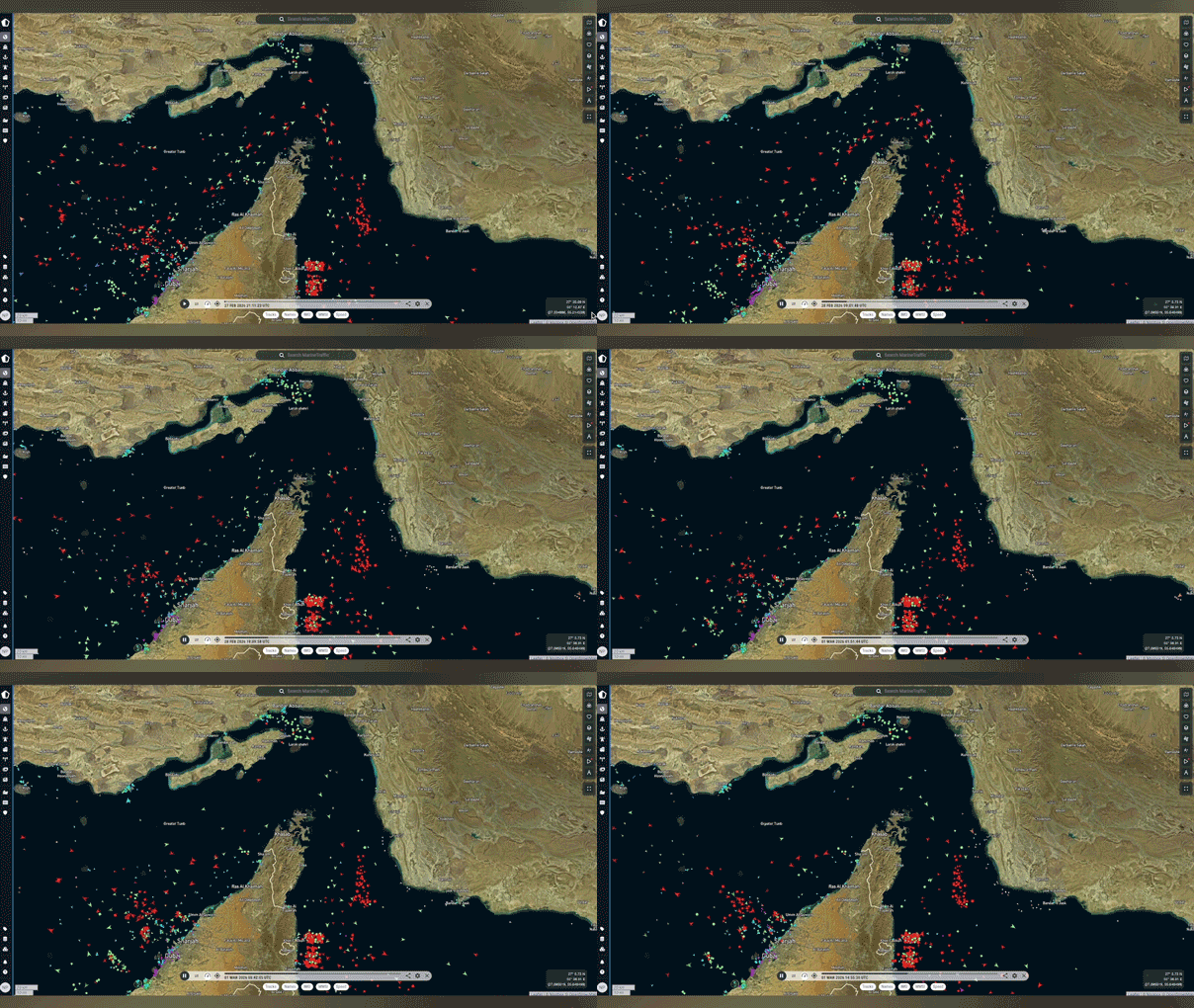
Jordan Schneider: Shashank, can we do the tactical story? You tweeted a question: can Iran lay mines precisely enough to avoid hazards for ships it wants through? And how do you mine the strait when American drones and planes are flying over this 30-square-kilometer patch of water? Can’t we just watch it at all times?
Shashank: I’m not a mining expert, but CENTCOM has dutifully destroyed all of Iran’s dedicated mine-laying craft — 16 or 17, I think. But Iran has historically prepared to lay mines through other means, including traditional fishing vessels, the dhows.
We need to keep in mind that the battlefield is more transparent than ever — surveillance is more pervasive and higher fidelity — but it’s not a literally, completely transparent battlefield with absolute coverage at all times. You’re running a campaign in which your surveillance assets may be in heavy demand elsewhere: tracking ballistic missile launchers about to fire on Israel, or assets targeting carrier strike groups in the Gulf of Oman. You may not be focused with all your Reapers and space-based ISR on Iranian fishing vessels in a congested waterway full of civilian shipping. Iran can still get stuff out there.
On whether Iran can lay mines with enough precision — Caitlin Talmadge suggested yes, it probably could. Abhijit Singh, a former Indian naval officer, made the point that even modern naval mines can distinguish ship size or acoustic signature, but they can’t tell the difference between an Iranian tanker and another tanker. Iran could jam up the straits even for its own exports. And yet Lloyd’s intelligence reported the Iranians have had about 10 ships through — they’re still getting their oil out. They don’t necessarily want to completely cut that route off for themselves.
Justin: I saw talk about seizing Kharg Island, the small island near the actual gate of the strait. Even if we did — does that let us say the strait is open? The Iranians have had 10 tankers through, but that Thai tanker that tried yesterday caught either a missile or a mine — looks like a missile, from the waterline damage. At least two lifeboats were off, the ship was on fire. Why would any other bonded international carrier try to force the strait? If you’re not flying an Iranian flag, you’re apparently likely to take a missile.
For all the strategic blunders we could discuss, this one gets me the most. The maximum pressure campaign during Trump one was supposed to demonstrate that we can economically cripple Iran. Instead, we’ve shown Iran that it has the ability to impose devastating economic consequences on the rest of the world by choking off 20% of the daily oil and gas supply.
Jordan Schneider: At the end of the day, would Trump rather have an Iran with a nuclear bomb or oil at $250?
Tony Stark: Bessent announced today they’re going to temporarily lift sanctions on some Russian oil. It’s quite clear he’d prefer oil prices to go down. But I think there was just no serious planning here. That’s the actual answer.
Shashank: I’d contest that binary. If the option truly were an Iran on the cusp of a nuclear weapon versus a major war causing an energy spike rivaling 1973, I could understand the trade-off. But the Iranian nuclear program had not substantially advanced since the guns fell silent after the 12-day war. There was residual capability — 400 kilograms of HEU sat under the rubble between Isfahan, Fordow, and Natanz — but it wasn’t materially closer to being weaponized. It was the missile program where we saw real progress, which is why the Israelis saw such a serious threat. The concern is that we may get oil at $200 a barrel and a nuclear Iran. Getting oil to $200 doesn’t solve the problem. The likeliest outcome is the regime stays intact, there’s some kind of deal, and it won’t be clear that Iran’s nuclear ambitions have been extinguished.
Seizing the Uranium
Tony Stark: Justin, you and I have both done the train-up for CWD extraction. It sucks. This is not a light lift, and there’s still no plan to recover the HEU. Everyone needs to understand — this is not five guys from JSOC with a black bag. It’s a task force–sized event at minimum, and that’s assuming everything goes right and you hit all the sites simultaneously.
Shashank: I wrote a piece on a raid to seize the HEU. You can envision a gigantic ground operation in Isfahan, but calling it a “special forces raid” is misleading — it would be the largest airborne raid in military history on its own. You’d have special forces, yes, but also a battle group to brigade-sized force holding a perimeter while you parachute in heavy machinery on pallets to get through the rubble.
What makes me really question it is that this material isn’t in one place. Raphael Grossi of the IAEA says roughly half is at Isfahan, but there are still a couple hundred kilograms between Natanz and Fordow. Executing one raid feels at the very edge of realistic military capabilities — maybe only the United States could pull off something of that magnitude. But doing it at three sites simultaneously to achieve surprise? It feels preposterous.
Justin: That’s the problem. They couldn’t do them simultaneously — they’d have to go in sequence. And as soon as you hit the first site, you’ve set a trap at the others. When you think about extraction teams, breachers, specialized training, equipment, suppressing enemy air defenses — there’s just no way you could do Natanz and Isfahan at the same time. There isn’t enough mass to run all three special missions simultaneously unless you’re invading the entire country.
Shashank: Can I just reflect on the incredible situation we’re in — an administration of people who spent their careers involved in Middle Eastern conflicts, who drew from that the lesson that these wars were America’s greatest folly for three decades, consuming national resources and sapping the country’s prosperity, will, and cohesion. And those same people have launched a conflict in the Middle East that will have massive spillover effects for America’s position in Asia — let alone Europe, if they cared about Europe, which they don’t. I would love to get Elbridge Colby in a room with a beer —
Justin: He’d take the beer — you’d have to do wine, I’m sure.
Shashank: A crisp Sonoma Chardonnay — and ask him: how did we get here? With the Bush administration, there’s a coherent intellectual chain from the unipolar moment through 2001 to 2003 — a thread of logic, even if you see it as gargantuan folly. With this, it’s a completely different kind of blundering.
Justin: This is Andrew Bacevich’s theory on steroids — the power of the American military has the ability to corrupt and make people think it can do anything, including substituting for policy, without any overarching strategy. The biggest problem with the use of military force right now is that no one can describe what the goal is. Is it regime change? Is it the nuclear weapons?
The Backlash
Tony Stark: I want to pivot to what’s really concerning me. Between the Anthropic debacle, the Iran invasion, and a few other things, a backlash is coming against all the work done in the last five years to build munitions stockpiles, build autonomous systems, and get Congress on board with funding for a Taiwan fight. After 2026, when there’s likely a split government, and especially in 2028 — the majority of people will be extremely skeptical of all of this because it’s been used in ways we didn’t intend. It’s going to be very hard for Democrats to convince their base to keep funding the defense industrial base at maximum levels. It feels very Imperial Russia circa 1914 in terms of mismanagement.
Justin: It won’t just be Democrats. The MAGA wing is already fracturing over this. Continued investment in the military is leading to continued use of the military, and that’s going to cost support on the far right too.
Shashank: It was interesting to see Joe Rogan’s comments on this. The polling suggests the MAGA base isn’t revolting broadly — that’s not in the numbers yet. But among prominent voices in that base, there’s real discomfort. And that will be shaped by the outcome. If there’s an early deal and the administration snatch a diplomatic victory — negotiate the withdrawal of Iranian HEU, limits on the nuclear program, declare the missile threat neutralized, announce “we’re going to build a great shiny new Trump Tower on Kharg Island” — you can see something satisfying enough people. And we shouldn’t exclude regime change. This was a weak regime going in. I don’t believe there’s been a meaningful rally-around-the-flag effect. The Israelis have been striking Basij and IRGC forces across the country, including provincial elements. Regime change is still very much on the table — though the main risk is disorder, civil war, and armed rebellion rather than anything neat.
Jordan Schneider: Can you talk about the Israeli campaign? I don’t understand how blowing up IRGC offices substantially degrades the government’s ability to put down protests. The guns are in people’s houses. What’s the theory?
Shashank: Your point about financing is interesting — there was a missile strike on the SAPA bank in Tehran on Wednesday, a direct effort to disrupt salary and payments to security forces. As for the offices, I imagine the logic is that you break command and control — you make it hard for authorities to coordinate a response to mass revolt, to mobilize local forces. You hope the individuals tasked with repression decide to leave their uniforms behind and go home, the way we saw in Afghanistan in 2021 and Syria 18 months ago.
Will it work? I’m doubtful. You may see a periphery effect where outlying areas usurp state authority, but that doesn’t mean a uniform ripple into Tehran. Israeli officials who understand Iran well are beginning to acknowledge this — there was an excellent piece by Emma Graham-Harrison in The Guardian quoting Israeli officials conceding the regime isn’t crumbling at the pace they’d hoped. Netanyahu himself said — in not terribly good taste — “you can lead a horse to water, but you can’t make it drink.”
Jordan Schneider: The Netanyahu stuff is fascinating. You see this analogy — is it the Gazans’ fault they haven’t toppled Hamas? That kind of strategic outlook, applied not to Hamas but to an entire country the size of Western Europe, seems tricky.
I want to come back to how this works out. Shashank laid out one pathway — revolution. Are there scenarios where the regime stays in control, even if they get Khamenei and it’s the third or fourth guy, but things are basically okay? Iran without a nuclear weapon in three years, oil manageable?
What Comes After
Tony Stark: Regardless of whether the Ayatollah or someone like him is in charge, there’s still the Sunni-Shia rivalry, still the Saudi-Iranian regional competition. This is like asking Russia to join NATO — even with a less hostile regime, there’s a limit to how friendly they become.
Justin: With HTS in charge of Syria, the Shia crescent is broken — the Iran-Syria-Lebanon corridor that let Iran project power against Saudi Arabia. You’d already stripped a lot of Iranian capabilities between the Hezbollah war, the beeper explosions on Hezbollah leadership, and the 12-day war. The really hard thing for a diplomatic settlement is that the regime now has to agree to give up the HEU — that’s been a stated reason for this war from both the Israeli and US sides. And there’d need to be some dramatic opening to the West. I don’t see that. Because the day before this started, Iran was racked by massive protests, had just killed 30,000 of its own people, and had lost its two largest regional allies in combat.
Shashank: I’d reflect on how the administration handled the Houthis 18 months ago — heavy bombing, some effect, but didn’t really reopen the Red Sea. So what did they do? They said “our work here is done,” stepped back, and declared victory. You can see the same totally self-declared victory here that bears no resemblance to the actual outcomes.
Justin: That’s probably the most likely outcome.
Shashank: The other interesting question is where the Gulf states go. This has been a total shock to their psyche — their vulnerability exposed, business confidence shattered. They’re furious at the US and Israel for dragging them in, but also furious at Iran for breaking all previous taboos on targeting, particularly Oman, which feels deeply betrayed. I can see a massive defense boom in the Gulf. The question is who they buy from. Do they keep their eggs in the American basket, or spend heavily in South Korea, in Europe, with Rheinmetall? Do they try to play nice with Iran — double down on the modus vivendi strategy of the last three years? Now that’s broken down, do they say, “We need protection”? Or do they pursue armed neutrality — arm to the hilt — which is exceptionally difficult for countries this size, given their dependence on things like Fifth Fleet and CENTCOM co-location?
Justin: Ukrainian Brave One and the Ukrainian defense techs are actively seeking seed and Series A funding. I know where there’s cash and willingness to venture-back anti-Shaheed weapons. I wouldn’t be surprised to see the Gulf states investing in Ukrainian defense tech — companies looking for production partners. Outside of high-end weapons, there’s no reason they’d keep buying lower-end US defense tech versus diversifying to the Ukrainian and European market.
Tony Stark: The defense tech rise is no longer just a US story. My other question: what happens to the IRGC? Say you get a friendly regime — that’s going to cost the IRGC money or insult their beliefs. Do you de-Baathify them? Good luck enforcing that. If the IRGC disperses, how does that help the regime or the region?
Justin: The Quds Force and the IRGC run a vast commercial network — many of Iran’s key ambassadors in Lebanon were Revolutionary Guard members. They have front companies pulling revenues from construction and shipping contracts across the region and beyond.
Tony Stark: So are we looking at a KGB-goes-to-the-mob scenario? The IRGC becomes its own version of organized crime post-conflict?
Jordan Schneider: Or Japan in the 1920s and ‘30s — the military just starts killing the people running the country who aren’t aligned with them. Gets dark fast.
Shashank: We don’t have many models of stable transitions from these ossified, oligarchic security states — Persian siloviki structures. De-Baathification was an almighty mess that leaked security capabilities into the non-state sector. The Russian model: the security apparatus just becomes a new nobility, as Andrei Soldatov puts it. The Egyptian model: the army takes over, praetorian-style. There aren’t many cases where these people go home peacefully and the economy gets demilitarized.
Jordan Schneider: Maybe the closest analogy is Cairo — you got your revolution, everyone kicked the military out, and three or four years later they’re back. Even that transition would’ve had less headwind than whatever Iran’s going to face.
Shashank: It is interesting that the administration seriously considered arming Iranian Kurds to pressure the regime, and from my conversations, changed its mind.
Justin: That probably had something to do with the nuclear-armed NATO ally to the north.
Jordan Schneider: Are we sure that was real, Shashank? Not just we’ll throw it out there, like “we’re going to arm the Québécois”?
Shashank: The line between throwing it out there and genuinely considering it is blurry in this administration. But I spoke to Israelis who were in those conversations.
Justin: After everything we’ve seen — every time the Kurds look like they’re forming a state, whether in Northern Iraq, Northern Syria, or now Iran, Turkey goes in and bombs them. Unless the idea was to drag Turkey into putting boots on the ground in Northern Iran.
Shashank: 3D chess — the Turks as the surrogate ground force who topples the regime. By the way, three ballistic missiles have been fired at a NATO ally in this conflict. That’s just nuts.
Tony Stark: Were they aimed at İncirlik, where we keep our nukes?
Shashank: I don’t know, but that would be a logical conclusion — aiming at a site that, by some accounts, stores B61s. I think they were intercepted by SM-3s.
Justin: They’ve also hit Jordan — Azraq and the Mafraq joint US-Jordanian base. The whole region is getting things thrown at it.
The Targeting Machine
Jordan Schneider: I want to talk targeting. Shashank had a wonderful article in The Economist — “How America and Israel Built Vast Military Targeting Machines” — an overview of how you can do the Vietnam thing, not by flattening forests, but by blowing up thousands of specific things within two weeks that are, for the most part, not girls’ schools. Shashank, reflections on that — and broadly, is the future of this stuff like Waymo being better than me at driving a car? Or is it the American military capability bias, where you trick yourself into massive strategic mistakes because you have this futuristic, superhuman ability to identify things you might want to blow up?
Shashank: Part of this story was about AI and demystifying the role of frontier models. I know you’ve talked about this on previous shows — people want to know what Claude is doing. It’s not actually doing all that much. The public accounts saying Claude has been identifying targets are misleading, based on my conversations with people involved in both the AI and targeting enterprises.
A lot of the piece was explaining what the Maven smart system actually is. The phrase I’d use is “decision support system.” Inside it, there’s a command-and-control element, a target intelligence element, an intelligence fusion element, a battle damage assessment component. It’s a machine that helps humans do at scale what they previously did with human staffs and obsolete computer aids — identify targets, put them into banks, match the right munition, check what’s nearby, all of that at industrial scale. The bespoke AI models handle things like object recognition. But what Claude does is primarily synchronize the other models — it operates at a higher level, overseeing the system.
The more interesting question is what happens when you can generate these vast target banks. We tend to think of AI-aided targeting as being about speed and overmatch — the classical maneuver warfare idea of imposing cognitive paralysis, hitting so many decision-making nodes simultaneously that the enemy can’t react. What’s striking about this conflict is that the same industrial-scale machinery is being applied not for rapid maneuver warfare, but for something much more like attrition. CENTCOM says “we’ve hit 6,000 targets, now 7,000” — a system built for cognitive paralysis and shock, deployed in a context where there’s no more shock. You’re just eking out more targets to keep striking.
My colleague Anshel Pfeffer, based in Israel, told me that in 2006 in Lebanon, the Israelis said they’d run out of targets around day 30. The lesson they drew was that you need a machine that can produce more targets. But none of this tells you whether your 6,000, 7,000, 8,000 targets have a causal mechanism for defeating the enemy. We have to be clear: this is operational excellence, but it’s not always married to something that actually wins wars.
Justin: That’s exactly right. Targeting, in its full military definition, supports the commander’s objectives. It’s not just about having more targets — it’s about targets that achieve a desired effect. Seizing a hill, denying the enemy a capability, whatever. Are the commander’s objectives just to hit more targets? Hegseth came out four or six days in and said we’d dropped twice as much as during shock and awe in 2003. Yeah — but we took Baghdad by that point. The objective was clear.
There’s a distinction the military makes between a high-value target list — this costs a lot, this is a leader — and a high-payoff target list: if we take this thing out, it lets us achieve this effect. The system can’t make that distinction. That’s where commanders have to get involved. And what is the objective? Every member of this administration who’s spoken about the desired outcomes has said something different. The same person has said different things in different press conferences.
Tony Stark: To go back to the video game analogy — there is no strategic progress bar where you hit 6,000 targets, you’ve got 4,000 to go, then victory. What the military means by autonomy in decision-making is dirty, dangerous, and dull. Maven is doing the dull work. When you’ve processed 2,000 targets and have 2,000 more to go, you’re not just throwing darts. During my first NTC rotation, my S2 hadn’t slept in days and was falling asleep and hallucinating during the brief — the guy telling you there are 40 tanks outside when there aren’t. That’s the problem Maven solves. But we’re not closer to victory because a machine is deciding which launcher to hit instead of a human.
Jordan Schneider: You can see how it happens — you get briefed, all these targets on a map, someone tells you with genuine confidence that they can blow all of them up in a week. Then 24 hours before, someone says, “We know where all the leaders are going to be at this exact moment — you’ve gotta act fast or we miss the window.” And you can imagine people in the room going against their better instincts and saying, “Fuck it, it’ll probably work out. Look at all these cool Palantir products.”
Tony Stark: I’m just picturing the Halo multiplayer announcer yelling “Killionaire!” after the Israelis hit that 88-person meeting.
Jordan Schneider: So dark.
Shashank: There’s an interesting disjoint here between the logic of shock-and-awe target banks and the reality of a grinding strategic bombing campaign. You don’t get to pick the kind of war you fight. There may be a strategic bombing component, but you also have to deal with things like Hormuz — which demands dynamic targeting of new mobile targets in complex terrain, shipping lanes, and areas you may not have surveilled before the conflict. If you have a military force that’s superb at strategic bombing but struggling with the dynamic dimension, that’s a failure of strategy.
Justin: This is the natural outgrowth of the John Boyd–Curtis LeMay strategic bombing school: “we can do it all from the air.” It’s been disproven so many times, and yet here we are back to McNamara — “I’ll tell you where to drop the bombs, and we’ll drop enough on North Vietnam to win the war.” We dropped more in a month than in all of World War II, and it made no demonstrable difference. You run the same risk here. All I’m asking for is a clear objective. If you have one, you can derive a coherent use of force. Without it, you’re just striking things.
Comms Over Policy
Tony Stark: From a policy standpoint, this comes from the triumph of comms over policy execution. For the last 10 years — the last five especially — Hill and executive staff have prioritized messaging bills and messaging policy over actual execution. I was at drinks two weeks ago with a staffer who said, “I so much prefer comms and messaging bills over actual policy work.” I almost fell out of my chair, but it’s common among the younger staffers now running the administration. To them, this is policy success — this is all they know. Something like 80% of bills on the Hill are messaging bills. They have their highlight reels, their Call of Duty kill streaks. I saw one with bowling pins and an F-18 strike.
Jordan Schneider: Wii Sports, man.
Tony Stark: To them, this is success.
Jordan Schneider: Presidents want to say they did things and won. Have 10 different victory conditions and you’ll probably hit one or two. Maybe what’s most interesting is the decision to talk about regime change from the start. They either thought talking about it would make it more likely, or that it was probable enough that declaring it would tip things over — the way HW got an uprising in 1991, which maybe with concurrent bombing could have worked. That seems like the big fork in the road: declaring what victory means.
Clearing the Decks for the Pacific?
Shashank: I was talking to someone this week — I don’t share his name, but it’s worth putting on the table. The Israelis learned since October 2023 that they’d have been overwhelmed fighting their adversaries simultaneously — Hamas, Hezbollah, and Iran all at once. Instead they dealt with them sequentially: degraded Hamas, then crushed Hezbollah, then turned to Iran. Each adversary mostly stayed out of the other fights — interestingly, the Houthis were the exception, jumping into every round.
There’s an argument that says, from the Pentagon’s perspective, if you’re looking at a window of risk in the Pacific from 2027 onward, you also have a concurrency problem with the Persian Gulf. There’s an interest in deeply reducing Iran’s military capabilities before any future Pacific conflict. I’m very skeptical. This conflict has real effects on American strength and readiness, and it’s revealed Iranian capabilities that were perhaps unexpected — giving Iran more deterrence, not less. But I challenged myself to at least understand the logic.
Justin: Two counters. First, everything that’s happened has benefited Russia, which is China’s largest military supporter. If you’re planning for a Pacific conflict, you’d want Russia weakened — but rising oil prices are making Russia materially stronger. Second, the administration just delayed the $11 billion arms package to Taiwan, supposedly for the upcoming Xi-Trump summit. But that signals the Pacific clearly isn’t the top priority — because if it were, you’d be strengthening Taiwan at the same time you claim to be setting conditions for a future confrontation.
Tony Stark: It was more comfortable to make the “clearing the decks” case when the war looked like it might be over in 72 hours. Then you could say, “It’s another Venezuela — we get a favorable regime.” I’ve heard that from senior staffers: “This is knocking down the dominoes” — always a great analogy in foreign policy. It’s clearly not the case. This remains a net negative. I can’t imagine Admiral Paparo’s blood pressure is any lower than it already was.
Justin: He’s a short, angry man — right now, angrier than most.
Lessons for the Pacific
Tony Stark: Are there operational lessons the Chinese are taking from this?
Justin: Their production capacity is the key factor. What I expect they’ll observe — Frank alluded to this last week — is that Patriot and THAAD will start changing their TTPs, potentially going from two interceptors per incoming missile down to one. Those changes lower shot probability — there’s a reason it’s two-for-one when you’re targeting something dynamic and moving. With China’s production capacity, they’ll be able to quickly overwhelm defenses protecting critical assets.
They’re probably concluding that Patriots are really good against ballistic missiles, but the limitation is exactly what everyone thought: numbers and production capacity. They’ve already hit at least one Patriot battery in Jordan with a Shaheed — it looks destroyed from overhead imagery.
Shashank: On the utility of long-range cheap strike munitions like the Shaheds — very few are getting through to Israel. They’re being shot down en route by aircraft carrying laser-guided rocket pods or air-to-air systems. That’s not a hard technical problem, just a supply and cost problem at scale. But at short ranges, they’re getting through because there’s much less warning time and less strategic depth. The Russians appear to have passed tactical lessons to the Iranians — the British think this is why the Shaheds can fly low enough to evade defenses and make it across the Mediterranean to hit Cyprus. We’ve seen precise short-range strikes on THAAD radar in Jordan, radar in Qatar, sites in the UAE, and communication nodes.
The operational lesson for the Asian context: at long range, these drones will struggle if you have enough air interdiction capacity. At shorter ranges, they pose a serious problem, and it’s not clear you’d have enough low-cost air defenses to cope on the timescale of a conflict.
Tony Stark: I wonder if that means for Guam, a lot of carrier-based aircraft will be tied up protecting it from long-range drones.
Shashank: You’re seeing that right now — a huge share of US and allied air power is being sucked into the defensive counter-air campaign against the Shaheds. It absorbs an enormous chunk of your force, even with low-cost interception methods.
Justin: One interesting development: the UAE is using AH-64 Apaches to target Shaheds. Helicopters fly low and slow, and they’ve got the right targeting capability — guns and rockets — to lock on cheaply. They’re proving to be a counter-drone platform nobody expected. The prevailing wisdom out of Russia was that the helicopter is dead, the drone will kill it. We’re now seeing that for mid-range defense, attack helicopters actually make pretty good counter-UAS systems. Not always, not every time, but it’s a real turn of events for a platform everybody was writing off a couple of months ago.
Tony Stark: I suspect that in the same way the Marine Corps walked back eliminating its conventional artillery, the Army is going to walk back eliminating a lot of its rotary aircraft.
Jordan Schneider: Thank you all for joining Second Breakfast, a real SportsCenter for war edition.
Shashank: Thank you for having me, Jordan. My Second Breakfast debut — very pleased.
As Sun Tzu put it: The best strategy is to foil the enemy's plans. The next is to disrupt their alliances. The third is to attack their army. The worst strategy is to attack their cities.
Really? Two weeks in and you pantywastes want to declare defeat? Nobody sensible didn’t think the strait might be closed. So, no, they didn’t surrender or engender a coup which was (and is) possible.
You don’t have to be maga to want this to succeed. Trump is a walking disinformation machine. Full of happy talk and conflicting BS 24-7. But once they started shooting rioters and Trump threatened the Mullahs if they didn’t stop, the die was cast. If you think Obama’s red line in Syria was an inflection point (or Bidens botched Afghan exit) then just wait. If we can’t persevere here, there is no hope for Taiwan under Trump or AOC.
Having started this conflict which we were “in” from January [7] on, the ramifications for the west if we fail are obvious and horrendous. And while there is no black line for failure, pretty much anything short of surrendering centrifuges and Ur probably is failure.
One of the few things Trump got right was when he said [we don’t win wars]. To all the talking heads here and elsewhere, you had two months before this happened. Your counsel before this started was as vapid as it is now.