
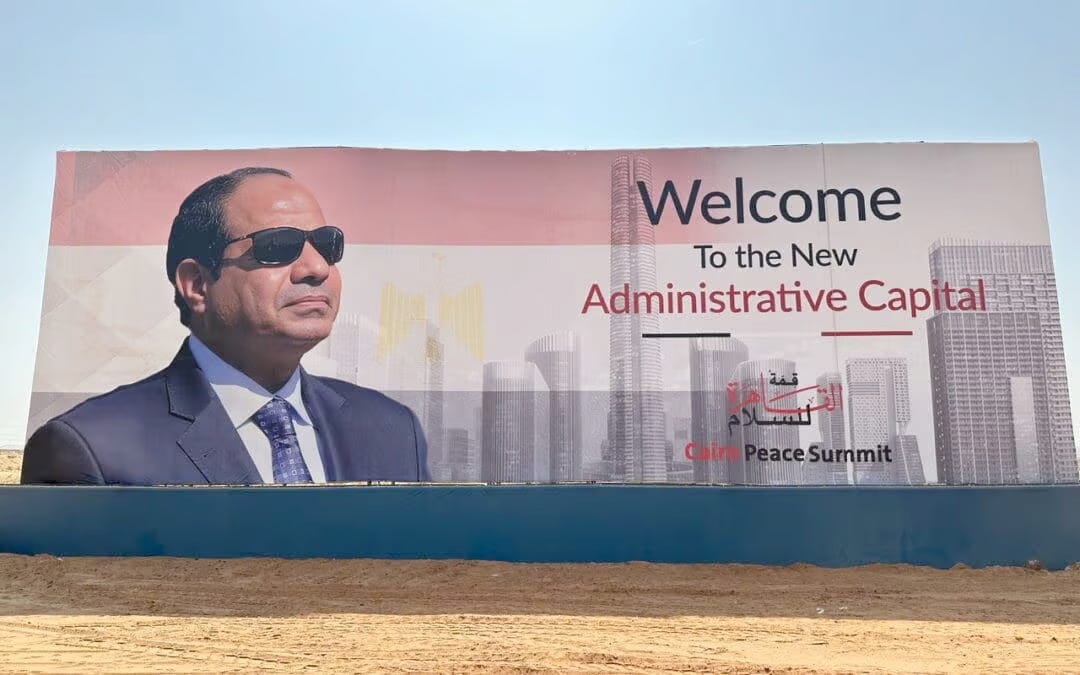
When my driver picked me up to take me to the New Capital, he was certain there had been a booking mistake. “Are you sure you want to go this way? I can take you to the pyramids or Alexandria instead.”
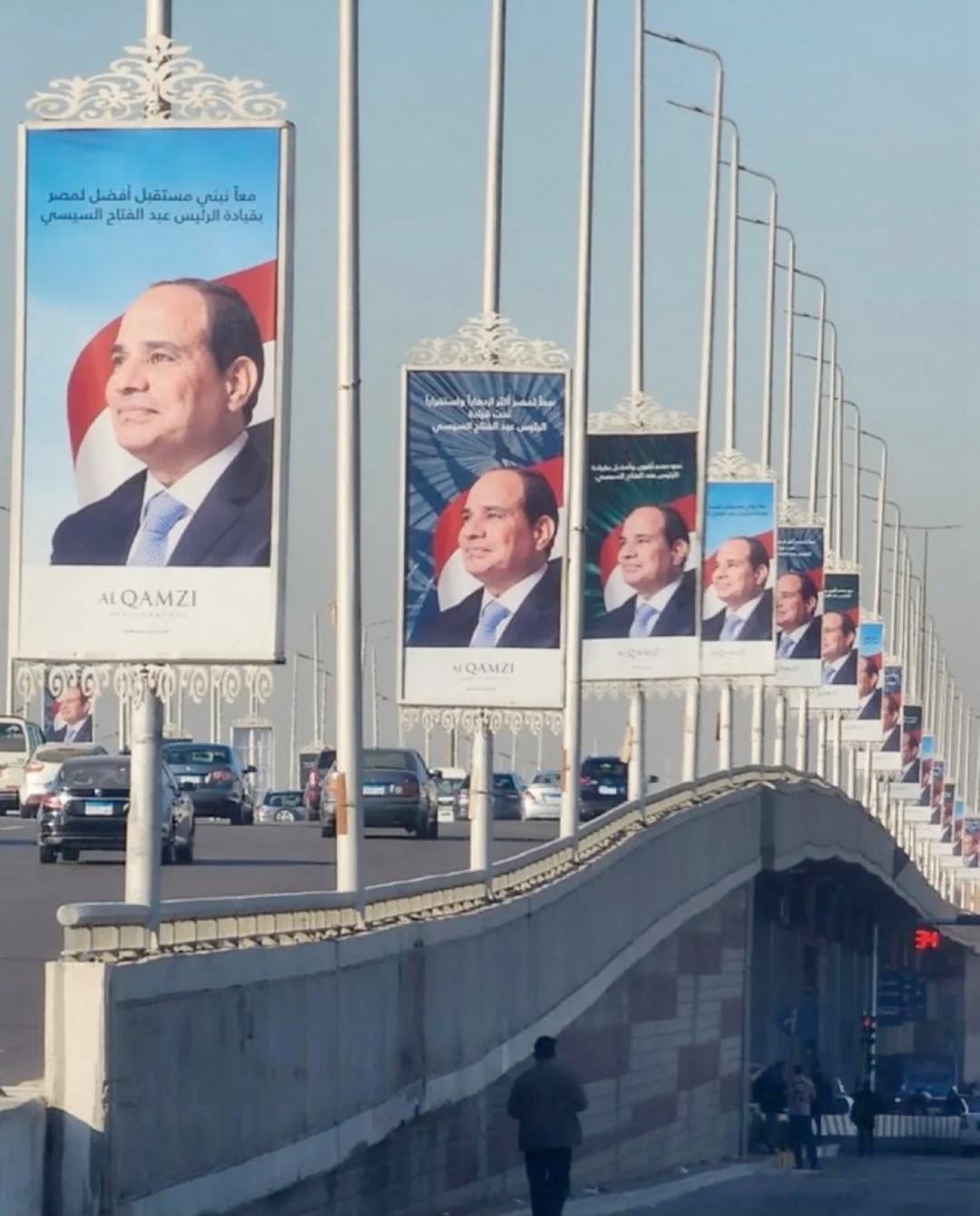
There was no mistake. But driving there, past a mural of Egypt’s President Sisi every few hundred meters (sunglasses on, pointing at renderings of his new mega-city) I didn’t know what to expect. There’s only so much you can understand about the New Capital from reading about it online. Almost all the pictures are airbrushed or shot to show only the skyline without the heaps of rubble just to the side. Even the name is confusing. After years of competitions, jury deliberations, and proposed names like “Kemet,” “Wedian,” and “Memphis,” the city is still technically just the ‘New Administrative Capital.’


Cairo isn’t sinking like Jakarta, and nobody seems to know for certain why the New Capital exists. The official reason is to relieve congestion in a city whose metropolitan population is ~20 million. Yes, parts of Cairo are incredibly dense and congested, but there are also parts that are quite nice and spacious. The New Capital isn’t just a convenient annex to Cairo’s outskirts. It’s in the middle of the desert and took us an hour to get there and, according to my driver, “two hours, if there’s traffic.”
On the night of Eid al-Fitr, Cairo was filled with swarms of teenage boys eager to practice their English with lost-looking foreigners. So I asked them why.
Based on my highly formal street survey, the most common response from teenagers was that “Sisi wants to show he’s got big balls.” Someone told me he wanted to be like Khufu, who built the first and biggest of the Giza pyramids. A lady who worked at one of the many lingerie shops in Cairo told me, with a look of historical resignation, “Egyptians have always liked to spend our money building great big things in the middle of nowhere.”
A surprisingly common response was that Sisi built the capital far away and with wide boulevards to make it revolution-proof. In a dense city like Cairo, crowds can surround a government building, but in a capital of eight-lane mega-highways, you’d need a car just to stage a protest. Several people also noted that it’s a place for the rich to escape to. This is expressed most clearly in Madinaty, the gated suburb near the New Capital that, driving through it, makes you question whether you are still in Egypt or in the suburbs of Southern California.
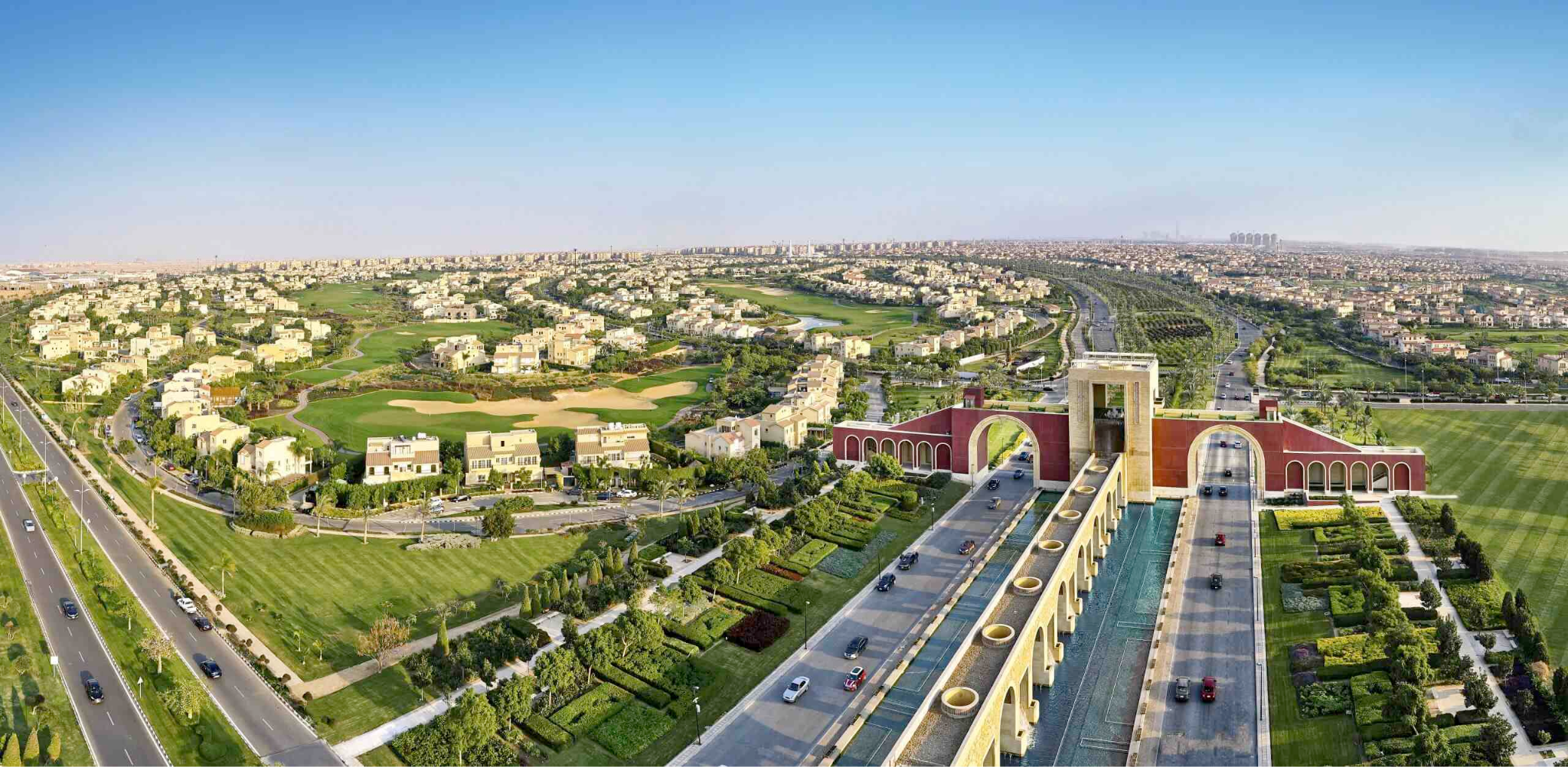
“It’s okay,” said a man in a dusted suit. “China is building it for us.”
Entering the New Capital
[Dune theme song plays]
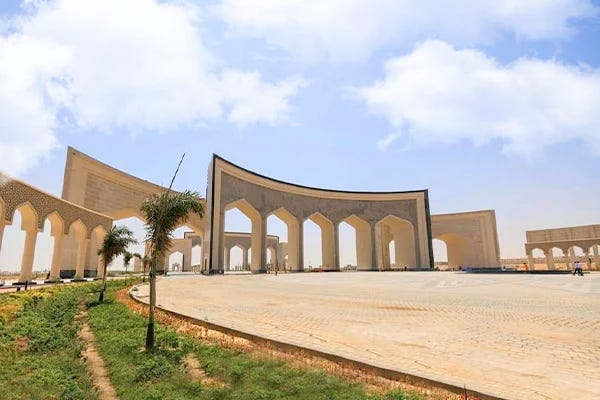
The entrance to the New Capital is a gigantic gate rising up from miles of sand in all directions.
Everywhere you go in the New Capital can basically be summarized the same way: the biggest, most gaudy thing you’ve ever heard of, surrounded by sand and rubble.
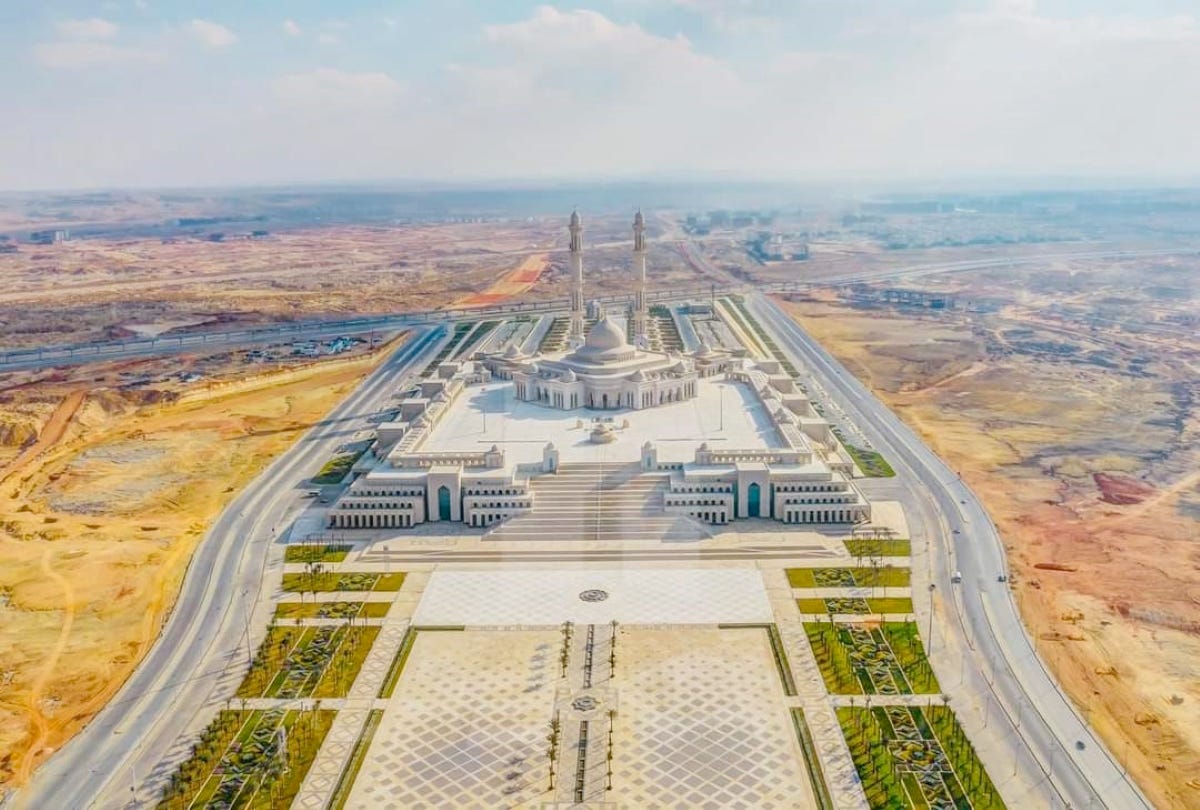
“That is the largest mosque in Africa,” my driver told me, gesturing with his cigarette at a pair of Redwood-like Minarets rising out of the sand. When I asked to stop for a photo, he didn’t take the next off-ramp or even pull over to the shoulder. He simply came to a full stop in the middle of the highway while I got out and took my picture. The mosque was empty.
We also passed:
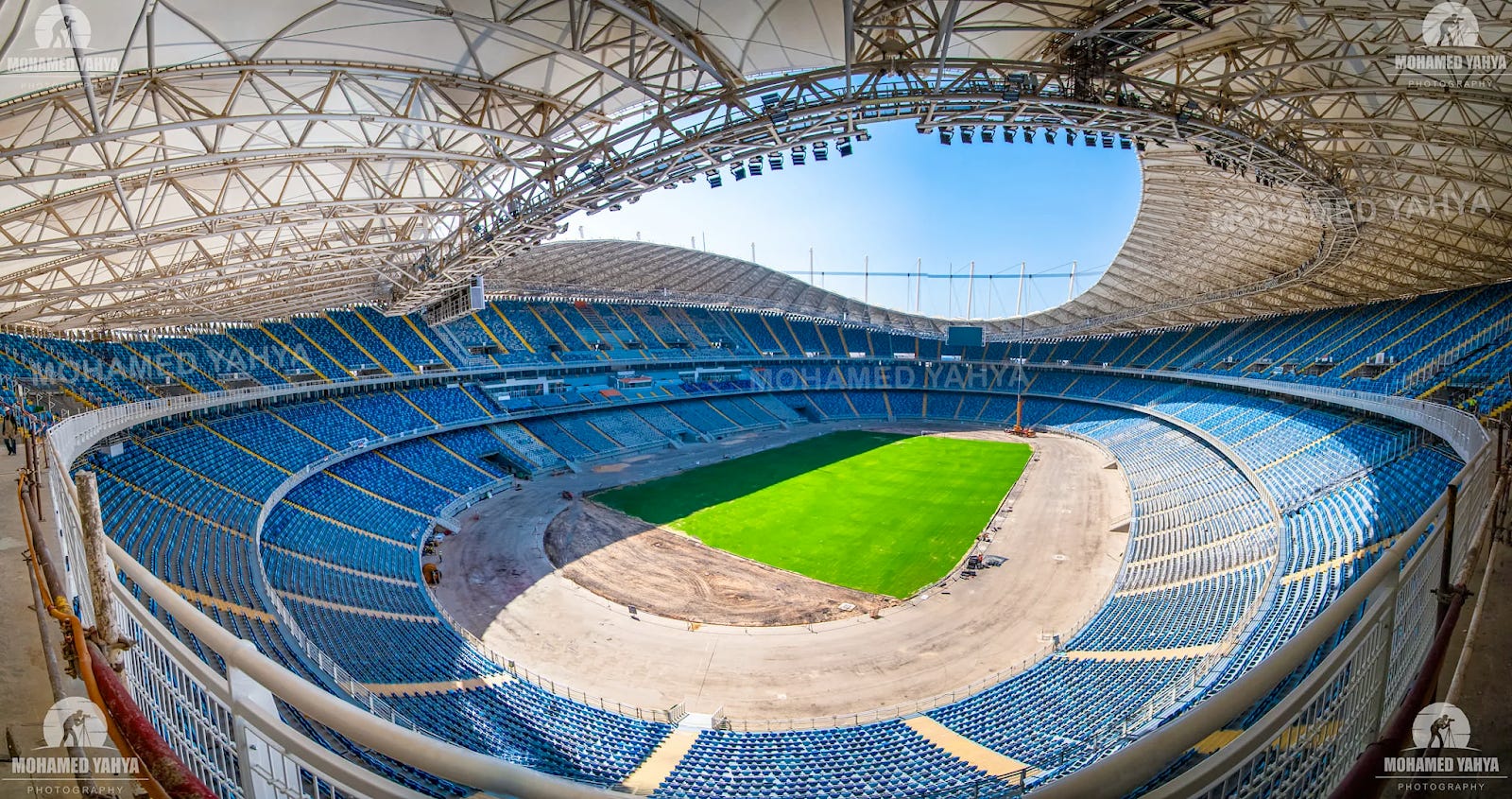
Sports City, built to anchor Egypt’s Olympic and World Cup bids, housing more than 22 facilities, including a stadium with nearly 94,000 seats, the largest in Egypt and the second largest on the continent.
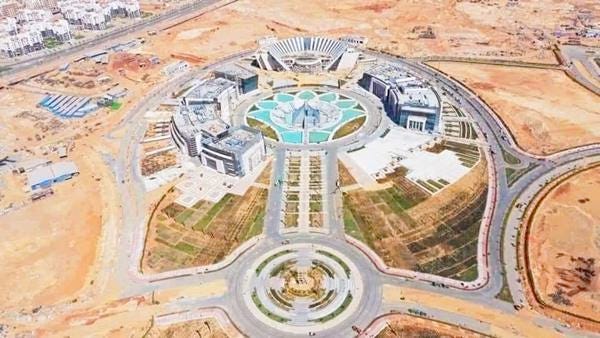
Knowledge City, a $950 million tech campus, the government bills as a node in a future digital economy (reminiscent of Zhongguancun in Beijing).
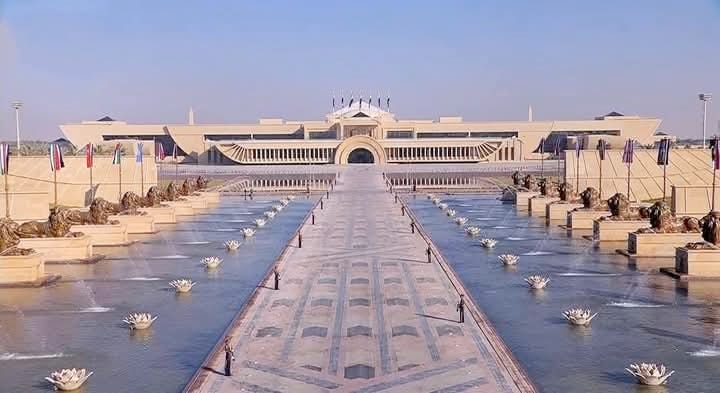
Sisi’s new presidential palace, an enormous disc-shaped structure, said to be shaped in the style of the ancient Egyptian sun god.
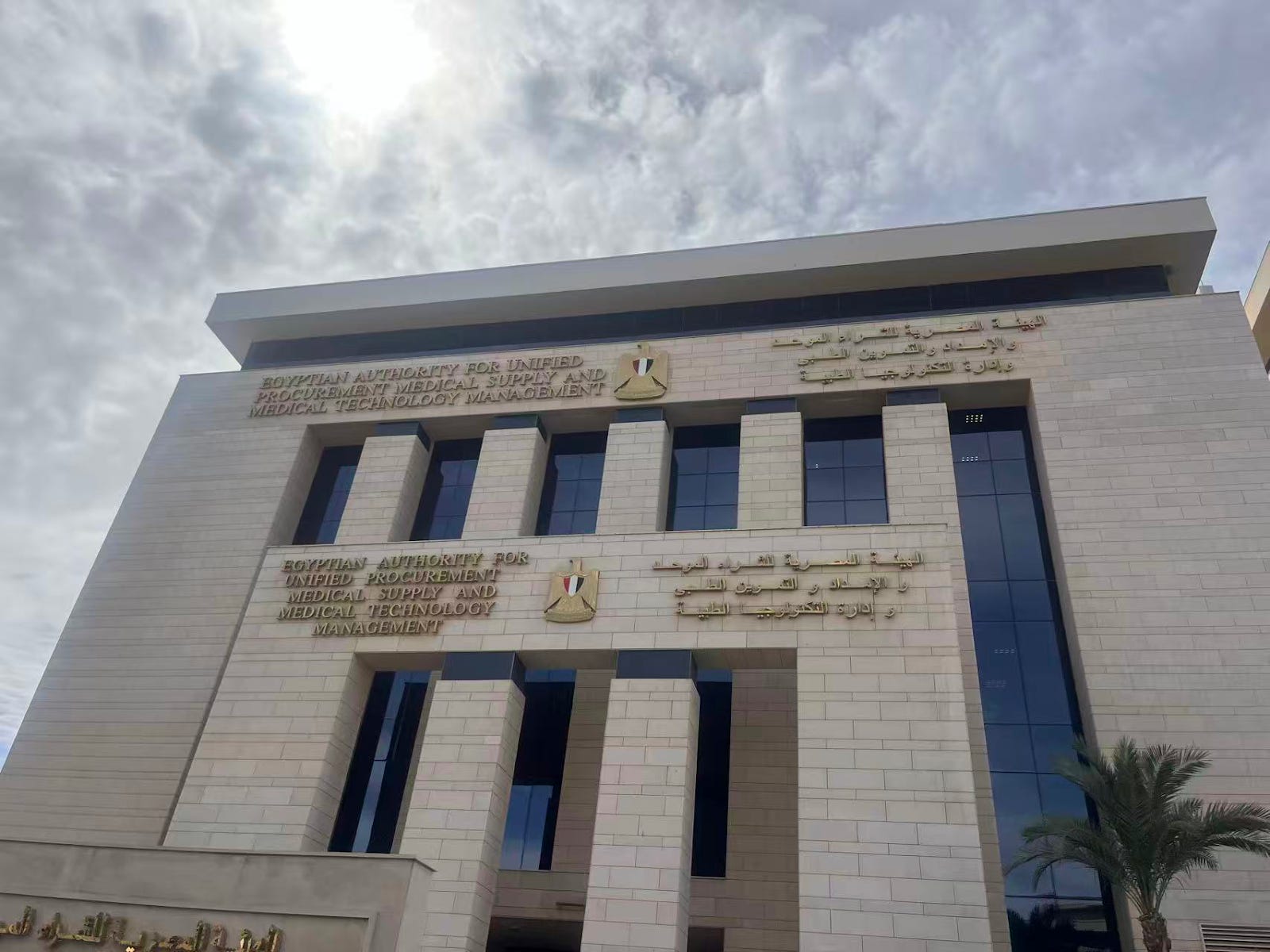
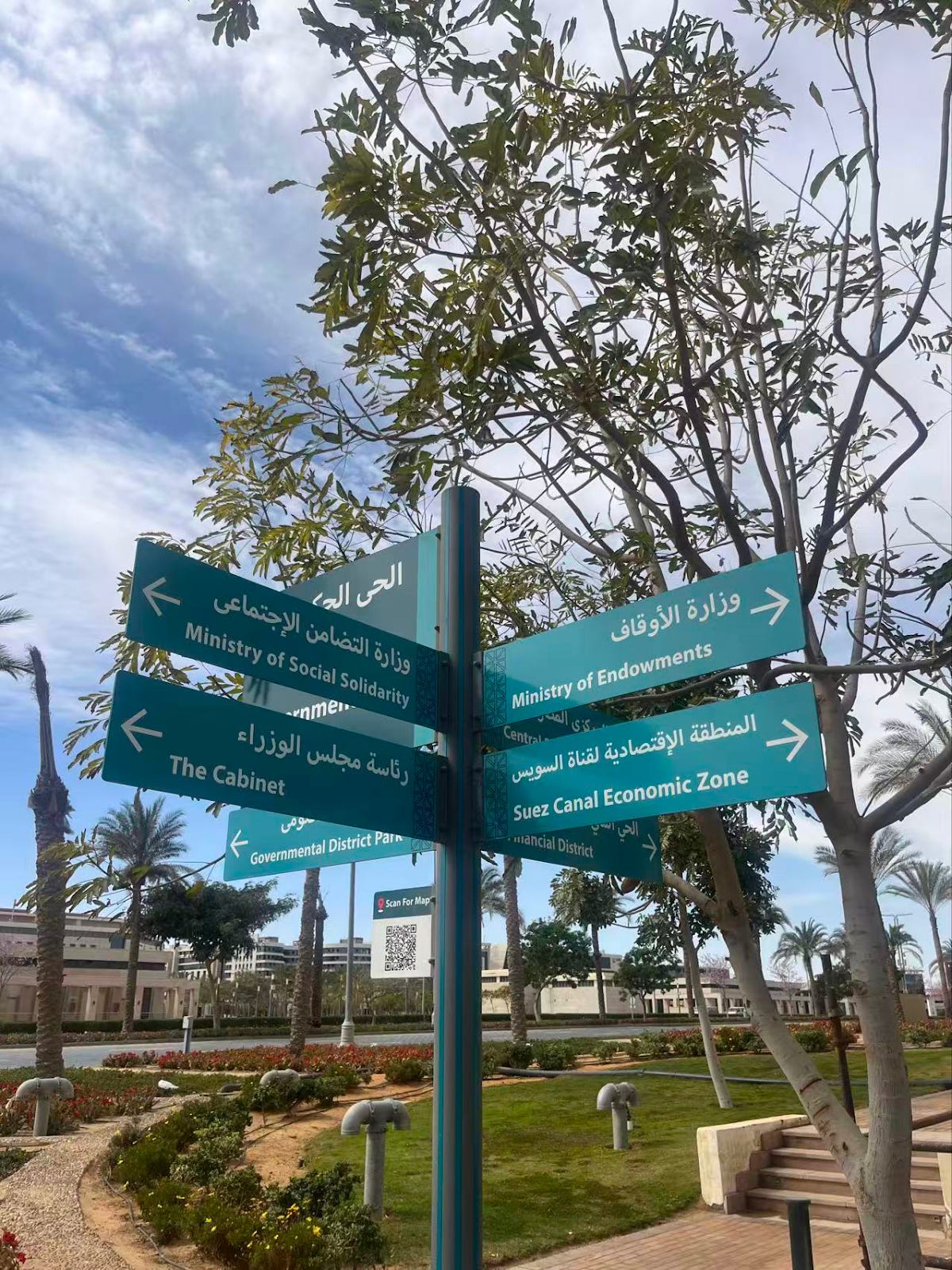
An endless row of government ministry offices, each in its own monstrously large and gold-laced building, some with titles so specialized it was hard to imagine the staff filling a single floor, let alone these giant structures.
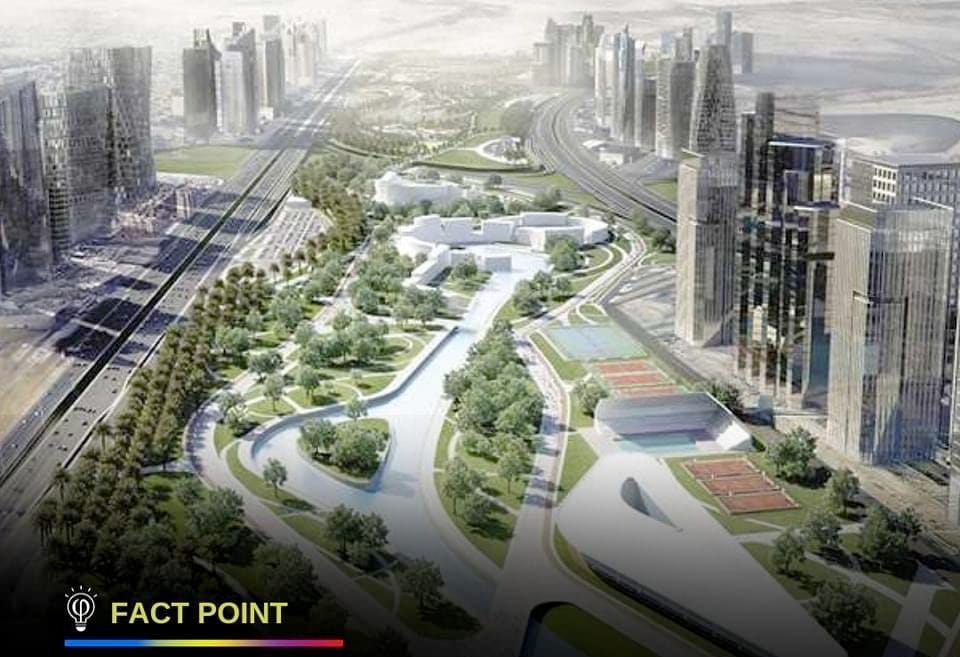
Green River, the capital’s park with fields of glowing green grass running through the desertous landscape, SIX times the size of Central Park.
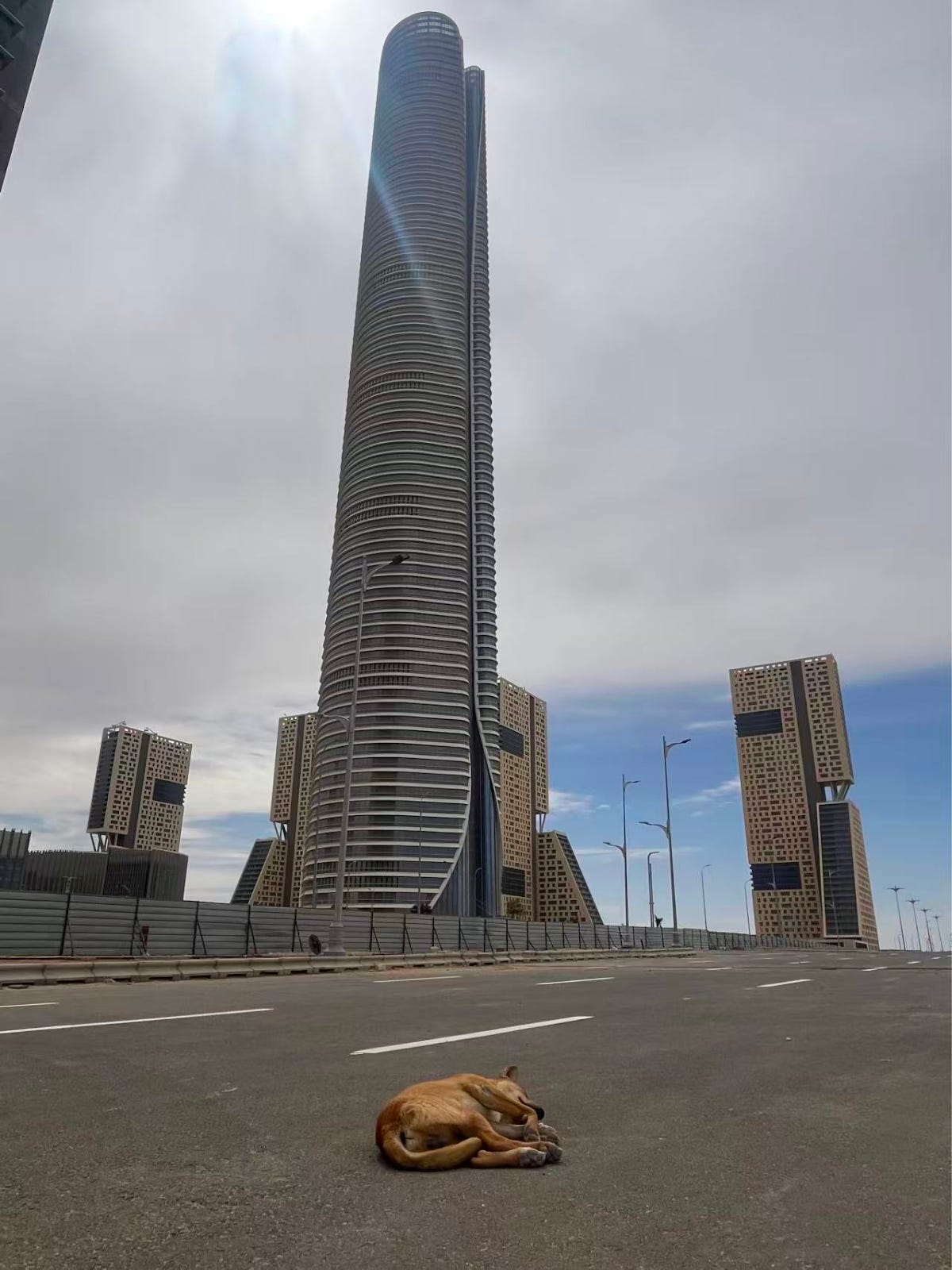
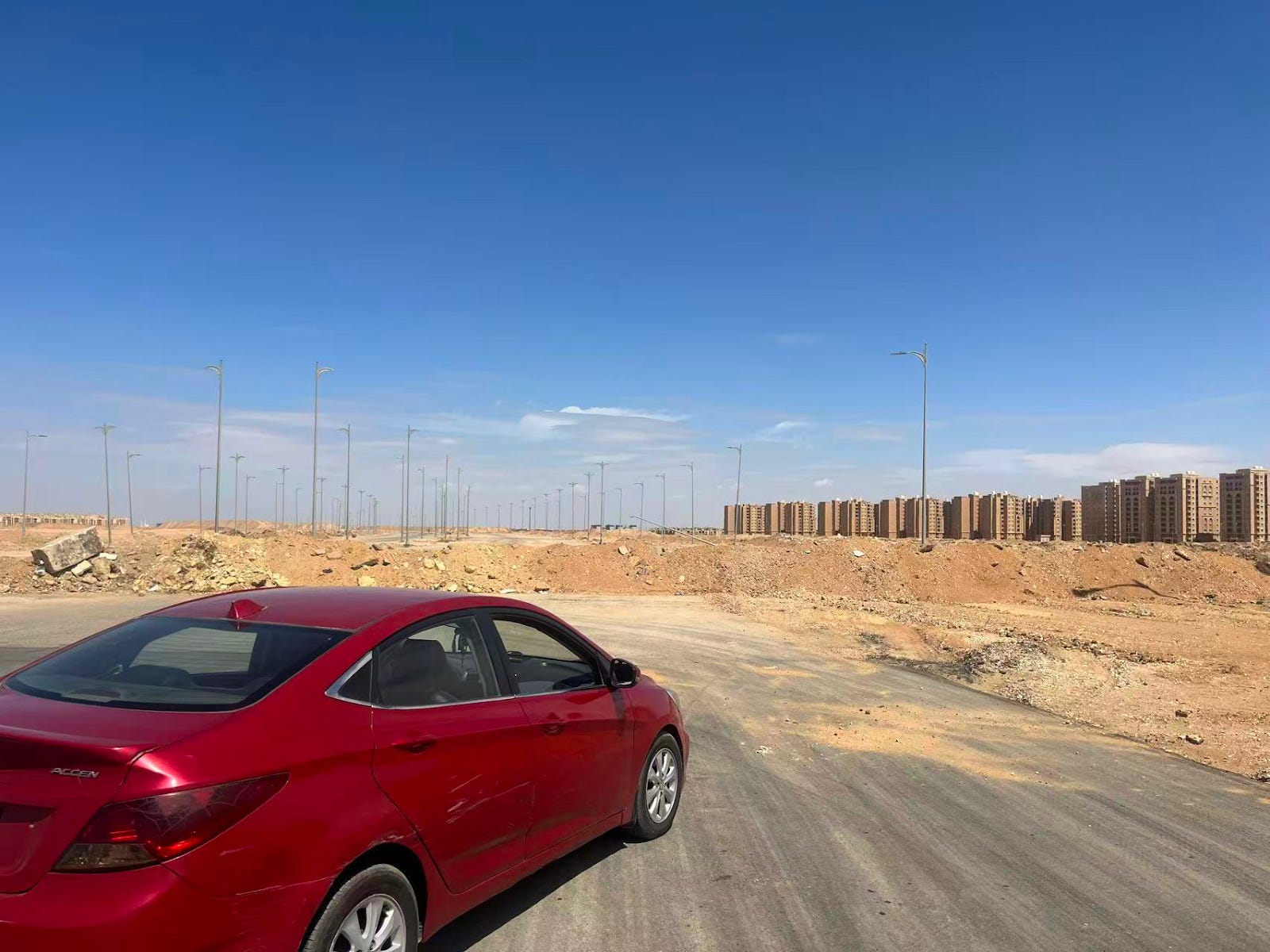
What thematically unifies these monuments is the windswept sand that coats them all, aging the white facades as if the paint has not fully dried. Rubble and half-finished construction stretch in every direction, and stray dogs sleep in the middle of the highways. My movie comp: Bladerunner 2049.
This is no more true than in the downtown, with its cluster of towers, including the tallest building in Africa, built by the Chinese.
China
The city was originally supposed to be built by Capital City Partners, a private real estate firm led by an Emirati businessman, but that arrangement collapsed in 2015. Egypt then signed a new agreement with China State Construction Engineering Corporation (CSCEC) to build and finance the administrative core, though CSCEC ultimately narrowed its involvement to the central business district. Europeans are involved too. Siemens built much of the power infrastructure, while the monorail is being built by Alstom (UK), though China is the biggest player.
The New Capital is being marketed as a “smart city,” which in practice means a city pre-wired for surveillance infrastructure, data integration, and perhaps autonomous vehicles. I’ve written before about how China’s approach to autonomous vehicles, at home and abroad, is about more than just exporting cars but about exporting an entire infrastructure stack, reshaping the built environment so that the technology fits cleanly into it rather than the other way around. I didn’t spot any Chinese AVs testing in the New Capital (I didn’t see many vehicles generally), but the roads themselves still showed the foundations. Compared to Cairo’s honking chaos, they were wide, clearly marked, and fitted with cameras and sensors at the finished intersections.
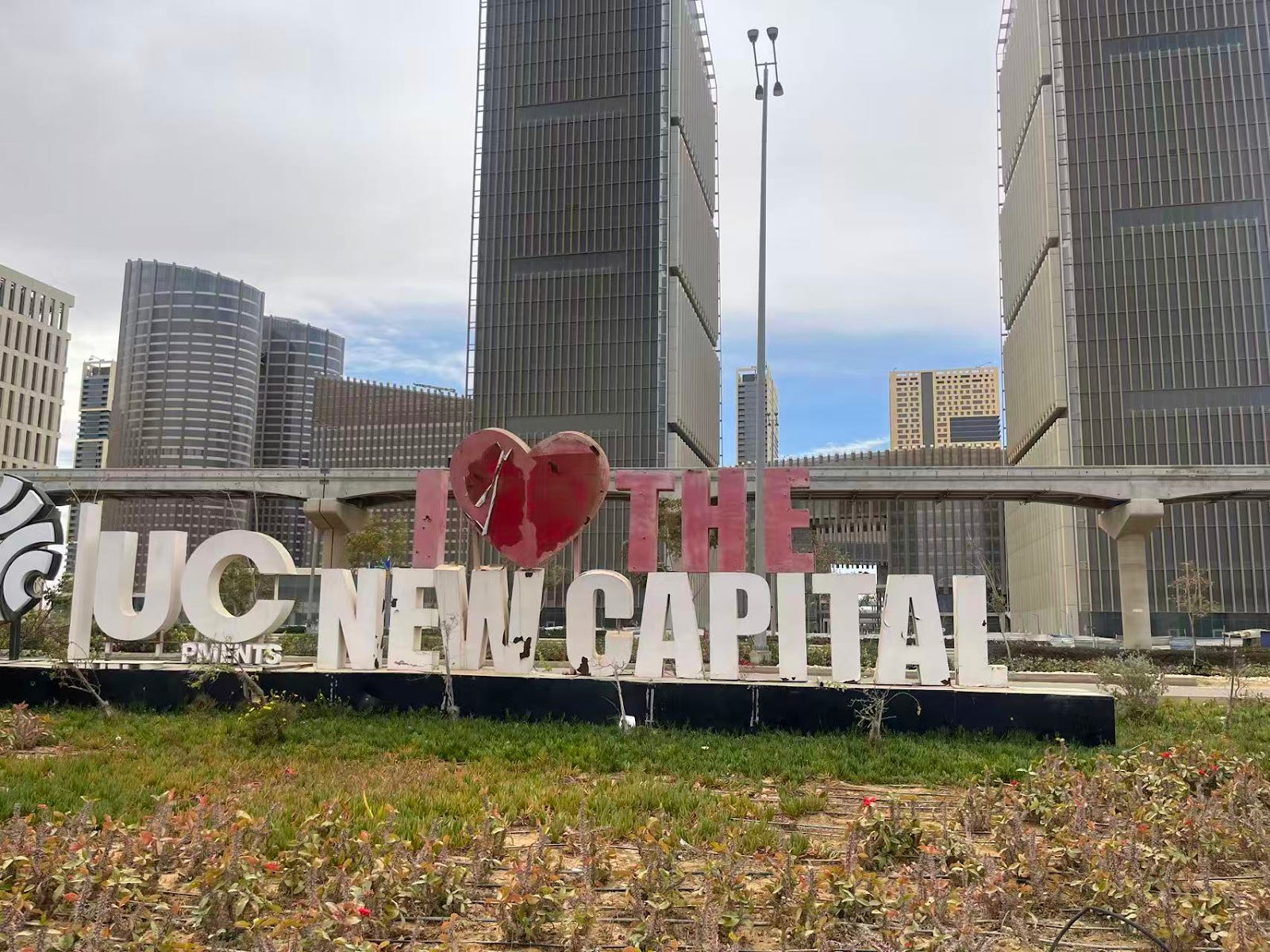
This is increasingly the playbook. Indonesia is building Nusantara on Borneo to replace Jakarta, with the same decongest-the-old-city rationale, heavy Chinese involvement in its smart city and surveillance infrastructure, and the same ghost-town-in-progress atmosphere, now compounded by a new president who has quietly cut the budget in half and moved on. Senegal built Diamniadio, thirty kilometers outside Dakar, with heavy Chinese financing. Malaysia’s Forest City, developed by Chinese firm Country Garden on reclaimed land near Singapore, is now empty after Malaysian political backlash and capital controls killed demand. (It is reported that Forest City was not targeted at local Malaysians but at upper-class Chinese buyers looking to park wealth abroad, for whom the seafront properties were relatively affordable compared to coastal cities like Shanghai.)
China, of course, is doing this on its home turf. Xiong’an, announced in 2017 as Xi Jinping’s personal urban legacy project sits 100 kilometers southwest of Beijing, planned to absorb the capital’s non-essential functions and eventually house 5 million people. Seven years on, it doesn’t seem to be going great.
To be fair, there are versions of these neo-cities that work out. Astana replaced Almaty as Kazakhstan’s capital in 1997 and is more or less functional, which is presumably why the Egyptian government sought advice from its planners. But the big question is who bears the cost if it doesn’t go well. For Egypt and countries like it, the answer is obvious. For China, it’s more complicated than it might seem.
Chinese SOE construction firms get paid to build, not to populate. Their revenue is front-loaded, and whether the city ever fills up is largely the host country’s problem. The Belt and Road Initiative, the Digital Silk Road, all the framework agreements and memoranda of understanding make the most sense not as instruments of grand strategic maneuvering but as the answer to a simpler question: What do you do with the most formidable construction apparatus in human history once you’ve run out of things to build at home?
The risk to China comes mainly when host countries can’t service their debt (which does happen, as Sri Lanka demonstrated, when it handed over a strategically located port to a Chinese state firm on a 99-year lease after defaulting on its loans) but even then, China has often been able to extract concessions, renegotiate on favorable terms, or simply absorb the loss as the cost of keeping its construction sector employed and its political relationships warm. In Egypt’s case, the dynamic is already visible. In 2023, China converted over $9.4 billion in Egyptian debt into developmental projects and investments, acquiring some state assets in the process.
If this is truly the Chinese century, build-outs like this are its texture.
The grand geoeconomic questions are worth asking, but driving past millions of empty residential units, I found myself returning to a simpler one: will these cities will actually be good for the people who end up living in them?
Abundance in the Desert
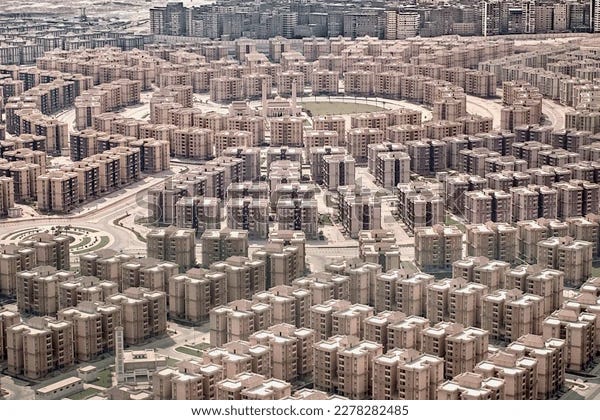
Millions of units already built, sitting completely empty. Imagine snapping your fingers and emptying Manhattan.
We spent an hour trying to reach the residential districts. Every street eventually gave way to rubble about a kilometer short of the entrance, with highway signs pointing toward destinations that went nowhere, like this:
What I could see from a distance wasn’t horrible. The buildings weren’t crammed together but weren’t too sprawling either (something close to what urban planners might call gentle density), and there were hints of genuine architectural thought. Cornices, setbacks, a sense of street-level scale.
The urban blueprint of the city, though, follows a kind of Soviet leisure logic: here is where you sleep, here is where you work, here is where you are permitted to enjoy yourself, and you will need a car to get between all of them. Le Corbusier’s dream.
As an American, there’s something mind-boggling about watching a relatively poor country throw up six million housing units in the desert while we struggle to build anything anywhere. But none of these places seem remotely pleasant to live in, which raises a question I keep coming back to:
Why is it that authoritarian and semi-authoritarian regimes, which can build at scale, almost always build so badly?
I have a few theories.
Central planning can’t account for how people actually use space, but that excuse only goes so far; it’s not a sophisticated insight to realize that walkable streets and mixed zoning are preferable to designated zones for socializing and designated zones for education.
A leap-of-faith bet on smart city infrastructure, the idea that you skip intermediate steps like building a subway and land directly in a future of self-driving cars. But walking will always be cheaper than AVs, and you can stop and talk to people!
There’s also something worth noting about what walkability enables politically. A city designed around cars is a city where spontaneous congregation, and therefore collective political action, is exceedingly difficult.
But my primary working theory is corruption and optics. When you have a vast plot of land but limited resources, the incentive isn’t to build densely and well but to spread what you have across the maximum possible area so the whole thing looks grand from an aerial drone shot to impress Sisi. If you can only afford to build twenty buildings, you don’t cluster them; you scatter them so the map looks full. The result is a city that photographs beautifully and is miserable on foot.
Most people on the streets of Cairo told me as much. They’d rather stay where they are, where it’s loud and cramped but there are shops, parks, places to kick a football, and no need for a car they can’t afford.
The bigger question lurking behind all of this is perhaps key to the century ahead. What’s emerging in Egypt and Indonesia and China looks like one half of a widening split: authoritarian and semi-authoritarian states with the capacity to build at an extraordinary scale, and liberal democracies that have lost much of that capacity, gridlocked by process, litigation, and political fragmentation.
The Japans and Norways of the world can still build metro stations and decent housing, so America’s particular impotence isn’t a universal feature of democratic governance. But those countries are also quite wealthy, and the more striking pattern runs in the other direction. Egypt, Kazakhstan, and yes, even China (once you step beyond the tier 1 and 2 cities) all retain a capacity to build that feels out of proportion to their material means. Their GDP doesn’t fully explain what they’re able to put in the ground.
The actual dividing line, therefore, might not be China versus everybody else, but between countries with entrenched rule of law and weak political consolidation on one side, and countries without either constraint on the other. One model can build a city for six million people and leave it empty. The other struggles to build enough housing for the people already there. Somewhere between the autocratic state that builds too much too fast and bankrupts itself chasing a pharaoh’s legacy, and the democratic state that can’t break ground on an apartment block without a decade of environmental review, there has to be a better answer. Finding it may be the central urban planning problem of this century (the one Abundance and Breakneck and YIMBYs are all trying to figure out), and, depending on how you look at it, the algorithm for how civilizations grow or decay.
Ozymanidias, King of Kings
Whether the New Capital succeeds or not, it is an unmistakable monument to Sisi. His face is everywhere out there. There’s something fittingly pharaonic about it all. Khufu didn’t build the Great Pyramid to house the Egyptian people either. He built it so that history would know his name. Whether anyone remembers Sisi’s in a few thousand years is another question, and the empty streets of his great capital don’t exactly inspire confidence.
Ozymandias is the Greek rendering of Ramesses II, one of the most powerful pharaohs in Egyptian history, a man so consumed with his own legacy that he plastered his name and face across every monument he could find, including ones he didn’t build. Shelley wrote this poem about an Egyptian pharaoh whose actual ruins sit a short drive from where Sisi is currently erecting his monuments to himself. History, especially in a place like Egypt, has a way of rhyming with itself.
I met a traveller from an antique land,
Who said—“Two vast and trunkless legs of stone
Stand in the desert. . . . Near them, on the sand,
Half sunk a shattered visage lies, whose frown,
And wrinkled lip, and sneer of cold command,
Tell that its sculptor well those passions read
Which yet survive, stamped on these lifeless things,
The hand that mocked them, and the heart that fed;
And on the pedestal, these words appear:
My name is Ozymandias, King of Kings;
Look on my Works, ye Mighty, and despair!”
Nothing beside remains. Round the decay
Of that colossal Wreck, boundless and bare
The lone and level sands stretch far away.
I eagerly await for washington's triumphal arch to be covered with the same amount of zeal
An example of such a new city which went reasonably well is Brasilia. The new capital in the far interior was an important catalyst for developing the vast areas which are now feeding the world.