
We’re running a quick reader survey to better understand who’s in this community.
It takes literally one minute.
Why? Better data helps us write more relevant content for you and find partnerships that keep ChinaTalk going.
Thanks for being here!
From Mar-a-Lago to the Great Hall, Trump returns to Beijing desperate for validation while Xi Jinping treats him to strategic flattery. It’s the first time an American president has been to China in seven years. It deserves a podcast, although, as Trivium said, the outcomes could have been an email instead of a summit.
Today’s guests are Sergey Radchenko, author of To Run the World: The Kremlin’s Cold War Bid for Global Power — which won a ChinaTalk Book of the Year award and got the four-hour podcast treatment — as well as ChinaTalk regulars Kevin Xu of Interconnected and Jon Czin, formerly of the CIA and NSC, now with Brookings.
Our conversation covers:
Prestige politics on the cheap: How Trump's delegation gawked at Chinese architecture while Xi scored propaganda points by getting the U.S. president to fawn over Zhongnanhai's gardens — reversing :cades of diplomatic protocol.
The G2 that never was: Why Trump's dream of running the world with Xi echoes Nixon and Brezhnev's failed détente, and how strategic competition makes genuine cooperation impossible regardless of personal chemistry.
The AI factor: As Beijing struggles with compute constraints and export controls, the US brings its AI safety dialogue proposal as its only real leverage in an otherwise empty summit.
The midterm calculation: How Xi is withholding concessions until September 2026, betting that Trump will need wins most desperately right before the elections.
Who’s using the pause better? While China methodically builds domestic chip capacity and refuses even approved Nvidia exports, the U.S. struggles with basic industrial policy on rare earths.
Have a listen in your favorite podcast app!
Limited Edition Visit
Jordan Schneider: To me, the most remarkable thing was the affect of it all, starting with Marco Rubio in awe of the ceiling at the Great Hall of the People and Trump being impressed by the trees.
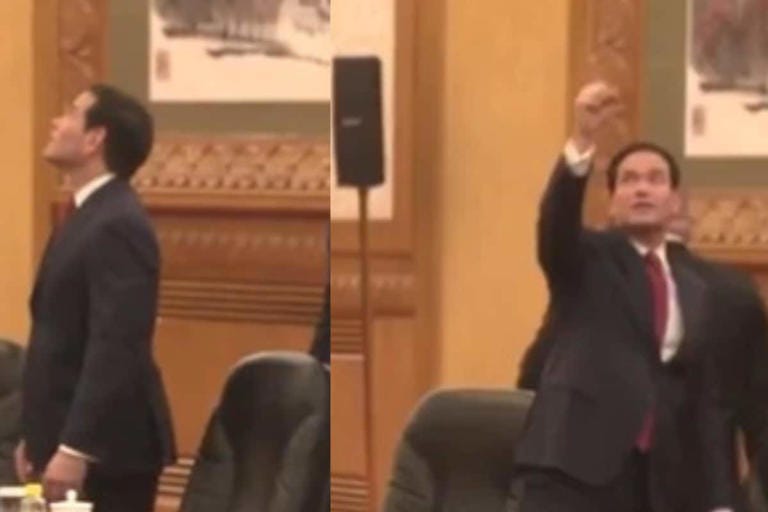
Maybe let’s start with Sergey for some historical context. Is this as odd as it felt to me, having a US president being won over by the CCP red carpet treatment?
Sergey Radchenko: Yes and no, Jordan. Obviously we get a lot of images coming out of this visit. Add to this Trump’s own proclivity for fancy things, and you can see how this has come together. But if you look historically at any summit, they always entail some element of pageantry of this kind. Some actually have had great resonance.
Consider, for example, Nixon’s visit to China in February 1972. I remember that image where he was walking down the stairway from the aircraft, and Zhou Enlai was down there to greet him. He extended his hand to greet Zhou Enlai. Those are images that reshape people’s perceptions. At that particular moment, it was important to show that it was Nixon who was making that step to visit China.
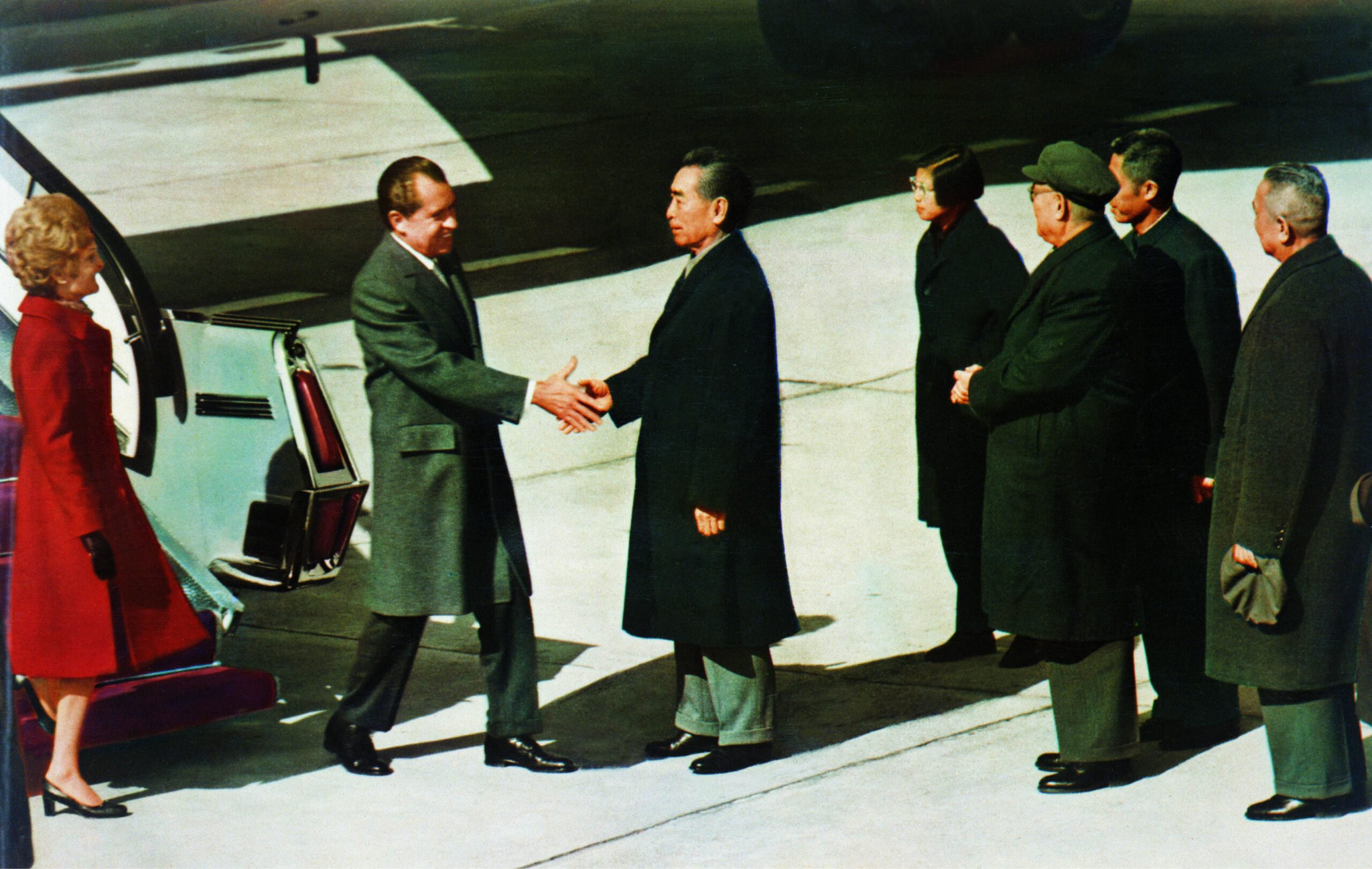
The funniest quip of the Cold War came when Nixon was asked about the Great Wall. Remember that moment? He said, “I think we can say that this is a great wall,” or something like that. We’ve always had that element — when Clinton went to China, he toured the southern parts and visited different places.
In other words, you always have the Chinese trying to showcase their best — the architecture, the pageantry, the receptions. That has a certain propagandistic effect, not least for China, which shows its glory to the world.
Jon Czin: The visuals and optics are probably some of the biggest takeaways from this meeting. The pageantry is always an element of this. One thing I’m mindful of, especially watching some of the pictures where the US side seems to be really taking it all in, is that they didn’t do a great job of playing it cool, frankly.
China rolls out the red carpet, but the affect you want in these meetings is to be business-like and perhaps a little stoic about it, because this is serious stuff. It’s one thing to take it in and appreciate it, but the clips of some senior officials gawking at it — I mean, it is cool when you’re inside those buildings, but you have to maintain your guard for the purpose of those visuals. I don’t think anybody on the inside or the outside would think that’s really the pose you want to strike in that kind of moment.
Jordan Schneider: Sergey, you wrote an entire history of the Cold War through the lens of prestige. It felt like the way the Americans comported themselves in China over these two days — you could not be giving more prestige points to China.
Sergey Radchenko: More face to the Chinese. Exactly. Just think about it — try to flip this and imagine some Chinese newspaper, let’s say People’s Daily or one of those newspapers, presenting videos of Xi Jinping being blown away by his reception in the United States and looking at Trump’s ballroom or something that is going or not going to be constructed.
That sort of thing would be a little bit humiliating. I don’t think the Chinese would ever do that. To see Trump do that, almost kowtow to the Chinese communist leadership — not quite physically, obviously, but expressing this level of admiration — I think this was over the top, frankly.
It’s one thing for Chinese propaganda to trumpet it up, to show it on the Chinese news or in any of those Chinese media. It’s another thing for the White House Twitter account to recycle these images as if to showcase China’s greatness to the American public. I found that a little bit strange, to be honest.
Kevin Xu: I just want to add a few more to that. I can think of two ways to think about this, right? One from the White House perspective. They’re all about their leader, President Trump, getting the treatment that no other leader gets when they go to these places.
I watched the whole raw footage of Trump getting the garden tour inside Zhongnanhai by Xi Jinping. If you listen to the audio of that entire tour, there was this one moment where Trump just had to ask Xi, “Do you bring other prime ministers and presidents to this kind of access?” And Xi was like, “Very rarely. We don’t really do this — maybe very rarely for other leaders, like Putin.”
The entire Trump team actually needs that validation just as much as China wants to provide that validation to stroke the visitor’s ego. I quipped a little bit on Twitter that Zhang Yimou must have started moonlighting at the White House videographer’s office because those videos of the Trump visit were fantastic.
But that being said, I actually think this was a more limited edition of what China wanted to provide to other leaders. If you think about it, just the previous leaders we’ve had from Europe — whether from Germany or Spain — usually get the multi-city tour. That’s what China actually wants you to see. They want you to ride the high-speed rail. They want you to visit either a factory or a robotics company. They want to showcase this entirety of China’s economic and technological rise which you can only show so little of if you have a limited edition of the visit in Beijing.
But they did the best they could to still provide that. Obviously, the Trump team lapped it up. In a way, China wanted to do more, but this is all they could have fit within whatever constraints the Trump team wanted, given that they’re still fighting a war in the region.
Jon Czin: Kevin’s point about how the Trump administration wanted to pick this is quite right — to show that kind of validation that they’re getting and the face that they’re getting in turn from the Chinese side. But I would say for a lot of the optics, I really wonder if it may have misfired. The same is true for the business delegation that showed up.
My suspicion — or my intuition — is that what the Trump administration was trying to do by bringing Tim Cook, Elon Musk, and Jensen Huang is to do it as a flex, to demonstrate how many high-end companies we have that are really at the frontier of today’s technology. But the way it ended up looking from Beijing’s perspective is that you are here to do business rather than to compete with us.
What’s really striking to me — Sergey referenced earlier engagements like this — it did feel like a throwback. It’s kind of the “back to the future” summit where all the emphasis is on commercial and trade relations primarily. You show up with a gaggle of executives signaling pretty loudly and clearly that you want to do business.
You even saw in Trump’s Truth Social post on the way over that they’re looking to expand access to the Chinese market. If you close your eyes or squint a little bit, that could be a statement straight out of the George W. Bush or Clinton administration, not from the period of strategic competition.
Jordan Schneider: Can we come back to this prestige dynamic? Because we all kind of agree that Trump and the team and the delegation sold prestige on the cheap. There is a debate about whether giving face upfront leads to better or worse outcomes. Lots of folks have made the argument that presidents — starting with George W. Bush and through Obama and Trump’s first term — didn’t give Vladimir Putin enough face. Part of the reason we’re here today is — should we quote your book, Sergey? “Obama’s occasional dismissive remarks about Putin, such as when the American president compared him to the “bored kid at the back of the classroom,” added to the sense of a personal affront. It was not just that the Americans felt they were exceptional. They also pretended to be teachers.”
Even if Trump isn’t trading trade concessions for propaganda points of looking overawed by Chinese imperial greatness, is there a sense where maybe this just leads the planet on a safer trajectory? Because the Chinese people and Chinese leadership are less ticked off and feel less looked down upon by an American delegation? Or are we past that sort of game in 2026?
Sergey Radchenko: If I may offer some historical observations on this, it is true that under all circumstances, speaking respectfully about the other side is just the right thing to do. Trading insults has never led to any productive relationship ever. The Chinese are especially sensitive to this. They have historically — for obvious reasons — we’ve had, for example, moments where Mao Zedong had really nasty exchanges with Nikita Khrushchev back in the late 1950s.
Speaking of what foreign leaders get to do or not get to do, Khrushchev got the real treatment. He got to meet with Mao Zedong in the swimming pool of Zhongnanhai because it was in the summer and Mao Zedong had a swimming pool installed there. But actually, this was supposed to be an insult from Mao Zedong in relation to Khrushchev because he was trying to show his superiority.
Khrushchev and Mao quarreled, and Khrushchev in particular called Mao names. In the end, it did not contribute positively. You might say that this relationship — we’re talking about the relationship between Moscow and Beijing back in the late ’50s, early ’60s — fell apart for reasons that perhaps were not all related to personal insults, but personal insults never helped.
You mentioned, Jordan, this question of Putin and Obama. There were various reasons why Putin would want to reassert Russia the way he thought he was reasserting Russia’s standing and quarrel with the West for any number of reasons. It did not help that Obama was trying to look down on him because there is a general perception in Russia of American arrogance.
Speaking respectfully about the other side is generally a good thing. President Trump has not distinguished himself by being consistent in treating others with respect. In fact, he seems to go from one extreme to the other — he can trash a foreign leader one day and then say something good about him or her the next. However, his treatment of Xi Jinping has been fairly consistently respectful, wouldn’t you say? He hasn’t really trashed Xi Jinping in any noticeable way, which is good for the relationship.
Kevin Xu: I agree with that. The only thing Trump still occasionally brings up is COVID, but at the end of the day, his praise of Xi Jinping — whether from afar or up close — has been incredibly consistent compared to any other world leader, past or present.
Sergey Radchenko: Some people will criticize us for saying that. They’ll argue that Trump admires Xi Jinping as a dictator and therefore feels he constantly has to praise him. There’s probably something to that — it’s fair to say that Trump admires Xi Jinping’s way of governing, just as he does with Vladimir Putin.
Yet you could also say — look, you’re dealing with the leader of an important state, China. We may not like what the Chinese are doing in many areas, but we still have to treat them respectfully because that facilitates our interactions. However, this won’t necessarily lead to a good relationship by itself. The reality is that China and the United States are strategic competitors. You can kiss up to Xi Jinping all you want — it won’t change this reality. Or you can swear at him all you want — it still won’t change this reality, except maybe making it worse.
Jon Czin: To embellish that point, one important element to keep in mind with these meetings is not how much they matter, but in some ways how much they don’t in shaping the long-term trajectory.
I was struck listening to Sergey’s previous episode about the personal interactions between Leonid Brezhnev and Richard Nixon and how important that personal rapport was. My sense is that especially under Xi Jinping, these meetings don’t necessarily move the needle — and certainly not in a positive direction.
As idiosyncratic as Trump is and as different as he thinks he is from his predecessors, there’s something essentially American about him. He really thinks that through his charisma and back-slapping, he’s going to somehow make a deal with the other side. That’s such an American way to approach things, and it’s so mismatched with how Xi conducts these meetings.
We just saw this earlier this year — as Jordan and I discussed in our episode about Zhang Youxia — Xi is very unsentimental about personal relationships. Even with people in his inner circle or people he’s known for decades, he’s willing to jettison them.
PLA Purges
Jon Czin spent years as a top China analyst at the CIA, served as China Director on Biden’s National Security Council, and now works at the Brookings Institution. We discuss what Xi’s fourth-term means for China’s top leadership and military, Taiwan, and the US. We cover:
My sense is that when he goes into these meetings, what he’s basically doing is sizing up the other side, right. What’s really interesting is what Xi is learning about Trump from this. It’s probably only at the margins because Xi’s had a decade now to interact with Trump and think about how to interact with him.
One thing that’s really shifted in terms of this prestige dynamic — my old NSC colleague Henrietta Levin pointed out in her recent Foreign Affairs piece — is that it used to be the US. tactic to trade form for substance. Now, because Trump is so focused on the forums, it flips the dynamic. The Chinese side can say, “We’ll roll out the red carpet” as a way to try to achieve their substantive objectives with the Americans.
Their objective wasn’t really clear from the Chinese side. What they were mostly trying to do is think more long-term and see this as a reprieve — trying to buy as much space as possible from US pressure and fortify themselves for the next round of the contest. That’s what they’re purchasing by trying to give Trump so much face in this meeting. In the big scheme of things, that’s a relatively small price to pay.
The Reversal of Neediness
Jordan Schneider: Contrasting with Soviet leaders being really needy — I don’t think Stalin was particularly needy, but going through Khrushchev and Brezhnev, as you show in your books, Sergey, they had this deep desire to be seen as a peer with America on the global stage.
Almost now it’s flipped, where we have Trump who is the needy one, wanting to be seen as a peer.
Sergey Radchenko: It is crazy if you think about it. In the Soviet case, it was clear why they wanted this American recognition — to be seen with Nixon, for example, or Eisenhower. The reason was that they didn’t have really domestic sources of legitimacy. They thought that by being recognized externally by the United States, they would stand tall and proud as leaders of this great superpower and be legitimized by another superpower.
It’s interesting to think that with Trump and the pageantry that we saw in Beijing, it’s almost the reverse. He wants to be legitimized by the Chinese as a great leader. You know how he says, “Other countries respect me,” et cetera, which a lot of us in Europe are rolling our eyes at. There’s frankly a sense of incomprehension in many European capitals. Trump is trying to use this opportunity to highlight that China respects him.
I wonder if it works the other way. Is Xi Jinping also in need of selling the images around Trump’s visit to the domestic audience to say, “Here we are, the two great powers, da guo, working together,” and that shows the strength of the CCP? Is that part of the domestic legitimacy discourse for Xi Jinping?
Jon Czin: Xi is happy to take the win, but especially this far along into his tenure, hosting an American president isn’t crucial for him the way it might have been for his predecessors like Hu Jintao and Jiang Zemin. He went almost 10 years without hosting an American president, and his power has only grown in that period because of the purges, expulsions, and other internal dynamics. It matters, but really at the margins. Xi isn’t in a position where he needs to assuage any politically salient internal audience or demonstrate China’s greatness on the world stage. He’s happy to do it, but it’s not essential.
Kevin Xu: On the margins of that — I don’t think Xi is doing this because he has trouble winning a fourth term. But the domestic situation regarding the economy, youth employment, and general consumer sentiment has been bottoming out ever since zero COVID for the last two and a half years or so. Last year’s trade confrontation didn’t help at all, even though you could argue China stood up to the US in ways no other country could. China flexed real rare earth muscle and is learning how to do export control in a weaponized and offensive way. That’s fine as China learns these new crafts when dealing with the US from the more adversarial side of the relationship.
But as far as being able to host Trump — China just wanted this trip to happen. It was delayed once, and we didn’t know when it could happen. It’s very important for Xi to be able to host a United States president on his terms in a way that could balance the narrative at home, which is that “we are fine from an international perspective. The G2 is back on the docket.” Now we can talk about the more substantive stuff as China has, frankly, a lot of domestic problems that it is wrestling with. We haven’t talked about the future impact of AI and all that, which is now on the deliverables for these two countries — kind of a new thing.
All that is to say, there is some domestic need for this to be both done and done very well. We can debate whether it was done well or not, but it had to be done.
Jordan Schneider: The awkwardness of the delay means that Putin is showing up in Beijing tomorrow. This idea of a G2 — this was the dream of Brezhnev telling Nixon, “together we will run the world.” The idea being whoever gets to pair up with the US — whether it’s China or the USSR — is the one in pole position.
As Julian Gewirtz pointed out in a recent article, when Xi went to Moscow to see Putin in 2023, a camera caught him speaking with the Russian leader, gesturing emphatically. Xi said, “Right now there are changes unseen in a century, and we are the ones driving these changes together.” “I agree,” replied Putin. We had similar language around that with Trump and Putin talking about how together they’re going to run the world. This is an idea that, at some level, appeals to Trump in particular. I’m curious for thoughts on how we’re going to be looking at this relationship, whether we’re going to be looking at this trip very differently based on the visuals that are going to come out of Putin and Xi hanging out tomorrow.
Sergey Radchenko: Jordan, on this question of running the world together, let me tell you an anecdote about the Soviet reaction when Nixon went to China in 1972 and made a toast about the future of the world being in America’s and China’s hands. That’s 1972 — Nixon goes to China, makes this toast that the future of China and the future of the world is in China’s and America’s hands, which is then publicly reported.
The Soviets read about it and get really upset. Brezhnev complains to Kissinger, “What are you saying? Aren’t the Americans and the Soviet Union supposed to be holding the future of the world in their hands?”
In other words, there’s a long historical background to this idea of the world being run or co-run by any number of these great powers. It’s interesting to see how this is evolving. I would imagine that from Xi Jinping’s perspective, it’s not even the G2 world. It’s almost like China is the center of the world, and the others are like spokes connecting to China. Very much a Sinocentric world.
Jon Czin: But it’s interesting because it’s primarily, in some ways, a question of optics. One of the things that’s interesting about how China responds to this G2 concept — they welcome the US side saying it, but they don’t actually like it in the sense that they don’t want to take on those burdens. You see it with their caution in the Middle East right now.
There’s one of these paradoxes at play in which China, being the second superpower, benefits from that position. They don’t have to take on the cost. All they have to do is continue to score singles and doubles at the US expense and build up their power without taking on any of those additional responsibilities.
That segues to another point I wanted to make in terms of the way the calendar worked out in the run-up to this meeting. The fact of the postponement meant that you not only have Putin coming on the heels of Trump, but you also had Iran’s foreign minister visiting just the week before, which was probably intentional on the Chinese side. It was designed to allow them to deflect US pressure on this issue since all they had to do was reiterate their long-standing talking point throughout this conflict that they support an opening of the Strait of Hormuz to try to assuage the US side.
The head of the KMT, Cheng Li-wun, ended up visiting Beijing and meeting with Xi Jinping before Xi’s engagement with Trump. We don’t know what happened in their internal meeting, but my suspicion is that Xi wanted to position himself to Trump as a man of peace — “You’re a man of peace, I’m a man of peace, I just met with the opposition” — and put the onus on Lai Ching-te. Based on Trump’s comments over the weekend, it seems this may have been Xi Jinping’s framing, which is unfortunate. The Chinese side was frustrated at a logistical level that the meeting was postponed in the run-up, but it actually ended up playing to their advantage because of how the choreography worked out.
Kevin Xu: I wonder if there was an alternate universe where the Trump visit could have happened after Putin. The Putin visit was long scheduled, while the US visit was much more in flux. Speaking from the US perspective, it might be a slight plus that Xi wanted to meet with Trump first before meeting with Putin, rather than meeting Putin first, which would look more like the evil axis colluding before receiving the US president in Beijing.
These days, everything is so haphazard. Based on my previous experience advancing White House visits to China from the US perspective, the Chinese side had to really compromise stylistically. These visits are usually rigid and planned ahead of time. To have one American CEO jump onto the plane halfway en route to the state visit, and then to have another member of the US cabinet delegation actually be on the sanctions list and you have to contort yourself to let him in — these are all compromises that are actually very rare from the Chinese side when preparing for these high-level visits.
This shows a level of practicality, respect, and accommodation that’s quite rare to make all these visits look good and not have any silly awkward moments that could overshadow the entire narrative.
Jordan Schneider: Shout out to the Chinese advance team. We really put them through the wringer on this one. They deserve some kudos and probably had late nights putting out that extra table setting.
Sergey Radchenko: Although we’ve talked a lot about the symbolism, and we don’t know what happened on the inside except for what Trump has let us know in his conversation with the press, it would be interesting to see how Ukraine was discussed.
Do we know anything about what Xi Jinping and Trump discussed regarding Ukraine during their Mar-a-Lago meeting, and how Xi might have reacted? Of course, this connects to Putin’s visit — perhaps messages were passed from Trump to Putin via Xi Jinping. It’s not even necessary because there are obviously the Witkoffs and the Kushners flying back and forth, but it would still be extremely interesting. Historians will find out in 30 years what was actually said, and maybe we’ll be massively surprised.
Jon Czin: It’s interesting on that point, Sergey, that my recollection is the Chinese side referenced Ukraine in their readout after the initial two-hour encounter between Trump and Xi, but there was no mention of it in the US readout.
Sergey Radchenko: Not in the readout, but Trump talked about it in his conversation with the press on Air Force One on the way back.
Jon Czin: You’ve got to keep in mind the mechanics of the meeting. If that was the main time when they spoke about Ukraine, this is a two-hour meeting. In all likelihood with consecutive translation, you really only have an hour of each side talking at most, unless somebody really decides to hold forth.
Sergey Radchenko: I think it was simultaneous because they published a small piece of it.
Jon Czin: That’s a fair point, but it’s still not going to be a lot of airtime.
Sergey Radchenko: Was it just this two-hour meeting between the two delegations? Did they have a private meeting? Sometimes you have these very small meetings of just the leaders and their immediate advisors. The delegations were massive — there were about 50 people altogether on both sides.
Jon Czin: Huge delegations.
Kevin Xu: They met for tea time, did the tour, and had a lot more informal meeting time. They also had a bilateral media availability where Xi said Trump loved the garden and offered to give him some flower seeds. Before or after that, they had more casual conversation that wasn’t as formal as sitting in a big conference room.
Sergey Radchenko: I hope they didn’t talk about organ transplants like Xi Jinping and Putin.
Jordan Schneider: Well, Kevin, this is your point — two old men hanging out. What are they going to talk about? Bad backs and trees.
Kevin Xu: Look, if you’re at the height of your game in your late 70s, organ transplants are the first thing on your mental agenda. The second thing is how old the trees are around you, to show deference to Mother Nature. We got the second part definitely on camera. The first part that Sergey mentioned, I don’t know — it could have been just “give me that guy’s number” kind of thing.
Arms Control and the Limits of Détente
Jordan Schneider: This idea of détente is interesting. You write, Sergey, that “the terrifying experience of the Cuban Missile Crisis was key to Khrushchev’s embrace of détente. Having come close to the brink, both Khrushchev and Kennedy glimpsed the darkness on the other side and understood that the world had changed forever. Nuclear-armed great powers were simply indestructible from without.”
Now, comparing the Cuban Missile Crisis to the great rare earths sanctions list expansion of October 2025 doesn’t quite fit the same category. But I’m curious about the analogy here — both sides deciding that the current temperature level is the correct one for them.
Sergey Radchenko: That’s a very interesting analogy. Of course, we haven’t had a crisis similar to the Cuban Missile Crisis. We could still have a crisis like that over Taiwan, for example, and who knows how that ends up.
But for now, it’s more interesting to compare what’s happening now to the Soviet-American détente in the early 1970s. There, you didn’t really have a crisis per se. Basically, at that point, the Soviets were in a situation where they had peaked and they understood that they had peaked. They wanted to have some kind of reasonable relationship with the United States — to agree to rule the world together, to listen to each other’s concerns, manage problems like the Middle East. That’s another interesting parallel. One of Leonid Brezhnev’s big concerns in 1972 — 73 was how to manage the Middle East together with Richard Nixon.
Of course, it never worked out because here’s the problem: You can have a wonderful personal relationship — and actually, Brezhnev and Nixon had a wonderful personal relationship. Brezhnev just loved Nixon for whatever reason. But you have two countries that were at that time strategic rivals. No matter what relationship you have, there’s always a tendency or desire to stab your partner in the back when the opportunity arises. There’s no alignment of values really, so you just basically go for it when you have an opportunity.
In the Soviet-American détente in the early 1970s, things seemed to be very nice. But actually, when it came to forcing the Americans out of Southeast Asia, the Soviets were more than happy with this. In 1973, you had the coup against Salvador Allende in Chile, and this was a defeat for the Soviets, a victory for the Americans. Then you had any number of conflicts in Africa, from Angola to Mozambique to Ethiopia, Somalia, etc.
Despite détente, this conflict turned into a zero-sum game for the two superpowers. Because in a situation of strategic rivalry, both sides understand that it is basically a zero-sum game. It is not — to use the Chinese propaganda phrase — “win-win.” It doesn’t work like this.
The Chinese can still talk about win-win all they want, but the reality is this is a strategic rivalry. No matter what Trump says to Xi Jinping or vice versa, it’s going to be unstable, and we are in a situation where more conflicts will arise. The question is not how to prevent the conflict, but how to manage the conflict.
Jon Czin: That meshes well with the point Julian Gewirtz has made about this. This isn’t really stability right now or anything like détente. It’s a stalemate. Basically, where we landed last year after the whole issue over rare earths is both sides realized the other side had leverage, and we’re just kind of stuck right now. The real question right now is maybe less about how long the stability lasts — that is one interesting question. But if we are locked in this longer-term competition, the question is then who’s doing more to fortify themselves in the meantime?
Sergey Radchenko: That’s exactly it. And by the way, détente fell apart, right? We cannot see détente as a stable condition itself. Détente was stable for a couple of years, and even while it was stable, there was actually a crisis in the Middle East that led to the United States raising nuclear readiness to DEFCON 3. That’s how détente was. We cannot say, “Now we have American-Chinese détente” — there’s no evidence for this. We have a summit, and the problems will continue.
Jon Czin: If anything, this past year is like a great natural experiment about the limits of the viability of an idea like détente in this setting. The US has, in some ways, hit the pause button on two of the issues that were the most contentious during the Biden administration — on technology and export controls, and then to some extent, with the giant exception of the big arms sale that was announced at the end of last year, pulling back at least on rhetorical support for Taiwan.
The reality is it hasn’t really yielded much in terms of some kind of deeper stability or an affirmative agenda, even recognizing, to Sergey’s point, the limits of détente in the first go-around. It underscores just how challenging it would be to get to something that does look more like that.
The other point is about the scary moment of the Cuban Missile Crisis and how that fed into subsequent discussions about détente and the need for arms control. That’s another really interesting point that’s embedded in all this — you don’t even have those conversations underway.
It’s one of the really striking things. When I talk to my colleagues who are Russia specialists, it’s such an interesting compare-and-contrast exercise. Jordan, you and I talked about this on an earlier episode. In some ways, we have a much deeper and more sprawling relationship with China than we ever did during the Soviet Union because of the people-to-people ties and the economic relationship.
But when you talk about those really sensitive issues, it’s much more awkward and truncated. It’s virtually impossible to have those kind of conversations about strategic stability — in a nuclear sense — with the Chinese, or really engage deeply on these issues, even though there’s been a push from the US side to have some of these conversations about crisis management and this whole suite of issues since the EP-3 incident.
My theory about this — and I don’t really have evidence for this — is that the EP-3 moment was kind of an “oh shit” moment for a lot of people on the US side.
Jon Czin: This incident, while not exactly analogous to the Cuban Missile Crisis, showed how a collision between military assets could spark a major diplomatic crisis.
The EP-3 incident occurred in the first year of the Bush administration when a Chinese fighter jet collided with a US reconnaissance plane. The US aircraft had to make an emergency landing on Hainan Island, and the Chinese pilot, Wang Wei, was killed in the crash. The Bush administration then had to negotiate for the release of the American crew members. Ultimately, they issued something resembling an apology to resolve the situation.
What startled US policymakers was their inability to establish communication — they tried calling Chinese counterparts, but nobody would answer. This wasn’t just bureaucratic delay. The Chinese military cannot operate independently without approval from political authorities in the Politburo Standing Committee, requiring internal deliberation before responding.
My theory is that China viewed this approach as successful. Going dark serves two purposes: it allows time for internal deliberation within their collective leadership model, and it works as an effective negotiating tactic. When China goes silent, it unnerves the Americans and provides leverage — China then controls when conversations resume and can set the terms.
This creates a fundamental mismatch in approaches. Many discuss achieving something like détente, and the Trump administration expressed interest in arms control talks, but China remains uninterested. They view such conversations as a trap, believing the Soviets’ participation in similar discussions contributed to their downfall.
Sergey Radchenko: The Soviet experience shows a different trajectory. After the major scare of 1962, they gradually moved toward arms control. One of the first steps was stopping atmospheric nuclear testing in August 1963 with the Partial Nuclear Test Ban Treaty.
This led to establishing the NPT regime — a remarkable achievement where superpowers agreed on nuclear nonproliferation despite their rivalry. In the early 1970s, this progressed to agreements like the ABM Treaty on ballistic missile defense.
Jordan Schneider: Well, let’s give Japan, South Korea, and Taiwan a few more years — then it really gets out of control, right?
Sergey Radchenko: Yeah, then we’re in a big mess. That’s right. That’s very sad. I was in Beijing, and I raised this issue with some of the Chinese experts. Their response was essentially that they simply cannot engage in this kind of discussion. On the other hand, they said we can talk about AI regulation.
AI Safety Dialogue
Jordan Schneider: Let’s turn to Kevin then, because in contrast to nukes, where everyone and their mother is going to have one by 2030, it’s not necessarily going to be the case in AI. At least today, there really are sort of two superpowers, though one can debate just how far behind China is relative to the US. Kevin, what’s your take on the idea that there’s going to be some sort of AI safety dialogue between the two countries?
Kevin Xu: I will say AI is the one thing that might throw that dynamic a little bit off in the US’s advantage. I was actually in China for nine days during the latter end of April through early May.
During these meetings with a small delegation of AI researchers and writers, all the Chinese labs complained about compute constraints — they can’t get enough compute.
The biggest culprit is US export controls. The second biggest culprit is the lack of domestic capacity to produce quality chips at a high enough yield. Even if Huawei can design the best chip, SMIC can’t manufacture them quickly enough with the quality needed to satisfy domestic demand. This doesn’t even address Chinese models or cloud providers potentially going abroad, which many would like to do if given the opportunity.
Against this backdrop, Anthropic recently launched their model in a way that scared every industry that cares even vaguely about cybersecurity. We’re hearing news about Dario Amodei briefing the largest banks in Europe, including central banks, about the power of AI.
This was the “Trump card” the US delegation brought to China to initiate what we might call a G2 AI safety dialogue, positioning the US from a place of strength in these conversations. The current consensus view of what this could produce long-term is relatively modest. This is an entirely different kind of technological threat compared to nuclear weapons.
In response to your mildly sarcastic point — yes, everybody will have AI in their computers. We already have AI in our phones, laptops, and at work, whether we like it or not. But not everybody has a mini nuclear reactor powering their house. The reverse is true with nuclear weapons.
There’s a larger non-military application to AI, but also a very legitimate military or national security dimension that makes this a more novel kind of dialogue between the G2 powers when it comes to technological containment or coordination.
The context of the US delegation going to China to discuss AI safety has much to do with non-state actors accessing advanced AI models. It’s less about the US saying, “You better not do this because we have the better model,” or China thinking, “You have the better model, we’re going to catch up, so you better not do anything crazy.”
This is where we’re heading, and it’s probably the most consequential factor that could shift the G2 dynamic in one side’s favor or the other, depending on where the models stand on any given day. This makes the dynamic much more fluid than traditional determinations of common denominators.
Jordan Schneider: If we’re stack-ranking what might break the stalemate for the rest of the Trump administration, we’ve got AI. We’ve got a Taiwan presidential election. What else, really? We’ve already done the trade war — I don’t think we’re going back to that. That’s kind of off the table.
Kevin Xu: The term “détente” may not be the best framework to describe the current moment. As Sergey pointed out, it’s more of a pause — a period where each side is buying time to reshore and strengthen themselves for whatever the future might hold.
We’re seeing clear examples of this strategy from the Chinese side. They’re refusing NVIDIA H200 chips from entering China, even though the US has granted enough licenses for them to be sold.
The Chinese side doesn’t want these chips because having more foreign technology come into their ecosystem — especially less advanced versions — would disrupt their reshoring playbook. They’re channeling every single lab in China to give all their purchase orders to Huawei, work with Huawei, co-design with Huawei, and ensure that supply chain is as robust as possible. Even if they suffer a lag of six months, nine months, or even a year, and even though every company would love to have the H200s, accepting them would dilute the revenue, attention, and mindpower needed to support domestic GPU suppliers as much as possible.
The big wildcard is what we’re doing on the US side to match this approach. That could change the dynamic significantly if we have real announcements — not just stock-pumping announcements from companies like Applied Materials or MP Materials. These are domestic rare earth suppliers and mines. If they could say, “Hey, we actually have enough going on now to support GM and Ford and all of our automakers without needing to rely on any foreign source of processed rare earth material in our supply chain,” that would change the dynamic quite a bit. But we’re typically not very focused on building our own capabilities right now.
Jordan Schneider: Let me share a Xi quote from March 2021: “Practice has repeatedly told us core technologies cannot be begged for, cannot be bought, cannot be bargained for. Only by holding core technologies firmly in our own hands can we fundamentally guarantee national economic security, defense security, and other aspects of national security.”
Sergey Radchenko: I think we can all subscribe to that, right? That’s what we’re all trying to do now.
Jon Czin: That’s great for our study session, Jordan. But I think this is really the key question. There are two critical issues here: What breaks the stalemate — either it falls apart, or somebody has a breakthrough — and who uses the time better in the meantime?
This is one of the things that causes me a lot of anxiety. I’m not persuaded that we’re using the time wisely or to the full extent. This is one of the interesting dynamics — if you talk to Chinese colleagues, they feel confident that they’re making good use of the time. You can see that reflected in the five-year plan and how they’re talking about it — the confidence they’ve been exuding since the fourth plenum last year. If you talk to people in the Trump universe, they also feel pretty good about the US position. Some of that is congenital to the Trump brand to have that bravura.
But it’s something that I’ve been really wondering about: Who’s making better use of the time? Yes, we’re having remarkable breakthroughs in the private sector on AI.
What I worry about is if you just talk about the particular issue like rare earth — I give the administration a lot of credit for the work they’re trying to do in the Pentagon in particular, and even the Pax Silica initiative. We have two real factors working against us just on that particular issue.
One is that we’re getting our act together belatedly, frankly. We’ve known about this issue since 2010, since they did it to the Japanese. Even the Japanese, as many people have pointed out, after 15 years of assiduously working on this, only reduced their dependency from something like 90% to 70%.
What’s been on my mind is that the Japanese have METI. They’re designed to do industrial policy. Even in the best case scenario, or even in the Biden administration, we are not really designed for this. This is hard. How are we going to do price floors and offtakes for something like rare earths, never mind the other supply chains that run through China? How much are we really devoting to figuring out some of these challenges?
The other issue is there’s other aspects to this competition too — things that people have pointed out already, the depletion of munitions with the war in Iran, the reallocation of resources from Indo-PACOM to Central Command that have been concomitant with this.
Even on the technology aspect of it, one of the things that I worry about — and that my colleague Kyle Chan points out too — is that I worry that we have AI myopia here in the United States and we’re so focused on this one technology. If you look at the five-year plan from China, they’ve got more of a portfolio approach. They are very much focused on AI, but there’s a whole suite of other technologies that they’re really putting a lot of emphasis on that I think are also quite important. Green energy, of course, has been very much in focus recently, but robotics, other aspects of this too.
It leaves me feeling unpersuaded as an American — or anxious — that if we do have this pause, maybe we’re not making as much of this time as we really could or should be.
One last thought — on what could break the stalemate or shake up the dynamic, the other element is just the mere fact of our midterm elections. As Beijing has thought about sequencing the diplomacy this year, this has been a crucial part of how they’ve tried to do the choreography.
It’s not like they think in terms of dynastic cycles — they’re just thinking in terms of the outlook calendar and recognize we’ve got an election coming up. They recognize that whatever they’re going to give the Trump administration in terms of concessions or wins, they’re going to get more bang for their buck if they give those to Trump during a state visit that’s very close to the midterm elections.
Jordan Schneider: They didn’t give him anything.
Jon Czin: They’re withholding it until later. They recognize that if it’s all about finding the minimum price point for mollifying Trump, you’ll get more mileage if you do it around the midterms. The really open question is how the policy and political dynamic in China shifts potentially after the midterms.
Jordan Schneider: I don’t know if this is a sell. We were talking about the Trump administration wanting to get some brownie points because they feel insecure. Are there voters out there who look at those videos? Are there swing voters — voters who might stay home in November — who see those types of videos and the quote-unquote “respect” we get from a Putin meeting in Alaska or a Xi meeting in Washington in September and think, “Yeah, this is the party I want to vote for”?
And on the economic stuff — okay, it’s one thing to make announcements. To actually reduce inflation, that has to flow through the economy, which isn’t just an October surprise type thing.
Jon Czin: That’s a really fair point. It’s not necessarily high political salience. It may have to do with how Trump wants to depict himself. At the very least, what he’s going to be loath to do is see one of his big international deals unravel right around the time of the midterms.
I thought this after the two leaders met in Bali and agreed to the supply chain truce. They’re looking at one year — it’s a one-year pause. Trump’s not going to want this to all unravel as he goes into the midterm election. They probably calculated that it gives them leverage to at least stabilize things or lock in the US side and prevent any competitive actions, at least through the midterms.
Kevin Xu: The Chinese side is much more willing to play that dynamic as well. Front-loading all the deals they’ve already said they’ll give to the Trump side right now is actually pretty dumb. If you’re that aware of the US political calendar, everybody knows nobody pays attention until after Labor Day when it comes to a presidential election, let alone a midterm election. That’s just how it always works.
A late September big announcement where Xi actually comes to the US and gives Trump a giant basket of gifts — whatever those purchases might be — is what the Trump side wants and what the Chinese side is willing to give. It would give Trump the best hand he could have for the second half of his second term so there’s actually more deal to be made. The moment the House and/or the Senate flips, a lot of the stuff that China may want to work with the US on that’s longer term or has a longer timeline becomes much more difficult.
All this investment stuff, where there could be joint ventures, actual booths on the ground, building certain facilities where Chinese companies or Chinese technology is involved — that could really flip on a dime, depending on who is part of the separation of powers getting to say. We just have to wait until then. I’m pretty sure the Iran war will end in some way, shape, or form before September. Let’s hope. Trump’s whole gimmick is that this will reduce gas prices overnight and inflation will come down.
I don’t think voters think about inflation from an analytical or academic point nearly as much as whether the gas pump is lower. If gas is cheaper, there’s no inflation, and then we move on to our daily lives. All that actually lines up quite well to almost this weird little — I call it G2 chemistry — where each side actually knows what the other side needs to keep each other in play, to keep working together in ways that we probably don’t give either side much credit for. We usually look at everything from a super competitive, confrontational, adversarial perspective in ways that dilute this interesting little understanding of realpolitik between Trump and Xi.
Jon Czin: Just to underscore that point, Kevin, when you think about it over the arc of the past year, it’s pretty remarkable that’s where we’re at now. Fourteen months after having a de facto embargo on China, where the administration comes in and thinks it’s clobbering time — and now this is where we end up, with this implicit gentleman’s agreement about scratching each other’s political itches for the moment. It’s striking to me. We’ll see how things play out with Iran, but I’ve had this thought that the Iran war is almost following a very similar narrative arc to what happened with China.
The administration comes in — literally in the case of Iran, guns blazing — they underestimate the other side, they realize how much resilience and appetite there is for pain on the other side, and then they end up looking for some kind of diplomatic denouement or off-ramp. There’s something essential there, both years that have defined the trajectory of each one of these contests.
A Book Recommendation
Jordan Schneider: I’ve got a book recommendation. Maybe we can end on that. I just finished Julia Ioffe’s The Motherland, which I found to be fascinating to pair with your book Sergey asbecause it tells the story of the Soviet Union through women.
The contrast between how the wives of various American presidents saw themselves and the wives of Soviet leaders — who were PhDs and had their own professional lives and really thought they wanted to mix it up on the world stage — was fascinating. At the same time, they had these status anxieties. They wanted to be perceived as prestigious and not these dowdy Russian babushkas.
You get that layer of history as well as Julia Ioffe’s personal arc, telling the story through four generations of her family and the social dynamics of what has led to this transformation. We’ve gone from the dream of the early days of the Soviet Union — where you have full and total equality and women are able to pursue exactly the same careers that men have — to Russia in the 2020s, where the ideal is to just marry a rich man and have him divorce you 10 years later so you’re kind of fine, I guess.
That whole loop has personal dimensions and policy dimensions. It’s a nice reminder that even though you have photos with the US and China where you have 15 men on either side, there are actually lots of women who are a part of these discussions and informing them, even if they aren’t literally the leaders of the two countries. Hopefully, we’ll get Julia on the podcast, but that was a fun book.
Sergey Radchenko: It’s a very masculine, toxic environment, considering the number of men in all of this. That’s something I suppose we should strive to do something about. Trump is not doing anything about it. Nor is Xi Jinping.
Sergey Radchenko remembers the familiar photo showing Zhou shaking Nixon’s hand next to Nixon’s plane. But this photo shows Nixon’s DEPARTURE from Shanghai after he had satisfied PRC’s requirements. My Chinese wife was in China in 1972. She told me that a film of Nixon’s arrival in BEIJING was circulated in China showing Zhou standing immobile at a conspicuous distance from RN’s plane, forcing Nixon to enact the historic role of alien supplicant. That photo gratified the Chinese masses, gaining prestige for Mao after his disastrous Cultural Revolution.
Historically aware observers may also see this episode as Zhou’s payback for the staged “humiliation” he received when JF Dulles refused to shake Zhou’s hand after Zhou waylaid him in the corridor at the Geneva UN Conference on Vietnam. Of course Dulles could not acknowledge the enemy of then-UNSC member state, Republic of China.