Tony Stark and Justin Mc return for Second Breakfast. In Part I, we break down the Trump administration’s new National Security Strategy (NSS).
Today, our conversation covers…
What a National Security Strategy is, and why they matter,
Controversial new inclusions in Trump’s NSS, including on Taiwan policy and the “reinvigoration of American spiritual and cultural health,”
How to reconcile the document’s ambitious vision for deterrence with the reality of Trump’s China policy,
The mixed signals this NSS sends to U.S. allies,
What Buffalo Wild Wings can teach us about competition with China.
Listen now on iTunes, Spotify, or your favorite podcast app.
Ends, Means, and One China
Jordan Schneider: Tony, give us the 101 on what a National Security Strategy is, and then we’re all going to go around and say one nice thing about it.
Tony Stark: There are three major U.S. government national security strategy documents. The first is the National Military Strategy, which applies to the uniformed services but is rarely noticed outside the Joint Staff.
Next is the National Defense Strategy (NDS), which is the Pentagon’s primary strategic document. It’s the one most people in the field care about because it’s a Cabinet-level document, even if it isn’t overtly political. Legally, a new NDS is required every four years, and developing a new NDS takes 6 to 18 months. New administrations are given a little extra time — about a year and a half — to publish their first one.
The NDS is written at the “action officer” level, which includes General Schedule (GS) employees, field-grade officers, contractors, and think tank experts. Then it is passed up to the Deputy Assistant Secretary level in the Office of the Secretary of Defense (OSD) — their equivalents are three-star generals — and then to the commands, the undersecretaries, and so on.
Finally, there’s the National Security Strategy (NSS), which is historically the most political of the documents because it comes out of the White House, not the Pentagon. The NSS is a guiding vision of the administration’s goals and incorporates all elements of national power. Historically, this is also the blandest document — its wide scope reads more as a political statement than a defense plan. The new Trump administration just released its first NSS. While the NDS has been ready for a while, they were likely waiting to publish the NSS first.
At 29 pages, the new NSS is the right length for a public national strategy document. There are usually non-public, classified annexes and other materials.
Justin McIntosh: The document correctly focuses on economic re-industrialization and re-energizing the defense industrial base — issues we’ve previously discussed. It puts those ideas forward in its “answers” section. But…
Jordan Schneider: No “buts.”
Justin McIntosh: Okay! Yes, that’s where the focus should be.
Jordan Schneider: The straightforward questions in the document are nice. The Q&A rhythm is interesting and provocative. It’s focused. There’s a section of questions like, “What should the U.S. want overall?” and “What does the U.S. want from the world?” There’s no artifice about how transactional it’s going to be — what you see is what you get.
Tony Stark: If I were framing a strategy document for the American people, this is how I would structure it. A clear layout saying, “This is what we want. This is why we have a strategy. What are the ends, ways, and means? What does that mean?” It’s written in a clear, accessible way, without many buzzwords. Although what replaced the buzzwords wasn’t great.
Jordan Schneider: Avoiding policy jargon in this document seems to have been a conscious choice.
Justin McIntosh: But it lacks nuanced, impartial language and contains statements that our adversaries will exploit. A comment on the necessity of securing borders said that any sovereign nation has the right to control them. The PRC and Russia can easily seize on a statement like that. This is a kind of language previous administrations have avoided, because they didn’t want a quote interpreted as agreeing with the Chinese or Russian position.
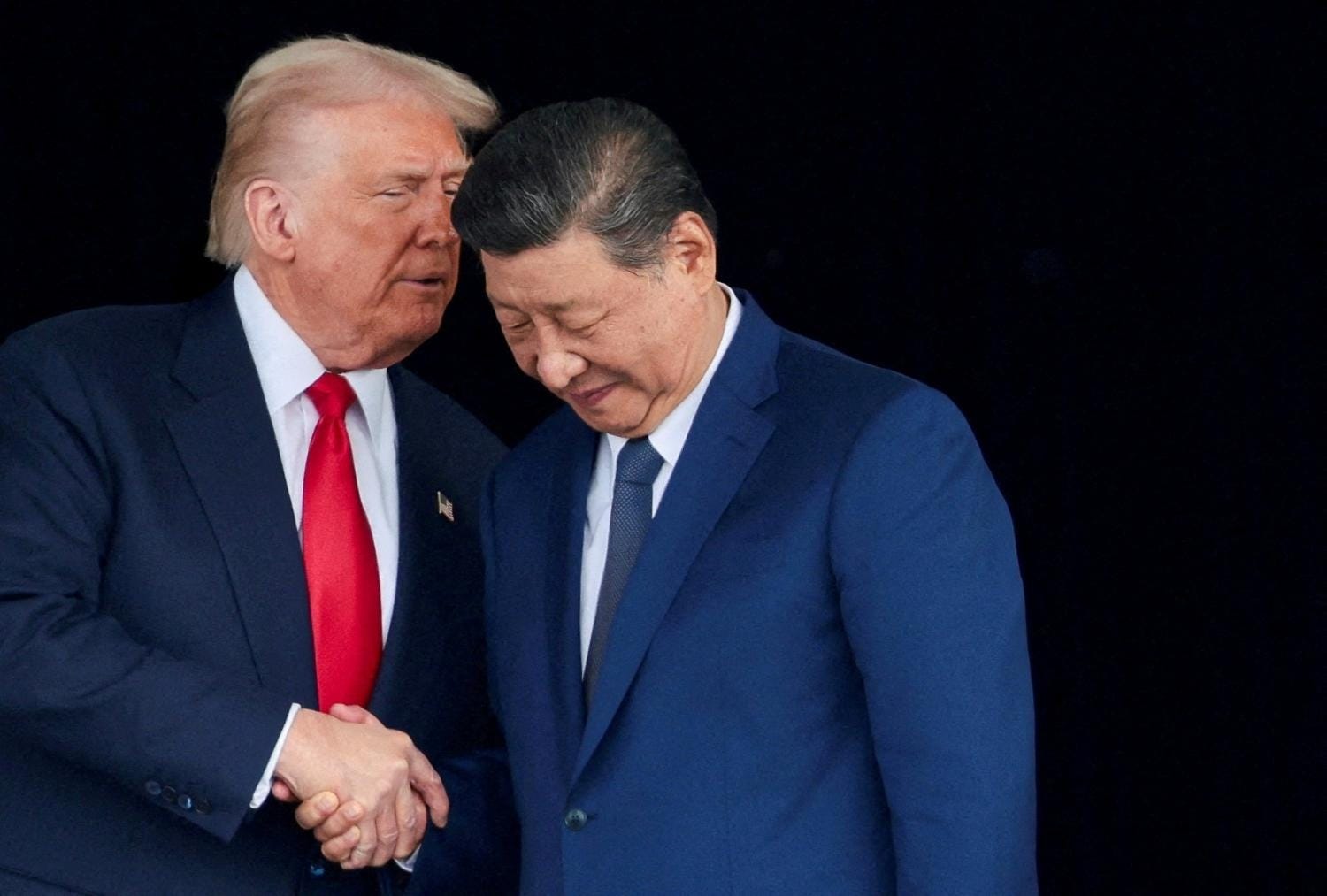
Tony Stark: The document does not change U.S. policy towards Taiwan. If anyone tells you it does, they are wrong. However, it does give the PRC political and legal ammunition. They can now say, “But you said you wouldn’t interfere in the internal affairs of others,” pointing to our supposed principles of non-interventionism.
The document also says we do have to intervene sometimes. This amounts to talking out of both sides of your mouth — we reserve the right to do whatever we want. The “flexible realism” section is a fancy way of saying we’ll do whatever is convenient. Historically, that has been U.S. foreign policy in practice, but that doesn’t mean it’s what we should aspire to.
Justin McIntosh: I don’t have a problem with them laying out the “ends, ways, and means” discussion up front, but it has limitations. That linear framework is well-suited to military decision-making, but a national strategy needs to be more pragmatic and flexible. At the national level, you control all the resources. You can marshal all those resources toward any goal that is deemed important. That makes the “ends, ways, and means” calculation irrelevant because you will find a way to make it happen.
Jordan Schneider: The Trump administration’s focus on “ends, ways, and means” raises the question — how weak do they think the U.S. really is?
Reducing the U.S.’s power to an “ends, ways, and means” calculation only works in military contexts — counting ships and battalions to see how many wars you can fight. The U.S.’s power to achieve economic and national security ends is elastic. The means to those ends can grow dramatically when the president builds a consensus around them — once the nation decides something must be done, it finds the capacity to do it.
It’s a mistake to define goals downward because those goals inevitably change. Consider the border — the Biden administration didn’t prioritize the issue and struggled to find the means. The Trump administration’s intense focus on the border unlocked congressional funding and operational capacity. The resources didn’t appear from nowhere — the will to use them did. This dynamic applies globally. To believe the U.S. cannot act because it lacks on-hand capabilities is a severely limited way of thinking about our power to shape events.
Mixed Signals
Tony Stark: The document’s focus on military and economic power isn’t unique, but its goals do not align with a realistic budget. It calls for both bolstering deterrence in the Indo-Pacific and shifting our entire global military posture to the Western Pacific, which would drain resources from Europe and Latin America. We have to assume this will happen.
This creates deep concern for our allies, but that matters for the U.S. too. The Germans will be wildly pissed about how they are described in the document. Asian allies are told to “do more,” a demand that ignores their significant recent efforts. Getting allies to increase defense contributions was an accomplishment of the first Trump administration that continued under Biden. The call to “do more” is now an outdated talking point — they are doing more. Japan is considering exporting weapons for the first time.
Justin McIntosh: Worse still, when allies make the kinds of statements the U.S. wants — like Sanae Takaichi declaring a PLA incursion into Taiwan a national security threat to Japan — the administration’s response is silence. Based on the reporting of Xi and Trump’s call, it appears the U.S. did not affirm that position. Instead of backing Japan’s strong stance, the message was to “calm it down.”
The Trump administration is sending mixed signals. Does it want allies to spend more on defense, develop a stronger defense mindset, and care more about their own security, or not?
Jordan Schneider: Let’s do some reading from the scripture here.
“A favorable conventional military balance remains an essential component of strategic competition. There is rightly much focus on Taiwan, partly because of Taiwan’s dominance of semiconductor production, but mostly because Taiwan provides direct access to the second island chain and splits Northeast and Southeast Asia into two distinct theaters. Hence, preventing a conflict over Taiwan, ideally by preserving military overmatch, is a priority. We will also maintain our long-standing declaratory policy on Taiwan, meaning that the United States did not support any unilateral changes to the status quo in the Taiwan Strait.”
From that, it sounds like a good idea for Japan to make its role in deterrence transparent. How seriously should we take any of these documents?
Tony Stark: I wish Eric were here for another briefcase-carrier rant. In the 2010s, a gripe of mine was hearing mainstream national security people, the ones in the know, say strategy documents don’t matter. That is a clear indicator they either haven’t written a good strategy document or haven’t marshalled the resources and people to execute it. I’ve occasionally had to metaphorically beat somebody over the head with a strategy document.
One problem is that people don’t read strategy documents. I have been in meetings with theater-level commands who’ve asked me, “What are you quoting from?” And my response is, “The National Defense Strategy.” They’ll ask me to send it to them. It’s a public document.
Justin McIntosh: “No, no, we meant the classified annex, Tony. Obviously, we’ve read the public one.”
Tony Stark: “The super-secret one that wasn’t even fully distributed to your command.”
Justin McIntosh: The document doesn’t matter, and there isn’t a robust national security apparatus anymore — at least in this administration — it’s as if the President is the sole decision-maker. Trump has consolidated his counsel — it’s a smaller group than it was.
Another problem is that the strategy document’s promises are often the opposite of what the president himself has done. The strategy specifically addresses deterring propaganda aimed at Americans, clearly referencing China, and yet TikTok is still legal here.
When X turned on a filter showing where accounts came from, it revealed so-called Mongolian accounts weren’t Mongolian, and supposed Uyghur accounts were run from mainland China. Pro-MAGA accounts were operated from VPNs in India and China to target Americans. Where was the action on that propaganda? We kept TikTok, and no one has suggested the government force X to shut down foreign influence accounts. These goals are in the document, but the follow-through is missing.
Tony Stark: Every administration struggles with inconsistencies between its strategy and actions. That’s the nature of a democracy — it’s the nature of any government worldwide. This strategy document’s main issue is its unusual use of national security language. The strategy says the administration opposes disinformation, but what do they consider disinformation? There are direct quotes that frame concepts like “de-radicalization” and “protecting our democracy” as a fake guise — that inclusion is wild.
On foreign policy, the document critiques the U.S. for focusing too much on projecting “liberal ideology” into Africa — it’s unclear if that means big ‘L’ or small ‘l’ liberal. Let’s assume it’s both. The most stunning part is that the National Security Strategy of the United States explicitly frames the concept of “protecting our democracy” as a ruse. That is insane.
The parts of a strategy document that truly matter are the ones that diverge from the previous strategies. While I’ve critiqued previous strategies, this document is on another level.
Justin McIntosh: The large section on China is a good example. It would be great if the administration enacted many of the listed actions — I’d be all for it. The cognitive dissonance between the strategy document and the administration’s actions is troubling.
Jordan Schneider: Six months ago, the AI action plan included interesting language about new export controls on semiconductor manufacturing equipment. Those controls are paused because Stephen Miller’s current job is to avoid upsetting China. This directive came after a Chinese official was angered by a Financial Times article on Alibaba and the PLA. Stephen Miller’s Twitter banner is a picture of him shaking hands with Xi. This is hard to square with official strategy documents demanding military overmatch.
You can try to connect those dots and argue that the goal is to keep the economic relationship calm while we re-industrialize and build up our military. Okay, maybe. But that still doesn’t explain the U.S NSS includes sovereignty language seemingly copied and pasted from Putin’s playbook.
Traditional Values, Universal Wings
Tony Stark: The document is also very undergraduate. That is not a critique of the accessible language — I also try to write for a wider audience — but of the concepts themselves. If an undergraduate at the University of Texas at Austin were assigned the paper topic — what should a national security strategy be — this would be that paper.
Jordan Schneider: There are 14 bullet points where each sentence is about seven words long.
Tony Stark: What does this all mean? The language in the National Security Strategy should not shock anyone — it’s consistent with the administration’s usual rhetoric. What has changed is that this language is now the official guidance — it has leverage in bureaucratic fights. The influence may not be immediate, but it will be cumulative. The real test will be when the National Defense Strategy comes out. Someone who worked on it texted me last night and said, “Well, they set the bar low, so this is great for us.”
Justin McIntosh: They’re being pragmatic. What troubled me was the traditionalist language at the end.
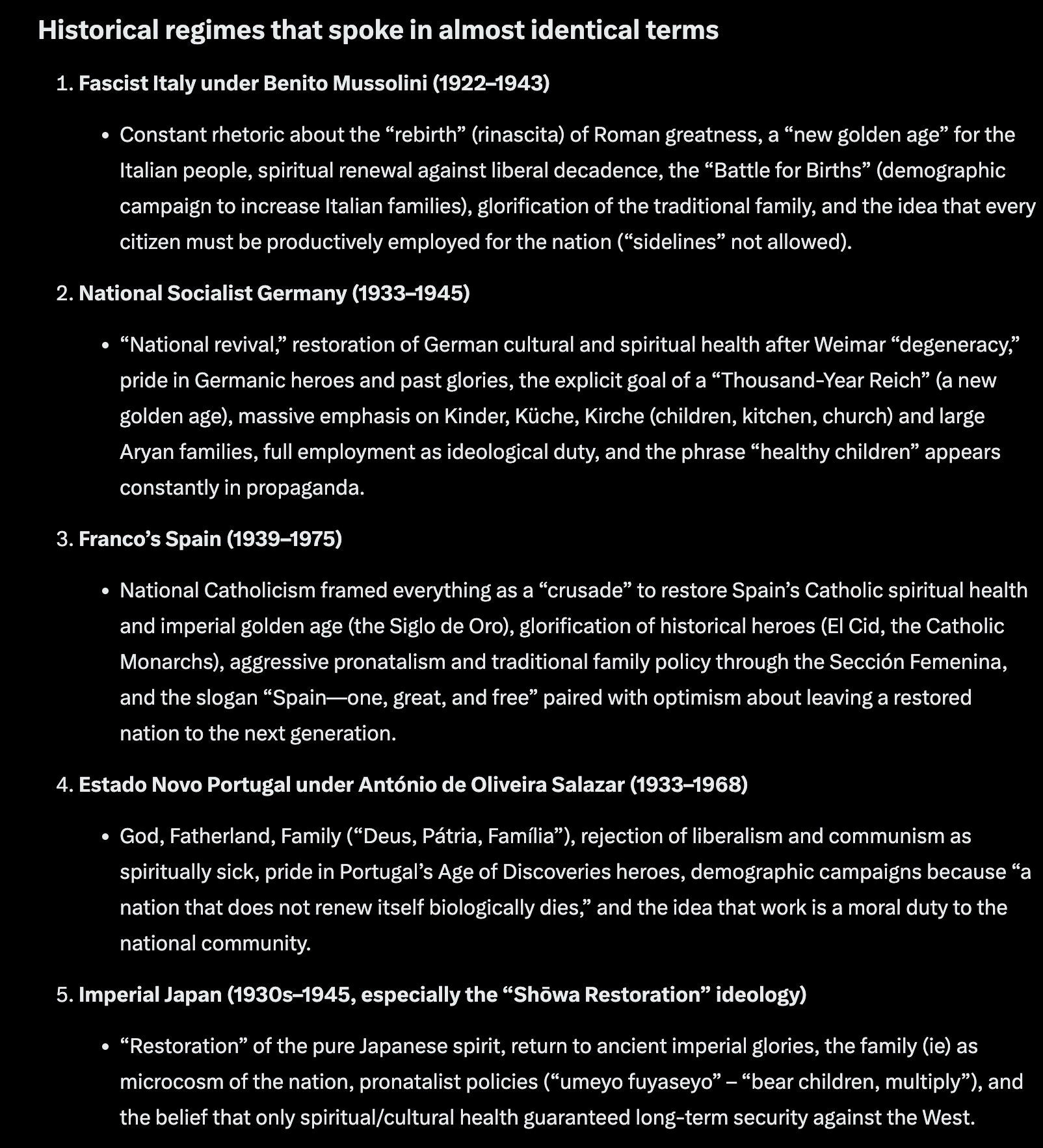
“Finally, we want the restoration and reinvigoration of American spiritual and cultural health, without which long-term security is impossible. We want an America that cherishes its past glories and its heroes, and that looks forward to a new golden age. We want a people who are proud, happy, and optimistic that they will leave their country to the next generation better than they found it. We want a gainfully employed citizenry—with no one sitting on the sidelines—who take satisfaction from knowing that their work is essential to the prosperity of our nation and to the well-being of individuals and families. This cannot be accomplished without growing numbers of strong, traditional families that raise healthy children.”
Tony Stark: “We will use every means to protect our precious bodily fluids.”
Jordan Schneider: Wait, if you’re raising a disabled child, or if your child is sick with a fever, then you are not contributing to the restoration of American cultural and spiritual health? Wow.
Tony Stark: That is what RFK Jr. said — if your kid is sick, that’s not a good societal contribution.
Justin McIntosh: His miasmas are off, or whatever non-germ-theory medicine he peddles but doesn’t practice.
Tony Stark: The Midi-chlorians from Star Wars.
Justin McIntosh: That language is reminiscent of what you see from Putin and China’s family planning policies. It is the exact type of language that Xi and Putin use to justify pro-natalist policies and promote traditional families and traditional gender roles. Reading about the one-child policy in Dan Wang’s Breakneck is heartbreaking if you have children. It’s striking how similar the NSS’s language is to China’s early discussion of the one-child policy.
Tony Stark: In a reasonable time, there would be ten articles asking, “What does this mean? How is the government going to encourage people to have more kids?” Now, it’s something I don’t even want to read about.
After COVID-19, as the “China Rising” narrative was gaining prominence in 2021 and 2022, discussions began in national security circles about how the U.S. population is numerically outmatched. Although we are solving that problem with robotics, it was a talking point among traditionalists. They argued that the U.S. won the Cold War by embracing traditional values. That’s not how we won. We won thanks to Skunk Works and the Soviet Union’s economic mismanagement.
This argument has surfaced before in national security circles — it’s not a new phenomenon. The other common concern is protecting our food supply — I’m surprised it was not mentioned in the document. But, to quote a former coworker of mine, “We have Buffalo Wild Wings and the Chinese don’t. I think we’re okay.”

Jordan Schneider: That would be a great cultural export. Maybe that’s what the world needs.
Tony Stark: Are there Buffalo Wild Wings locations in Shanghai or Beijing?
Justin McIntosh: I’m sure there’s one in Taipei. [Note from Lily: Taiwan does not have a Buffalo Wild Wings, but it does have three Hooters locations.]
Tony Stark: Is the food different, or is it universal?
Justin McIntosh: It’s universal, but like McDonald’s in Japan, it’s better.
Tony Stark: Another American cultural victory. We don’t need to change anything.
Justin McIntosh: You can watch a baseball game while eating Buffalo Wild Wings in downtown Taipei.
Tony Stark: During COVID, my former American University professor, Justin Jacobs, uploaded all his lectures on Spotify — excellent lectures on the history of China and Japan. He has an episode about why baseball is played in Taiwan but not on the mainland. He discusses the Japanese occupation of Taiwan and the differences in Confucian culture and masculinity. Prof. Jacobs is an amazing resource for East Asian history.
Jordan Schneider: I asked Gemini what other regimes this resembles. It suggested Vichy France, Fascist Italy, and modern Hungary.
Justin McIntosh: I wonder what Grok would say…