
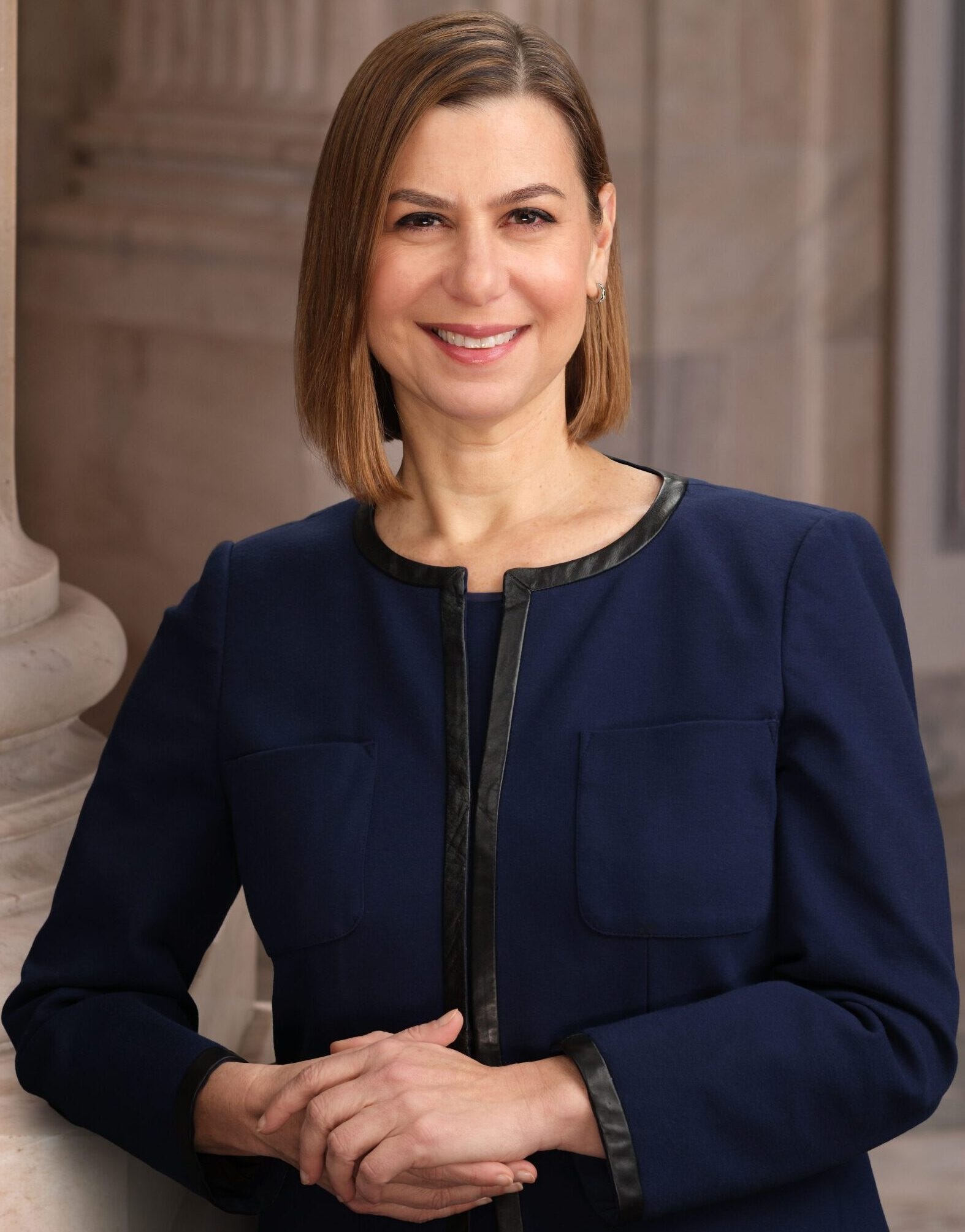
Senator Elissa Slotkin of Michigan, who served in OSD Policy and three terms in the House before joining the Senate Armed Services Committee, joins ChinaTalk to break down what got in, what got voted down, and why NDAA markup days are the only two days a year the Senate acts like a functioning institution.
Beyond the NDAA, we also discuss…
The AI Guardrails Act, the Anthropic debate, and why no one SecWar or AI company should set the rules for the kill chain,
Her bill with Bernie Moreno banning Chinese connected vehicles,
The Democratic playbook if the party flips a chamber in November,
Data ownership, the Midwest’s data center revolt, and why a healthy democracy would be talking about AI every single day.
Listen now on your favorite podcast app.
NDAA Markup—The Most Fun to Be Had in the Senate
Jordan Schneider: Senator Slotkin of Michigan, formerly of OSD Policy and the House of Representatives — welcome to ChinaTalk.
Senator Elissa Slotkin: Thanks for having me.
Jordan Schneider: Let’s start with the new NDAA we have, sort of. What are you excited and concerned about? Let’s talk in particular about ROBOCOM, the robotic and autonomous systems combatant command that the committee was excited to kick off.
Senator Slotkin: Look, the two days we do the NDAA markup in the Senate are typically my best days of the year. They are behind closed doors — which is probably why people act more normal — and there’s real substantive debate on provisions. Most importantly, say a Republican colleague has a provision and I’m like, “Look, I’d be with you if you just changed X, Y, and Z.” They send their staff back to change X, Y, and Z, and three hours later we revisit it, it gets a vote, and it gets in. Or two people have similar amendments on different sides of the aisle, and they go compromise over lunch and fix it. That doesn’t happen enough in this place, so I’m always happy to be in NDAA markup.
Jordan Schneider: Maybe before we do the specific stuff — is there any structural change that would make more of the building work like SASC does on NDAA markup days?
Senator Slotkin: The way you would do it is probably never gonna happen, because it means you kick the cameras out. That’s the only difference — the cameras are not there, so people don’t feel like they need to play to an audience. They aren’t kicking back with their political talking points; they’re actually doing substantive work. And it’s a pretty hard argument to make: “Hey America, we’re going to be less transparent in the Senate.” That’s a hard thing to do.
I think there’s a million ways to make the Senate more efficient. The Senate was a caterpillar and could one day be a butterfly, but is right now in the disgusting cocoon and doesn’t know what it’s going to be. I have a million ideas on how to reform this institution. But we’re effective in the NDAA because people are not playing to the bleachers.
Jordan Schneider: Do people really need those clips, though?
Senator Slotkin: I don’t know that people wake up in the morning and say, “I’m so excited for my five minutes in front of an Armed Services hearing today.” But those hearings have been televised for over twenty years, and no one’s gonna be the chairman who says, “I’m kicking out the public,” right? And I don’t think the public feels like they want less oversight and insight into what the House and Senate are doing. So it’s a tough position.
The way to deal with this is a different vision of how we use these committees — how we do work, how we build coalitions around big ideas. You were just talking about the robotics command. That’s a big deal — the idea to pass something that would potentially be a new command — and unfortunately, we don’t start discussing it until we’re really in markup. Our staff are looking at it before then, for sure, but you could imagine different ways of doing these things. I’m open to all of that. But for the reasons I described, I like NDAA markup because people quite literally roll up their sleeves and do real work.
Jordan Schneider: There’s a broader, weird information-asymmetry thing here. There’s so much in the NDAA, and as a principal you can only really get your head around a few provisions. How do you manage that principal-agent issue?
Senator Slotkin: Like everywhere in Washington, you have staff who are smarter than you and who are immersed in all of these things — who read everything, who go through hundreds of amendments and flag the most important, the most controversial, the most consequential, the sexiest, whatever. And you prep. If you do your homework — and some of my colleagues really do their homework, some of them don’t — if you care about substance, your staff is saying to you, “Hey, we’ve read through the two thousand pages. Here are the nineteen things we think you really need to know that are gonna come up for real substantive debate, and we’re going to make a recommendation on how you vote.” We discuss all that before I ever get in that room. There are giant binders full of amendments — it’s a whole process. But no one is the master of every detail. You get smart staff who can appropriately flag the big, big strategic stuff.
Jordan Schneider: Great. All right, let’s come back to my first question — though I do want to do an hour on procedural reform. Maybe for next show.
Senator Slotkin: You need a life. You need a life.
Jordan Schneider: What else is there to live for? Well, I watched the Knicks last night — that was incredible.
What pieces of the NDAA are you excited about and concerned about?
Senator Slotkin: I don’t like the Knicks, but okay.
When you have two thousand pages, there are things you’ve really fought for and care about, and there are things you don’t agree with. The things I was really glad got in there: the AI Guardrails Act — actually putting some guardrails on the Pentagon and its use of AI, particularly in matters of life and death. Banning Chinese cars on all military bases — I’ve been working on this for four years, and that’s for bases here in the United States but also overseas, where Chinese cars are just everywhere. We had important provisions on Selfridge, an Air Force base in Michigan, on PFOS — making sure the military cleans up after itself when it’s contaminated local communities, including in Michigan.
Then there were disappointments — things voted down that left me downright shaking my head, including my own provisions banning uniformed military from collecting ballots and voting machines, breaking the chain of custody of votes. That’s illegal anyways, and we should never be spending a dime on it. That got voted down. Also: not sending the uniformed military to voting locations. I’m very concerned about the authoritarian playbook we’ve seen over and over again, including in Hungary a couple months ago. The president has said if his party doesn’t win this election, then it was rigged. I just don’t want them to precipitate a national security threat such that suddenly they have to send uniformed military to the polls for the first time in our history. Never done that.
And we genuinely didn’t talk about the war in Iran. It was this massive elephant in the room. We know they’re all talking about $350 billion, $400 billion as the cost of the war right now — and it’s not over. Could we please discuss that? This war isn’t authorized, so are we gonna appropriate money for a war that’s not authorized by Congress? The top line is huge, and they’ve slashed spending on domestic issues. So there were big strategic issues at the big-picture level, and then a lot of things I was glad got in.
AI and the Kill Chain
Jordan Schneider: Let’s pick up on a few of those themes. AI starting a nuclear war is something where it’s pretty easy to see the consensus. But as you think down from the strategic to the operational and tactical level, there are a lot of really exciting applications. I was just thinking — to what extent could Claude Mythos do your old job at OSD Policy? Would I rather have a chatbot negotiating an Iran peace deal than Witkoff? Maybe! Probably! What makes sense, and what should people be concerned about? Because clearly there’s going to be a real edge from an effectiveness perspective if you can figure out how to use these tools right.
Senator Slotkin: There’s already experimentation going on across our economy on AI, and certainly at the Pentagon — there has been for years. What the whole debate with Anthropic brought up is that there shouldn’t be any one Secretary of Defense or any one company deciding the rules of how AI is used in what we would call the kill chain — decisions of life and death. That should be legislated, because I don’t want someone to come in and change the rules, make them too onerous or too lax. So we took a stab at putting some left and right guardrails on the use of AI, and it’s really about keeping a human being as the ultimate decision maker.
We all understand that AI is everywhere — even just doing a Google search, you’re using more AI on a regular basis, and so is the military. If it’s using AI to amalgamate health records or collect information about employees in a faster way, okay. That’s different from making final decisions on when and where to deploy a nuclear weapon, or domestic surveillance, or — again — decisions of life and death.
AI is here. I don’t think AI is anywhere near ready to take over negotiations for anybody. And the other piece we got into the NDAA was the unbelievably rigorous testing we need before any of this stuff is fielded. That is the difference. In the race to get more and more technology into the Pentagon, we need to take a beat and make sure we’re properly testing — just like we would a new weapon system, just like we would a new part. I would say even more so, because of some of the advanced capabilities AI brings. You just need really rigorous testing, and that got in on a bipartisan basis.
Banning Beijing’s Cars
Jordan Schneider: Let’s talk about your efforts to keep Chinese electric vehicles out of the US. You put forward some connected vehicles — CVs, sorry, not EVs —
Senator Slotkin: Chinese connected vehicles. Electric, combustion, whatever they got.
Jordan Schneider: What do you say to the argument you’d hear from someone like Dan Wang — that the way to actually do industrial upgrading is through the kinds of partnerships rumored between, say, a CATL and a Ford? That China’s advantage is now so great that we have to play the same game the US played with Japanese and Korean automakers in the eighties and nineties?
Senator Slotkin: I wrote legislation with Bernie Moreno to ban full Chinese vehicles and to ban the connected parts — the parts that send data back to Beijing. We did allow for joint ventures, but it can’t be a Chinese-dominant joint venture. Unlike our Korean allies or our Japanese allies — who in my mind are completely different, trusted partners in these deals — I’m sorry, I don’t have the same faith in China. I watch them cheating in the international system every single day, and so does every single Michigander. It’s apples to oranges. So we laid out a path for how you can do a joint venture in the United States, but it means the Chinese have a fifteen percent stake in that joint venture, not an eighty-five percent stake. I’ve written that this is the right way forward.
I’ve also put out a bill to ban them coming over our international bridges and tunnels. Michigan’s a border state. Canada is big mad at the United States — well deserved, for them to be mad at us. They feel the president is trying to kill their auto industry, so they’ve made the decision to import Chinese vehicles — tens of thousands of them, including BYD vehicles — with the same data package sending everything back to Beijing. So I told the Prime Minister directly: I’m going to try to ban those things from coming over our bridges and tunnels, because I don’t want them driving up to one of our bases or one of our infrastructure nodes, taking video and collecting data.
We’ve got a real challenge here. That’s why I did the bill, and that’s why it was bipartisan, just a couple of weeks before the big summit with Xi Jinping — because even my Republican colleagues were saying, “We’re hearing Donald Trump is gonna allow Chinese cars into the United States. We think that’s bad. Let’s work on a bill together.”
Does Michigan Care About Taiwan?
Jordan Schneider: Speaking of other things folks were concerned about Trump potentially doing on his Beijing trip — you’re a co-chair of the bipartisan Senate Taiwan Caucus. I don’t think you need to convince our audience of why Taiwan matters to US national interests. But I’m curious for your pulse check on where Taiwan sits in the constellation of things people care about, both among your colleagues and from a broader Michigander, American-people perspective.
Senator Slotkin: If you’re a national security nerd, as many of your listeners tend to be, you understand the importance of Taiwan and the implications of a Chinese takeover — the global implications, economically, militarily, the whole thing. But if you’re back home in Michigan — and I know, if you’re back home in Michigan — Taiwan is not at the top of your list. You certainly know a lot about China, but that’s because you feel like you’ve watched jobs steadily march out of your state for thirty years, over to low-paid workers in China. There is certainly a feeling that we have lost out economically to China.
I did a series of open-ended foreign policy conversations in Michigan. I pulled together a bunch of people — cops, teachers, nurses — with no national security background, and said, “Hey, you should get to contribute to what you think our national security priorities should be. What do you think of?” It’s probably very different from your listeners. They certainly talked about China, but all through the economic lens, and feeling like we had lost. And then things like cyber threats that affect them — their K-12 school, their hospital that got ransomed, their elderly mom who got money stolen from her. It’s national security threats, but brought home to the middle of the country.
So people have a lot of frustration with China. But when you say Taiwan — I don’t think they want any country to be invaded, but I gotta tell you, right now the American public is pretty frickin’ exhausted with foreign wars. In my state, they voted for Donald Trump last time. They were pretty convinced he was the guy who wasn’t gonna get us into more foreign wars — and now they’re paying for it, literally, at the pump. If you brought a bunch of Michiganders together and asked what they think of Taiwan, they’d say, “We know we get a lot of chips from them. We want them to be happy and healthy. But that’s not where my focus is. My focus is on surviving so I can afford to send my kid to summer camp.” They’re interested in the economic issues — not what feels to them like military issues very far away.
If the Dems Flip a Chamber
Jordan Schneider: Say the Dems get the House and Senate in six months. What are you excited to do?
Senator Slotkin: When the Democrats flip at least one of the houses, we should focus on two things. First and foremost, we’ve got to demonstrate to the American people writ large that this place can still function and pass laws that help them. What I would do first is take all the ready-to-go bipartisan bills — on housing, on protecting against deepfakes, a lot of the internet safety and digital safety bills. These have either passed one house or the other, or they’re completely bipartisan. Pass that stuff and show that government can still do good things, because I think there’s a real question about that.
Number two, there has to be appropriate accountability, follow-up, and oversight. With the graft that’s going on — which we’re only starting to understand — this place has a responsibility to taxpayer dollars. That’s what we do: we appropriate the money. You can decide what your lead foot is on any given day, but for me, the American people have a fundamental question about democracy, and we need to demonstrate that our system of government still works as our founding fathers intended.
Jordan Schneider: The defense-acquisition graft is a really interesting one, because on the one hand, for the Pentagon to be functional in the 2020s, it needs to play with stuff like OTAs [Other Transaction Authorities] and have more flexibility in spending money. But on the other, Don Jr. is on the cap table of half these companies that are now getting contracts. How do you think about managing that tension?
Senator Slotkin: It falls into a category I see across the Trump administration: Trump often has the wrong answer to the right question. The Pentagon does need new authorities, new flexibility. When I think about China, by the way, and some of our problems vis-à-vis China — it’s not that we don’t have interesting innovation going on in the United States that we can use as a warfighter. It’s that our adoption rates are years slower than the Chinese. Adoption is the thing. And that’s because we have really big bureaucratic systems that don’t turn and move and flex quickly. That’s a fundamental problem. So there’s a lot of truth to the need to be more speedy, efficient, and flexible.
But then they go and give it all out in these sweetheart deals — to relatives of the president, or friends of the president, or people who have done favors — and they just sour the entire thing. A lot of the innovation, especially in defense circles, is coming from the private sector now. It’s not like the 1940s, when the government was leading — at Los Alamos, say — and innovation migrated out to the private sector. Now a lot of it’s in the private sector and we need to bring it in. That requires different thinking. But I do not trust these guys farther than I can throw them to actually put up real rules and regulations to prevent massive conflicts of interest. Massive.
Rules of the Road for AI
Jordan Schneider: Let’s do one more, on the legislative response to technological change. The two priorities you just called out for your 2027 pitch — deepfakes, digital safety — have been baking since the era when social media was the biggest thing we were scared about, not the AI anxiety that’s going to accelerate over the coming years. How are you thinking about managing that transition, and what would Congress need to do to help us get to the other side?
Senator Slotkin: Okay, let’s imagine an alternative version of the multiverse where we had a healthy political system. If we were functioning like a healthy democracy, we would be talking about AI every single day in the US Senate and the US House. I always tell people: we’re at the point right now that was 1988 in the internet boom. Some early folks understood it and the transformation that was coming, but it was hard for the average person to grasp just how much change was on the way. We didn’t do enough to think it through and put up rules of the road. We are now at that moment on AI — that breakout moment — and we’re busy talking about invading Greenland. It is literally the definition of opportunity cost.
For me, that’s this body’s responsibility. A lot of it is connected to ownership of your own data. Your data should be something you possess, and we need a structure that allows for that in everything we do — because your data is obviously being monetized, but it can also be stolen and used against you, everything from a deepfake on down. So there’s a lot there on control of data.
And then we need rules of the road on the human being remaining the decision maker — the guy or gal who presses the button. That’s true on military matters, and we got this legislation into the NDAA. But I’m also working on a bill on veterans’ health care: yes, you can do pilot programs with AI to help speed up the process of getting veterans their care or their benefits. But you are not allowed to let AI decide which veteran gets a benefit or a surgery. A human being must be the decision maker — the AI can be a contributor to the decision. That’s an important rule of the road no matter how we’re thinking about AI.
Leaders have a responsibility to chart the path from the dark to the light. On AI and the future of work, that is just not a big enough conversation. I certainly know in my state there is a ton of fear and concern about what AI will do. We’ve seen job loss from automation, and now people feel like we’re up for another wave of it. And that’s all pouring out, by the way, in this debate on data centers. If you want to understand why data centers are basically the hottest, most galvanizing, most grassroots issue in a lot of the Midwest — certainly Michigan — it’s not just that a giant center coming to take a ton of energy and water off your system is controversial. It’s that they’re doing it on behalf of these AI companies, and no one knows what these guys are actually about — or what the future looks like for their kids if we hasten the use of AI in everything.
Anyways, that’s a long-winded way of saying: if we were not ill as a country, we’d be talking about AI every single day.
Motown and the Founding Fathers
Jordan Schneider: Awesome. All right, last question: one book and one musical genre. I’ve gotta write a song about how you just told me I needed to get a life because I’m too into parliamentary procedure.
Senator Slotkin: Sorry. I’m sorry! On musical genre — if you grew up in Michigan, you basically grow up on a combination of Motown and classic rock. Maybe a few other things in there, but those are fundamental. Chances are, if you’ve got a Motown song or a classic rock song, I grew up driving around with my friends after high school listening to it.
And on a book — I just bought a bunch of copies to give out to other people. It’s a very, very slim volume that uses primary sources on the editing of the Declaration of Independence — why certain word choices were made, with each chapter built around a different phrase. It’s fascinating. It sounds nerdy — okay, you’re a nerd, I’m a nerd — but it’s super fascinating and super important in the moment we’re going through right now.
It’s a book called The Greatest Sentence Ever Written, and it’s about the sentence “We hold these truths to be self-evident…”
Jordan Schneider: Amazing. There’s another version of that book that a historian wrote on the Gettysburg Address, for people who like their deep textual analysis of founding American documents for our 250th anniversary.

Senator Slotkin, thank you so much for being a part of ChinaTalk.
Senator Slotkin: Thanks for having me.
Motown song…
There's a single reason the Senator doesn't want Chinese cars in Michigan, and it's got nothing to do with data collection. If China wanted to collect the data she listed, they'd do it with the folks they already have on the ground or with satellites. She's talking nonsense to hide from the one single simple fact, to whit...
Chinese cars make the crap coming out of Detroit look like a joke, and they cost about half as much. If they let Chinese cars into America, American auto manufacturing evaporates. It's already a dead man walking. There's a reason Farley (Ford's CEO) doesn't want to send his Xiaomi SU7 back to China.
(Michigander living in Wuhan for the last 15 years.)
Data collection is the cover story. The supply chain that makes a 9,998 yuan robot at 40% margin is the same one building the 25K dollar EV. That is what cannot be banned.