
Welcome to another installment of the ChinaTalk radio show! Today, we’re diving into Taiwan’s war on green energy.
Shenanigans abound in this episode, including:
The lights-out scenario — Taiwan only holds 11 days of LNG reserves, and 97% of the island’s energy is imported, but the ruling party phased out nuclear and botched the renewable rollout anyway.
The offshore wind graveyard — how made-in-Taiwan components drove developers to abandon the world’s best offshore wind sites,
The Taipower unbundling reversal — and the Kafkaesque system that keeps electricity prices dirt cheap despite the Iran war.
“Green energy cockroaches” — why corruption is Taiwan’s dirtiest secret, and how the Taiwanese public came to associate renewables with scandal,
The nuclear U-turn — How President Lai Ching-te walked back forty years of “Non-Nuclear Homeland” orthodoxy to restart Taiwan’s nuclear reactors.
Special thanks to “Jason Feng,” Angelica Oung, Ricky Huang, Tsaiying Lu (DSET), and Yu-Hsuan Yeh (formerly of CSIS and DSET) for their time and expertise. Everyone’s views are their own.
You can watch this episode on YouTube or listen on your favorite podcast app.
Why Taiwan Isn’t Ready for a Blockade
Lily Ottinger: Imagine yourself on the streets of Taipei. It’s August, 2028 — aunties are pulling their wheeled grocery carts through the vegetable markets, and commuters on motorcycles weave through traffic under the brutal sun. But something is missing — the AC isn’t humming, and the lights are out. Eight days earlier, Chinese warships encircled the island, attempting to strangle Taiwan’s economy without firing a single shot.
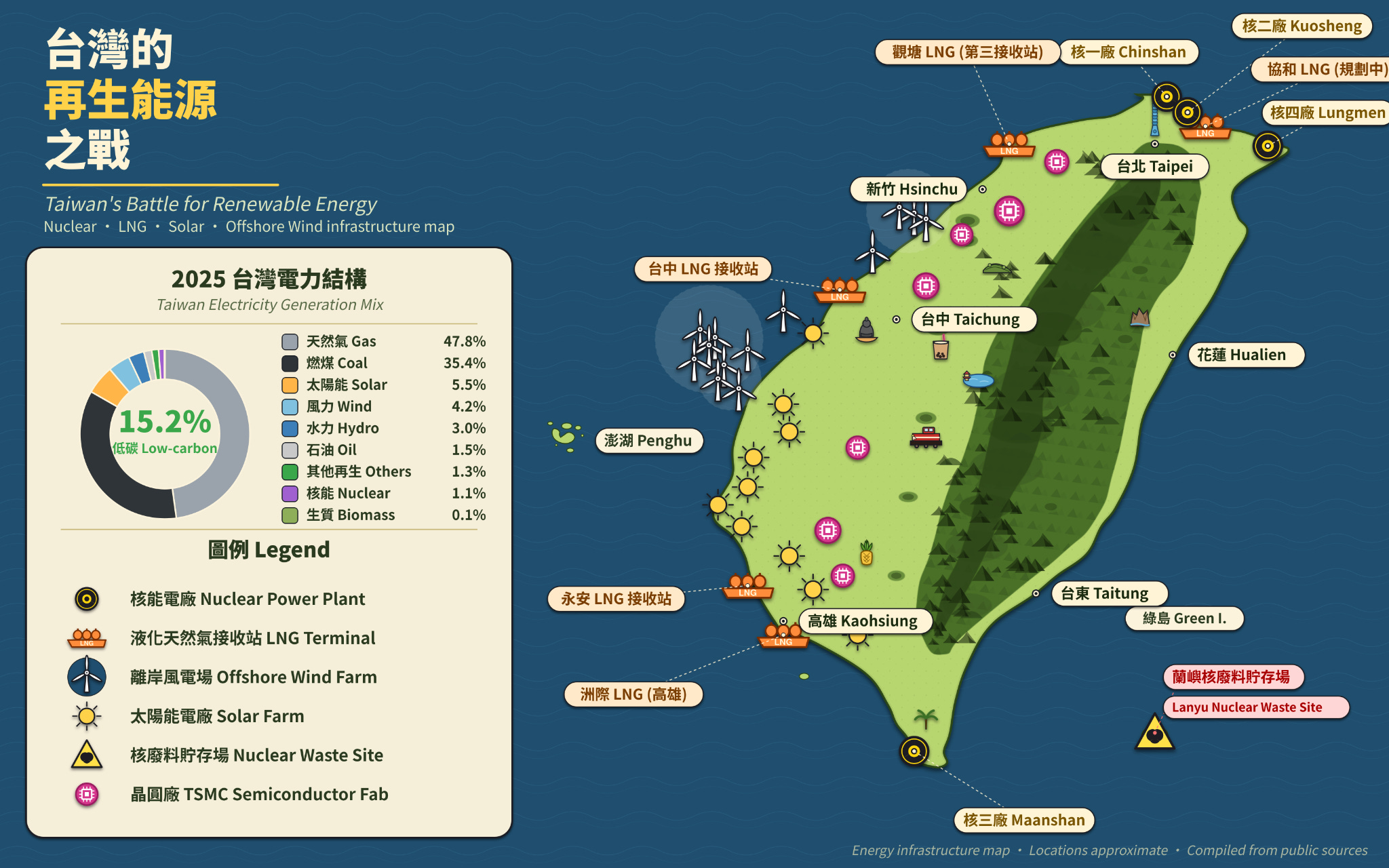
97% of Taiwan’s energy comes from imported sources — the highest rate of any major economy. The island runs on liquefied natural gas shipped through sea lanes that China’s navy — the world’s largest — can cut at will. Taiwan holds roughly 11 days of LNG reserves. Coal lasts about 42. After those are used up, the lights go out.
Aqib Zakaria: This isn’t a hypothetical war game. Right now, the war in Iran has closed the Strait of Hormuz and damaged Qatar’s largest LNG complex. Asian spot prices for natural gas have surged over 140%. And Taiwan — which gets roughly a third of its LNG from Qatar — is paying the price.
Angelica Oung: “Taiwan should send a thank you note and a fruit basket to Beijing right now because the reason we’re not having an energy crisis is because of China. The Strait of Hormuz has been blocked for a couple of months now. We’re supposed to get 35% of our LNG from Qatar. We’ve just been buying it on the spot market and we’ve been fine because we have money.
But the fact that there are all these excess cargoes floating around is because of China, because there’s been tremendous natural gas demand destruction in China. They have all this excess capacity in coal plants that they don’t use, and in the crisis they just crank those coal plants on. It does temporarily create more pollution, but that loosened up supply on the LNG spot market.”
Aqib Zakaria: That was Angelica Oung, an energy journalist in Taipei. She started off as a renewables reporter and is now one of the island’s most prominent nuclear advocates.
Lily Ottinger: Taiwan’s politicians have known about their energy vulnerability for decades. And instead of fixing it, they’ve been systematically dismantling every domestic energy source the island has. They killed nuclear. They sabotaged renewables. They doubled down on imported natural gas. But why did this happen?
Welcome to ChinaTalk. Today, with the help of industry insiders, energy journalists, and policy experts, Aqib and I are telling the story of Taiwan’s war on renewable energy.
Ricky Huang: “Multiple forces have united against renewables in Taiwan, each with different motivations. This reminds me of cross-strait relations, where we say ’one China, multiple interpretations.’ Here it’s one anti-renewable sentiment with countless different rationales.”
Lily Ottinger: This story is a fantastic case study in the ugly side of industrial policy, and the West can learn a lot from Taiwan’s renewable energy failures. And yet — this is also a story about how to build progress in a democratic society, how to change public opinion on polarized issues — and I find myself cautiously optimistic about how this story will end. And if things don’t improve… well… Taiwan’s energy poverty might just be able to resurrect the electoral chances of the Kuomintang — even though the public broadly dislikes their ties to China.
Aqib Zakaria: Please let us know if you enjoy this format and want more episodes like this! This is only the second radio show we’ve produced and would love your feedback.
“No Nuclear Homeland” politicized the grid
Aqib Zakaria: To understand why Taiwan is in this mess, you have to understand the party that wrote the policy. The DPP — the Democratic Progressive Party — is Taiwan’s ruling party. President Lai Ching-te represents the DPP. His predecessor Tsai Ing-wen was also DPP. The party was founded in 1986, the same year as the Chernobyl disaster. The party was organized by dissidents against the authoritarian Kuomintang government that ran Taiwan during martial law. From the very beginning, two causes were welded together in the DPP’s DNA: democracy, and opposition to nuclear power.
Yu-Hsuan Yeh: “Taiwan started construction of nuclear power plants in 1971 during the energy crisis. All four nuclear power plants, including the fourth one that never became operational, plus the Lanyu storage site for low-level nuclear waste, went through their siting and construction processes during the martial law era. This means Taiwanese people never got to be consulted — they never had a say on whether they wanted nuclear power plants in their backyard.”
Aqib Zakaria: That was Yu-Hsuan Yeh, an energy policy researcher formerly at CSIS and DSET.
Yu-Hsuan Yeh: “The DPP, formed from the broader anti-authoritarian democratic movement from the mid-1980s to late 1980s. They developed very close relationships with civil society groups organizing anti-nuclear protests. This relationship continues to have political implications today.”
Aqib Zakaria: The specific slogan “Non-Nuclear Homeland” — in Mandarin 非核家園 — actually came later. It emerged around the year 2000, after the DPP first took power under President Chen Shui-bian, and was written into Taiwan’s Basic Environment Act in 2002. When Tsai Ing-wen ran for president in 2012, she attached a specific deadline to it: 2025. By the time she enshrined “Non-Nuclear Homeland” into the Electricity Act in 2017, it had become the DPP’s single most identifying piece of energy branding.
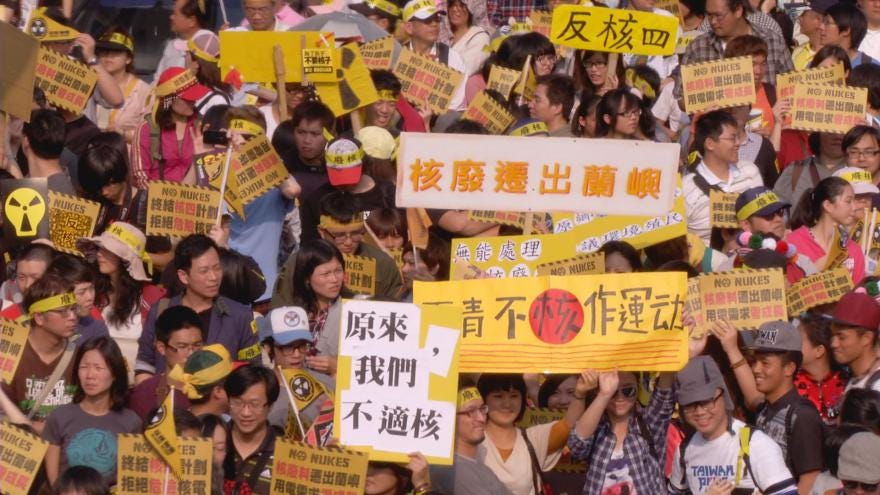
Aqib Zakaria: When Tsai won the 2016 presidential election, the DPP didn’t just win the executive branch — they won a legislative majority for the first time in the party’s history. That gave them the political room to pass one of the most ambitious energy reforms in Asia. The plan had two pillars. Pillar one: phase out all four nuclear plants by 2025 and replace them with renewable energy. Pillar two: break up the state-owned electricity monopoly. We’ll come back to pillar two in a bit and focus on pillar one for now. The plan for pillar one was to shut down every reactor on the island, and replace them with wind, solar, and battery storage. The targets were aggressive. By 2025, the energy mix was supposed to be 20% renewables, 30% coal, and 50% liquefied natural gas. By 2030, the renewables share is supposed to rise to 30%. The whole framework is called the “5-3-2 plan.”
Plant 1 was decommissioned in 2018-2019. Plant 4 — Lungmen, the one that was never completed — was mothballed in 2014 under KMT President Ma Ying-jeou in response to public outcry after Fukushima. A 2021 referendum permanently put an end to construction. Plants 2 and 3 went offline on schedule. Taiwan officially achieved its “Non-Nuclear Homeland” goal when the last reactor at Maanshan went dark on May 17th, 2025. But Taiwan did not meet its 20% renewables target to compensate. As of 2025, renewables only provide about 12% of Taiwan’s electricity, with about 6% coming from solar and 4% coming from wind.
Lily Ottinger: Before we go further, we need to look at the partisan structure that this debate lives inside. The governing DPP is pro-renewables — but historically anti-nuclear because of its authoritarian connotations. The two opposition parties — the KMT and the TPP — are pro-nuclear, but increasingly anti-renewables.
Aqib Zakaria: Quick crash course on the opposition. The KMT — the Kuomintang — is the party that fled mainland China in 1949 and ran Taiwan as a one-party state until democratization. They’re pro-nuclear, broadly friendlier to Beijing, and they currently control the legislature in coalition with the third party, the TPP. The TPP — the Taiwan People’s Party — is the newest party, founded in 2019 by the former Taipei mayor Ko Wen-je. Angelica Oung describes the typical TPP voter as someone temperamentally Republican but socially liberal — politically homeless and focused on bread-and-butter issues. They caucus with the KMT on most things, including nuclear energy.
So nuclear and renewables are on opposite teams, and posited as mutually exclusive energy paths instead of compliments. That means the pressure to combat climate change doesn’t actually motivate crosspartisan cooperation. The people we talked to broadly preferred an all-of-the-above approach, but that constituency is by and large unrepresented in Taiwan’s legislature.
Yu-Hsuan Yeh: “Political polarization has been a huge problem in all aspects. In the past, there were rooms for both sides to support each other’s bills, but it has been harder and harder over the years — probably similar to the US situation right now. This polarization has resulted in the lack of cross-party alliances or consensus.
Especially on energy, which has been a huge topic that people are aware of, the parties have already built up this image that the major two parties and the third smaller party have different stances. Because this has been part of their branding, they don’t find it attractive to work with the other side since they have already attacked the other side on this issue so much.”
Lily Ottinger: To me, it seems that the pressure to “pick a side” on the nuclear vs renewables debate emerged as a result of President Tsai’s initiative to bring nuclear power to zero percent, and her explicit framing that wind and solar were suitable replacements. Angelica argued that the KMT wouldn’t have made this mistake if the tables were turned.
Angelica Oung: “The KMT are not anti-renewables. If they were in power, they’d be pushing ahead with those renewable projects and probably be much more successful because they just have more capacity. I hate to say it — I know it’s a cliché — but the DPP are really more the party of lawyers and activists. When they formed, they were the dissidents against KMT one-party rule. The KMT is more the party of engineers because throughout the authoritarian period, they were a one-party technocracy. There’s a tradition in the party of being good with numbers and respecting the tangible, pragmatic aspects of projects.”
Lily Ottinger: But that hasn’t stopped the KMT from criticizing renewable energy projects on proceduralist grounds. Perhaps the KMT’s real complaints are about cost or corruption, but they have also amplified narratives that renewables are bad for local ecosystems and infringe on the rights of farmers. Both parties have resorted to sensationalist political stunts and smear campaigns.
Angelica Oung: “They’re not anti-renewables, they’re anti-how they perceive the DPP is not doing the renewables projects in a way that is not up to their standards. I do admit they do get into demagoguery because they feel like, “Well, if you’re gonna smear our nuclear power plants, we’re gonna smear your solar panels,” and that’s not worthy of them. But I don’t think that’s behavior that can be solved by a simple political deal.”
Lily Ottinger: Now, Taiwan has a DPP president, and a KMT/TPP-controlled legislature. This is only the second period of divided government in Taiwan’s democratic history. The first period of divided government ran from 2000 to 2008, but there was far less partisan gridlock thanks to Wang Jin-pyng 王金平 of the KMT, a legendary dealmaker who served as president of the legislature. Notably, he facilitated a quid-pro-quo deal that restarted construction on the 4th nuclear power plant despite the DPP holding the presidency. There is no Wang Jin-pyng today.
Aqib Zakaria: Only about 16% of Taiwan’s electricity comes from domestic renewable or nuclear power — and TSMC alone consumes 8 to 10 percent of Taiwan’s electricity. The rest — 84% — comes from burning coal, oil, and natural gas, almost all of which is shipped in by sea. To cut Taiwan’s gas supply, China would only need to blockade three LNG terminals.
Angelica Oung: “In terms of the blockade scenario, you can’t store natural gas. The more natural gas you have in your grid, naturally, the more vulnerable you are, both to a blockade scenario or to just stuff happening — like the Iran situation.”
… “Obviously the Iranians demonstrated it can be done. But for China, they wouldn’t even need to shoot missiles into the Taiwan Strait. They have the vessels, they have the means to say, ’We have a new renewable energy mandate. Any energy vessels coming into our territorial waters have to get this permit. If you don’t have a permit, then you’re out of line.’ That’s just one scenario. There are 101 ways they can disrupt the flow that doesn’t even rise to the level of a blockade, which is an act of war.”
Lily Ottinger: We talked to Tsaiying Lu, who runs the Energy Resilience Group at DSET, a Taipei think tank, who told us that Taiwan’s natural gas stockpile is capped at around 11 days worth of consumption. Strategic coal reserves only last about 40 days under current conditions. Once coal reserves are exhausted, wargaming by CSIS found that Taiwan’s total electricity production would fall to about 20% of pre-blockade levels, at which point all manufacturing would cease. So the question is: what would it take to push that 20% number higher?
Aqib Zakaria: To decapitate offshore wind, the PLA navy would have to cut undersea electric cables deep within Taiwan’s air defense identification zone. Bombing solar fields would require air superiority — and even then, it would be a warcrime to bomb all the apartment buildings with solar panels installed on the roof. Renewables are by their nature distributed, and distributed infrastructure is hard to kill.
The Broken Promise 一紙空文
Lily Ottinger: Earlier I mentioned the 2016 reform had two pillars. Pillar one was killing nuclear. Pillar two was breaking up Taipower. Taipower — the Taiwan Power Company — is the state-owned electricity monopoly. It was established under Japanese colonial rule in 1919, nationalized by the Republic of China in 1946. Taipower is highly vertically integrated — today it controls all fossil fuel and nuclear generation, as well as 100% of transmission, distribution, and retail. Every kilowatt-hour of electricity consumed in Taiwan goes through Taipower. And the only thing they don’t own is renewables.
The plan was to separate generation from transmission and create a market where renewable developers could sell freely to industrial consumers. Nine years later, pillar two was strangled in its cradle by the same party that birthed it.
Aqib Zakaria: On May 9th, 2025, Taiwan’s Legislative Yuan formally rolled back the requirement to break up Taipower. The legislation was sponsored by DPP lawmakers and passed with cross-party support. Taipower’s union cheered.
Jason Feng: “From outside, the whole Taipower structure is like a black box. We don’t know where the losses occur, or why the prices are being set this low. That is why now they’re using this administrative decision-making process to decide the electricity price.”
Lily Ottinger: That was “Jason Feng,” a veteran of Taiwan’s offshore wind industry with years of experience dealing with Taiwan’s grid. Jason Feng is not his real name, and we’ve anonymized his voice with AI tools for his privacy.
As he just alluded to, we have to look at Taiwan’s system for pricing electricity to understand why the rollback is so devastating.
Taipower sets artificially low prices for the electricity it sells, which are approved by the Electricity Price Review Committee in the DPP-controlled Executive Yuan. Then, Taipower turns around and begs for government subsidies to make up the difference. Remember, renewable generation is the only thing Taipower doesn’t own. All of the electricity Taipower generates comes from LNG, coal, and nuclear, so these bailouts are overwhelmingly subsidizing fossil fuels. By mid-2025, Taipower had accumulated NT$418 billion in losses — about $13 billion USD. As LNG prices soared in the wake of the Iran war, Taipower froze household electricity prices at NT$3.78 per kilowatt-hour. That’s about 12 cents US.
Jason Feng: “The reason the government wants the electricity price to be kept so is monetary policy. Because electricity price is one of the important factors in CPI. If they control the CPI to keep it below 2%, then they don’t have the pressure to increase interest rates.”
Lily Ottinger: It would be political suicide to suddenly charge consumers the actual price of the energy they use, which is why none of the three parties wants to liberalize Taiwan’s energy market. Meanwhile, the artificially low fossil fuel prices ensure that renewable energy can’t compete.
Jason Feng: “Now we see renewable energy prices like 4.5 to 5 NTD per kilowatt hour compared to the conventional price averaging 3 NTD. Renewables are much more expensive than the conventional electricity. If there’s no such push or encouragement, normally people will not want to use renewables.”
…”They categorize industries in Taiwan, saying we have this high-margin industry — could be semiconductor, could be AI data centers. These are the ones that make more money. They will be directly impacted by this price increase. But then they also categorize another group of industries that are lower margin, make little money, and they say, ’Okay, you can enjoy a delay of that electricity price increase.’ That really discourages these industries from finding innovative approaches to manage their energy costs. That further slows the whole economic development of the country.”
Tsai’s Baby
Lily Ottinger: Taiwan has some of the best offshore wind sites in the world, as the Taiwan Strait is essentially a 200 mile long wind tunnel. International developers lined up to build there. And then it turned into a boondoggle.
Angelica Oung: “Offshore wind was Tsai Ing-wen’s baby. While she was in office, it got every good benefit, and every time it got seriously in trouble, magically somebody would come and help it out. This is no longer the case under Lai Ching-te, and everything has stalled.”
… “The problem with renewable energy in Taiwan — the original sin is overpromising, because when you overpromise, like President Tsai did when she started the renewables rollout in 2016, you create all these conditions to meet milestones that are very aggressive. You put money into it, and when the amount of money is excessive to the amount of pipeline and bandwidth, corruption is just the inevitable product of that scenario.”
Aqib Zakaria: Taiwan’s offshore wind program runs in three phases. Round 1 was small subsidized demo projects. Round 2, allocated in 2018, offered a 20-year feed-in tariff. A “feed-in tariff” is a guaranteed price the government pays renewable developers per kilowatt-hour, locked in for the lifetime of the contract. It’s the standard mechanism for bootstrapping a renewable industry. We’re now in Round 3 — which is aiming for 15 gigawatts for 2026 through 2035. But Rounds 3.1 and 3.2 came with notorious “local content requirements.” To win the auction, developers had to promise to build wind turbine components in Taiwan. The more localization they committed to, the more points they got in the bidding. The problem is that Taiwan doesn’t have a wind turbine supply chain.
Angelica Oung: “Sometimes when you create political consent for a project, you need to appeal to different constituencies. When Tsai got started, in addition to the very ambitious targets, she also promised, ’This will be a new industry for Taiwan. We’re going to make these turbines at home.’ That’s why, even though the electricity might seem more expensive, it’s worth it for the economy. But the problem was it wasn’t worth it for the economy. There are a lot of wind turbine components that are very specialized, and the way you push the price down is by having scale. If you only had the Taiwan market, there isn’t a lot of scale. Made-in-Taiwan components ended up costing sometimes 2-3 times the components made outside of Taiwan, which dragged the whole profitability picture down.”
…”I’m very disappointed because at one point I was a huge fan of President Tsai Ing-wen. She was such a cool girl boss president and she got us so much international goodwill. She was very good at that part of her job. But her energy plan was just such a disaster.”
… “ And to tell you the truth, that’s when I started doubting the DPP. I used to be quite pro-DPP, and I used to be quite pro the idea that Taiwan should stand up to China and retain our, at least de facto independence and our way of life. But I’m just like, “You guys aren’t taking this seriously. You guys are doing political theater.” Because if you’re not taking energy security seriously, how am I gonna trust that you’re taking national defense seriously? If I don’t trust you to actually have the ability to protect Taiwan, then I’m gonna have to take a fundamentally different approach to how to keep my home safe.”
Aqib Zakaria: Then, the government announced that Round 3.3 would drop localization requirements entirely — prompted by an EU challenge at the World Trade Organization filed in July 2024. Taiwan settled the case in November 2024, agreeing to phase out the rules.
Jason Feng: “Now it’s just a draft, if this final version is so attractive than 3.1 and 3.2, then those who got awarded in those two rounds — it’s like asking them to abandon those green fields they acquired and then move toward 3.3.”
Lily Ottinger: When I was interviewing Jason, this part of the story made me a little crazy.
Lily Ottinger: “So, the government has said, ’Sorry guys, turns out these localization requirements are impossible to fulfill. We’ve just now realized that.’ But the government’s going to continue to hold some of these offshore wind projects accountable to satisfy an impossible requirement that the government admits is not possible to satisfy. And the alternative is that they just abandon this zone that they’ve secured — which is a limited resource around Taiwan? Why can’t the government solve this problem?”
Jason Feng: “Because not everyone failed to realize the commitment. Some of them still can. Copenhagen Infrastructure Partners is the one still proceeding with and making a lot of progress on their development in 3.1 and 3.2.”
Lily Ottinger: “You say ‘a lot of progress’ — are the turbines spinning? Are they generating power?”
Jason Feng: “…Not yet.”
Aqib Zakaria: The localization requirements hit developers hard. The German utility RWE announced in November 2023 that it was pulling out of Taiwan. JERA, the Japanese giant, sold its stake in Formosa 3 to Corio and TotalEnergies in 2023. The flagship Yunlin project — a 640-megawatt wind farm — finally reached full operation in early 2025 after years of construction delays and cost overruns — and saw its NT$70 billion financing deal, originally signed in 2019 with 19 banks, fall into emergency restructuring. Sponsors had to put in roughly three times their original equity commitments.
Angelica Oung: “And the feed-in tariff starts high, but then there’s supposed to be this learning curve, and costs for projects are supposed to go down aggressively until it’s very cheap. The problem is costs didn’t go down in Taiwan, costs went up. Costs went up because the localization requirements were phased in, so that increased the cost. But also in the aftermath of the Ukraine crisis, commodities went crazy, interest rates went crazy. Offshore wind farms — their whole business case was predicated on a zero-interest-rate environment. And then you have copper going up. Wind projects were dropping like flies all over the world. They were dropping like flies in the United States. Europe had a little better resilience — it’s the home of offshore wind. But it’s not just Taiwan that got hit, but Taiwan got hit really hard because it also had those stupid localization requirements. So you loosen those localization requirements, now you have a real problem because now you have a group of people who’s really mad at you because there are people who invested a lot of money into their factories making renewables components. And they were counting on localization to stick around, not forever, but for a while so that they can at least recoup their costs. So it’s a really sticky situation.”
Lily Ottinger: And perhaps this goes without saying, but Taiwan blocks Chinese players from participating in their offshore wind industry. That could have been a boon for European and Japanese developers that have struggled to compete with Chinese overcapacity. Instead, the DPP government privileged made-in-Taiwan components over parts made by democratic partners, and these projects have been phenomenally expensive as a result. By late 2024, Taiwan had installed just 2.8 gigawatts of offshore wind, far below its original 5.7 gigawatt target. But there is still hope for Taiwan to get back on track.
Tsaiying Lu: “Technically speaking, Taiwan has only failed to reach the first milestone, which is expected to postpone to this November. So I would say it’s on a bumpy road, but not a dead end, as its percentage in the power generation mix has already increased nearly three times in the past decade — from roughly 4% in 2015 to about 12%.”
Tsaiying Lu: “The total power generation last year was projected at 257.5 billion kilowatt-hours. However, the actual rate was actually 288.9 billion kilowatt-hours last year. So there is an increase of 31.4 billion kilowatts over the original estimates, equivalent to the annual output of actually 4.5 new gas-fired units, which is really big. So this demonstrates that it is not actually a failure of energy technology, but a challenge of rapid economic growth outpacing the infrastructure policy.”
Lily Ottinger: Is this just cope though? We’ll put a pin in this and come back to it.
Solar + Aquaculture
Lily Ottinger: Solar energy has its own problems — and they’re mostly about land. Taiwan is only about the size of Maryland, and mountains blanketed by dense jungle dominate much of the main island. As you might expect, solar projects have been bogged down by land use disputes and permitting nightmares.
Yu-Hsuan Yeh: “For solar farms, the solution they came up with was building solar farmland on fish farms. But that has caused a lot of problems. When they started to do this farmland project tryout, a lot of people just turned farmland into solar farms because that’s more lucrative. That actually impacted the farmland and created stress that threatened our food security as well. The Ministry of Agriculture stopped that.”
Aqib Zakaria: Solar developers responded by splitting large projects into smaller ones to dodge regulations. The most notorious case is Liyang Energy. In April 2024, Taiwanese prosecutors indicted 15 people — including the Liyang Group chairman, the Energy Bureau’s solar group director, and the former director of Tainan’s Economic Development Bureau — for using forged documents to circumvent a 2020 ban on converting small farmland plots to solar. The estimated illegal profits ran to NT$9.1 billion — close to $300 million. And that’s just one company. State-owned Taiwan Salt Green Energy had its own scandal, with the former chairman fleeing abroad — and surrendering to prosecutors weeks later — after a scheme to inflate engineering costs. Local township mayors in Yunlin and Changhua have been indicted for per-kilowatt kickbacks. The result is a public that now associates renewables with sketchy land deals.
Legalizing Batteries
Lily Ottinger: Our next case study in kafkaesque dysfunction is the battery market. Battery storage is supposed to smooth out the intermittency problem with renewables. Taiwan has actually built a meaningful battery fleet. The problem is that the fleet was built for the wrong market.
Jason Feng: “In other countries, they can store energy when the price is low and then release it into the grid again when the price is high. But in Taiwan, Taipower is the only one that can sell conventional electricity. When the battery energy storage system cannot prove that all the energy they store is from renewables, they are not allowed to do power trading in Taiwan.”
Lily Ottinger: Let me make sure you understand what he’s saying. In most countries, battery operators buy cheap power when demand is low, store it, and sell it when demand is high. That’s called energy arbitrage, and it’s how grid-scale batteries make money. But in Taiwan, up until the 2025 amendment that rolled back the Taipower unbundling — only Taipower was allowed to sell fossil-fuel-generated electricity. Batteries store power from the grid, which is a mix of renewable, nuclear, and fossil fuel power. Since they can’t prove that the electricity they stored came purely from renewables, they were locked out of the merchant arbitrage market by Taipower’s monopoly. What they COULD do is sell narrower products — frequency regulation, what’s called “ancillary services,” plus a newer reserve-capacity market. And that’s exactly where the fleet has been built. The problem is those markets are small and fixed. When too many battery operators piled in, the auction price collapsed.
Jason Feng: “When the supply exceeds the demand, the auction price will drop to zero. All the batteries in Taiwan now suffer from this zero price thing.”
Lily Ottinger: The 2025 reform — the same one that killed Taipower unbundling — did create a permitting regime that would allow battery farms to store electricity and sell it to Taipower for demand response. But that’s not the same thing as legalizing arbitrage. Taiwan doesn’t have a degregulated spot market where prices swing widely from hour to hour — in fact, Taipower charges the same price for electricity consumed at peak times vs in the middle of the night for 98% of households, which makes arbitrage a nonstarter. Industrial users are only charged NT$6-7 more per kWh at peak times — which makes it very difficult for battery farms to turn a profit [note: Taipower said that they would increase the gap to NT$7-8 in early 2025, but it’s unclear if that actually happened].
Without batteries, replacing non-intermittent natural gas with renewables impossible — which leaves Taiwan structurally dependent on imports and guarantees that Taipower can continue to collect their handouts from the taxpayer.
So Taiwan’s energy market is still tightly controlled. Tsaiying Lu has a view on whether Taipower’s monopoly is actually the binding constraint.
Tsaiying Lu: “I do feel like unbundling TPC is not a prerequisite to solving our current dilemma. Because the primary hurdles are about limited landmass, administrative bottlenecks, and green infrastructure. All these three will exist regardless of TPC corporate structure. So I think Taiwan’s renewable market is already largely driven by independent power producers, and the real solutions lie in market reform rather than just corporate restructuring.”
Angelica Oung: “To unbundle Taipower — where there’s one entity to do the generation, one entity to do the transmission, and one for the marketing and sales — you need to have a pretty hands-off approach to your energy policy. After the Ukraine war, there was significant intervention to push power prices down. That put Taipower’s financials in a terrible state, and they had to be bailed out by the taxpayer. When you have that level of intervention, you’re not ready for a power market. You’re not ready for price liberalization, because the whole idea of price liberalization is to let the market decide.”
Lily Ottinger: The battery economics that do work in Taiwan are “behind the meter” — meaning batteries sited at large industrial customers like semiconductor fabs, used to optimize their own electricity bills against time-of-use rates. In March, The Ministry of Economic Affairs announced a subsidy of up to NT$5 million per megawatt-hour for industrial users installing behind-the-meter storage. That’s a strong signal that policymakers see the gap in the front-of-meter market — and have chosen to subsidize private bill management rather than build the merchant market that would let battery farms engage in arbitrage. Naturally, Chinese-made batteries aren’t eligible for the subsidy.
It’s turtles all the way down
Aqib Zakaria: Now, you might be wondering: why doesn’t the government just subsidize renewables more to level the playing field with fossil fuels? Well, they used to. The government offered generous feed-in tariffs that jump-started Taiwan’s solar and wind industries in the late 2010s. But then the scandals started. We talked with Ricky Huang, the founder of Climate Era Catalyst, for more details.
Ricky Huang: “You often see news stories about solar projects in southern Taiwan where certain high-up government officials invested in a project and bribed local residents or worked with gangsters to fast-track the project. There are so many ghost stories like this. I don’t think these are baseless. These stories are to a certain extent true, but many have been wildly exaggerated.”
Lily Ottinger: Taiwan’s permitting process for renewable projects is highly unstandardized across localities and often totally opaque. This created opportunities for what the local press calls “green energy cockroaches” — 綠能蟑螂 — which are corrupt local officials and gangsters who demand bribes from developers in exchange for permits and protection from protests.
Aqib Zakaria: Here’s one example. In 2020, Poseidon Solar Energy announced plans to build a fishing-solar coexistence project in Kouhu Township, in Yunlin County on Taiwan’s west coast. As soon as the news broke, the former township mayor Lin Che-ling reached out through intermediaries. The original ask was an NT$8 million bribe — negotiated down to NT$4 million, about $125,000 US, in exchange for expediting permits and quote “eliminating public protests.” Poseidon paid the bribe in three installments. The permits sailed through in two weeks. The deal eventually came to light, and Lin was sentenced to ten years for bribery. And the project? Abandoned. When reporters visited four years later, they found a deserted wasteland with piles of waste earth. The phone numbers on the construction sign were all disconnected.
And the corruption goes higher than local mayors. In late August 2025, Cheng Yi-lin was detained by Taipei prosecutors. He was basically the government’s point person for the entire offshore wind industry under Tsai Ing-wen, and extraordinarily young for the role. The Taiwanese press called him “Little Ying boy” — 小英男孩 — for his closeness to President Tsai. Ricky referred to him as Tsai’s “renewable whisperer.”
Cheng was indicted on December 26th, 2025, on bribery, money laundering, and “unexplained assets” charges. Prosecutors say he took 1.98 million new taiwan dollars in bribes from a construction company called Tungwei in exchange for pressuring Taipower’s then-vice-president. He was allegedly pressuring Taipower to fast-track electricity feeder capacity for a development project in Taipei’s Neihu District — Taiwan’s tech and data center heartland. Prosecutors flagged an additional NT$6 million in unexplained assets. The money was allegedly laundered through relatives. Prosecutors are seeking 14 years.
Ricky’s view, when we talked about the Cheng arrest and a broader wave of indictments, was that there’s an intra-party purge happening inside the DPP — and that the renewable industry is collateral damage.
Lily Ottinger: President Lai has declared war on the green cockroaches. But critics note he’s mainly targeting officials associated with his predecessor Tsai Ing-wen, not reforming the permitting system that created the corruption in the first place. Ricky told me that Lai cares a lot about gratitude and vendetta — 恩怨 — and that anyone who stepped in his way years ago is a target now that he’s in power. There were tensions between Tsai and Lai going back to the 2019 DPP primary, when Lai challenged her renomination. The renewable industry, Tsai’s baby, became a target as Lai sought to distance himself from Tsai.
Ricky Huang: “Again, this is definitely real, but in recent years it’s been weaponized by certain interest groups for various purposes. Some people approach this from a NIMBYism perspective — ’I don’t want solar panels around my house,’ or ’I don’t want wind farms around me,’ or ’I don’t want geothermal or whatever.’”
… “What’s fascinating is that when you actually engage these critics in substantive conversation, their concerns are often narrow and specific. Some focus solely on procedural issues that fuel corruption rumors. Others fixate on technical limitations like variability and lack of baseload capacity. Ultimately, they’re not fundamentally pro or anti any energy source. They care about the procedures and underlying economics.”
A Year to Install a Solar Panel
Lily Ottinger: The permitting process itself — or lack thereof — also facilitates corruption. Saul Griffith, the Australian electrification-evangelist, describes how installing household solar panels works in his country. You go online, enter your address, and within roughly 10 minutes you get quotes from five contractors. Once you’ve selected a vendor, the permit to build can be issued in as little as 24 hours. Securing the electricity company’s permission to connect to the grid takes just an hour in Queensland, though full interconnection takes a bit longer. In theory, the whole process could be done in a week, but in practice two to six weeks is more realistic.
Ricky Huang: “California takes approximately six months and costs significantly more due to various bureaucracies. But Taiwan is even worse — the average timeline exceeds one year. Breaking down that timeline: interconnection approval alone takes 1-3 months, local permitting requires another 2-3 months or more. This doesn’t include potential environmental impact assessments. For wind or geothermal projects, developers must conduct consultation sessions with local residents, noise impact assessments, and more.”
Ricky Huang: “This friction discourages developers from taking on risk and investing the capital required for these projects. The problem compounds itself: as anti-renewable sentiment grows among the public, the government becomes less willing to streamline these processes. These government officials probably don’t spend three months researching the interconnection impacts of each project. They wait because they fear the repercussions of approving projects too quickly. It’s fundamentally an optics and perception issue.”
Aqib Zakaria: For all the dysfunction we’ve been describing, Taiwan has made some real progress on solar.
Ricky Huang: “If you look at the density of rooftop solar on plain lands and compare Taiwan to the world, Taiwan is number one globally — even ahead of traditionally solar-rich regions like California or Australia. Even though solar accounts for less than 10% of Taiwan’s electricity mix, its density is remarkably high. We have exploited much of the potential that exists. That doesn’t mean we lack additional potential, but most of the low-hanging fruit has already been exhausted.”
Lily Ottinger: That sounded too good to be true, so we asked Ricky for his source. It turns out that he was slightly misremembering — he texted me a source link from the Taiwan Climate Action Network (TCAN) along with the following correction: “Taiwan has higher rooftop solar density than any country we typically associate with high solar capacity, but it’s actually #2 globally, after the Netherlands.” This makes sense — Taiwan has very little land, so the denominator in this statistic is smaller.
Aqib Zakaria: “We’ve talked to a bunch of people who are very pro-DPP, and particularly pro-renewables. What they often say is, ’Look, we’ve actually done a phenomenal job adding energy to the grid in terms of green energy, wind, or whatever.’ Maybe the problem is not just how quickly supply is increasing, but how quickly demand is increasing — such that it’s a very difficult problem to solve. What’s your take?”
Angelica Oung: “The grid is so tight in Taiwan right now, you can’t even build a 5-megawatt data center in North Taiwan. By modern standards, a 5-megawatt data center is like a data center for ants. It’s so small — they’re building hundreds of megawatts in Japan and China. In the US, they’re talking about gigawatt-scale data centers. The fact that you can’t even site a 5-megawatt data center in North Taiwan, which is the industrial heartland, is pathetic. I heard about an 80-megawatt data center in southern Taiwan. They said, ’Yeah, that’s finally an approved project.’ Then I was like, ’Wait, you’re telling me it’s an 80-megawatt data center, but because of the power shortage, it has to be broken up into 4 phases, and the phases might be built in different townships?’ That’s not — that is 4 twenty-megawatt data centers in a trench coat trying to be an 80-megawatt data center.”
Angelica Oung: “Google, Amazon, all these tech giants would love to build infinite data centers in Taiwan if they could. They can’t because they are constrained by electricity. Our chip sector is constrained by electricity. TSMC alone takes up 10% of the grid. People say, ’Well, at least we’re not blacking out.’ But it’s not good when you’re leaving money on the table. I actually think the AI part is more of a shame than the TSMC part, because TSMC — they want power, they’re going to get it somehow. TSMC gets first dibs. But with AI, Taiwan can’t just be TSMC island. Not everybody works at TSMC. We’re already creating a tremendous imbalance because if you’re not in TSMC, there’s less going on in the economy.”
…“Taiwan hasn’t had blackouts, but I would say we’re energy-starved. We’re like somebody who could be growing more, but there’s not enough protein in the diet.”
The Nuclear U-Turn
Aqib Zakaria: And then, on March 22nd, 2026, President Lai Ching-te dropped a bombshell.
Lai publicly announced that two decommissioned nuclear plants — Plant Number 2, Guosheng, and Plant Number 3, Maanshan — “meet conditions” to restart. Lai cited rising electricity demand from AI development and decarbonization goals. He stipulated three conditions: nuclear safety assurance, waste management solutions, and public consensus. Taipower is submitting restart proposals to the Nuclear Safety Commission, and Maanshan could restart by the end of 2028. The press reported the news with headlines like “A Return to the Nuclear Homeland” and “Throwing Away the Ancestral Tablet of Non-nuclearism” (“非核家園神主牌不要了”).
The DPP had spent forty years making opposition to nuclear a defining cause. Tsai Ing-wen built her legacy on shutting down every reactor only for her successor to bring them back less than a year after the last one went dark.
Angelica Oung: “First of all, fundamentally, I don’t think President Lai is anti-nuclear power. There’s plenty of evidence from what he said to believe that he’s actually pro-nuclear power. He’s only been dragging his feet on nuclear because there’s people within his own party that are holding him back. “
Lily Ottinger: But does restarting two reactors actually solve Taiwan’s energy crisis? Our sources disagree about the magnitude. Restarting the two nuclear power plants will provide about 10% of Taiwan’s current electricity needs, which is useful but not transformative. Angelica pointed out that 6% from one reactor is already more electricity than every solar panel on the island combined. And if Taiwan completed the never-opened fourth plant, nuclear’s contribution could reach 16 to 18%.
Aqib Zakaria: About the fourth reactor. The Lungmen plant has the strangest story of the four. Construction started in the late 1990s. Plants 1, 2, and 3 were already running. Lungmen was supposed to be the next-generation reactor: an Advanced Boiling Water Reactor, designed by GE, with Hitachi and Toshiba building the actual reactor units, turbines from Mitsubishi Heavy Industries, and construction from Shimizu. But construction dragged on for fifteen years. Anti-nuclear protests organized harder against Lungmen than against the others, and the project was never completed.
Angelica Oung: “Reactors 1, 2, and 3 were built relatively unproblematically for a long time. But Lungmen had a lot of problems getting built because by that time, people had been anti-nuclear for a long time. They were organizing residents against it. The construction was stop-start because they kept saying there’s an earthquake risk. It’s all nonsense, but they realized at some point that it was easier to smear the project than nuclear energy itself. If you want to smear nuclear energy, you have to explain why the other reactors are running great and have no problems. But if you want to say there’s something specifically bad about the Lungmen project, that’s much harder for advocates to refute. They changed tactics to smearing the project as a uniquely bad and dangerous project. President Tsai Ing-wen called it a dangerous ’Franken-reactor’ [拼裝車] just because it had parts from different suppliers — but that’s every single nuclear power plant.”
Aqib Zakaria: The smear campaigns and politicization of nuclear power have led to political stunts from both major parties.
Lily Ottinger: “Do you want to recall the story of Crystal Yang and the irradiated water from Lanyu?”
Angelica Oung: “Oh my goodness, that is so good. That is, like, peak Taiwanese democracy. If you needed a reason to defend Taiwanese democracy, this is it. You had some DPP anti-nuclear politician who decided to do a stunt. He went and got a pallet of mineral water, put stickers on them like ’irradiated water.’ He took the water to Lanyu, which is a far outlying island where they store some low-level nuclear waste. He actually went on site, plopped the water on one of the facilities overnight, came back and got it the next day, then went to the KMT headquarters to try his stunt. He had a news crew with him, and he was pushing the water in their faces, saying, ’This is irradiated water from Lanyu. Do you dare?’ Before he even finished, Crystal Yang came down. She’s a spokeswoman, and she knew what she was doing. She just grabbed the bottle out of his hand and chugged it right in his face. He was stunned. Then he ran off and left all his water behind. The beautiful thing is he had a news crew with him, so they captured it all. Later that night, Crystal and a bunch of KMT politicians had a livestream where they were all drinking the water on air and educating the public about nuclear energy.”
The False Dichotomy
Lily Ottinger: So what does Taiwan actually need? The answer, according to everyone we spoke with, is not nuclear OR renewables. It’s both. Fundamentally, this is a political economy problem, not a technological one. I asked about a quid pro quo: could the DPP give the KMT/TPP a budget for restarting nuclear, an approved nuclear waste site, money for small modular reactors, in exchange for renewable energy reforms? Ricky told me he hadn’t thought of it that way originally, but was skeptical it could work in such a polarized environment.
By reversing the shutdown unilaterally, Lai has paradoxically removed his own leverage. The opposition now knows that he actually likes nuclear, so offering pro-nuclear carrots isn’t much of a concession.
Ricky Huang: “I’m personally pretty nuclear agnostic. If you do nuclear, that is going to take burden off land usage for renewables. But nuclear also has a lot of its own challenges. Of course we should take an all-of-the-above approach. We should consider their potential, but I don’t feel like by doubling down on nuclear we can be more complacent on deploying renewables or doing more microgrids.”
Lily Ottinger: Ricky presented another interesting idea during our interview — something he’s calling Pax Electricana.
Ricky Huang: “We already import most of our iron ore from Australia. What if Australia could process that ore into iron before shipping it to Taiwan for steel production? Steelmaking has two steps: ironmaking and steelmaking. The ironmaking step accounts for 85% of the entire process’s energy consumption. Australia desperately seeks new export opportunities to replace conventional fossil fuel exports, while Taiwan desperately needs solutions for load growth. These opportunities allow us to use trade, commerce, and geopolitics to reshape supply chains and the global economy with clean energy and electrification at the core.”
Lily Ottinger: There are some pretty obvious costs to offshoring heavy industry when your country is facing invasion threats. But the fact that he thinks this would be easier than building reactor four and maximizing wind and solar buildout is telling.
Aqib Zakaria: Yu-Hsuan floated the idea of controlling demand.
Yu-Hsuan Yeh: “Every time there’s an expansion need — especially from the chip manufacturing industry but also other industries — when they demand more energy, the government’s first response is to provide more supply. They don’t use efficiency measures or pricing mechanisms to effectively curb this growth.”
Lily Ottinger: Again, perhaps it’s a bad sign that she thinks reducing demand would be more politically feasible than expanding supply, but considering that Taipower artificially keeps power prices dirt cheap, maybe there really are some low-hanging efficiency increases being left on the table.
Aqib Zakaria: So, let’s stack the reforms our sources called for.
Standardize the permitting process across localities.
Restore incentives for renewable deployment — like feed-in tariffs and tax credits, or remove the artificial price advantage that subsidized fossil fuels enjoy.
Liberalize the trading platform at least enough that batteries can do arbitrage and independent generators can sell freely, even if Taipower remains integrated.
Restart nuclear as a baseload complement, not a competitor, to renewables, and start a conversation about finishing reactor four.
Build out a demand-side policy with higher prices for peak-time consumption.
Lily Ottinger: I asked some of our guests about the role of international audiences in Taiwan’s fight for energy independence. The European Union successfully challenged Taiwan’s offshore wind localization requirements at the World Trade Organization. But I was wondering how else democratic governments could help push things in the right direction.
Lily Ottinger: “Perhaps there could be collaboration over geothermal sites, since there’s significant crossover with skills learned from fracking.”
Ricky Huang: “While innovative American technologies — such as Fervo Energy’s application of fracking techniques to geothermal energy — could benefit Taiwan, the US government’s priorities appear elsewhere. The current US administration prioritizes selling Taiwan conventional fuels over technology transfer for renewable energy development.”
Lily Ottinger: For context, in February 2026, Taiwan signed a Reciprocal Trade Agreement with the Trump administration committing to $44.4 billion in US LNG and crude oil purchases through 2029, which will increase US LNG imports to roughly one-third of Taiwan’s total supply.
Between this and the lack of optimism about a nuclear-for-renewables quid-pro-quo, I got the sense that Taiwan’s climate advocates have met a lot of dead ends over the years. Of course, political activism is about maximizing impact within the confines of what is possible, but Taiwan is a young democracy, and the playbook of possibilities is still being written. Given how much is at stake, I can’t help but wonder whether there is room for some Wang Jin-pyng-style needle threading or creative international partnerships.
Angelica Oung: “Taiwan is overly sensitive to the foreign press. So I think when I was a nuclear advocate, it was very, very helpful for me to say, ’Hey, nuclear is cool everywhere. Look, they’re doing more nuclear in Europe.’ But fundamentally, this is a Taiwan issue, a local issue. People should be aware of what’s going on. If I could say one thing that international audiences can do that will help us out a lot: get rid of the very facile view of KMT versus DPP as one side being for the protection of Taiwan, while the other side are evil trolls who want to sell out Taiwan. Look a little bit deeper. One side is talking the talk, but they’re not walking the walk. That results in a lot of resentment within Taiwan. And I think that it’s probably going to lead to an epic electoral backlash, both in this year’s local elections and probably in 2028 — although it’s two years away.”
… “There’s a level of sick and tired with the DPP in Taiwan that has nothing to do with cross-strait relations. It’s got to do with their incompetence, a lot of anger, a lot of rage. The political landscape is going to shift, and then people are going to have this very simplistic idea like, ’Oh yeah, the Taiwanese, they’re pro-China now. They don’t care about democracy.’ And that would be the wrong picture. There’s something about Taiwanese energy that’s not working. It is an international geopolitical risk. Taiwan is very fragile and people here are really sick and tired of it.”
Lights Out
Aqib Zakaria: Taiwan once aspired to be a clean energy leader. But the DPP’s botched green revolution has left the island structurally addicted to imported fossil fuels.
Lily Ottinger: President Lai showed courage by admitting that “Non-Nuclear Homeland” was a fantasy instead of doubling down to save face. And there are other signs of progress, like the unwinding of offshore wind localization rules and legal restrictions on batteries. But there’s a lot more work to do to fix Taiwan’s broken energy market.
Angelica Oung: “I wouldn’t say intractable. There are structural problems there. Every step of the way, to the extent the DPP government has done the right thing, it’s because we were at the edge of the precipice. There doesn’t seem to be any respect for experts or any kind of risk management. You don’t have to touch the stove, guys. That’s my big frustration with DPP — if they can’t solve the problem with spin, they don’t want to solve the problem with action.”
Lily Ottinger: Energy poverty is a choice, and Taiwan is in for some difficult conversations about how to move forward. While researching this story, it gave me hope to see how many smart, engaged, young people are fighting for Taiwan’s energy independence. But as the saying goes, “Hope is not a strategy.”
Production Notes
If you want to learn more, check out Angelica’s ongoing work on her two Substacks, Taipology and Elemental Energy. You can also check out Ricky’s two podcasts where he hosts cross-partisan debates about energy policy and more.
“Jason’s” voice was anonymized with ElevenLabs’ text-to-speech tools.
Finally, we know Angelica is a controversial figure, but we decided to interview her because, on energy policy specifically, her views are shared by a not-insubstantial portion of the Taiwanese public. [See: this poll which reported that 59% of the Taiwanese public didn’t feel confident that Lai’s administration could protect Taiwan from power outages, and this poll from June 2025 that shows a near-even split in public opinion for and against the non-nuclear homeland policy.]
Outro song lyrics:
「燈火 Taiwan」
(Lights of Taiwan)
[Verse 1]
The AC stopped humming on August day eight
Aunties in the market, no fan on their face
Eleven days of gas, forty-two of coal
Then the island goes dark, and the story gets old
O-lóng-mn̂g, o-lóng-mn̂g (黑黑暗暗, pitch black)
We knew this would come, but we looked away
[Pre-Chorus]
Forty years they said hūi-hi̍k (非核, non-nuclear)
Forty years of dreaming we could wish it all away
But the strait is a wind tunnel, and the sun still shines
While we burned the future for cheaper times
[Chorus]
Góa ê kò͘-hiong, lí kám ū thêng-thāu?
(我的故鄉, 你敢有聽著? — My homeland, can you hear?)
The Franken-reactor sleeps beneath the hill
Crystal Yang drank the water, but the people got ill
Góa ê kò͘-hiong, lí ài kiàⁿ-khí-lâi
(我的故鄉, 你愛起來 — My homeland, you must rise)
Not nuclear OR green — we need both to survive
[Verse 2]
Round 3.1, Round 3.2, localization chains
RWE went home, EnBW felt the pain
Yunlin’s turbines turning, three times the cost
While the lūi-chhù (綠能蟑螂, green cockroaches) ate what we lost
Behind the meter, batteries wait
Zero price auction — we sealed our own fate
[Pre-Chorus]
Taipower’s black box, CPI’s lie
TSMC pays more so the aunties don’t cry
But the data centers can’t grow, AI waits at the door
While we argue if nuclear is sin or chó͘ (善或惡, good or evil)
[Chorus]
Góa ê kò͘-hiong, lí kám ū thêng-thāu?
The Franken-reactor sleeps beneath the hill
Crystal Yang drank the water, but the people got ill
Góa ê kò͘-hiong, lí ài kiàⁿ-khí-lâi
Not nuclear OR green — we need both to survive
[Bridge]
(Spoken, over soft piano)
March 22nd, 2026
Lai Ching-te said the words nobody wanted to hear
Kò͘-hiong needs power
Not slogans, not pride, not forty years of fear
[Final Chorus]
Góa ê kò͘-hiong, lí kám ū thêng-thāu?
The blockade is coming, the Hormuz is closed
Spot market gas at 140% — who knows?
Góa ê kò͘-hiong, lí ài kiàⁿ-khí-lâi
Distributed and hardened, let the sun and wind rise
With nuclear beside them — open both your eyes
[Outro]
O-lóng-mn̂g, mài koh o-lóng-mn̂g
(黑黑暗暗, 莫閣黑黑暗暗 — Darkness, don’t be dark again)
Kiàⁿ-khí-lâi, Tâi-oân
(起來, 台灣 — Rise up, Taiwan)
Kiàⁿ-khí-lâi...