
Some of the top headlines coming out of China this year have trumpeted its struggling economic situation, as the nation emerges out of zero-covid: property sales have been falling, local governments are collectively in the red by trillions of dollars, and youth unemployment is at a record high or 21.3% (and you need to work only an hour per week to be considered employed). With extremely poor job outcomes and a home price-to-income ratio as high as 35:1, Xi Jinping’s urging for today’s youth to “ask for hardship” 自找苦吃 is hardly comforting.
After a summer trip, ChinaTalk editor Irene gives us a first-person window into a small city in northwestern China, Baoji 宝鸡.
In honor of ChinaTalk’s 300th episode, I’m running the only promo I will do all year, offering 30% off an annual subscription to ChinaTalk, which will give you full access to all of our content.
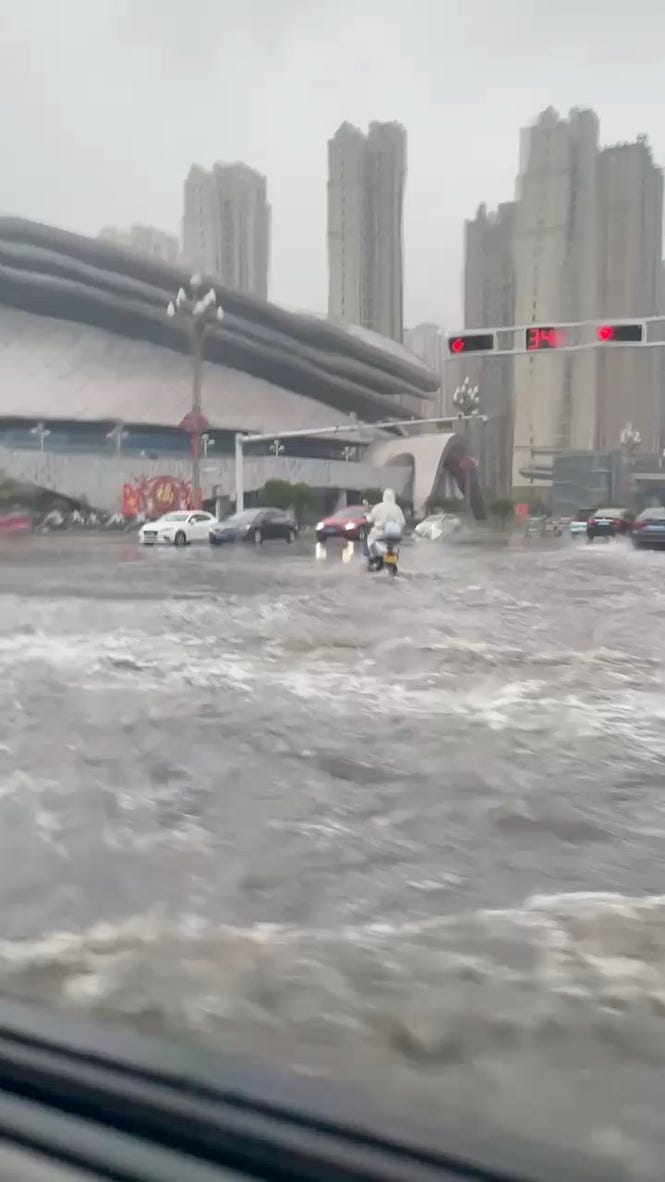
It’s a balmy late-July afternoon, and the car hasn’t moved in an hour. I’m stuck on one of Baoji’s widest streets — in front of the city’s only university, its biggest high school, and a cluster of eateries serving laborers and students. Four hours of torrential rain have created a flood zone in the middle of an intersection. Hundreds are trapped in broad daylight.
As my mother tells me, the Wei River 渭河 has flooded every few years since when she was a child in Baoji. The city of three million, built along riverside plains, sits between the Yellow Loess Plateau 黄土高原 to the north and the verdant Qinling 秦岭 mountains to the south. It is the fifth-largest city in China’s northwestern Shaanxi 陕西 province: surrounded by mountain passes that separate the west from Inner China, these Silk Road lands have cradled rich histories all the way from the ancient Zhou dynasty to the Second World War. Nearby, villagers keep digging up 3,000-year-old bronzeware in their backyards.
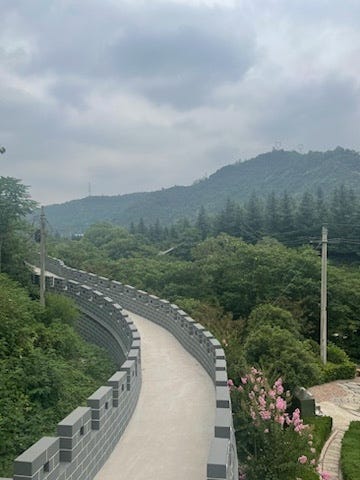
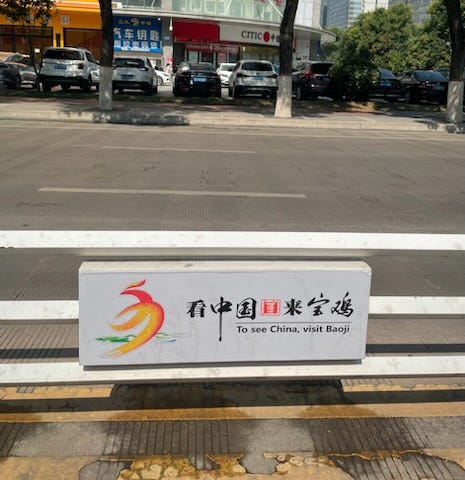
My parents grew up here, and much of my extended family still live in town. It is the closest thing to “Middle China” that I know well: neither poor nor rich, neither globalized nor remote, half urban and half rural. In many ways, life in a place like Baoji is the kind of urbanization most Chinese people know best. After all, the city government’s newest slogan is 看中国,来宝鸡: “To see China, visit Baoji.”
ChinaTalk is a reader-supported publication. To receive new posts and support our work, consider becoming a free or paid subscriber.
Old folks tell me that once upon a time, every train running from eastern China to Xinjiang or Tibet passed through Baoji. Its strategic location “within the passes” made it an industrial hotspot, particularly for military-related production. Baoji sits within the Guanzhong 关中 Basin, and 关中 literally means “within the passes”. Various PLA cannon factories’ code numbers are still familiar to older Bǎojīrén 宝鸡人. But market reform in the 1990s shut down most of Baoji’s chimneys, and with it their treasured iron rice bowls. The 76th Group Army, which forms half of the PLA Western Theatre Command’s Ground Force, moved its garrison from Baoji to Xining 西宁 (on the Tibetan Plateau) in 2017. Now, the only vibrant industry left is critical minerals: firms in Baoji process, for instance, 33% of the world’s titanium.
Nowhere are problems with China’s economy more glaring than in a post-industrial minor city. Baoji’s home prices are falling back to 2019 levels, its city government owes billions, and its local government financing vehicle (LGFV) has one of the country’s highest debt ratios. There are art-deco bridges, a sparkling science museum, and busy new malls; there is also a dilapidated inner city filled with elders in inaccessible walk-ups. For college-educated jobseekers, SOEs and the civil service are the only two options that make sense: average private-sector pay is half that of the public-sector equivalent, and enthusiasm for entrepreneurship has waned with the pandemic. And there aren’t many white-collar jobseekers here in the first place: 22.66% of the city is sixty or older, and the city’s population has been shrinking since 2010. With only one university around, most local kids who pursue higher education leave at eighteen and never move back home. This winter, 4,718 Baoji candidates will take the civil service exam and compete for 905 local openings.
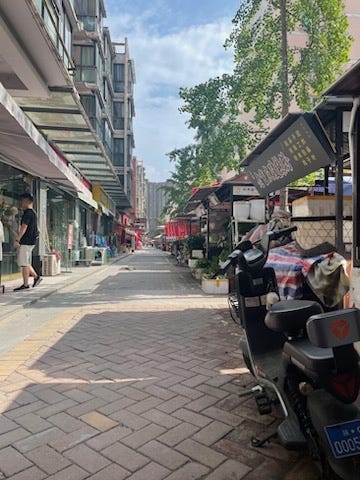
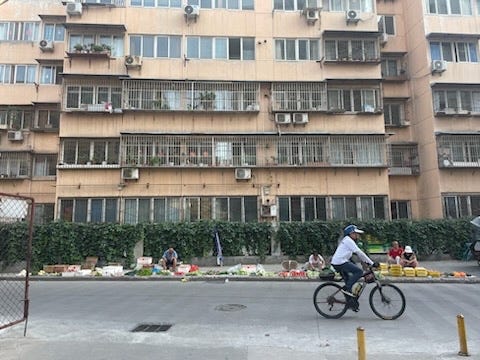
Most things in Baoji are built by and for the iron rice bowl. Even the local Crowne Plaza, the most luxurious hotel in town, bears the name of Dongling 东岭, a particularly successful Shaanxi SOE. Restaurants have special set menus for public-sector agencies to book for functions. Local handymen ask you if you need receipts for reimbursement by default — some civil servants evidently get to expense their home repairs. Especially in the older side of town, one comes across many Jiāshǔyuàn 家属院, “dependents’ housing” built by state-owned factories, government agencies, and other public-sector entities. A generation ago, most of urban Bǎojīrén lived in these multi-story collective courtyards. Couples often worked at the same factory or government office; in retirement, many remain neighbors with their former colleagues. Some reminisce about a time when no one had much, but everyone shared what little they had.
Baoji had on-and-off lockdowns throughout 2022. Today, the only remnants of the pandemic era are abandoned PCR-testing booths. According to the rumor mill, cremation facilities were so overwhelmed this January that city folk resorted to burying their own loved ones in the surrounding hills.
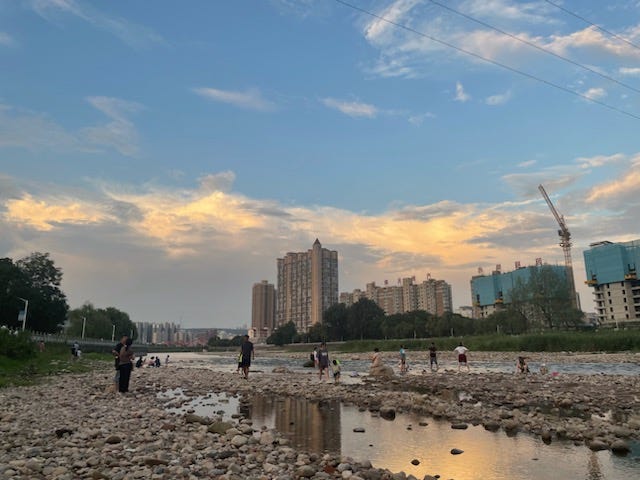
For all its historical importance, Baoji today is placidly apolitical. An acquaintance who got in trouble at work once for browsing foreign websites told me that, when colleagues heard about his misdeed, they thought “scaling the wall” meant literally climbing the office courtyard’s wall (not the Great Firewall). No one reads the Baoji Daily — the turgid, state-owned broadsheet that reports on the city — and local WeChat blogs post mostly sensational spam. Only occasionally does censorship mean fierce resistance and rapid erasure; most of the time it just gets quieter. People don’t talk when there’s nothing to talk about.
Baoji Middle School, known to locals as Baozhong 宝中, was founded in 1940 and is the city’s most prestigious high school. This fall, four of its 2023 graduates will be attending Tsinghua University in Beijing.
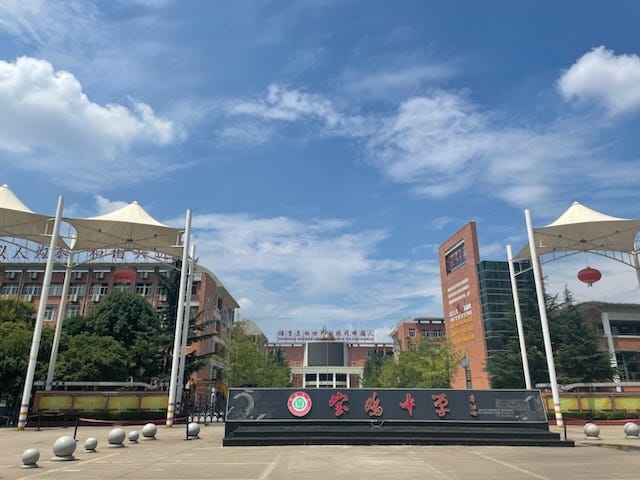
Being one of the country’s poorer provinces, elementary schools in Shaanxi regularly cram sixty students into one homeroom. Public schooling in China ends after the ninth grade. Students then take the zhōngkǎo 中考 — the high school entrance exam — after which they are admitted to academic or vocational institutions, depending on their scores. While the city’s top 380 scorers can attend Baozhong for free, everyone else must pick up the tab for tuition. Exactly how much it costs is never clear until one makes that fateful call to the admissions office, but some families budget six figures (RMB) for the entire three years. (The city’s average public sector salary in 2022 was 79,326RMB ($10,882) per year; the private sector equivalent was 46,205RMB ($6,338).) My parents, both Baozhong alumni, lament that their alma mater now bows to Mammon.
High school education can be remarkably marketized in small-town China. While ambitious Beijing parents might pick from a variety of well-respected public institutions, families in cities like Baoji fight to pay extra to send their children to the only local high school that guarantees a decent university offer. In rural regions, there are growing concerns about private “super high schools” vacuuming up ambitious students and marginalizing county-level public education. Baoji’s cream of the crop go east to the provincial capital Xi’an, whose elite high schools send hundreds of graduates to top universities. Brutal regional inequality casts a shadow upon Chinese education at every level.
Mom grew up in a different Baoji. In the late 80s, Baozhong regularly produced provincial top-scorers and sent dozens to Tsinghua and Peking universities. Her high school friends are everywhere now — there’s even one who emigrated to Denmark. A number stayed in Baoji and married young. Others like her left for the country’s biggest cities in the 90s, and their kids are no longer Bǎojīrén. China is always too big for any kind of polar simplification, but if what happened in Japan and South Korea is any guide, its shiniest metropolises will keep shining, while dozens of cities like Baoji may face a much quieter future.
On that rainy July day, no one ever showed up to direct traffic. Drivers started getting out of their cars, and someone figured out that the divider fences in the middle of the road were removable with a hard kick. Soon enough, everyone was engineering their own U-turn.
An excellent sketch of the view from a small, isolated town. Good on-the-scene reporting
I liked this quote:
"Only occasionally does censorship mean fierce resistance and rapid erasure; most of the time it just gets quieter. People don’t talk when there’s nothing to talk about."
Sounds just a place that is similar to many American midwest cities.