
What’s the hidden ingredient behind every advanced chip? It’s not just the silicon, the machines, or the engineers — it’s the world of specialty gases that make modern semiconductor manufacturing possible. These chemicals are purified to extraordinary levels, shipped across continents, and in many cases toxic and explosive.
To understand this foundational piece of the semiconductor ecosystem, I’m joined by ChinaTalk regular and Chip War author Chris Miller, ChinaTalk analyst Aqib Zakaria, and Carl Jackson, co-founder and managing director of SSoT Group. Carl has spent more than 25 years at the center of the specialty gas industry, working across Asia, North America, and Europe.
We’ll do a 101 on the chemicals behind the chips, see how China built a world-class semiconductor gas industry in just 15 years, and talk about vulnerabilites in the global chemical supply chain.
Plus, why Taiwan may be the worst place in the world to host a semiconductor industry and the existential supply-chain risks that come with it and, the surprising appeal of a career in industrial gases.
Listen now on your favorite podcast app.
Chris Miller: Carl, to start, tell us about the role of helium in the chipmaking process and why the Hormuz shutdown has been so disruptive to the industry.
Carl Jackson: On the application side, helium is used by every semiconductor manufacturer in every fab in every location in the world, and it’s primarily used for cooling. A lot of these semiconductor manufacturing processes are quite violent, they’re quite exothermic, even though it looks very calm and silent from the outside. There’s a lot of cooling required to keep the manufacturing process at reasonable and workable temperatures, and that’s the role of helium mainly in these fabs.
In terms of why the Strait of Hormuz issue has been so significant — the Ras Laffan Qatar helium production facility now produces about 15% of the world’s capacity. It was an overnight closure of the tap, essentially, of 15% of the world’s capacity that generally operates at or around equal supply between production and demand.
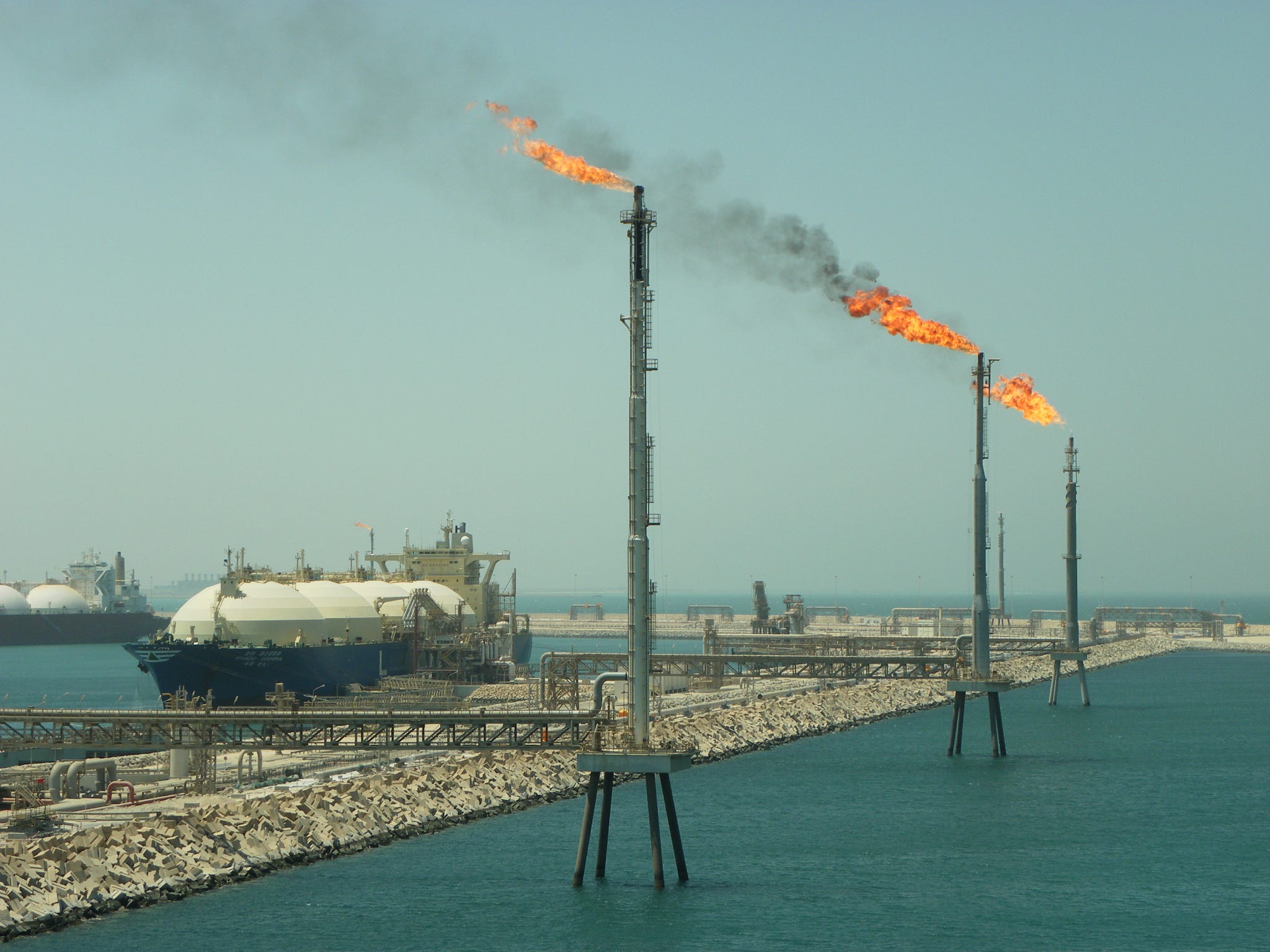
This is not an example of a molecule that’s got a huge overcapacity that’s very easy to just take up slack from alternative sources and deliver to a fab. It’s also a very difficult molecule to deliver. You need to move this around in the world’s most expensive thermos flask at -269°C. That whole logistics supply chain is extremely complicated as well. Just turning off the ability to move those assets, plus the production that comes from that site in Qatar is a pretty major disruption.
Chris Miller: That’s just one of dozens of types of gases that are used in the chipmaking process. Walk us through at a super high level — what are the gases you need to make a chip?
The Gas Chemistry Behind Semiconductor Manufacturing
Carl Jackson: The role that gases play generally in chip manufacturing is often misunderstood. People don’t realize that semiconductors are basically made using gas.
You look at your phone, and it’s made of plastic and metal. People don’t see the inputs required to make that in these fabs — which is all gas. There are probably 120-odd different chemicals that go into a fab from different suppliers. There are probably 60 unique chemicals that go in, and they’ll all basically go in in gaseous form.
It’s a huge chemistry toolkit that’s been developed and is required to build all chips. This is not just future advanced technology. This is every chip everywhere that needs this chemistry set.
Jordan Schneider: You mentioned cooling as one of the applications. What are other things that the gases do?
Carl Jackson: They build with gases. Everybody’s seen a picture of a silicon wafer — that ultra-high-purity silicon that’s the most perfect structure in the world. That gets delivered as a building block. I always talk about this in terms of a skyscraper to help people imagine what it looks like. This building block arrives as your concrete foundation. Then every floor, every elevator, every piece of wiring that builds the next 300 floors of that skyscraper — which is essentially what a chip looks like — is built using gases.
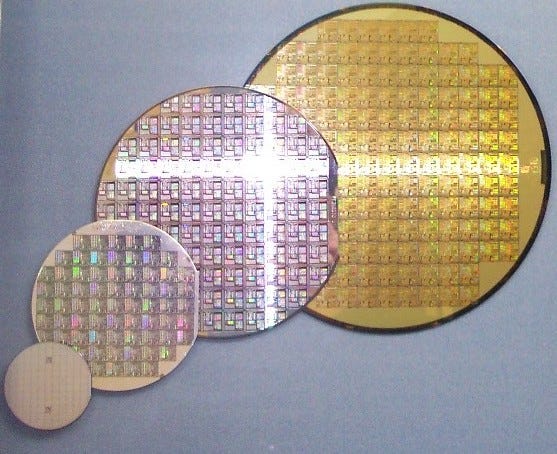



Silicon gets deposited via a gas called silane. These deposition steps happen over and over again, creating a repetition in how you build these structures. You then need to knock some of that structure out using fluorine-based gases to etch and remove portions. You need doping gases to change the electrical properties of some layers. You need to build the transistors in there, which requires different types of gases and processes.
It’s an extremely complex, almost unbelievable manufacturing process, all made possible by the use of gases. This underlayer — this supply chain and chemistry set — is not very well understood as an input into this industry.
Chris Miller: Can you talk about the categories of gas? As I understand, some are pretty straightforward, produced in bulk, while others are highly specialized to the chip industry. Walk us through the key categories we should think about.
Carl Jackson: I would split them into two categories. Any major fab needs a huge amount of what we call bulk gas. These would be the inerting gases — the gases used to create the clean environments needed to make chips. That would be nitrogen, argon — things that don’t react or essentially don’t do anything in the process apart from keeping things clean.
Then you’ve got the specialty gases. The bulk gases would typically be delivered by gas companies with an on-site air separation system. The volumes required are massive, so they dictate that you would need a plant built next to your fab that would deliver these gases 24/7. We’re talking about tens of millions of dollars of investment by the gas company.
Once they’re built — and they get built wherever the fab goes — there’s a relationship with the gas company that extends over 15 to 20 years because nobody builds a competing air separation unit next to your fab. There’s a relationship anchored around the bulk gases.
On top of that, you’ve got 60 or 70 different process gases that are typically delivered in a range of different containers. You’ve seen these larger containers rolling down the highway, cylinders, and packages smaller than cylinders. They deliver the rest of these specialized gases for deposition (putting new material onto a wafer), ion implantation (which changes the electrical characteristics), and etching (which shapes and helps create the devices you need on silicon).
The toolkit’s very big. A typical fab will be taking these materials from every geography, probably with the exception of China. If you want to talk about Taiwan as one example, they’ll be receiving their bulk gases from the on-site supplier, but the balance of materials they need to run their fabs will probably come from at least another 4 or 5 countries. It’s extremely complicated logistics and supply chains to get that balance of the other 60 to 70 materials needed.
The Quest for Purity
Chris Miller: In terms of the purity level of these gases — we know that silicon wafers are extraordinarily pure silicon. How do we think about the level of purity in each of these types of gases? Is it different between bulk versus specialty, or what’s the way to distinguish the level required?
Carl Jackson: Well, one commonality is that it’s always increasing. There’s a drive on the customer side — TSMC, Samsung, or GlobalFoundries, etc. These companies run very sophisticated SPC and quality assurance systems where they’re consistently tracking everything that comes into their fab.
Obviously, as node sizes decrease and the complexity of these devices increases, they want to ensure that every input into the manufacturing process has higher and higher purity. At the extreme is the silicon wafer at 11 nines, which is industry speak for almost impossible. Only two companies in the world currently can achieve that.
The gases range from parts per million, which is now completely standard. A one-part-per-million impurity is really just the basic requirement to be a supplier of any material into this market. Some gases are now reaching parts per billion, and some even get into parts per trillion.
Parts per trillion is very difficult to imagine. It’s basically a heartbeat in 32,000 years. For the entirety of anything that’s been known to be living on this planet, it’s a heartbeat within that scale of time. That’s the level of impurity we’re talking about. That’s how to think about how difficult this is.
Chris Miller: I’m just adding up zeros in my head, but that’s dramatically more pure than 11 nines for a silicon wafer. Is that right?
Carl Jackson: Yes, and that’s the trajectory. Where it all stops, I don’t know. It’s obviously leveled out. There was a huge push in the early days of semiconductors where big advances were made in the way materials are purified, packaged, delivered, and used. It’s tailed off a little bit, but they still continue trying to improve the purity of all these materials to impossible levels — levels where, really, the difficulty is measuring the impurity, not making the product.
Jordan Schneider: How do you measure parts per trillion?
Carl Jackson: With extremely expensive analytical instruments that hardly anybody knows how to use properly. It gets into ultra-specialist and extremely expensive equipment that’s so sensitive it makes the whole job very difficult. Ultimately, that will be the limitation. There’s a cost implication of increasing the purity of these products, but ultimately it’s the metrology around it that will be cost-prohibitive.
Jordan Schneider: It just seems like when you’re that deep, there’s some Schrödinger’s principle going on where it’s the measuring tool’s fault more than your poor gas refiner.
Chris Miller: How do you get these gases? It’s different for different types of gases, but if you want a gas purified to 1 part per trillion level, how does that happen?
Carl Jackson: Well, that’s the extreme, Chris. But let me give you one example. The other thing to say is quite a lot of this chemistry set is also used in industrial chemistry.
One example is HF, or hydrofluoric acid, which is made in the hundreds of thousands of tons. That material starts life in a mine — it starts life underground as a material called fluorspar. It’s literally dug out of the earth at concentrations that you would never recognize as suitable for a semiconductor fab.
It’s then made into an industrial-grade HF. At that point, it isn’t destined for a semiconductor fab. That’s used, as I say, on a scale of hundreds of thousands of tons industrially.
Then the semiconductor guys get involved. They’ll take a small part of that volume and start to process it using very different types of purification systems that have been developed around the requirements for semiconductors. You start with a typical industrial-grade HF at 3 nines purity, and that’s good enough for almost everything required on Earth that uses HF — for pharmaceuticals, for all of the different industrial applications, but not for semiconductors.
That material then needs to go from 3 nines up to 6, 7 or 8 nines, depending on the process. That’s where the semiconductor supply chain, the people involved in this, really add their magic. It’s how you get and maintain and then ship and have that high-purity product delivered all the way to the wafer through this supply chain. At that point, it becomes very specialized, and you need to rely on a very small number of people in the world who can do that.
Chris Miller: If you get a jar of HF at 3 nines and want it to be 6 nines, what do you physically do to that jar to get to that level?
Carl Jackson: In that case, you put it through a distillation system. It’s a little bit like the petrochemical distillation system. Distillation is distillation, but not all distillation systems can be set up to handle HF and to get to that level of purity required for these semiconductor customers.
It’s advanced distillation with all the steps built into it to take out impurities that you wouldn’t normally need to remove. It might be distillation plus another couple of steps that, as I say, wouldn’t be necessary in industrial processes.
Aqib Zakaria: Is the jump from 3.9 to 6.9 significantly easier than it is from 6.9 to 9.9? We think of the semiconductor industry going from 7 nanometer to 5 nanometer as extremely difficult, a lot more difficult than from 28 to 14. Can you give a picture of how much money it takes to get to the next step and how much time it takes?
Carl Jackson: It depends on the product. Some materials are easier than others to purify. The next 9 — from where we’re at now — is extraordinarily difficult to produce and deliver. Almost nobody is interested in investing to get to that next 9, because there’s no demonstrable evidence that it’s actually required in the process.
There’s an interesting dynamic where the drive from the customer side to get even purer material, consistently improving that purity, isn’t actually required to make the devices. There’s a drive based around math and SPC and quality data that doesn’t necessarily triangulate with what’s needed on the process side. If you understand that and you’re on the production side, then you’re really not motivated to try and increase your whole production system and your supply chain to that next 9. It might give you some competitive advantage, but ultimately nobody’s going to pay for it unless it’s really needed on the manufacturing side.
Aqib Zakaria: You were saying earlier that at some point the semiconductor guys get involved and say, “Hey, I need an extra 9, I’m willing to pay this much money for it.” In that scenario, is it TSMC saying we need better gas, or is it the deposition toolmaker where the gas is used saying we need better gas? What’s the player here?
Carl Jackson: The industry talks about recipes — when these gases are used, they’re used in a recipe just like a cooking recipe. The recipe dictates what materials you need to make a certain type of device at a certain time in the manufacturing process.
Those recipes will typically be developed by the toolmaker. They’ll tell you what chemistry you need and at what purity. They’ll guarantee that you can make a particular device. They say, “Okay, you’ll need five materials and they all need to meet this purity. If you provide that into this tool, you can make this device.” That’s what TSMC will receive.
They will then improve that recipe. They’ve got thousands of people working on optimization of their processes and their tools. There’s a juxtaposition — always between improving, optimizing, but not changing anything. That’s a force that’s always fighting here, but they typically will have people that are optimizing and improving. Part of that will be, “Okay, we need purer material.”
Sometimes it’s just a blind requirement — it just needs to be purer. If you challenge it, they’ll say, “We’re the customer, we’re telling you that it needs to be purer.” Why? “It doesn’t matter. If we’re going to keep buying it from you, it needs to be purer.”
At the toolmaker level, they will typically put performance guarantees around a particular recipe set and a particular purity for that recipe set that will work. When it gets into the hands of the guys who are actually making the devices, then it goes into a different world. Some customers don’t change. Some customers are pretty active in terms of demanding better materials.
But it’s slowing down. The parts per trillion thing is really extreme — it’s an outlier. I’m certain that all of this standard chemistry set isn’t going to get there. Some specialist materials may be for some ultra-specialist devices, but generally people are not going to be demanding that. It will stay in the parts per million, parts per billion.
People forget that parts per million is an unbelievably difficult thing to deliver for a material that is — for example, HF will try to eat the cylinder that it’s being delivered in.
Lethal as the Specification
Chris Miller: Could we dig into that? One of the fascinating parts of this is that it seems like half the materials we’re talking about are either toxic or explosive or both. Why is it that you can’t make chips without all these seemingly awful chemicals? And what challenges does this impose in terms of transporting them?
Carl Jackson: Almost everything in this toolkit is lethal. It either poisons you, explodes instantly upon contact with air, or can kill you quickly or slowly. But lethal here is not a bug — it’s the specification.
If you’ve been to a fab or seen pictures or videos, you see this very quiet, controlled, seemingly delicate process going on to make these chips. People envisage it as delicate. But at the atomic level, it’s an extremely violent process. The violence requires the most violent chemicals and the most reactive chemistries.
This deposition and etching process that builds these layers — you’re trying to drill the equivalent of an elevator shaft down through 300 stories in one go, straighter than anything imaginable physically. You need something that’s extremely reactive in the process to allow you to do that.
Similarly, when you’re doing an ion implant to change the electrical characteristics of the silicon so that it actually works and burns the transistor, you’re firing boron, phosphorus, or arsenic — all of these lovely gases that you need to do some work. You’re firing these things in at 400 kilometers a second into the silicon wafer. Most of the molecule disintegrates when it hits this wafer. It’s like firing a bullet into a concrete block. That bullet needs to go exactly where you need it to in that concrete block — the depth, the angle, everything. Then it disintegrates and leaves something behind that does some work.
The process itself is extremely reactive and violent. That’s why you need these chemistries. Which is unfortunate because making them and delivering them safely is a little counterintuitive.
Semiconductor doping: how a chip is made (A really calm explainer of an extremely violent process.)
The chemistry set that you need, because of the difficulty of the device that you’re making, needs to be large and contain these difficult gases. To your point about how they’re delivered — it’s done in all kinds of weird and wonderful ways. It’s part of the IP of the semiconductor industry and the people that feed into it. How do you get these products to the customer?
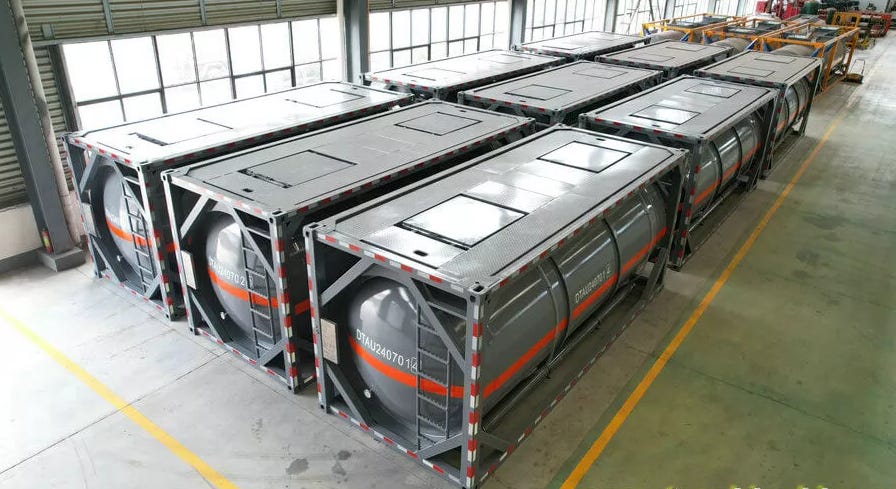
Some products are eaten themselves on the way — you make these products, and they start consuming themselves. Some products start to consume the packages, the cylinders that they’re in, and create impurities on the way. They’ve got a very short shelf life. Some of them are so dangerous that you can’t just ship them in a cylinder. You need to ship them in some other container that, in the event there’s damage to that container, these chemicals won’t come out.
There are innovations around the handling, safety, and maintenance of purity in this business that are never really seen, but they’re a huge part of enabling how these devices are made.
Chris Miller: What’s the most dangerous chemical used in chip manufacturing?
Carl Jackson: There are so many dangerous chemicals. The one that people fear most is HF (hydrofluoric acid), largely because there have been a few incidents with it. It’s used in fairly large volumes. What makes it particularly frightening is that it doesn’t immediately kill you — it gets into your skin and then pulls the calcium out of your bones over time, essentially killing you slowly.
I’m not trying to fearmonger here. I’m painting a picture of what could happen if this industry wasn’t as well-managed as it is. In reality, there are barely any incidents these days. On the fab side, there are almost no reportable incidents in a year across every fab worldwide, which is absolutely remarkable when you consider the chemistry set involved. Similarly, in the shipping of these materials, there are barely any incidents. On the production side, there are a few, but nowhere near the amount you would have in a normal industrial process. It’s probably one of the safest businesses, given the risk profile of these materials.
But HF is definitely not a good actor — it’s a difficult one to deal with. Arsine is used on every chip. Every chip requires arsine. It’s essentially arsenic — the same molecule that was the housewife’s poison of choice in the 19th century. The same molecule that makes a transistor work is the one you used to be able to buy to slowly kill your husband. It’s the same chemistry, just doing a different job.
Silane is another dangerous one. This is silicon in gas form. People figured out a long time ago that you need to build chip structures using silicon. You get your starting wafer, but then where do you get the silicon from to build these structures? You can’t just get a matchstick-size piece of silicon and glue it on — you need to build it differently. That’s where silane comes in.
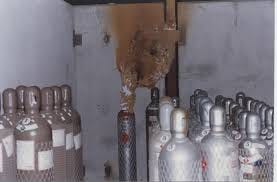
Silane’s great unless it starts to leak. If it leaks from a cylinder, the current safety protocol is actually to leave it leaking. It’s quite counterintuitive. If a valve on a cylinder fails and silane starts to come out, you literally get sand everywhere because it reacts with air — the hydrogen gets replaced with oxygen, and you end up with silicon oxide, which is sand. But if you create some kind of static or some issue that causes it to ignite, you end up with a fireball coming out of the cylinder instead of a load of sand. It’s still not very well understood why this happens, but it does.
When training someone to deal with a silane incident, the instruction is: if it’s leaking, leave it to leak. Don’t close the valve because, in closing the valve, you might create a fire, which is worse than creating sand.
As I say, it’s a big toolkit, and really none of it is very friendly. Even nitrogen — the most benign chemical used in large quantities — is really dangerous. If you’re in a room with just nitrogen... Right now the air is 79% nitrogen, which is fine because you’ve got your oxygen there. But if you start getting nitrogen concentrations any higher than that, you start having issues. Those are actually the most common safety issues you’ll see — nitrogen asphyxiation rather than problems with some of these more dangerous chemicals.
China and the Chemical Supply Chain
Aqib Zakaria: Let’s discuss these potent chemicals that are sometimes delivered at mind-warping purities. Who are the companies actually delivering them? How many are there, and what differentiates one from another?
Carl Jackson: It’s best to look at this over time because the landscape is changing rapidly — almost all of it happening in China.
If we go back 10 to 15 years before China’s Big Fund initiative to localize semiconductors and their supply chains, the market was segregated by chemistry specialty. Japan historically excelled with fluorinated gases — anything with a fluorine backbone. There are probably 15 different fluorine-based chemicals and chemistries used in semiconductors, and Japan was the go-to source for these.
The US had a pretty broad range of manufacturing capabilities since that’s where this industry originated. Twenty years ago, there was near self-sufficiency in almost everything required. While that’s somewhat depleted now at the scale and scope needed, that capability existed then.
Most of these gases were typically made by a few Japanese companies, but the majority came from the majors: Linde, Air Products, and Air Liquide. These companies that built and installed air separation units also provided all the other required chemicals. It was a self-funding, self-financing model — you’d install the air separation unit as the anchor that paid for developing all the other materials. They offered a complete portfolio to each semiconductor customer. Twenty years ago, almost everything came from one of these majors with their comprehensive portfolios.
Chris Miller: Before we discuss the present situation, I’d like to understand what the industry looked like 20 years ago. Would one Intel fab have an air separation unit from Air Liquide while a different one uses Linde? Were these company-to-company relationships or fab-to-fab?
Carl Jackson: Fabs prefer to split risk, though there’s minimal risk with air separation units now — they’re extremely reliable with installations worldwide.
For example, if TSMC were to build a new cluster of three fabs in a new location, it would typically award one ASU per major supplier. Linde might get one or two, Air Liquide might get one or two. There’s very little differentiation in what the customer receives — all provide extremely good reliability and quality, with some negotiation on pricing. No single major would win all the contracts; the split between fabs and awards depends on the customer’s situation or whether one of the majors can offer something particularly compelling. The business is basically split almost evenly among them.
Chris Miller: So you mentioned that the industry is changing. Tell us what’s new in the gas industry and the role of China.
Carl Jackson: The Big Fund is really what’s driving China’s transformation at this level. Big Fund 1 kicked off around 2014, and we could see it was different from the start. Unlike other similar initiatives — the CHIPS Act, for example — the Big Fund targeted all levels of semiconductor manufacturing.
I won’t speak to areas outside my expertise, like design and tool manufacturing infrastructure, but all of that was included in the Big Fund. You’re not just getting new fabs and new IDMs making devices — you’re getting the entire supply chain. They went after everything at once.
There was a lot of money. About $120 billion has been invested in that whole infrastructure ecosystem. It was managed regionally rather than through top-down directives saying “you do this over there, and you do that over there.” While there was an overall top-down directive, implementation was managed on a regional basis.
This led to different regions competing with each other for all the different materials in this chemistry toolkit. Take one product: NF3, which is part of the fluorine family. It’s used for cleaning — it’s like the janitor of the semiconductor world, used by everybody in every process. At the time, China didn’t have any NF3 capability and needed to import it.
Different provinces with different leadership and scopes started developing supply chains for these materials in parallel. This resulted in massive overcapacity. You had new players who had never been active in producing these materials or supply chains. Initially, it was the whole story of China — low-quality materials, questions about trust in where and how things were being made. That took a long time to overcome.
They started out feeding themselves, but because of how the Big Fund was organized, they ended up with huge overcapacity. Now you’ve got China plus the rest of the world in terms of their ability to provide these 60 gases. They’ve developed the capability to make almost everything in China independently and in parallel with everybody else in the world — with a capacity that could almost feed everywhere in the world from China.
We’ve ended up in a situation that is totally different from where we were 15 years ago because of how this Big Fund has been funded and rolled out. There were really no checks and balances on whether it made sense to put this capacity in place. The attitude was: “We don’t care. It doesn’t matter. We’re doing our job.” As a result, there’s now a lot of material available that can feed and compete with this existing supply chain that previously had a very small number of suppliers.
Chris Miller: Do we see Taiwanese or South Korean firms buying gases from the Chinese supply chain?
Carl Jackson: Taiwan is 100% reliant on Chinese supply chains today — 100% reliant. Chris, you talk about missiles, but I could just change that to NF3 as an example. If the Chinese government decided to put an export restriction on NF3, then the Taiwanese fabs would shut down.
Chris Miller: Help us understand how we should think about finding alternative sources of supply. I think back to 2022 at the start of the Russia-Ukraine war — both countries were big suppliers of neon. The Azovstal steel plant, where there was a big siege at the start of the war, was itself a neon supplier. That created a crisis for the semiconductor gas industry, but it didn’t end up impacting chip production much at all. This suggests there was flexibility in the neon market. Is that unique to neon? Is it different from NF3?
Carl Jackson: Helium is probably the best example of a supply chain that’s inelastic, mainly because of the packages. The most basic package to get gases from the supplier to the consumer is a cylinder. These cylinders cost $50, and there’s no shortage — millions circulate around the world.
The helium packages I mentioned before cost $1 million each. They’re extremely complex. You’ve got 45 days to get from production to consumption before you start to lose the product. That’s pretty inelastic.
On the other extreme, take NF3, for example. Chinese domestic consumption requirement for NF3 is about 8,000 tonnes. You have one producer in one province in China making 55,000 tonnes a year. Those guys are busy recruiting international sales and marketing teams and trying to sell their NF3 internationally — into Taiwan, South Korea, the US, anywhere that can take that material. They’ve got almost zero incremental cost of selling anything above what’s required domestically.
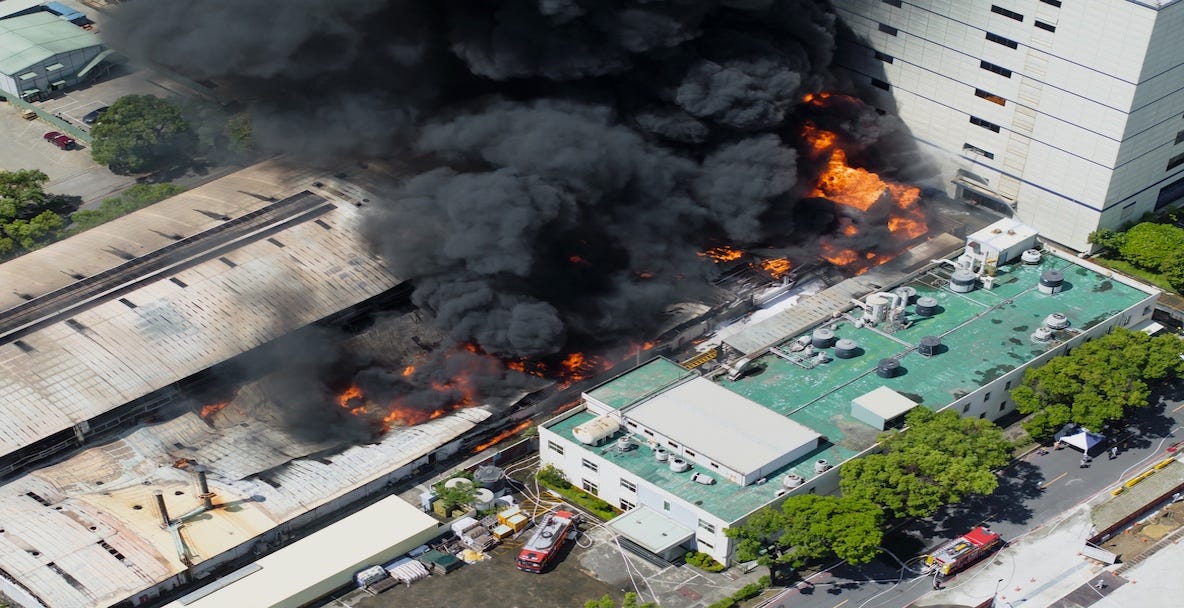
You’ve got real extremes on either side. The Iran situation isn’t a minor blip — it’s a pretty big one. But we saw something similar with an NF3 plant in Japan in 2024. An NF3 plant blew up and took one offline. The impact that rippled around the semiconductor world was pretty small. Existing customers needed to requalify and re-establish supply chains. But for a material that’s abundant and easy to deliver because the packages are available, those supply chains can reroute and customers can take new material very quickly.
China’s Dominance and Dependency
Chris Miller: Absent the subsidy and overcapacity story, is there a reason why you’d produce more NF3 in China than elsewhere? Energy costs or some sort of comparative advantage, or is it solely a story of governments paying for it?
Carl Jackson: It’s a mixture — a blend of things. NF3 is part of this fluorine family. Fluorine comes from fluorspar, and China controls 70% of the world’s fluorspar. That whole supply chain is integrated inside of China, allowing them to do everything internally at an extremely low cost.
Some of this comes down to economies of scale. Some of it involves ignoring domestic requirements and building out huge capacity for some future need. Some decisions simply don’t make economic sense from a Western point of view.
When Linde invests in a plant, using the Western example, the amount of due diligence required around profitability, customer identification, and production ramp is like a finely polished machine. The Chinese approach sometimes doesn’t follow the same economic logic. They build it because there’s a directive to build it. If they need 10,000 units, they’ll build 25,000. It’s that kind of math — no exaggeration.
Someone in a province 1,000 kilometers away might be making that same decision because it doesn’t matter. The availability of these products internally is far more important than any return on investment for an individual plant. The result of that internationally is what we’re starting to see now.
Chris Miller: You mentioned fluorspar, which is critical for a bunch of different gases, with 70% mined in China. I understand some is mined in Mexico. Can you walk us through the process from fluorspar mining to gas? This seems like one of the key areas in terms of China’s market position.
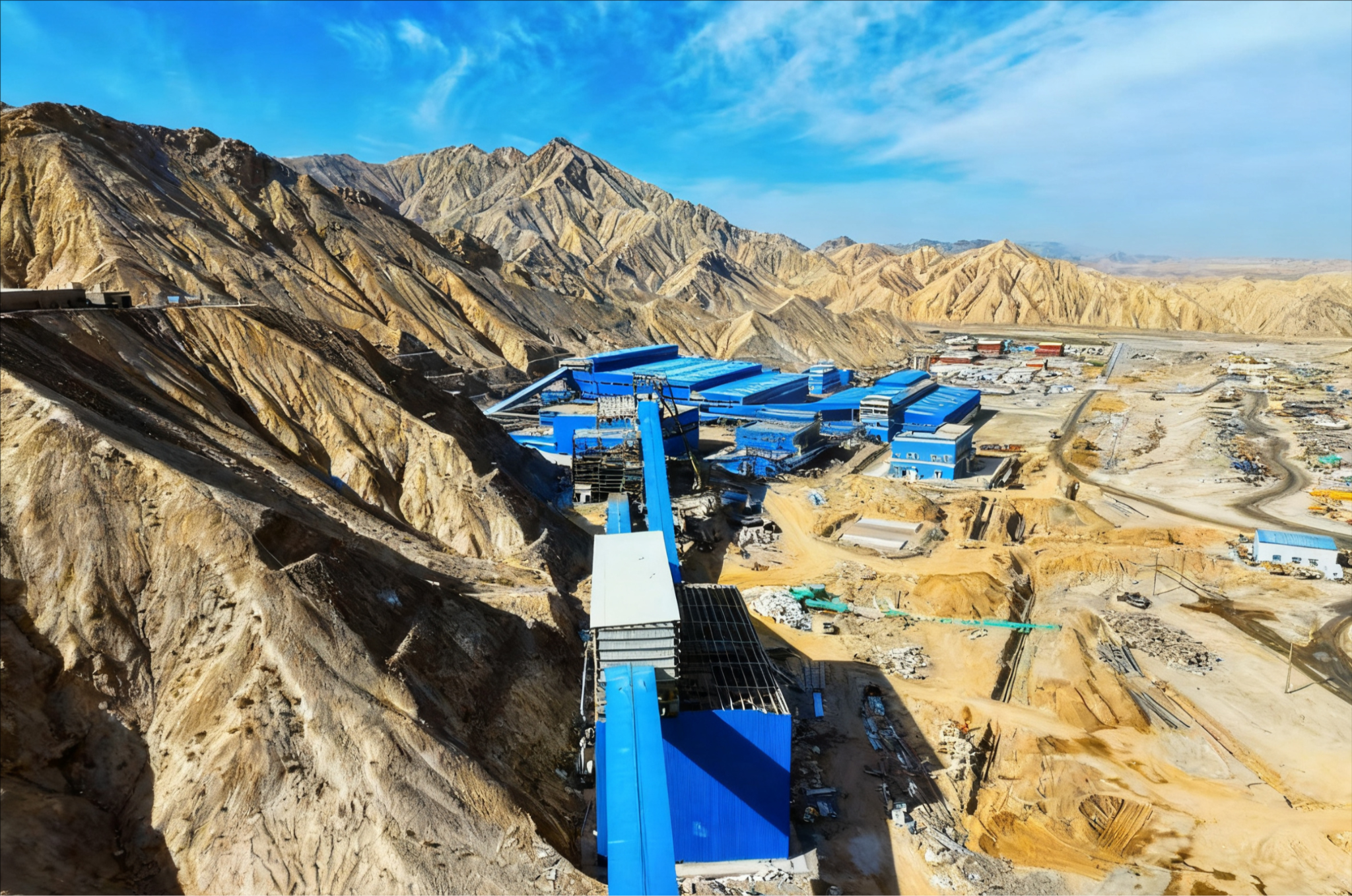
Carl Jackson: The process literally starts with rocks dug out of the ground. fluorspar just looks like a rock. Those rocks go into an autoclave — basically a massive hot reactor. China has hundreds of thousands of tons of capacity in these reactors, while semiconductors only require a few thousand tons. It’s a tiny proportion of what’s made industrially.
You dig the rock out of the ground, send it to an industrial HF producer — there are probably 10 world-scale producers in China. That gets converted into industrial HF. As I mentioned before, the semiconductor business requirement is to siphon off a tiny proportion and make it an ultra-high-purity material.
The key point is these chemical families. HF is used to make fluorine. Fluorine is then used to make C4F6 and sometimes NF3. There’s a whole family of chemistry built off HF or fluorine that requires additional processing but ultimately comes back to that fluorspar mine.
Aqib Zakaria: I’m curious if there are any cases of it going the other way. We’re pretty accustomed to stories like rare earth minerals and now fluorspar where everything comes from China, creating great dependency. But are there any cases among these 60 or so gases where the mine isn’t in China — maybe it’s in Peru or somewhere else — and China has to import all of it? Are there cases where the dependency goes both ways?
Carl Jackson: Helium is an interesting challenge for China. From a Chinese perspective, helium represents the biggest gap and most high-value, important material for semiconductors. The reason they don’t have enough helium is purely geological. The US is extremely lucky with great geology for extracting helium, and anyone making LNG also has great capacity for making helium.
Helium typically isn’t produced on its own — it’s a co-product from something else. Until recently, nobody mined or extracted helium specifically. You extracted LNG, and helium happened to come along with it. When helium started gaining high-value, important applications like MRI and semiconductors, people became more interested in separating and producing that helium.
China has a challenge — the amounts of helium in their LNG production are extremely small. Where they produce it is basically all in the wrong place, distributed around a couple hundred different small sites. Their LNG infrastructure isn’t conducive to making helium, so they’re still a net importer of helium.
That’s being fixed. In the Chinese way, they’ve figured out ways to produce their own helium despite these restrictions. But it’s going to take time to develop the infrastructure they need to stop being a net importer. At the moment, that’s probably their biggest vulnerability for the semiconductor supply chain. But as I said, it will get fixed — they’re busy trying to figure that out in really smart ways.
Taiwan and Korea are in a similar position where the geology doesn’t allow economically for helium production. They will always be 100% reliant on helium imports, plus almost every other chemical needed to run these fabs forever, unless they do something they haven’t yet done in 30 years. Their supply chain vulnerabilities will remain when China’s fully fitted out.
The Big Fund vs the CHIPs Act
Jordan Schneider: Carl, given your vantage point, how does the comparison between the Big Fund and America’s CHIPS Act look to you?
Carl Jackson: At the fab level — reshoring the actual device manufacturing — they look somewhat similar. The CHIPS Act is about reshoring the manufacturing of semiconductors, typically with existing manufacturers. The CHIPS Act successfully got TSMC to make a new investment in Arizona and got Samsung to make a new investment in the US. At that level, it’s worked because there’s going to be more domestic production of semiconductors.
Where it stops short, in my view, is anything underneath that layer required to support that domestic production. I haven’t seen anything at all yet about how the supply chain and the security of the supply chain and the chemistry supply chain that feed those fabs and any new fabs. All of these domestic production requirements are being announced, but without any of the supply chain underneath. If nothing changes from the US perspective, then there will be total reliance on importing almost every chemical required to build those new capacities.
On the Chinese side, they’ve done it differently. As we mentioned before, they’ve set out to put the entire ecosystem in all at once. It’s not just new fabs built by existing suppliers — it’s new companies entirely building new fabs, creating new technology, and underneath that is the full and complete supply chain to put all the materials required to build those components in, fully domesticated.
The scope and scale of the Big Fund are much larger and, while not perfect by any stretch, it’s certainly more integrated and forward-thinking than CHIPS in its current form, which looks like it’s either ignored, not quite gotten to yet, or isn’t interested in the supply chain vulnerabilities underneath those new fabs being installed.
Aqib Zakaria: Everything you said is right. For me, history keeps rhyming. With fluorspar — every new supply chain I look at tells the same story. You could just copy and paste, swapping out words. Gallium, rare earths — there are just so many examples.
It’s fascinating and needs to be better studied. Western economics makes you prioritize things that are later down the value chain, even though they’re dependent on things that are way more upstream. For one reason or another, China has become dominant in those upstream sectors, whether it’s because of state policy or because of their perceptions of secure supply chains.
That sometimes poses a threat for us in the United States or the West. I might be making the $1,000 iPhone, but it’s still dependent on the $1 gas or $1 mineral coming from China, which leads to some pretty disruptive or strange geopolitical topics. I’m curious what you think about this, Chris.
Chris Miller: Carl, if a chip costs $100 to make, what share of that is gases?
Carl Jackson: The numbers typically talked about are around 10% — that’s the bill of materials that contributes to the value of a chip. That’s all 60 gases combined. It depends on the chip.
I did some work on this maybe 10 years ago when we were trying to figure out the value of the products that we were selling into an iPhone. For each iPhone manufactured, how much value of gas is in it? What’s the weight of the gas in there? Because you’re trying to explain that this is made with gas, and people say, “It can’t be. It’s solid. What are you talking about?” We tried to figure out how we could contextualize it a little bit more. Then we asked how much is in a Tesla? It’s about 10%. But again, it depends on the structures and devices you’re trying to make. That’s one way to look at it.
The other way to look at it is — which one of those 60 can you live without and still manufacture your products? The answer is zero. None of them. You need all of them — exactly when you need them, exactly at the spec that you need them.
The vulnerability is there. It’s not about how much you need or what the breakdown is or what it’s worth. The question is, what do you do if one of those is missing? How do you run your fab?
It looks even worse because if you break the 60% down into 10%, you might have a line item in your materials that’s $100,000 a year for one gas that is barely used. If you’re missing $100,000 worth of gas, you can’t run your fab. The output cost — the opportunity cost or the downside — is huge in relative terms to the input gases. It’s more important that you get them there and in spec than what you pay for them ultimately.
Chris Miller: Given potential supply disruptions, one might expect chip companies to stockpile gases on site. You mentioned certain gases can’t be stored because they corrode their containers. How do chip companies approach on-site inventory management?
Carl Jackson: Credit where it’s due to the gas companies — typically, all materials arrive on site with barely any safety stock. Some materials physically can’t be stockpiled because fabs don’t have the necessary permits to store large quantities.
Take HF, for example. You can’t just store a few tons of HF in the fab as a precaution against supply chain disruptions. You can only order and store what you need for the next month of production. There’s no stockpiling capacity.
These supply chains work miraculously. Despite their complexity, they deliver all these materials and molecules through customers’ gates exactly when needed. But this reliability has become part of the problem — if there’s any real disruption, there’s no facility in place to cope with it well, particularly when materials come from overseas.
This is where Chinese infrastructure will demonstrate its power. It’s not just about cost. They have multiple domestic options, all at the right capacity, all manufactured domestically. While it might be a few thousand kilometers away, there’s no import-export barrier requiring ships, planes, or export restrictions that could disrupt supply. That’s the real vulnerability in this business.
Chris Miller: That’s pretty ominous — the implications are obvious.
Carl Jackson: Taiwan — and I say this as someone who lives there and loves the country — is arguably the single worst location you could pick for semiconductor fabs. It has no natural resources, water is an issue, and there are significant geopolitical risks. They had a brilliant industry pioneer in Morris Chang, but if you were to look at a globe and choose where to drop a semiconductor industry, Taiwan probably wouldn’t make the list. It’s in seismic zone 4 — the earth moves regularly there. Not ideal for making these kinds of devices. But it is what it is, and they face existential supply chain risks.
The R&D Death Spiral
Aqib Zakaria: You mentioned 10 to 15-year contracts for gas suppliers. That doesn’t seem particularly healthy. Could pure gas become the next bottleneck for future nodes? Should we worry that it won’t happen because the investment isn’t there?
Carl Jackson: Fifteen years has become the norm, based on a sensible premise: these plants are incredibly reliable. The 15-year operational lifetime of air separation plants has been proven repeatedly.
Some of these air separation units cost $50 to $60 million or more. No gas supplier will invest in one with just a one-year contract — it’s pointless. You can’t move it. The piping required to transport gases from the separation unit to the fab runs underground. All the infrastructure is permanent and built-in, so there’s no reason not to establish a long-term relationship.
The problems emerge on the special gases side — what we call the “balance of plant.” These typically involve one-year contracts, sometimes longer. They’re often rolling contracts –- you get a year, and if nothing goes wrong, you might get another year. If you improve quality, you might secure two years — but definitely not ten.
The race to the bottom on pricing is in full force for almost all these materials. They’re fully commoditized and extremely difficult to differentiate when customers demand identical products from every supplier. What can you do when they want silane at six nines purity? Deliver it in a different color bottle?
This standardization benefits buyers who see no difference except pricing and supplier reputation. It’s increasingly difficult to remain an unchallenged incumbent. This race to the bottom means major companies like Air Liquide, Linde, and Merck have less money for R&D and are less prepared for the next materials required by OEMs developing new recipes in Santa Clara or Tohoku. Those materials — and their supply chains — may not be ready.
Fifteen years ago, we had well-integrated programs like Tech Set. During my time at Linde, we developed many materials with a high risk of never being used. We were happy to invest in R&D for products we thought might go into next-generation devices — that was part of the program.
But when your entire portfolio faces permanent cost pressure that keeps worsening, you enter a death spiral that makes R&D economics extremely difficult. R&D becomes the first casualty. You won’t maintain ten different research programs when your entire portfolio faces pricing pressure. Eventually, you decide to compete purely on scale and price rather than frontier innovation.
This shift has accelerated over the past decade and will likely continue. We’ll see a growing disconnect where new material supply chains take longer to develop.
Chris Miller: Can you explain what an air separation unit is and how it works?
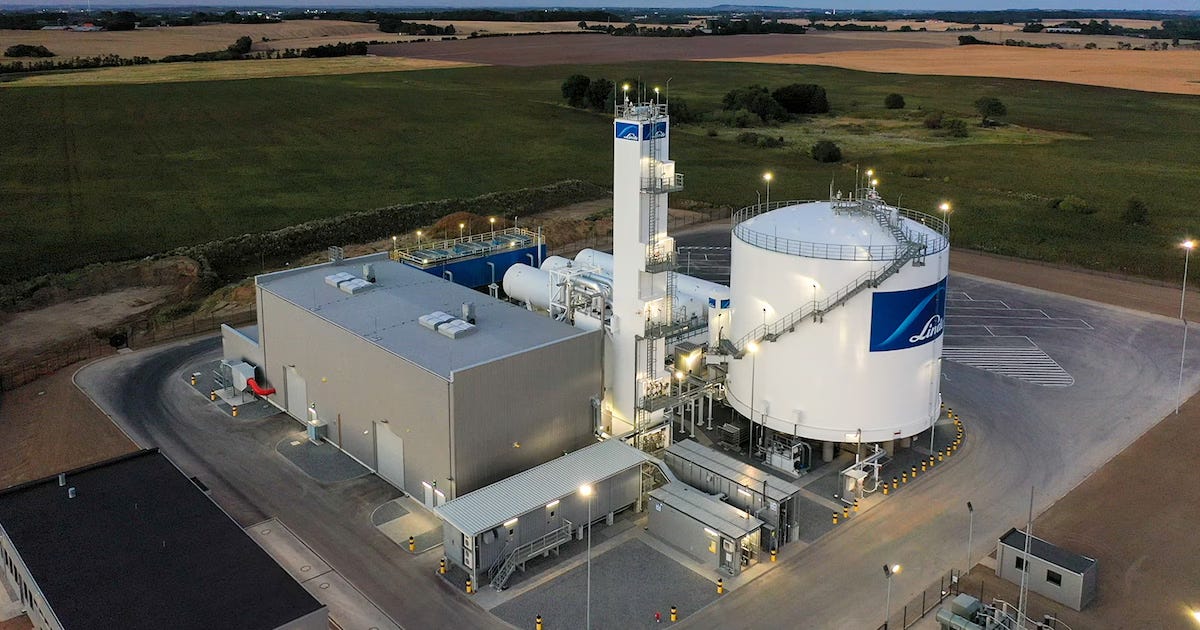
Carl Jackson: You get different flavors of air separation units, but basically all the components in air — nitrogen, oxygen, and in some cases argon and the rare gases like neon, krypton, and xenon — exist at various concentrations. The only way to economically get the amount of nitrogen or oxygen that a fab needs is to separate the air right next to the fab.
You’ll have seen these things without recognizing them. They’re tall boxes, about 30 to 40 meters high, sitting close to fabs. They have huge compressors that suck air from the atmosphere and cryogenically separate it. They cool the air down to liquefy it, then separate different components at their various boiling points. These purified gases are delivered straight to the customer.
Semiconductor customers need massive amounts of nitrogen for inertia and environmental control. It would be physically impossible to ship that quantity in — you have to make it on site. The only way to produce those volumes is through air separation.
It’s an unbelievable thing to do, but it’s now so commonplace that separating air cryogenically and feeding it into a fab 24/7 for 15 years with zero interruption and no quality problems. It’s just Tuesday at a gas company.
Chris Miller: You’ve mentioned that the Japanese are experts in fluorinated gases and lead in many semiconductor manufacturing materials. But the three key companies that have historically provided gases — Air Products, Air Liquide, and Linde — are US or European. Why isn’t there a big Japanese gas provider?
Carl Jackson: There are large Japanese gas companies, but they haven’t achieved the scale and scope of the big three you mentioned. Some have joint ventures and international operations, but they’ve maintained a primarily domestic focus — Japanese companies set up to serve the Japanese market.
There’s also a portfolio mix issue. The companies you mentioned are very strong in air separation, which requires building a global footprint. If you need an air separation unit somewhere, you must physically build it there rather than making it in one place and shipping the material. This naturally creates a global presence.
The Japanese companies aren’t as historically strong in air separation. Like most complicated questions, there’s no single reason why there isn’t a Japanese equivalent of Linde. However, if you go to Japan, there are dominant and very large-scale industrial gas and special gas manufacturers with a high degree of self-sufficiency, especially compared to somewhere like Taiwan.
Chris Miller: Let’s turn to the supply chain question. Do companies know if they’re getting NF3 into their fabs where the fluorine is coming from?
Carl Jackson: In most cases, no. There are probably outlying examples, maybe from companies like TSMC, which is at the extreme end of their quality systems and supply chain tracking. They may know one or two steps, but typically, the purchaser of those materials at a fab will be interested in the specification, how much you can provide, and what the price is.
They won’t go back one, two, or even sometimes six steps in these manufacturing processes to understand where their supply chain risks converge. Sometimes it matters, sometimes it doesn’t. The reason it mostly wouldn’t matter is that the volumes required for most of these gases are so small compared with the industrial volumes being made that there’s not a huge amount of risk.
Where people aren’t looking is where these materials are coming from and whether there are any issues in terms of those countries being able to turn off those taps via export controls. It’s more the geopolitical risks than the actual supply chain that may converge into a single mine somewhere for 10 or 12 of those materials. The mine is so big, the industrial base is so big that it isn’t a question of running out of capacity. It’s if something geopolitically happens and I’m unable to access this, then what happens? That’s the more important question.
Chris Miller: Seems like a highly relevant question to be asking.
Career Paths in Industrial Gases
Jordan Schneider: Carl, what are these people like? Who gets into chemicals? How would you distinguish them from other wonderful people?
Carl Jackson: People in this business are wonderful. Everyone’s got a strange story coming into industrial gases. No one’s going to school saying, “I want to be in the industrial gas business.” There’s a wide mixture of engineers and chemical engineers that end up on a project that may involve some gases and get interested in production methods or metrology or some element to do with this supply chain, and then they stick around for a long time.
The number of people I’ve met in my career who have been involved in this for 20, 30, 40 years is amazing. People are not in and out of this. They come in, and they stay. Don’t ask me why. I’m not sure.
Jordan Schneider: I have to ask you why. What’s the appeal? We’ve got a lot of kids listening. Why should they get into industrial gases, Carl?
Carl Jackson: As I said before, if you start to understand what these materials are required for, the scope of the different chemistries underneath this and the number of different projects that you can work on is almost limitless. You’re at the frontier of everything, if you want to look at it that way. If these chemistries don’t fulfill the requirements of the next device that’s being manufactured, there’s no device.
You can look at it as, “Well, it’s just a gas. Gas is a gas. Who’s interested in that?” If you want to frame it in terms of enabling everything, then you can. You just need a bit of imagination of how you talk about this industry, this business. If it’s logistics of moving a cylinder around the world — yawn. But what’s in that cylinder? How’s it been made? What’s it going to get used for and by whom? And how has that all happened? And where’s it going to go in the future? From my point of view, that’s pretty interesting stuff to be working on.
That’s what keeps me going. There are challenges of taming these materials, there are challenges of developing new ones. The customers that you’re selling into are changing all the time. Nothing’s still in this business. Nothing is the same from day to day. But on the outside, it looks pretty boring. This is like, “Wow, I see a gas truck going up the highway now and again. I’m not sure what’s in it, but whatever.” But when you get on the inside, it paints a different picture.
Jordan Schneider: Carl, thank you so much for giving us all this insight as well as an inspirational closure. I did not think that we were going to end this podcast with a bit of industrial gas romance. But here we are. Thank you so much for being a part of ChinaTalk.
All of this reminds me of the classic Venkat essay “The Zeroth Mile,” wherein a category encompassing “trash” and “noise” and “runoff” denotes “all those things which aren’t worth registering in our collective aperture of attention.”
Until they are.
What has been wild to me about the ascending relevance of rare-earths, gases, chip manufacturing equipment, etc., is how fundamentally *commoditized* they seemed to be until competitively recently. Working at NVidia, much less having the foresight to found a company like Durin, just did not register on the Trendy Societal Relevance Hotness Scale until very recently.
Which in turn makes we wonder how many of tomorrow’s most rare limiting opportunities are right now sitting beneath our collective noses, perhaps literally in the dustbin.
This is a very well-told story about a highly technical area of industrial chemistry that was largely invisible until it became vulnerable.
One question I came away with is whether there is already a meaningful response to these vulnerabilities, or whether we are still in a fairly precarious geopolitical position.
The AI factory is not just creating demand for chips. It is forcing nations to rediscover entire industrial ecosystems that had become almost invisible: gases, purification, cooling, glass, connectors, chemicals, and advanced manufacturing processes. These upstream capabilities increasingly look less like commodities and more like strategic infrastructure.
Are we protecting that strategic infrastructure yet? I’d love to learn more.