
F. Ichiro Gifford is an energy analyst and a former civil servant, having worked in electric utilities as a planning-economist integrated resource planner. He is going through a very Soviet period in his life and recently read To the Success of Our Hopeless Cause (2024) by Benjamin Nathans, whom Jordan has interviewed on ChinaTalk! Ichiro thinks that the story of late-Soviet dissidents (and of the Russia they lived in) offers some guidance for how we should approach the 2020s in the United States. Ichiro’s Russification has also motivated snippets of fiction written in the style of a Russian-language screenplay translated into English.
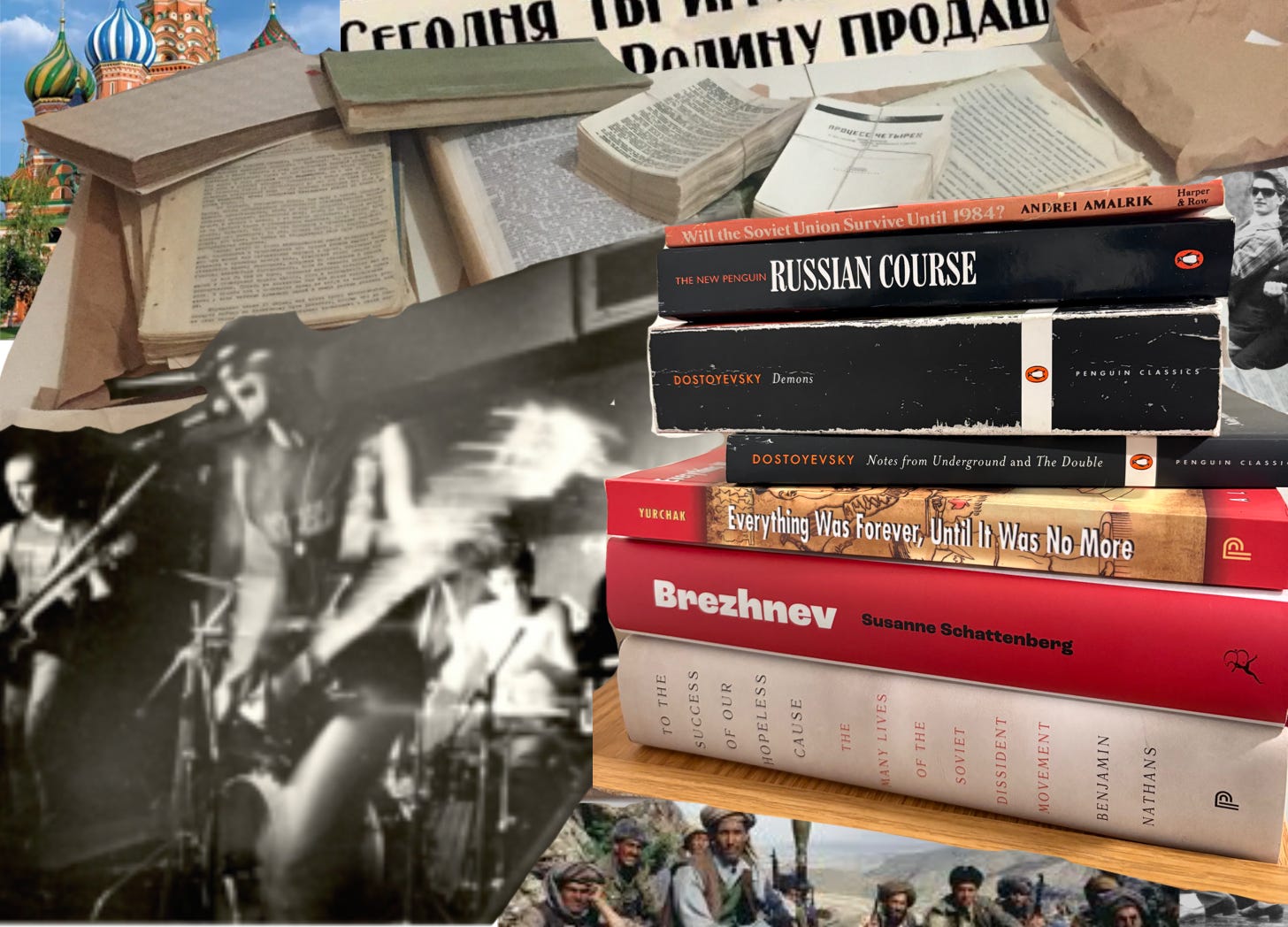
A core challenge with writing a history of the Russian dissident movement is that they didn’t do much. There was a transparency meeting митинг гласности, some international contacts that went nowhere for years, a 1968 demonstration on Red Square that served as a peak of direct action (although that was only eight people)… but little more.
The Soviet dissident movement kickass books though.
KGB Agent: Good afternoon. Your name is--Aleksei Blagoslavovich Nepobedimov, right?
A.N.: Alyosha Blagovich is fine. And you are?
KGB Agent: Andrei Il’ich.
A.N.: Quite pleasant to meet you. You--you want some tea?
KGB Agent: No. But I have heard you’ve picked up some new reading material.
A.N.: Well--I like reading.
KGB Agent: Do you like your job?
A.N.: Yes. It’s good work.
KGB Agent: TETs-20,1 correct?
A.N.: That’s the one.
KGB Agent: Do you prefer reading more than doing your job?
A.N.: The reading is just for fun. The work--that’s what helps people.
KGB Agent: So why would you read material that harms people?
A.N.: How do you mean?
KGB Agent: You’re reading anti-Soviet propaganda. Passed in, passed on. You know that material is harmful, right?
A.N.: I don’t take it seriously.
KGB Agent: Why not?
A.N.: It doesn’t mean anything. They’re just weird books. I’ve--I’ve run out of Dostoyevsky, you know? I can’t just stare out the window. I get bored. Nothing more.
KGB Agent: Understood. But the things you’re reading are bad for you. I’m sure you know.
A.N.: So is vodka. We still drink.
KGB Agent: I would advise you be careful. Oh, and you wouldn’t happen to remember who gave those materials to you?
A.N.: I don’t ask for their names, Andrei Il’ich.
KGB Agent: Maybe you should, next time. I might ask someday.
Benjamin Nathans’s rockstar history book To the Success of Our Hopeless Cause (2024) is less a story about a protest movement (a mistaken assumption by contemporary Western observers) and more about a book club that the Central Committee thought way too much about. The cohort Nathans talks about — Volpin, Litvinov, Bogoraz, Gorbanevskaya, Yakir, Sakharov — are disproportionately Muscovite intellectuals. To the extent that the dissidenty диссиденты left Moscow, it was to be exiled — to Siberia, to psychiatric hospitals, to Cavendish, Vermont for Solzhenitsyn. Even St. Petersburg — sorry, Leningrad — is barely mentioned. And no matter how prominent the dissidents got — and they were most prominent in Yuri Andropov’s head — their primary actions focused on defending their friends. Volpin himself had a straightforward (to him) focus on making the Soviet Union follow its own laws, and to that end, he aspired to a legalist framework popular enough to be supported by people he didn’t know. But the vast majority of the “chain reaction” between 1965 and 1968 came from hip Muscovite writers defending their writer friends with more writing. And credit to the dissidents, they were better writers than the Committee for State Security.
Susanne Schattenberg’s 2017 (translated 2021) biography of Leonid Brezhnev gives some context on the Kremlin’s view. Brezhnev, along with Alexei Kosygin and Nikolai Podgorny, had just yanked control away from a Nikita Khrushchev who couldn’t stop being an asshole. And ol’ Lyonya wanted everyone to like him. He wrote his speeches by consensus, took world leaders on hunting trips at his dacha, and insisted on calling the most powerful men in the Second World by pet names, even as he sidelined many of them. He was trying to be a nice guy, and clearly, that message trickled down to the KGB: stop shooting people. You’re not the NKVD, and you’re not the First Secretary’s attack dogs. Act like professionals. But Vladimir Semichastny didn’t know how to run an unscripted trial. No one did. The KGB team assigned to the trials of Yuli Daniel and Andrei Sinyavsky figured that if they simply grilled these guys on their obviously anti-Soviet writing, they would get their proof that these writers were, I guess, CIA-funded rubes consumed by the same demons that got Stavrogin and Verkhovensky.
It didn’t work out like that, in part because the morally-grey, unreliably-narrated, flatly-bizarre literature of Daniel and Sinyavsky is perfectly in line with Dostoyevsky, a man who wrote a story within a story about the Grand Inquisitor of the Spanish Inquisition arresting and interrogating Jesus, Son of God.
A.N.: What I’m saying, is that Dostoyevsky would have been arrested just like Daniel and Sinyavsky, and it would have gone exactly the same way.
S.L.: Dostoyevsky was a great man of Russia. The KGB wouldn’t arrest him.
A.N.: You sure, Seryoga? Demons was not kind to the people in power. And it was just as goofy as This is Moscow Speaking.2
S.L.: You read that thing?
A.N.: Of course I read it. You think I wouldn’t check what the fuss is?
S.L.: Wasn’t that the story about a “Public Murder Day?” That’s a dumb premise.
A.N.: Well, yes, and the “group of five” in Demons were pretty dumb too. That’s the point.
S.L.: But the book itself wasn’t dumb.
A.N.: Listen here, run through the accusations made to Daniel and Sinyavsky--they have characters who say horrible things. They depict things that are flatly ridiculous. They have sex and heresy in them. Dostoyevsky did all that.
S.L.: Not like that--
A.N.: Exactly like that! So you put him on trial and say, “In the story, you have a famous writer who thinks Russians are all drunk idiots, and who says he’d rather be in France--”
S.L.: Alyosha--
A.N.: “--Do you, Fyodor Mikhailovich, think all Russians are drunk fools, and would you rather be in France?”
S.L.: You sound like a drunk fool. You.
A.N.: Yes, on whose vodka?
S.L.: Yes, yes, remind me not to ask for your literature opinions.
A.N.: Would you prefer we complain about work instead?
S.L.: Yes, actually. Because work, I can understand. A stupid director I can go around, or at least deal with. But what did Sinyavsky want? Why make trouble when things are quiet?
A.N.: Because it makes for better art?
S.L.: Is annoying people good art?
A.N.: Sometimes. The best art comes from people poking the boundaries of what is and isn’t art. Look at Picasso.
S.L.: I never understood Picasso.
A.N.: You’re right, let’s talk about something else. You’re still seeing Natalya Ivanovna?
S.L.: Went to see a movie with her. Three Poplars on Plyushchikha.3 It was pretty good.
A.N.: Was it Diamond Arm4 good?
S.L.: No. She picked the movie. It’s for girls. Do girls like Sinyavsky?
A.N.: No, they don’t. That’s for my entertainment.
The Prague Spring was the turning point — more specifically, the tanks deployed in response to the Prague Spring.
Alexander Dubček’s pitch was notionally straightforward: What if socialism asked the secret police to chill out? What if socialism allowed a free press? What if socialism had a human face?
This was Brezhnev’s first test as a leader of the Soviet Union. He didn’t take it well. He had seen himself as a mentor to young Dubček, but as the political view in Prague diverged further from the Politburo, he resorted to a “friendly” negotiation at the Ukrainian-Slovakian border, mediated between train cars and swarmed with KGB agents. Brezhnev’s health suffered: headaches, stomach pain, fevers, conducting negotiations in pajamas. As the rapport with the Czechoslovak delegation collapsed, Brezhnev promised that he would resign should he lose the ČSSR, sobbing at the moral loss of his mentee, Comrade Dubček, dear Sasha. And although the Prague crisis would turn out “fine” for Brezhnev (less so for the dead Czechs and Slovaks), it introduced him to a sleeping pill habit that Western observers wouldn’t learn about until the fall of the Soviet Union. The ’68 invasion of Prague proved the defining moment of the Brezhnev Doctrine: protect Party control over socialist states for fear of a revisionist domino effect. But it also precipitated the stumbling, gerontocratic decline that defined the ‘70s and ‘80s in the Soviet Union.
The response to Prague was similarly both the defining moment of the dissident movement and the source of its decline. Eight protesters showed up at Red Square, in front of the Kremlin, with banners. The KGB found them in minutes, beat them, and dragged them away. This was, in Nathans’ words, “the most celebrated fifteen minutes of history in the history of the Soviet dissident movement.” Joan Baez wrote a song about it. But it was a mortal blow to the movement. Larisa Bogoraz, Pavel Litvinov, and Natalya Gorbanevskaya were key figures. Bogoraz at the time was married to Yuli Daniel, whose arrest kicked off the dissidents’ chain reaction. Litvinov was a major distributor of the samizdat самиздат literature that defined the dissident movement. Gorbanevskaya was a founder of the Chronicle of Current Events Хроника текущих событий, a samizdat periodical of Soviet attacks on human rights — and apparently the most consistently productive thing dissidents did. Bogoraz and Litvinov were sent to Siberia, Gorbanevskaya to a psychiatric hospital a year later. Without them, it seems like a lot of things didn’t get done. The Chronicle of Current Events kept on without Litvinov and Gorbanevskaya, but by the time these three returned from their exiles in the early ‘70s, the dissident movement had lost its mojo, much in line with a declining General Secretary.
A.N.: Andrei Il’ich.
KGB Agent: Aleksei Blagoslavovich. We are no longer playing games.
A.N.: I was on my way to work. To work.
KGB Agent: And now you’re talking to me. Why are you still reading anti-Soviet literature?
A.N.: Listen here, I still don’t understand what makes my reading habits “anti-Soviet.” What does that even mean?
KGB Agent: You’re reading the Chronicle of Current Events.5 That’s anti-Soviet literature. As a member of the Party, no less! Why are you playing both sides here?
A.N.: Playing both sides? I’m on the side of the Soviet people.
KGB Agent: Then why read foreign-funded accusations about the Soviet Union?
A.N.: Foreign--? Well--let’s argue the merits here. Is it true or is it not true that the USSR still treats the Crimean Tatars like they’re traitors?6
KGB Agent: Those are baseless accusations.
A.N.: Then why not refute them? I read Pravda.7 No mention. I would like to believe we treat our minorities better than the Americans, but do we? And if not, why not?
KGB Agent: Have you considered focusing on your job, Alexei Blagoslavovich?
A.N.: Why, I have. I’ve managed to cut maintenance costs by 25% compared to 1968, by instituting a predictive maintenance plan instead of waiting for things to break. I think my work is replicable. It’s in a nice little report--you know about me, you’ve probably read it. But it has sat on my director’s desk. For three months. Three months.
KGB Agent: Have you considered working harder?
A.N.: I’d only be too glad, Andrei Il’ich. I would love to run economics for a second TETs plant. But right now, I’ve run out of things to do. The work I’m responsible for gets done by 2 PM, and then I do extra work to improve the TETs, and that extra work does nothing. Nothing. And why? Because Mosenergo8 is managed by complacent blockheads who haven’t learned a new fact since the Great Patriotic War.9
KGB Agent: I would be careful what I say about war heroes.
A.N.: Because they were great men at my age? Well, they’re fat and lazy now.
KGB Agent: Would you like them to know what you think?
A.N.: Do what you like. Send me to Tashkent10--what do I care! You’ll replace me with someone worse at TETs-20, and there I’ll get real work done. To the devil with it, they might actually let me improve things.
In fairness to the dissidents, it took more than a few arrests to quash their energy. The KGB got their act together by 1969, with Yuri Andropov’s Fifth Directorate. The KGB figured out that they couldn’t out-read or out-write a cadre dominated by writers and scientists, but they could curtail their influence by targeting normal people who hung around the dissidents. Because to most Soviet citizens, at least in the primary cities of Moscow and Leningrad, the ‘60s and ‘70s were the best time to be Russian in a century. No more purges, no more total war, no more civil war, even a reprieve from the ambient violence that marked the dying decades of the Tsar.
Most importantly for regular Russians, material conditions improved under Brezhnev. One of his first projects (along with his number-two Kosygin) was a series of economic reforms to prioritize improving living standards among the Soviet citizenry. Brezhnev wanted washing machines, refrigerators, larger apartments, consumer goods — even if they were imported from capitalist countries, even if they came at the cost of Soviet gold reserves. Brezhnev’s dream was to produce so many cars in the Soviet Union that it would become a dowry item for weddings. And although material conditions never quite matched the West — a Sensitive Young Planning-Economist like yours truly would have at best had a bed in a hostel room — they were beyond the realm of complaint. No one thought to ask for more, even among the dissidents.
This made being a true dissident a risky bet for unclear gains. The KGB would and did track people with samizdat, and by 1969, they had figured out how to handle them. First, a “prophylactic conversation” профилактическая беседа to clarify what was and wasn’t acceptable. And if that wasn’t enough, the targeted individual might face a pay cut, or lose some job perk, or get their room searched (or bugged), or even get fired. And of course, they’d become The Guy With A KGB Tail. That’s all it took for most people, especially because the dissidents asked for very abstract things: civil liberties, justice for people you haven’t met, permission to read and write weird books. These are not normal things to want. Even if you liked reading Andrei Amalrik, you needed some extra je ne sais quoi to like Amalrik more than access to a car. It was always easier to be a bystander than a true dissident — and besides, what was the point? The stability of the Brezhnev years was the best one could have asked for, and it was much easier to imagine a return to Stalinism than something as strange as “rule of law.” What laws? There was an agreement: the government pretends to follow the law, and the people pretend to follow the law. You play your part in the charade, and you carve out a life that matters to you, in your friends, in your family. And if that’s really not enough, you pray to God, you freak.
These measures ultimately kept the dissident movement small. In the Soviet Union, it remained a smattering of friend groups that the Central Committee kept bringing up in conversation. In the late ‘60s and early ‘70s, a city’s true dissident movement apparently could fit in a kitchen or two, with a wider network of samizdat readers that didn’t want the real smoke. These movements could straightforwardly be crushed by arresting enough people… just more than a handful. And by the late ‘70s, the Fifth Directorate had managed it. But by that time, Amnesty International had figured out inroads with the dissidents, and Brezhnev’s quixotic dreams of world peace and personal friendship with glamorous Western heads of state had made him care what the West thought. Yet the Westerners kept asking about all those political prisoners, and Yuri Andropov didn’t have good answers beyond “Nuh uh,” and “What about your human rights abuses?”
Brezhnev didn’t understand the dissidents any more than regular Russians did. What did they have to complain about? The regular Russians had a point, but those same complaints were rich coming from Brezhnev, who had a car collection to rival the flashiest heads of state and had cultivated a sense of open discourse among the top echelons of the Communist Party. He at least asked for deputies who spoke frankly, although he might not have liked that dissent from guys like Kosygin. Brezhnev could say things were going wrong in the Soviet Union, in a way that regular intellectuals could not. And the guys around Brezhnev had freedom to operate that they did not pass down the chain of command.
Then again, power enables its own freedoms, independent of any laws.
KGB Agent: Alexei Blagoslavovich.
A.N.: Andrei Il’ich. Welcome to my home.
KGB Agent: We have a warrant to search your residence.
A.N.: Yes--consequences. Would you or your colleagues like some tea?
KGB Agent: You will stay where we can see you.
A.N.: Understood. The materials I suspect you are looking for are on top of my bookshelf. But I’m sure you’ll look through everything regardless.
KGB Agent: Do you think you know what we’re looking for?
A.N.: I have--some understanding.
KGB Agent: Of anti-Soviet materials?
A.N.: You have not provided evidence that anything I have read is anti-Soviet.
KGB Agent: Is this your roommate?
A.N.: He is. He--he wants no part of my reading material. I would offer his name, but I’m sure you know already. At any rate, you have work to do, I’ll let you get on with it.
KGB Agent: Thank you.
A.N.: --
KGB Agent: I hear you have been transferred to another TETs facility.
A.N.: Yes, Andrei Il’ich. TETs-16.11 The commute is longer, the pay supplement is slightly less, but--I’m getting proper work done. Proper work.
KGB Agent: Is that so?
A.N.: Yes. I learned that one of the boilers had been out of order for four months, but because there were some typographical errors in the fuel consumption reports, no one had noticed. Innocent mistake. However--well, so--I keep carbon copies of everything I send to the chief of planning and economics. For archives. Personal archives.
KGB Agent: Indeed.
A.N.: But I made a mistake in my filings, and I lost my personal copy of that report. And two weeks later, I get a call from the partkom secretary12 saying he had found it. What a relief.
KGB Agent: I wonder how the report got to the partkom.
A.N.: I was about to ask you that. Maybe there was another warrant for my desk. I’m joking. Joking. At least someone found the issue before winter. I managed to organize a fix of the issue. Somehow the TETs had run out of copper pipes, but I found replacements.
KGB Agent: I should investigate where those parts came from.
A.N.: Well, Andrei Il’ich, I am a good planning-economist.13 I meant to ask you, did you hear about the recent outage at TETs-20?
KGB Agent: I did not.
A.N.: Turns out there was a major accident there last week. I had reported that some of the seals in the hot water loop were due for maintenance, and I left a report for my replacement to order new seals. The order was made, but the replacements were lost in transit. The seals failed, a pipe burst, and a worker got burned badly.
KGB Agent: --
A.N.: An honest mistake, I’m sure, but I liked tracking our parts shipments. I would have followed up. I would have. But it was an honest mistake.
KGB Agent: What does this story have to do with me?
A.N.: Nothing, I’m sure. Nothing. And I know you have nothing to do with my transfer. But I want to thank you anyway. The consumers of Khoroshyovsky raion need heat, and I got to do my part to help them. And I’m sure TETs-20 will get on well without me. Once they replace those seals.
At no point did the dissidents ask for a new government, or even the political reforms that Alexander Dubček sought. With rare exceptions, they insisted they were apolitical — and who can blame them? Russia had seen enough of revolution, and considering how much “political activity” the Communist Party asked of people, even asking people to sign Yet Another Letter was… too much. But by the time the Fifth Directorate started arresting people for the notionally prosocial cause of monitoring the USSR’s participation in the Helsinki Accords that Brezhnev had proudly signed, it became clear that even asking the Soviet Union to follow its own laws was too high a bar. The only freedom a Soviet citizen could find was in their own soul.
And as Alexei Yurchak describes in Everything Was Forever, Until It Was No More (2005), the exhausted complacency of the late ‘70s and early ‘80s of Russia made personal individuation increasingly attainable. As the Soviet project sacrificed the ideological dynamism and chaos of Stalin for the more staid and stable rule-by-committee of Khrushchev and Brezhnev, the language of the USSR increasingly became uniform, anonymous, and predictable. The norms of Soviet administration ossified, and in ossifying, they opened up space between what the words of the Soviet Union were and what they meant. Yurchak names this phenomenon a performative shift, in which citizens were only asked to perform the rituals of Soviet citizenry, not to hold the revolution in their souls. And by the time the Fifth Directorate had taken up its mission of quashing the dissidents, they had stopped probing the souls of the people they arrested and interrogated. It was easier to write off dissident action as drunkenness, or foreign interference, or mental illness if they kept talking.
The dissidents took notice, and in parallel evolution to Victor Frankl, they concluded that one’s soul could be free even in a labor camp, no matter how hard a totalitarian tried. But because the Kremlin gradually placed less and less emphasis on Soviet souls, almost everyone found room for their own personal freedoms. It became possible to be neither activist, nor dissident, but simply a normal person нормальный человек. Komsomol meetings became social groups that started with perfunctory votes to please the raikom райком (district-level party committees). Black markets (always a normal part of Soviet life) pulled in Western clothing and trinkets. Coworkers exchanged anekdoty анекдоты making fun of their home country, and sometimes, their supervisors joined in.
A man has traveled to a hostel with two coworkers. His coworkers start drinking in the evening and talk loudly late into the night. The man leaves the room, asks the front desk for a pot of tea, and then returns to the room.
Then, as his coworkers start exchanging political jokes, he walks to a wall socket in the corner and asks, “Major-General, could you send up a pot of tea?” Minutes later, the pot of tea arrives. The coworkers abruptly stop talking, and the man is able to sleep.
When he wakes up, his coworkers are gone. He walks to the front desk and asks where his coworkers are.
“They have been arrested.”
“Well, why have I not been arrested?”
“The Major-General thought your tea joke was funny.”
By the early eighties, the Party’s monopoly on discourse had dissolved. Samizdat publications about art, religion, feminism, Western economics, and more had become accessible. Leningrad in particular developed countercultural spaces like Saigon, a cafe that became a hub for poetry, and Kamchatka, a boiler room that served as an impromptu venue for the now-famous rock band Kino Кино. By the time Gorbachev instituted glasnost — the same term Volpin used in 1965 — as official policy, Kino was already famous. And as the war in Afghanistan limped to its conclusion, Kino produced the album about the war.
I could pay what is asked — but I don’t want victory at any price.
I don’t want to place my boot to anyone’s chest
I’d have liked to stay with you — just to stay with you.
But a star up high calls me to the road
But even Blood Type Группа крови (1988) refrains from overt political statements — read literally, there’s no mention of the Communist Party, of Afghanistan, of a specific war. It’s more about the self. If you can’t change The System, if you know that changing The System will only make things worse, then all you can do is save yourself and those you love.
And if you can’t do that either, at least you can save your soul.
A.N.: Andrei Il’ich.
KGB Agent: Alexei Blagoslavovich.
A.N.: Pleasant to see you. Would you like some tea?
KGB Agent: --
A.N.: As a guest. A guest.
KGB Agent: I would be glad to.
A.N.: I take it you have a request for me?
KGB Agent: I do. We are investigating a man you may know--Aleksandr Dronov.14 We have evidence that he distributed anti-Soviet material.
A.N.: Dronov--
KGB Agent: No games. You’ve spoken to him.
A.N.: I see. I see.
KGB Agent: We are collecting witnesses to his activities. I would like you to corroborate our report. We have already collected testimony from his associates at the Oil Institute.
A.N.: Will I need to write my own testimony?
KGB Agent: That is not necessary.
A.N.: May I review the testimony before signing it?
KGB Agent: That is also not necessary.
A.N.: And the alternative is--Tashkent?
KGB Agent: Tashkent--no, Surgut.15
A.N.: Surgut.
KGB Agent: Yes.
A.N.: Lot of oil and gas work.
KGB Agent: So I have heard.
A.N.: They need men.
KGB Agent: Yes.
A.N.: They need planning-economists.
KGB Agent: Good ones.
A.N.: Sounds like hard work.
KGB Agent: Yes.
A.N.: Much less time to read.
KGB Agent: I understand that is important to you.
A.N.: --
KGB Agent: Of course, I am here regarding Dronov.
A.N.: You are a kind man--Andrei Il’ich. I’ll start packing.
KGB Agent: And Dronov? Dronov?
A.N.: I’m not providing testimony.
My interest in the Brezhnev days extends beyond mere fascination with the geopolitics of my father’s generation. I got hooked in part because I recognized myself in the history. I read the abstruse, block-quoted language of august socialism, and I recall boring leftist zines from college. I read of the political infighting and cliquey politics of the ‘30s, and I remember the Twitter of old. I read of enforced conformity and aesthetic philistinism in a nation of snitches and narcs, and then I open up the Twitter of now. And as I stumble into a doomscroll, I see sclerotic institutions collapsing from senescent bureaucracy, a nation led by an aging ex-thespian who is losing the ability to stand, much less speak. I ask myself what room there is for an artist, a civil servant, a dissident-by-temperament who has sought conventional power. I ask myself what I must do for the people beyond me, beyond the people I personally care about, the us свои, the ours, наши. And I find my answers in Yurchak and Nathans; I find the aesthetic register in Dostoyevsky and Tsoi; I realize that if I play my cards right, I can live a full life no matter what happens.
I can serve the people in a dying superpower.
I can seek beauty beyond the envious and the incurious.
And if all else fails, I can — like Andrei Tupolev — be too useful to truly dispose of.
Should they drag me to the gulag, they will hand me a laptop.
Combined heat and power (ТЭЦ) plant. TETs-20 is in southwest Moscow, near the hub of intelligentsia in the early ‘70s.
Govorit Moskva Говорит Москва: The standard opening phrase of Soviet state radio broadcasts. Also the title of a Yuli Daniel novella (1960-61, published abroad 1962), published abroad under the pseudonym Nikolai Arzhak. In the story, the familiar radio voice announces a government decree authorizing a single day of legalized murder.
Tri topolya na Plyushchikhe, Три тополя на Плющихе, 1968, dir. Tatyana Lioznova. A lyrical film about a kolkhoz woman visiting Moscow who shares a brief, unconsummated connection with a taxi driver. Plyushchikha (Плющиха) is an old street in central Moscow near the Arbat. The film is remembered for Tatyana Doronina’s performance and for a scene in which she sings a passage from a popular romance in the back of the taxi.
Brilliantovaya ruka, Бриллиантовая рука, 1969, dir. Leonid Gaidai. A slapstick comedy in which a mild-mannered senior economist on a Mediterranean cruise accidentally has smuggled diamonds cast into his arm in a plaster sleeve. One of the most-watched Soviet films ever made and a source of widely quoted catchphrases.
Khronika tekushchikh sobytij, Хроника текущих событий. A samizdat human rights bulletin circulated underground in the USSR from 1968 to 1983. Modeled on the format of an official news digest, it documented political arrests, trial proceedings, prison camp conditions, and censorship. A digital translated archive lives here.
The Crimean Tatars were deported en masse from Crimea to Central Asia in May 1944 on Stalin’s orders, under the collective accusation of collaboration with the Nazi occupation. The deportation killed an estimated 18–46% of the deported population in transit and in the first years of resettlement. The charge of collective treason was formally lifted in 1967 by a Soviet decree, but the Crimean Tatars were not permitted to return to Crimea in significant numbers, and administrative obstacles to repatriation persisted through the Soviet period.
Правда–Truth. The daily newspaper of the Central Committee of the Communist Party of the Soviet Union, and the most authoritative organ of the Soviet press from 1918 until the dissolution of the USSR.
Мосэнерго. The principal power-generating utility serving Moscow and Moscow Oblast. Its fleet consists primarily of ТЭЦ (combined heat and power) plants supplying both electricity and district heating to the Moscow metropolitan area.
The standard Soviet designation for the Eastern Front of World War II. Excludes the Soviet-Japanese War and the broader Allied campaigns in Western Europe and the Pacific. Carries a specific ideological weight, particularly as commemorated by Leonid Brezhnev.
Ташкент. Capital of the Uzbek Soviet Socialist Republic and the largest city in Soviet Central Asia. Three days from Moscow by train. In 1966, an earthquake leveled much of the city center; by 1971, Tashkent was the site of a massive, highly publicized all-Union reconstruction effort, with workers and engineers arriving from across the USSR.
TETs-16 is in northwest Moscow, in a more working-class neighborhood, Khoroshyovo. A downgrade in prestige.
Head of the local party committee (abbreviated to partkom партком), the primary Communist Party organ at the level of an enterprise, institute, or other workplace. The partkom operated parallel to the formal management structure: the plant director ran operations, but the partkom secretary wielded influence over personnel decisions, political reliability assessments, access to housing and benefits, and ideological compliance.
Planovik-ekonomist Плановик-экономист. A staff position within the planning-economic department. At a TETs, the planning-economist was responsible for compiling production plans, reconciling them with the targets handed down from local authorities, tracking plan fulfillment, and preparing the statistical reports submitted upward through the planning hierarchy. An analyst, not a manager or engineer.
A postgraduate student at the Moscow Oil Institute, arrested December 1971. During a search, KGB confiscated samizdat literature associated with Dronov. Reported in Issue 23 of the Chronicle of Current Events Хроника текущих событий.
Сургут. A city in Western Siberia. In 1971, Surgut was in the earliest phase of the West Siberian oil boom: the settlement had received town status only in 1965, geological teams were still discovering major fields, and the first unit of the Surgut ГРЭС-1 (GRES-1) state regional power station would not come online until December 1972. At least two days by rail from Moscow. Workers posted to Surgut received an extra pay supplement because of the hardship of living there–isolation, winters reaching −50°C, a near-total absence of cultural and consumer infrastructure.

The Volpin framing of making the regime follow its own laws is the load-bearing claim in this piece, and it travels poorly outside the specific Soviet rule-of-law lacuna. Soviet legalism worked as a dissident lever because the gap between written law and KGB practice was wide, public, and embarrassing to the Brezhnev-era image-management apparatus. The defense-of-friends pattern matters here too: the chain reaction from 1965 to 1968 stayed small because the goal was protecting named individuals rather than building a mass political base. Where the analogy breaks for the 2020s United States is that the formal-law gap is narrower and the regime-image cost of ignoring it is lower.
Where to begin if one is interested in understanding more about the dissident strains of cultural thought? I'm so wholly ignorant about the USSR in most ways, but particularly in the period of time this article focuses on.