
On August 31, Beijing-based Caijing Magazine 财经杂志 published “The King of Unitree,” a feature about CEO Wang Xingxing’s leadership at Unitree and the robotics company’s recent IPO travails.1 The details in it are amazing, and we’ve decided to publish an abridged translation. Read on to learn about:
Just how much Wang is obsessed with cutting costs;
What it was like bringing humanoids onto the Spring Festival Gala stage;
Unitree’s managerial structure;
And how the IPO has — and hasn’t — changed Unitree employees’ lives.
Footnotes, bold markings, and block-quote comments were added by ChinaTalk editors. The translation was drafted with Claude Opus 5 and revised by the ChinaTalk team.
But first, we’re running a personal classified from a real life friend of Jordan!
I’m 30, a straight guy based in DC who works in tech and national security policy. Most of my “free” time is spent outside. That’s a lot of 6am long runs, and hauling a camera up mountains that don’t require it. Date me if you’re looking for someone who’ll plan the trip, carry a heavy pack at a price Unitree can’t beat, cook when we get back, probably lose to you at every sport that isn’t running slowly for a very long time, and always give you that Strava kudos.
Respond to this email if you’d like to learn more about a person I strongly vouch for as a good human being and hang!
By Tang Min’an 唐敏安 and Huang Siyun 黄思韵, researchers at Caijing
Employees say that at Unitree Robotics (hereafter “Unitree”), any expense reimbursement over 100 yuan requires Wang Xingxing’s approval.
Wang Xingxing is the founder of Unitree Robotics Co., Ltd. Since establishing the company in August 2016, he has served as its chairman, general manager, and chief technology officer. On August 19, 2026, Unitree listed on the STAR Market, becoming the first “humanoid robot” stock on China’s A-shares market.2 After the IPO, its market capitalization briefly reached 440 billion yuan, and Wang Xingxing briefly became the richest person in China born in the 1990s.
In the eyes of Unitree employees, Wang Xingxing’s personal traits are pronounced: his communication style is relatively blunt and severe; he requires employees not to disclose anything about Unitree externally; he is product-focused, frequently discussing product details with front-line staff, down to the length of a single screw; he cares intensely about cost control and insists on spending every cent where it counts; and he rarely talks about anything outside of work.
Working at Unitree comes with high pressure. Employees often queue outside Wang Xingxing’s office waiting for approvals. Nowadays, he has less and less time to go around, with many people ringing him up to chase him. Employees reporting to him have to talk fast — two sentences in, they will likely be cut off or told to hurry up.
For Unitree’s R&D staff, being criticized is routine. Coworkers compare who gets criticized less among themselves. Unitree’s performance scores range from 0 to 1.5; Wang Xingxing gives every senior executive a score of 1 or below.
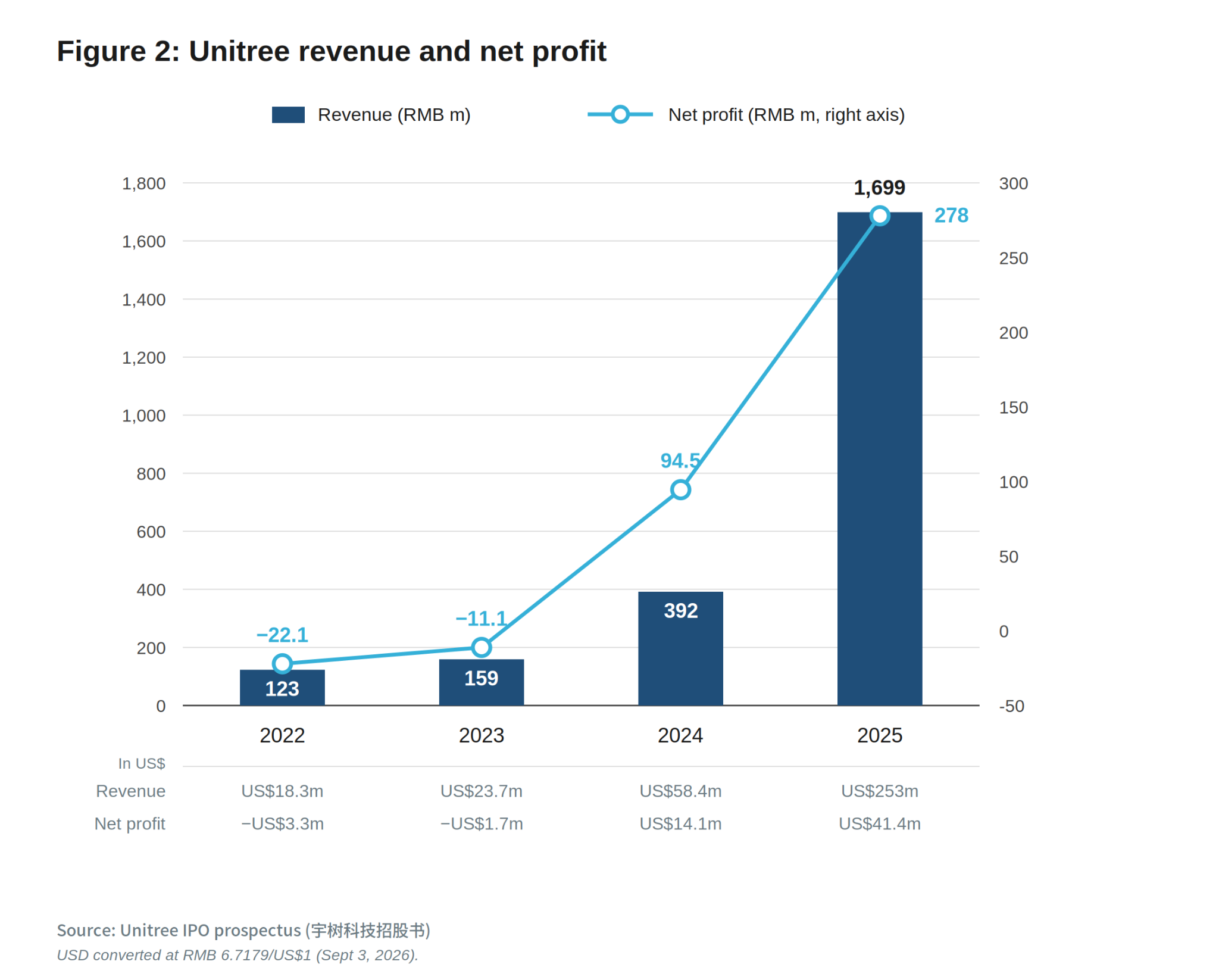
Within China’s embodied AI industry, Unitree is currently the most closely watched star company. It solved the problem of humanoid robots’ high price tags and has stayed profitable for several consecutive years — one of very few companies in the industry to sustain profitability. The label on Unitree’s robots is “low cost, high performance.”
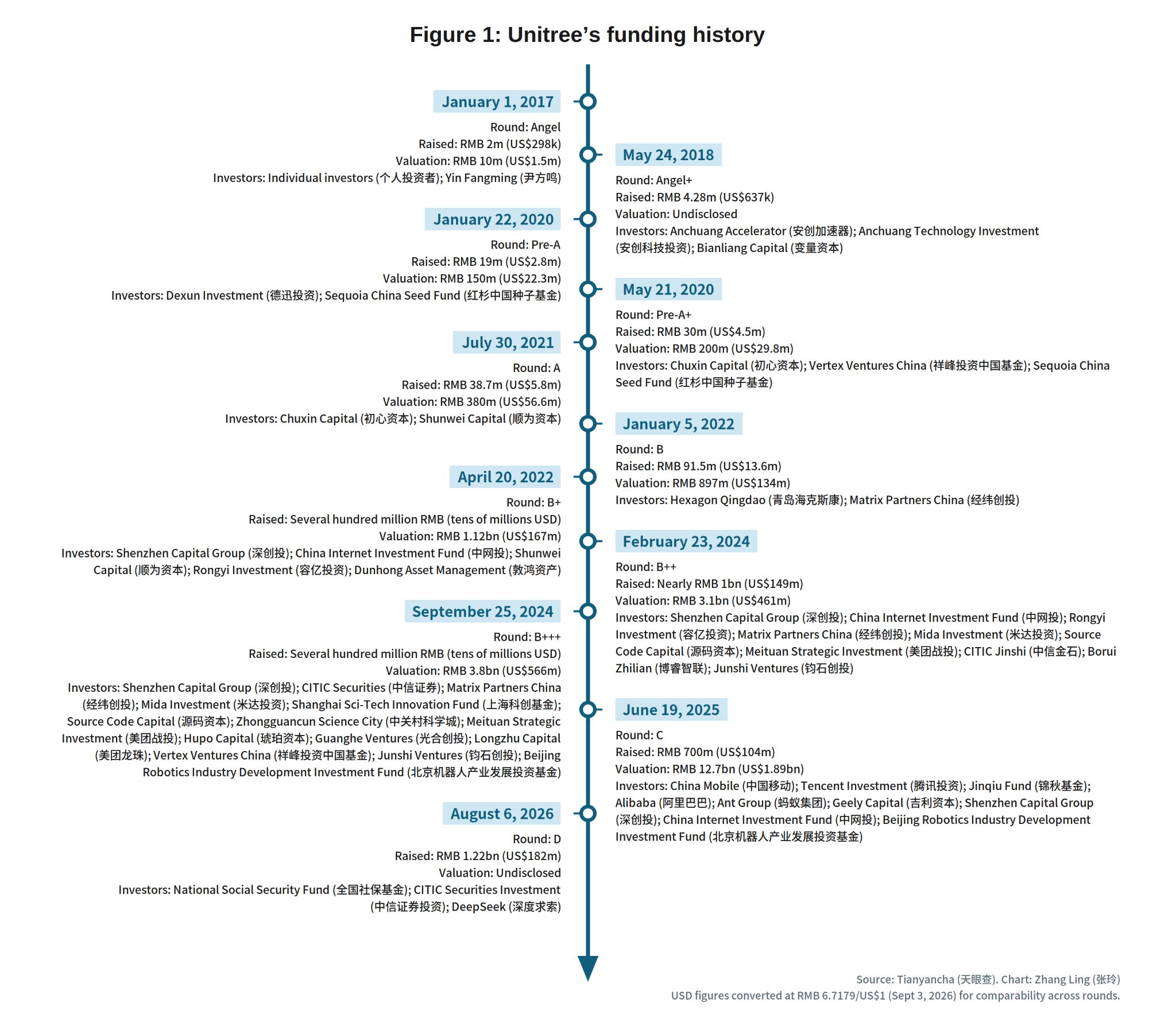
For capital markets, Unitree set the trend for “humanoid robot concept stocks.” As of August 28, its market capitalization stood at roughly 248.8 billion yuan — seven times the contemporaneous market cap of UBTech, a robotics company which previously listed in Hong Kong, and ten times Unitree’s own valuation in its final pre-IPO funding round.
Doubts about Unitree mostly center on R&D spending. The humanoid robot is called the jewel in the crown of robotics: the humanoid form is the most general-purpose and has the widest range of applications, but it is also the hardest to build. According to its prospectus, Unitree spent 145 million yuan on R&D in 2025, or 8.53% of revenue — a middling level among tech companies, given that STAR Market-listed firms average roughly 11%. UBTech spent about 500 million yuan on R&D in 2025, about 25.4% of revenue.
Unitree’s R&D-to-revenue ratio was 31.39% in 2023 and 17.83% in 2024. The decline is mainly because revenue grew explosively over the same period, diluting R&D as a share of the total.
…
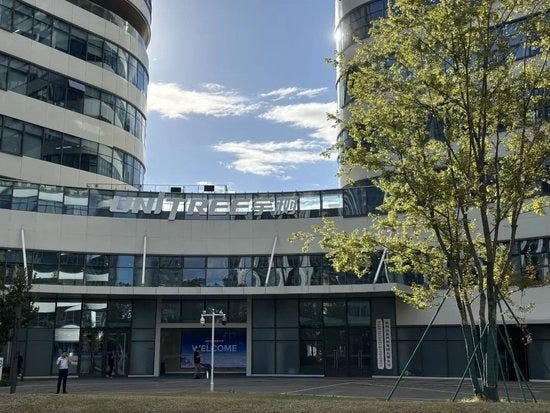
Unitree’s offices in the Zhongguo Shugu Building 中国数谷大厦, Hangzhou. Photo by Tang Min’an
Three Spring Festival Galas
Unitree values public visibility — ideally, the kind that costs nothing
The Spring Festival Gala was a defining moment for Unitree. It was also the beginning of the public’s impression of humanoid robots.
At the 2026 Gala, several embodied AI companies appeared on stage. Multiple industry practitioners told Caijing that ahead of the 2026 Gala, one such company based in Shanghai approached the Gala’s production team and raised its sponsorship bid from 30 million to 60 million yuan. Others followed, and market rumor put each company’s sponsorship fee as high as 100 million yuan. CCTV has not disclosed details of the fees. The company that bid first ultimately withdrew.
One Unitree employee was somewhat surprised. “Unitree hadn’t originally planned to go on the 2026 Gala, because we’d already gone last year,” he told Caijing, but management eventually decided to take part for reasons he does not know. “It’s always been that if [a promotional activity] required us to spend money, we definitely wouldn’t take part.” This time was an exception.
For the 2025 Gala, Unitree paid nothing. Director Zhang Yimou approached the company, and the humanoid robots were supporting players in the act. Unitree’s first Gala appearance, in 2021, also cost nothing — that year, 24 of its quadruped robots were dressed in ox costumes for the Year of the Ox and performed the number “Niu Qilai” alongside stars like Andy Lau. The debut made little splash, but it let some investors know that besides the US’s Boston Dynamics, there was also a domestic startup developing quadruped robots.
The 2025 Gala that cost nothing, in which Unitree’s robots performed a yangge folk dance in floral-print clothes, was the most important of the three appearances.3
Employees were the first to feel the impact. One Unitree employee told Caijing that after the 2025 Spring Festival holiday, overtime became the norm and he once worked at least half a month straight. Urgent capacity expansion was needed and there was not enough production space, so Unitree’s plant in the Shangtai Industrial Park had to relocate to Guanshan. Headcount expanded in parallel: only a few hundred humanoid robots had come off the assembly line at that point, but orders were already queuing up, and Unitree hired large numbers of outsourced workers for production and after-sales as a stopgap.
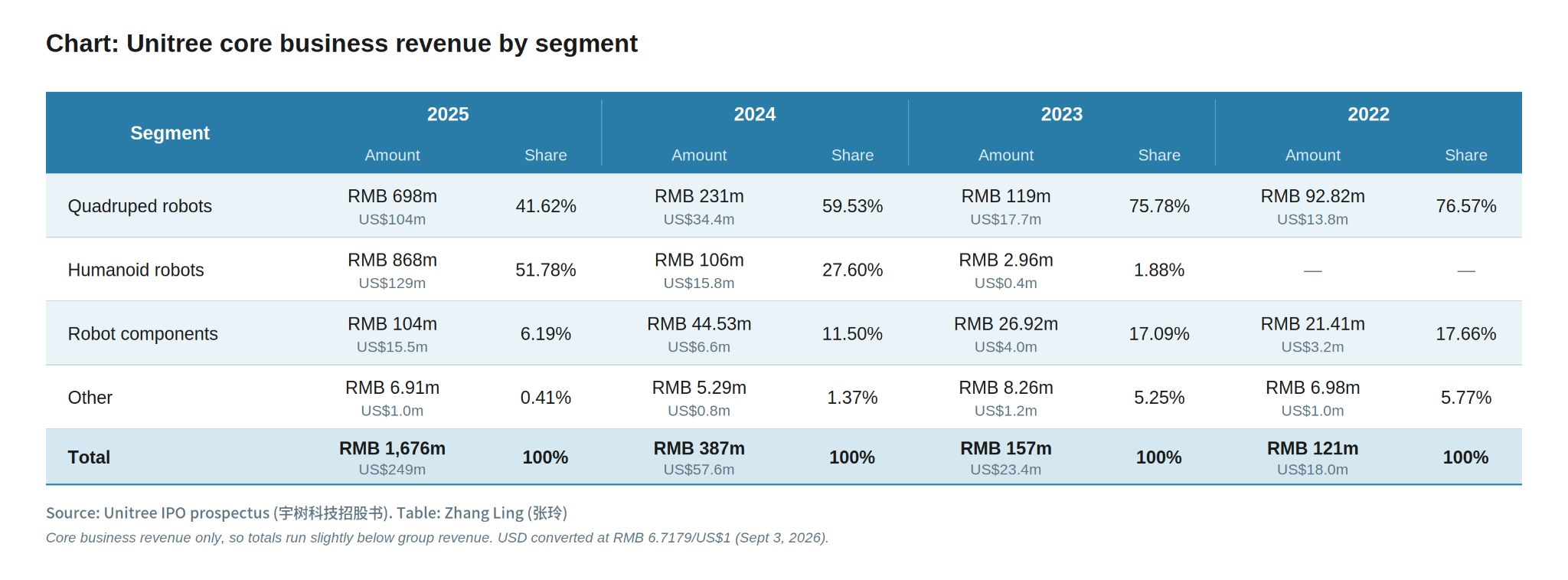
Unitree’s prospectus shows sales of both quadruped and bipedal robots surged in 2025. Quadruped sales reached 23,000 units, up 222% year-on-year from 7,136 units in 2024. Bipedal humanoid sales reached 5,215 units, up 1,165% from 412 units in 2024.
…
Wang Xingxing cares about how the company appears in public. One employee got a private message from Wang reminding them to be careful after they shared work experiences on social media. Unitree encourages employees to report colleagues who leak internal information, with rewards of 10,000 to 500,000 yuan once a report is verified.
Unitree employee Luo Lan (a pseudonym) told Caijing that every promotional video goes through Wang Xingxing. Not only does he review the finished cut, he also picks over the setting, shots, and even lighting before filming. Whether there is a budget at all is entirely his call.
Wang Xingxing likes to fuss over details like adjustments to a material’s color, even though these don’t affect function. They come more from his personal aesthetic taste. Some employees mention that the face of the H2 robot was designed by Wang himself. After the H2’s bionic face was unveiled last year it drew an “uncanny valley” reaction online; Wang later responded that the decision to add a human face came from user expectations.
Unitree takes its Gala performance very seriously. One employee told Caijing that for the 2026 Gala, the company stationed nearly 50 engineers on site for tuning, “living on American time every day,” for more than two months of adjustments in total. Because of venue constraints, Unitree kept more than 20 robots at the Gala site for rehearsals, while algorithm testing was done on another batch of 20-plus robots at a site in Daxing. Whenever he had nothing else on, Wang Xingxing would come to the site and solve problems alongside everyone. He personally verified every machine and “would talk through every change with every person there.”
Unitree treats the Gala not merely as “promotion” but also as an opportunity to systematically crack hard technical problems. One key breakthrough in the act was swarm control of robots performing difficult movements and complex, fast repositioning — hardware stability varies from unit to unit, so even the same algorithm running on different robots of the same brand may well not produce the same result.
It was only in the months before this Gala that Unitree’s algorithmic stability improved enough to accommodate robots with differing hardware stability. Achieving the effect seen on stage was no easy feat.
Spending Where It Counts
“Don’t try to beat us on cost — we can still go a lot lower”
Hardware and motion-control algorithms are the most-cited advantages for Unitree. The prospectus shows the gross margin on its quadruped robots rose from 43.71% in 2023 to 56.72% in 2025, while the gross margin on bipedal humanoids has held steady above 60%, reaching 63.18% in 2025.
Several robotics hardware engineers told Caijing that Unitree’s hardware advantage is not that its quality and precision are especially good, but rather that through design choices and structural engineering, Unitree drives costs down to the extreme. And through shipment volume and delivery speed, it iterates hardware development quickly.
…
Achieving the same result with a cheaper approach “is itself a demonstration of technical skill.”
Several practitioners summed up the industry’s conventional approach to cutting costs on robot hardware: on the production side, use larger shipment volumes to push down unit purchase prices. “In the long run that’s viable. But it’s still early days, real order volumes are limited, and a large enough sales scale is itself a paradox,” one practitioner said.
Wang Xingxing has been cutting costs since the company’s earliest days, and believes that relying on mass production alone to do it is a siren song. He has said publicly on several occasions that cost reduction depends first on design — the most fundamental path — and only then on mass production. In a 2025 interview he said, “A lot of people think that once I have volume I can cut costs. That’s pure illusion.” He also said: “Don’t try to beat us on cost — we can still go a lot lower.”
…
Quality control comes under pressure as a result. Luo Lan said most of Unitree’s quality inspectors are outsourced and mainly check appearance, and material quality varies between batches. “At this cost and this speed, the supply chain isn’t going to give you especially good quality control,” he said, adding that R&D staff frequently have to deal with material quality problems over and over.
One Unitree employee told Caijing that the early return-for-repair rate was “extremely high,” whereas now they can at least guarantee a product will not break within its one-year or six-month warranty. An investor with stakes in several embodied AI companies noted that plenty of firms’ robots need repairs within one or two months.
Several people in Unitree’s supply chain told Caijing that in any collaboration, Unitree is definitely the dominant party. All of them noted that Unitree iterates product designs very fast and is unyielding about details.
One supplier described Unitree’s delivery rhythm as “short, flat, and fast,” and they set up a dedicated liaison team with a working model geared to responding to design changes within three to four weeks.
When another supplier first dealt with Unitree, the order was for just ten sets. Even ten sets was hard to schedule for a company of their modest size. She believes Unitree can only work with small companies, because only they can accommodate its need for fast-response iteration; large supply-chain firms cannot even get the order into their queue. “If delivery is required in three days, many big companies need three days just for internal processes.”
The same person said that even counting labor cost as zero, there is not much money to be made — “unless the company’s strategy is very bullish on robotics and it’s determined to break into this space.” That is precisely why they want to be part of Unitree’s supply chain.
As Unitree’s production scale gradually expanded, small factories’ capacity could no longer meet its needs. The company has been both looking outward for firms able to take on current volumes and expanding its own capacity. Since 2025, embodied AI has become an explicit part of many listed companies’ strategic plans — especially firms originally in the automotive or consumer electronics supply chains, which treat embodied AI as a “second growth curve.” Numerous supply-chain companies told Caijing that Unitree’s supply chain is very closed off: they do not know which firms are in it, and they themselves cannot get in.
…
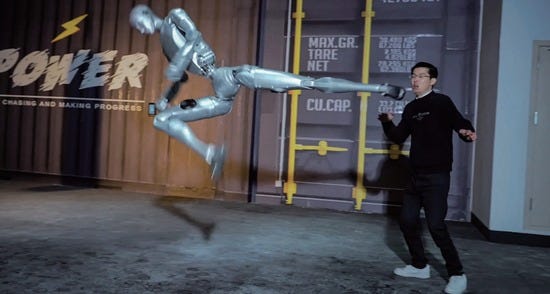
On the evening of January 4, 2026, Unitree’s official video account posted a clip of Wang Xingxing (right) at an H2 humanoid robot training site. Photo/IC
Wang Xingxing’s Trade-offs
What to do and what not to do — Wang Xingxing has a clear plan, and everyone else just carries out his orders
Unitree employee Yu Le (a pseudonym) finds Wang Xingxing’s daily routine hard to imagine. He told Caijing that Wang is still posting technical documents in work chats at two or three in the morning, generally leaves the office at three or four, and can be seen at his desk again by eight — and he comes in on weekends too.
By Yu Le’s account, Wang Xingxing is a thoroughgoing introvert. “If you run into him in the hallway he’ll walk past with his head down and won’t say hello. Sit down next to him and he’ll actually be uncomfortable.” Several people close to Unitree told Caijing that in the early days Wang refused all interviews and public appearances; only after investors pressed him on account of investor and government relations did he begin showing up in public.
When it comes to products, though, subtraction seems difficult for him.
Luo Lan said Wang cares a great deal about whether product performance beats competitors’, wanting to lead on every metric — cost, performance, appearance. Features that enterprise customers want, he wants consumer customers to have as well. “That’s impossible; you have to make trade-offs. He never makes trade-offs. His demand is ‘I want all of it.’”
On AI models, Unitree is pursuing both WMA (World Model Accelerator) world models and VLA (vision-language-action) models, an approach many robot-hardware companies share. No agreed technical paradigm for embodied AI models has yet emerged, and companies across the field are all working toward their own GPT moment. At this year’s World Robot Conference, Wang Xingxing said Unitree began work on video-generation-based world models in early 2024, shelved the effort for a period at the end of 2024 because results were not particularly good, and from 2025 began pushing its world model framework hard again.
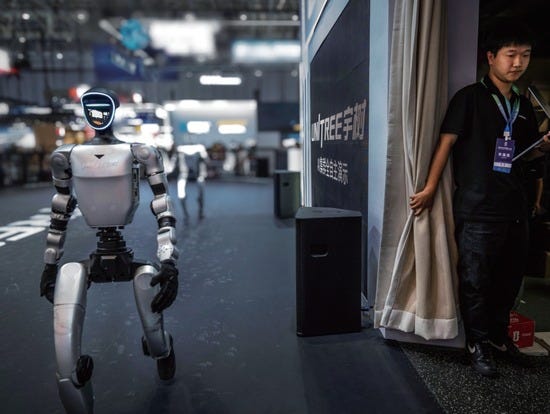
On August 19, 2026, during the 2026 World Robot Conference, Unitree humanoid robots walk off stage after a performance. Photo/VCG
Wang Xingxing has said more than once that large embodied AI models are not yet mature. In an interview this March he noted that “video generation models — the world model direction — demand far too much compute,” such that pure robotics companies anywhere in the world “simply can’t train them.” Unitree is pinning its hopes on models with smaller data requirements.
In an early exchange with brokerage analysts, Unitree argued that sufficiently stable and reliable hardware plus motion-control algorithms can cover a certain set of industrial tasks. Several practitioners told Caijing that in some industrial settings today, the work is indeed done through fixed-point motion control and rule-based vision algorithms rather than by training large robot models.
From 2025 Unitree began expanding hiring for roles related to large embodied models. Beyond algorithms, data is the infrastructure for such models: on the recruitment page of its website, roles related to robot data infrastructure are marked “in hot demand.”
At the IPO celebration, Wang Xingxing spoke for the first time about the direction of Unitree’s advance research on the robot “brain”: self-evolving physical AI, in which robots, built on large AI models, achieve an autonomous loop of perception, decision, execution, evaluation, learning, and evolution.
…
Wang Xingxing came up through hardware structural engineering and has ten years of experience as an engineer. He drew up ten rules specifically for the structural engineering department, each a technical standard distilled from his own experience — for instance, that a given component’s thickness may not fall below a specific figure.
“He really isn’t much like what we usually understand a boss to be.” In Yu Le’s view, a company’s number one is supposed to focus on strategic direction and setting broad systems, whereas Wang Xingxing makes the call on everything from end to end, whether corporate strategy or a detail of product design.
At Unitree, the founder’s attention has become a resource-allocation mechanism, with the company’s resources increasingly revolving around one person’s judgment. Unitree once launched a resistance-training device called the “Fitness Pump.” One employee recalls that Wang, working on motors one day, realized they could be used to build exercise equipment; he quickly made the call, pulled in a few colleagues to start on it, and, convinced the product would sell well, stockpiled tens of millions of yuan worth of materials that are still sitting in the warehouse today.
Unitree also launched a boxing edition of its G1 robot, still on sale today. A person close to the company told Caijing that while preparing for a robot boxing match, Unitree modified the G1, swapping out prototype components on the fly to improve its performance in the ring. After the match, Wang Xingxing decided to cut new molds for the modified parts and push the boxing robot into mass production. In this person’s view, Wang only makes such a decision after due diligence or once orders are in hand: “Only when there are clearly orders or market demand will he put in more R&D spending.”
Unitree’s general-purpose humanoid G1 sparked wide discussion as soon as it launched in 2024. The base version started at 99,000 yuan [less than $15,000], addressing the previously prohibitive cost of humanoid robots.
Geek and Businessman
Wang Xingxing is both a businessman and a “geek.” Together, those two traits produced the “low cost, high performance” formula behind Unitree’s robots.
Employee Pang Geren 庞歌仁 vividly remembers walking into Unitree for the first time. It was the third floor of an office building in Hangzhou. Factory and company were crammed onto the same floor, a space of less than 300 square meters, “like a roadside repair stall.” The workshop was dimly lit, filled with the sounds of cutting, drilling, screwdrivers, and hammering, equipment and people jumbled together.
He recalls this as Unitree’s fastest and most efficient period. The company was still relatively small; as he sat at his desk, line workers would walk straight over, tap him on the shoulder, and bring him problems to solve. There was almost no distance between R&D and production. Later, when production moved to a larger park, he would still go down to the line frequently.
Wang Xingxing has said publicly on several occasions that before 2021, he was firmly against building humanoid robots, on the grounds that the technology could not handle so complex an integrated system and that he saw no practical value in it. In August 2023, Unitree released its first humanoid, the H1.
A person with knowledge of the matter told Caijing that an investor once asked Wang Xingxing why he was building humanoid robots, and got an answer the investor found “unbelievably plain”: because the orders came in. Another investor who met Wang at a very early stage asked who he would sell the robot dogs to once they were built. Wang responded that if he really built them, someone would definitely buy them. That investor passed on Unitree at the time.
“No compelling pitch deck, and absolutely no grand narrative about a ‘hundred-billion-yuan market of the future.’” That is how Zhang Peng 张鹏, an investor at Bianliang Capital 变量资本, describes Wang Xingxing in his earlier days. “But the moment the conversation turned to the product, the technology, and the engineering itself, he clearly had authentic enthusiasm and understanding beyond his years.”
In one interview, Wang Xingxing said Unitree’s commercial logic is that any business activity must generate a reasonable commercial profit. Cost has always been the KPI behind everything Unitree does, and the core of it is to make money.
…
Caijing sent Unitree Robotics interview requests regarding expense approvals, performance reviews, the terms of supplier confidentiality agreements, and early quality control. The company did not respond.
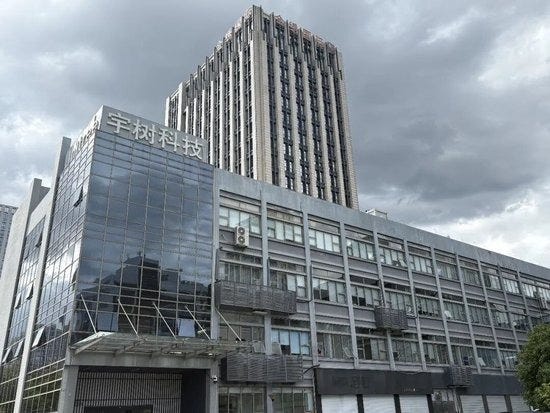
Unitree’s offices in the Fengda Creative Park 峰达创意园, Hangzhou. Photo by Tang Min’an
Still a Startup
Unitree’s management structure remains flat; it’s simply “Wang Xingxing and everyone else”
Unitree’s organizational structure has not grown more complex in step with the expansion of its business.
Several employees told Caijing that the company has no management layers and that a great many things require Wang Xingxing’s approval. At the same time, one R&D employee argues that Unitree’s incentive system consists only of penalties, with almost no rewards. For some staff, taking on one more feature means maintaining more things later with no additional reward. “They’ll think, why not just keep it simple?”
The same employees said R&D spends most of its time pushing projects forward, with no time for cracking hard technical problems. One person carries several projects at once, most running in parallel. The company used to focus on robot dogs, then added humanoids, dexterous hands, and assorted custom projects; new projects keep coming in, and custom work easily ties up manpower — “but there are only so many people.”
At Unitree, one person functions like a team. Per employees’ accounts, a promotional video may be handled by only one or two people, and business lines such as dexterous hands may each be the responsibility of just one or two staff. To a degree this preserves the company’s vitality; on another level it creates problems.
Employees sometimes find Wang Xingxing’s thinking hard to keep up with.
Sometimes a business team will thoroughly debate its way to an approach, only for Wang to insist on his own idea and redirect the team elsewhere. Months later, when that path proves unworkable, the company reverts to the original approach.
Several people close to Unitree told Caijing that its salaries are not high by industry standards. One former employee said pay is somewhat higher than at traditional industrial robotics companies, but on the low side compared with the embodied AI startups that emerged after 2023.
Two employees noted that raises for ordinary staff are smaller than the industry norm, while the workload is not light. One said that in the early days, on top of a 996 schedule with alternating six-day weeks, there was additional daily overtime.
A veteran employee told Caijing that last year and this year have seen the highest attrition of core staff in Unitree’s history.
…
On August 19, Unitree listed on the STAR Market, opening up 629%, with market capitalization briefly hitting 444.9 billion yuan. As the spotlight fell on Wang Xingxing and the investors ringing the bell, the gap felt by rank-and-file workers only widened.
On listing day there was none of the internal celebration Luo Lan had expected. Everyone was working — “not even a can of Coke to mark the IPO.” Luo Lan feels Unitree does not care about the company’s environment for employees or benefits. A desk at Unitree consists only of a desktop, with no cabinet or drawers. The annual party is simply a meal. Unitree’s HR does not do HR business partner work, taking no part in employees’ mental health or in company culture, and handling only recruitment and performance reviews.
Unitree’s options are locked up in the hands of a few people. According to the prospectus, the company settled most of its option grantees between 2017 and 2021, signing 1-yuan-per-share options with 17 employees, and added six more between 2024 and 2025. Nine people subsequently left and had their allocations cancelled; of the remaining 14, 11 have exercised.
In the IPO, the company set up employee asset-management plans No. 1 and No. 2, under which employees had to put up their own cash to subscribe for new shares at the offer price of 150.8 yuan per share. In the end, 171 senior managers and core employees took part in the strategic placement, subscribing for roughly 272 million yuan in total.
As Pang Geren sees it, this lets the company tell the world that employees are backing Unitree with hard cash while also raising interest-free money — and employees who have already been with the company for the long haul have to put in still more of their own. “There’s a feeling of being wrung dry.” One employee who holds equity told Caijing that he has not been able to feel happy since the listing either. “Every day I wake up and, on top of the unsolved technical problems, I have to face the stock going up and down and the sound of people cursing us out.”
The prospectus states that under the employee stock ownership plan, the upper-tier partnership interests in Shanghai Yuyi 上海宇翼 — held by Wang Xingxing, the company’s actual controller — will in future be used entirely for employee equity incentives (with Wang himself excluded as a recipient). No less than 50% is planned to be granted within the two calendar years after the 36-month mark following the IPO, with the remainder granted over the plan’s remaining term.
Unitree investor Chen Cheng (a pseudonym) has followed hard-tech for years and sees nothing wrong with a tech startup adopting a “1+N” management model — the founder and everyone else. Commercializing technical results is full of difficulties and requires a strong person to lead; if everything has to go through multiple rounds of discussion among many people, that is actually ill-suited to efficient iteration.
He believes that post-IPO, if Unitree is to become a larger enterprise, it will need to shore up the capabilities of its other executives and cultivate a “minus-one” team one level below the founder, spanning management, sales, production, and R&D.
In July 2026, Wang Xingxing appeared with the GD01 on the cover of Time under the headline “The Big Robot Moment,” A person with knowledge of the matter said Time approached Unitree of its own accord after the GD01’s launch. It had been eight years since a Chinese entrepreneur last appeared on Time‘s cover.
The Wang Xingxing in Chen Cheng’s eyes is a different figure. At the 2025 National Day military parade, Wang was invited to watch from the Tiananmen gate tower; by then, Unitree was already the undisputed leader among China’s embodied AI companies. When the parade ended, Wang walked out of Tiananmen with a black backpack, in a white T-shirt, jeans, and white sneakers, and spent more than thirty minutes walking along Chang’an Avenue to get somewhere where he could hail a cab. No assistant, no car and driver — just as he had looked the first time Chen met him, backpack on, white T-shirt on, “out doing a roadshow like that.”
The article’s original title, 宇树的王 (“The Wang of Unitree”), is a pun on Wang Xingxing’s first name. Wang 王 is both a common Chinese family name and the character for king.
The Shanghai Stock Exchange’s STAR Market, established in 2019, focuses on science and technology equities trading.
Yangge 秧歌 is a form of northern Chinese folk dance. Here is one version by villager in Haiyang, Shandong:
And here is Unitree’s version, Yang BOT:
Wangxingxing is the most ideal, most stereotypical Chinese business man.
While most of excellent, traditional Chinese business CEO might not be the most well educated, spoken or have the ability to provide hype to its own company, they are good hard realists who knows how to keep the fundamentals of the company in sight.
They are made to run a structured system that is carefully engineered with precision.
As a national symbol, I am sure he has more than plenty of resources to ensure the investment and attention is flowing into Unitree. While the company will suffer its up and down from the financial world. He is certainly a man that will keep his nose down rather than looking around. Definitely an operator’s dream CEO
This is why I still enjoy ChinaTalk as a Chinese reader. They have good editorial taste and respect China’s local context, even when covering its problems.
I’d bet they’ll next translate reports on Xingyu’s layoffs of new graduate hires and the social media backlash over BYD scrapping employee bonuses. Neither story seems related to Wang Xingxing, but they show two sides of Chinese manufacturing. Your greatest strength is often also your greatest weakness.
Also: I hate Mike Gallagher.