
Constanza Vidal Bustamante, Senior Researcher at CNAS and author of the landmark report Quantum’s Industrial Moment, joins ChinaTalk to map out how supply chains behind quantum computers wind through the US and China. Co-hosting are Chris Miller, author of Chip War, and Zachary Yerushalmi.
Our conversation covers:
What it takes to build a quantum computer — Inside the cryogenic supply chain, the helium-3 bottleneck, and why mining the moon might actually make sense.
How export controls backfired — How restrictions on dilution refrigerators helped spur China to go from zero to more cryogenic suppliers than the rest of the world combined in just two years.
The scaling problem — Simply multiplying dilution refrigerators doesn't get you to a million-qubit machine. Cooling, cabling, and the chips all have to be rethought — and no country owns that yet.
Why being first isn’t winning — Why long-term victory isn’t cracking Shor’s algorithm first, but locking in supply chains across multiple modalities.
The public-private fault line — The high-stakes balancing act between the government stepping in to accelerate innovation and letting the market work on its own.
Plus, what China is getting right, where the US still has an edge, whether the US should ban Chinese components, and why quantum supply chains are a national security priority.
If you read ChinaTalk, you care about what’s actually happening in China. The people who understand China most deeply access it directly — reading the news, hearing the debates, talking without a translator in the room. Without Chinese, you’re always one step removed.
That gap is what my old internet friend Andrew Methven has spent two decades closing. He built a fantastic substack RealTime Mandarin — a must-open for me each week — for intermediate and advanced learners. Now he’s made something for beginners!
Interactive Mandarin for Beginners is a 12-week program covering characters, vocabulary, grammar, reading, listening, and speaking, all through real Chinese news stories. You’re learning with real Chinese from day one, alongside a community of fellow China watchers. It’s for anyone who’s tried for years and never found something that stuck.
Enrollment closes this Saturday night. Check it out here!
Jordan Schneider: Constanza Vidal Bustamante has done dramatic, impressive work of public service, writing one of truly the best think tank reports I have ever come across: “Quantum’s Industrial Moment: Strengthening US Quantum Supply Chains for Scalable Advantage,” co-authored with John Burke. It goes incredibly deep, and I learned so much about everything that goes into making a quantum computer.
It really reminds me, Chris, of reading those 2018, 2019, 2020 reports where Washington was wrapping its head around the semiconductor supply chain — the work that ended up delivering what became the CHIPS Act and the program office. There is an enormous amount of detail and knowledge here. Every few sentences, I found myself wanting ChatGPT to give me the ten-page version of some three-sentence reference Constanza made. We are excited to give you a taste, but you should all read and dive into the full report.
What Does it Take to Build a Quantum Computer?
Chris Miller: To start, what does it take to build a quantum computer?
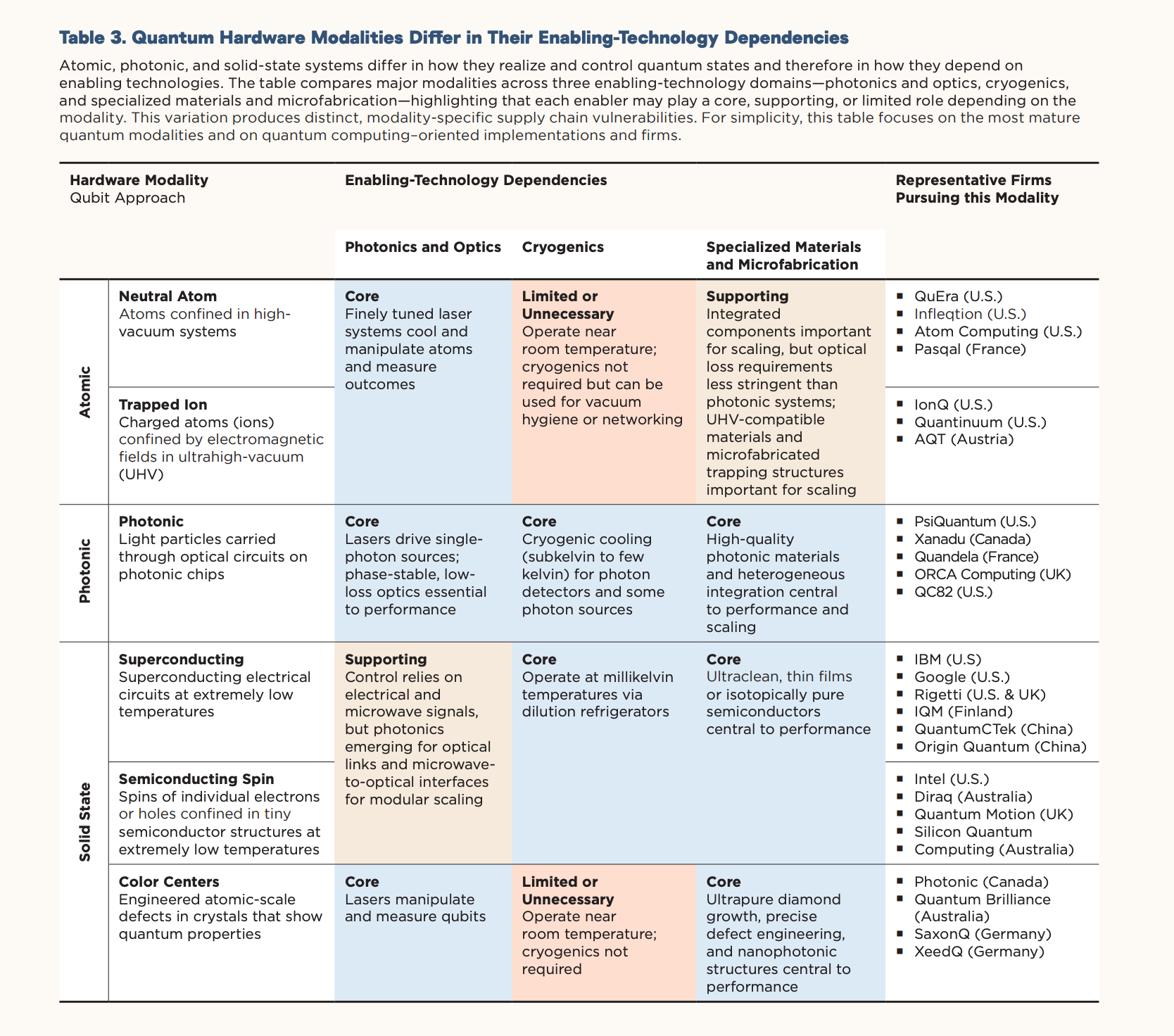
Constanza Vidal Bustamante: That’s a big question. In the report, we try to answer this complex question because it seems like it would have a simple answer, but it’s quite complicated — starting from the fact that there isn’t just one kind of quantum computer. Different companies are pursuing different modalities. We have superconducting computers, atomic computers (which could be neutral atoms or trapped ions), photonic computing, and many other modalities cropping up as well.
Each has a different bill of materials, pulling from various layers of the quantum supply chain in different ways. Some of these are partially overlapping, but they’re distinct enough that it gives rise to the idea that there isn’t just one supply chain — we have multiple supply chains we should be taking care of.
In terms of commonalities, they’re all drawing from similar layers of the so-called quantum stack. They draw from specific materials, or they may use distinct atomic sources or isotopes. They place these elements within an environment — a cryogenic environment with ultra-low temperatures or an ultra-high vacuum environment. They use different components to interface with these atomic sources or materials that generate the quantum state, such as lasers or various control electronics. There’s a software layer, and there’s networking, if you think a little further into the future, as we start putting together different chips for these various modalities.
All of these modalities draw from these various layers, but the specific elements that go into each layer vary quite a bit. That’s why it was very important (and why the report runs on the longer side) because there isn’t an easy answer or just one list of elements you can point to. These things are also changing over time, so it gets complicated.
Zachary Yerushalmi: Quantum is at a super early stage as a technology package. We are pre-transistor. Because of that, you have to deal with the inherent uncertainty of supporting all these different supply chains in their current state. But it’s also a wildly fast-moving industry. The next phase will require a step change and a reinvention of that supply chain, even if a lot of these existing modalities are successful.
The example there would be something like photonic integrated circuits, which are the photon equivalent of the integrated circuit of the electron era. Right now, most AMO — atomic, molecular, and optical — approaches, which represent one of the big clusters in quantum computing, are using methods that don’t scale based on current manufacturing techniques. To scale them, you have to move to PICs. To move to PICs, yet again, you need to reinvent the supply chain and do that continuously. It’s a fascinating one to grapple with, with a level of uncertainty that I really don’t think we see in any other technology package at this scale.
Chris Miller: The analogy is sort of like it’s 1945, we’re two years out from the transistor having been invented, and we’re trying to think through what the computing supply chain looks like in 1955. We don’t know what the transistor is going to look like exactly, so we’re going to go through the cabinets at Bell Labs and figure out, on average, what the scientists are using as they run their experiments. Is that a good analogy?
Zachary Yerushalmi: Yeah, almost to the point of pre-vacuum tube. I’d be curious about Constanza’s perspective.

Constanza Vidal Bustamante: When we think about the heterogeneity of supply chains, it’s not just across these modalities horizontally, but also along the time dimension. As we think about the prototypes being built right now, we have a good sense of what those supply chains look like. They’re very globally distributed, and we can point to sources of dependencies — some things we’re importing from China, where it may be the only source, or other things where the best in market comes from Europe or Japan.
But as we look ahead to when we’ll have quantum computers capable of breaking encryption — the version of these machines that will truly be revolutionary — the supply chain is probably going to look quite different from the one we have right now. As I argue in the report with John, when you think about geopolitical stakes and international competition, that’s the place where the United States can still dominate, because nobody has control over a supply chain that doesn’t yet exist.
If we think carefully, we’re not entirely without an idea of what it will look like. As Zach said, we have models. We need to move to photonic integration if we want to manufacture this at scale and at a competitive cost. To actually build these machines at volume, we have a rough idea of the path to get there. It’s just a matter of breaking the chicken-and-egg cycle of waiting for enough market demand before making major investments in the supply chain. Because you don’t have those investments, you never get to a point where the product becomes very attractive to the market.
There’s a path forward. It’s just a matter of gathering enough momentum, political will, and capital. At the end of the day, it’s capital. We need to unlock the next-generation supply chain for these machines, and the United States is definitely still in time to dominate if we move quickly.
Zachary Yerushalmi: Let me give a couple of examples on the stakes of locking in your role as a country in that supply chain, and why you get so much leverage when you do.
Think of the two dominant approaches. One is solid-state or superconducting, which requires cryogenic systems of a wild scale. The other is AMO. Take the cryogenic side. For innovation there right now, you need a dilution refrigerator to operate these systems. It takes 40 hours to go from room temperature down to the level of cold needed to operate a superconducting circuit. That 40 hours means you can only run one test a week. If China invents an ability to take that from 40 hours to 12 hours, you go from one test a week to one test a day. Your iteration cycle changes completely, and they’ll lock that down and grab that supply chain.
On the other side, with PICs for the AMO approaches, nobody has really made a scalable PIC — the architecture transistor part for that computer. It’s really hard. The country that does that has a total lock on the ability to scale whole approaches in quantum computing. That actually reads across to quantum sensing as well, because AMO and quantum sensing approaches are pretty similar.
The Cryogenic Supply Chain
Chris Miller: We’ve got these different qubit modalities, which are sort of like different transistor structures, if that’s our analogy. We know the supply chain underneath them has some similar parts. We can start with cold temperatures, since they were just mentioned. Constanza, what does the cryogenic supply chain look like today? Also, give us a glimpse as to how cold we’re actually talking about.
Constanza Vidal Bustamante: Very, very cold. Even within cryogenics, it gets more complicated because some modalities require millikelvin temperatures while others operate at cryogenic temperatures over one Kelvin. That doesn’t sound like a huge difference, but it’s actually quite substantial in the energy requirements and the specific components or subsystems that produce those temperatures. Those are almost like another fractioning of the supply chain.
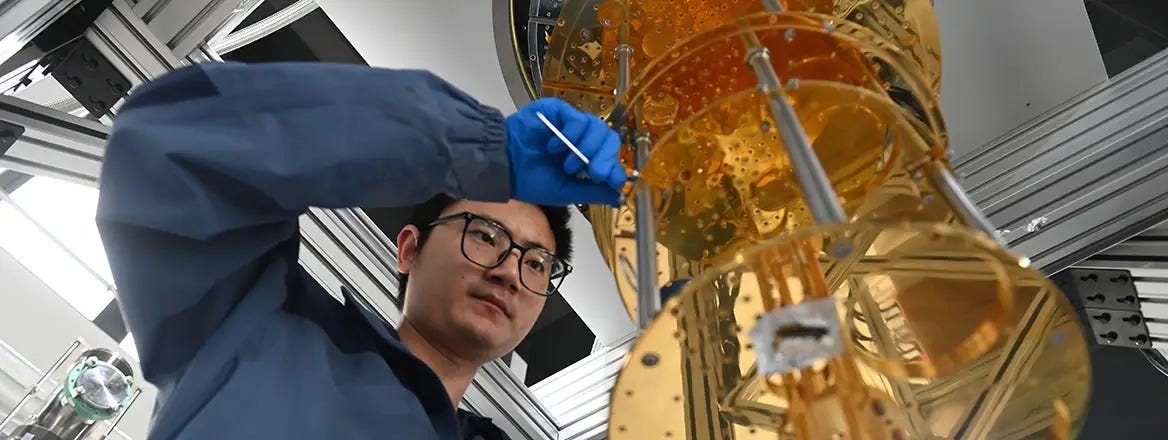
For instance, the superconducting modalities we were talking about — the computers that companies like IBM and Google are building — require those super shiny, chandelier-like dilution refrigerators usually portrayed in the media whenever there’s a quantum piece published. You can dig further into what it takes to make those refrigerators. For photonic computer modalities, some subcomponents also require cryogenic temperatures, but not low enough to require a dilution refrigerator. That leads to other complications, which we can talk about.
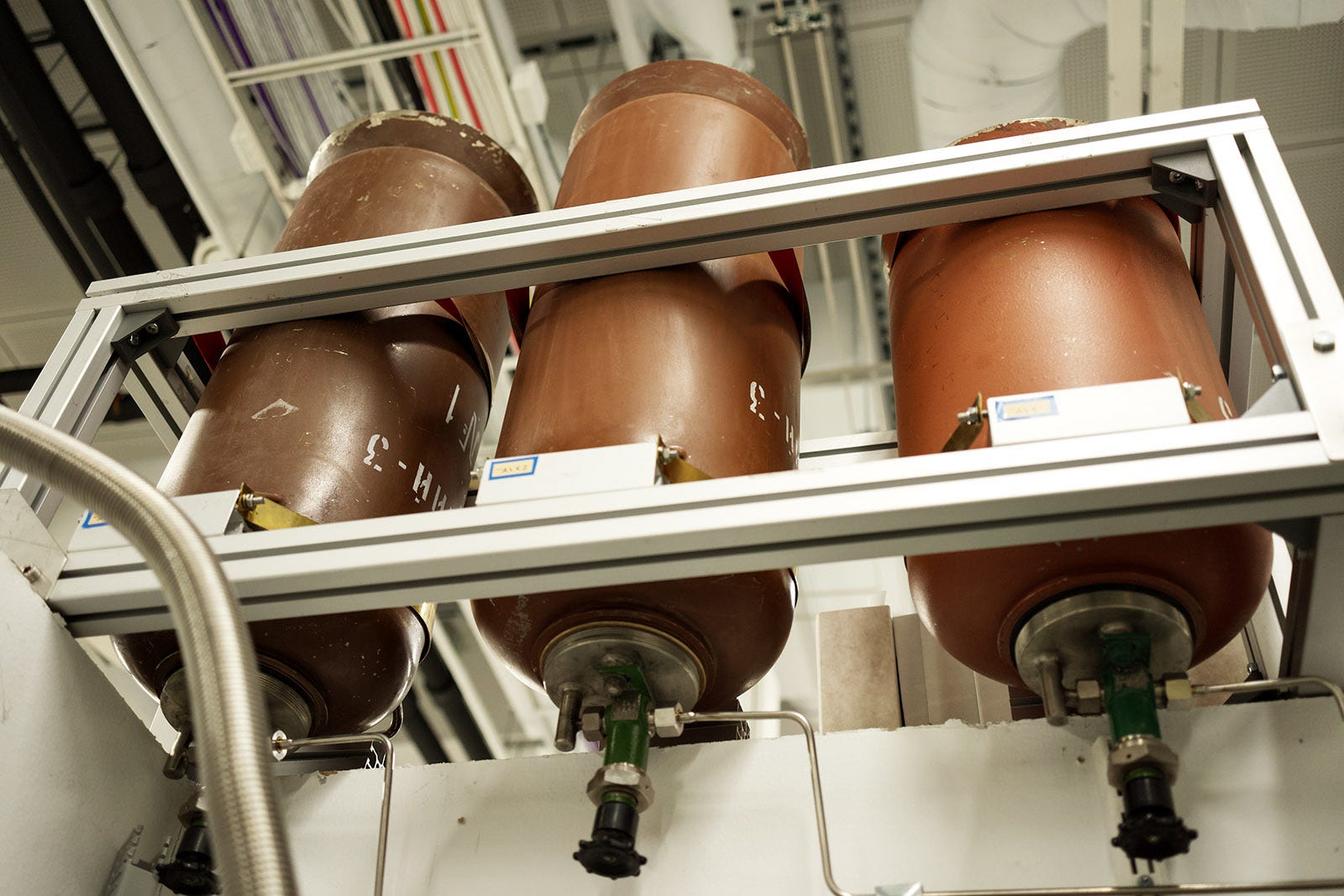
In the dilution refrigerator camp, there are a few different issues, starting from the fact that they use — and this is perhaps more well known — helium-3 as part of their cooling approach. Helium-3 is an extremely rare and highly regulated isotope that you can’t simply build or supply on demand. It comes as a sub-product of nuclear processes. That seems to be an area where, if you start developing machines at scale and you need to access a supply of helium-3, you could find a choke point.
Jordan Schneider: But there is some on the moon, right?
Constanza Vidal Bustamante: I don’t think it’s questionable that there is helium-3 on the moon. The question is whether it’s ever going to be feasible to extract it. Zach, you’ve looked more deeply into this. Maybe you can join me on the lunar sourcing option.
Jordan Schneider: Look, if we’re going to put data centers up there, I feel like a little bit of helium...
Chris Miller: Let’s step back and say what a dilution refrigerator is, and how they actually work, before we get to the moon?
Jordan Schneider: Okay, it’s a teaser.
Chris Miller: Before we get to the moon, walk us through how these machines work. We’re getting as cold as outer space. What does it take to make a machine that makes things that cold?
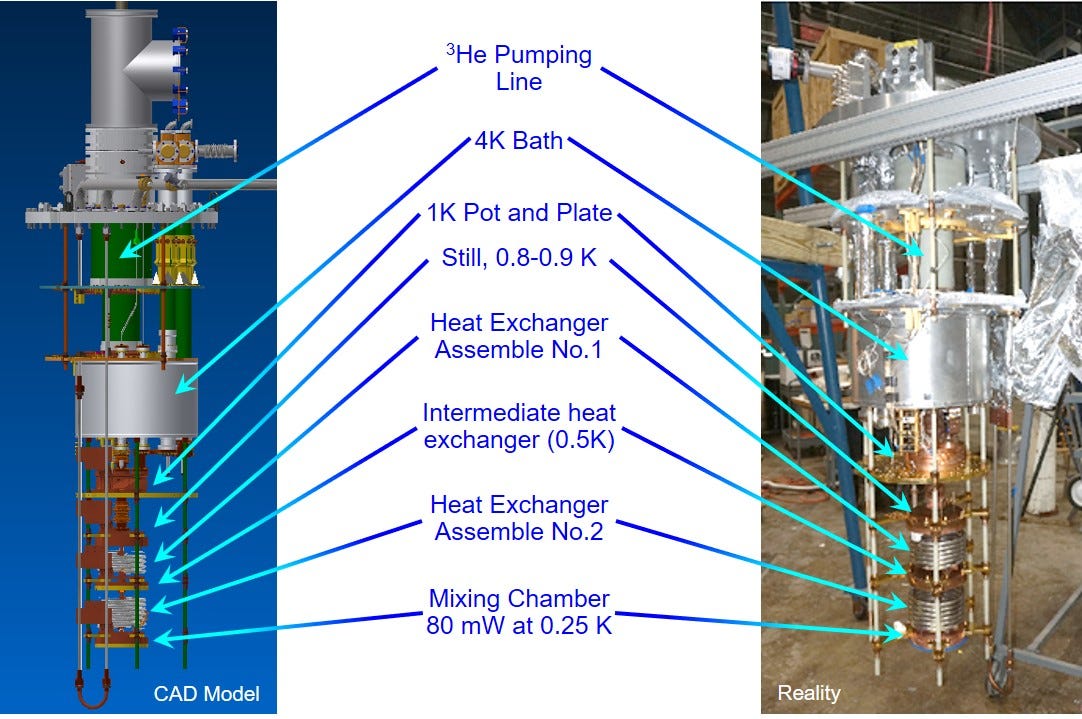
Constanza Vidal Bustamante: At a high level, they take several different stages to get there. You don’t go from ambient temperature directly to extreme, colder-than-outer-space temperatures. If you look inside one of these chandeliers, they have several cooling stages that step down progressively. It goes down to maybe 4 to 10 Kelvin first, and then continues down. The bottom is the coolest stage, where you place the quantum chips for superconducting or semiconducting spin modalities of computers. That’s the actual coolest part — the part colder than outer space.
To achieve this, you require a combination of helium-3 and helium-4. Helium-4 is not really a source of concern. It’s the most common helium isotope, so it’s not a supply bottleneck I’m aware of. But the helium-3 part of the mixture is the absolutely necessary element to get you to the millikelvin temperatures these systems require.
Zachary Yerushalmi: The whole point of building a quantum computer — and why it’s hard — is that these quantum states are incredibly fragile. They get messed with by everything. Heat messes with them. The wider environment messes with them. Cosmic rays mess with them. Looking at them messes with them. That’s the whole point of quantum mechanics.
What you have to do is isolate these quantum states from absolutely everything. The most effective way to do that is to get them wildly small and wildly cold. When you get them wildly small, a different type of physics takes over that enables you to manipulate these systems in such a way that you can do useful calculations.
On the helium-3 side, this is one of those things where I really wish a quantum computer made going to the moon economically viable. The sad thing, particularly for America, is that the major supply of helium-3 is tritium decay from the nuclear stockpile. As long as we don’t go nuclear-free in the US, from most of the calculations I’ve seen, we should be okay.
That said, access to these systems — not just ones today, but ones that actually enable that scale — is critical. There are three credible suppliers in the West that can supply these — Bluefors, Oxford Instruments (which just got bought by another company), and Maybell in the US. It’s that hard — there are only three companies, and really only two of them are credibly there at scale.
China went from having none to, just in the last couple of years, creating more companies building these systems than the rest of the world combined. They went from not publishing in this space at all to dominating over 50% of the publications on new innovation in this area. It takes decades to get good at this. Folks are coming up the chain very quickly in places where the Finns will share their dilution refrigerator IP with us. China is not going to do that.
Constanza Vidal Bustamante: To Zach’s point about China announcing all these different manufacturers of dilution refrigerators, some people point to the export controls that the United States, along with several other international partners, put in place starting in 2020 and into early 2024. Within a year or so, this seems to have backfired. With those export controls — of which dilution refrigerators were importantly a part — you accelerated an ecosystem where China rapidly mobilized to procure their own systems and continue innovating on the computing front.
Chris Miller: I’d love to dig into that as well, but I’d like to go to helium first. Helium is on the moon, and we’re going to mine on the moon, maybe—but it also comes from the nuclear stockpile. Is this from civilian energy production, nuclear weapons, or a mix of both?
Zachary Yerushalmi: Nuclear weapons. Tritium decay. That’s the majority of the source. You can get it from a couple of other places. Evidently, Canada has loads of helium-3 randomly stored away.
The reason there’s lots of helium-3 on the moon is that cosmic radiation strips away helium-4 and converts it to helium-3. Unfortunately, you need to launch a rocket there, harvest it, and bring it back. The only economically viable use of lunar helium-3, from what I understand, is if you need to go to Mars and build quantum computers. You launch off from Cape Canaveral, get to the moon, and if you’re still going with Elon Musk on board, then you have an awesome business. But if we’re focused on the helium-3 supply for the US and keeping it tertiary, I’ve heard a bit of skepticism around lunar mining. I’m bummed, but sadly, we are where we are.
Export Controls Backfiring?
Chris Miller: We know that things like dilution refrigerators are hard to make — which is why there are a small number of companies, and you need to mine helium on the moon or do something comparably difficult. On the other hand, there’s an argument that the export controls the US and Europe put in place on dilution refrigerators a couple of years ago spurred this brand new industry in China. That suggests it wasn’t actually that hard, or at least that the response happened pretty quickly.
Help us understand how we should think about this case study. Does it tell us anything broader about the relevance of export controls in the quantum computing space?
Constanza Vidal Bustamante: It really depends on the specific inputs we’re talking about and the timelines related to the volumes at which you need them. What Zach was perhaps trying to say is that we shouldn’t worry too much about helium-3 in the near term. At the rate we’re building refrigerators and the rate they’re being purchased and acquired, we’ll likely be fine for the next few years. Luckily, the US has a big source for that, so we’re in a privileged position as the provider for much of the world.

But going back to what we were saying earlier about the next-generation supply chain — as we start scaling these systems, you no longer have just one chip to cool. You start building machines that require what becomes almost a side problem of cryogenics — how much dilution refrigerators can scale to support much bigger qubit counts. Once you have a lot of demand for many large systems, I start worrying about whether the sourcing of helium-3 or the refrigerators themselves can keep pace with that demand.
Going back to the China example — I don’t think they’re building these machines at volume yet. It certainly doesn’t seem to be the case that they’re selling these machines beyond procuring them for their own experimentation within their top-level academic research labs — those at the frontier of hardware development for quantum computing. They were able to develop these machines for maybe one or two systems, possibly more, but definitely not in the hundreds yet. They made enough to continue progressing on prototyping and iterating, but I wouldn’t say they’ve reached the level of Bluefors in Finland or Maybell in the US.
That points to a story where the controls accelerated their start in developing these machines in-house. Maybe they weren’t planning to build that domestic capacity quite as quickly, but they were pushed to do so by the controls. They haven’t yet reached the stage where they’ve equaled what Western companies can make, but they seem to be on that trajectory. You can still question whether it was the right time to put controls in place on those.
Zachary Yerushalmi: The China anecdote ultimately boils down to the stakes of this industrial competition — both how high they are and how different they are from other technology packages, because we are so early in that race.
The US actually has an incredible moat around semiconductors. That doesn’t mean we can sleep on it, but we’ve been doing that for decades. We have friends, partners, and allies all across the world. Because we haven’t built a fault-tolerant quantum system, a commercially useful quantum system, we don’t have the same moat. That means China gets the ability to leapfrog and reach near parity with the US on certain manufacturing capacity. As you add in friends and allies, it gets closer, but if you look forward, the stakes are big.
This also hints at something Constanza spoke to in the report. We need to rethink how we do the supply chain to get to real scale. If China is the country that comes up with the intellectual property on the core method to reach that scale — if they invent the kind of transistor of the scaled cryo system you need — then they will have an unfair manufacturing advantage. China is typically quite good at that. They’ll also have an unfair IP and understanding advantage on the key path you need.
We have to think differently here. If we just project forward the existing engineering design of these subscale systems, we will not have enough helium-3. That’s why we have to reinvent the systems that make these computers, the QPUs (quantum processing units), really small and actually get them to that temperature. We have to rethink that process. The country that innovates and locks that down — that holds the manufacturing intellectual property — will have an unfair advantage to win. We just don’t have the decades that we rest on as an advantage in semiconductors.
Constanza Vidal Bustamante: In the report, we elaborate on exactly this point. In the near term, the most advanced dilution refrigerators available on the market can host around a thousand qubits. If you want to get to machines requiring a million qubits or more (though qubit count isn’t the only metric to consider), the path we have right now is essentially to put together dozens of these dilution refrigerators.
But the scaling doesn’t quite work that way. As you add more qubits, at least for the superconducting modalities that would require them, you need cables to connect the qubits together, and that adds to the heat load. That makes the cooling less efficient. It’s not as simple as multiplying the refrigerator by X number. You need to do what Zach was saying — innovate so the cooling approach you’re taking is much more efficient at scale.
That’s where we’re seeing real activity. Maybell just put out a new system at APS this week. I haven’t looked into the details yet, but that’s where we need to focus a lot of attention, as Zach said, so we don’t get out-innovated in this space. Otherwise, it becomes much easier for countries like China to reach that scale before we do.
That’s the challenge. We need to focus both on the near-term supply chain to continue iterating and innovating, while keeping a very strong eye on what comes next. That’s where we will reap the most reward in terms of economic and security benefits from the utility of these large-scale machines.
Policy Recs for Quantum Success
Zachary Yerushalmi: If you could talk to policymakers and give them suggestions on what they can do — the policies, the tools they can adopt to give the US the best shot here — what comes to mind? What’s the strategy to win on supply chain?
Constanza Vidal Bustamante: This goes beyond cryogenics, which is the subject we’ve been discussing. The report tries to be comprehensive in its assessment of the problems, but the solutions we provided are preliminary and need a lot more fleshing out. Maybe I’ll do subsequent reports, putting much more detail into what the solutions could look like.
Broadly, for the cryogenics problem, we’re calling for intentional and targeted multi-year advanced R&D programs on cryogenics. Similar dynamics apply for highly precise laser systems and other optical components, where the systems we have right now work for the prototype machines we’re building, but we know we need to keep innovating to reach utility-scale machines.
This is an R&D tool, but it’s not just fundamental R&D. Given the race dynamic and the time-sensitive nature of this, it needs to be a dedicated, advanced R&D effort. Another big point that cuts across the report is bringing together the enabling technology manufacturers — in this case, the companies building dilution refrigerators — with the end users, the system integrators in the quantum world. We want the computing companies that will use these machines to co-design, where possible, getting down to the specific requirements these machines will have. That accelerates the process rather than just building and hoping the result will be useful.
I’m less worried in the cryogenics sector that this isn’t happening already, because the market for these machines beyond physics research or quantum computing isn’t that diversified. They’re definitely thinking about quantum as their primary sector and paying close attention to the requirements. But for other components with broader markets, you have to be very deliberate from the government perspective when setting up R&D programs to ensure the enabling technology manufacturers are closely aligned with the needs of the quantum end users.
Zachary Yerushalmi: I look at three levers. There’s supply — do I have the widget on the shelf when I need it? That’s the current widget. There’s innovation — do I have the support to skate to where the puck is going in the industry?
The last lever I think of is capabilities that exist in a market failure. The canonical case there is high-mix, low-volume fabs, like what you see in the semiconductor era. At the intermediate volumes you need, there’s an explicit market failure in running those fabs given their cost structure.
To make it specific, take the fab we have at Elevate. It costs about $40 million in capital equipment. Every year, because we focus on a particular level of TRL-ness, we hope and pray that we make about a million dollars a year on it. That sucks — no investor is going to give you $40 million and hope you make a million dollars a year. Governments have to think about supporting that long-term market failure in order to maintain that industrial capacity.
Constanza Vidal Bustamante: I focused on the R&D lever because it was most pertinent to what we were just discussing about next-generation cryogenics. In the report, however, we provide a menu of different policy actions that can be taken to support various elements of the supply chain, depending on the specificity of the issue at hand. Different problems—and different levels of maturity in the components or systems involved—will require different levels of support, and the federal government may be more or less well-suited to take action in each case.
There’s definitely no one-size-fits-all approach. The supply chain is so heterogeneous that it would be very surprising if any single intervention solved the entire problem. Some issues will require less federal activity than others. Helium-3 is a good example of where more intervention is warranted. It’s a highly regulated isotope, the private sector isn’t going to be the right actor here, and the solution can be as cleanly structured as having the isotope program under the Department of Energy take a close look at their inventories, set aside parts of that inventory for quantum needs, and do the right calculations for repurposing some of the helium-3 already in use. They could also think through some out-there ideas for new sources of helium-3, but in a deliberate way.
That’s a very specific example. Others require a completely different scale of investment — for instance, what’s needed to make some of our current foundries quantum-ready or quantum-grade. There you need to call on multiple actors to play a role. There’s a wide range of tools we can deploy depending on the specificity of the issue at hand.
Zachary Yerushalmi: My sense is that governments can either make markets or distort markets. Do you have a North Star or heuristic for when government intervention is needed and when you should let the market do its work? Big question, but it’s so pertinent here.
Constanza Vidal Bustamante: A big piece for me is not whether the private sector could eventually do it. It’s when you put all of this under a geostrategic, geopolitical race dynamic where it’s time-sensitive, you don’t want to wait. If you pressed me, I would say sure, let the market take care of it and figure out which modality is best. Whichever has the most manufacturable supply chain and relies the least on highly vulnerable items should be the one that wins.
But if we believe there’s a higher-priority objective — where we don’t want to be second to anybody, especially China — then we’re under a very different set of circumstances. Every day matters, and we want as many modalities as possible for the US to dominate. It’s not just about supporting whichever is most promising. Let’s say superconducting wins — we don’t have a great definition for what “winning” means, but say a superconducting machine is the first to break Shor’s algorithm, and it’s a US-based company. Even at that point, I wouldn’t call victory. I would still want the other modalities to dominate in their respective categories.
It’s very plausible that a different modality — say, photonic quantum computing in China—will also clear that bar, and they may have figured out a supply chain that’s more nimble, cheaper, and more cost-competitive. That would outshine the superconducting machine that the US got across the finish line first. The finish line is moving, so it’s all hands on deck. When you start thinking about those circumstances, there’s a big role for the government to serve as an accelerator of that market. That’s why I think of all of this in terms of a broad innovation and industrial policy portfolio — because that’s the scenario we’re in.
Zachary Yerushalmi: I love this point. Two things occur to me. First, if we got to vacuum tubes as a nation and said, “This works, this is good enough, down tools,” you’d miss out on the transistor. That was actually pretty important for scaling these systems. It’s a repeat game.
The thing I do worry about is that the stakes of getting policy wrong are wildly big. The example that comes to mind is China itself. There’s a technology area called quantum key distribution. We don’t need to get into the technology of it — folks can look it up online. It’s really cool math. Unfortunately, the math is so cool that if you do your postdoc on it, you just want to do that math all day, and you forget that it’s economically and cryptographically not all that secure.
Because the head of China’s quantum program, Pan Jianwei, is obsessed with this, he puts a wild amount of resources toward it—even though you can literally just look up “NSA QKD” and find intricate detail on why this whole thing is dumb. The upshot is that we need industrial policy because the competition is so intense, but it’s very easy to get wrong. We just hope our competitor gets it wrong more than we do.
China’s Quantum Approach
Chris Miller: On that point, someone recently made the following analogy to me: China has a Manhattan Project for quantum — one plan, one team, one system, and most of the ecosystem oriented around that particular pathway. Whereas in the US and the West, you have these different qubit modalities and different companies competing with each other, and as a result you have somewhat distinct supply chains.
Is that analogy true or false? And if so, who’s got the better strategy?
Constanza Vidal Bustamante: That analogy used to be true, but it’s changing rapidly. The comfortable narrative we had about China for a while was that they’re undoubtedly leading in communications. They’ve deployed large-scale infrastructure, optical fiber, and quantum key distribution systems to exchange keys in a supposedly tamper-free way. In addition to the fibre that they’d deployed over something like 10,000 kilometers in China, they also have some quantum satellite link demonstrations. It sounds very impressive.
But the assessment from the West was that even though they’re leading, at least in deployment of this technology, this isn’t a technology we care about or believe brings a lot of value. It’s a very narrow solution. It’s not a full cybersecurity system in the sense that you still need a lot of classical encryption and authentication systems for other parts of cybersecurity. Even for the piece it does cover, it’s not fully secure. You can hack it in different ways. China can take that piece, and we don’t care about it.
In computing, the narrative used to be that they’re catching up quickly, but, like Chris was saying, they’re really only putting a lot of their chips on superconducting. They’re moving quickly, and they’re impressive, and we should watch them, but they don’t have the diversity that we have. Just in the last year or two, however, we’re seeing a lot of startups appear in China, often led by prominent academics from Pan Jianwei’s group or others who lead quantum research in China across different modalities.
They announced two different neutral atom computing companies last year. They have some photonic ventures — a photonic company has been prominent for a while. They’re growing the number of superconducting ones. Recently, I read about even topological qubit developments. All of these are new companies. With the information we have, they’re probably not very close to matching the capabilities of the various computing modalities we have in the United States, but there’s definitely rapid movement. It’s not just that all of these are state-driven and therefore won’t be effective — these are coming out as private startups from highly talented folks.
We should worry about that. We shouldn’t just rest on our assumption that they’re limited in what they can do.
Zachary Yerushalmi: This is one of the many reasons I think Constanza’s report is literally a national security priority. The reason China can move up the chain so fast is that they’re so thoughtful in their approach to the supply chain. If you have the key components to manufacture all of these different modalities — all these approaches to building quantum computers — then regardless of what you learn about which approach is better, you can react quickly and deliver against it.
We spoke before about photonic integrated circuits, critical tools for scaling these systems. In the US, even for some of the biggest providers, because they don’t have access to the fabs and the supply chain to manufacture those, it can take 12 to 18 months to go from an idea like “I want this new PIC” to actually getting your PIC. In China, because they’ve really invested in this area — it’s used across many different applications in photonics and certain material systems — you can go from “that’s a cool idea” to having your PIC in literally two weeks.
A lock on the supply chain is a gift that keeps on giving, because you can be literally ten times as reactive and adaptive as your adversary. It’s like a supply chain OODA loop of sorts. Nobody has been attuned to this the way Constanza’s report has captured.
Constanza Vidal Bustamante: Two other things came to mind as we were speaking — one for China and one for the US.
For China, in addition to what I said earlier about prominent scientists starting their own companies across different computing modalities, what is true — and what Chris was alluding to in the Manhattan Project analogy — is that China has been deploying moonshot programs to a much greater degree than the United States has. This cuts across different levels of government. A lot of the provinces or local governments frequently launch moonshot programs where they say, “submissions accepted: by 2026, create a dilution refrigerator that can host a thousand qubits with these error rates.” Those targets are usually just matching the top performer of the West. The timelines are typically pretty crazy — within a year, you need to deliver this thing.
That might sound at first like it won’t work, but they do it frequently enough that eventually you get there. Maybe you get a thousand submissions of which 999 are bad, but one isn’t, and that one is successful. Even without highly talented folks running these programs, they have that forcing function of serving as a constant source of demand for these products. There’s some money attached, and even if it’s not substantial, it’s enough to get enough submissions that one of them might be good. I worry about that.
The counterpart in the United States is that even though we haven’t incorporated grand challenge or moonshot–style programs to the same degree — although that seems to be changing with this administration — what we do have are highly talented government folks who are so deep on the specifics that they can craft really thoughtful programs. I’m thinking here of DARPA, DOE, NIST. Programs that aim for the right level of requirements and have enough incentives attached. You don’t need a million programs like in China. You can have a few, but they’re very thoughtful, driven by people who really understand the science and the technology.
That’s an asset we have compared to everyone in the world. China is an easy counterpart, but even in Europe, you don’t have the same level of technical sophistication we have here. I worry a little bit about that changing in the last few years, but in general, we still have incredibly talented folks in government.
Zachary Yerushalmi: To dovetail with this, the reactivity in the Chinese academic sector is incredibly powerful. I was chatting a couple of weeks ago with a prominent quantum physicist. They were telling me about a paper they read on a new type of PIC. What had happened was that a Chinese group had a certain type of material system they were working on, and they had friends over at Columbia working on another type of material system. These were adjacent publications and approaches.
What this Chinese group did was look at the two approaches and ask, “What would you do if you could just put them together?” It turns out you get wildly better results. Their point was that in America, hitherto, you’d never do that, because the bureaucratic system around applying for grants is so intense that you couldn’t just say, “Let’s put these two material systems together.”
What I would call out with the new administration — and for all sorts of reasons, I don’t want to get political, but I’d say as a real positive — is that when you look at Deputy Secretary Dabbar and Undersecretary Gil, they get that, and they’re really driving toward a totally new paradigm. You can say, “That material system is cool, that material system is cool — let’s drive this thing and see what new innovation you can do.” You don’t have to spend new money. You just have to move fast and be creative, and they’re going for it.
Chris Miller: Constanza, lasers — critical for quantum computing. Tell us where they’re made today and how they should be scaled up.
Constanza Vidal Bustamante: In the report, we cover them in this big category of photonics and optics. Lasers are part of that and are the star of the show, but definitely not the only component to watch. They affect different modalities differently. When you think about the main subcategories we cover — solid-state superconducting and semiconducting modalities, atomic ones, and photonic ones — lasers matter most for the photonic and atomic modalities.
It’s not as simple as one laser. You need multiple lasers doing very different things. Take the atomic modalities — neutral atoms or trapped ions. You need different kinds of lasers to cool the atoms. Instead of a cryogenic system, you use a laser system. When you shine the laser beam on the atoms, you bring them down to ultra-cold temperatures so you can manipulate them. Then you have different lasers to elicit different energy transitions, and other lasers to read out the effects. It’s a chain of lasers.
What they share in common is that they’re all highly specified to the specific wavelengths you need to hit, and they need to be extremely stable in those wavelengths to maintain the frequencies that make them usable for these computations. It’s not just one laser, and it’s not just lasers. You need all these optical components to route the light, change directions, change the frequency — maybe double it — various lenses to focus the light, and so on. There are a lot of subsystems involved.
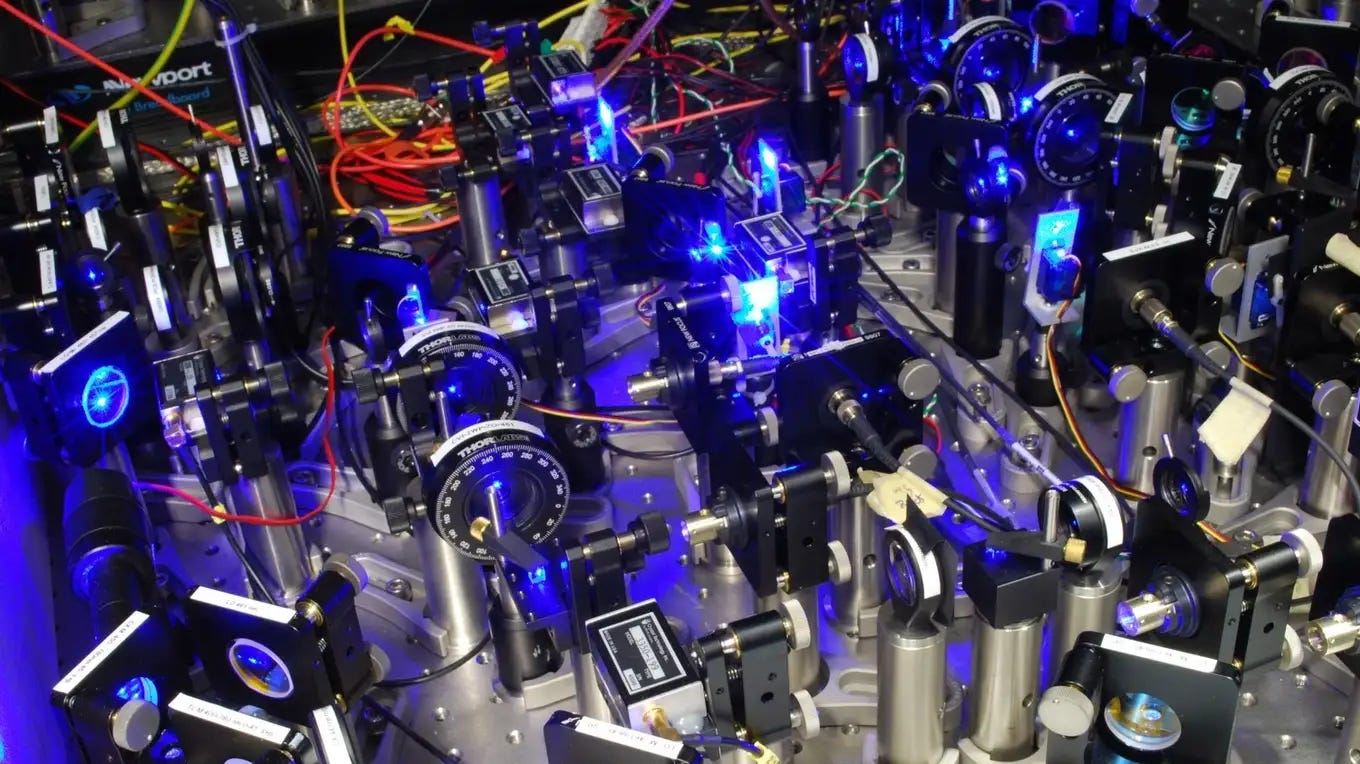
The supply chains are also complicated because they’re all different things. The lasers we cover with the highest priority in the report mostly come from companies in Japan, Europe, and China.
There’s an interesting case study we cover in the report. A provider appeared in China that started manufacturing lasers essentially identical to those of a Danish company — but at a much cheaper price. There has been a lot of behind-the-scenes discussion over whether this was reverse engineered, and this Chinese company is well documented to receive government subsidies. There’s a seemingly clear story of what happened. Nevertheless, they’ve become a very important provider of lasers in the US ecosystem to this day.
What’s especially baffling is that even with the tariffs that have impacted everything, including the quantum industry, you can still call for an R&D exemption for those lasers. Those are still being purchased to this day by companies and universities that can claim an R&D exemption. They have a good product going. It’s price competitive, they apparently deliver reliably, and so it has become the preferred laser system for many organizations.
Zachary Yerushalmi: This point on price is a really big deal. It’s seen both in lasers and on the cryogenic side. There are key components like wiring trees, which you need to operate dilution refrigerators. For most experimental setups, you need a new wiring tree. The cost of a Chinese-produced wiring tree is literally one-tenth of the US equivalent — even after tariffs and all that. I’d imagine similarly so on the photonics.
When you look at the photonics side, like cryogenics, there are only two credible laser providers for quantum systems in the US — Vector Atomic and Vescent. Only two. They’re still medium-sized companies despite their headcount, and they have amazing teams. The criticality is not just that if China underpins them, prevents them from scaling, and undermines their ability to innovate — that’s a real big deal. But even more near-term, these laser systems are used for quantum sensors.
Quantum sensors — going back to the report — covers how the very thing that makes a quantum computer hard to build is what makes these amazing sensors at a unit level that can transform our world. One example is providing navigation without reliance on a GPS uplink, which, as we’ve learned in the conflict with Iran, and as we knew long before, is a really big deal. The same laser systems play in.
Should We Ban Chinese Components?
Chris Miller: China’s producing components for a tenth the cost of Western firms. We’ve seen this far outside of quantum, in many other spheres. We’re at this point where, as you’re saying, we’re going to have a dramatic scale-up over the next half decade or decade in the number of these components, as we build bigger and more capable computers.
Option one would be to subsidize Western producers tenfold so the price equalizes — that seems expensive. Option two, ban Chinese components from our quantum systems, but then you have higher prices. What should we be doing here? And should we be banning Chinese components from our quantum computers?
Constanza Vidal Bustamante: This will not be well taken among the quantum industry, but I do think we should not let this product continue entering the US market. That said, there are lots of considerations. I’m so glad Zach brought up the sensors, because that’s a much nearer-term market that will require these laser systems and various optical components at scale, much sooner than quantum computing. It becomes a real near-term bottleneck.
In terms of options, I think it’s both. We call in the report for some kind of subsidies, but really more like strategic financing or tax breaks. If you think about the supply chains of the lasers, some are dependent on foreign suppliers, including for some of the tooling needed to build them, often from Europe. Part of the solution is to provide some support for domestic suppliers while making it harder for Chinese products to take over the market, given that they may have used illegitimate ways of obtaining or accessing the IP that led to those products and have received substantial subsidies from the CCP.
Chris Miller: Suppose we go down the path of banning Chinese components from quantum computers. You get into a similar set of questions as if you said to a lot of people in Washington, “Let’s ban Chinese components from our AI data centers.” People often, at first glance, say, “Great idea.” Then you say, “Well, wait a minute—what about the screws? What about the light bulbs?” Where do you draw the line? Help us understand how to think about drawing lines in quantum computing.
Constanza Vidal Bustamante: That’s an excellent question. It’s hard to have an easy solution. Even if you stop the import of some of these devices or inputs overnight, that can lead to a lot of problems in our own ecosystem and our ability to keep innovating across broader products.
To your point about all these other sub-components —should we also block those? Is that worth blocking? There are layers of complexity. The inputs that require sophistication and that have the value we care most about are the ones we should bring in-house. In this case, for the lasers, we have some domestic suppliers. We have the talent. We have a path to get there with really good products that are having difficulty because they’re encountering anti-competitive practices.
Those lasers will be useful across different quantum technologies — sensors, computers, and to some degree networking too. They also serve beyond quantum — telecom and various defense needs. That makes them strategic enough as an enabling technology that I’d want to preserve our domestic capabilities. Compared to much simpler inputs to the inputs, that’s where I draw a distinction. I don’t have a super clear line in the sand, but that’s broadly how I think about it.
Zachary Yerushalmi: Take the wiring tree. If we say no Chinese wiring trees, that means for some groups, they can buy ten times fewer wiring trees, which means they do ten times fewer experimental runs. It’s not exactly linear, but it would act immediately as a hindrance on our ability to innovate. There are real trade-offs.
What I’m more clear on is the end state we aim for, which is some mix of three things. First, access — is the widget on the shelf? Second, security — particularly for end-stage products, do we know where that supply chain is, so that China isn’t putting a little microchip into the thing to listen to our experiments, or some Stuxnet-style attack? Third, can we continue to out-innovate?
Out-innovating is a lot more reliant — maybe even more than on price — on the speed at which you can get the widget. For a lot of these systems, you don’t require new fundamental physics — you just require being able to run through ideas quickly. There’s a separate learning that comes with that, around how you get to scale.
If you can balance these different priorities — using iteration speed as a proxy for staying innovative at every stage of a technology cycle — I think we’ll be in a good place. There are lots of different ways to skin a cat. We just have to be mindful of those trade-offs.
Constanza Vidal Bustamante: Another key aspect, related to what we were just saying about how many layers down you go. A big point we make in the report is the category of specialized materials. These are the ultimate substrate you need to actually build many of the components — for instance, the photonic integrated circuits we were talking about. Even some of the bulkier lasers rely on highly specialized photonic materials, including wafers that you process to make into devices. Some of those are sourced single-source from China right now.
That’s another concern. It’s not the laser itself, or the optical or photonic component itself, but the raw material you need to build it. If you don’t have access to that, you can go upstream in the innovation chain.
Zachary Yerushalmi: There’s a law that the second you create a metric, it ceases to be useful. The thing that comes to mind is — if you focus on whole product systems and ask, “How long does it take to go from initial design to inception of the product?” and you try to reduce that as much as possible, then you identify the requisite bottlenecks that you need to prioritize for investment.
You can do that for non-national security tech and just allow the component tree from anywhere. But then you have to apply a separate lens of national security, where you probably don’t want a certain chip coming from a certain place that’s not the US. Look at the lead time for that. If you compare these two lead times and try to ruthlessly bring them down — in a general sense, but also compared to your adversaries — you have a bit of a North Star: how are we doing, where do we prioritize, what do we do next? I hold that pretty lightly. You’ve been thinking about this more, but that’s where my silly bad supply-chain brain goes.
Comparing Stress Levels
Jordan Schneider: Constanza, you did your PhD thesis on managing people’s stress over time. As you talk to all these people in the quantum supply ecosystem, what’s their stress level? Are they like, “I’ve got exams in a week”? Or are they feeling good?
Constanza Vidal Bustamante: Oh my gosh, what an honor that you went back into my history. I guess it hasn’t been that long.
In talking to the quantum folks, there’s a lot of excitement, but also a lot of uncertainty. Obviously, I approach this from a policy perspective. There’s a lot of enthusiasm from the administration and Congress to do something big on quantum and to build on the foundations of the National Quantum Initiative, which came out during the first Trump administration, and the National Quantum Initiative Act, which solidified that and provided funding mechanisms for specific programs at different agencies. There’s a lot of expectation, but also a little bit of fear about what will actually happen. The stress levels are real.
All of these companies have a lot of pressure to deliver on these machines by the roadmaps they swore by. They’ve all been claiming they’ll start delivering utility-scale machines by the end of the decade, and the clock is ticking. Some have been more aggressive than others about what they’ll deliver, so there’s a lot of expectation about whether they’ll come through. If they don’t, there’s worry about what will happen to the field. Even if a competitor firm fails, will that lead to a generalized lack of confidence that brings down private capital writ large? There’s a lot of fear about what will happen, and a lot of pressure they’re feeling right now.
Jordan Schneider: Can you compare that to the semiconductor community? You’ve also done research interacting with them. I don’t think the chips folks are worried that chips won’t be a thing in five years. What anthropological differences have you picked up on?
Constanza Vidal Bustamante: That’s such a great question. It’s a very different environment. At the same time, there’s an incentive to present quantum as being as close to the semiconductor industry as possible — to give the idea that we have a path to manufacturability, or to build on top of the CHIPS Act or the CHIPS and Science Act energy and come up with this big industrial moment, as I called it in the report.
What’s interesting is that compared to the semiconductor industry, you have all these different modalities, with apparently close to 90 companies now building quantum hardware across various modalities. That’s so different from the semiconductor industry. It leads to all sorts of competition among them over who has the best qubit and why the others are inferior. It’s funny to hear — everyone will tell you endlessly why you should support their qubit modality and why they have the right one going.
Jordan Schneider: That was really my big takeaway from my little quantum journey over the past few weeks. In the semiconductor industry, things are consolidated. You have two EDA players, a handful of people making photomasks, and one company making EUV machines. It’s been that way for a pretty long time, and it’s probably going to stay that way. Maybe you’ll have an entrant here or there on the design side, but the entire industry is pulling in basically one direction, with everyone trying to capture an extra 10 or 20 percent of where they sit in the supply chain.
When you walk through the quantum stack, everyone’s using more or less the same ingredients to varying extents, but what the computer is going to look like is totally up for grabs. It’s not like Game of Thrones with six or seven royal houses — there are 90 different little empires competing for the prize.
Constanza Vidal Bustamante: That’s right. We’ll see how many survive, and what diversity survives. We didn’t even get to this, but even within a modality, there are different ways to build your architecture. There’s a lot there.
Zachary Yerushalmi: My mental model for quantum is biotech. When you’re trying to cure cancer, you have small molecules, CAR-T, antibodies, immunotherapies — all these different approaches trying to address something out there, which is a kind of unified target.
In other domains, we’ve figured out how to take hardcore fundamental science and mature it to impact our lives, even when there are many different approaches. That’s a slightly different mental model from semiconductors, but it doesn’t mean it can’t exist.
One of the 50 reasons I’m so excited that Jordan is covering this, that Chris is super attuned to it, and that Constanza writes these seminal reports, is that folks have spent decades from different perspectives asking, “How do we get biotech right?” Public policy folks have a frame of reference around biotech. Public finance folks understand it. Doctors understand it. Physicists understand it. In quantum, that hasn’t happened yet. We haven’t had proper academic rigor across the disciplines.
I really don’t think we’ll get this right unless we bring that interdisciplinary best practice now, at this stage. I’m super stoked for more.
Jordan Schneider: All right, kids, shout out to Zach and Constanza. I’m sure they’ll find some work for you. This was a pleasure.
This reminds me of Neal Stephenson’s Polostan - not as direct analogy but as reminder that strategic technologies have a deep prehistory. Before the bomb was an object, there was already this invisible world of think tanks, labs, spies, and industrial capacity taking shape. Seems like a similar moment with quantum: the decisive asset isn't the machine yet, but the surrounding ecology of untested policy, lasers, cryogenics, and foundries.
The discussion here on the 'foundry gap' and the struggle to move from lab to fab really highlights that. I just wonder if this frontier-industrial frame needs more skepticism. There’s a recurring American temptation to turn these moments into 'heroic builder' stories (like HH Harriman/Musk style of necessary acceleration).
Thinking Tim Weiner’s The Mission feels like relevant counterweight here - that is, national security institutions often start with a need to know the world, but under pressure, they slide toward acting on it by justifying that slide through urgency. The real policy question is how to win the race without letting the 'race' become its own justification.
The chip industry story and the quantum story have the same underlying logic: early-stage hardware that nobody knows how to manufacture at scale ends up defining who leads in the next technological era — usually decades later. The lesson from semiconductors (which took from the 1950s through the 1980s to mature into a geopolitical battleground) seems directly applicable here. The countries building out the fabrication and supply chain infrastructure now are likely to have an enormous and durable advantage later, even if the advantage isn’t visible yet.