
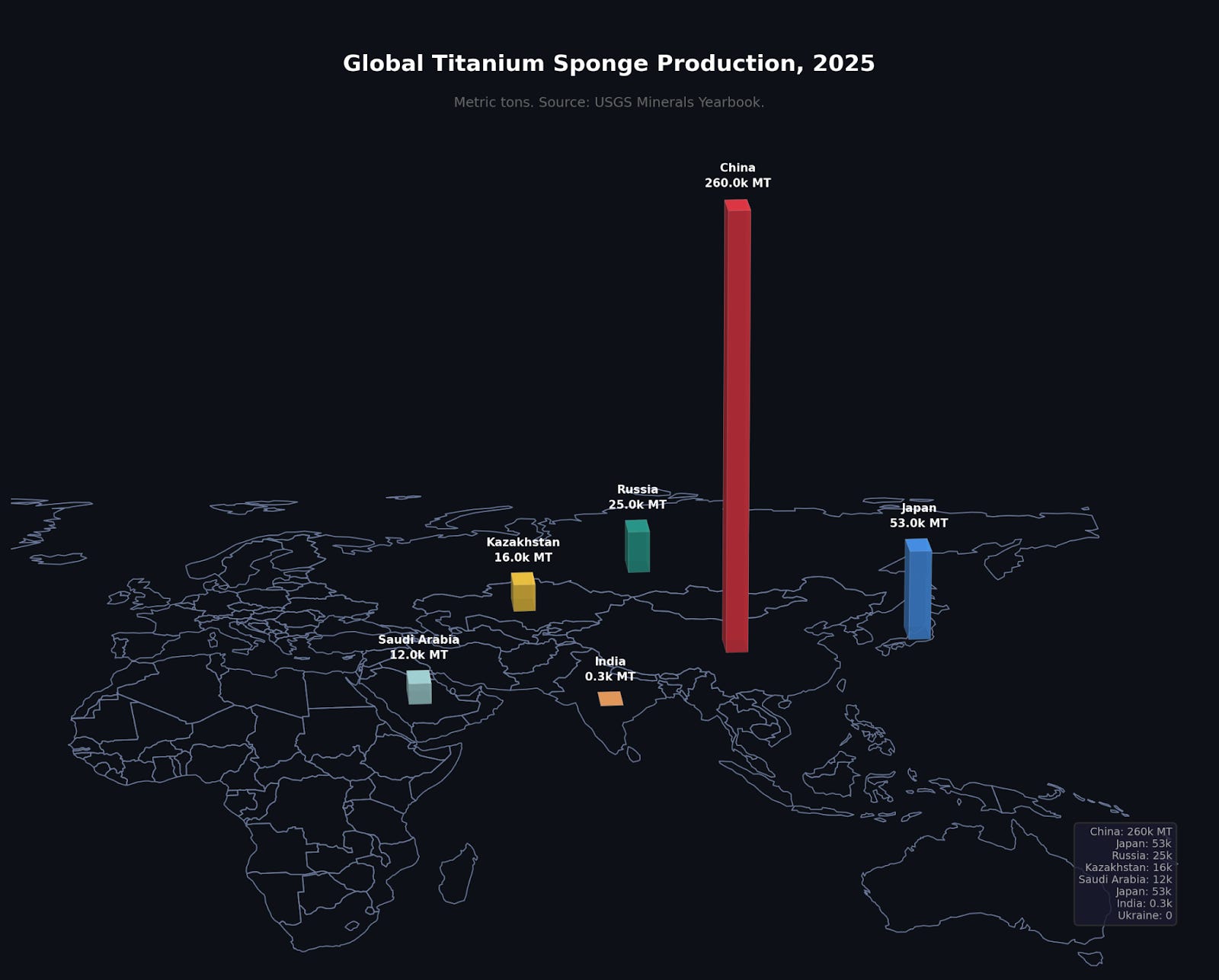
Titanium! Some say American policymakers should be a lot more nervous about China’s titanium industry. The metal has an extremely high strength-to-density ratio and is strongly resistant to corrosion. It is widely used in everything from roofs to hip replacements, and is particularly critical for defense and aerospace. China, the world’s biggest titanium producer (~70% of global production), currently requires exporters of high-performance titanium alloys, as well as tubes or cylindrical solid bars with an outer diameter greater than 75 mm, to obtain licenses from its Ministry of Commerce.
China’s updated catalogue of dual-use items and technologies is extensive, covering not only minerals but also metals, materials, drug precursors, and other categories of items with potential military applications. Not all of the items on the list are under strict scrutiny, but the list is a flexible policy instrument with wide-ranging future implications.
Are the concerns justified? It depends on who you ask, and we will get to that in Section 3. But first, let’s understand what titanium is and why it is valuable.
Titanium is the ninth-most-abundant element in the Earth’s crust. Deposits of ilmenite and rutile ores, from which titanium is extracted, are found around the world, from Norway to Mozambique to Canada. How did China even become the world’s biggest titanium exporter? Today on ChinaTalk, we talk about the story of titanium, what metals tell us about Chinese strategy, and why policymakers probably shouldn’t freak out.
History of Chinese titanium
“There are 64 nonferrous metals and we can’t do without them.” 64种有色金属,没有它不行。 — Mao Zedong, 19581
Nonferrous metals do not contain iron in appreciable amounts. They are usually lighter, more conductive, and resistant to corrosion. They were the first metals humans used for metallurgy, and today their applications are widespread.
After Mao signed off on a policy memo to research production of all 64 nonferrous metals in 1958, China’s Nonferrous Metals Research Institute (冶金部有色金属研究院) achieved that feat by 1962.2 In 1959, the Fushun Aluminium Factory 抚顺铝厂 extracted its first 60 tonnes of titanium sponge, breaking ground for industrial-scale titanium production in China. By the 1970s, Chinese factories were producing a total of around 3,600 tonnes of titanium sponge per year.
Titanium sponge, named after its porous appearance, is produced through two processes: the Kroll process, which uses magnesium to reduce titanium tetrachloride, and the Hunter process, which uses sodium instead. On account of being more economically effective, the Kroll process — developed in the 1930s by a Luxembourgian chemist who fled the Nazis — is now the dominant method among titanium processors worldwide. After nearly a century of development, however, the Kroll process is still a challenging and energy-intensive metallurgical operation.
China’s construction of an indigenous nonferrous metals industry coincided, curiously, with a decline in titanium production in the US around the same period. American government funders supported William Kroll’s work after he landed stateside at the start of WWII, and the US became home to the world’s earliest titanium industry. Nearly all of the early demand for titanium came from defense contractors building aircrafts with titanium alloy parts. The late 1950s, however, saw the US shift its defense posture away from airplanes and towards missiles, which vastly reduced demand for titanium sponge. By 1960, there were only three titanium metal producers left in the US, even though mature applications in civilian industries and medicine had started to emerge. Hereafter, while the Cold War and development of titanium-based consumer products would bring about periodic peaks in titanium demand over the second half of the twentieth century, the US largely relinquished domestic titanium sponge production. Today, it is the world’s largest titanium importer.
Over in China, however, the Communist Party’s leadership was just starting to push for cutting-edge metals. Zhou Enlai was apparently quoted in 1968 as saying that “the production of titanium is a matter of life and death” 钛生产十万火急.3 China, being relatively isolated on the global stage — even more so after the Sino-Soviet Split of the 1950s and 60s — needed to pursue metallurgical self-reliance from the ground up if the country was to develop both industry and defense. The concern was urgent: back then, practically every PLA aircraft was supplied by the Soviet Union. (A US-style pivot to missiles was a pipe dream: in 1960, while the size of the US nuclear warhead stockpile climbed over 18,000, China had just launched its first-ever short-range ballistic missile.) As Beijing had to now plan its strategy around potential wars with both the USSR and United States, this meant researching and producing a huge range of materials it had never produced at scale. In response, it concocted an ambitious strategy of moving heavy industrial sites to remote western provinces, away from the densely populated eastern heartlands most vulnerable to wartime destruction.4
China’s titanium industry landscape
The story of titanium in China became one of two western cities: Panzhihua (攀枝花) and Baoji (宝鸡). Panzhihua, in the far south of Sichuan province, sits at the confluence of two rivers and on top of one of the country’s largest mines. Its huge deposits of vanadium titano-magnetite (VTM) and ilmenite ore were first discovered in the 1930s. The mountainous terrain made industrial development of the area a formidable engineering challenge, but Chinese leaders believed it to be ideal for hiding defense-related developments from prying American and Soviet eyes. Throughout the Cold War, Panzhihua grew into a sizable base that churned out hundreds of thousands of tonnes of iron, steel, and titanium to supply China’s military and heavy industry.
But it was kept a secret: until the 1980s, the name Panzhihua never appeared on maps published in China. Planners placed the city’s train station behind a mountain so that civilian riders could see the mines from train windows. Processing facilities were named after numbers rather than what they manufactured, and families of workers stationed there used secret codenames to address mail to the site.


Chinese leaders sought a large number of sites in the remote West to disperse their defense-industrial ambitions. Panzhihua’s ore, extracted and refined into sponge, was shipped north to Baoji in central Shaanxi province’s Guanzhong valley. Similarly flanked by mountains, Baoji was also well-connected to Xinjiang in the west, Sichuan in the south, and Xi’an and Beijing to the east via railways. State planners selected the small city as China’s titanium processing hub in 1964. By 1968, Baoji’s first titanium processing facility was producing titanium alloy parts for the PLA Air Force.
Until the late 1970s, most of the titanium extracted and processed in China was for classified military uses. Civilian applications emerged slowly over the 1980s and 1990s. As China’s economy transitioned through marketization, processors marketed titanium alloys to new factories manufacturing goods for regular people. Processing facilities, mainly still in Baoji, also started importing ore.
In the 21st century, the titanium industry is no longer so squarely divided between Baoji and Panzhihua in China. Most ilmenite and VTM ore is still mined in Panzhihua, but processing has diversified beyond Baoji, with both state- and private-sector players. Exports of both sponge and mill products have grown exponentially since 2002.
Contextualizing China’s dominance
All this context explains why China pursued — and managed to achieve — self-reliance in titanium, and eventually came to lead the global market through economies of scale. However, it doesn’t answer the question of why China started producing exponentially more titanium nearly every year since the mid-2010s:
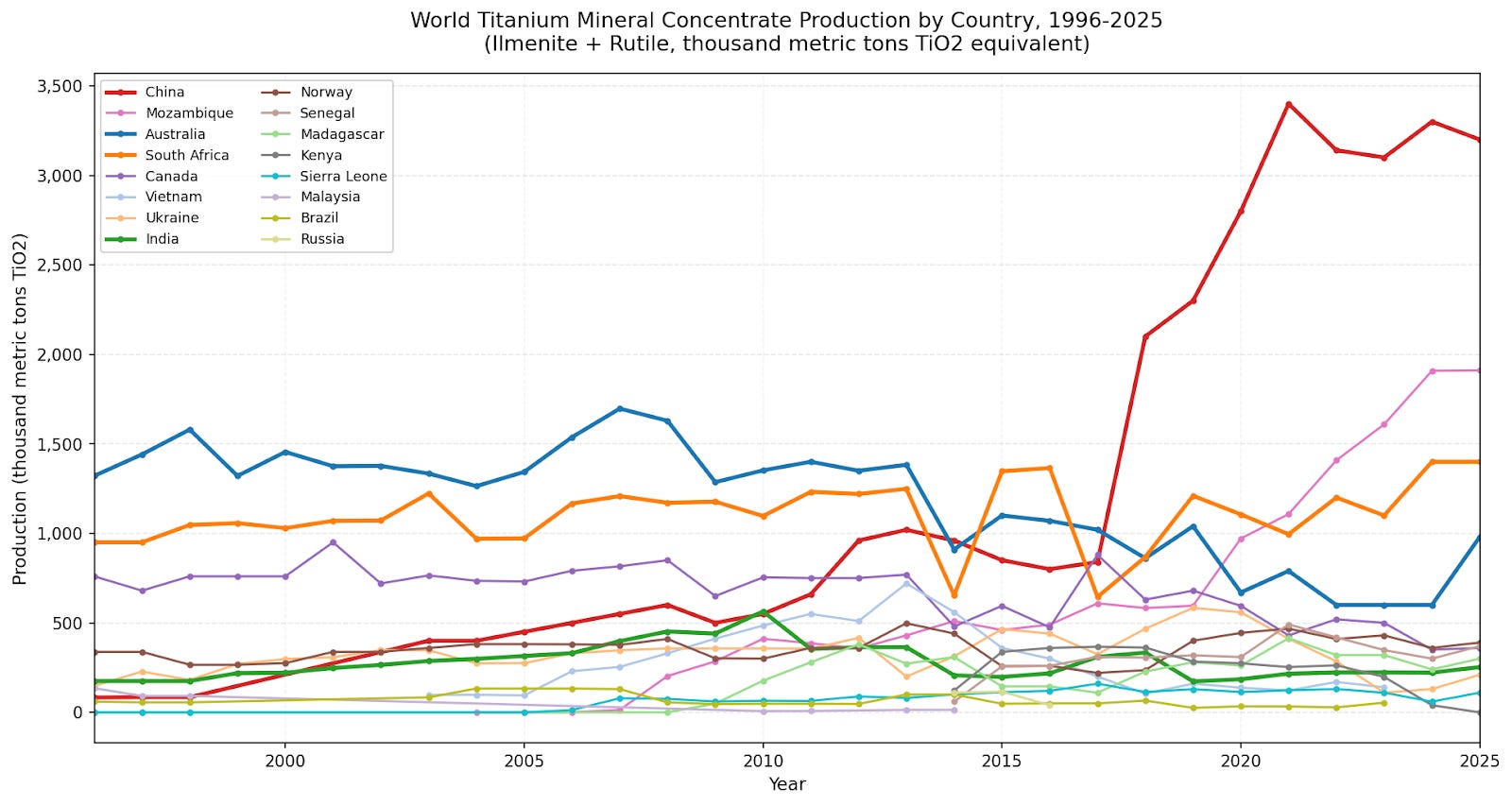
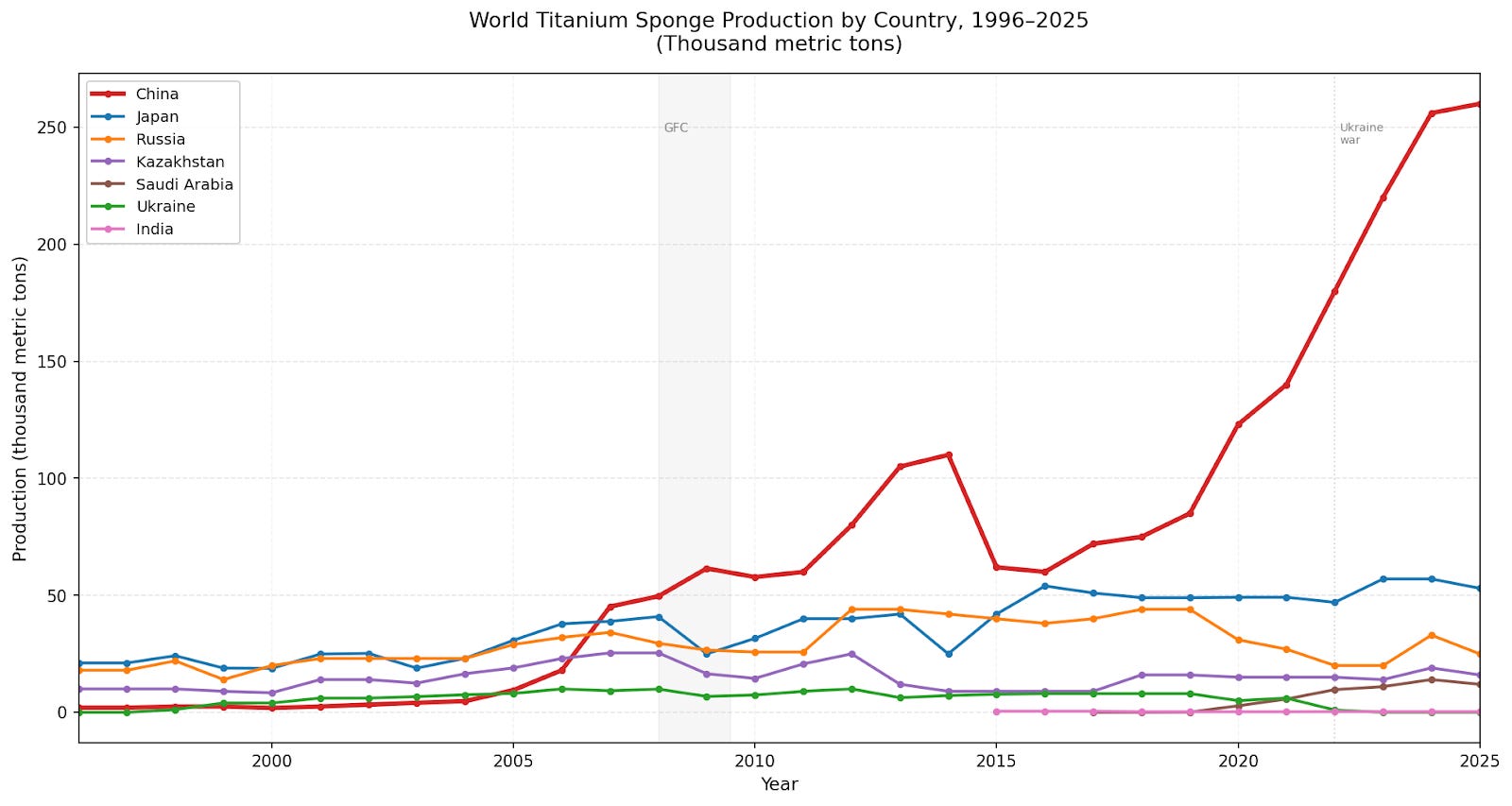
Two downstream industries help explain titanium’s boom-and-bust cycles and newfound ascendance in China: construction and aerospace. Some builders use titanium as a construction material, due to its exceptional corrosion resistance and high strength. Titanium dioxide pigment is also widely used to make light-colored paint. Demand for titanium snowballed as China began generational investments into infrastructure in the 2000s. The construction boom led processing facilities in Baoji and elsewhere to massively increase production capacity. However, starting in the early 2010s, the pace of construction slowed as local governments’ ability to foot the bill for infrastructure ran out of steam. Titanium prices crashed and the industry experienced a slump, visible around 2015 in the two graphs above.

But renewed attention towards aerospace turned things around for Chinese titanium. Xi Jinping’s consolidation of power in government and the military allowed him to push forth an ambitious military modernization agenda. Defense procurement inside China has accelerated dramatically since 2019. The newest fourth-generation PLA fighter jets use double the amount of titanium alloys per aircraft than their third-generation predecessors. Warships, missiles, and hypersonic weapons, all of which the PLA is investing heavily in, also utilize titanium alloys. Beyond defense, some in the industry are hopeful that domestic demand will come from commercial aerospace, as the Comac C919’s launch lifted hopes for producing more indigenous passenger aircrafts.
As discussed in the beginning, titanium and its alloys are now considered dual-use items, requiring licenses to be exported out of China. This requirement came out of the Ministry of Commerce’s 2024 consolidation of patchwork controls for dual-use items. Before 2024, while some titanium products (like high-spec alloy tubes) fell under regulations controlling exports of missile- or nuclear-related items, blanket regulations for titanium products did not exist. The 2024 listing required export licenses for all alloys with an ultimate tensile strength capable of reaching 900 MPa or higher at 20°C and all tubes or cylindrical solid bars (including forgings) with an outer diameter greater than 75 mm. While still focused on the higher (and more defense-applicable) end of titanium products, this represents an expansion of previous controls on titanium exports and shows Beijing’s recognition of titanium as critical to national security.
Why is there no titanium panic?
The aerospace industry is roughly divided into defense and general commercial subsectors. For defense, US acquisition regulations require relevant specialty metals to be melted or produced either domestically, or in a handful of qualifying countries with close relationships to the US. Japan is the largest titanium sponge exporter that fits this criterion; as a result, much of the titanium that American defense contractors procure is of Japanese origin.
But what about commercial aerospace? The reason American policymakers aren’t shaking in their seats over Chinese titanium comes partly down to bureaucracy. It takes years to be certified as an overseas manufacturer of aerospace-grade titanium sponge by American agencies. Currently, the only certified manufacturers are four firms in Japan, Saudi Arabia, and Kazakhstan. (Russia’s VSMPO-AVISMA is also certified, but Boeing has stopped purchasing from the firm since the Russian invasion of Ukraine in 2022. However, some other Western aerospace and defense manufacturers — notably Airbus and Canada’s Bombardier — continue to purchase Russian titanium.) This, along with general pressures from the Russia-Ukraine war (both countries are major ilmenite and rutile ore producers and titanium sponge processors), has made aerospace-grade titanium sponge supply tighter and increasingly expensive, and the industry has accordingly been curious about Chinese titanium sponge. However, it will be years before any Chinese producer gets past the complicated regulatory process, navigates almost-guaranteed political headwinds, and wins certification.
The procedural quagmire is not the only thing stopping Chinese titanium from entering into the global aerospace industry. Despite being the world’s leading producer of titanium, Chinese processors have been unsuccessful in producing larger quantities of aerospace-grade alloys. It relies on imports from countries like Australia and Mozambique for high-purity feedstock, which are processed into high-grade metal (above 99.99% pure titanium). Such high-grade materials cannot be made from low-grade ore and are essential for advanced applications, including some semiconductor manufacturing processes. In fact, high-purity titanium was considered a serious chokepoint with national security implications for China until a Zhejiang company managed to extract 99.999%-pure titanium in 2014. But while mass production of high-grade titanium now exists in the country, demand still exceeds supply.
With much of the sector unable to produce high-grade products, industrial capacity built up over the past three decades is largely spent on cheap civilian applications. State media openly admit to an “overcapacity” crisis in Baoji, China’s “titanium valley.” Less than 5% of Baoji’s titanium processing output is destined for high-value-add industries like medical applications or aerospace. Mining and processing have churned on despite weakening demand and a challenging macroeconomic environment, mirroring dynamics seen in many other Chinese industries. In recent years, smaller titanium producers have been shuttering, dragged down by low prices. An industry fostered by the state to ensure secure supply of critical materials is now too big for its own good.
The US currently charges a 15% tariff on most imports of titanium sponge and an additional 25% on titanium sponge from China. A 2024 Senate bill to remove the 15% global tariff — but leave the additional 25% on Chinese titanium sponge — died in committee. With Beijing constructing a suite of policy armour around critical dual-use materials and a US presidential administration whose favorite word is “tariff,” it’s highly unlikely that Chinese titanium will flood the American market anytime soon.
Have thoughts about titanium? Please reach out!
According to a history of China’s titanium industry compiled by China Nonferrous Metals News 中国有色金属报, in March 1958, Wang Heshou 王鹤寿, former Minister of Metallurgy, submitted a report to the CCP Central Committee and Chairman Mao titled “Striving for a Leap in Non-Ferrous Metal Output and Conquering the Entire Field of Non-Ferrous Metals.” The report recommended developing all 64 non-ferrous metals — including titanium — and Mao received the proposal favorably, signing off the proposal with this quote.
From the same history above. Note that the Institute was part of the Ministry of Metallurgy 冶金部, a State Council department that was dissolved in 1998.
For more on this movement, see The Third Front 三线建设.
This was a really fascinating and insightful piece, thank you for it. Great fusion of history, political economy, and background info.
huge, from the standpoint of titanium