
ChinaTalk book club is happening in SF! The first book we’re reading is Xiao Hai’s Adrift in the South, and we’ve partnered with a local bookstore to supply copies — in SF or online. You can RSVP and find out more on Luma. We hope to see you there!
Julian Gewirtz, author and former Biden NSC China director, joins ChinaTalk days before Xi Jinping’s first White House visit since 2015. With little substantive agenda on the table, what is the US getting in exchange for the symbolism and pageantry of a state visit?
We discuss:
Trump-Xi summit scenarios, Beijing’s management of uncertainty and protocol, and how the script of US-China diplomacy has flipped, with things once seen as American concessions to China now treated as concessions from Beijing;
Julian’s framework for a K-shaped US-China relationship, with leader-level diplomacy pulling upward while competition pulls downward;
What Xi’s visit says about the changing political salience of China in the US
Why Beijing’s public statements on AI risk don’t necessarily tell us how it will handle pacing and safety;
What the decline of Xi Jinping could mean for a political system and why China’s next succession could be especially difficult to predict;
China-maxxing from Kissinger to Trump
Plus: The Scholars (儒林外史) and why Qing-dynasty satire about corrupt scholars might make you feel better about America in 2026.
Listen now on your favorite podcast app, or watch on YouTube!
And subscribe to Julian’s substack!
Jordan Schneider: We are recording this just days before Xi Jinping touches down in the US for his first visit to the White House since 2015. That deserves a ChinaTalk podcast.
Julian Gewirtz: Absolutely. You can feel the vibes in the air. Everyone is thrilled, waiting with bated breath for all those readouts.
Jordan Schneider: Julian has his money on Nicki Minaj performing at the state dinner.
Julian Gewirtz: I do not have my money on Nicki Minaj. But Xi Jinping is going to get a state dinner, which is a big deal. It’s not something the president gives freely these days, and usually a state dinner is followed by some sort of musical performance. In 2015, Xi got Ne-Yo, the R&B singer. I don’t think Ne-Yo is coming back this year.
Jordan Schneider: Kanye West really would be something…but that may be a bridge too far even for this admin.
Actually, I just got word that ChinaTalk Records is going to do three of its top singles. Me, just pressing play on my AI music. Do you think Peng Liyuan will sing?
Julian Gewirtz: That would be interesting. Peng Liyuan, Xi Jinping’s wife, is a trained singer, but she hasn’t performed very often in her role as China’s first lady. It would be giving us way too much for her to do it for the first time in twenty years.
Jordan Schneider: Did you know there’s a betting market on Xi getting a divorce? Less than a percent, I think. Sounds about right.
Julian Gewirtz: The logic chain by which someone decides to put money on that scenario at all is hard for me to grok. But here we are.
Jordan Schneider: All right, let’s talk about substance. People could not have lower expectations for what is coming. It’s the first time this administration has managed expectations correctly in a long while.
Julian Gewirtz: When Trump went to China in May, the last time we spoke on the podcast, the administration was in a mode of building up expectations: this is going to be a historic visit. Beijing was playing into that too, because for Beijing it was a huge deal to have the President of the United States go there.
This time we are not seeing that same amping-up, for a few reasons. One is that this state visit is happening forty days before the US midterm elections. President Trump clearly wants to do it. He’s excited to show off his White House renovations to Xi Jinping. He’s excited to have somebody he sees as a peer on the world stage come through town. But the rest of the apparatus around him is not in the mode of building this one up.
Second, on the Chinese side, my own view is that there’s a lot of anxiety about how little planning has gone into this. When the Chinese side is hosting, Beijing decides what they’re going to do. In this case, they’re sending Xi Jinping into what a lot of them see as the lion’s den. Washington, DC is not a terribly friendly place. Seventeen percent of Americans have a favorable impression of Xi Jinping. It’s a pretty fraught moment, and both sides are in that mode.
Jordan Schneider: What’s the actual worst case for the Chinese?
Julian Gewirtz: The thing there’s always a lot of anxiety about is that somehow the Americans will embarrass the Chinese leader. In the annals of US-China diplomacy, there have been a few moments that give folks in Beijing reason to worry. The canonical example was when Hu Jintao came to Washington in 2006. During the arrival ceremony, he was interrupted by a protester, and the White House announcer introduced “the national anthem of the Republic of China,” which is Taiwan. A number of things didn’t go as China would have wanted. Hu Jintao displayed good humor in the Oval Office transcript afterward, Bush apologized, and the moment passed. But we’re now dealing with a leader in Xi Jinping who has been in office for more than a decade and is clearly very focused on control over his personal image. Anything like that would go over very poorly.
Jordan Schneider: Let’s stay on disaster a little longer. Protesters around the motorcade — we got a version of that when Xi went to San Francisco, and it was fine. That should be priced in and expected.
Julian Gewirtz: Absolutely. One of the things that is so remarkable about this visit is that there is not a very deep substantive agenda at all. Across the board, it’s clear that Trump is inviting Xi Jinping primarily because he wants to put on a show. He wants the pageantry, he wants the optics, and he wants to change the channel on things like the Iran war. We’ll see if he’s able to pull that off.
From Beijing’s perspective, that should make them feel less nervous than if they thought it was going to be a more adversarial dynamic. But we know two things. First, Trump is profoundly unpredictable, and Beijing has internalized that. The orientation he’s had over the past few months doesn’t make them feel this is going to be entirely smooth sailing. Second, they look at the chaos in Washington and see that the president himself is routinely in positions we would not want Xi Jinping to be in: not going to the right place, unflattering images, adversarial questions from reporters. The question is less whether there’s an intentional trap being set and more whether this blunders into a scenario they’re eager to avoid.
Jordan Schneider: There is no universe where this turns into Zelensky in the Oval Office. I’m trying to imagine the awkward, fly-by-the-seat-of-the-pants thing. When the US went to China, it was all of a sudden Jensen hopping on — but all positive vibes, we’re hanging out. Is there anyone in this administration who hates China enough, or is uncomfortable enough, to deeply undermine the president forty days before he’s about to lose the House and Senate?
Julian Gewirtz: I would think about it a little differently. It’s not that they have a highly specific scenario they’re worried about. It’s that they want to feel certainty. The system on that side is structured so that the protocol around the leader and the movements of the leader are all micromanaged to an extraordinary degree, and Xi Jinping’s people have been doing this for a long time now. Not having certainty about exactly where he’ll be going and when, or the route he’ll take from his hotel to the White House, or exactly how the sequence of elements will go — that uncertainty is itself very fertile ground for paranoid anxiety about how this is going to go down.
That’s an important factor to keep in mind. If we accept the premise that there is not actually a big substantive agenda, then we are in a space of symbolism and optics. It’s a fine game to trade symbolism for substance: to give some of the pageantry Beijing craves in exchange for getting things that concretely matter to Americans and American interests. The question I think we have to be relentlessly focused on is not where could this go wrong or where could there be a protocol slip-up, but fundamentally: where is the trade happening? Where are we getting substance for giving them symbolism?
The Flipped Script
Jordan Schneider: The pattern of US relationships over the Cold War and after has been that America gives the symbolism, gives the legitimacy, gives the photo shaking hands with the president, and in return these countries do something we want. We did a four-part deep dive into To Run the World last year, and basically this was a game where the US would dole out prestige to Khrushchev, Brezhnev, Gorbachev, and they would say, “Oh wow, we get to be on the world stage with America — that makes us look cooler internally, cooler to the Soviet bloc.” In return, they’d give a little on this third-world country or that nuclear issue.
For Trump, probably more than anyone else — I don’t know who else in the administration is saying we need to have Xi here. If the orientation is, “We’re going to fly over there to stroke Trump’s ego and make him feel alive,” then the directionality of who’s getting the substantive wins has flipped for the first time in post–World War II great-power politics.
Julian Gewirtz: Things that once used to be concessions the United States might give to China have somehow become flipped, and are weirdly almost gifts or concessions China is giving to America. An example is precisely what you just said: the pageantry, the optics. Xi Jinping and Beijing officials want those things, but it’s being treated in Washington as if it’s almost a concession to America that he’s coming. That’s a very strange fact in and of itself.
It’s not just visits. The script has been flipped on advanced semiconductors too. It used to be the case that the United States wasn’t selling those, and it would have been an enormous concession to let something like the H200s go. Now it would actually be perceived by many in Washington as Beijing making a concession to Trump if they agreed to buy them. The script is getting flipped over and over again.
The bigger reason this matters is not scoring points about the administration. It’s that it reflects what can happen so easily in a superpower rivalry where the power imbalance is getting smaller. As a result, very small distinctions and interpersonal dynamics can produce much larger shifts in the overall strategic dynamic.
Jordan Schneider: Bring this to your K-shaped US-China relations take.
Julian Gewirtz: It’s an honor to hear my Substack invoked. One way I’ve been thinking about this strange dynamic — where there are contradictions every day, where Scott Bessent on the same day is trying to rally the G20 to push back on Chinese overcapacity and planning amazing diplomacy because the president has such a great relationship with Xi Jinping — is through the K-shaped economy.
We talk about the Chinese economy or the American economy as K-shaped: an upward leg where manufacturing and AI in China are soaring, and a downward leg where real estate and consumer demand are really struggling. A K-shaped system is held together because the upward leg is pulling the system forward and overcoming those downward pressures. But the question looms whether you can keep that up, or whether, as the K widens, it all falls apart.
There’s a similar version of that at play in US-China relations. The leader-level channel — the intense cadence of back-and-forth visits, the friendship, the optics — is the upward leg. The competitive realities, and the actions parts of each government continue to take, are the downward leg. The system is currently being held together by that upward leg, but it’s very fragile.
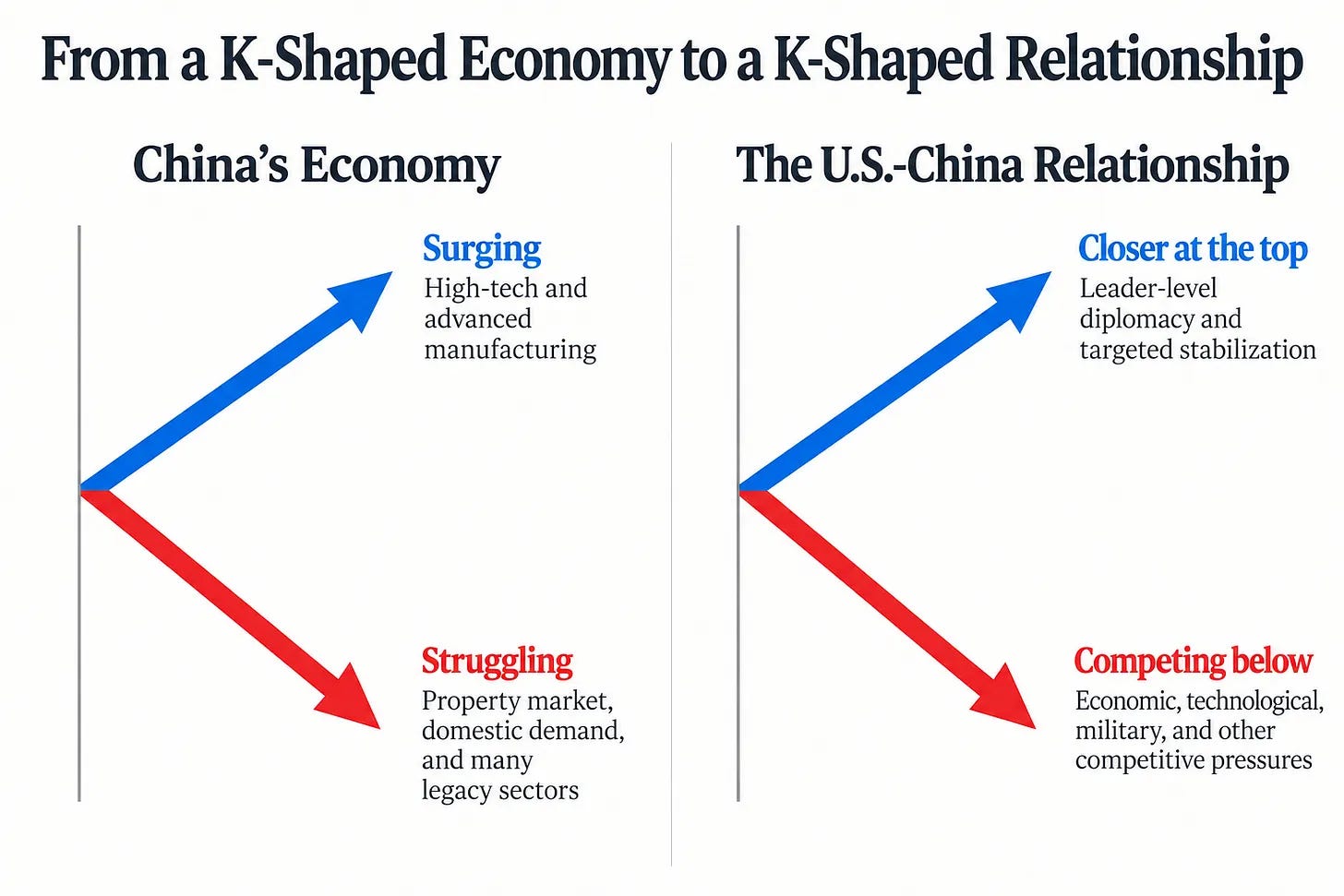
The metaphor is more than a parallel. When I hear talk of a truce or a détente, that sounds static, like a situation we’ve arrived at. But we all feel that US-China relations is actually quite dynamic and quite unstable, moving in two vectors at once.
The Midterms
Jordan Schneider: I don’t know who in the Trump administration is excited about this visit. I don’t know what Republican currently holding on to their seat for dear life is excited about this. There’s a lot going on in America right now, and I don’t know if this moves any voters. How does this ramify in domestic politics?
Julian Gewirtz: Having worked in the White House myself, doing a big state visit for China this close to a tight election where a lot is at stake is a strange thing. Think of what goes along with a state visit. First, the president will say a lot of nice things about Xi Jinping because he’s hosting him. Second, normally you hang a huge flag of the visiting country on the Executive Office Building, and smaller flags all over DC. So DC could be covered in Chinese flags thanks to President Trump. These are the kinds of things administrations tend to avoid because they’re a political net loser.
President Trump has either made the calculation that China isn’t that salient to voters and it just doesn’t matter, or he just doesn’t care. He wants to do this, and he views the political laws of gravity as applying to other people. Either way, some Republicans in battleground states will have to do some tap dancing. But the core question — and we’ll run the natural experiment in real time — is whether Americans do care, whether Trump’s high-risk gamble on the political timing is in fact right. That is instructive for how we think about the politics of China in the United States.
From my perspective, doing this kind of diplomacy isn’t necessarily a bad thing. But we’re in a strange moment where China does connect to some very high-salience political issues. It connects to affordability and cost of living. The tariffs are having an impact there. President Trump has not gotten the kind of economic deal he has said over and over would be coming. On Iran, another thing driving up costs in the United States, China has not been doing much to help end the conflict. And as AI becomes politically salient, China is a big part of that conversation too. I wonder whether Democrats and others will find ways to increase the salience of this — not by talking about China, but by talking about affordability and AI.
Jordan Schneider: There are things China could do that could help Republicans’ election chances. In a different timeline, you’d have a president condition a visit like this on the Iran war ending. There are carrots you could get that are electorally relevant. Even if you get them forty days out, it’s not going to change the price at the gas station. It’s hard to do the generous Politico reading.
Julian Gewirtz: We could quibble over how much China could do on issue X or Y, but the core point, which I agree with, is that it doesn’t really seem like the Trump administration is trying. There is a play one could design and run that would be about generating concrete deliverables. A lot of those you and I might not think are good for other reasons, but they could at least have some political resonance. It doesn’t even seem like they’re trying.
Jordan Schneider: The Brezhnev-to-Ford thing — we’re on the world stage together, keeping chaos at bay — doesn’t work when there’s a war in Iran pushing prices up.
Julian Gewirtz: I’d sharpen that point. Xi Jinping has been on a bit of a world tour over the past month. He went to the Shanghai Cooperation Organization meeting in Central Asia, then to Egypt, then to India for the BRICS. Instead of the image you’re alluding to — the American president and a foreign leader standing on the world stage as icons bringing stability — Xi Jinping’s world tour before his Washington trip has been precisely to make that message, but only about himself, only about China as an island of stability in a chaotic world. We can debate that, and we should. But it’s not a coincidence that he’s doing all of that in the lead-up to Washington. That’s precisely the point of the sequencing. He can make that argument around the world and still go to Washington and get a grand reception from the United States.
Where Is Washington’s China Policy Going?
Jordan Schneider: If this is issue fifteen for voters, I can’t imagine too many people screaming about Trump cozying up to the Chinese. But let’s zoom out. Where should we start when thinking about the Democrats and their China policy?
Julian Gewirtz: I’d step back and think about Washington’s China policy more broadly. We are in such a strange moment. President Trump obviously played a role in shifting the tenor and substance of the conversation in the 2016 election, with really intense rhetoric on China. My own view is that parts of the Democratic Party were already shifting on China by that point, but no doubt President Trump became the symbol and, in many ways, the standard-bearer of that shift. When I worked in the Biden administration, there were big differences between what Biden did and what Trump did in his first term, but there was a sense that broadly, a lot of people in both parties see China in a similar way.
What is particularly strange about this moment is that, having helped create that shift, President Trump has now helped destroy it — or transform it.
Jordan Schneider: As of April 2025.
Julian Gewirtz: That’s right. My own view is that President Trump has actually been fairly consistent on the parts of China policy he cares about. He cares about the economic stuff, and he cares about his relationship with the Chinese leader. Even in his first term, his drive to deal-making — to that Phase One deal — held a lot of competition at bay. His way of talking about China was different, but he was quite obsessed with getting that deal. It was only during COVID that you saw the unleashing of the full spectrum of the US government on China issues.
Today in Washington, both parties are dealing in complex and still somewhat inchoate ways with the realization that this shift is not what it looked like. There was an extraordinarily interesting essay by David Feith, published by the Hudson Institute, about what he calls a new Cold War in an age of doubt. His argument is basically that the great rethink on China, which he was an early participant in, hasn’t turned out to be as great as many people thought. Whatever you think of it, it’s an important argument to reckon with.
If that’s the case — if the political dynamics are more complicated and there isn’t the bipartisan consensus some people talked about — then there’s a moment of incredible fluidity that took me by surprise, and I think it’s taken a lot of people by surprise. I don’t feel confident, on either the Democratic or Republican side, about what the direction of China policy is going to be over the medium term.
And I don’t think Beijing is confident either. What Beijing does in response to its perception of this greater opportunity, this fluidity, is going to be perhaps as important as the internal conversation inside the Beltway.
Jordan Schneider: If I’m sitting in the foreign ministry trying to process our current prediction market — fifteen different candidates who all have somewhere between five and fifteen percent, from Rubio to AOC to Josh Shapiro to Jon Ossoff — what do you even do with that?
Julian Gewirtz: They’re definitely trying to wrap their minds around it. At the moment, my impression is that most Chinese foreign ministry folks feel they’ve got a pretty good thing going with the current arrangement. President Trump has set a trajectory that is ramifying not just through the executive branch but through Congress, and affecting public perceptions beyond Congress, that is moving in the direction Beijing would like to see: lowering tension, a slightly more positive view of China, and splitting up the seemingly monolithic push toward a more competitive or confrontational direction.
Something like Xi Jinping coming to Washington is also partly about Beijing being able to shape the perception of China in the United States — laying down a marker. The American president, this political force that is Donald Trump, is going to show Xi Jinping a good time, and there will probably be less criticism of that than many would expect. Beijing resets the floor on the politics, and on the performance of the politics, in the United States. There will be plenty of critics of how it’s handled, but for Beijing it can be a useful precedent-setter. To their mind, that’s more important than analyzing at this stage exactly what one governor or one cabinet official might do if they run for president in 2028.
China Salience in 2028
Jordan Schneider: China salience in 2020 was, hopefully, the highest it will ever be, with COVID. Coming into 2024, it was still a serious thing, because a lot of the Biden-Harris legacy was legislative responses to China: first COVID stimulus, then the CHIPS Act, then Build Back Better.
How does China touch domestic politics in a way a president is going to campaign on? Trade, and increasingly AI. Whatever domestic AI stuff there is will far outweigh the international stuff from a national political standpoint. So 2028 comes around, and none of these candidates besides Rubio has that much intrinsic China interest.
Julian Gewirtz: Some have been governors of states affected by China, but it’s not their thing. They didn’t sit on the Senate Foreign Relations Committee and do China policy for years.
Jordan Schneider: What would it take over 2027 and 2028 for China to rise from issue fifteen to issue seven? Probably just some catastrophic thing. Once you’ve gotten past the China shock and China Shock 2.0, if we’re banning imports of a lot of the things that could have caused that, it almost by definition lowers the temperature, because there’s less to get cooked on if you have less interaction in the first place.
Julian Gewirtz: There’s some truth to that, though I have a different view on the AI-China nexus. What you say is very possible; that may be how it plays out. But it also may be that the regulation debate in the United States gets tripped up on the “but China” question. The people pushing back against the regulation that many Americans seem to want really lean on the China argument. It’s possible, and we’ve certainly seen experiments with it. If it does, you could imagine a lot of the critique of people standing in the way of AI regulation getting tangled up with US-China questions.
Jordan Schneider: Once you have your catastrophic thing, once you have your job loss, the “losing to China” riff gets completely washed out by actual things this technology is doing that touch people’s lives.
Julian Gewirtz: Hopefully we don’t have to go through that particular timeline. There can be concerted action in the nearer term. But what’s going to drive the AI conversation is developments in the technology — incidents of the sort we’ve already seen — and then what we do here in the United States. The China piece is of secondary practical importance in a lot of ways to ordinary Americans.
Jordan Schneider: Not secondary — this is something to Substack about. Fifty percent of people polled think it’s going to kill us all. I don’t know how many relatives have reached out to you. Once you cross that threshold, the China stuff rounds to zero.
Julian Gewirtz: That’s totally plausible.
Jordan Schneider: Do your Dario riff.
Julian Gewirtz: I don’t know if I’d call it my Dario riff, but I was struck by how the American conversation around the big essay by Chen Yixin, the Minister of State Security, played out. He writes an essay that is largely language that Xi Jinping and other officials have used before, and it gets huge attention. It’s held up as this moment where China is talking about the political risks, the regime-security risks, of AI, and set side by side with the Dario “pacing the frontier” moment: Americans are freaking out about existential risk, and China is freaking out about regime security.
I think about it a little differently. That’s true on the face of it. But when you’re an American AI model company leader, you can talk as much as you want about risks you don’t have a solution for. These guys all do it. They talk all the time about big future risks that they admit they don’t know how to solve. If you’re the Minister of State Security in China, you cannot do that. You do not get to talk about risks you don’t know how to solve. When you name a risk in public, you are naming it because you are also saying: we, the Communist Party, see this and are going to deal with it. We have a solution for it.
One of the big questions as we assess US-China AI competition is how much we treat what we can see coming out of Beijing as the be-all and end-all, and how much more is going on in the system that we don’t see. This has been a recurrent theme throughout the history of US-China relations. Twenty-five years ago, Americans were predicting the internet was going to cause regime change or dramatically change the political system in China. Chinese leaders were staring down those predictions. Bill Clinton said it’s like nailing Jell-O to the wall. Good luck. And of course Beijing did nail Jell-O to the wall.
For many in the Chinese leadership apparatus who’ve been around — they haven’t changed parties and presidents four or five times since then; it’s a lot of the same people, just much older — when they think back to those moments and hear Americans warning again today about the risks to China, they view their own ability to assess what is risky in China as much better than that of the Americans. Both of those things are true.
Jordan Schneider: In the media’s defense, the essay is only a thousand characters long. It’s a nice little summation. If you haven’t been reading through TC260 and just want a reminder that they’re focused on state stability rather than a sense of risk, there it is.
Julian Gewirtz: I don’t mean to knock that interpretation, which I think is correct. That is one of the fundamental differences here. But as this plays out so quickly, with so much changing at once, there is relentless pressure to offer definitive takes on things that are very much in flux. It’s not unhelpful to make the top-line analytical point and then say: remember there are a lot of things going on here that we don’t see.
Jordan Schneider: If you’ve read two things coming out of the Chinese political ecosystem about AI in 2026, it’s been Xi’s speech — smiley, we think this technology is great and we want to be open — with the final paragraph being “TBD on all those risks.” I was at a conference when it came out, and I was like, guys, there’s a whole lot more to the Chinese worldview of technology than Xi Jinping talking to a global audience about a product his companies are selling to the world. Then you have the split screen of the state security guy, which is a higher priority for the CCP than AI exports.
Julian Gewirtz: That split screen is so instructive, because you’ve had cycles of exuberance or interpretation around each of those speeches. What we do not have yet from Beijing is the one thing that actually matters most: an answer about how they are going to regulate open-weight models proliferating globally, which carry many of these risks but also carry strategic benefit to Beijing. That’s the trillion-dollar question. You can read either of these speeches as pointing in a direction, and we debate it, but we don’t have that decision yet. My guess is that Beijing itself has not decided, because this is moving so quickly and the trade-offs are enormous.
Jordan Schneider: The Trump administration didn’t make that decision until Mythos hit. Then they made a call, then Fable hit, and they made another call, and now we’re memeing about effective altruists. TBD.
Fifty Years After Mao’s Death
Jordan Schneider: Speaking of moments in history that mattered, as opposed to what’s going to happen in the White House: the fiftieth anniversary of the death of Mao was a seismic event for China and for the planet, and there was basically no acknowledgment.
Julian Gewirtz: I have to confess that I too did not, shall we say, commemorate the date. But Mao died fifty years ago, in 1976. It is one of the most extraordinary things about modern Chinese history that many of us know people who’ve been on the planet for fifty years, and Mao was leading China fifty-one years ago — with all the horror and brutality and grandiose ambition of that period.
Jordan Schneider: Sit in 1975 and 1976 for a bit. The Cultural Revolution has cooled down. Universities are starting to open a little. GDP per capita is around $150.
Julian Gewirtz: Mao has been the dominant political figure in the People’s Republic since its creation in 1949, and before that as leader of the party during the revolution, the civil war, the Japanese invasion. He has loomed so large. And by 1975 he’s very old and quite incapacitated. He is in and out of being responsive. He can barely be understood when he speaks.
There’s a dynamic here that is universal throughout history: transformational political figures who hang on, who are not what they once were, and who go deep into their winter years still in control. Kissinger goes, Ford goes, George H.W. Bush is there as liaison chief. There are dealings with the Americans, but even compared to 1969 to 1972, when all the important diplomacy ahead of Nixon’s visit happened, Mao is significantly diminished.
Kissinger has one of the truly strangest meetings I’ve ever encountered in all my time in the archives, or in government. He goes to help prepare for Ford’s visit, and Mao is briefly semi-lucid. Henry Kissinger was married to Nancy Kissinger, who passed away recently and who was extremely tall, and Mao completely loses it over how tall she is. There’s video of this — he’s pointing, and she’s much taller than Kissinger — and there’s an account in the memorandum of conversation where he writes a note about it. He just can’t get over it.
Then the substantive meeting starts, and Mao is spouting very odd one-liners. Right at the beginning he says, “I’ve already received an invitation from God,” predicting his own death. At one point he starts hitting his chair and says, “I like people to curse me. If you don’t curse me, I won’t see you.” Kissinger, trying to be polite and get some business done, says it’s always a pleasure to meet with the Chairman, and Mao says, “Oh, I’m just a showcase exhibit for visitors.” For anybody who’s been to Beijing, that’s particularly ironic, because Mao in his mausoleum now literally is a showcase exhibit for visitors. It’s a disturbing and strange meeting late in life.
Looking at that history and at where we are today: we’re in an era with a lot of leaders staying in power way past their prime. Xi Jinping intends to stay in power for a while. The American president is eighty. A few years ago there was the “peak China” debate: do we need to start preparing for China’s decline? By and large, most people’s view now is that China is doing pretty well — at least the K-shaped dynamic is in place and they seem to have it moving in a relatively sustainable direction. We’ll see.
But the real question to my mind is not “do we need to prepare for China’s decline,” but “do we need to prepare for Xi Jinping’s decline?” All men are mortal. We know from recent Chinese history that leaders who stay in power change as they age. Certain obsessions become more prominent; behavior changes. We have to keep that in mind as Xi enters his winter years too.
Jordan Schneider: The China decline question is interesting when the country is growing at half a percent, even with AI and chip manufacturing and EVs. Those are tiny segments of the economy, and the rest has been struggling with unemployment and probably will continue to. We have a whole show with Logan Wright called Broken China running in the next week or two. But what does it mean to prepare for Xi’s decline?
Julian Gewirtz: To me it’s not about departure per se. It’s recognizing that there is a lot of uncertainty. We have viewed Xi Jinping’s tenure as quite predictable, because since coming to power in 2012–2013 he has laid out a set of objectives and generally pursued them. The core point is that when we consider scenarios for Xi in his late seventies and beyond, it’s not simply whether he feels he’s running out of time to achieve certain objectives — though that’s there too. It’s also: does he change? You can imagine any number of changes, but we don’t know.
I don’t mean to be dismissive of the China-decline narratives, which are important. My only point is there’s a corollary. We have to prepare not just for China as a powerful rising country, and for the downward leg of the K to no longer be something the upward leg can outrun, but also for a scenario where Xi Jinping changes or evolves in ways that a lot of China analysts — who’ve gotten pretty comfortable, as I sometimes do, with a vision of who Xi Jinping is — don’t expect. And when I say change, it could get worse for the United States. That doesn’t mean he’s going to mellow.
The Day After Xi
Jordan Schneider: We’re fifty years from the death of Mao, so let’s do a little death-of-Xi for a second. China changed tremendously after Mao. There has not been another leader since whose passing would matter nearly as much — we can do the Julian Gewirtz late-1980s what-if with Chen Yun and Deng, but regardless of how Xi evolves ten percent this way or that in his twilight years, once this guy moves on, the aperture is going to be wider than it has been since post-Deng.
Julian Gewirtz: Maybe. I’ve devoted a lot of my academic life to studying these decisive turning points in modern China: the death of Mao, Tiananmen in 1989, WTO accession and the transition that happened then. One key thing to keep in mind is that those are often described as elite power struggles, or as high-level, Beijing-centric change. But they are also, and maybe even more, changes in Chinese society — transformations driven not just top-down but bottom-up.
What does a post-Xi China look like? There is a scenario where you extrapolate linearly: continuity. There are scenarios, which folks have written about well, where you see more nationalistic or adversarial behavior. There are some scenarios with upside — more openness, a little more liberalization. It’s not impossible to imagine. But the clearest trend across these moments of historical contingency is that nobody predicted exactly what was going to happen. There was rapid change within those moments of transition. It was not as if on day one everything changed. There were experiments with different responses. Anybody predicting confidently what China the day after Xi looks like should at least be asked to predict with equal confidence what it looks like six months and a year after.
Jordan Schneider: What’s interesting about 1976, or 1989, versus today: if you want to take the bottom-up version, we just have much more Chinese society now. We have a modern economy. We don’t really have civil society in the way you’d describe it, but we have way more educated people, way more universities, way more functional and developed businesses. Which is not to say Jack Ma is going to pick the next leader. Back then you had the army, and that was it. Maybe at the end of the day you still have the army and that’s it. But there’s just a lot more that the next person is going to have to navigate as they try to establish themselves.
Julian Gewirtz: The late, great political scientist Joseph Fewsmith used to talk about the succession problem in Chinese politics as a perennial problem. It’s not only about a leader like Mao who dies; it’s the simple fact of succession, handing off power. One of the profound risks now ingrained into the Chinese system, because of the incredible elevation and centrality of Xi Jinping, is that any leader who follows is simply not going to have the prestige and personal status of Xi himself. When Xi came into office, he didn’t have it. He had to build it up, and he had to get the whole system ginned up to build it. That is a profoundly unpredictable thing. And Xi came in at a time of much more collective leadership, with a much less dominant predecessor, so it was far easier to build in that direction. It’s going to be very hard for whoever follows. The nature of the Chinese political system at present, so oriented around one man — his actions, his sayings, his deeds — is inherently not neatly replicable.
Jordan Schneider: My point was about the interest groups that have been kept at bay — factions, however you want to define them, local and provincial interest groups, firm-level interest groups, industries trying to get attention and support. They’ve been cowed. But these are human beings who want more money, power, and fame, and once they see an opportunity, people are going to try to bend the system to their interests. Whether the next person is a Hua Guofeng who disappears after a year and a half, or there’s a period of messy consolidation, or a drive toward consolidation that may or may not succeed — it’s going to be very fun to cover on ChinaTalk, but potentially super messy for the party and the people.
Julian Gewirtz: And for the world. One of the other big differences between 1976, 1989, and now is that China is globally integrated on a level it was not in either of those moments, even with all the Fortress China activity under Xi. China’s a superpower. It matters globally in profound ways. Countries around the world, including the United States, will see this moment, whenever it occurs, as a profound juncture that affects them too. Not that they’ll have any say in it. But how China evolves over the next fifty years is a question that matters for everybody. It’s sometimes hard to talk about because it feels so unknowable. But when we envision how the world is going to change over the next fifty years, the question of how China’s politics change, and the ramifications for everything else, has to be on the table.
Jordan Schneider: We’ve had The Death of Stalin. No one’s ever going to greenlight The Death of Mao, even in today’s era of relations. But now I have AI-generated video, so I’m going to make it. This is my eval: I ask all the new models to make me the trailer.
Julian Gewirtz: They’re getting better and better. In Armando Iannucci style. I would watch that.
Jordan Schneider: We have ChinaTalk Records on Spotify with all the songs. Give me six more months and we’ll have ChinaTalk Productions. The irony is that the best video models are all Chinese, and it’s difficult to prompt them to put Mao in it. We’ll work on that.
Chinamaxxing, from Kissinger to Trump
Jordan Schneider: Coming back to Chinese negotiating behavior: the ability of China to romance its American interlocutors. My favorite line in the book is Henry Kissinger saying, after a dinner of Peking duck, “I’d agree to anything.” Brzezinski, when he goes to Beijing as national security advisor, comes back and literally says, I’ve fallen in love. I’m enamored, I’m enthralled by interacting with the Chinese.
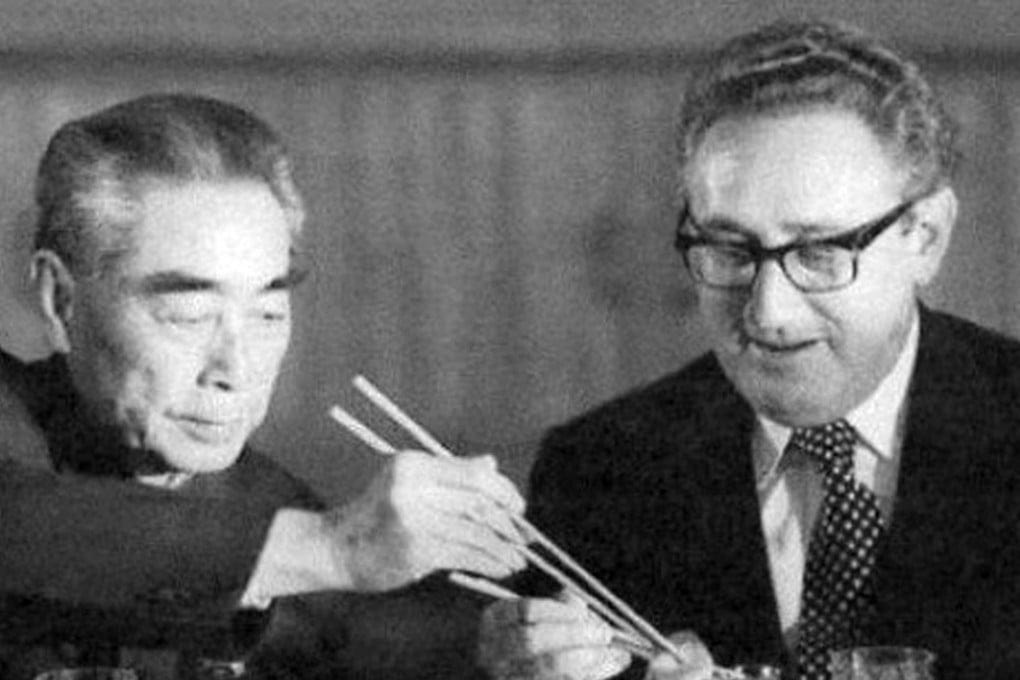
Julian Gewirtz: Chinamaxxing wasn’t invented in 2025 We can go back to Voltaire. We’ve been Chinamaxxing for a very long time.
Jordan Schneider: It’s interesting that even in 2026, when this is not a hermit kingdom, when we’ve had diplomatic relations for a long time and all this economic interconnection, we still have a president who is just enamored with the majesty of China. Hats off to the PRC. Maybe this is Trump indexing on the 1970s and 80s, when China was exciting and sexy. I’m surprised that in 2026 we still have a president who gets all tingly when he talks to the Chinese.
Julian Gewirtz: The idea that China is very far away from the United States, a different culture, an enormous country in size and population — those facts are still the case. China being more open to the world and more globally integrated hasn’t changed them. So the dreamy, starry-eyed, slightly Orientalist thing vis-à-vis China is still a factor. In addition, for someone like Trump, who aspires to be a strongman, Xi Jinping is one of the ultimate strongmen on the global stage. And China has developed rapidly, has an enormous economy, and is in so many ways becoming technologically very advanced. Those things are very contemporary, and they’ve reinforced the older ones.
Jordan Schneider: If we go from Trump to a Gavin Newsom or a Josh Shapiro, the Chinese system, the foreign ministry, is still able to make even figures who aren’t excited by strongmen tingly. They get to cosplay as Kissinger.
Julian Gewirtz: On that point, I think we talked about it last time I was on the show, but some of this — not all of it — is actually not really about China at all. It’s an American set of archetypes. The way many people doing foreign policy, or many political leaders, envision themselves as a great big leader on the world stage is sitting in those stuffed chairs: Kissinger talking to Zhou Enlai, Nixon talking to Mao. That’s the image — “the week that changed the world,” as Margaret MacMillan called it. In a strange way, it’s not about Beijing. It’s about us. One of the big themes of this conversation, which I feel acutely right now, is that so many aspects of current American policy toward China have something to do with China, and that’s important, but fundamentally they are inextricable from Americans’ views about ourselves, and our leaders’ views about our country.
Jordan Schneider: We can bring this back to AI. One of the reasons people gravitate to the idea of nuclear-arms-control-style negotiations or an IAEA for AI is because it sounds sexy. You look at those photos of Brezhnev and Carter signing documents and there’s aura there. Going to a 3GPP 6G standards meeting is the opposite: a boring technical thing where there aren’t great stakes.
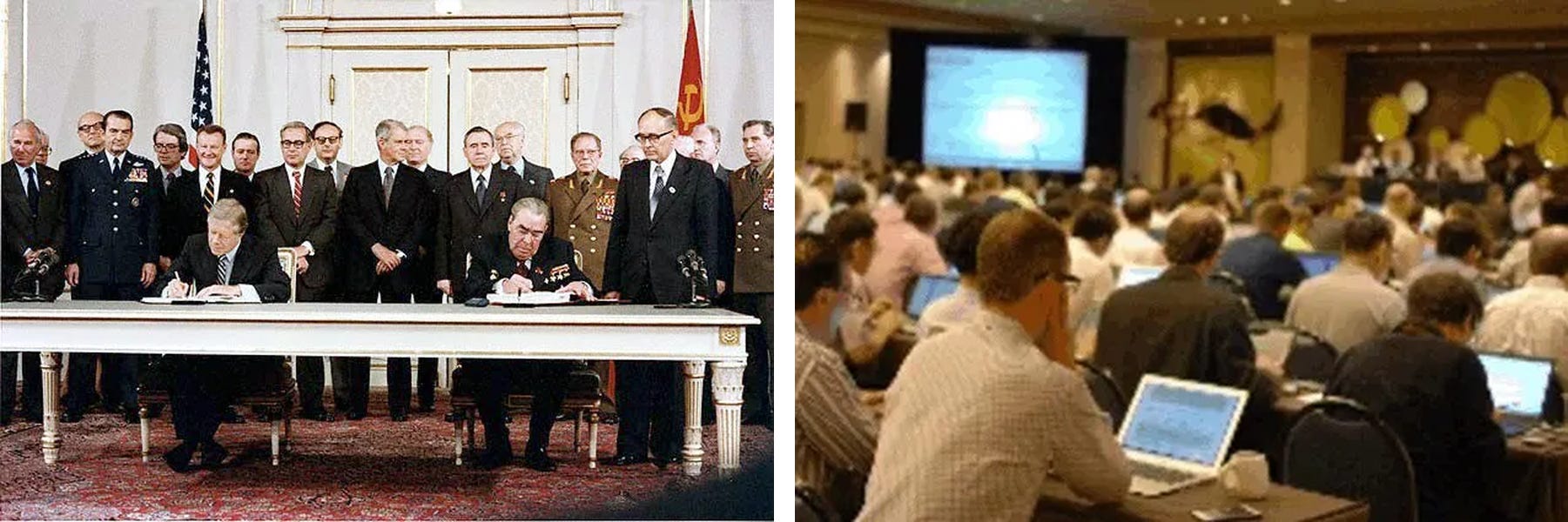

Julian Gewirtz: You saw Sam Altman do a version of this when he said President Trump could get his Nobel Peace Prize with Xi Jinping if they pulled this off. There is an awareness that you’ve got to make this a moment, zhuzh it up. But the arms control negotiations were built on a lot of deep technical work that was not the sexy photo op. You need both, and you can only get a photo op worth the camera it’s shot on if you do the hard work up front — which is why Matt Sheehan and I just published an essay arguing for what some of that work could look like.
Jordan Schneider: It’s super important. But it’s 2026. We don’t do work. We take photos.
The Scholars
Jordan Schneider: Last thing. You are the only ChinaTalk guest I could talk into reading The Scholars.
Julian Gewirtz: I’m doing it. I haven’t finished it. It’s amazing. You introduce the book, but what I’ll say is that right now the literature I’m most interested in is satirical. It’s about human corruption and craven behavior, and the way these things we see all around us in contemporary life are eternal, universal, part of every human society over centuries. I say that not because I want to feel worse about our own time, but because I want to feel better about it.
When you read The Scholars, remember it’s a Qing dynasty text written about the Ming. It’s making that point in a doubly embedded way: I can’t write about the Qing being corrupt and craven, so I’m going to write about the Ming being corrupt and craven, but everybody’s going to know it’s a way of talking about our own time. I do not think it’s a good thing if we’re comparing the United States today to the Qing dynasty. That is not a happy comparison. But it’s been a total delight to read, because the human behavior on display is so fresh, as if it’s happening today. And in a way, it is.
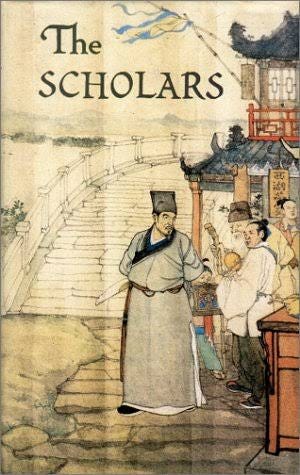
Jordan Schneider: The reason I got to this book was that I started writing those satire Substack articles — about Claude opening the Strait, about Newt Gingrich tweeting about nuking a canal to get three or four moves ahead. Then I thought, people have written better satire than I have. I’ve never studied this genre. So I made a reading list of the best American and Chinese satire, and I’m going through it. We’ve done some Lu Xun, which I’ve talked about on other podcasts.
The Scholars, like these Ming and Qing dynasty novels generally, is chapter-based and highly episodic. You read ten to twelve pages, they tell one little story, then there’s a cliffhanger that brings you into the next one. If you read Dream of the Red Chamber, there are a handful of main characters you follow throughout. This is instead an incredible panorama. It feels like one of those scrolls where you keep going and there are different people who interact a little. Because there aren’t main characters you’re following, you get so many little slices of this world. This guy wrote the book over the course of thirty years, and it feels like every time he traveled somewhere or met a fun character, he thought, I’ve got to put in the salt dealer, this prostitute, this corrupt merchant, this sad earnest soldier. As a time warp to put yourself in, you’re getting really rich sociological observation condensed into ten-page bites that are entertaining, have you laughing, and have you reflecting on contemporary society. And it’s totally wild, totally bawdy.
Julian Gewirtz: It’s primarily about scholars, people taking the imperial exams who want to become officials, with a lot of other characters. But you basically realize that what’s being portrayed is a deeply fractured and ill society. The goal is not a Bildungsroman, the rise and fall or development of a main character. It’s to analyze, in a non-normative, non-moralizing way, and diagnose a very ill society. I have a side of myself where I write poetry and do creative writing, and it’s a kind of work we don’t see very much of now, but it really resonates. It’s satire, but it is not a screed.
Jordan Schneider: He’s making fun of these guys, but in a sympathetic way. He is one of them. Wu Jingzi was a failed scholar; he didn’t make it past the provincial level of the imperial exams. He empathizes with this world. He sees their foibles, and yes, there’s venality and corruption, but there are also human beings just trying to make the most of it. Looking at the status games being played in Qing-via-Ming satire and reflecting back on what’s messed up and broken about us today is interesting.
Reading it actually made me feel a little better about America in 2026, because fundamentally the things our society orients people toward are more net positive than testing well on Confucian imperial exams and extracting money from the people once you become a bureaucrat in some random corner. It’s not all just selling Bitcoin. We’re building big things, we’re making new drugs. There’s good stuff getting developed. How did it make you feel better?
Julian Gewirtz: For me, the thing that made me feel better is realizing that some of the things we all get spun up about in our own society, in our own moment — a whole lot of that has been rising and falling throughout human history. Societies change, but they also recover and come back. Realizing the universality of some of the really tough things happening right now — there’s a weird optimism in that for me.