
From Xi Jinping invoking the Thucydides Trap to Hegseth’s “high-T military” and love affair with 300, the modern security world keeps reaching back to classical Greece to explain itself. Usually badly.
Our guest is Roel Konijnendijk, ancient history lecturer at the University of Oxford and author of Classical Greek Tactics: A Cultural History, joining Jordan, Justin, and Tony.
We discuss…
Why most scholars of Thucydides think there’s not much left of the “Thucydides Trap” once you take his name off it
300 and Gates of Fire as studies of masculinity: “It’s about the USMC in fancy dress”
The counterintuitive reason Greek citizen-soldiers thought training for war was ridiculous
Homeric gore, the slaughter of the suitors, and whether the Odyssey wants you to approve
Achilles on immortality versus glory, and why this poem still keeps us arguing 2,700 years later
Listen now on your favorite podcast app.
Jordan Schneider: WarTalk, Ancient Greek edition. We have with us the delightful Roel Konijnendijk, professor at the University of Oxford. We talk about, my goodness, Graham Allison and the Thucydides Trap, 300 and how it pollutes teenage boys and defense secretaries’ minds, Homer really liking blood, guts, and gore, and military ethics. This is a really good show. You guys are going to have a lot of fun. All right, let’s roll the tape.
The Thucydides Trap Is Fake
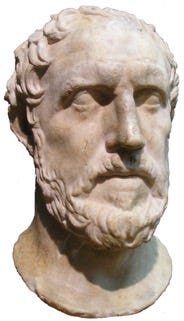
Jordan Schneider: So how do ancient Greek historians today feel about Xi Jinping talking about this Thucydides Trap?
Roel Konijnendijk: So the Thucydides Trap is an idea that was invented in 2017, I think, by Graham Allison. He’s not an ancient historian. So it’s one of those moments where on the one hand, okay, it’s great, everybody’s talking about Thucydides, surely that’s good. But on the other hand, it is in an extremely shallow way. I read Graham Allison’s book on this, and I noticed that within a few pages he never talks about Thucydides again. He talks about Thucydides, but he doesn’t have any examples from ancient history except for the Athens and Sparta thing. He just talks about modern strategic situations. He’s not interested in ancient history as such. He’s mining it to get a nice little slogan for a phenomenon that he’s observed in the modern world. That’s absolutely legitimate. But it means that for us, that engagement with antiquity is very shallow.
And I think most scholars of Thucydides now would say that there is not that much to the Thucydides Trap that needs to have Thucydides’ name on it. There is, of course, an understanding in Thucydides that there is a dynamic between states, which he was the first to formulate, in which there is an established power and a rising power, and that creates tension, which according to Thucydides inevitably led to war. But his own narrative can easily be used to disprove that point, because it’s not actually that which leads to war. It’s not because Sparta was afraid that this war happened. It’s because of the host of other reasons he also mentions, most of which don’t have anything to do with Sparta. They have to do with Corinth being offended at its naval empire being encroached upon by the Athenians. So if you were to read this a little bit more closely, you might decide that what you call the Thucydides Trap should be called something else. But it’s a nice little label that makes people think Thucydides is still relevant. So on that level, we’re pretty grateful.
Justin: When I read it, my takeaway was I couldn’t identify who is Sparta and who is Athens. The way he applies the metaphor, both countries are both at all times, and it’s constantly changing. So I had no idea who was who.
Roel Konijnendijk: It’s like gender.
There’s an interesting point about drawing parallels between ancient Athens and Sparta. There have been certain historical parallels drawn, especially between the commercial, maritime, outward-looking, global US versus the landbound, conservative Soviet Union. That is the classic one, very dominant during the Cold War. But the Soviet Union was not the established power. They are the new ones, they are the rising ones, they are the ideological threat to the world order. So in that sense, the Thucydides Trap doesn’t apply there. And similarly now, if you wanted to make that parallel with the situation Thucydides describes in the fifth century BC, you would have to say that the US is Sparta, with the most powerful fleet in the world and these overseas trade interests and this cultural hegemony. There’s just no way that this can ever work.
It doesn’t work except at the most superficial level. We’d love to go into a discussion of the Peloponnesian War, what’s actually going on, because it’s a lot more complex than that. But then this is a journalist writing about modern politics, and this is me, the historian, laying out the ultimate cliché line of every historian: actually, it’s more nuanced than that. So no one wants to hear it.
Jordan Schneider: Graham Allison, journalist, ladies and gentlemen! …He does have a PhD in political science, but okay, we’ll leave it at that.
Roel Konijnendijk: A political scientist, fair enough. But not someone who has necessarily made a detailed study of the ancient world, of classical Greece, of Thucydides as an author.
Jordan Schneider: You can try, right? That’s the point. You don’t have to be deep in your Delbrück to understand there’s some nuance here.
Roel Konijnendijk: A general point I always try to make is we shouldn’t gatekeep antiquity. It’s actually good that he wrote a big book that made everybody look at Thucydides again. Kagan did this in the past too. He was always trying to make sure everybody was reading Thucydides, at least if they were taking any liberal arts degree in American universities. Now, I don’t know if Thucydides is necessarily the source I want you to read from classical Greece. But it’s a great book. Read it, by all means. It’ll make you think. There’s a lot in Thucydides that feels timeless and relevant, and that was exactly his intention. He explicitly set out to write something that was going to be around forever.
What I’m saying is that as far as ancient historians are concerned, that engagement is facile, convenient. It’s not really an engagement with the ancient world. It’s an appropriation of a model for the purposes of making a point about modern politics, which is fine. But that means I have less to say on it than I would if he had tried to find examples throughout history, or even throughout ancient history. That would have been really cool.
Justin: One of the reasons he used it, in my opinion, is that a lot of US military war colleges use Thucydides, at least portions of it, to start discussing the beginnings of strategy. The issue being that it’s also not great for that, because it’s not a great look at strategy. Thucydides was both too close and not close enough to the decisions being made on all sides. His investigations are great, but to try to apply that to the US and China, or even the US and the Soviet Union, is doing a lot with that narrative that doesn’t necessarily fit.
Roel Konijnendijk: For sure. One of the fundamental things at the heart of history as an academic discipline is that we acknowledge every historical society is different. The cliché goes that history is always repeating itself. The first thing you learn when you study history is that history never repeats itself. Every single historical situation is different. So you always have to worry, how comparable are two historical situations really, and on what level? What Allison has done with the Thucydides Trap is say that at a very zoomed-out level, you have a similar dynamic, an established power and a rising power. But at almost any closer level of detail, this comparison breaks down.
It’s the same with people who want to compare the modern US to the late Roman Empire. These are not the same entities in any meaningful sense, except that there is a narrative. We come back to this idea of telling ourselves stories, a narrative in which the protagonist is going through the same process. This idea that the downfall of empires always looks the same. And then you can ask yourself, first, is that what’s happening? And second, is the late Roman Empire a meaningful comparative case when the environment of that empire, the way it’s run, the way it thought of itself, is all radically different? The world is different. You can’t just say what happened there will happen here. So whenever somebody tries to make a model that applies to all of history, you have to immediately think, how universal are these factors you’re implying?
The High-T Military
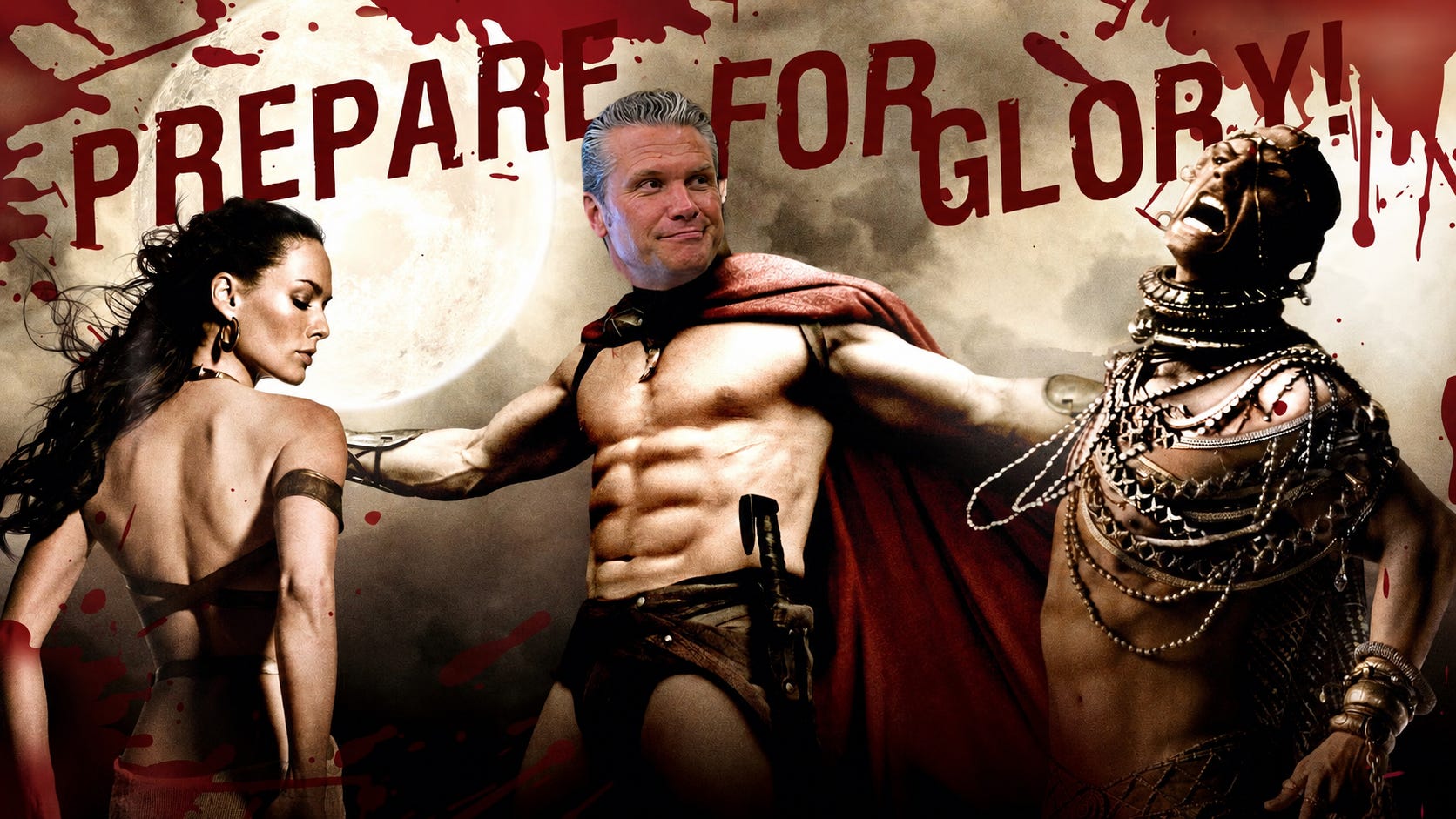
Justin: The news of the week is that the United States military is going to be the T Nation, I guess, which is an old bodybuilding website that definitely wasn’t about the use of steroids. It was about the use of steroids. So the Department of Defense is going to start looking at everybody over thirty to see if their testosterone is low and then give them more.
A couple of things. Testosterone being low is a real thing. There is a thing called operator syndrome, and if you actually read the memo Hegseth signed, that’s what he specifically addresses. That’s a real condition that affects a small portion of operators who have been in continual high-stress environments, where they’ve had adrenal fatigue and their body’s hormones are out of balance. That said, I think it has like a five percent occurrence in the normal population. So I don’t know that this is really going to fix much. But then the way he decided to come out with his video talking about the high-T military.
Jordan Schneider: Do we have 300 to blame for this?
Justin: I think so. I told you this. I was in Fifth Special Forces Group. Fifth Special Forces Group, when they were in Vietnam in the sixties, became known as the Legion. That name carried over through the years, and they still are referred to as the Legion. They use some Roman symbols whenever they make their unit crest. The battalion I specifically was in, though, called themselves the Spartans, confusingly. And that only happened after the movie 300 came out. The commander at the time was like, we’re going to be the Spartans. That’s where that came from.
Roel Konijnendijk: There’s a lot of that. There are people who specifically study this as reception of the ancient world, the idea of people trying to take things from antiquity and reapply them to their own lives. There’s a whole cottage industry of people writing about how different organizations have used the version of Sparta you find in 300 to identify themselves as very tough, very manly, very brave.
When I watched 300 when it came out, I was a teenager, and my mind was blown. That was super cool. I watched it in IMAX, this huge screen, went with a friend, wow, this is amazing, best thing ever. Now when I watch it, I’m just like, this is really quaint. The only way I can take it seriously is as a study of masculinity. It’s about what it’s like to be a man. That’s very explicitly what it’s about. It’s all about the perfect man, Leonidas, being a perfect man, and no one can possibly touch his sheer raw manliness. That’s fine for a movie. It’s just a bit ridiculous when you realize nowadays surely we’re a little more critical of that image. But Hegseth’s not quite there yet.
That masculinity is a death cult. These men live to die. That’s all they want. They don’t want to beat the Persians. They want the Persians to keep coming forever so they can keep killing and dying forever. They don’t actually want peace. That is the pinnacle of achievement for them. So this is very disturbing if it starts to affect the ideology of modern militaries. You don’t want soldiers thinking in these terms. You don’t want them glorifying the idea that dying for your state is all you live for. You want them to think pragmatically about how they’re going to achieve strategic objectives and maybe, hopefully, survive and get home in one piece.
That version of Sparta is entirely a modern product. This is the result of Zack Snyder having a very weird interpretation of Frank Miller’s graphic novel, which is already really extreme, but which is not about Spartans. It’s about the USMC in fancy dress, as I always like to say. It’s a vision of modern military training applied to the ancient world. It’s recursive. It comes out of the US military, it’s about the US military, it comes back to the US military, and the US military says, this is awesome, we want to be like this. Of course you’re already like this. It’s based on you. It’s not based on the ancient Spartans. Same with Pressfield’s Gates of Fire, which I think a lot of people in the services read.
Justin: It’s highly, highly recommended when I was a young guy. It’s exactly that same thing.
Roel Konijnendijk: It’s about a modern military, its ethos, its training methods, its attitudes, the whole vocabulary. It’s modern, with a little sauce over the top to make it feel ancient. It’s now being imposed back on that world in an ever more extreme, radicalized way. It’s almost like asking ChatGPT to keep summarizing the same piece, and it gets more and more wild and extreme. It goes further and further off track, because you’re perpetuating the errors within the system as you replicate it.
What the Sources Actually Say About Sparta
Justin: If you wanted to quickly correct the narrative on the Spartans, what is the best source? Is it Xenophon?
Roel Konijnendijk: You can read Xenophon’s Constitution of the Spartans, a very short text that literally just sets out: one day I woke up thinking, why are the Spartans so great? And then I thought about it, and here’s the answer. It’s about how they organize their society, based on the idea that the Spartans are militarily effective. But when you read it, you have to bear in mind, this is all we know about Spartan military methods. This is all he says about it when he’s trying to prove they’re better than everybody else. And it is so little. There is so little about the upbringing, the military training, the military methods. What you see is a bunch of guys trying to manage their society, control the values of their children, and maintain high birth rates, which is also something Hegseth would probably enjoy. These things don’t have a direct impact on their military abilities. It’s really just trying to foster a good civic spirit. These people are obedient, deferent to their elders, they obey the laws. Fighting? Meh. Very secondary. Not a skill they prize. And all these sources agree on this.
If you want a more nuanced picture of Sparta, there’s a very good book by Nigel Kennell just called Spartans, came out in 2010. There’s also Andrew Bayliss’s Spartans, which is okay, similar in trying to introduce some of the new ideas about how people now think about Sparta. That’s really very different from the way it used to be interpreted back when Frank Miller was writing 300. You can go read 300, I have a copy here, and flip to the back to see his inspiration. It’s Victor Davis Hanson. That’s what he read in order to write 300. So again, it’s a uroboros of cultural influences, into which historical knowledge penetrates very little.
Justin: I always wondered about this idea that the soldiers were completely divorced from their families, that they only lived in the barracks and were separate from society until they reached manhood. When you go look for where it says that in the historical text, it’s like, not really anywhere.
Roel Konijnendijk: Especially not in contemporary text, in Xenophon. They just go home. They hang out with the boys during the day and then they go home.
Justin: It doesn’t sound that much different from the gymnasium of Athens. They go, they hang out, they wrestle, they go back home.
Roel Konijnendijk: Exactly. It’s just about social conditioning, like the gymnasia. You do a bit of physical exercise, but you’re also being socialized. You’re getting used to having conversations with older men who are there to instruct you on how to be a good citizen. And for a little while you’re looking really good, which is good for you because you’ll be healthy, and also because older men will want to get into a relationship with you. Then you can get patronage, better connections, all sorts of benefits.
But in Plutarch, in the much later sources from the Roman period, they suddenly do live in barracks, they suddenly are separated from their parents, and they do have to do a lot more training, especially to learn how to sing and how to talk like a Spartan. That later source is written after multiple documented reforms of the Spartan education system. So we know this is not the system they had before. This is the system after they lose their prominence, but they’re doubling down on their traditions, which is something societies will do. You’re no longer very important, but you are unique, people look at you like you’re special, so you double down.
Jordan Schneider: You become a tourist destination, right? By 300 AD? Come on, what are we even doing?
Justin: They get pushed around the battlefield. It’s after the Peloponnesian War, the Thebans, I think it’s thrice, that just push them around.
Roel Konijnendijk: It’s the Thebans in the fourth century. They defeat them a couple of times.
Leuctra
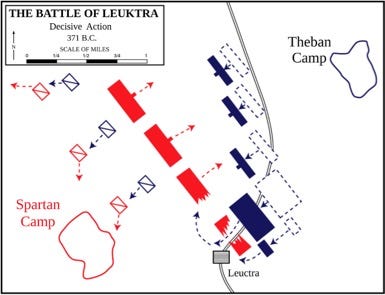

Jordan Schneider: Wait, wait. do you actually think Epaminondas did at Leuctra?
Roel Konijnendijk: That’s a big one. It’s a combination, and I wrote about this in my book. The story is always that he must have done something revolutionary because he beat the Spartans, and no one had been able to do that for a while. What he ultimately did, according to the best accounts we have, is he just didn’t run away when the Spartans bore down on him. That is already quite special.
He got an army together that was decently experienced. The Sacred Band may have something to do with that, a very experienced picked unit of men who had physical training, spent time together, been in the wars together. So you have an experienced lead unit heading your phalanx. And then he massed the rest of them very deep, a very deep formation, which is very strong for morale. You literally can’t run away, so you’re more likely to stand your ground. There’s a physical block against doing that. And the people behind you are in really high spirits, because the fight’s not going to get to them for a long time. So everybody’s kind of like, yeah, let’s go. In that very deep formation, with the Sacred Band likely at the head, he was able to slam into the Spartan formation, possibly when they were in disorder out of a bungled maneuver, their own cavalry having disrupted their lines when they were driven back into them.
So there was disorder in the Spartan line, and they smashed into it. And then they were willing to engage Spartans in hand-to-hand fighting, which most Greeks just didn’t do. When they saw the Spartans advancing in regular formation, good order, uniform equipment, they would just break and run away. The Thebans decided to stand their ground. And once you stand your ground against a Spartan, he’s no better than you. That follows from what we know about their training. Their training isn’t about skill at arms, or strength, or becoming individually a superior fighter. It’s about moral and disciplinary conditioning, becoming part of a well-oiled machine of devoted citizens. But in a fight, one on one, a Spartan is no better than anyone else in the Greek world. So if you’re willing to stand and face him, you can beat him, fifty-fifty at that point.
And then the enormous weight of that Theban column, ranks upon ranks behind them, comes to the fore. You can say, we can stick in this fight as long as we want. You can’t, because your formation is not as deep as ours. Do you want to keep flipping that coin until you’re all gone? And the Spartan Royal Guard, to their credit, say yes, we’ll do that. They all die. Something like four hundred Spartiates are killed, which likely includes most or all of the three hundred guarding the king. But the rest of that army doesn’t.
Jordan Schneider: But we have these quotes saying he’s the greatest of all time. Is that enough to get you there?
Roel Konijnendijk: He did something no one had done for a long time. But greatest of all time is Cicero trying to give credit to someone he admired, because Epaminondas was a democratic leader fighting against a king, somebody who represents the Republican ideals Cicero himself stood for. He goes into the Peloponnese and strips away all these governments imposed by the Spartans, replacing them with more pro-Theban regimes. Cicero will consider that a real act of liberation. And he did permanently break Spartan power. They never recovered. So he achieved something that really changed the map.
Jordan Schneider: He didn’t just win a battle, he ended an empire. He’ll get some credit for that.
Roel Konijnendijk: Exactly. And that isn’t just because of the battle, it’s because he followed through. Victor Davis Hanson, in one of his more lucid moments, wrote an article about Epaminondas as the inventor of strategy in a sense, because he followed through. He said, I’m not just going to win this battle, I’m going to march into your home territory, strip your assets, clear your allies, break your alliances, reduce you to a rump state. That is a much more decisive way of waging war than saying, okay, we beat you, now let’s come to terms.
I say “one of his more lucid moments” because he’s increasingly just sloppy. He doesn’t need to be a good scholar, he’s selling books anyway. *That book A War Like No Other, on the Peloponnesian War, that was propaganda for the Iraq war. That is explicitly why he wrote it.* And that’s just depressing. When we’re talking about modern authors using the ancient world, don’t do that, man. You’re not making us look good. It’s hard for me to keep citing him, because his academic career has so nakedly come to serve his pundit career that you can no longer really take anything he says seriously. But he was a very important voice in my field in the eighties and nineties, so you have to acknowledge that.
The Myth of the Technological Revolution
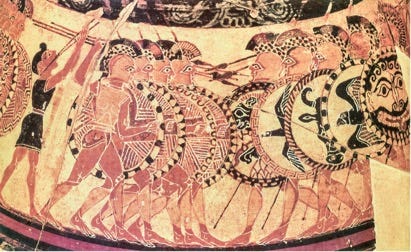
Hoplites on the Chigi Vase, ca. 650 BC. Wikimedia Commons (public domain).

Jordan Schneider: Longtime theme on WarTalk: the influence of technology, particularly emerging technologies, on how war changes. What’s the right place to start with that in the classical Greek context?
Roel Konijnendijk: There’s the expected answer and the real answer. The expected answer is you start in the Bronze Age and then say, okay, iron comes in, that’s the big change. It’s not, really. When we get Homer’s poetry, a lot of the weapons are still described as bronze. It’s not like iron comes in and displaces it entirely. Even in the classical period, when iron has been around for centuries, they have iron-headed spears but bronze butt spikes. They’re using both technologies at the same time for different purposes. It isn’t as simple as saying iron gets introduced, radical technological revolution, everything changes. That is an old assumption, and it’s just not what happens on the ground.
Around the time the Homeric poems come to their final form, you have the introduction of a new type of shield, the big round double-grip hoplite shield, the aspis. There’s an old argument that this determined the use of different tactics, because it only works in certain formations, and that determines the whole shape of warfare for centuries. But more recent scholarship has pushed back and said, actually, we can’t see any of that. Nothing confirms this is the only way to use the weapon effectively, and initially the number of people who could afford it would have been really small. So you need changes in society. You need people to get a lot wealthier and cities to get a lot bigger before you can say this shield leads to things like hoplite phalanx formations. It ties into a lot of other features, rather than just saying this new technology arrived, use it or lose it.
Justin: That’s an interesting segue, because you’re talking about the economic culture that underpinned the core differences between Sparta and Athens by the time of the Peloponnesian War. Do you think the hoplite army dictated the differences in the way their economies developed, or were those just byproducts of Athens having access to silver and seafaring, whereas Sparta used iron and helot slaves?
Roel Konijnendijk: The important thing to know about the Peloponnesian War is that there’s no technological difference between the two sides. They have exactly the same weapons and armor, right down to naval warfare. The Athenians have the much more powerful fleet, they really specialize, they know what they’re doing. But their triremes are exactly the same as the Corinthian triremes they’re fighting. Zero difference as far as we know. So it’s really about how you use it, the tactics, the experience, the confidence, and what you want strategically to do with them.
Athens has a lot of overseas interests, so they invest in making sure their navy is strong, protecting allies, keeping trade lanes open, pushing their influence. Whereas Spartan society grew into this rigidly hierarchical thing dominated by a leisure class, a large number of people who don’t work, who have an enslaved underclass doing all the work, who band together and run the state. That agricultural economy propping up a leisure class expresses itself militarily in this large hoplite army. But it’s not like the Athenians don’t have a large hoplite army. They have a larger one than the Spartans. It’s just that most of those guys aren’t leisure class in the same way, and a lot of them don’t see themselves as defending a way of life when they pick up that shield and spear. They don’t have the same attachment to how society is organized.
So those different ways of war come out of different strategic considerations, which grow out of how these states developed socioeconomically and politically. And modern scholarship has pointed out that Sparta is not that different from a lot of other Greek states in that sense. There are plenty of other states that focus all their resources on propping up a huge leisure class, staying in power, oppressing everybody else. And militarily they’re quite effective, precisely because they’re permanently available for service when needed, and because they have the economic means to supply themselves the best armor and weapons, all privately arranged. They pay for their own stuff.
Nobody Trained
Jordan Schneider: In your book, one of your keys is these few quotes, one Aristophanes play and a piece of Plato, where they’re making fun of the idea that anyone in Athens would ever want to train militarily, that this was the lamest thing you could possibly do with your time in 475 BC. You could philosophize, you could drink with your friends, but the idea that you’d put on armor and learn how to hold your spear and shield is just unconscionable.
I guess, thinking about how we talk about this stuff, you have technological overhang and then operational overhang. Here’s the technology available in any given year: have you figured out the right way to organize your society and train and have the right doctrine to get to the frontier of what’s possible with whatever’s been invented? It was shocking to me that this was a big limit, that no one wanted to deal with it. Why doesn’t it get competitively eaten out of existence? Is it just the geography of Greece, that you could not train and still exist as a city? How do you get into this as an equilibrium?
Roel Konijnendijk: Well, it’s very effective. That’s the weird thing. It’s completely counterintuitive to us. If you’re trying to be a fighter and survive, you rely on your skills, your ability with the weapons, you obviously try to be as good as you can. The Greeks don’t have that attitude, and I argue that not because it makes sense to me. I don’t really get it. I’m arguing it because that’s what the evidence tells me. We have explicit quotes that they don’t train, they say they don’t train, they actively, repeatedly assert that no one does this, they find it silly and ridiculous, they explain why. You’re making a fool of yourself, everybody’s going to scrutinize you, you’re going to slip up someday and everybody’s going to laugh at you. Why do they exclude it from their military experience?
The best answer I’ve been able to come up with, and this is really speculative, is that there emerges from these societies, especially the democratic ones like Athens, but elsewhere too, in these societies that rely on a citizen militia. In wartime they don’t have a professional army. When war comes, all the adult males get called up and march out to fight. In an economy that’s still to a large extent subsistence, you have a lot of people living hand to mouth. They don’t have the time to set aside to go and train. They don’t have the time to say, I’ll take my weekends, I’ll drill with my buddies, we’ll figure out how to do this properly. They get called up and they serve.
And with that reliance on a militia comes an ideology, this need to establish that as long as you’re willing to turn up when the call comes, that’s enough. That’s all we ask of you. Because otherwise you immediately get enormous differences between those who have time to train and those who don’t. A lot of people are going to feel inadequate, feel like it’s not worth it to turn up, feel like their contribution isn’t needed. If you want everybody to be willing to take part, you have to tell them, as long as you show up, we’ve got what we need from you. So there develops this ideology that you don’t actually need to train. You just need to have the spirit, the right attitude, to be there, to have your spear and shield, to show up and not run away. And that’s going to see us through.
A large part of that is affirmed by the fact that a lot of these Greek battles are over in a flash when one side breaks. That’s what happens most of the time. One side almost immediately collapses, runs away, gets speared in the back. So spending a lot of time trying to get better with a sword or spear isn’t actually going to help you very much in that very small window where you’d use those skills. Even the Spartans, who take warfare more seriously and are famous for it, when they train, they don’t train with weapons. They don’t do weapons drills or weapon proficiency. They don’t think that part of military skill is important. What they care about is unit cohesion, formation drills, formation evolutions, keeping the line steady. It’s not individual skill that makes the difference. It’s the individual will to stay in the line, to keep your post. And you don’t train that directly by requiring people to spend their time doing sword-fighting drills.
Justin: So how did the mercenaries change that? You have a portion about Jason of Pherae, and Alcibiades after the Peloponnesian War goes off and becomes a mercenary for hire. How does the rise of this mercenary class change the way the Greeks look at warfare, or is that just an offshoot?
Roel Konijnendijk: It’s one of a couple of ways this militia system gets changed over time, as states develop more means and devote more of them to warfare. From the classical period onwards they invest hugely in fortifications. That’s one way they throw money at the problem. The Athenians investing massively in their fleet is the same idea. But they also figure out that if you can pay people to serve you in certain ways, that can make up for weaknesses, let you rely on specialists, and foster within a certain part of your population the skills they need to do better.
There’s an understanding that people who have experience in war will do better than those who don’t. That’s their first connection to what we consider necessary military training: we need to foster people’s military experience. We need people who have done it before, who aren’t encountering these problems and emotional responses for the first time. Mercenaries are just better in a fight, and the Greeks understand that partly through weapon skill, but largely because they’re not as afraid anymore, not as nervous. They’ve seen it all. They’re doing a job and they know how it’s done.
But the problem is these states are very small, and when they call up the army, they’re calling up all of their population. They can’t afford to have all of that population raised to the same level, because they have lives to live, an economy to run, farms to farm and shops to shop. So the sheer tiny scale of these Greek states puts a hard limit on how much professionalization you can do. But the spread of mercenary service, especially by the fourth century, is a sign that all these states are thinking seriously about how to get at least some of the advantages of professionalism, training, and military experience.
Fifteen-Year-Old Prussians
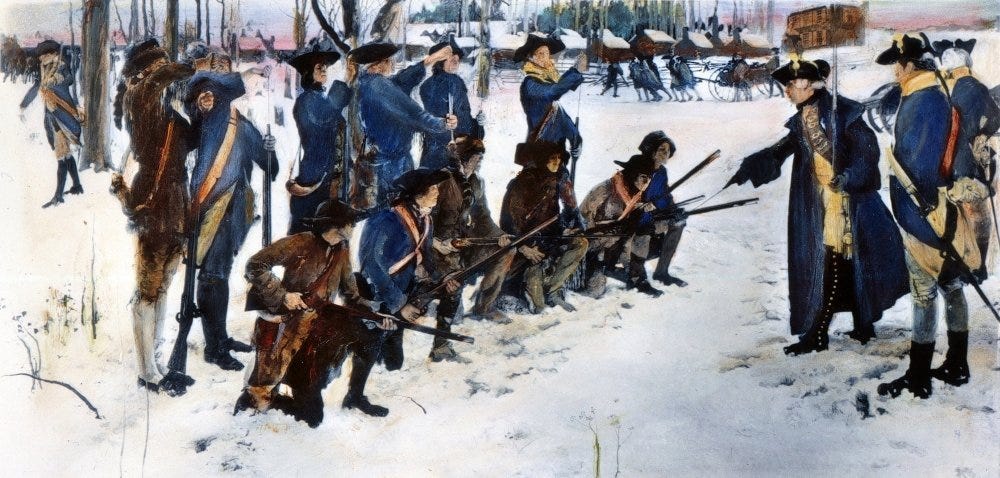
Jordan Schneider: I want to stay on the sad militia who don’t have time to train. In the book you have this awesome contrast between the nineteenth-century Germans who fought under Von Moltke, with their vision of warfare where everyone’s doing cute little turns on the battlefield, reshaping how deep their lines are, and these Greek hoplites who can’t even turn. The Spartans probably can, but everyone else just drifts away from the open side of where their shield is. How hard was it for these Germans, who idealized Pericles and Epaminondas, to reconcile with the fact that you had fifteen-year-old Prussians who were way more functional than what you were getting out of Thebes?
Roel Konijnendijk: They’ve been put through their paces. This is a really interesting thing about the way the warfare of the period you’re writing in affects your understanding of the warfare of the period you’re writing about. These Prussians are the first guys to seriously write about Greek warfare academically, but they were hugely influenced by the warfare of their own day, in which Prussia was spectacularly victorious over all its rivals, one of the most efficient, well-oiled machines in military history. So they saw this as something every other society must have been striving toward. They must have been trying to be like us.
But that way of running a disciplined army grows out of Napoleonic musket drills, where you have to be as quick as possible reloading and as precise as possible maneuvering. Some Greeks had awareness of these advantages, and it goes right back to Homer. In the great battle outside Troy in the Iliad, the Greeks are advancing quietly, in silence, and the Trojans, who aren’t used to that, are terrified. We understand the power of discipline, the importance of keeping your cool, or appearing to, in front of the enemy. But to structurally impress that on the entire militia, you need to get them all to take the time to figure out how the maneuvers work, and imbue them with the confidence that when the order is given they can do it without a hitch. Otherwise they’re going to be even more scared, because they think it’s going to be chaos.
This is what happens in a couple of Greek battles. Cleon outside Amphipolis wants to retreat and orders his army to wheel. They don’t know how to wheel, so they fall into complete disorder, and the Spartans attack them as they’re running away. Complete slaughter, seven Spartans and six hundred Athenians killed. And that’s explicitly why the Spartans chose that moment to attack.
So there’s this understanding that you have to get them to take the time to drill, and the simple fact is that from various accounts, the other Greeks besides the Spartans just didn’t get it. They didn’t understand why or how it would work. Spartan drill is very simple. It’s described by several sources, especially Xenophon, who had personal experience with it. You essentially have officers in front, and you just follow them. You do exactly what the guy in front of you does, and everything will be fine. But Xenophon explains this at length to his audience, clearly assuming they don’t get it, that they think it’s all way too complicated. I can teach this to students in twenty minutes. It’s very easy, but you have to have the mindset. We inherit from generations of people in the army the idea that we understand how parade-ground drill works. For the Greeks, this is still quite a novel idea. Very few of them know instinctively how to do it. And most of the ones seen doing it have clearly had Spartan training. The Spartans bring others into their army and say, right, we’ve got to do this first, get these basic formation drills into your head, then we can continue. That seems to be the singular source for this kind of tactical sophistication.
How the Greeks Thought About Military Thought
Tony Stark: On that note of how they didn’t understand how Spartan warfare worked, where did military thought rank in the philosophizing and socializing? How did Greeks think about what it meant to think about military thought? Was it valued, or was it something that, like training, they’d wait until war came?
Roel Konijnendijk: Excellent question. You don’t have militaries in the Greek world. You don’t have military academies. So all of this is informal. When they talk about warfare and how to get better at it, they’re doing it among friends, because there are no professional soldiers. In Athens, a board of generals is elected every year and serves for a one-year term. The generalship is one of the few magistracies where you can get reelected. Some people are considered very good at it, so they get reelected lots of times. Pericles, like thirty times. Phocion, a general in the fourth century, gets reelected forty-five times. He holds the record, that’s basically his entire adult life. But that’s very rare. Some of these guys only get elected once, go into battle, and immediately die. There isn’t much continuity of expertise. There’s no old generation of generals informing the new one. They’re doing this informally.
So you have to imagine people getting together at drinking parties, or sitting outside talking to philosophers, chatting about current events, rehearsing ideas they’ve heard, trying to pass on the necessities to the next generation. You get philosophical dialogues where this happens, where Socrates has to explain to some kid who comes up and says, I’ve been training with this drill-master for hire who goes around the Greek world teaching basic military skills. And Socrates goes, yeah, but did he teach you how to be a general? No, he just taught me tactics, how to position a formation, how to stand in a line. So Socrates has to say, there’s a lot more to being a general. This is increasingly, by the end of the fifth century, starting to be considered something teachable.
That’s a new development in classical Greece. Before that they seem to want to reinvent the wheel each time. There’s no awareness of any continuity of knowledge. That’s quite a new genre of text that emerged in the late fifth century BC, military treatises written explicitly because you all need to know how to do this and no one’s going to teach you unless you read my text. The first of those are very practical, aimed at, for instance, Athenian cavalry commanders. There’s a text from Xenophon that specifically says, here’s what to do if you’re commanding the Athenian cavalry. Or Aeneas Tacticus’s manual on defense under siege, which basically says, if your city is under siege, here’s how you prepare, here’s how you fight them when they’re not at the wall, here’s how you fight them when they are. These come out of that world because they fill a vacuum. There’s no systematic education in these matters. They’re starting to think, we have to make sure this knowledge isn’t lost, and then hopefully we can iterate.
Justin: Wasn’t there resistance among the philosophers to projectile throwers, light infantry, people who weren’t hoplites? Lower down the hierarchy, using weapons that were less manly, but with the ability to inflict damage on the oligarchic class in the hoplites. Didn’t that also serve a stagnating function during the Peloponnesian period?
Roel Konijnendijk: We’re all familiar with the effect ideology has on military developments. We’re not just trying to solve a problem in the best way, we’re imbued with values and ideas that tell us who we are. For the Greeks, most of the people in charge are wealthy, and they have a certain way of fighting because of how they can afford to equip themselves, mostly as hoplites, as heavy infantry. So an ideology develops in which that is the correct way to fight and everything else is for foreigners and the poor. That’s not for real men who are citizens fighting for their city as hoplites.
But there are a couple of points where this ideology cracks. One of the supports for the idea that we can go into battle and win even without training is that as long as we fight as hoplites, we’re being real men, the ultimate warrior. We stand our ground. The emphasis of that entire ideology is never on “I’m a very good spearman.” It is always on standing your ground, keeping your place in the line. And that is very much the ideology of a man who has absolutely no idea what he’s doing and needs a simple line to hold on to. I kept my pride, I did what I needed to protect my city, I stood where they told me to stand, that’s all I did. Leonidas being the ultimate example. So you use that ideology to prop up a very faulty military system.
But the other part is that once it becomes more normal for people to afford hoplite armor, you get large masses of citizens who can just about afford a spear and shield. It’s not that expensive. You can equip yourself as a hoplite for about thirty drachmae, about a month’s wage. So a lot of people can afford this by the end of the archaic period. The wealthy want to distinguish themselves from the common people, because they are not like the common people. So you see the rise of a lot of them fighting as cavalry instead. You can afford a horse. That’s the sports car of antiquity. So the ideology of the hoplite, the baseline, we’re all hoplites here, has to accommodate people trying to break away because they want more hierarchy in their society.
And on the other side, you can look down on light-armed troops, sneer at them, but they still beat you, because you can’t catch them. There are a couple of famous fights where hoplites straight up lose against these poorly equipped troops, because ultimately there’s nothing you can do about them. They will just slowly bleed you white. So from both ends, that ideology that we’re all hoplites here has to be caveated with the practical realities of Greek warfare. People will claim they’re hoplites regardless of whether they actually fight as cavalry or can’t afford to. It’s a citizen ideal. But when these ancient authors start talking about warfare, they very quickly leave that behind, and tell you in detailed terms how other forms of warfare are also effective. So I’m not entirely sure it had a very great deal of practical effect.
Homeric Heroes
.jpg)
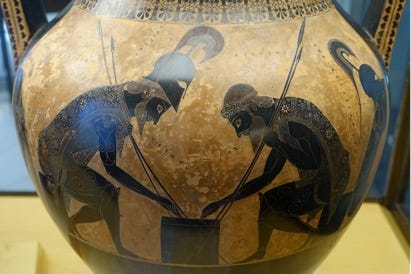
Justin: You mentioned the Iliad earlier. There are long passages that talk about Ajax being imbued and able to draw blood from Ares, Hector being able to fight off the gods, fighting as an individual and heaping bodies on the pyres. Why isn’t that something held up in actual Greek warfare? Why is it the unit, the phalanx, what the body is able to do, when in Homer it’s very much a focus on the capabilities of the heroes and their individual abilities in battle?
Roel Konijnendijk: That’s a huge question, because it’s one of the key differences between how we picture classical Greek hoplite warfare and how we picture Homeric warfare, which is all about singular heroes. The most compelling way to account for it is that society changed. In this earlier world you have far fewer people wealthy enough to afford full armor. They lord it over others. They’re literally called basileis in the poem, which means kings in later Greek, lords, princes, with a much more exalted station, and there are fewer of them. One of the ways they justify their position is by being better warriors. It brings personal glory, but it also makes the ordinary people, the laos, look at them and say, okay, fair enough, of course he’s in charge, because he’s a badass. So it feeds into itself. You have a system of status that in reality is based on wealth, but that has an ideology that it’s based on merit, and they have to prove that in these narratives by achieving feats beyond ordinary people. And to some extent it’s probably true. If you were fully decked out in armor, you’d be more willing to go to the front and throw a javelin at your man than if you were showing up in your tunic picking up a rock from the ground.
You get this in archaic poetry outside Homer as well, and even in some tomb monuments right down to the end of the archaic period, where they claim, I was with the promachoi, I was with the front-fighters. We shouldn’t see that as a front rank. It sometimes gets mistranslated as a front rank in a formation. No, these guys go out in front of others. They challenge their enemies directly. In the Iliad they literally do this. They’ll say, you over there, I know you, I knew your dad, now fight me. This kind of very personal, deliberately showmanship way of fighting, because these guys depend on it.
Over time, of course, that becomes subsumed by the communal need to work together to be militarily effective. The more of these heavily armored guys you have, the more effective they are working together. So you have to suppress that impulse, get rid of this urge to stand out in front and prove yourself. But it’s not perfect. It doesn’t go away completely. There are really strong anecdotes right down to the Persian Wars and beyond of individual warriors who deliberately go out in front, challenge enemies to single combat, try to make themselves conspicuous, make sure everybody sees who they are and knows they did something above and beyond what’s asked of the ordinary hoplite. They still learn, they get spoon-fed this idea that that’s how you behave as a hero. So it sits a bit awkwardly. There’s always this tendency to go out and be a Homeric hero, even though there’s no longer really a place for it.
Bite the Dust
,_around_440_BC,_Altes_Museum_Berlin_(13718420225)_glare-reduced_white-bg.png)
Jordan Schneider: Let’s start with glorifying violence and then go to how violent these fights actually were. These famous similes in the Iliad, and a bit in the Odyssey too, where the blood is spurting everywhere, look how badass I am. It makes for kind of nauseous reading in 2026, Roel. How do you process how excited they were to see literal heads roll?
Roel Konijnendijk: The phrase “bite the dust” is Homeric. That’s a phrase we get from Homer, where people literally die, fall over, and bite the dust, grimacing and falling into the sand. Especially in the Iliad, you get these really graphic descriptions of exactly what happens when a spear meets a face, how many teeth are knocked out on its way through. It’s really quite shocking.
But that is really unique. There aren’t many sources that go into such graphic detail. That’s something Homer in particular was really interested in. Part of it is the spectacle. They’re playing it up to let you know the stakes are very high, this is serious. They’re also not trying to sugarcoat that it’s a war. The more you amplify the horror of it, the more you also amplify the heroism of people who endure it, which is still a factor in modern war fiction. And the other thing is something we can relate to when watching modern action movies. There’s a degree of spectacle in gore that makes it more interesting to watch. The more you push the envelope of how gruesome something is, the more it becomes almost entertaining in its gruesomeness. These poems needed that. They have an audience, they’re being performed, they’re being sung, and that audience needs to be engaged. If what they want to hear is how many organs are severed before the spear comes out the other end, that’s something Homer will give you.
How you deal with that as a modern reader is actually a good reminder that they are not trying to say war isn’t horrific. They are not arguing that this is all beautiful and everybody’s a hero. They are saying that if you’re on the wrong end of Achilles, you’re going to have a really terrible time and die in agony. And that is not something that’s celebrated, because Achilles is not celebrated. We’re not here to say he’s the hero, he should win, the good guys win, we get our happy ending. He is a man who transgresses the rules of human society. He is behaving badly in that moment, and his victims are suffering for it. So it’s necessary for Homer to say, this is not nice and clean, this is a horrible act of violence.
Jordan Schneider: Can we do my favorite one? The suitors getting piled up like fish. Let me find the quote.
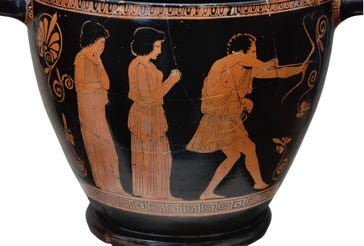
Roel Konijnendijk: What’s very cool in that scene, you get them picking up the little tables to use as shields. They’re improvising weaponry in the banqueting hall. And there are vase paintings of that, you see them picking up little tables to hold up with arrows sticking out. Greeks realized how theatrical that was. They absolutely wanted to show you that.
Jordan Schneider: All right, this is from Fagles. “He found them one and all in blood and dust, great hauls of them down and out like fish that fishermen drag from the churning grey surf and loop in coiling nets, and fling ashore on a sweeping hook of beach, some noble catch heaped on the sand, twitching, lusting for fresh salt sea, but the sun god hammers them and burns their lives out, so the suitors lay in heaps, corpse covering corpse.” Eat your heart out, Christopher Nolan.
Roel Konijnendijk: It’s a hundred and eight of them. You have to remember there are a hundred and eight suitors, they’re numbered. So this is an absolute slaughter. He’s throwing fish out onto dry land and they’re being beaten to death by the sun god, dried out. But there’s another simile that’s really gruesome, when he’s talking about how the Cyclops treats the crew of Odysseus. He grabs them two at a time and smashes their heads against the floor. And the simile he uses is, like you would a puppy. This is how you kill puppies, I guess puppies you don’t want, dashing their heads against the floor until there’s brains everywhere. That’s how he puts it. This is a world in which perhaps life isn’t always treated with the same amount of reverence that we tend to be taught by our own society to have.
Jordan Schneider: When you read the Old Testament in synagogue, the rabbis have to keep doing this thing, being like, yeah, it’s really bad, but God’s still a nice guy in the end, don’t index too much on all this smiting. When you read Homer, you don’t have to turn them into heroes or conclude that Homer’s a good person and a positive influence on your life. It’s almost easier to accept that this is what some human being was thinking twenty-eight hundred years ago, and just go from there, live in their head, as opposed to ethically justifying how it’s still okay somehow.
Roel Konijnendijk: It’s similar to how I like that the new Odyssey has already generated so much discourse, because when you see these scenes, you have to imagine that even in the ancient Greek world this was meant to generate discourse. As you’re hearing this song from the bard, you have to ask yourself, do we think this is right? Do we think this is proportional? Do we think this is the correct response to the situation? To some extent, killing the suitors, yeah, they were very bad guests, they were misbehaving, a threat to the household and the community. You’re led to think this is good riddance. But the poem immediately then says, of course, they were prominent people in Ithacan society from all the surrounding islets, and so immediately when you kill them, their families show up with weapons and demand satisfaction. Odysseus at the end is with Telemachus and his dad Laertes at the farm, preparing to die, because it’s three against an army, an army of the families of the suitors coming to kill them.
And the only reason they survive is because the gods literally step in and say, that’s enough, you’re going to stop fighting now. But the idea is, you can say these individual acts are morally justified, whatever, but there’s always this sense in Homer that they do have consequences. You can’t just do whatever you want because you think you’re doing the right thing. You have to accept that somebody else is going to think you did something horrible, or try to avenge it. There is more in this world than your own personal relationship to your morality.
Battlefield Ethics
Tony Stark: There’s some modern discourse, particularly in America, that battlefield ethics are a modern creation. I think the story of Achilles is perhaps the best argument against that. But can you talk about how battlefield ethics were discussed and considered during that time period?
Roel Konijnendijk: There is some evidence that the Greeks were particularly brutal in battle. They don’t recognize a lot of different kinds of battlefield ethical restraint. That’s one of the arguments I made in my book: fundamentally, there are a lot of ideas that they supposedly thought all sorts of things were distasteful, like attacking by surprise or killing wounded people. They don’t really have those restrictions. There are only a few rules they recognize. But they do recognize them, and they acknowledge there are ways you can transgress. One is if somebody is a suppliant at a temple, stretching out their hands to seek the protection of a divinity. Those people are off limits. That doesn’t mean they never get killed, there are various occasions when the Greeks do kill them. But that is understood to invoke a curse upon you, your family into the nth generation is going to be cursed, the gods are going to want comeuppance.
These understandings exist both in a religious sphere, envoys of the gods, people going to the Olympics to attend a festival dedicated to Zeus, those people you can’t touch, there’s a truce, hands off, because they’re sacred. But there are also practical understandings. If somebody supplicates you, reaches out to clasp your knees and throw themselves at your mercy, you can kill them, and in the Iliad, when Menelaus wants to offer mercy to somebody who does this, Agamemnon steps in and says, no, you should kill them all. But it isn’t good. This is something you shouldn’t do. If people have fallen into your hands as prisoners, there are very rare occasions when they’re mutilated. Killed, they sometimes are, but mutilated is very rare. You very rarely mutilate either corpses or live captives. So these things are absolutely recognized by the Greeks as just wrong. You don’t do that.
Violence against women and children is sometimes practiced, but sometimes also deliberately eschewed. They try to avoid it. It depends on the situation. In some cases they are horrifically violent against women and children. The enslavement process they often go through is absolutely horrific, and we shouldn’t sugarcoat that. But sometimes the population of a city that surrenders from siege is allowed to go free, allowed to become refugees and look after themselves. So there are ways the Greeks recognize that it is better to be good. That doesn’t always restrict their actions, but they do recognize a morality in those actions.
Jordan Schneider: Coming back to the Odyssey. At the end we have Odysseus. He gets three supplicants, saves two, kills one. It’s unclear where exactly he draws the line. And then he murders some of his female slaves, who he’s blaming for getting raped by the suitors. It seems like you’re getting a bit of that judgment in there from Homer, even though he’s trying to make you feel for the guy.
Roel Konijnendijk: Absolutely. I think this is one of those cases, especially that scene where he kills the enslaved women in his own household because they collaborated with the suitors. This is something that also happened, for instance, in occupied Europe after the liberation, a lot of women in local populations suffered horrific punishment and ostracism because they had relations with the occupying forces, with the Nazis. You can say they weren’t doing that out of free will, or you could say the Netherlands, for instance, was occupied for almost five years. You have a reality that doesn’t seem to be going away, so you deal with it, you try to continue a normal life as best you can. Some of that may be open to people’s free will, some may not. But populations do have a tendency to react as if it’s all deliberate collaboration with the enemy. That is often unfair, but it’s also something that happens. So that’s one of those occasions where Homer wants you to talk about it, to discuss it and say, do you think this is right? Do you think Odysseus and Telemachus are justified, or do you think this is where he goes too far?
That’s also true in the Iliad, which is also about people transgressing. You can debate who the good guys and bad guys are, but there’s always people who cross a line. Agamemnon is not wrong to say he should be the most honored, because he has the largest contribution and the most authority in the army. But when he steals Briseis from Achilles and demands her specifically as his prize, he’s going too far, because he’s not just granting himself the highest honor, which everybody agrees he deserves, he’s taking it away from someone else. And then later, when he tries to make up for it, saying, okay, Achilles, I’m sorry, have all the gifts you could possibly imagine, a huge list including entire cities, if you’ll just come back into the fold and fight again, and Achilles refuses. Then we’re meant to understand it’s Achilles who’s transgressing. He refuses a good compromise, a generous offer, and isn’t willing to play ball with the way human society works. When someone tries to say sorry and you say, no, I don’t forgive you, then the onus comes to be on you. And Achilles goes further and further from there. Ultimately he takes a couple of captured Trojan prisoners of war and throws them onto Patroclus’s funeral pyre. And every Greek knows that’s going too far. You’re making human sacrifices to your buddy. This is absolutely unacceptable.
So there are a lot of those moments where Homer’s deliberately trying to tell you, yeah, you can come along with me as I describe this very emotional, recognizable, relatable response to something. But I’m also going to show you there’s a limit to how much you’re willing to stomach, how much you’re willing to say, okay, I’m with this character so far, I believe they’re doing the right thing. And then he says, okay, but how about now? He keeps pushing that. I think the composers of this poem want you to think about what’s right in these different scenarios.
Immortality or Glory
Justin: Achilles is the greatest hero, name written in the stars, talked about for thousands of years. And then his oration as a ghost, when he says if he was given the choice again between being immortal and being remembered forever, he would choose to be immortal, because death is terrible. What is your interpretation of what Homer was trying to say about the value of legacy and martial virtue versus just being alive?
Roel Konijnendijk: It’s hard to know. You have those two contradicting accounts, that Achilles very deliberately chooses a short life and eternal glory, and then once he’s dead and shows up briefly in the Odyssey, he says, actually, it was wrong. There isn’t necessarily a single morality there. It makes sense from the perspective that Homer is trying to explore the human condition. What good is anything to you if you’re dead? What’s the point of having eternal glory and your name remembered if you’re not around? You can’t experience anything. The way they describe the underworld, there are shades living in an eternal fog in the darkness. There’s nothing for them, they’re hungry, they’re thirsty, they’re suffering. So he would have given up a lot to have a few more years just living life, enjoying the things you enjoy and suffering the things you suffer as a human being.
The Greeks certainly didn’t think being alive was good per se. The life of an ordinary person was very hard. There’s a lot of poetry, like Hesiod’s Works and Days, describing how you have to work really hard to live even a little bit comfortably. It’s hard, there are cold winters and hot summers and hard work and bad people. But all of that still means you get to experience things. All of us who think about the afterlife in any form usually consider, is it better to be in whatever that place is, or better to keep on doing this, to keep experiencing my own consciousness in this world?
It’s one of the ways you can see that even though this poem was composed twenty-seven hundred years ago, in the form we have, it’s incredibly prescient in the sense of which questions are going to matter, which are going to keep us talking for a very long time. When you read Works and Days, you’ll find very little that makes you go, yeah, I could use this to open a conversation about my view on life. Whereas the Odyssey is absolutely packed with it. We know why this survived. It keeps us talking, keeps us thinking, keeps us making this same consideration of, well, was Achilles wrong? What should he have done? That must have been at the forefront of the minds of all these people who live in a world where you somewhat regularly go to war yourself, risk your life in battle, where the only reward you can expect to receive is a memory, to be well remembered as a person who died doing what’s right as a citizen. You have to wonder, do I want that, or is it better to run away so I can live a little bit longer? That’s obviously on a lot of people’s minds in that world, and after.
Jordan Schneider: If you’re thinking about what literature is going to last, and by last we mean hundreds, thousands of years, it can’t just be compelling, it can’t just be the blood-gore popcorn stuff. It needs to have people split on it, reasonable people split, and continue to split on it in totally different cultural contexts, so you want to keep talking about it. I’m sure there are Hesiod arguments about is this god the better god or that god the better god, but no one cares once Christ comes around. Getting on those timeless human themes is a pretty hard thing to do in the moment. Hats off to Homer for pulling it off.
Roel Konijnendijk: Some of it is timeless. Other things you’re just like, okay, there must have been an environment in which this was very useful, but I don’t think now we need Hesiod to explain to us that we shouldn’t piss in the river where we get our water. Which he spends some time explaining.
Tony Stark: Unfortunately, battlefield hygiene is still a challenge for a lot of folks.
Justin: If you had worked with privates in the military, you would know that you still need to teach that lesson regularly. I mean, tie it to the two hundred and fiftieth anniversary of America. It was a Prussian who came over and had to look at Washington and be like, you recognize that your men are shitting next to where they’re cooking their food, right? That’s the reason you all have dysentery.
Roel Konijnendijk: That’s that Prussian military method rearing its head again. I read about that, when Steuben’s training the Continental Army, where he started out drilling Washington’s guard and then they passed it on to the rest of the army. The idea there is very much similar to the Greek situation, where these are militia that have received very little training and are constantly being defeated by a more professional force. And what they’re learning is not that difficult. It was like two weeks that he spent training them. And that’s for musket drill, way more complicated than what Greek hoplites would have to do. So just that basic element, it’s not that you have a lot of trouble figuring it out, it’s that you need someone to tell you, okay, this is what you’re going to do, and take you through your paces, set aside the time, which they had in Valley Forge. And you come out a much more effective force. Sometimes you just need someone to drop in and say, here’s how you can get much better very easily.
This is one of the ways knowledge was passed on in a period before you had dedicated treatises. You had these poems aspiring to teach everything, from morality to the practicalities of military organization and combat and farming and proper marriage relations. Those things are discussed and composed into songs and texts that last longer, precisely because there’s no community college, no way to get this from a professional. You’re passing it around as stories, as oral tradition, and eventually as written poetry.
Cultural Blinders
Jordan Schneider: I want to come back to violence. It was a fascinating theme in your book, this idea that everyone wanted to think these battles were clean and respectable, that these citizen oligarchs of this city didn’t really want to kill that many oligarchs of that city. What was so weird was the evidence you used to argue against it. It’s just right there. It’s pretty obvious in a lot of these texts that once the other army starts fleeing, you run and try to kill as many as you can.
Given that we spend a lot of time on this podcast talking about lessons from Ukraine, where there’s so much data, so many different things you can look at, it boggles my mind that with these battles you have a limited amount of text and artifacts to work with, and people will just overlook things because they have cultural blinders of their present day. I’m sure fifty years from now your PhD students’ PhD students will say the same about you. Any thoughts on people missing stuff in the text that they don’t want to read?
Roel Konijnendijk: It’s a really interesting point. The argument I made in the book is that these earlier authors were so guided by their own conception of what these battles looked like, how they wanted to model them, create a template of what a battle typically looked like, in which they included statements from the sources that seemed generalizing, like, okay, the Spartans never pursue a fleeing enemy. These statements occur. They’re not true, but they occur. And if you want, you can privilege that information over the counterexamples you could conjure up from specific accounts. They did that initially because they had this model in mind, this strong sense of wanting to make it make sense as an overall picture, and they didn’t care so much about the smaller details.
And they had this investment in the idea that the Greeks were deliberately hobbling themselves, denying themselves the opportunity for the victory of annihilation that Clausewitz would privilege, because they were more civilized, more gentlemanly, but also because they hadn’t quite invented yet how to be maximally effective in war. This goes through a linear progression, from the Greeks to Alexander, and then Alexander to the Romans, getting better and better at figuring out how to be maximally effective, which lets them conquer larger empires and defeat harder enemies. If you have a linear development, you’ve got to start somewhere where it’s not very effective and build it up.
But the other thing is, there’s a point at which this grows above the head of an ordinary person trying to make sense of it all. This is why increasingly, when working with large data sets, we rely on automated processes to help us understand these things, put them into graphs and charts, because otherwise we can’t handle the data. In the study of ancient warfare, despite the comparatively small amount of evidence, there’s already this sense in which people will decide on something to privilege, some narrative to tell, and in doing so decide other things are less deserving of their attention. A lot of the time they’ll explicitly say, this is just a sideshow, not the main issue.
Jordan Schneider: People decide the story because it fits with some Victor Davis Hanson broader political narrative they have. Or they just want to piss off their advisor. When you see people go story-first, where does it often come from?
Roel Konijnendijk: Very often it comes from the historiographical tradition, other scholars they’ve read. That has so much influence. We all have this image of Sparta as a super-conservative militaristic society focused exclusively on war. If you talk to an expert who works on Sparta now, they’ll reject all of that. But that’s the cutting edge. If you pick up a book from a bookstore, you’ll pick up Paul Cartledge’s book on the Spartans from the 1970s, and you’ll read all of that old account exactly as I’ve just said it. It’s not that it was wrong, it’s that it was believed at the time, the best of their understanding, which may have come from political ideologies or personal proclivities. But now those ideas are just around, and it’s very hard to say, you have a bunch of books on Sparta all written by respected academics, but these are wrong and these are good. It takes a long time to develop the critical ability to do that for yourself.
Around 1990, everything changed. Up to then, everybody had more or less the same idea of what Spartan society was like. And then suddenly a number of scholars from different angles started to completely reinterpret the evidence, trying to privilege other parts than the ones previously taken as baseline, saying we need to look more at contemporary than later evidence, and more critically at what the evidence tells us, because it isn’t always straightforwardly telling us what we want to know. Getting a better understanding of what genre and propaganda do to the records that survive. All of that contributes to thinking better about the material. And that’s why views in scholarship can change quite radically even in ancient history, where the literary evidence has been more or less stable for a hundred and twenty years. The ideas that come out of it keep changing.
Reading Recommendations
Jordan Schneider: I’m curious, in the ChatGPT and Claude age, where you can just ask these models to surface all the references instead of going back to the books and flipping through, do you see anything interesting in how your grad students are using these tools, or has it changed your process?
Roel Konijnendijk: You’ve probably encountered other humanities scholars being extremely hesitant to foster this technology, because we generally don’t trust it. It can get information for you, but you still have to check whether its references actually exist and whether the material says what it says it says. People are using this technology in ancient history especially where there are large data sets, like inscriptions. In Latin there are tens of thousands, often partial, often damaged, and scholars use large language models to feed in all the ones we have and help predict what might fill a gap in the formula. It’s used for that sort of thing.
But when you’re looking at something like what I study, which is mostly qualitative and literary, you can’t just ask the question and have the machine tell you all you need to know. You need not just familiarity with the passages, but to know what they are in context. When I take my students through some of these passages, we can all read the same passage in a short amount of time. A lot of the time in ancient history you can read all the available evidence for a particular question in half an hour. But that doesn’t mean the students can immediately say anything I would say, because they don’t have the same grounding, they don’t know what these sources are, how to rate them, how to evaluate them.
As is often true in humanities research, the journey is the end. It’s about building up the expertise to assess these things critically. You can’t outsource that, because the machine can’t do it. It doesn’t know what you want to know. So I hope people don’t try to use LLMs to replace the kind of work I do, because the work would be terrible. You need to commit your own expertise and critical thinking. Otherwise you’re just going to regurgitate what was already there.
Jordan Schneider: This is my pitch for why this stuff is particularly fun to read in undergrad. If you’re trying to get to the frontier of World War II studies, I’m sorry, that’s ten years. You’re not going to consume all the primary sources. But if you want to deeply understand even something as big as the Peloponnesian War, over the course of a semester you can consume a pretty high percentage of the primary source material that’s out there. And then all of a sudden you can engage with the secondary sources at something approaching a peer level, in a way that just isn’t possible with modern stuff because there’s too much out there.
Roel Konijnendijk: Absolutely. It’s one of the things I always say I enjoy most about ancient history, the relatively low threshold. You can read everything there is to know about Sparta in a year. Every single thing. But then the next thing you need to do is develop the empathy, creativity, imagination, and critical thinking that lets you actually construct theories about historical reality based on that limited material. How do you get from reading all of that to having something to say about it? That’s a fascinating process, and something you can’t replicate with a machine. That is the great fun of ancient history, you really have to use your brain. You have to step in and say, what do I make of all this? Can I resolve these contradictions? Can I fill these gaps? You have to get to the level of comfort and confidence where you can say, this doesn’t scare me.
Jordan Schneider: What do you want to get the kids going on? What are your primary sources to throw folks at?
Roel Konijnendijk: It depends. Nowadays a lot of people come into classics through myth, which is radically different from the way it used to happen. They’re reading myth adaptations or Percy Jackson, and that’s what brings them in. So if that floats your boat, you’ve got to read Ovid’s Metamorphoses, or Apollonius. Those are the main sources we have for the myths we’re retelling.
For the WarTalk option, the Iliad is great. There’s just no two ways about that. It gets boring in parts of the beginning, because you have to go through the catalogue of ships and who kills who in the fighting, but you have to think about that as functional for the text. The Iliad is absolutely wonderful, and there are some really good translations, so you almost can’t go wrong.
I’m a huge fan of Xenophon, who is himself an experienced commander writing about warfare. Polybius similarly, although he’s very unpleasant as an author, I really don’t like him very much, but he’s a good military historian willing to go into a lot of detail. These are all people you can find cheap translations of everywhere, a lot of them online for free. Herodotus is the gateway drug for people interested more on the history side, just because he’s so varied. Some of it very military, especially books seven and nine, Thermopylae and Plataea, all warfare all the time, but the rest is so interested in the enormous scope and diversity of the world around him. He’s fascinated by everything, and it’s something that infects you when you’re reading it.
Jordan Schneider: I just want to shout out Lucian of Samosata. I don’t think there’s any war stuff in there, maybe I haven’t come across it yet. I’ve been writing more and more satire this year, and I was like, who’s some ancient-world satire I should start with? The guy’s hysterical. He’s making fun of all the philosophers, the gods, society. He has a sci-fi novel in there where the humans go to the moon. He’s just a wacky dude. And he’s from two thousand years ago. What a treat.
Roel Konijnendijk: Who would have thought? But you have to imagine this is not the ordinary people who live in that society. These are the people whose works are preserved over two thousand years. And the first fifteen hundred of those, they had to be manually copied. Every now and then a monk has to sit down and physically write every single word he sees on the page, otherwise it gets lost.
Jordan Schneider: He’s making fun of Jesus. The fact that you can make fun of Jesus and then be so loved that you still get the monks to copy you, you really have to be on your shit.
Roel Konijnendijk: That’s a boss move, I have to admit.
Justin: My favorite is still Antigone. I got to hear Lucy Lawless read the part of Antigone on a show more than a decade ago, and it was a throwback to my childhood. It’s seared into my mind now, she is Antigone. Every time I think of an ancient Greek woman, Lucy Lawless becomes that person.
Roel Konijnendijk: It’s another one of those examples of a text really thinking about the morality of war. Sophocles’ Antigone is also great.
Jordan Schneider: I’ve been listening to two Odysseys simultaneously. There cannot be a stronger contrast between Claire Danes’s Emily Wilson Odyssey and Ian McKellen’s Fagles Odyssey. It’s the same text we’re working from, but it’s so fun. These things contain multitudes.
Roel Konijnendijk: I didn’t know Claire Danes did the voice work for that. That’s great, I’ve got to find it somewhere.
Jordan Schneider: She commits. Keeping that tone up for fifteen hours is a remarkable accomplishment.
Roel Konijnendijk: Twelve thousand lines. I wouldn’t want to do it.
Jordan Schneider: We’re going to call it here. We’ve got to do this again sometime, this was such a treat. Thank you so much for being a part of WarTalk.
Roel Konijnendijk: It’s a real pleasure. Thanks so much for having me.
The very fact that every generation throws its particular military culture back into antiquity is the lesson that this passage teaches. The 19th-century Prussian theorists believed that the disciplined drill was characteristic of all antiquity because their contemporary military thought dictated so. Same way, the modern international relations analysts appropriate the ancient Greek historian’s concept of the Thucydides Trap, because the great-power rivalry is the backdrop of today’s world politics. This fact puts the very existence of timeless political wisdom in brackets, which can be applied in future as well, not only in the past, as some scholars of comparative political theory are claiming nowadays..
The most useful correction here is not simply that the “trap” is historically inaccurate, but that it confuses structural pressure with causation.
A rising Athens altered the field, yet Corinthian interests, alliance commitments, domestic calculations, and contingent decisions turned pressure into war. That distinction matters today: structure can narrow choices without choosing for states.
History is valuable less as a catalogue of outcomes than as a way to separate constraints from decisions.