
The “love tap” White House readout. A failed convoy operation. KSA pulling overflight rights. Iran with 70% of its missile force still intact. And one F-15E shoot-down from absolute disaster. Retired Air Force Lt. Gen. Jack Shanahan, the founding director of the JAIC, joins the WarTalk crew (Bryan Clark, Eric Robinson, Justin Mc, Tony Stark) for a postmortem on a weird week in the strait.
We discuss…
Why Project Freedom failed
Whether this war is “bereft of strategic thought”
Steelmanning Midnight Hammer and the cul-de-sac the administration walked into
70% of Iran’s missile force still standing, Saudi economic exposure, and Iran hitting AWS data centers
F-15E losses, electronic warfare, and the lessons we’re not absorbing for the Pacific
Why we’re not seeing offensive cyber against Iran and what that tells us
Listen now on your favorite podcast app.
It Was a Love Tap
Jordan Schneider: This has been the murkiest week we’ve had in a while, right?
Bryan Clark: Absolutely. The White House has announced that the war is over as well as continuing in a new form. It was a “love tap,” it was a trifle. It’s a whole smorgasbord of military operations.
Justin: These shootings do not equate to a ceasefire being broken.
Bryan Clark: Exactly. Like if you went to tea at the Langham in London. So the latest — the leverage Iran has right now is the closure of the Strait of Hormuz. The US saw an opportunity to say, well, if we can erode that leverage, maybe we get a better position in negotiations. The gambit was an escort operation on the cheap.
Back in the 80s, in the Tanker War, the US Navy had to escort shipping through the Strait with dozens of warships interspersed among convoys, defending against missiles, small boat attacks, and mines. Shipping companies had to flag their ships under US flag and have US warships next to them as bodyguards. It was a large undertaking.
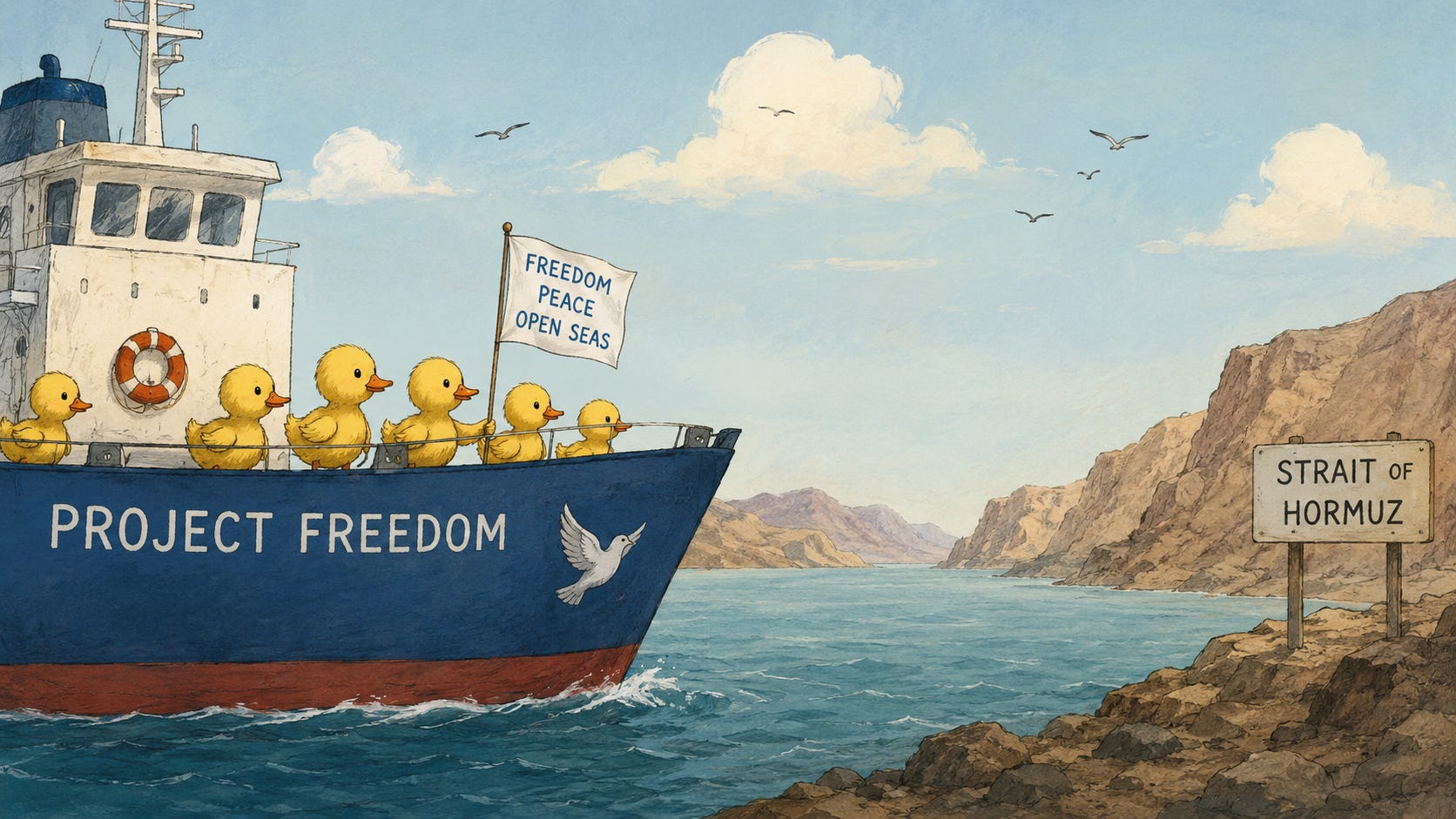
The administration didn’t want to pursue that level of effort this time. They tried to convince shipping companies to join a sort of convoy of convenience — a couple of US warships leading them out, commercial ships falling in like ducklings behind. If that worked and Iran didn’t attack, you’ve called their bluff.
Well, shipping companies didn’t find it credible. The level of protection wasn’t sufficient, and the US wasn’t willing to flag their ships. So they begged off. The only two ships that came out were two US-flagged Maersks that knew they’d be protected no matter what. The US took out some Iranian small boats and a pretty good number of cruise missiles and drones launched at the warships and commercial ships. Those threats were neutralized — but the rest of the 900 or so large ships in the Persian Gulf are still there.
One complicating factor: the Kingdom of Saudi Arabia decided not to allow basing or overflight rights for US forces doing this defense operation, which really constrained the air power available. Without that air cover, without willingness to put Navy ships at risk in larger numbers, it just wasn’t credible. The US, to save face, said we’re going back to the negotiating table — Pakistan and Saudi Arabia have asked us to. It was a nice way to walk it back without looking like you’re running home with your tail between your legs. But in a lot of ways, it was a failure.
Eric Robinson: 20,000 sailors are aboard those vessels. Bryan — about a month ago, there was robust commentary about how MBS was aggressively advocating for increased military action, that between Riyadh and Abu Dhabi there was this percolating assumption that if you’d breached the peace and gone to war, you might as well try to finish off the regime. What transpired in the past month that has led regional stakeholders to back off? Or was that original viciousness not particularly well-sourced?
Bryan Clark: Probably a combination. We met with MBS back when he was defense minister as part of the effort to sell multi-mission surface combatants. He seemed very savvy, very knowledgeable. I find it hard to believe he’d be so naive as to think the Iranian regime would fall just with sustained firepower from US and Israeli air forces. So I think it was probably not that well-sourced at the start. And then in the last month, we’ve just seen evidence that the Iranians aren’t going to fold.
Justin: I think this speaks to two things. One is that the preeminence of an air campaign alone was never going to be enough to capitulate Iran. And the coalition building necessary to even sustain those operations — we didn’t have those conversations already in place. Like, hey, if they try to close the Strait, this is what we’re going to do, this is the access we’re going to need from Saudi Arabia and UAE. And then as soon as Project Freedom gets launched, UAE gets hit. Iran is denying it was them. So there’s also the question of what else is going on in this area where maybe KSA is like, hey man, stuff’s getting wilder than we’re prepared for.
Bereft of Strategic Thought
Jack Shanahan: A couple of things. First of all, it’s become evident that all I have to do is come up with a new name and you get another 60 days. So we’re going to see a lot of different names used to get around the War Powers Act, which is crazy by itself.
But to a broader point — I’ll never forget being in a meeting in Secretary Mattis’s office, not long before he resigned. Wasn’t a meeting I had to be at, but I was in. Very small group, OSD policy was there, and he was clearly tense. Came back from the White House. The discussion was about Russia, and the OSD policy people were in a good mood saying, here’s what the administration wants to do.
He was terse. He picked up this paper they were talking about and said, “This paper is bereft of strategic thought.” Very classic Mattis. This operation is bereft of strategic thought. We don’t know what the end state is. They’ve tried to explain it 15 different times, but it’s a variation on a theme and nobody can understand. I feel bad for the people doing the targeting because they’re going to do what they were told to do. But if anybody’s trying to ask, what are we doing — the connection of ways and means against what strategic end state — I don’t have a good answer. Right now it appears to be the Strait of Hormuz is open, and I can’t get much beyond that. Maybe enrichment is under negotiation — how many years, with complete obliteration to, well, maybe 10 years.
Without that clarity in strategic end state, this is not going to end well. Sourcing is a little unclear, but UAE may have been attacked again by ballistic missiles and drones it successfully defended against. And Bryan, those US naval ships were attacked, successfully defended, but we’re one inch away from catastrophe if you successfully hit one of those ships. And it will not be hard to do because they still have plenty of fast boats, drones, and other capabilities.
If we end up killing American sailors on these ships, that is going to make a turn I don’t think we’re prepared for. The president used a phrase yesterday I’m trying not to read too much into — that there will be “a bright glow” coming from the country should Iran successfully attack one of our ships. That sounds to me like he’s suggesting nuclear weapons. That is not a path we should be walking very far down.
Eric Robinson: Didn’t the president come out and say he wanted to buy the HEU?
Jack Shanahan: I’ve heard a lot of different things. One is, it’s so far underground they’re never going to get it. Two, they’re going to give it to us. Three, well, maybe we can pay for it. The response from the Iranians has been clear: no, we’re not giving it up.
Tony Stark: Well, to be fair, if anyone knows the market rate for highly enriched uranium, it’s the Pakistanis. So we’ve got the right negotiators.
Bryan Clark: AQ Khan, exactly — he’s our negotiating partner. To Jack’s point, that’s the reason we didn’t do the full meal deal on the escort mission. It’s inevitable that one of these ships gets attacked if you put them in contact with Iranian forces long enough. And the US doesn’t want that visual. They’ve built up the expectation that this is a risk-free operation. There hasn’t been a strategic rationale that would justify having a lot more casualties. They’ve backed themselves into a corner where they can’t mount any operations that are higher risk.
I’ll note one other thing from Navy land. The passage US ships have been using, right next to Oman, is pretty narrow. They’ve identified that as an area free of mines — a Q route, as we call it. But it’s not wide enough for two-way traffic. So if you’re going to restore access to the Strait, it’s one-way traffic, single file, nowhere near 130 tankers per day. There’s some other mine-clearing operation that still has to happen even once we get to a negotiated settlement. That’ll take a couple weeks at least to verify the area is clear, and probably a couple more to clear what you find.
Justin: Bryan, sticking on that — during the Tanker War, that’s when the SEALs really leaned into VBSS, the visit, board, search, and seizure missions. What’s our strategy right now?
Bryan Clark: The Marines do those now. So one of the things Marine Expeditionary Units are doing out at sea is VBSS missions to support the US blockade. The Marines have gotten a lot of experience between Venezuela, Cuba, and now here. They view one of the ARGMEU missions as now being blockades and VBSS, which we’d always envisioned but they hadn’t really practiced.
Justin: When we talk about risk acceptance, is there an acknowledgement that that is a highly risky mission? I think back to even training in the Gulf — those two SEALs killed two years ago, the swim buddies, one fell off the boat trying to climb in and the other one went in after him. And that’s training. There’s also the question of, back to the Tanker War, the Vincennes shooting down the Iranian airliner. When all of our defenses are turned on, what prevents something like that from happening?
Jack Shanahan: What you’re not hearing is — and I know this is military talk that won’t resonate with the typical American — what is the acceptable risk to mission, risk to force? Those are concepts everybody in the military lives by. You could try to translate that at the administration level and say, this is so important, we’re going to accept a certain level of risk. You’re not setting the stage to accept some level of casualties. If you did it in a way the American people would buy into, that’s different. Right now, that risk discussion is the opposite — no, no, this is a cakewalk, piece of cake.
Eric Robinson: And it’s also grounded in almost anti-constitutionality. Civic risk management is Article 1, Section 8 — this is supposed to flow through Congress to the executive. There are numerous parts of a regular process that have been avoided or skipped.
Jordan Schneider: And this is how you get to that no-more-ammo conversation we’ve been having for the past month. Part of buying down potential casualties, potential hostages is using more long-range stuff, which is more fancy and expensive — so you don’t have to have planes flying over the country. That doesn’t mean no risk, that means more risk in 2027 and 2028 when you have less of this stuff for other theaters. By dialing this down, you end up sort of spending more.
Tony Stark: Yeah — using long-range exquisite munitions is to buy down risk to force. What they will not say is that creates more risk to mission, because you still need to be able to hold ground or hold blue ground, and to impose your will upon the enemy, which they haven’t been able to do. Now you’re inviting greater risk to force and mission in other theaters, which is really killing me. If we have to do another three to four months of this, as the leaked CIA report says, the amount of munitions we can burn in that time is another two to five years of magazine relays.
Eric Robinson: Hyperpowers have constraints.
Memorial Day Math
Jordan Schneider: Setting aside a broader economic turn — if this war lasts another few months and gas hits $5, $6, what are people going to be campaigning on in October and November? National security as a vibe in Washington has been on a pretty long bull run. Since 2018, a broad consensus around preparing to deter a big conventional war in East Asia. Having such a dramatic military adventure go poorly — if it ended tomorrow, this wouldn’t necessarily bake in. But if this drags on much longer and the inflation impact really starts to kick up, it’d be a scary time for me working in a Pacific-oriented defense tech, much less a prime.
Jack Shanahan: Part of this goes back to national-level messaging. If the case was made to the American people — look, there is going to be pain — I don’t want to make this a Jimmy Carter “feel the pain” message, but if that messaging was strong enough, you’d get some people to accept the short term. It’s open-ended right now. And when it’s open-ended, all people are hearing is one, gas prices, two, fertilizer, things they don’t even know about. The pinch is going to be felt in four, five, six more months. By then, the question on the election will not be a national security question — it’ll be economic. We’re in this purgatory right now. It’s neither war nor peace, and we don’t have a solution for it.
Jordan Schneider: I just think it’s unsellable, Jack. Iran getting a nuclear weapon is not something that the current body politic is willing to send thousands of people to die for and spend hundreds of billions of dollars on.
Tony Stark: The next trigger here is Memorial Day weekend, two weeks away. That is the first big test of whether people are willing to tolerate big gas prices. I think the answer is going to be no.
Eric Robinson: There is going to be a historic precedent of rally-to-the-flag, that people will take their countryside in times of challenge. The administration, through its muddled messaging about — it’s about nuclear weapons, it’s about respect, it’s about conventional capacity, it’s about just killing their leaders because it’s fun — has muddled that. And when you do not go to Congress and compel members of the House and Senate to put their careers on the line to affirmatively acknowledge that we’re going to war for this purpose, you lose the opportunity to create civic virtue around the expenditure you’re about to expect the country to bear.
Steelmanning Midnight Hammer
Jordan Schneider: I’ve gotten some critique from more right-leaning family members about how all we do is beat up on these guys. So let’s do a counterfactual. You’re sitting there, you really think Iran’s about to get a nuclear weapon. You know you can’t get Congress to vote for a real military operation. You also know that the American people will not tolerate 100 or 1,000 Americans dying. So what is the path that’s left to you? It’s a negotiation, but say you don’t believe in negotiation and you can’t trust them. So you’re left with this very uncomfortable, narrow path where you’re just trying stuff and seeing — because there aren’t necessarily good options. Got to bake in 10% — maybe I draw two aces on the river and if we kill everyone, things end up going swimmingly. I do feel for these guys at some level.
Eric Robinson: Jordan, I think Kamala Harris, if you’d given her the mission profile of Midnight Hammer — that the Israelis, by virtue of their intelligence services and special operations, had reduced Iranian air defenses to a negligible position, that they had good targeting data on the three principal sites, that you knew where the HEU was, that if you used a certain number of ordnance penetrators against these targets you could set back the Iranian capacity for 10 years — I think Kamala Harris would have been compelled to think about that seriously. The original military operation against the nuclear program fits within the traditional span of American national security decision-making. There are very serious Democrats that would have looked at that mission profile and said, let’s go.
Bryan Clark: Even after that operation — and people said maybe it only set it back a few months — you could just mount more of those strike operations. The air defense network in Iran was fairly degraded. With normal SEAD-type operations and whatever the Israelis had done, you could continue to degrade it over time. As long as you don’t take it to the level where the Iranians feel they have to escalate by closing the Strait — when we run these war games, the Iranians generally don’t take that action unless they’re backed into a corner because it puts them in the penalty box. So as long as you keep hitting them and degrading the capability without forcing them into that corner, you could have ended up degrading the nuclear program without getting to the cul-de-sac we find ourselves in today.
Jordan Schneider: So it’s really that temptation of the jackpot — we kill these guys and the whole house of cards falls down.
Jack Shanahan: Midnight Hammer is so defensible in so many different ways. Up to that point, you could have made — and reasonably did make — a case to the American people: we stopped them from getting a nuclear weapon. You could argue on the timelines, was it really a couple of weeks? No, it was not a couple of weeks. We all know it was not a couple of weeks. But it’s a reasonable one. From that point to today, the message has become so muddled we don’t know what we’re trying to achieve.
I watched an interview at FP Live yesterday with Ali Hashem, an Iranian reporter in the Middle East. He says this really does seem to have a reverse rally-around-the-flag for the Iranians. You’ve gone from mass protests in the cities to “why does the United States keep hitting us, and what are we going to do about it?”
Justin: Those are my two big hangups. To Bryan’s point, you could have just continued to do Midnight Hammers. If that’s where all the highly enriched uranium was, they go in to try to get it, you drop again on it. They go in to get it, you drop again on it. Captain America in the Avengers — I can do this all day. Every time you go back to touch it, I’m going to hit it again. You’re not getting a bomb, you need to come to the negotiating table. That’s the big-brother tactic I would have expected us to use. You could also have had a humanitarian argument — 30,000 protesters, they want regime change, they’re calling for it.
We didn’t do either of those things. We waited for the protests to be suppressed, waited for the killings, then started targeting and bombed a girls’ school, maybe multiple girls’ schools. Hit things of civilian importance that would be necessary for any new regime to come in and run the country. We didn’t do those things. We didn’t build coalitions. Then we started hitting random strikes outside of leadership within Iran. And then the ceasefire — and according to some intelligence reports and open-source reporting, something like 70% of the Iranian ballistic missile capability has potentially survived and been reconstituted.
70% Still Standing
Eric Robinson: That’s sourced to a CIA analysis that segments of went to the Hill. It’s supposed to be classified, but yeah — 70% of pre-war defensive capabilities still in check. After all that.
Jordan Schneider: What does that mean? They went from shooting like 200 missiles a day to two missiles a day, and by the end they were up to five or six. So 70% of what exactly?
Tony Stark: Without having seen the report — is that all missiles? Just long-range? The shoot-and-scoot type? Are we including Shaheds? If you said 70% of long-range effectors, that would make sense. That’s the “you can do this all day, lob warheads across the strait on their end.” Look at the targeting packages we went after first. First it was regime change. Less than a year later, regime change. Then we pivoted basically to infrastructure and kind of trying to do scud hunts, but not really. Given what the targeting priorities looked like, there’s maybe a world where the mobile targets were harder to hit.
Justin: And that gets to Bryan’s war games. It doesn’t take a lot to close the Strait. Even if it’s 70% of whatever the amorphous thing is, it only takes a couple of those shots for shipping companies to go, well, we’re not moving through the Strait today.
Jordan Schneider: It could be 95%. Right?
Eric Robinson: It is much less about damage control on an Arleigh Burke destroyer as it is about insurance carry rates and force majeure provisions in contracts that are tied regionally. Those are much more brittle devices than the engineering on an American destroyer. That is the core vulnerability — the financial component, which I don’t think the senior stakeholders in the Pentagon really thought through.
Jack Shanahan: And the economies of every country in the Middle East right now. I’m not trying to claim a causal connection between the Saudis pulling out of funding LIV Golf, but I actually think there’s something there.
Eric Robinson: The Saudis had a really robust strategy by virtue of their partnership with McKinsey — they were going to shift from hydrocarbons to mining to financial services to tourism. The mining project hasn’t taken off. Maaden, the state-owned enterprise, has dramatically pulled back ambitions. The megaprojects are pulling back. Even mundane residential efforts in and around Riyadh are slowing down. The Saudis worked under an extraordinarily robust set of assumptions, and those assumptions all broke based off this war.
Tony Stark: The problem with pivoting to tourism and finance is that it’s dependent upon missiles not raining down on your key industries.
Jack Shanahan: And this other one got headlines for a couple days and faded — hitting the AWS data centers. To me, that reinforces why in the world are we going to go Stargate $500 billion and build all this infrastructure in the Middle East? A very savvy move on Iran’s part — just enough to say, those data centers, yeah, we can hit those too. And by the way, if you’re thinking this whole economy is going to be based on the back of AI, we can hit that. Whether or not it did long-term damage is less the point than the fact that they demonstrated they can and will hit commercial targets they assume are being used for national security purposes.
Eric Robinson: They put data centers into the concept of critical infrastructure very aggressively. The United States has to adapt to a whole new series of targets. It’s not just like Ukrainian armed services hitting Russian oil infrastructure — there’s a much broader array of authentic target opportunity these armed actors can now put into their thought process. It was true innovation.
No Such Thing as an Air Campaign
Justin: Jack, you’ve been looking at this. What do you think the SEAD lessons learned are, given the F-35 getting hit, the A-10 getting shot down or hit, the F-15 getting hit — what are we learning or not learning from a SEAD and projection-of-military-power perspective?
Jack Shanahan: I’m absolutely shocked we’ve lost four F-15Es in a conflict I’d consider low-level. Three were by fratricide — by the Kuwaitis — so I put those in a different category. But when you only have 218, four is a pretty significant loss. Maybe the Air Force views it as, it gets us to the F-15X quicker than we expected, but that wasn’t really the intent.
The shoot-down and the near-absolute-tragic loss or capture of the crew really hit me — F-15E background, watched all that play out. Really disturbing how we got into the place where we’re getting hit by probably shoulder-fired or some infrared SAMs. As a broad comment, we’re very, very good at certain things, including SEAD. But this idea of — what do we really mean when we say air superiority, air supremacy? We have air superiority in localized areas, but we clearly do not have air supremacy over the entire country, because an airplane got shot down. You could say that was an aberration. I don’t accept aberrations. You either have air supremacy or you don’t.
We’ve suffered on the electronic warfare part for about 15 years. Thanks to counter-terrorism and counter-insurgency, we didn’t invest. The service kind of gave up on it after the EF-111, put the eggs in the F-16 Wild Weasel basket. But what we’re seeing now, both in Iran and really in Ukraine and Russia — if we do not go all in on electronic warfare, electromagnetic spectrum operations, we’re in serious trouble in a fight in the Pacific. Very serious trouble. The DDIL — denied, disconnected, intermittent, limited bandwidth — environments, that’s not an assumption anymore. It’s going to be a fact of life.
There is no such thing — I had this drilled into me by former JFACCs, real JFACCs — there’s no such thing as an air campaign. There’s a joint campaign of which there is an air component. To think you’re going to win the war by air alone is delusional. And if we put people on the ground, it’s going to get ugly very quickly.
We’re fighting two different wars. We’re fighting a very conventional one — go destroy their Navy and Air Force. We talk about how well we’ve done that. The Iranians are saying, look, we’re not going to win against you with our Navy and Air Force anyway, have at it. We’ll go at you with our ballistic missiles, our Shaheds, these fast-boat attacks. Call it asymmetric, an economic war on their behalf, while we’re fighting a much more conventional military fight. In general, we’re doing very well on the kind of things we know how to do. But that shoot-down was a wake-up call. We were one inch away from absolute disaster — a bunch of people being killed or captured on TV, prisoners of war. We got lucky in my opinion. Very high-risk mission. The heroes in special ops, CSAR, Air Force — nobody else in the world could have pulled that off. But we shouldn’t be expecting everything to go right in the future in a different fight.
Justin: Do you think the shoot-downs are going to drive more impetus for uncrewed capabilities, or do you think there’s going to be a move to get pilots all out of the aircraft faster?
Jack Shanahan: It won’t be binary. There’s always going to be a place for the crewed platform. But this is one of the many reasons driving more and more toward unmanned. It’s a little bit shocking to me — doesn’t get talked about a whole lot — I think we’re up to like 30 MQ-9s shot down. That’s not a small number. They’re what, $30 million plus or minus on the page. So we’re talking a billion dollars of assets, plus the AWACS, plus the four Strike Eagles. Many billions of dollars of assets.
Eric Robinson: Plus, all the aircraft getting knocked down are recovered by Ministry of State Security and rebuilt. All those assets are now known to our opposition. Electromagnetic signature, visual, acoustic. The crown jewels of American special technology have been revealed in Venezuela, Iran, and elsewhere.
Jack Shanahan: Like the RQ-170 that got shot down years ago.
Two big things scream to me. One — to Justin’s point — yes, more investment, but a different kind of drone. Much cheaper, mass-produced. From one of your episodes, Jordan, with a person from Ukraine, I caught onto this idea: it’s no longer just-in-time logistics, it’s just-in-time disassembly and reassembly at the operational unit as they get thrown in. Because the technology has changed in the 48 hours since the thing was delivered to where they’re going to use it. I don’t think we’ve fully absorbed these lessons yet. We’re trying to pretend that all of them are or it’ll be a different fight in the Indo-Pacific.
But counter-drones is the bigger one. We’ve struggled on this. Where does it really reside, who’s got overall lead? The counter-drone piece is the ultimate wake-up call of seeing what Iran can do with just a couple of Shaheds here and there — really having big impact well beyond the tactical level. Some of those will be electronic warfare, some kinetic, some cyber at some point. But I don’t see crewed airplanes going away anytime soon. It’ll be a question of where in the fight you use them — stand off and work your way in as you reduce the air defense threat. Maybe it was a lucky shot, a golden BB. Perhaps. But that doesn’t mean you have air supremacy.
Quiet Cyber
Justin: Why do you think we’re not seeing more cyber usage offensively against Iran? Is it the nature of the internet in the country, or have they learned lessons from Stuxnet and made it harder?
Jack Shanahan: I think we’re not seeing it because we’re not going to see it. There’s probably more happening than we’d normally think. But all the claims of cyber offense have been countered by cyber defense. It’s the classic history of military technology — Newtonian third law for every action, equal and opposite counteraction. When we’ve hit them hard with cyber, they put defense in place. Maybe — speculation — they’re getting advice from Russia or China on bolstering cyber defenses.
What would we go after? Probably command-and-control networks. Take down their ability to command and control their military and national security. That’s probably happened. Once you start talking about electrical infrastructure, you get into a much more gray area.
There’s a lot to what we saw at the beginning of the Ukraine war with Russia. We all thought Russia was going to come in with state-of-the-art cyber and completely shut down Ukraine. That did not happen. Speculation is they didn’t want to reveal their best capabilities, or it just didn’t work the way they thought — you change one router box and your cyber attack is no longer good. So a combination of things: their defenses are probably better than 10 years ago, they’re probably getting help, and on our side, what are we trying to do and why.
What I remember from Brigadier General Tim Haugh, who was vice commander when I was down in San Antonio many years ago — the operation they put in place, cyber supporting the CENTCOM fight as a truly supporting element, not trying to go off and do things by itself. Let the national agencies do what they’re going to do, but figure out how to make this part of the overall campaign. One day it’s a cyber capability, the next day it’s something kinetic. CENTCOM, as the owner of the overall fight, gets to make those choices, as opposed to treating cyber as this special thing over there. The good news for me is both cyber and space have become normalized in a way I always hoped they would. It is being integrated into the overall campaign. At the national level — what are we doing? There’s something happening, but the good news is I’m not privy to it, because I’d be hauled away if I said anything.
Jordan Schneider: Thank you so much, Jack, for being a part of WarTalk. This is a pleasure.
Jack Shanahan: Thanks, all of you. You guys are legendary. Every time I read something with Jordan, I ask myself, when the hell do you sleep? ChinaTalk keeps me occupied for at least an hour and a half every day just reading this stuff. I commend you for doing it. But God, you put a dent in my day just trying to keep up.
Amen to China Talk putting a dent in my day. But it can't be omitted. Nothing else is close in insider (or perhaps recent insider) knowledge.
Since this site is called "China Talk," I will add this. 920 Pounds of Leverage: How China Can Ground the F-35 Without Firing a Shot. Some analysts now suspect China is content to watch the Iran conflict drag on, since every interceptor launched over Tel Aviv is one fewer available for a future contest over Taiwan. In a kinetic conflict, the side that controls the magnets controls the missiles. Replenishing the stockpile, by most estimates, will take years. I don't think China will ever use force to retake Taiwan. If it had to use force, it would attack the bases in the Western Pacific just like Iran attacks the bases in West Asia.
https://www.financialsense.com/blog/21641/920-pounds-leverage-how-china-can-ground-f-35-without-firing-shot
Is this a serious discussion? Are the people in charge capable of strategic planning? Consider their "accomplishments" during this century. E.g., they spent 20 years in Afghanistan replacing the Taliban with the Taliban. It is a pathetic joke that Kamala would make a better commander in chief.