
WarTalk regulars Bryan Clark of the Hudson Institute, Justin McIntosh, and Tony Stark join Jordan.
We discuss…
The Potemkin Pacific — why Paparo has half the planet on his map and nothing to fight with, and how the Iran blockade became the status quo
The midterm budget squeeze — what a Democratic Senate means for the defense topline, why Anduril won’t keep working at risk, and how a shipbuilding binge could hollow out the force
Who replaces Hegseth — the two Mike Rogerses, and why the talent pool for a lame-duck Pentagon is drying up
The AI Force — why a SOCOM-style AI branch cuts against a technology meant to be everywhere, and what a benchmark-setting version could actually do
Manned-unmanned teaming — why putting sailors on robot ships is “asinine,” and what combined arms for robots should look like
Gifts for Beijing — the Anduril drone Iran fished out of the Gulf, dud PrSMs as intelligence windfalls, and why compute still can’t blow anything up on its own

Listen now on your favorite podcast app.
Potemkin Pacific
Jordan Schneider: WarTalk, Friday, September 25th. We’ve got the AI Force —
Justin McIntosh: “Farce” is the right way to say it?
Jordan: AI Farce, great. Paparo watch has begun — he was on the cover of Time, and I’m worried for him. The Iran war is apparently about to hand the Democrats three Senate seats. But this is sort of ChinaTalk, so let’s start with the state dinner. Takes?
Bryan Clark: Maybe the most interesting video from the whole visit was the B-2 flyover. The president was wincing, not really able to handle the noise of the stealth bomber going overhead, whereas Xi stood stoically and almost looked bored with the whole thing. That kind of sums it up in a nutshell. Xi was bored, going through the motions.
Jordan: All right, WarTalk. I can’t get over that he restarted this freaking war. He could have gotten away with it —
Bryan: Right, he could have still walked away. But as of this week, we’ve still got two carriers, about sixteen destroyers, and thousands of troops ashore.
Justin: And 30% of our missile stockpiles.
Bryan: When you add up the numbers, something like 40% of the underway Navy is sitting in the Middle East right now. So you’ve got Admiral Paparo on the cover of Time, while all the forces he’d otherwise command — including the carrier he’s on, as a matter of fact — are deployed to the Middle East. That’s the definition of a Potemkin navy.
Justin: They had to deploy him to the Middle East for that photo.
Tony Stark: The Time tagline was that his forces cover half the planet and he has to win without fighting. Yeah — because he’s got no assets.
Bryan: He has to, because he has nothing to fight with. He owns half the world from an operational perspective, but has no forces to actually do anything with. So yes, he’s going to be winning without fighting.
Justin: The idea that his forces cover half the earth’s surface is completely incorrect. Somebody shaded in Paparo’s land on a map, and that’s about as far as it goes.
Tony: That was actually a keep-out zone for US forces.
Justin: They used to have this big argument — they always wanted some kind of command post forward of the international dateline. But it would literally be two hobos with packs on their backs, and that was all they had. Then they’d say, “We need to borrow forces.” And we’d say, “Whoa, you’re supposed to be in charge. What are you doing?”
Bryan: The funny thing is, they just renamed Indo-Pacific Command back to Pacific Command this year — a big change to try to get back to tradition. Meanwhile, all the forces in the command are actually in the Indian Ocean. If you really wanted to command those forces, you’d want to be Indo-Pacific Command, because that’s where your whole Navy is — there are something like 24 or 25 ships out there right now. It’s a crazy statement on where we are with the big pivot to China. Xi’s visiting the US, all of our forces are in the Middle East, and Paparo’s on the cover of Time talking about winning without fighting.
Tony: The largest force presence in the Pacific is actually that F-35 that got shipped to Hong Kong.
Bryan: Tony’s here all week. Try the chicken.
Justin: Oddly enough, it’s the one right behind Paparo in the photo.
Bryan: Still missing a canopy. We’re still looking for that.
Justin: Somebody asked how they knew it was being shipped from Australia —
Bryan: They used a shipping company, and every shipping company is so penetrated by the PRC at this point that it’s not even worth having a discussion about.
Jordan: Should I only use FedEx in protest?
Bryan: They probably used DHL. And DHL’s Russia-penetrated.
Justin: This is something we used to complain about all the time. The only way to deploy forces to the Indo-Pacific — 1st Group struggled with this a lot — was to contract with DHL or FedEx. At one point we got so far behind on payment, because we went through a government shutdown, that FedEx cut us off. FedEx is a real company and expects to be paid for the services it renders. They said, “We’re not taking your shit anymore,” because we were about four months behind on paying for JCETs [Joint Combined Exchange Training] that happened right before the shutdown.
Bryan: All the services rely on that. The Navy relies on DHL and FedEx to ship parts all the time. It’s crazy that this level of exposure is there and we don’t put much thought into the vulnerability it creates for just-in-time resupply. And we don’t have enough parts to do it any other way. There aren’t enough to station them forward or keep them on supply ships — if you’ve got three parts and they’re all sitting on a cargo ship somewhere, no one can use them.
So the war continues. We’ve got all these forces in the Middle East, and we’ve decided the blockade is the only way to get the Iranians back to the negotiating table — and that it’s somehow paying off. There are no other cards to play, so they’re doubling down. We’re going to keep two dozen ships in the Arabian Sea running a blockade the Iranians are now essentially ignoring, conduct periodic strikes against Iranian targets that pop up, and protect an anemic flow of shipping out of the Persian Gulf. That’s the status quo.
And you’re right, Jordan. The president could eventually say, “Okay, we declare victory. Everything’s good. We’re walking away.” Everybody accepts that the baseline cost of oil and gas goes up a little, you’re paying a vig to the Iranians, and that’s the end of it. But he just couldn’t stand the idea of being portrayed as the loser in this conflict — and the Iranians would do exactly that. They would not let him get away with declaring victory and going home.
Every Service for Themselves
Tony: What’s really going to look like a loss is if they go through with a diesel export ban, because the entire world economy will probably crash. I think we refine something like 20% of the world’s diesel.
Bryan: We export a lot of diesel. It’s shocking.
Tony: Which is a great pivot to the midterms, because we are now thirty-nine days away. To Jordan’s point, the war is probably going to cost the GOP extra Senate seats. For those not tracking: we were probably looking at Democrats picking up ten to fifteen seats in the House and one or two in the Senate at most, or maybe a 50–50 split. Now you’re looking at probably plus four for the Democrats in the Senate, and somewhere between plus twenty and plus forty in the House.
Bryan: We did a summit yesterday at Hudson — Chatham House rules — and we had some minority staffers from the Hill there. They basically laid out the case that when the Senate flips to the Democrats, we’re going to see defense budgets flatten, if not go down. They won’t be on board with the continued largesse the department’s been enjoying for the last couple of years. And I don’t think folks inside the department have organized their processes around that. Their decision-making is built on the idea of more and more money coming in, so they can spread it across a more and more diverse array of startups and experiments. It’ll be interesting to see how they pivot to accommodate a smaller top line.
Tony: And that’s the thing. Normally you can rely on flat budgets, or maybe a 1–2% increase, even if the House or Senate flips. Usually HAC-D [the House Appropriations defense subcommittee] is the problem. But it seems like the Senate is really going to go after Hegseth on this, because the Secretary of Defense is so unpopular.
OSD Policy under Bridge [Colby] has not communicated with Congress, to the point where now it’s not just “we’re going to play a little hardball, but you’ll get your funds too.” It’s “actually, we’re going to make it hurt.” I’ve said this on the show before, but a lot of these folks are either checked out or aren’t used to a transition in Washington and what that looks like. Thirty-nine-plus days from now, it’s going to look like absolute chaos. Bryan, I think you said it in our chat — every service for themselves.
Justin: You’re starting to see it even in the defense tech market. Anduril came out and said, “If this budget doesn’t get approved, we won’t be able to work at risk anymore.” That’s been the Pentagon’s go-to over the last couple of years: juice these defense tech startups to use VC money and work at risk on the promise that we’ll give you money at some point in the future. Anduril’s finally big enough that it’s starting to land where Raytheon, L3Harris, or pick-your-prime is: “We’re not doing that. You’re going to have to pay us at some point.”
Bryan: These companies are also all going to have to start making themselves financially viable for an IPO. If you’re going to IPO, you don’t want your balance sheet to show you working at risk for the government in so many places that you’ll never get a return on investment. So I imagine more of these companies will get judicious about how much R&D they do on their own dime. And you can see the department starting to do more deals where it arranges funding from an outside entity to supplement the company’s own R&D, because they recognize the days of massive VC investment to grab market share are over. Partly because the market share just isn’t materializing. If you’ve got ten companies making small USVs, there’s not going to be a big enough market for all ten. Eight of them are going to wash out.
Tony: Can we talk about the Fed for a second?
Justin: I was literally about to bring up the dot plot.
Tony: If we’re looking at more rate hikes — somebody did a chart of the historic crashes in the US economy, and the worst ones are always when the market is propped up by a surge in a single sector. Railroads in the 1800s, speculation in the twenties. The concern is broader than defense tech. If the entire economy is basically being carried by the AI boom, what does that look like as the cost of money goes up and you can’t finance deals as easily? And that comes back to how the government is going to fund the rest of the budget if it’s flat or even lower.
Bryan: One of the challenges I see is with the One Big Beautiful Bill, and even this budget. The current budget will probably get approved in some form because people want it off the table before Congress changes hands. So you’ll end up with this relatively large budget this year, the $1.1 trillion or whatever, and then it flattens out if it doesn’t go down. But these budgets have an enormous amount of capital investment in big platforms that are expensive to keep. There’s something like $82 billion in shipbuilding in this year’s budget, on top of $60 billion in last year’s. Ships cost a lot to crew and maintain, and the same goes for all the fighter aircraft in there.
We’re setting ourselves up so that three or four years from now, all this force structure arrives and there isn’t enough money to keep it. So either we retire the old stuff and the military stays the same size, or we become hollow and let readiness falter, because nobody wants to be part of a shrinking military. The Trump administration at the end of its term will be trying to keep the military big, probably at the cost of readiness.
Justin: The rising cost of capital is going to be a big determining factor, too. We’re already seeing that VCs can’t juice as much. There’s a ton of debt sitting in the wings that’s getting more expensive — the old debt’s fine, I got that when rates were good, but my new debt is terrible.
I also wouldn’t be surprised if the appropriators start looking really hard at how these deals are getting made. Take the way the competition went down for NGC2 [Next Generation Command and Control], the new command post integration effort — the fact that Anduril was able to partner with Palantir, but Lockheed wasn’t. There are a couple of things where I think people are going to look really hard and ask, “How did this happen?”
Bryan: The Army’s C2 efforts over the last decade have been very ad hoc and kind of chaotic. NGC2, the latest iteration, is going to be another one where they start down a road and a year later say, “We can’t continue this. We have to pivot to a new construct.” The Army and the Air Force are both having these issues with their C3 architectures. They’ve spent a ton of money on them in the last few years — the startups have been part of that — and I think we’ll find on the back end that they have to retool again. It’s just unsustainable.
Who Wants This Job?
Jordan: I want to talk about investigations. You mentioned Palantir — Palantir and ICE will be a thing. And Hegseth — where to fucking begin with him? We’ve got Venezuela; we almost forgot about those drone strikes. We have the trading. If he leaves, does that change the tenor of the budget discussion at all? Can you imagine a world where Trump picks a secretary of war who’s somewhat more amenable?
Tony: Let me game this out. Before Pete was chosen for SecDef last time, there was talk around Mike Rogers, current chair of HASC. He’d probably be the most reasonable pick because he comes from Congress. They won’t have to worry about his seat, because they’ll be in the minority and down so many already — the thin margins were one of the reasons he wasn’t picked last time.
I can see a world where somebody like him — it doesn’t have to be him — gets picked as the replacement. Someone who knows they have to talk to Congress, who knows the budgets. Congress is always friendlier to its own. If that happens, maybe you get back to at least flat, or at least you can communicate better. From what I understand, Rogers and his staff are well liked on both sides.
The question is who else wants to come in as a staffer to a historically unpopular administration, when it’s going to be a struggle to get anybody through Senate confirmation. And who wants to be there heading into ‘28? Who thinks this burnishes their credentials versus hurting them? That’s going to be a decision for all the politicals. You could look back at the second Bush term and say it’s close, but in terms of toxicity, if you were a second-term Bush nominee, you were still fine for 2008, 2010. With how the party is splitting now, it’s much different.
Bryan: I agree. Mike Rogers would be a good choice, because if he loses his Senate campaign, he’ll be looking for an opportunity and will be dependent on Trump.
Tony: Is he running for Senate? I was talking about the Alabama Rogers.
Bryan: Sorry — wrong Mike Rogers.
Jordan: That’d be way too normal, Bryan. Come on.
Bryan: I know. That’s why I don’t think the Alabama Mike Rogers will be the choice — he’d have his own perspective on defense, and the president won’t want anybody who’s anything but a rubber stamp for his policies. The Michigan Mike Rogers would be a good choice, because he’ll have lost his campaign and will be looking for an opportunity. It could be a way for him to stay in the mix after a failed campaign against the first Muslim senator in the US Congress.
Justin: It’s like when Chris Miller didn’t get nominated but was appointed acting. Even Chris Miller was seen as somebody the Trump administration had to control in the first term — he had handlers. Then he writes the defense chapter of Project 2025, has a big hand in things, and people said maybe it would be Chris Miller. But if you listen to people on the Hill, that was never even a consideration, because he was a free thinker with his own ideas about where the Army, the Navy, and the military writ large should be focused. So I do wonder who that’s going to be. I doubt we’ll see a return to normalcy in those last two years if the administration is dealing with a truly adversarial Senate and House.
Bryan: In the interest of transparency, I’ll note that I interviewed for a position in the first Trump administration. This was when Mattis was still Secretary of Defense, and the perspective of the other people interviewing was, “Mattis will have our backs, so we can do our jobs.” Yeah, this guy’s crazy and it’s going to be chaotic, but the leadership is a bunch of normal guys who won’t let you get called out by the White House. But as I was interviewing, it became clear Mattis was on his way out. And I said, “Okay, I’m going to pull the ripcord, because I’m not going to hang around for whatever’s next.”
It’s the same thing here. You’re not going to get any support up the chain of command. Whoever goes in is doing it because they feel it’s their last hurrah, their last chance to serve in a political position. You’re not thinking there will be a Republican on the back end you can get in line with. There’s a cadre of people who are MAGA enough to be willing to do that. But I already talk to people in the think tank world who are lining up behind potential 2028 Republican candidates. There’s a shrinking pool of folks willing to serve in a post-Hegseth defense department.
Tony: You’re just going to get the lamest of ducks for the next two years. Everyone will have their eyes on ‘28, because unlike the second Bush administration, there’s a split over the direction of the party. A lot of people, particularly career operators, will be more interested in shaping the party’s future than in carrying out what is clearly a failed project — or at least an unpopular one in their minds.
Jordan: If you weren’t in in ‘25 and you come in in ‘27, I don’t understand the calculus of that individual. Unless you literally just graduated from college and this is your first job.
Tony: You have to be really young or really desperate.
Justin: So we’re going to get the DOGE kids back.
Tony: I’m going to warn everybody listening — not that anybody in that set listens to us — if this is your first or second job out of college and they ask you to be a political, do not do it. It will go really badly for you.
Lemonade from Lemons
Bryan: As a side note, if anybody out there works for the China Aerospace Studies Institute at Air University, we’re interested in hiring over at the Hudson Institute. Please reach out. We’re actively looking to see if any of those folks might want to join our little band that’s seeking to disrupt the department’s approach to defense.
Tony: Can we talk about CASI getting nuked for a second?
Justin: Come on, guys. Reading books isn’t lethal. I’ve never killed someone with a book.
Tony: Sun Tzu famously said, “If you know your enemy, you’re woke.”
Bryan: That’s right. Empathy is the enemy of lethality. You’re a low-T, woke, empathetic person.
Justin: There are two wolves. One says we’ve closed down all the war colleges because their reading is woke and everybody there is stupid. The other one asks, “Why didn’t you guys tell us Iran was going to fight back?” Yeah — global politics is hard. We tried.
Bryan: Some of those are the same people, unfortunately.
One interesting side note: I was thinking about our friend Bridge Colby this week, because he spoke at the London Defence Conference’s Washington forum, and I was there. He’s stuck in a job where he has to make lemonade out of lemons. He’s not following his book, he’s not following through on any coherent strategy — he’s just trying to make it through day by day, like anybody in one of these government jobs. The problem is he’s not candid about that, which a lot of people in the past have been. Political appointees used to be candid that they had competing demands and a boss with his own priorities. That’s just how it is in these jobs. But in this administration, you can’t do that. You have to act like these are all the best ideas ever, and you would have had them yourself if you’d been smart enough.
Tony: Not to sympathize too much with Bridge, because his advocacy that this administration was going to turn around China policy caused a lot of problems. But it does have to suck. He believed in the China fight, and I think he still does, and then he goes in and everyone says, “Actually, you’re just here as a prop. We don’t really care.” For anyone in DC who’s been around that circuit, you get into that position thinking, “I finally have it,” and then they say, “Actually, no, we just used you.” That has to suck.
Bryan: You go give a talk about being hard on China, and two blocks away the president is canoodling with Xi to get him to be nice about AI or something.
Jordan: Did they let Bridge into the dinner? Was Hegseth there?
Tony: His name was on the list, yes.
Justin: On the list I saw, Jensen Huang was listed with the business leaders, along with Tim Cook and all the others. But on the same page as the US delegation was Jensen’s wife, and her title was literally “wife of Jensen Huang.”
If we had the ballroom, we’d do these more often.
Jordan: The more seats there are, the better the odds of some new-media press access — which sadly I didn’t get. I was told that if I were a right-wing TikToker, they would have been able to get me in.
Justin: You and Bret Baier would have been the only two there. It has been funny watching the blowback on those clips of the president speaking with no sound, because none of the press pool is following him.
AI Farce?
Jordan: All right, other topics. The AI Force.
Bryan: Justin has thoughts. I want to hear Justin’s thoughts.
Justin: I do. They’ve announced the AI Force. They haven’t announced what it’s going to be or where it’s going to be. But let me play with the idea. Say they create an AI Force similar to a Cyber Force or Space Force — a branch of the military devoted to AI. Even the idea of an AI Force means you now have two competing ideas that have to coexist. Either AI is so special that we need hyper-specialized capability and knowledge to use it effectively in military and policy decisions, or it’s going to be so powerful that it’ll do all this thinking for us. Those two things are diametrically opposed. It can’t both be able to do everything and be so specialized that you need a special capability.
In some of the documents I’ve seen, they reference SOCOM, NRO, NSA, CIA — “it needs to be like these.” When you start saying that, you’re saying, “I want it to be special. I want it to exist and do its own thing, and I want my people in charge of it.” That’s a very dangerous road to go down if you actually think this is a ubiquitous technology that can raise the median thought and capability of people across government. That’s my opening take.
Tony: As I’m trying to finish this manuscript on what combined arms looks like with warbots in the mix, my concern is that when people talk about this stuff, they’re conflating commercial AI — chatbots, the broader frontier-lab work, which is important in its own right, plus all the government labs that should probably get around to doing something — with the physical autonomy on the warbot, or the heterogeneous controllers for it. Those are two very wide branches: weaponized AI and commercial AI. Talking about an AI Force is really just saying, “I want a group of strategic thinkers to think about AI all day.” The more you segregate this from the rest of the force, the worse it’s going to be, whether we’re talking about the federal government or the military. It’s not just disastrous, it’s pointless.
Bryan: Tony, you bring up a point, though. There may be some value in having people think about how to incorporate AI most effectively into the force. You need some kind of vanguard. Think about autonomous systems: the services were all going to sprinkle them throughout the force, which you can do to a degree. But if you want to figure out how to best exploit them — how to take advantage of the most cutting-edge systems that go the farthest and longest and generate the most dangerous effects — you probably need a vanguard thinking about that. Your general-purpose force is focused on routine activities, and on how autonomous systems or AI can support those day-to-day tasks. Somebody else should be thinking about how to use AI to get the next level of warfighting effectiveness. In theory, CDAO [the Pentagon’s Chief Digital and AI Office] was supposed to help do that, and it hasn’t panned out. But somebody should be looking at it in this advance-guard way, rather than having it diffused throughout the force.
Justin: I agree with that, but whenever we’ve created these kinds of vanguards — look at EW and SIGINT — we end up bifurcating it so much that it becomes useless to the tactical elements. It becomes something you can’t talk about, something you need special permissions, authorities, and funding sources just to use. So commanders at that mid-tier level don’t even think about it, because they can’t access it routinely. And it becomes pissing contests over who thinks they have authorities over what.
Bryan: In the Army, you’ve got specialized capabilities held at the corps or division level — EW, or fires in some cases. But eventually you push those down. The Army and the Marine Corps have both pushed electronic warfare down across the entire force. We’ve got man-portable systems, and basically everybody has their own EW system now, thanks to the lessons from Ukraine. So you’d want a path where you push this cutting-edge exploitation of AI for warfare out into the rest of the military, instead of having everybody run their own experiments.
Tony: Exactly. I’m seeing that across the force. Aside from the drone battalion getting killed because it was Randy [George] and Dan [Driscoll]’s idea, there are Transformation in Contact units throughout the Army getting this stuff first. The problem is there’s no Army- or service-wide strategy that says, “I’m going to give it to this unit, and the lessons learned are going to be actively spread throughout the force.” I know we’ve said it on the show before, but the lessons learned are not getting spread. So you have all this duplication, to Bryan’s point, and no one is sharing information. There are no good mechanisms for recording and sharing it, and that’s doing more harm than good. Anyone familiar with the history of military transformation knows the examples — Patton and Eisenhower working on their tanks in the interwar period, the Marine Corps practicing amphibious landings. We keep having to relearn how to do this, but there are ways that actually get the job done.
Benchmarks, Not Command
Justin: The reference I always make is to the aircraft carrier. There were people visionary enough to see that was where things were going, and they could push it forward because they were put in the right positions. How we construct the military and how we promote people matters more than creating a separate force or some other body in government to be the deep thinker. Realistically, the people thinking deeply about this are at the frontier labs and the companies building autonomous weapon systems. That’s both scary and good, because in some ways we’ve divorced that thought process from DARPA and the big military and government mechanisms and handed it back to industry.
Think about DARPA’s autonomous driving challenge. In the first year, I think the furthest car went a mile or something like that. Over time that got into the tens and then hundreds of miles. That was largely spurred by DARPA saying, “We’ll fund this, there’ll be a prize, but we’re not going to tell you how to do it. We’re just going to set the parameters for the test.” If the AI Force — and I’m using air quotes — is just somebody who sets up benchmarks and tests them in militarily useful ways to help guide autonomy toward adoption, that’s great. The problem is that some of the people associated with this aren’t the benchmark thinkers. They’re the ones who want to command it. That’s where you get into trouble, because there is no command of this. It has to be diffused throughout the force, or it won’t be useful.
Bryan: The other thing that’ll help spread it is that this is all commercial technology. Unlike something militarily unique that you can keep inside a specialized unit, these technologies are already widely diffused. The only question is whether somebody is thinking about how to best exploit them. You’re not going to keep them out of the hands of your other units. But it would be nice to have some people with the time to think about how to use it most effectively, as opposed to people with day jobs trying to incorporate AI on the side because the Secretary of War has a bunch of posters in the Pentagon telling them to use AI every day.
Justin: They’ll just run it out of their basement.
Tony: To tie it back to Congress: at this point it’s fairly certain the China Select Committee is going away at the end of this Congress, and it sounds like the current proposal is to replace it with an AI select committee or something like it. If that goes through, my hope is that they keep some of the China Select Committee’s structure — a military focus, a commercial focus, et cetera. Given the popular support, from the labs and from regular people asking what we do about this, I think it’ll get more oomph than the China Select Committee had. But that requires having the right people on it and dividing the labor correctly. You can’t just have abstractions like “our goal is to ban artificial superintelligence.” That’s not a goal. It’s a hope. I too would like to ban cloning and cross-galaxy teleportation.
Jordan: Do we have another thing?
Justin: We have an autonomy topic that I think feeds into this pretty well.
Jordan: What were you guys really mad about?
Combined Minds
Bryan: There was an article in the current issue of Proceedings, the US Naval Institute journal all the Navy geeks read, arguing that autonomous technology is immature and not ready for prime time. Instead of relying on robots for independent military operations, it says the Navy needs more combined approaches — optionally unmanned ships where people are aboard managing things until they need to jump off for a sacrificial mission. It’s a reversion to the old model: a manned robot driving around, and the people jump off if it gets too dangerous. There are a lot of reasons this is a dumb, ill-informed idea that reflects a retrograde mindset among a lot of officers in the military and some of the retired people I talk to. But I’m interested in Tony’s perspective.
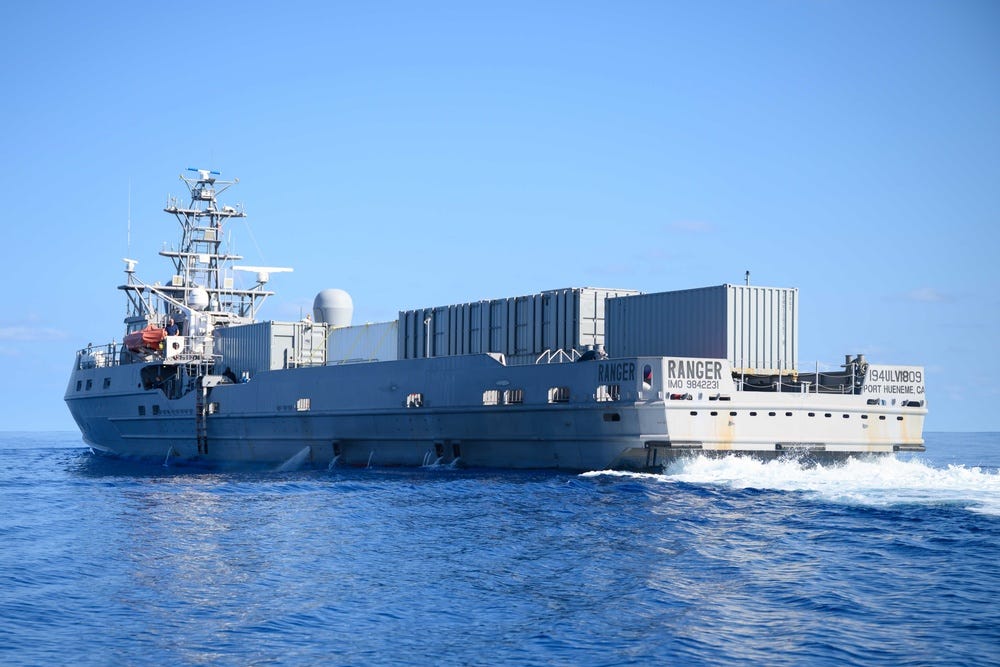
Tony: The fundamental problem — and the reason I’m writing this whole combined-arms-for-robots manuscript — is that a lot has happened very quickly in industry and then transferred to the military. There are a lot of lessons learned, and a lot of abstractions that are no longer abstract. We actually have data, and we can see how things behave on the battlefield.
Take the question in this article of what a hybrid fleet looks like. People get the idea that the goal of the machine is to replace the human. It’s not. The goal of the machine is either, at a strategic level, to augment force balance so you’re not burning exquisite assets — and people are an exquisite asset — on non-priority efforts, particularly when you have a priority effort (hint, hint, INDOPACOM). Or you want to put the robot first through the proverbial breach — sometimes the actual breach — because you know you’re going to take losses, and you don’t want your exquisite systems burned the first time through. That makes a sustained fight much harder.
And to my earlier point about people confusing types of autonomy and AI, people also confuse what they mean by robotics. The robots are there as autonomous machines — we see it every day. When people start talking about robotics in the sense of a humanoid robot that’s fully thinking, sure, but you’re confusing what’s in the lab or academia with what’s actually happening. You have to be very specific about what you mean by autonomy and robotics, because things are already being executed today, versus what we think of from science fiction.
Bryan: We see it in Ukraine. If you’ve seen any of the video of people being hunted down by autonomous quadcopters, the robots are pretty capable, at least in that context. And in the Persian Gulf, we’ve seen small USVs go pick up pilots and do operations independently. They’re not being remotely piloted for a lot of that. They’re doing missions on their own.
These articles reflect a lot of thinking out there that autonomous systems aren’t ready for naval applications in particular. The Air Force runs into this too with CCAs, collaborative combat aircraft. They think the autonomy needs to get to the point where it can replace the person in the cockpit doing the same mission a multi-mission aircraft does. That’s not what we’re talking about. The robot has a very specific function — one of the many a multi-mission aircraft would perform — and you send it to do that one thing because it’s good at it. To Tony’s point, that might be a long, persistent operation that would be boring and expensive for a person to do, or a place dangerous enough that you might not bring it back. Or you want to send a lot of them out and don’t have enough people to send a bunch of ships, so you send robots instead. But you’ve got to constrain the use case to the level of automation available today.
The idea of having people and robots operating together is just asinine. The Air Force is seeing this with CCAs, where the pilots say, “I don’t want to fly around with the robot airplane, because it’s just going to attract more attention to me. I’m flying a stealth aircraft — an F-47, the super Trump jet — and I’m not going to be visible. If my robot airplane is flying around next to me, it’ll draw attention. Why can’t it fly somewhere else and attract attention elsewhere?”
Same with robot ships. They don’t go as fast or as far as manned ships — if they did, they’d be as expensive as manned ships, and then I wouldn’t need them. So they’re a liability. They need refueling more often. They’re slow, so I have to slow down to keep up and not lose them. And if we get attacked, I have to protect the robot ship too. For all those reasons, manned-unmanned teaming just doesn’t work. We’ve got to keep the people and the robots separate and use each for what it does best. Articles like this reflect shallow thinking — as if I need to monitor my Roomba at home because it’ll periodically run into the cat. That’s not how we’d use robots in a military sense.
Tony: I’ve written about this for a few years, and I’ve termed it “combined minds.” Combined arms is the idea that the different arms of the military — artillery, tanks, infantry — work together. It doesn’t mean the infantry and the tanks walk at the same speed or go after the same targets. It means they complement each other in an organized, orchestrated fashion. To Bryan’s point, manned-unmanned teaming isn’t about the machine and the human walking side by side doing the same mission. It means they improve each other’s qualities by doing what each does best, together, in a synchronized way.
Bad History
Justin: My issue with this article is that it started off talking about the technical limitations of robots, and I’m fine with that. You need to experiment. We’re a military that’s not at war — I know we’re in Iran right now, but we’re not in a global conflict. The entire Navy’s not committed, just, you know, 77% of it. So I’d like to see more experimentation, because that’s where you derive the lessons for the next conflict.
Where I struggled: he references both Sims and Mahan, thinkers around 1900 with competing theories about what battleships and dreadnoughts were going to look like and how they’d evolve. He takes the lesson that Sims argued for standardizing on bigger guns, against tradition, and was proven right over Mahan — and somehow concludes that we shouldn’t make the boats autonomous. He’s taken what actually happened and turned it exactly on its head to argue that we need to keep the manned system and stay in the tradition of men in the Navy doing the Navy thing. The reference is exactly wrong. And I’m going to mute, because there’s hammering going on in my building that I’m sure you’re hearing.
Bryan: It always bugs me when people talk about new technologies and reach back to history to describe what’s happening today. I’d rather people just describe what’s happening today and what they think the right answer is, because a lot of these historical analogies just don’t wash.
Tony: Well, Bryan, that would require actually going out and working with the machines, or running war games — doing the things that actually shape this — instead of just saying, “This is what I think.”
Bryan: Or reading a bunch of books at war college and deciding these things are timeless. That’s the perspective: war is timeless, naval operations are timeless, there’s always a set of things that matter, and new technology doesn’t change any of those paradigms. I think that’s absolutely incorrect. Those analogies break down in an era where autonomous systems make denial so much easier, even for countries that don’t have a navy. What does Mahan say about Ukraine denying Russia the open ocean by using drones to cut off the Black Sea? History doesn’t have any lessons for us there. You’ve got to approach things fresh, and a lot of current officers have difficulty doing that, because they get steeped in history at the war college and think these are timeless truths.
Jordan: For books this week, I’ve been giving some time to Rick Atkinson’s Liberation Trilogy. Best line so far: after Patton slapped the soldiers, a journalist who was there attributed a line to him — “There is no such thing as shell shock. It is an invention of the Jews.”
Bryan: That didn’t show up in the movie.
Jordan: You’ve got to buy the Blu-ray for the extended scenes, Bryan.
Justin: Again, we don’t try to judge the past through our present lenses. However — come on.
Jordan: I have another Patton story. Patton was apparently Nixon’s favorite movie, and when Nixon went to China, Zhou Enlai 周恩来 told him he’d watched Patton to prep, because they’d done their background research.
Bryan: Back in the good old days, when the Chinese actually cared what the US thought. I wonder if Xi watched one of the president’s favorite movies — the new Melania documentary, Brewster’s Millions, or Home Alone 2, which Donald Trump was in.
Justin: Trading Places.
Jordan: A WWE special.
Bryan: That’d be much better strategic preparation than anything else.
Justin: The Paul brothers were invited to speak at the Pentagon, which is troubling for a lot of reasons. I told a buddy, “Look, we’ve entered Idiocracy.” And he said, “No, no. We should aspire to Idiocracy, because President Camacho still loved America. He still put the smartest man in the world in charge of their hardest problem. We should hope we could reach that level of Idiocracy, because we’ve sunk so far beyond it.” And I said, “Damn, that’s really dark. But you’re right.”
An FME Bonanza
Jordan: I don’t want this to go by. The Iranians just had a US submersible wash up on their shores. How does that even happen?
Bryan: There was some kind of malfunction, apparently. The US had been using the Anduril Dive-LD for mine hunting, because it’s big, it can go for a long time, and they can launch it from shore and run it up and down the strait for the shipping escort mission. But the strait is very shallow — the whole Persian Gulf isn’t more than about five hundred feet deep at its deepest point, I think. These bigger vehicles have trouble maintaining depth control with that little water to maneuver in. It seems like it lost depth control, popped up to the surface, and was detected and harvested by the Iranians — who, despite the fact that we’ve been destroying their military, seem able to get out there with a lot of equipment and pull this thing out of the water. They had a davit and a crane, the whole nine yards. You’d think that if their military had been decimated, they wouldn’t be able to mount that kind of recovery effort.
Justin: The biggest thing is that the Pentagon tried to say nothing happened and was very coy, and then Anduril came out and said, “Yep, it was working for about four months, it malfunctioned, and we lost control of it.” Now you get into questions about self-destruct sequences and what was on it. The Pentagon has said there was nothing classified on it and no sensors to worry about. But it’s logical to assume that if Iran gets a piece of US hardware, the information about it goes to Russia and China very quickly.
Bryan: The equipment on it isn’t going to be that sophisticated compared to what you could get commercially, especially compared to other drones they’ve gotten hold of. They’ve shot down RQ-4s and harvested plenty of MQ-9s on their territory. Reportedly they picked up a stealth drone, an RQ-170, at one point. So they’ve gotten plenty of US drone technology that I imagine has made its way back to China — along with a box of F-35 parts. This whole war has been a good FME [foreign materiel exploitation] opportunity for China.
Justin: And the US may get to see what the new rocket-powered Shaheds look like, if we can capture some of the ones Russia’s apparently giving Iran.
Bryan: The Gerans, yeah. That’s a good point. I wonder how many of our PrSMs hit and didn’t explode or didn’t fully decompose, so they’re getting pieces of PrSMs, pieces of JASSMs. We’ve basically dumped a bunch of new technology we were holding on to for China on the Iranians. Not only did we use it up so we can’t use it against China, we’ve also delivered it to Iran. And from previous wars, that stuff doesn’t blow up enough to be completely useless as an intelligence source.
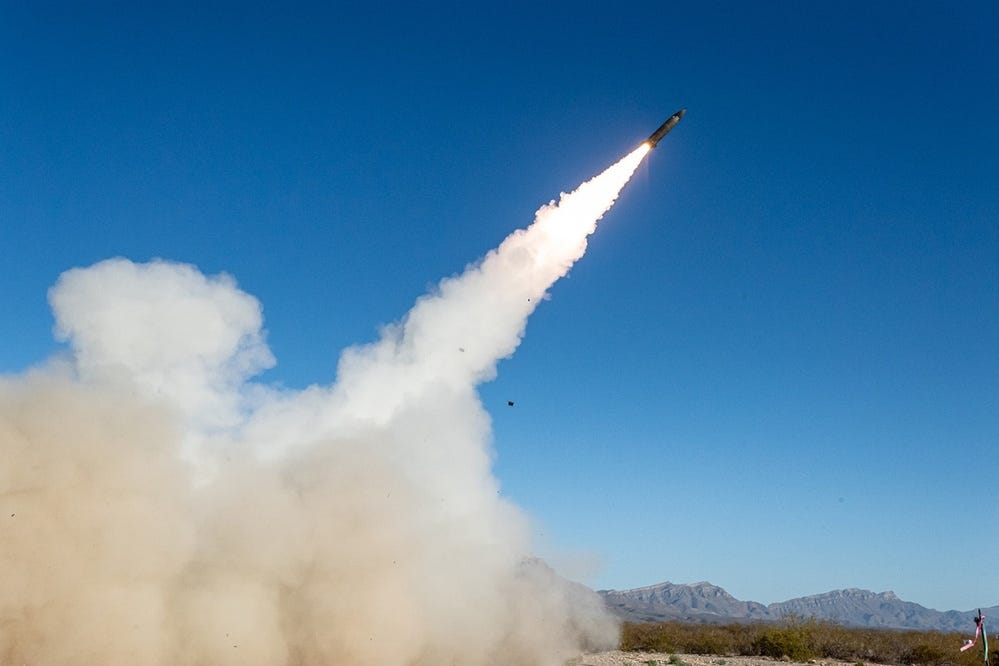
Justin: That’s how the Russians got the Sidewinder — it got stuck in the side of a MiG, and they were able to reverse engineer it. So the idea that it’s not happening... Apparently there was an anchored Iranian ship we shot a large percentage of our PrSMs at. It wasn’t doing anything, just floating there, and we kept missing.
Bryan: A SINKEX, then.
Justin: I wonder how those came out.
Bryan: We used to pull stuff off the sea floor all the time, because the Russians would routinely drop things that turned out to be useful. So this is probably a big FME bonanza for the Chinese. I hadn’t even thought about it until just now.
Justin: The more exquisite stuff we use — the stuff meant for the China fight — the more they get. You’re getting data and telemetry, but they’re also recovering pieces and the outputs from the explosions. And there are always duds. There was a time we had to go back through places in Syria and pull out bombs that didn’t go off. They’d be foolish not to take all that. So then the question becomes: what’s our next level of exquisite technology for an INDOPACOM fight?
Physics Still Wins
Jordan: It’s the AI Force. That’s it.
Justin: That’s why we need it.
Bryan: Exactly. We’re going to out-think them.
Justin: They’re just going to distill it. Jordan, what are your thoughts? Do export controls help with the distillation of AI?
Jordan: Look, it’s not great. We’re working on an article about this. The answer is that no one really knows what percentage of Chinese progress is distillation versus them getting better at other things. Stopping distillation tomorrow would not stop Chinese progress. But clearly you don’t spend this much time and energy on an effort like this unless it’s saving you time and money.
At the end of the day, we’ve got a lot more chips than they do, and as long as we don’t sell them more semiconductor manufacturing equipment or more chips, that’s going to continue. Models are hard things to keep secret. They’re just numbers on a few hard drives. Even if you can’t distill them, you can try really hard to steal them. So the compute advantage is a more enduring source of power. Does that translate into being two generations ahead on a fighter jet? TBD. But it’s a nice thing to have.
Bryan: Does it help on the inference side too? When I’m actually using the model, does the compute advantage make a difference? Or is inference such a low-compute task that China and the US are on a level playing field?
Jordan: No — you need all the chips to use the models. We’ve already seen orders of magnitude more compute going to inference. It used to be you asked the model a question and it gave you an answer in five seconds, because it wasn’t thinking. Then it started thinking. Now we have agents, agents working for days, thousands of agents working for weeks. You’re going to keep getting returns from having more inference to throw at problems.
The open question is to what extent that intelligence transfers into things that are hard-power related. Clearly there are human cognitive tasks where you can be smarter, where you can optimize equations and software. But at the end of the day, you need a thing to blow up another thing, probably, and that’s not something these models have quite solved yet. In the Leopold [Aschenbrenner] RSI [recursive self-improvement] world, our super-smart models start building robots that build the factories, which means we’ll have more drones than China, so we’ll be fine. But —
Bryan: There are maybe some command-and-control applications, where it can do a better job thinking through the second- and third-order implications.
Jordan: Command and control, cyber, targeting, EW — anything that’s software, it’s clear this is going to be incredibly useful. But at the end of the day, can you win wars with software? Can you win wars with air power? There’s more to it.
Justin: Armies still have to hold terrain.
Bryan: We found that out — naval power and air power don’t win a war.
Justin: Not until we get to dark factories run entirely by robots, serviced by other robots, constantly turning out robots that can go attack people — which is dystopian, but also seems very far off. I tend to agree with you, Jordan. We’re already seeing human adoption of AI create crutches, like with the school strike in Iran, where they assumed the Palantir Maven software would be able to detect old, outdated data. Why would you think that? It can only do what’s in its database. If the only information in its database is old and outdated, that’s what you get. It doesn’t matter how much compute you throw at it.
There’s an adoption curve, and people are at different points on it. The people earlier on it — who haven’t adopted yet or are just starting — see it as kind of magic that’s just going to work. They can’t distinguish between generative AI and agentic AI. When you bring that into a military context, you start letting things in that drive a decision process you don’t understand, based on underlying data you don’t understand. So you can’t make the argument, “Maybe we shouldn’t do that.” That’s going to be a big learning curve. And again, that’s why I don’t think the AI Force is a great idea. Every command center responsible for strikes needs to be having very hard conversations about how to think about the outputs and what to do with them, because that needs to be demonstrably different from how we’ve been approaching it.
Jordan: Even in the limit — say 2029, 2030 — where we clearly have superhuman mathematical abilities, and we get superhuman military reasoning and coding abilities: until you get the materials science breakthroughs that let you make more things cheaply in America in a way your adversaries can’t, you’re still stuck. Your command and control is only as good as the things you’re commanding and controlling, which are physical and in the real world and have to fly around and get wet and stay submerged long enough to not show up in Iran.
Bryan: Physics is still the limitation.
Jordan: There are clearly dramatic gains to be had. But you still come back to the fact that we’re going to have a factory in Tennessee that needs to make ammunition.
Justin: Thank God we have Hanwha.
Jordan: All right, let’s call it there.
Have you guys seen The Wargame? British TV show where they have taken high ranking politicians, ex-intelligence and military officials, and put them through a televised war game. Follows a podcast by the same name. Curious on views, I found it interesting and plausible as a Brit