
Beijing just announced a persistent Coast Guard patrol east of Taiwan, the administration is calling arms sales a “bargaining chip,” and the NDS doesn’t mention Taiwan at all. Is deterrence in the Strait quietly coming apart?
Randy Schriver is Chairman of the Institute for Indo-Pacific Security (the successor to Project 2049), current chair of the US-China Economic and Security Review Commission, and served as Assistant Secretary of Defense for Indo-Pacific Security Affairs in the first Trump administration.
We discuss…
China’s new persistent Coast Guard patrol east of Taiwan, and how lawfare, fishermen rescues, and radio queries make sovereignty claims physically manifest,
Why treating arms sales as a “bargaining chip” puts the US out of compliance with the Taiwan Relations Act,
Whether Seoul and Tokyo go nuclear as hedging accelerates — and what the axis of autocracy means for a Korea contingency,
Blockade vs. invasion, Hellscape, and why the US should exercise a Keelung–Yonaguni corridor with Japan,
Why rebuking Takaichi blew Randy’s mind, plus Pelosi vs. the blocked Colby-era CODEL and Hegseth’s two Shangri-La speeches,
The own-goal management of US-India relations, plus Randy’s reading list for new Indo-Pacific hands.
Listen now on your favorite podcast app.

Read What They Write
Jordan Schneider: Let’s zoom out a bit. How worried are you, Randy?
Randy Schriver: Well, I take China at their word. Some people talk about China being enigmatic, difficult to understand. At my think tank, we have a very sophisticated approach to trying to understand China: we read what they write and we listen to what they say. Or the way another friend of mine, James Mulvenon, puts it — the first line of encryption for the Chinese is Chinese. If you can get through that, they’re pretty clear about what their ambitions and intentions are.
I do think they want to win without fighting. August 1, 2027 is a be-ready-by date, not necessarily a go date. And I suspect there are a number of things — including watching Russia’s experience in Ukraine, but also their own internal situation, the massive purges that have been going on in the military, and, in the Rumsfeldian lexicon, the known unknowns: how does a military perform that hasn’t seen combat since 1979? All of these things probably give them a degree of pause, or at least an understanding that there’s risk. So I think they would like to win without fighting and get some sort of political capitulation without having to fire a shot.
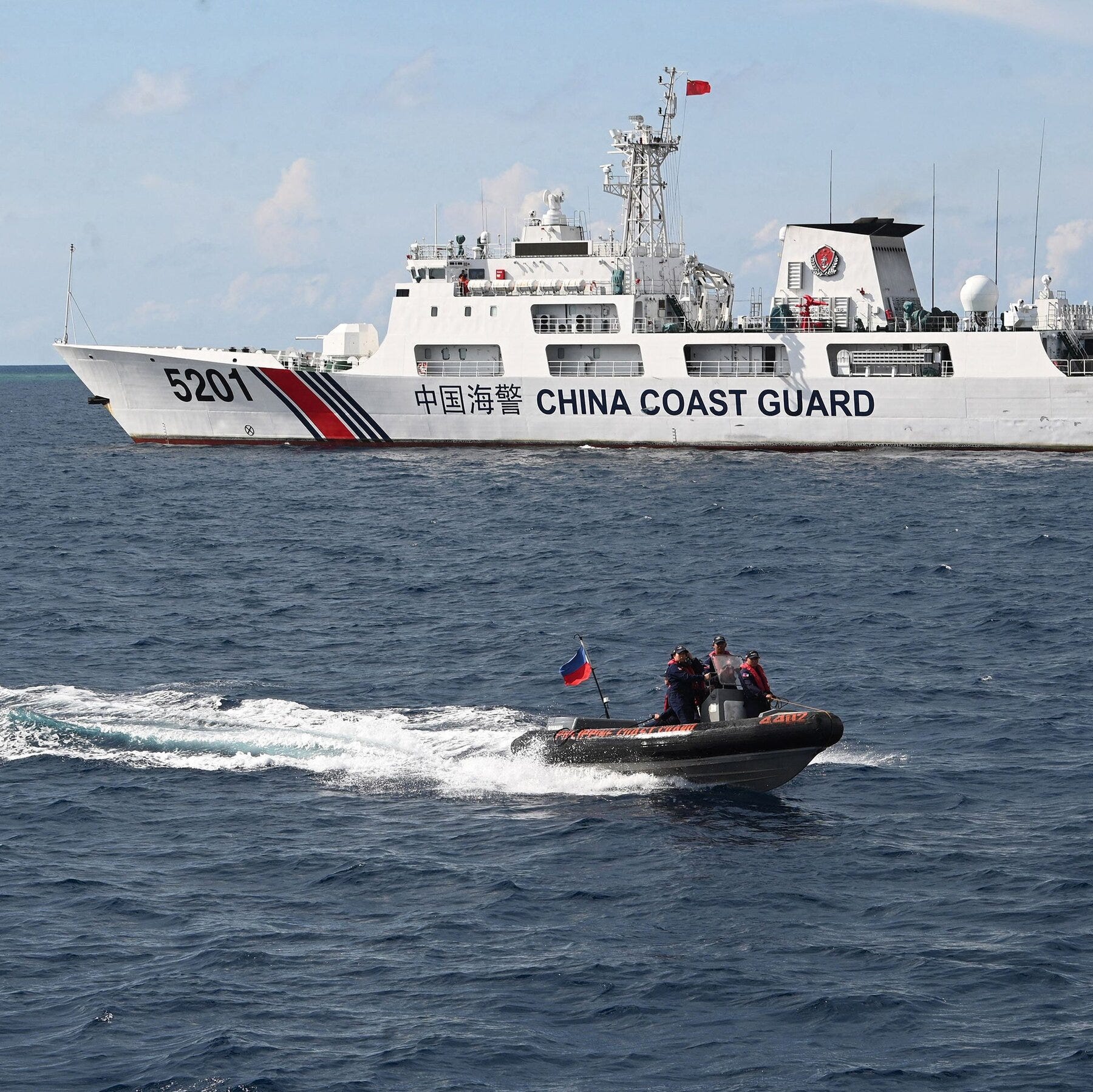
But even in so-called peacetime, if you look at what’s happening around Taiwan, the levels of coercion and intimidation are pretty extraordinary. They integrate lawfare, political warfare, information warfare. One of the most significant developments of the last few weeks is the announcement of a persistent Coast Guard patrol east of Taiwan. From a lawfare perspective, this is China exerting through its activities and actions a claim: we are the sovereign power with the sovereign right of law enforcement in this area east of Taiwan.
They’ve already queried commercial ships, and Taiwan has said don’t answer those queries. But if you’re carrying cargo and have to keep your insurance, the easiest thing to do is pick up the radio and respond to the query. Or imagine a fisherman in distress: if a Chinese Coast Guard vessel is the closest vessel and makes the rescue, everybody’s going to say, wow, what a great humanitarian thing they’ve done. They’ve actually just physically made manifest their sovereignty claim.
So yeah, I’m worried. And I think the recent statements by President Trump after his meeting with Xi Jinping in Beijing were not helpful. He seemed to have absorbed a lot of the Chinese narrative. “Taiwan’s been part of China for thousands of years” — well, no, it hasn’t, and it’s never been part of the People’s Republic of China. “We don’t want to fight a war 9,500 miles away” — I certainly don’t want to fight a war with China, but this 9,500-mile thing — look at where our forces are: Guam, Hawaii, Japan, Okinawa. Let’s not just absorb everything Xi Jinping has said.
And then the statement about our arms sales being a bargaining chip — I would submit that puts us firmly out of compliance with the law. The Taiwan Relations Act says we must provide Taiwan with weapons of a defensive character sufficient for self-defense. That reads as a must. You must make them available. It’s not a choice, it’s not a policy option. And we also have a part of the law that says we must maintain the capacity to resist force. Wearing my commission hat — the US-China Economic and Security Review Commission — last year we put a recommendation to Congress to say: show your homework, do the math. Do you have the capacity to resist force with everything that’s going on in Ukraine and Iran? With everything they’re saying about munitions, everything they’re saying about logistics and maintenance support — don’t look behind the curtain. I’m not sure I’m buying. They’re pitching, I’m not catching. I think we’ve got issues on that front.
So there’s a lot to worry about. But I’ll put on the other hat and say Japan’s never been more engaged. They said they were going to double their defense budget in five years — they did it in three. They’re giving us access to the Southwest Island chain. Yonaguni is the closest island to Taiwan — it’s not China, it’s not the Philippines — and we’re now able to do activities out of there. The Philippines, with the EDCA sites in northern Luzon and Palawan. Japan-Philippines cooperation — we’re not even in that hyphenated minilateral all the time — and all of that to me is very encouraging. So it’s a mixed bag. I just hope we keep our eye on the ball.
Overplaying the Hand in the Pacific
Justin: The Japan-Philippines piece, tying that back to your discussion of the eastern patrols, is interesting because that’s obviously their fear of encirclement. When you couple that with the launch of the Chinese ballistic missile earlier in the week — and now some of the islands in Micronesia and the Pacific Islands are starting to raise concerns about the Chinese threat outside that direct sphere — what are you starting to see or hear about the way they’re viewing China, given how China is acting toward some of their larger partners?
Randy Schriver: I think for the most part, China has overplayed its hand, and its provocations have tipped some of these countries toward actions they might not otherwise have taken. Look at the defense treaty that was just signed by Prime Minister Albanese and Fijian Prime Minister Rabuka. That’s the first defense treaty Fiji has ever signed, and it’s only the fourth for Australia — US, New Zealand, Papua New Guinea. PNG was another island moved to take such an action, and that was two years ago. So within the last two years, you’ve got PNG and Fiji saying they want to be defense treaty allies with Australia.
The compact states are in a bit of a different category, but I was recently in Palau, where they are refurbishing the airstrip at Peleliu — quite a history there. We fought an extremely bloody battle over that airstrip. Turned out we didn’t need it for the invasion of Japan after all. But the fact of the matter is the geography is still quite important, and Palau obviously has the greatest proximity to the Western Pacific, where potential conflict contingencies might happen. And there are activities in the Federated States of Micronesia and the Republic of the Marshall Islands.
So I think we’re seeing the second-order effects of overreach on the part of the Chinese. When their face and their activities are in the economic domain — providing investment and development assistance, setting aside that a lot of it is predatory and has debt-trap features — countries in the Pacific are much more open to that and welcoming of it, because they’ve got such extraordinary needs. But when they see the PLA, or even the Coast Guard or the maritime militia, enabling illegal fishing in their territories and other illicit activities, and you see something like the submarine launch of a JL-2 or JL-3 — I don’t think we know yet which — that’s getting people to really consider their defense needs and take steps they might not otherwise take.
Hedging Toward the Bomb
Tony: When Ely was on the show, we talked about what we call the bullshit détente — we’re not really talking about China at the strategic level because of Iran and everything else, and because the president sort of wants to be friends with Xi Jinping. But then all of this is going on in WESTPAC. As that gap widens, is there a point of no return, where there’s so much difference between what our friends in WESTPAC are doing and what we expect that either they go it alone, or they decide it’s not worth it because the US isn’t going to show up?
Randy Schriver: I suppose theoretically there is. The interesting thing to me about where we are now is that most of these countries are doing things we have long encouraged — even if they’re doing it as a hedge, even if they’re doing it because they’re concerned about the reliability and credibility of the United States. These are nonetheless things we’ve long wanted: Japan doubling its defense budget, reinterpreting Article 9 of the constitution, introducing counter-strike — which to the untrained eye looks a lot like strike — creating a joint operations command. Korea, in terms of their defense spending and preparedness. All these are things we’ve long encouraged.
So as this goes forward, if it’s still the result of a hedge and starts to accelerate because they don’t believe in the credibility of the alliance or the United States, then we tip into another era, I guess. And there are a couple of things talked about now that would be indicators of that. If South Korea goes nuclear — and look, popular sentiment in South Korea is over 70% for an independent, autonomous nuclear capability. That’s extraordinary. I don’t know that it’s a very well-informed view when it comes to what it would require and what it would all necessarily mean, but it’s extraordinary. And in Japan — a taboo subject for a long time, for very understandable reasons — it’s openly discussed and talked about now. That would be a step beyond the minor hedging and outreach we’re seeing right now.
Jordan Schneider: Can we talk about that world?
Justin: Let’s say we have a bunch of equal nations, no leadership — this is kind of the Carney vision of Europe sans the United States, where the EU and France and all these countries vie for levels of influence and power, with no overarching first among equals. Say we apply that same approach to Seoul, Japan, even Australia with regard to China. What prevents that from turning into Chris Clark’s The Sleepwalkers — where, because there’s no one there to pull the reins or set conditions or make a strategic move, all these different countries slowly make moves in their own best interests, and those interests just nudge us toward what ends up being a cataclysmic war?
Randy Schriver: That’s a possibility, and a pretty dark outcome. I think there’s a reason our alliances have been so resilient for so long. World War II was, by my measure, quite some time ago, and yet we still have this strong alliance with Japan — and popular support for the alliance is still very high, notwithstanding America First rhetoric and questions about credibility. In the Philippines, I think we poll at over 80% popularity as an alliance. Australia, over 70%. There’s a reason they’ve endured. It’s been interest-based, but there’s also the track record of stability and security.
You have this notion of a trapeze artist — you really don’t want to let go of one thing that’s been pretty good to you until you get your hand on the other thing. There are scenarios where there’s a degree of stability if South Korea and Japan have nuclear weapons and nobody’s going to mess with them. But South Korea would be facing not only North Korea but the growing axis of autocracy. My Chinese friends will tell you up and down — it’s not a thing, it’s not an alliance, there’s no secretariat, no coordinating meetings. My response is: first of all, that’s not a weakness, that’s a preference. China doesn’t like binding alliances where they’re bound to support countries in certain ways. Number two, even limited cooperation can sure be consequential. Look at what’s happening in Ukraine, where North Korea is providing forces, artillery, and ammunition to Russia, and China is providing material support in terms of components and technology for drones.
So if North Korea gets even that sort of minimum support — Russian troops, Chinese material support — in a conflict with South Korea, that’s a much more difficult conflict for South Korea to deal with, let alone if they’re dealing with it without US assistance. And would US forces stay on the peninsula? We’ve had two presidents try to pull them off — Jimmy Carter, and President Trump in his first term. Pull this thread: are we in a more stable, secure world? I sort of doubt it.
Blockades, Hellscape, and the Yonaguni Corridor
Bryan Clark: Randy, talking about Taiwan — obviously the will to fight is a question, but in a lot of ways they’re building systems that make it almost automatic that they’re going to fight, right? This Hellscape thing that INDOPACOM is pursuing — the Hellscape robots are basically going to attack whatever’s coming at them like a bunch of rabid dogs. And then coastal defense cruise missiles — all the stuff they would do, which is in a lot of ways automatic, is just going to impose a lot of casualties. But to what degree does Taiwan also need to invest in the kind of stuff that would help them break a blockade? Because if China is worried about casualties and about the risks of an invasion failing, it seems like squeezing them — getting them to where they can’t make twelve days of LNG imports — is an easier road to getting the regime to capitulate. Is Taiwan preparing for that contingency in their force development?
Randy Schriver: They are, and at times that has put them at odds with the United States. Ely and I — Republican, Democrat — probably agree on 99% of things. You’d be hard-pressed to get us to debate something. But I would say the previous administration chose to look almost exclusively at the counter-invasion capabilities. And I sort of get it: limited resources, where are you going to put them? Not necessarily the most likely scenario, but the most dangerous one, okay. But I think a far more likely scenario is a blockade or a soft blockade — and that’s part of deterrence too. In fact, the two are related. You would actually, unintentionally, make the invasion more likely if there’s no pushback in the gray zone.
I think we could be doing more in terms of networking the sensor piece with Japan and the Philippines and Taiwan. And we should be exercising with the Japanese and the Filipinos — I think we should exercise what it would take to have a corridor from the northern port of Keelung to Yonaguni, and demonstrate it, show that we’re willing to do that. That would be both prudent in terms of preparation and have some deterrent impact.
Bryan Clark: Sure. And you could use some of the stuff they’re putting in Yonaguni to support that.
Randy Schriver: Absolutely. And you have a window with the Japanese. Again — irony after irony after irony. When Prime Minister Takaichi said the quiet part out loud about Taiwan being a “survival-threatening situation” — awkward English, but that’s actually the Japanese term in the Diet legislation — she was rebuked by the Trump administration. It blew my mind. For decades, we wanted Japan to say something like that.
Justin: That’s the hard part — in some ways the administration has been right. I was in Taiwan during the middle of the Biden administration, and it was kind of verboten to bring up invasion and defense with your Taiwanese counterparts outside of specific settings, because there was a fear you’d scare them. Then a company in Taiwan produces Zero Day, an amazing docudrama about the invasion — great show — which shows they actually are willing to talk about it, they understand the neighborhood they live in, and the society is willing to watch something like this and understand the problems. The inverse being: we change administrations and switch from not wanting to talk to the Taiwanese to all of a sudden not backing up our allies when they do things. It’s the same mistake we made with Australia pushing to investigate the origins of COVID — China cuts off their imports, and what the United States doesn’t do is say, hey, we’ll buy your wine. Instead of backing them up.
Randy Schriver: I stepped up on that front personally.
Bryan Clark: And thank you.
Two Entirely Different Administrations
Tony: There’s an interesting comparison here. During the Biden administration, there was the freakout from the executive over Pelosi going to Taiwan. And then in this latest spat between Mike Rogers and Bridge Colby, it came out that allegedly Bridge had blocked a Republican congressional delegation to Taiwan. That’s such a reverse course from all the messaging over the last few years. It somewhat aligns with Bridge’s book and his focus on stability — but that seems more indicative of how this administration views the conflict than anything else.
Randy Schriver: I consider Bridge a friend. I actually took him to Taiwan for his very first visit with a think tank delegation, and then again the spring before the 2024 election, where on at least one occasion he and I debated one another in front of Lai Ching-te 賴清德, which was kind of interesting.
The story on the congressional delegation, if I understand it correctly, was that he wasn’t going to provide an airplane, because most congressional delegations get milair. And I mean — how in the world do you have a department where your two authorizing committee chairs in the Senate and the House, chairs of the same party, are saying you’re not telling the truth and criticizing you? How did you get to that point? It’s a little mind-boggling, because it’s not hard. You go tell these guys that you care what they think, that they’re important — anytime you want to speak, please. That’s it. How they got to that point is just remarkable.
On the differences: the problem with the Pelosi visit wasn’t the visit per se — it was the Biden administration being publicly against it. The Chinese, as sophisticated as they are — and they’re so much savvier now about our decision-making process, the role of Congress versus the administration — thought, “We can stop this. The Biden administration doesn’t want her to go.” Now, that ignores any understanding of how Nancy Pelosi operates. But I think that’s how we got into trouble. If the Biden administration had just said, “Separate branch of government, we’re not going to intervene one way or the other, she has a right to make her own travel decisions,” I think it would have been a little different. Maybe not, but I think it would have been different.
My issue with where the Trump administration is now: number one, if you read Secretary Hegseth’s Shangri-La speech from a year ago and his Shangri-La speech from this year, it looks like two entirely different administrations — over the course of a year. If you look at a National Security Strategy that talks more about Taiwan than any NSS I’ve ever seen, and then an NDS that doesn’t mention it at all, that looks like a disconnect. And when Secretary Hegseth says we want to be — what’s his formula, quiet and strong? — the quiet part, I think, doesn’t quite capture how deterrence works in the Chinese mindset. When you’re quiet, you won’t have Lai Ching-te transit the United States; you knock the Monterey military talks down to a lower level and hold them in Alaska. What the Chinese see is: are the Americans really willing to fight for this? It sure doesn’t look like it. Some of this symbology actually matters in the deterrence equation. Whereas Bridge would say nothing else matters other than whether you are militarily capable — and that reverts to the point I made earlier about readiness.
I was worried about munitions and contested logistics before Ukraine, before Iran. Are we better now? Surely we’re not. So the quiet part — debatable. The strong part — extremely debatable. I think there’s a lot more work to be done here. I’m glad allies and partners are stepping up. The part of Secretary Hegseth’s speech I did like was that he went through each ally and was complimentary, which was not always the case — certainly not if you’re in NATO. Praising Korea and Japan and Australia and India, that’s good. Omission of Taiwan — not so good.
Bryan Clark: Can we double-click on that? Japan is obviously investing a lot more in its military — we’ve been doing some work with Japan on its force design. It seems like they’re still looking to build a military that complements the United States military, assuming the US is doing a lot of the heavy lifting in Japan’s defense. They’re not looking to field the kind of capabilities you’d field if you thought you’d have to defend yourself for some number of weeks. Same with Australia — not increasing defense spending very much, if at all, but investing in the kind of stuff that makes them complementary to the US rather than an independent actor. Do they need to be investing differently?
Randy Schriver: It’s a very fair point that our allies are investing in ways that are complementary to the US in support of alliance and coalition operations, and I think we should be grateful for that. If there’s a radical departure from that, it’s another one of these potential mileposts suggesting they’ve given up and don’t regard us as reliable or credible. And a large portion of this is also fungible: Japan needs to invest in integrated air and missile defense in southern Japan, including the Southwest Island chain, whether or not US forces are going to operate out of there. So first of all, we should be grateful they’re doing it, and secondly, I don’t think we’re at a point where we’re saying this investment pattern is somehow off.
Justin: That’s where the issue runs in with the way we’ve gone about challenging our allies and partners. I don’t think Japan is going to be in a position where they have a self-sustaining military that can conduct operations on its own — nor do we really want that. Same with South Korea, same with Australia. But if they start moving in that direction, and instead of complementing our capabilities they’re replicating the capabilities we’re supposed to bring into a fight because they’re afraid we won’t be there — you’re really just lowering the defense posture of everybody. And we’re not talking about replicating production capability, just replicating the niche things the US says we’re going to bring into a fight in the Pacific.
Randy Schriver: Yeah — and if you look at certain aspects of this, it would really be years and years. Japan is investing in counter-strike. Looks like strike. But the kill chain is still very reliant on US sensing and tracking, and for Japan to say “we’re going to have a completely autonomous kill chain” — that’s space, that’s other airborne sensors, that’s a lot of integration of data. That’s going to be years.
Justin: There’s a new acronym — it used to be C2, and now it’s probably C7IS4T-something-squared. Whatever the new acronym is, one of the Cs is “computer.” I don’t understand how that matters or why we need to make that differentiation.
What Actually Deters Beijing
Tony: Back to the deterrence part. There’s a lot of tea-leaf reading that goes into how the CCP and the PLA operate, and I’ve heard a lot from folks in government about what the CCP really cares about these days in terms of messaging. What are the actual deterrence activities we can undertake that can impact CCP decision-making?
Randy Schriver: The military piece is not insignificant. Continuing robust security assistance to Taiwan; the posture initiatives — Ely was terrific on that; the opportunities for diversification and dispersal during a contingency — all of that is really important. But if you reverse-engineer what the Chinese really fear, it’s the alliance piece: the cohesion among like-minded countries with shared interests and concerns, and the thought that a move against Taiwan would bring in a very powerful coalition of countries — on the military side, which would likely be limited, but also on economic cost imposition and sanctions.
The thought that we’re telling the Europeans — after decades of trying to get Europe interested in Asia — “you’re not needed, you’re not wanted, take care of your own backyard” is extremely counterproductive from a deterrence point of view. You want the Chinese to believe they can’t fight an isolated war in the Taiwan Strait — that the potential for the Malacca Strait to be closed is very real. Remember, it was the Chinese — Hu Jintao — who came up with the phrase “Malacca dilemma,” not the United States. You want them to think there could be multiple fronts, with potential for India. You want them to think the EU is going to act swiftly and in unison on sanctions. That has always been our asymmetric advantage — the ally and partner piece and our ability to hold it together in a meaningful, credible way. That’s where the work needs to be done. And some of the rhetoric suggests otherwise — certainly the trip to NATO where, evidently, we’re not only ending the ceasefire with Iran, we’re also threatening Greenland again. And by the way, this American remembers that Denmark lost more people per capita in Afghanistan coming to our defense than any other country outside the United States. The fact that we’d be threatening them is unconscionable.
Justin: I’ve had the same experience. When I talk about having been in dangerous situations, especially in Syria — if it wasn’t an American pilot above me, the Dutch pilots were the ones I most wanted flying overhead. Probably the hairiest day I ever had in Syria, it was two Dutch pilots dropping bombs for me through a dust storm to help me break contact. I say that to say: a hundred percent. The lack of acknowledgement of where we are, what we’ve done, and the length and depth of these alliances is one of the things that feels the grimiest in these conversations. Because yes, there are countries in NATO that need to spend more money. Yes, there are countries that have been self-interested — the Rheinmetall CEO tells the story of having a conversation with Merkel, saying she needed to invest more, and she says, “We’ll just call on the Americans for defense.” We made it easy for some countries not to invest in their own defense apparatus. But what that did in turn was invest in our defense apparatus — jobs, technology, things that went into the US ecosystem. That’s now changing. Do we want to shepherd that change, or allow it to be driven by Mark Carney and Emmanuel Macron and people who may not have the best interests of the US at heart?
Randy Schriver: Couldn’t agree more.
Tony: On the NATO part — we’ve seen what goes wrong there: you end up with thirty different defense industries in Europe, none of them capable of expeditionary fighting, all with different battle plans and no real ability to surge forces quickly in a conflict. Ely, when he was on the show, talked a little about the need for some sort of collective defense arrangement. Is there a way, without disrupting the cultural restrictions on collective defense in Asia, to get all the countries together to talk about complementary defense planning?
Randy Schriver: There is, but we have to embrace it ourselves, endorse it, and be the leader of such an effort. Ely literally wrote the article about an Asian NATO. And there are people in Asia — former Prime Minister Ishiba of Japan has long called for an Asian NATO. So it’s not taboo. It would be very difficult to operationalize and make meaningful, but not impossible. It is impossible without the United States.
Own Goals in Delhi
Justin: One thing that always gets left out: India has always been a very tough country to bring in politically, and if you’re going to have a NATO in Asia, you want India in it as a bulwark. How has the administration’s approach to India changed or morphed over the last year or two? When you look at issues like the Himalayas and the Line of Actual Control, where are they putting the right and wrong emphasis on that engagement as a counterweight to China?
Randy Schriver: If I were to rack and stack all the own goals I’ve seen over the last two years, the management of the US-India relationship is near the top, if not at the top. Our future is not Pakistan — it’s with India. For years I was going to Delhi and hearing about the Chinese, the growing threat, the long-term threat — you’d never hear about Pakistan anymore. Now it’s back. We’ve put Pakistan in the center of our negotiations with Iran. President Trump hosted the chief of their armed forces and praised him as a brilliant general in the Oval. We’ve tariffed and criticized the Indians. The timing of hosting the Pakistanis in the Oval Office so soon after the dust-up between Pakistan and India was extraordinarily bad.
Look, in my time in office we got a lot of help from the Chinese — Doklam and Ladakh, two pretty big dust-ups in a two-to-three-year time frame. I think that pushed the Indians to more fully embrace the Quad. It allowed us to move forward on the defense relationship in ways they might otherwise have been reluctant to. We might get help from the Chinese again in the future, and hopefully we’ll leverage it for all the benefit we can. But right now there’s a great deal of mismanagement. Prime Minister Modi is going to do his hedging. There’s virtually nothing we can do to peel them away from Russia. But there are little things that are actually pretty important: they’ve lifted the restrictions on Chinese FDI in India — maybe not a little thing at all, actually a pretty significant thing — and signs that we’re moving in the wrong direction.
Justin: The FDI one was a big one. And tariffing India after we spent more than a decade trying to beat down the tariffs India had already put up — trying to open it up to be more capitalistic, more modern, more integrated into the global economy. The own goals are not limited to military or strategic cooperation. We racked them up and knocked them all down.
Randy Schriver: I don’t think the damage is permanent, particularly in the case of India, because our strategic interests will continue to be largely aligned and will compel us to cooperate. Even at one of the low points, after the Pakistan engagement in the Oval, we renewed a ten-year defense framework agreement with the Indians, and a lot of that work is actually advancing. I’ve participated in some Track 2 dialogues where I’m the only optimist in the room — if you deal with the Indians, they’re not subtle or shy about telling you their opinion, and I think a lot of Americans were absorbing that and reacting to it. I said, look, I think we’re going to be in a better place a year from now, and an even better place five years from now. And I am optimistic. But what’s the rule about being in a hole? The first order of business is to stop digging. I don’t think we’ve stopped digging quite yet.
A Reading List for the Indo-Pacific
Jordan Schneider: Any final thoughts — anything else, Randy, we should be asking you about?
Justin: I went to the Indo-Pacific late in my career — I spent the overwhelming majority of it Iran and Middle East focused. And I think it was purely luck that I didn’t fall into reading The Hundred-Year Marathon and having that be my viewpoint on China. For mid-career and early-career people coming up: what’s the base level of knowledge they need about India and the Indo-Pacific? If you had to name five books, what do they need to read? What media should they be consuming to be at a good jumping-off point?
Randy Schriver: Well, I welcome the opportunity for a little self-promotion. I’m the chair this cycle of the US-China Economic and Security Review Commission, and I think our annual reports are phenomenal. I liken it to the old Encyclopedia Britannica — maybe some younger people won’t know what that is — a thick book that, when it arrives, you look at it and say there’s no way I’m getting through all of that. But it’s on the shelf, it’s a great resource, and if you want to know something, chances are it’s in there. We take pride in looking beyond the inbox — emerging issues, calling on Congress to do things that aren’t necessarily this year’s priority but had better get looked at in the not-too-distant future.
And then my think tank, the Institute for Indo-Pacific Security — we’ve been China watchers from the start. We’re the successor brand to Project 2049, which was an early adopter of this idea of read what they write, listen to what they say, and document it. We’ve got a product line that I think is very strong in terms of understanding the Chinese.
There’s a ton of really good books out there. I think history is still very important in this region — because everybody’s trying to manipulate it. Again, irony along the way: the Chinese used to always accuse the Japanese of forgetting history, manipulating history. The Chinese are masters at it. If you go through the Museum of the History of the Communist Party near the Forbidden City, you’ll notice some portraits missing from the general secretaries of the Party — you won’t find Zhao Ziyang 赵紫阳 there. They’re master manipulators of history.
So I’d look at The Generalissimo, by a retired Foreign Service officer [Jay Taylor] — a biography of Chiang Kai-shek, but with a lot of the history of the Civil War and its aftermath. It debunks a lot of things. For example, the Kuomintang Nationalist forces probably took about 90% of the casualties in the war with Japan, and the CCP was basically able to husband its forces and resources to fight the Civil War after the end of World War II. That’s very well documented in the book, and it’s an important part of history — the Chinese now try to co-opt the Flying Tigers and things like that. It’s just outrageous.
I also just read a good book on George Marshall’s mission, written by Daniel Kurtz-Phelan [The China Mission] — really extraordinary history for understanding China-Taiwan today. You get a very in-depth, sophisticated look at how these differences emerged and evolved, and how it explains where we are today.
I’m less well-read on Indian history, but I’ve learned from Indian friends that you can’t have a conversation that goes on too long before they start talking about Partition. It all goes back to Partition.
Jordan Schneider: Midnight’s Furies?
Randy Schriver: Yes — extraordinary book about Partition and how it explains, to a great extent, what South Asia continues to experience to this day. And one other book I thought was extraordinary: The Blood Telegram — about the consul general in Dhaka, Archer Blood, who wrote a dissent cable about the genocide going on in what was then East Pakistan, which became Bangladesh in 1971. They had created the dissent channel at the State Department because of reporting that was being suppressed during the Vietnam War — and the first guy to use it is summarily fired by Henry Kissinger, because he said there was a genocide going on. God forbid somebody report on that.
So yeah, I’m a big fan of history. Probably the frustrating — and maybe somewhat endearing — part of dealing with Americans is that we’re very ahistorical, so we come to a lot of conversations extremely ignorant. When you come with a little bit of knowledge about what these countries have gone through and why we are where we are today, it gives you a leg up.
Jordan Schneider: Amazing — I think we’ll end with that. Randy, thank you so much. Next time we’ll bring you on with Ely and have you two find that one percent and throw some haymakers at each other.
Randy Schriver: Let’s go for it.
This interview seems to reverse cause and effect in two important places.
First, Washington’s slowdown in arms sales to Taiwan should not be romanticized as Trump’s “art of the deal.” The deeper constraint is material. The Pentagon is already struggling with depleted missile inventories, while China has made increasingly clear that American defense companies cannot indefinitely rely on Chinese rare earths, critical minerals and permanent magnets while continuing to arm Taiwan. Washington spent years assuming that military containment and industrial dependence could coexist. That assumption is now breaking down. Calling arms sales a “bargaining chip” may simply be the diplomatic language used to manage a vulnerability the United States has failed to eliminate.
Second, China’s new Coast Guard presence east of Taiwan did not emerge from nowhere. It followed Japan and the Philippines opening maritime delimitation talks in waters overlapping Chinese claims—effectively attempting to draw a new strategic line east of Taiwan without Beijing. China answered by putting ships there.
This has become the recurring pattern across the Taiwan Strait. Every time the United States and its allies advance an inch, China advances a foot. More arms sales produce larger exercises. More military access for Japan and the Philippines produces a wider Chinese naval and Coast Guard presence. Attempts to tighten the island chain push Beijing farther into the Western Pacific.
Taiwan’s strategic space will therefore continue to shrink. Western analysts describe each Chinese response as a unilateral attempt to “change the status quo,” while treating the preceding moves by Washington, Tokyo and Manila as neutral or defensive. That interpretation erases half of the causal chain.
The status quo is being eroded through action and counteraction. The uncomfortable reality is that many of the steps now allowing China to normalize a presence east of Taiwan were triggered by attempts by the United States and its allies to move the strategic frontier closer to China.
The interplay between the PLA purge uncertainty and the economic timeline deserves more attention. Randy's framing of August 2027 as a "be-ready-by date" is correct — but the underlying logic is bifurcated: Xi faces both a narrowing economic window (five consecutive quarters of GDP deflation, $1T+ in regulatory-driven market cap destruction 2020-2022, capital increasingly seeking exits) that adds urgency, and a military reliability question mark (the PLA hasn't seen combat since 1979; the purges create chain-of-command uncertainty at precisely the joint operations level) that adds caution. Those two pressures don't cancel out — they push toward gray zone operations like the eastern Coast Guard patrol: coercive enough to advance the sovereignty claim, deniable enough to avoid triggering the one unknown Randy flags about how a purged military actually performs under pressure.
The Keelung-Yonaguni corridor proposal is the right call. What's underappreciated is that demonstrating a credible resupply lane through Taiwan's eastern coast removes the "one-way island" framing China exploits — the idea that any fight over Taiwan is inherently enclosed and won by the side that can sustain siege longest. Showing a viable corridor changes the strategic math before it needs to change the military math.
At Blue Lotus Research, the economic coercion timeline and PLA purge dynamics are the two threads we track most closely in the Xi-era risk picture. — bluelotus1618.substack.com