
Africa is the literal center of the world’s map and increasingly the center of gravity for ISIS, the manpower source for Russia’s war in Ukraine, and the contested geopolitical ground where China builds bases and drops off free weapons. Our first active-duty guest pulls back the curtain on a combatant command that runs on 0.1% of the defense budget.
LTG John W. Brennan Jr. is Deputy Commander of U.S. Africa Command and a 30-year career Special Forces officer, with command tours spanning 5th Special Forces Group, the anti-ISIS task force in Syria, and 1st Special Forces Command. He’s joined by ChinaTalk’s Justin, who served under Brennan as a young NCO in the Middle East.
We discuss…
How AFRICOM runs a counter-VEO away game on 0.1% of the defense budget by working “by, with, and through” partners
“Putin’s Purse”: trafficking thousands of Africans onto the Ukrainian front lines under false pretenses
The Houthi–al-Shabaab pipeline and the threat triangle around Djibouti’s PRC naval base
Building an “alternate DIB in exile”: drone centers of excellence in Morocco, South African artillery, Namibian satellite radios
Why Brennan wants to “declare jihad against proprietary data streams” and where AI actually helps a combatant commander decide
Listen now on your favorite podcast app.
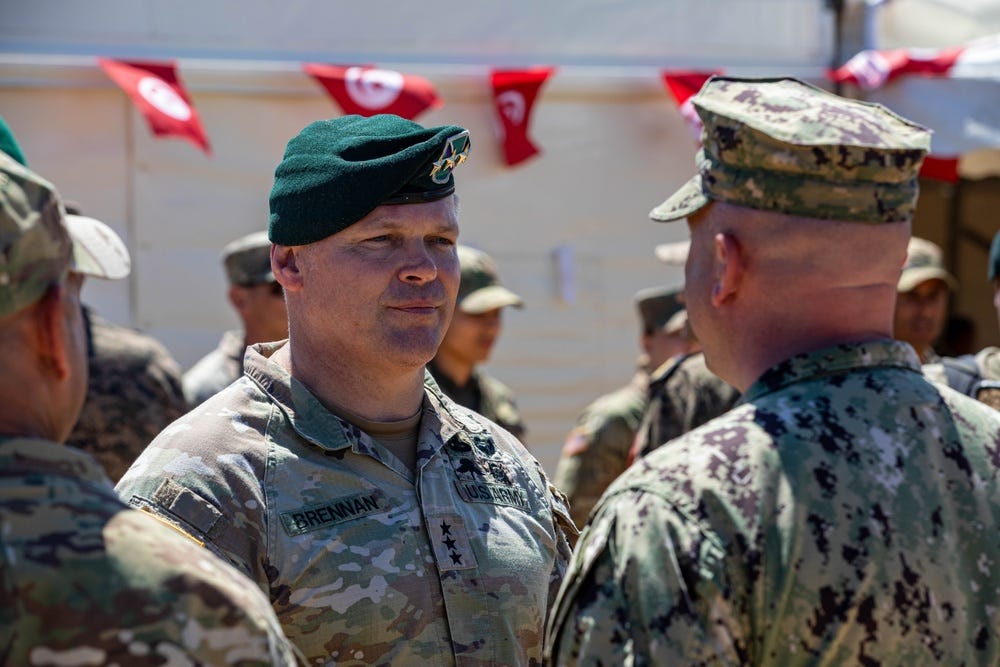
Jordan Schneider: Our first active-duty guest here on WarTalk, joined today by Lieutenant General John W. Brennan Jr., Deputy Commander of U.S. Africa Command, dialing in from Stuttgart. He used to boss Justin around for a while, and we’re looking forward to Justin perhaps getting a little bit of revenge today. TBD.
Justin: So I’ll start off with one of my favorite stories from my own career that doesn’t involve shooting or blowing things up. We had a major who I didn’t necessarily see eye to eye with. Colonel Brennan at the time had sent me to work in the Amman embassy, and this major decided that I needed to report to him instead of the Colonel. About two weeks went by, and all of a sudden I get an email: “Hey, haven’t heard much from you. What’s going on?” I forward him the reports that I’d been writing over that time. And then the next day Colonel Brennan comes over with an email very nicely to everyone that says, “Hey, just so everyone’s clear, Justin works for me and he reports only to me. So please direct all questions to the tower from this point forward.”
Really a storied career General Brennan has. I think letting him kick off, talking about his time — thirty-plus years in special operations, from Third Group, JSOC, Fifth Group commander — and then how you’ve seen the maturation of SOF and its role in the Army over that time, I think would be a really good way to kick us off, sir.
John Brennan: Yeah, absolutely. Appreciate the intro, it was great letting you think I was in charge.
While we were working this, the toughest problem set I think I had to work to this day, which was how to create a new army in Syria without talking to a Syrian or being in Syria. It started off really hard and it ended up finishing up in a very interesting way. But it shows you the power of SOF, and really the unconventional warfare aspect of what SOF and SF means, which is why we were created. So we’ve kind of come full circle through twenty-plus years of CT, but Syria is a great vignette of CT overlaid with unconventional warfare, because ISIS was the occupying power. We overthrew them. It took us a little longer than we wanted, but at the end of the day, that is why SF was made.
Created by John F. Kennedy, going back to the Jedburghs — and we’re kind of full circle coming back to that, competing with China and Russia, enabling partners to overthrow an occupying power should that come to pass. So I think we’re setting the seeds for what needs to happen across the globe.
It was great to come into the Army right on the heels of Desert Storm. Major conflict, but I watched everything transpire with defense cuts, and SOF actually grew during that interregnum period — late eighties, early nineties, we actually grew. In the nineties, the only people doing anything was SOF. SF in particular, I started off in Third Special Forces Group, probably deployed about two hundred and seventy days out of the year on the continent of Africa.
When we weren’t doing Africa, we were also getting pulled into things like Bosnia, as well as Kuwait, because we had plans we finally executed in 2003 and overthrew Saddam Hussein. But it was the closest thing to a shooting war that was going on — the leftover residual conflict with the Iraqis, enforcing the no-fly zones, and working with indigenous folks actually in Iraq. Not a commonly known thing, that we had SOF teams on the ground in both northern and southern Iraq well into the nineties, before the war started, working with indigenous groups to keep tabs on what Saddam and his ilk were doing, and then set the conditions for an invasion if we needed to activate the then O-plan. Which actually was hugely beneficial — you saw it play out in 2003. You had Kurds rolling up the parachutes of the 173rd when they jumped in. For the price of a candy bar, you could get pulled out of the mud too. So, ten Special Forces guys with their partners on the battlefield.
Again, the CT fight has shown over time the need for the interoperability of SOF and conventional forces, the power of combinations. We can’t do what we do globally without conventional support. We spot, assess, recruit, and train SOF operators from the conventional force for a reason. The lessons we learned over twenty-six-plus years of CT are still going on in Africa, by the way, and in the Middle East — we don’t want to forget them. But it’s been an interesting ride.
Why Special Forces, and Why Now
Justin: I really want to get to that. There’s been a lot of articles written in the last couple of weeks — Ned Marsh came out with a couple of pieces in Modern War Institute, Doc Duclos responded, there’s been some back and forth. What’s your take on the people calling for a wholesale personality change for special forces — that they need to come back and be reset — versus where you see the benefit being engagement, employment, and more contact? How does that balance look for you?
John Brennan: Yeah, I think it’s all about working with indigenous folks, whether they’re existing military surrogates, to do the work in their country so we don’t have to send eighteen-year-old kids in tanks to some place to do it. The only people that can do that are special forces, SOF folks. And then we have, obviously, the high-end National Mission Force missions — but they recruit mostly out of existing SOF formations for a reason.
It’s all about creative thinking, thinking outside the box, using old things in new ways and new things in new ways, to create effects wherever it’s needed. SF specializes in different parts of the world for a reason, so that you become experts and you have those relationships when you need them. Coming back here to AFRICOM in the twilight of my career has been interesting because the first place I went was Tunisia, and I met up with an old friend. We were friends as captains. He was in charge of their SOCOM. I’ve got examples of that in multiple countries. Those relationships matter, especially when you are in need and someone on the other end of that phone is a familiar voice. It really makes a huge difference.
Justin: When you talk to policymakers or decision-makers, how do you bring that reality to them? Like, “Hey, I personally know this person, and this is what he’s telling me” — from a decades-old relationship that I’ve stayed in contact with. How does that translate when you talk to an NSC staffer or someone in a decision-making role?
John Brennan: It’s hugely important. You can frame an action that may look one way, but you know the person — you’ve talked to them. You can tell a staffer or a decision-maker, “He’s doing this to get to this goal, and this is where we can help him. And if he goes across this line, he or she is probably not in line with our policy.”
Some of the coups that have happened in Africa — not every coup is a bloody one, and the reasoning behind it maybe is because the soldiers haven’t been getting paid. I’ve seen that happen. Going back to the nineties, I did a Flintlock-type event in Côte d’Ivoire and got home two weeks later, there was a coup. And I knew the guy on the front page of the Washington Post. He was hitting someone — he was actually hitting a rioter who wanted to take advantage of the coup. He was actually stopping it. His name was Sergeant First Class Sanson, and he hadn’t gotten paid, and his family hadn’t had the money to feed themselves until we showed up and they got what’s called 1206 monies from the embassy. They got extra stipends, because we train them hard, they need more calories. So I knew right away what he was doing and why. He was actually trying to stop violence, not create it. There are multiple examples of that I can point to.
The Center of the World
Justin: When you do have those engagements — one of the things we see is there’s a huge focus on Indo-Pacom, now there’s become a huge focus on Southern Command, and CENTCOM has always been the eight-hundred-pound gorilla. How do you talk about the importance of Africa and the role it plays in how you envision US national security and policy?
John Brennan: Sure. You start by looking at a map. Africa’s the biggest landmass and it’s literally the center of the world. To get somewhere you have to go over it or around it. And six of the biggest, most important global chokepoints touch Africa.
You see that play out in the policies of other countries. China tries to invest near the Strait of Gibraltar, near the Suez, near the Bab-el-Mandeb. Their only naval base outside of mainland China is in Djibouti, for a reason — because it’s the gateway to the Bab-el-Mandeb. They invest heavily in South Africa. You’ve got to go around the Cape if you want to get to the Indian Ocean from the Atlantic, or go through the Suez, you pick it.
The other reason is population. The growth projections are that 30% of the world’s population will be in Africa by 2050. Pretty daunting, and the growth rate is huge. Future markets, future labor force, future industry — it’s all going to converge at some point in Africa, along with a lot of critical minerals, natural resources, and energy. The biggest gas field in the world is right off the coast of Mozambique, in an area that’s a stronghold of ISIS-Mozambique — the only place they’re really operational. So getting access to that energy, and not allowing Russia and China to prevent us from accessing it, is really important.
Jordan Schneider: What are the trade-offs from your perspective of the fact that you get way fewer A1 stories in major American media about Africa versus Indo-Pacom or CENTCOM? How is that frustrating, and what liberties does it potentially allow you guys?
John Brennan: It’s super frustrating when you see China and Russia spend billions on information operations and all the media outlets they acquire influence over for propaganda purposes. Our story is a powerful story — it gets told, but it doesn’t necessarily resonate in the West. We get a lot of coverage in Europe, not as much as in the Western Hemisphere.
The things that we do, Russia and China can’t do in Africa. We have exercises like African Lion — we bring in forty-three different countries from four different continents. Russia does a BRICS exercise, they’re lucky to get five countries to participate. And it’s very scripted. They use African partners like training tools — it’s not an authentic, genuine partnership. We put the Africans in charge and then we support them, we mentor them. And like we talked about earlier, Jordan, we bring in companies that have tech that may be of interest — low-cost, very effective weapon systems that can be purchased without going through the laborious FMF/FMS process. I know the department’s doing a lot of great work to shorten the flash-to-bang time on that — direct commercial sales. But the import-export laws are very, very difficult to overcome when China just comes and drops off free stuff. It might break in six weeks, but it’s free stuff.
Doing a Lot With a Little
Justin: When you’re dealing with the military aspect, the FMS, the Flintlocks and the African Lions — how do you from the command sphere look at the DIME problem set and weigh where you apply more economic or more diplomatic effort? How does that interplay work with the sister agencies from an AFRICOM standpoint?
John Brennan: Our convening power — for conferences, exercises, persistent CT operations — brings the interagency together. And we do a lot with very little. We’re 0.1% of the Department of War budget. So we rely on interagency partners, international partners, and allies to convene where it can have the most effect. Everything from innovation to information operations, we do it by, with, and through partners as much as we can, so we can create those outsized effects with little assets.
Justin: That’s super interesting — 0.1% of the budget. I didn’t realize it was that small. Something Africa brings to mind for me: people talk now about how we’re going to have to abandon the golden hour — the one hour to get to medevac if somebody gets injured. But Africa’s had to deal with that for a very long time. Do you think there are exportable lessons from the African theater that people should be learning as they start looking toward Indo-Pacom or a less robustly equipped CENTCOM — for how to stage the force, build the force, and operate in the theater?
John Brennan: Yeah, absolutely. We have the tyranny of distance like no other combatant command over land. And the tyranny of access, basing, and overflight, which is like a Tetris game — it changes constantly. The way we do counterterrorism operations remotely, advising using tech, is something that’s very exportable. We do not rely on the golden hour because we’re not out in the trenches very often. And when we are, it’s for a very bespoke reason. Ninety percent of our advising and assisting and enabling is from remote fires, from RPAs, and then at the battalion level, where we can bring in all the different warfighting functions — not just maneuver and fires — together in one place and have effects across multiple subunits.
And then we bring in industry to try new things. We’re an experimentation theater, an innovation theater. We can bring in new things, try them out during exercises, and then combat-evaluate them in places like Somalia, in very difficult combat conditions. We have EMI problems, anti-access/area-denial systems all over the place, drones all over the place. Our partners buy drones from anyone who will sell or give them. So we routinely encounter high-end Russian air-defense systems as well as drones from all over the world.
Snake Oil and Open Architecture
Justin: Two questions there. First — when you bring in US industry, what are the marching orders? How are you discerning, “This is a real capability and this is snake oil”? Do you let the partners do that, or are you filtering before it gets down to the partner level?
John Brennan: We absolutely filter it. And they’re not all US vendors either — that’s a whole different discussion. But if it’s a venue in a partner nation, the partner nation has to allow them to come in too. So it’s in their best interest to get tech that works. And it’s not just weapon systems. We’ve had great discussions with transportation companies, software companies. The new Silicon Valley’s in Morocco. Until I got to AFRICOM I had no idea that so many countries have space programs. Rwanda — it’s eye-opening. Angola has a space program. I had no idea. And then energy companies — anytime you want to invest in production industry, you’ve got to have the energy to do it. You’ve got to have the people, the people have to have food, they have to have transportation to get to work. So some investments from larger US companies have to bring in a whole ecosystem to get their company operating effectively on the continent.
Justin: The second part — if you’re seeing this other technology coming in, where are you seeing this merging of first- and second-world tech, for lack of a better term? And what are the complications as you’re trying to run partnered operations with friendly nations that are also still receiving equipment from Russia or the PRC?
Jordan Schneider: And have you — like AngoSat-2? Is that a big part of your comms strategy going forward?
John Brennan: We’re trying to develop open-architecture networks that can accept any form of data flows. We have Libyan partners that have Chinese and Russian equipment. We have to develop a way to make the systems talk, and then protect any American kit they have as well. That’s a huge challenge. I say declare jihad against proprietary data streams, because I’ve got American weapons systems — IAMD systems — that don’t necessarily talk to one another. We have to have the open architecture so we have one pane of glass for everything, from air-defense systems to drone systems to networks, so we can see what everybody’s seeing without a separate monitor. That’s been a definite challenge.
Justin: How open do you find the US-based defense-tech companies to that — to being more plug-and-play, having a middleware that lets them interface with all these other systems?
John Brennan: If it’s a program of record, some companies are more open to changing their business model and their product than others. If we start off in the development stage, that’s the sweet spot. Get the engineers close to the operators so they can iterate to greatness. Something I used to do with our CTO at JSOC. Get the thing in the operator’s hands so he or she can break it and show you how to improve it rapidly. That’s what we’re all about here in AFRICOM. As we’re testing things, that’s the time to create the most advantageous inputs to the system and get it morphed into the form factor you want.
We’re doing a lot of that with AI and software, with the partner in mind. Our COP — when we go to things like African Lion, it’s distributed across all the partners so they can get it on an end-user device. Something we tried back in the day with ATAK. We’re trying to supersize that for more than just a moving-map tool — it’s all your feeds, whether from a UAS system, a human spotter with a GoPro, the cell phone, or a closed-circuit camera as a collection device. How do we get all those data streams into a place where we can make sense of it and display it?
Justin: When you’re looking at these common operating pictures, what’s the biggest holdup? Is it intelligence sharing? Getting the devices to talk? Bringing the other countries in and flattening the comms across all the allied nations? Where do you spend the most time trying to make these capabilities actually functional?
John Brennan: The mechanics of making the data streams accessible is the easy part. It’s the regulation. Whoever owns the data stream owns the bureaucracy that goes with it. Depending on where the stream is coming from and who it’s going to, there are a whole lot of hurdles. Even from a partner — I’ve worked with partner nations that provide FMV, and I have to go talk to their chief of defense to get them to approve letting us pull that data stream in for an exercise or operation. We’re doing it a lot with air-defense and IAMD systems with partners. And sometimes it’s more than one way. I’ll just leave it at that.
Justin: Do you find the US role to be more connecting other nations — neighboring nations — or do they do that inherently and then it’s harder for us?
John Brennan: It’s sort of an Erector Set. It depends on the partner. Some of our NATO allies operate more seamlessly with other African partners, and sometimes we’re bringing in things they’re sharing. We’ve got the MNJTF in Chad — it’s US, French, and all the Lake Chad Basin countries: Cameroon, Niger who dropped out, Nigeria, Benin. If you have bilateral sharing agreements, sometimes it gets a little discombobulated and you have to come up with a whole new ecosystem to feed a thing like an MNJTF. But tech-wise, we’re definitely the lead convener — we provide the COP tools when we go on exercises.
The Black Hole of the Sahel
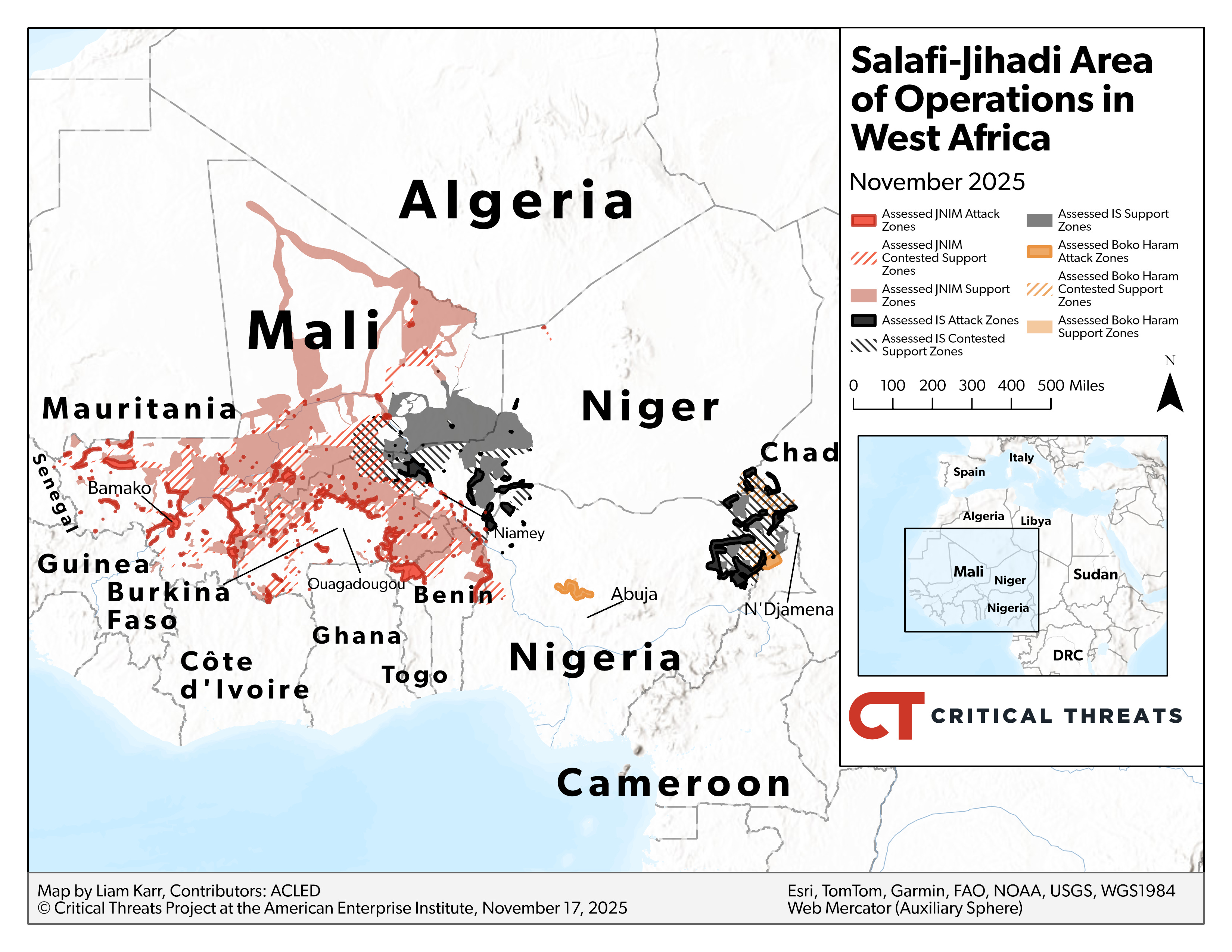
Justin: When you look at recent history — Niger, Burkina Faso, Mali all tilting toward Russia — where do you see risk, and where is there opportunity with some of those nations trying to find another champion? How does that change the way you view the map strategically?
John Brennan: General Anderson covered this very explicitly in his testimony. The black hole of the Sahel — that’s where we’ve got the most VEO growth, between al-Qaeda affiliates and ISIS affiliates. The dwindling of Western support in that area — Russia came in, they could not fill that gap, and so the VEOs are filling the gap.
We’re trying to do what’s best for the US, which is prevent a terrorist attack on the homeland that hopefully does not emanate from that black hole. We’re still working with the Sahelian partners — we still have embassies there, we still have small teams working with partners. It’s not what it used to be, but we can identify an issue before it becomes a problem for the homeland. That’s the main goal for the Sahel. And I think you’ll see a natural turning away from Russia if they keep doing what they’re doing, which is they kill a lot of civilians. Their brand of CT is not nearly as precise as ours. If you look at recent operations in Nigeria, it’s markedly different, and the outcomes are markedly different.
Justin: Do the VEOs distinguish between the Russian and the US presence? Do you think there’s a bright line, or do they just see those as all “others” and equal targets?
John Brennan: You can see from their own propaganda — they exploit Russian heavy-handedness to recruit new members and agitate old grievances. Civilian casualties are one of their biggest narratives when confronting Russia. They try to loop us in. We investigate every civcas allegation to the nth degree, but they’re always levied against us because the VEOs know it causes us trouble and we burn calories. That said, we have much more technical expertise and AI-enabled tools that help us do our own investigations and prevent civcas upstream. Never cause civcas — that’s number one in our playbook. The Russians don’t necessarily care. The VEOs are much more attuned and fearful of our CT, because it’s so precise and effective. Ultimately we want to enable the partner — there are certain operations only the US can do, that we get permission from partners to do in their country.
Putin’s Purse
Jordan Schneider: Justin brought up Russia. Could you talk a little about the recruitment pipeline that takes you from Burkina Faso to Bakhmut? It’s sort of a surreal thing. How do you process it? What’s there to be done from an AFRICOM perspective?
John Brennan: We try to highlight it when we see it. It’s basically human trafficking of Africans to go fight on the front lines in Ukraine, as well as work in factories like Yelabuga. Under false pretenses, the Russians recruit them for educational or job opportunities in Russia, and then they take their passport and now you’re on the front line. It came to a head in Kenya when they recruited a famous football player and he ended up getting captured in Ukraine. Kenyans have come out publicly — you’re not doing that here. We’re trying to engender that in other locations, but it is a problem. Thousands of Africans are getting recruited under false pretenses and then either killed or captured on the battlefield in Ukraine. It’s Putin’s purse — Africa’s Putin’s purse, and it’s a manpower source they’re trying to exploit.
Justin: Looking at the manpower thing — another thing we’ve been seeing recently, showing how connected Africa is to all the conflicts going on, you see stories about the Houthis starting to export some of their expertise. Have you seen that come into any of the African VEOs — the idea of Houthi advisors? Is that something starting to percolate?
John Brennan: Absolutely. It’s widely reported in the press — al-Shabaab working with the Houthis. They send trainees to Yemen, the Houthis send weapons materiel to Somalia. Al-Shabaab has a pretty robust budget, they have an innovation cell, they’re trying to exploit drones against the federal government of Somalia and the Somali National Army. No surprise there. But we can’t let that happen — they get true advanced conventional weapons from Yemen. Now you’ve got the Bab-el-Mandeb in a crossfire. For the global economy and US national security interests, it’s in our interest not to let that relationship mature.
Justin: Building on that — you have Djibouti right there in the same neighborhood as Somalia, you have the PRC building the naval base. How does that threat triangle look to you, between the Houthis, the PRC naval base, and the Somali VEOs?
John Brennan: They’re all impediments to us doing our job, for sure. It’s more than tension sometimes with the Chinese. The EMI environment there is bad for a reason. They’re there for a reason — it’s not in the interest of the United States. Is there collusion between the Iranian threat network and the Chinese? I think it’s more economic than anything, but that key critical chokepoint is really important for a whole host of reasons, and the threats that emanate from Somalia back to the United States are there. We’re trying to make sure it doesn’t become a home game. We want to keep the away game successful, so it doesn’t turn into a home game.
The center of gravity of ISIS is Africa. That clearly shifted from our time in Iraq and Syria, a decade-plus combating ISIS. The talent pool’s very shallow compared to what it was — CENTCOM’s been very successful in Iraq and Syria. So the path of least resistance for a VEO is to go where there’s people, ungoverned spaces, assets, and resources. Now you’re seeing those flow from the cartels in our hemisphere along with a lot of money, and drug shipments — not just through Africa, which has been going on for decades, but production on the continent for export into Europe and through our northern border from Canada, as well as Australia.
Shifting Sands
Justin: Historically that’s kind of been what it’s been — al-Qaeda birthed in Afghanistan, post-Afghanistan they run to Africa, ungoverned spaces, that’s where they rebuild the base, and only after a while do they matriculate out using finance and terror networks. When you see ISIS near Mozambique, or in the Sahel, do you start to see it like we used to look at Syria — where originally there were sixteen or eighteen different groups and then slowly they all got taken over by the black flags and coalesced into one? Is there a similar worry, or are these such disparate groups — religious fundamentalists and economic extremists — that there isn’t so much worry about them joining forces?
John Brennan: They all stemmed from roots of al-Qaeda back in the day, going back to the nineties. That’s where bin Laden got his start — in Africa. He didn’t go straight to Afghanistan. The roots are still there, a lot of it because of the resources and the money — he had money stashed in banks in Somalia going back to the nineties. There’s money to be made, and the drug money is drastically increasing it. The ISIS affiliates kind of spun off from the al-Qaeda affiliates. You see that with al-Shabaab — the current caliph of the ISIS global network used to be an al-Shabaab guy, then he became an ISIS-Somalia guy, and now he thinks he’s in charge of the global caliphate. There’s tension because they’re all fighting over the same turf. In some places you see a division of labor — the al-Qaeda affiliates tend to go after security forces, the ISIS affiliates go after the civilian population. It’s shifting sands. But the minute a capital falls — like almost happened in Iraq — now you’ve got, for lack of a better term, the mujahideen bug light. Affiliates will start to adhere and come to where they can control territory, resources, and people, with the trappings of a nation-state. That’s the sum of all fears — that that happens in Africa.
Justin: When you look at Syria, there were always the Uzbeks and fighters from other countries — Chechens. Have you seen a foreign inflow, or is it still largely homegrown, outside of the remnants of ISIS that ran?
John Brennan: No, it’s international. Same thing. And I think it will become worse — exponentially worse — if a capital falls.
Justin: On your watch list, what’s the number one — “God forbid, this is the one that will fall and cause that”?
John Brennan: Any of them are bad. The ones we’re most concerned about are in the Sahel, because the fear is that one falls in their self-amalgamated, made-up alliance — the AES — and then they all fall. Somalia, I think, has proven over the last year and a half — we’ve upped our partners’ tempo on the ground. They’ve been the beneficiary of a lot of kinetic support from us, based off the Secretary’s policy decision to return to the previous target-engagement authority. We’ve been using that to great effect. So ISIS-Somalia has lost a lot of territory up in Puntland. Similarly, al-Shabaab is not doing so well — most of the gains they made in 2024 and early 2025 have been rolled back.
Justin: Do you think that’s a product of overreach, or increased capability, popular resistance — or a tiered effect of all of those coming together?
John Brennan: I think it’s a combination of all of the above.
A DIB in Exile
Justin: That brings up an interesting point. When you’re doing foreign internal defense and building partner capacity of a host nation, how do you interplay what the host nation says it needs versus what your assessment says it needs? How do you play those two to get the most capable force going out to do counter-VEO operations?
John Brennan: Very delicately. Everyone wants F-35s — these are expensive and we don’t make enough of them, the DIB production being what it is. But we also employ other allies to help shape the environment and demonstrate to them what they need, and exercises are a great way to do that. If you fail often at one particular aspect of an operation, you know you need to work on it. Typically it’s the warfighting functions besides maneuver and fires that cause the most problems — C4, ISR, and logistics in particular. Everyone wants to overlook logistics. You can’t in Africa. The distances are so great. Northern tip of Somalia down to the southern tip — that’s a thousand-plus miles. You’re talking Maine to Florida. When your partner runs out of food and water and ammo, it’s a pretty rough gig. It’s hard to get it to them.
Justin: It’s always one I find interesting, because you see it in Taiwan, and I saw it in Thailand when I was working with the Thai special forces — there’s a desire for technology, and it doesn’t always fit the situation. That brings up an interesting discussion. A while ago you started adding an innovation block on sitreps, where you asked, “How are we doing innovation?” Initially people viewed that as “what new tech?” but slowly it morphed into “How are you thinking about a current problem in a different way?” Has that picked up, or are you still seeing people fall into “innovation is technology”?
John Brennan: It’s a trap, for sure. We do a lot more of using things in new and creative ways, or developing a new process for a new thing that’s impactful on the battlefield. The denied area that was Syria was a great battle lab, because we had the world’s most interesting problem — couldn’t step foot in the country, but we had to generate effects and a force to create those effects. That spurred that in my mind when I was at Fifth Group. We used things like ultralights — they’d been around thirty, forty years before that — in ways beneficial to us, to fly under radars we knew the Syrians had. Necessity is the motherhood of invention, and nowhere is that more true than in Africa, because we don’t have a lot of the resources the other combatant commands have.
Justin: That’s interesting, because you talked about the defense industrial base. Is there a desire to start building out a native supporting defense industrial base? I think of something like the Lucas — conceivably Nigeria could produce that in relatively robust numbers, and then export it in the area to enhance the fires capability of neighboring countries, especially in the counter-VEO fight. Do you see a desire and movement toward that, or are there cultural blockages?
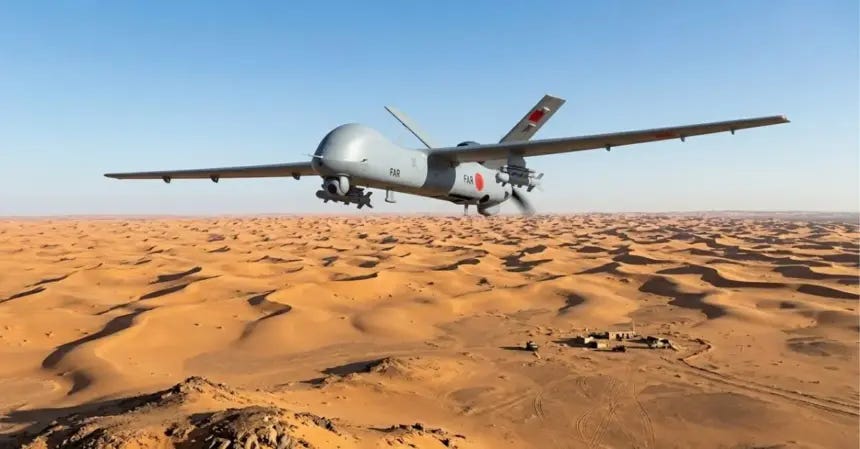
John Brennan: A hundred percent. Everybody’s all in, particularly the African partners — they want jobs, they want their own DIB so they don’t have to rely on us, which is a good thing. It’s ultimate burden share, burden shift through technology. We started up the first drone center of excellence in Morocco — the first class graduated right around African Lion. Giving them or selling them things like 3D printers and showing them how to build their own drones, so they’re hands-off once they get the ability to produce and the raw materials.
Africa’s a great vignette for an alternate DIB, because you have many countries that have all the right materiel — the natural resources, the labor force — and they want to co-produce things with us. Some of these countries already have their own arms industries. South Africa builds really good artillery. Namibia builds satellite radios. And then you have a DIB that, if they co-produce American weapon systems, it’s closer to the fight in the Pacific than from the west coast of the United States. It’s way closer.
Justin: That’s one of those things — when we start talking about distributed logistics, it becomes a question of where would we put it. You’ve talked about the tyranny of distance and the access/basing/overflight issues with Africa, but those exist for Indo-Pacom as well. There’s a lab here where we can experiment with a “DIB in exile,” forward and producing at least some of those capabilities. Do you think not having access — I’ll make fun of Kurilla, but the ability for him to just yeet T-LAMs at the Houthis or into Syria — do you think not having that access in AFRICOM has actually made you more inventive in trying to get after problems?
John Brennan: Yeah, absolutely. We’ve exploited the cross-combatant-command transition authority as much as we can to get assets from other theaters. We’ve been lent things like P-8s for exercises and operations, and vice versa — we’ve given to the CENTCOM bank on many occasions.
Justin: One of these days, guys, when we have stuff, we’re gonna share it back, I promise.
Jordan Schneider: Those Mozambique radios, though — everyone’s gonna be hounding for them. You’ll have the inside track, right?
Closing on AI
Justin: If you could have one thing AFRICOM needed over the next two years — is it a unit, an engagement, a piece of technology? What’s the thing you wish you could pull from big DOW and give to the theater?
John Brennan: There’s so many. I think we get what we need when we need it — it’s always a matter of priorities at the department, across the combatant commands. We’ve made a lot of headway with AI, and I think we could use more of it. The amount of data we have to deal with is unbelievable, because we have all the threat groups plus Russia, China — even North Korea pokes around in Africa. Everybody has interest on the continent, and figuring out who’s doing what to whom on a daily basis is consuming. Our analysts do an awesome job, but we need more AI tools for them.
And then better ways to shorten the FMF/FMS process for partners. We’re trying to work ourselves out of a job every day. The tools we used to use, like the BPC monies, are no longer with us — so how do we compensate for that? Some partners are much better resourced than others. It’s getting access to places that are meaningful, where we see threats metastasizing but can’t see the contours, because we’re just not there and we’re not collecting. So we always need more airborne ISR. We’re testing some things for the department, and hopefully we get the ability to test more so we can provide feedback and make sure those things are what we need for the future fight.
Justin: That goes to the difficulty in AFRICOM — you’re really an early sensor. That has a primary role, which is probably different from the way other theaters are conceptualized, especially UCOM and CENTCOM. That’s a tough role to be in, because SR teams routinely are not treated super well, and you have a kind of early-warning SR theater.
John Brennan: We do. We also identify opportunities — there’s so many for private-sector investment. We work hand-in-glove with the economic defense unit out of the department, newly created, to help capitalize on those and provide indications and warnings: “Hey, this would be a good investment, and here’s where our competitors are trying to outmaneuver us.” That’s been a huge change. It’s opened a lot of doors for companies to get involved on the continent.
Jordan Schneider: I’m going to close on AI, sorry, but I feel like I have to. We talked a little about data streams and bringing stuff together. There’s been a lot written around AI and targeting in the Iran conflict over the past few months. I’m curious, specifically from a command-decision perspective — one of your first answers was that you’ve known these people for twenty-five years, which is data that Claude doesn’t necessarily have. From your perspective sitting in a combatant command, what’s the slightly more sci-fi, forward-looking AI stuff — more like intelligence decision-making as opposed to just putting data streams together — that you’re excited about, maybe worried about? And how do you see “intelligence on tap” potentially changing what your successors’ jobs might look like?
John Brennan: I’m hugely excited about it. As a vignette: we and our partners pull terabytes after terabytes of CHEM off the battlefield. How do we make sense of it, find connections where it takes analysts weeks and hours? Things like breaking codes to get into crypto wallets that terrorists and drug cartels are using — I think that’s a huge offensive capability.
And then making sense of those data streams. I’ve got a sensor over here telling me this, one over here telling me that — what does it mean? What decision do I need to make? I can’t do that unless those data streams are multiplexed and analyzed quickly. Integrated air and missile defense is a great example. And then investment — I have limited resources, where does my boss place those resources on the continent to have the greatest effect? Do we have a predictive tool that says, if you invested this much in this industry in this location, what’s it going to look like in five years? What’s the effect on that nation’s economy? Some of the things ExxonMobil’s doing will double some of these economies in one year. And reducing civilian casualties is really important as well.
There’s so many uses — it’s up to your imagination how you want to employ AI. But it’s central to everything we’re doing. For the first time ever we have a Chief Data Officer — we never had one of those — and we’re getting a CTO in. I’ve got companies that want to sell us data all the time, and making sense of what application is right for us is difficult. But we’re getting professionals — data scientists, data engineers — involved, so we’re not paying for the same data twice. If UCOM’s paying for it, why should I pay for it? Let’s craft the contract accordingly. Data as a service — I think that’s going to be more prevalent, not just with us but with our allies and partners, so we can see things the same way and understand the same data in the same way.
Jordan Schneider: So we’re not quite at the point where you’re asking Claude or ChatGPT how to defeat ISIS and just kind of going with it.
Justin: Press play and go.
John Brennan: Bring Justin back on active duty and give him a really sharp knife. No, just kidding.
Justin: Please, no. My back…
Jordan Schneider: Justin, anything you want to close on?
Justin: No, I think that was great. I really appreciate it. Full disclosure — I’ve known John Brennan for thirteen years now. He put me in a position when I was way too young and too junior in rank to have a role in US national policy in the Middle East, and it really set the trajectory for my career. Obviously, nothing but respect. I really appreciate you coming on, sir.
I'm not a big fan of these broad political discussions. In fact I'm very disappointed that science is not about the actual theories but instead people confuse facts with attempting to explain the facts which is what theories are. What this means is that science even is infested with the kind of opinion forming that is politics. I don't know how we're going to save ourselves if we just can't actually judge the arguments...