
Leia Wang is a is a nonresident scholar in the Technology and International Affairs Program at the Carnegie Endowment for International Peace, as well as an associate at the Centre for the Governance of AI (GovAI).
击鼓传花 (ji gu chuan hua), roughly translated as “beat the drum, pass the flower,” is a Chinese children’s game in which players pass a flower around while a drum sounds. When the drum stops, whoever is left holding the flower loses the round.
The phrase has recently acquired a secondary use in Chinese financial and policy commentary as a shorthand for a speculative chain in which risk is passed between participants. From anonymous investor forums to listed-company risk disclosures, it has been applied to the 2015 A-share bubble, property speculation, local government debt rollovers, P2P lending, and, most recently, the venture capital (VC) market. As one Chinese venture capitalist explained to me,1 the game is China’s AI market, and investors are the players. Each investor races to pass along overvalued AI companies before the “beat” of the capital-raising cycle stops.
Many domestic financial actors caution that this dynamic indicates China’s early-stage AI market is becoming a financial bubble. Valuations have inflated faster than revenues, capital is concentrated in a handful of hot subsectors, and money keeps flowing toward companies with no clear path to profitability. They cite the roughly 80,000 Chinese AI companies that have dissolved or deregistered in the past two years.
While they may be right that these are indicators of a market about to correct itself, it is more likely that they are signs that Chinese industrial policy is at work. Since 2017, when AI was designated a strategic technology, Beijing has taken an active role in promoting the industry’s growth. Over the past eighteen months, the state has prioritized funding early-stage companies, launching dedicated national AI funds and committing hundreds of billions of yuan toward AI ventures. This influx of concentrated capital has contributed to bubble-like dynamics as funding rushes in faster than the industry can absorb it.
Yet the strategy of financing new ventures in strategic sectors is one Beijing has used before. From solar panels to electric vehicles (EVs), the government used state capital to build other priority industries. Whether AI follows a similar trajectory depends on how the funding is deployed, including the mechanisms and stakeholders involved.
The Rise of Policy-Driven Funding
The origins of the government venture funding architecture stem from the history of China’s AI financing ecosystem. Over the past decade, shifting domestic and international policies have shaped the sources of venture capital and the structure through which it is deployed.
Before 2018, foreign venture capital played a major role in Chinese tech financing. Firms like IDG, Goldman Sachs, and Peninsula Capital funded the first wave of internet giants, such as Alibaba, Tencent, and Baidu. These firms brought both large-scale capital and a Western investment philosophy of high-risk, staged investment, which shaped what got funded and how within the tech startup world. However, driven by rising US-China tensions, the share of Chinese VC deal value involving foreign investors fell from 54.8% in 2018 to roughly 20% in 2023. President Biden’s August 2023 executive order (EO) on outbound investment, which prohibited or required notification for certain US investments in Chinese AI, semiconductor, and quantum firms, accelerated this process. Although the EO didn’t take effect until January 2025, many international firms split off their China entities, downsized their domestic presence, or withdrew from China altogether in anticipation of its enforcement. Dollar-denominated funds, which accounted for nearly 14% of China VC fundraising in 2021, accounted for barely 1% by early 2025.
Domestically, private capital actors were in no position to fill the gap. As foreign funding retreated, a wave of new regulations hit the Chinese tech sector, stymying the industry’s main sources of funding and exit avenues. The 2018 asset management rules restricted the underlying wealth management structures that supplied the largest source of domestic private funding. This was exacerbated by Beijing’s 2021 tech crackdown, beginning with regulators fining Alibaba a record 18.2 billion yuan ($2.8 billion) for anticompetitive behavior. The campaign subsequently swept up Tencent, Meituan, and many of the other Chinese consumer internet champions. Beijing then launched a cybersecurity probe into ride-hailing giant DiDi as it pursued a New York IPO, leading regulators to pull Didi apps from app stores and forcing the company to delist. On the US side, the Holding Foreign Companies Accountable Act threatened to delist Chinese companies due to disputes over auditing standards. This made US listings, once the clear objective of most startups, no longer a viable option. By 2024, venture capital fundraising sank to its lowest level in almost a decade.
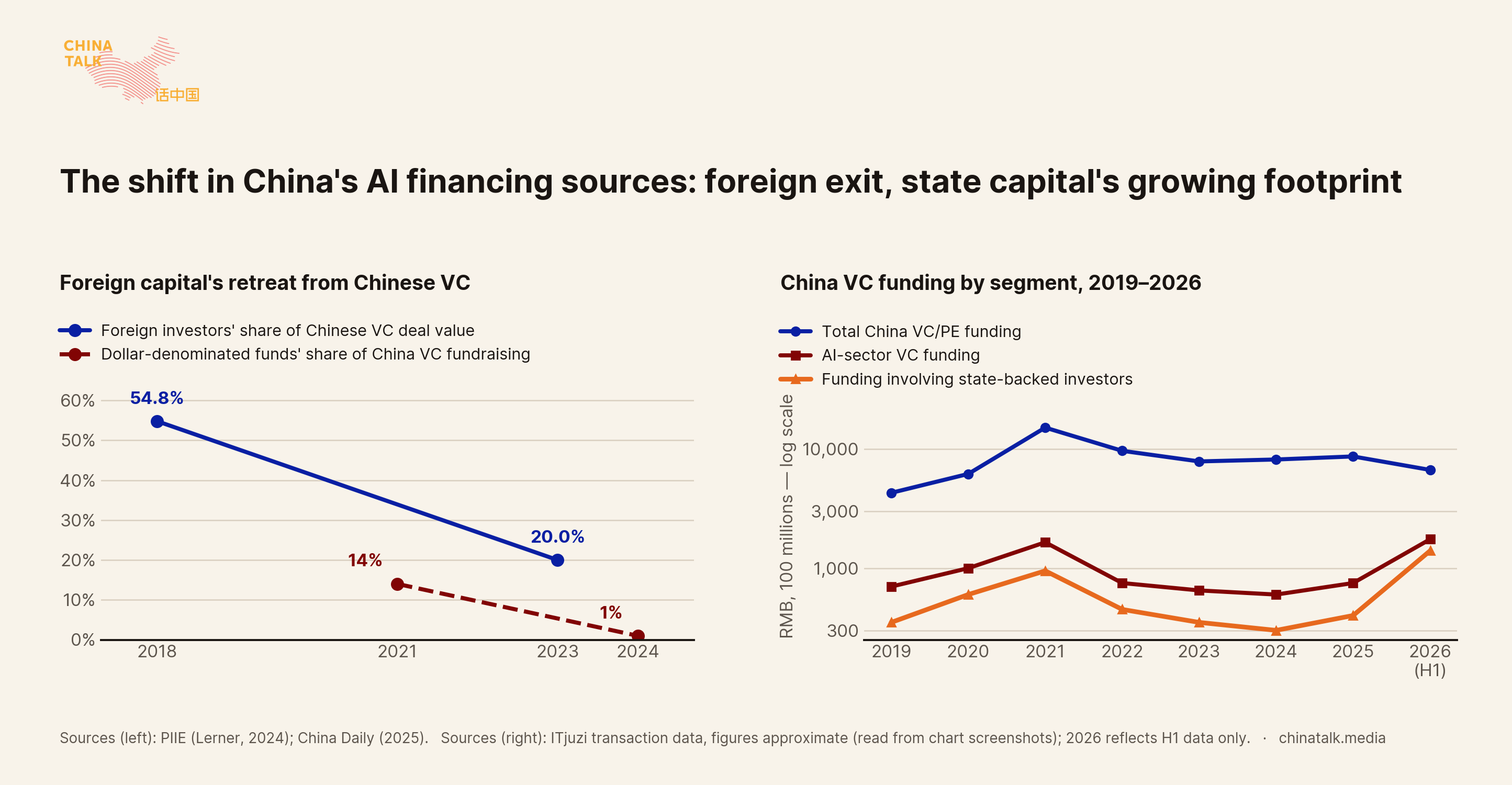
With the retreat of private funding, state capital came to dominate early-stage funding. The same year private VC was at its lowest, state-owned capital accounted for 82% of all new LP contributions. Since then, state funding has continued to pour into the venture capital ecosystem, especially within AI. As AI has grown in importance, the government has expanded its breadth of funding to various stages and types of AI companies, with state investors leading some of the sector’s largest financing rounds.
Government Funding’s Role in the AI Industry
As Beijing increases its investment in the AI industry, government priorities and funding mechanisms are playing a large role in shaping the industry. The set of stakeholders involved in the government financing apparatus, the terms attached to the funding, and how this money is directed and allocated now disproportionately determine what gets built.
Currently, much of this capital has been deployed via government guidance funds (GGFs), vehicles set up to channel state capital in line with industrial goals, including promoting “strategic emerging technologies” (战略性新兴产业 zhan lue xing xin xing chan ye), advancing industrial upgrading, and reducing reliance on foreign suppliers in critical sectors. GGFs have played a crucial role in incubating “leapfrog technologies” such as EVs and renewables, 5G and telecom, and now, semiconductors and AI. Over the past two decades, GGFs have amassed 7.7 trillion yuan ($1.1 trillion) in committed capital,2 roughly twenty times what the US government’s public-private investment program, the Small Business Investment Company (SBIC), held at its record 2025 high, and enough to fund DARPA at its current budget for two centuries.
Between 2000 and 2023, nearly a quarter of GGF capital flowed to AI-related firms. Within the AI supply chain, the National Integrated Circuit Industry Investment Fund (the “Big Fund”)3 has been instrumental in shaping the semiconductor industry. Its first 138.7 billion yuan ($21.8 billion) anchored national champions along the chip-making supply chain from downstream chipmakers like foundry leader SMIC and memory maker YMTC to upstream equipment and materials suppliers like NAURA and Piotech. The fund was renewed several times, first in 2019 with 204 billion yuan ($29 billion) after China’s AlphaGo moment, and again in 2024 with 344 billion yuan ($47.5 billion) after ChatGPT’s launch to further increase AI chip and chipmaking equipment production.4
Chinese government spending was further accelerated by US attempts to curb the industry. In January 2025, days after Washington tightened semiconductor export controls, the Ministry of Industry and Information Technology (MIIT) and the Ministry of Finance (MOF) established a dedicated 60 billion yuan ($8.2 billion) National AI Industry Investment Fund.5 Unlike the Big Fund, this fund explicitly targeted early-stage ventures across the AI supply chain from upstream inputs, such as compute and data, to downstream applications, especially within embodied intelligence and autonomous vehicles.
Less than a year later, the National Development and Reform Commission (NDRC) and MOF launched another 100 billion yuan ($14 billion) national venture capital guidance fund. This fund set up three regional sub-funds (Beijing-Tianjin-Hebei, Yangtze River Delta, and the Greater Bay Area) as innovation centers registered at roughly 30 to 47 billion yuan ($4.4 billion to $6.9 billion) each. Since their launch, the sub-funds have signed over 25 deals across integrated circuits, quantum, biopharma, AI, and other priority sectors.
GGFs have been criticized for creating the bubble dynamics experienced by industry and being “poorly conceived and implemented.” In some ways, this is true. Yet the dynamics that look like a financial bubble at a surface level are the same mechanisms that allow Beijing to achieve its industrial policy goals.
Not-so-patient Capital
Early-stage companies, especially in capital-intensive fields like semiconductors, robotics, and foundation models, often require years of research and capital before they turn a profit. GGFs are meant to supply this source of “patient capital”6 within hard technology sectors (硬科技 ying ke ji). While these funds nominally have 15 to 20 year time horizons, in practice, their effective horizons are usually much shorter.
This timeline compression is driven by the process through which GGFs are often deployed. National GGF managers rarely invest directly. Instead, they often delegate decision-making downward7 to various regional levels and/or private VCs to bring in industry expertise and “amplify the leveraging effect” of government capital. Central capital is thus passed through a chain of investors before reaching companies. The 2025 fund, for example, operates through a three-tier structure where the national guidance fund company seeds regional funds, which in turn seed sub-funds typically run by private VCs.
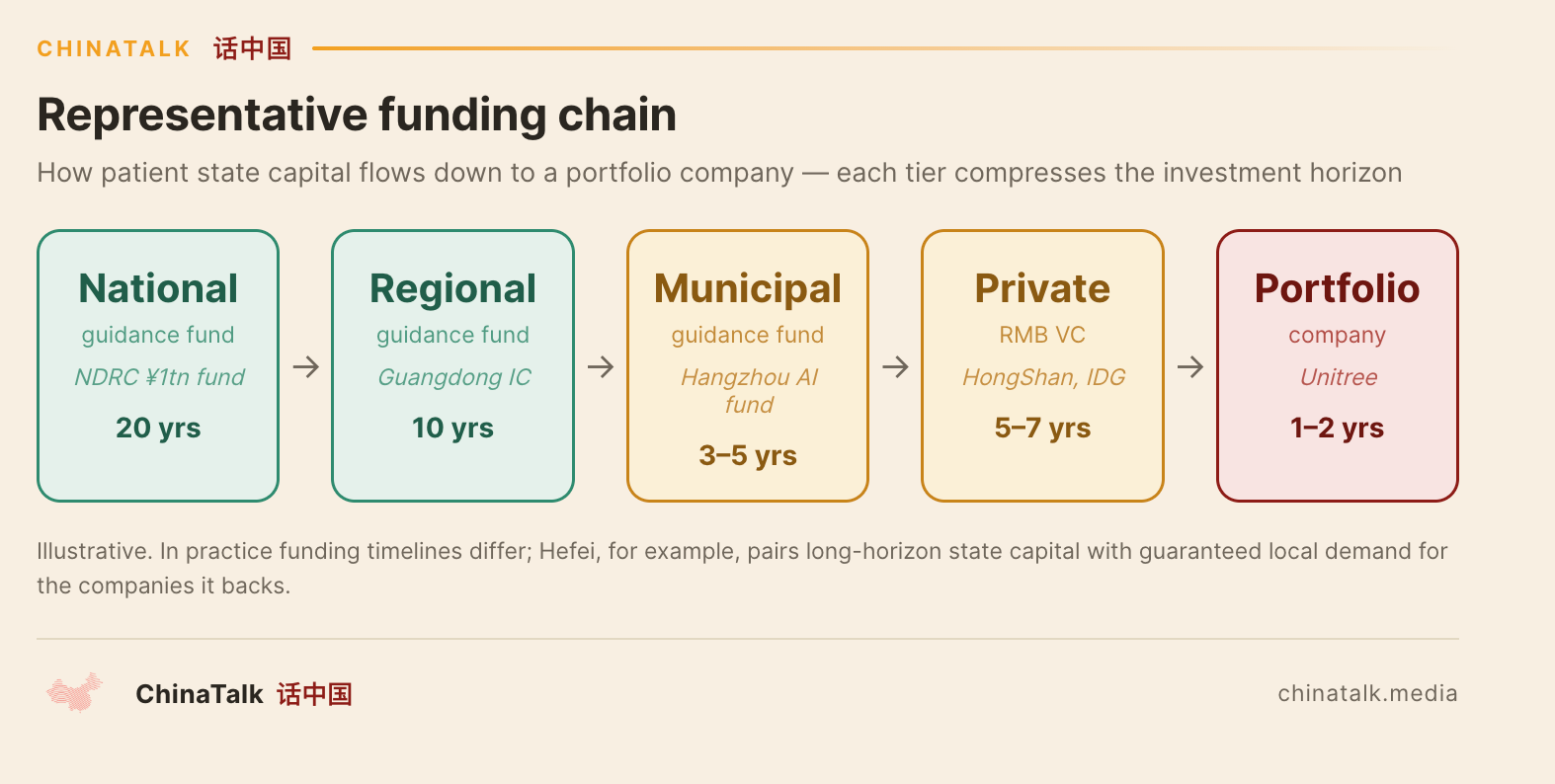
As capital flows through the system, each actor attaches their own, often short-term, objectives. Local officials, among the most active stakeholders in this process, operate on cadre rotation cycles (干部交流 gan bu jiao liu), in which they switch departments and geographic posts every three to five years. They therefore optimize their funding decisions to meet their promotion targets within that time frame, prioritizing investments that can demonstrate measurable progress by the time they are up for review. One popular condition among officials is a geographic reinvestment requirement (返投 fan tou), which mandates that companies bring capital back to the local economy in some form. To hit these targets, companies often trade off investing in longer-term ambitions for resourcing tangible short-term projects.
Private VCs also have their own short-term incentives. Chinese funds have shorter lifespans than their Western counterparts, and as the IPO pipeline has narrowed, investors are turning to instruments that guarantee near-term returns. The dominant instrument of this kind is the redemption clause, a contractual right that requires the company to buy back an investor’s stake plus accrued interest if the firm misses an IPO deadline, valuation target, or revenue metric. This clause is written into more than 80% of Chinese venture and private-equity deals, and roughly two-thirds of the time, that liability extends to the founder personally. As funds struggle to return capital to their own LPs, they have begun enforcing these clauses aggressively, pursuing founders’ personal assets and placing those who cannot pay on a national debtor blacklist. A Supreme People’s Court reference guidance further compressed the window, holding that buyback rights must be exercised within six months of being triggered. This incentivizes fund managers to call in capital before rivals do, passing on the time pressure to portfolio companies.
The result is a capital chain that is “patient” at the national level and impatient at the layers actually making investment decisions. By the time capital finally reaches companies, the 20-year horizon at the top has often compressed into a demand for returns within just three to five. This short-term optimization creates a sense of urgency to quickly sell and exit. While this roughly follows the pattern of a speculative market, its underlying driver is the structure of the flow of government funds rather than investor sentiment.
Institutionalized Herding: Concentration of Capital in “Hot Sectors”
When Beijing signals8 a priority sector, provincial and municipal governments realign their guidance fund mandates to demonstrate political alignment, private VCs shift their portfolio allocations, and founders flock to that sector. GGFs compound this effect by drawing in additional “social” capital (社会资本 she hui zi ben) to their own investment rounds. The 2025 national venture capital guidance fund, for example, is meant to mobilize a trillion yuan ($140 billion) in regional and private capital into state-designated priority sectors over its lifetime. The effect of this capital concentration is that both regional governments and private sector actors are piling into the same state-signaled priorities.
One way this realignment is playing out is through geographic convergence. Regional governments have historically specialized in distinct industrial sectors: Shenzhen in electronics and hardware, Hangzhou in digital platforms, Hefei in display panels and EVs. AI investments nominally reflect this specialization, but capital is increasingly pushing localities into the same subsectors. The “Eastern Data, Western Computing” (东数西算 dong shu xi suan) plan, for example, was intended to route compute-heavy workloads to cheaper-power western provinces. However, between 2023 and 2024, more than 500 data center projects were proposed, many of them not in the West.
At the model layer, the Hundred Model War (百模大战 bai mo da zhan) is another example of capital concentration. After ChatGPT’s launch triggered a global LLM development race, new Chinese companies appeared almost overnight. By mid-2023, China had at least 130 large language models, roughly 40% of the global total. Established tech companies, such as Baidu, Alibaba, and Tencent, were joined by ByteDance, Zhipu, Moonshot, Baichuan, MiniMax, and dozens of smaller entrants who released their own, nearly identical LLMs.
Within the application layer, humanoid robotics has become the system’s newest concentrated bet. In November 2023, MIIT published national guidelines designating humanoid robots as a potentially disruptive technology. Soon after, provincial and municipal governments issued their own humanoid robotics action plans and stood up dedicated local funds. In the first nine months of 2025, Chinese embodied intelligence startups drew 610 funding rounds worth roughly 50 billion yuan ($7 billion). Within two years, more than 150 manufacturers had entered the market.
Unitree Robotics is a clear example of this funding concentration and how valuations can quickly skyrocket. Founded in 2016, the Hangzhou-based firm raised a modest seed round and remained relatively unknown for several years. However, following the 2023 MIIT guidelines, the company quickly raised nearly 1 billion yuan ($147 million) from Shenzhen Capital Group and the state-backed China Internet Investment Fund, alongside private investors such as Meituan. By its Series C, its cap table9 had grown to include the Beijing Robotics Industry Investment Fund, the Shanghai Science and Technology Innovation Fund, CITIC, Tencent, Alibaba, Ant Group, and Geely Capital. After a dancing-robot debut at the 2025 CCTV Spring Festival Gala, secondary trades reportedly valued it above 15 billion yuan, and it has since filed for a STAR Market IPO targeting a 42 billion yuan ($6.2 billion) valuation.
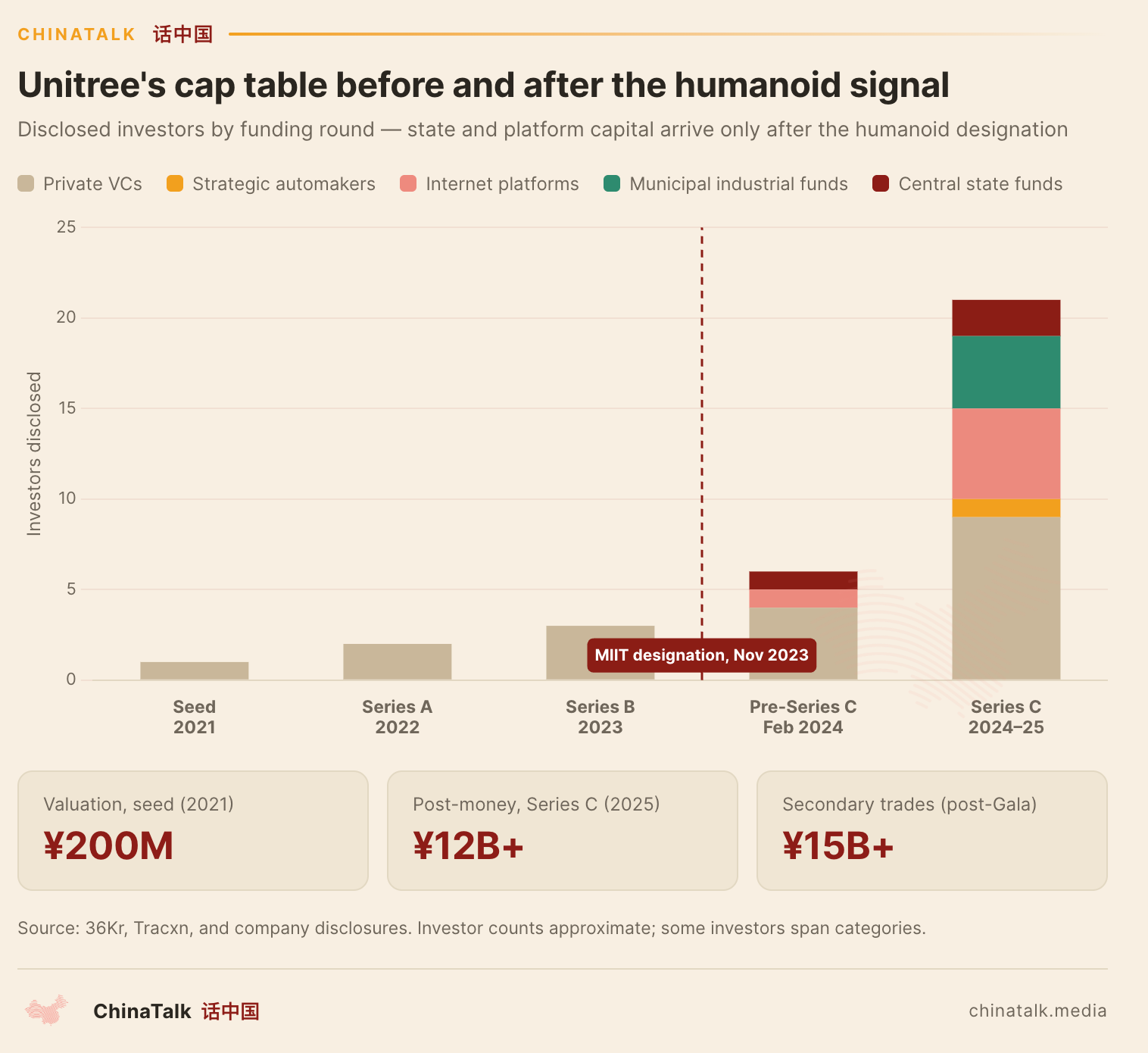
The immense concentration of capital and the inflated valuations are largely driven by investors’ taking “safe bets” and following government signals. While many have and will continue to lose their investment, the funding has counterfactually propelled various AI subsectors forward and produced emerging national champions.
The Export Advantage of Overcapacity
As funding concentrates in a few sectors, companies producing highly similar products begin competing for resources, customers, and political relevance. Many foundation model companies launched just a few years ago are accepting down rounds, pivoting to other business models, or shutting down entirely as margins compress and returns shrink. This pattern of increasing competition over shrinking returns, known as involution (内卷 nei juan),10 has already played out in electric vehicles, solar/polysilicon, food delivery, and now in AI. Baidu CEO Robin Li called the Hundred Model War “a significant waste of resources, particularly computing power,” and President Xi Jinping called for a halt to “disorderly” price competition. Since the boom in 2023, many data center facilities have remained idle or operated at just 20% to 30% capacity, and more than 100 projects have since been scrapped.
In response, the Politburo has launched a formal campaign against involution, but so far the attempt has not amounted to any meaningful results. The NDRC has publicly directed localities to act “according to local conditions” and avoid duplicative investment, and has tightened approval requirements for new data center projects. Various initiatives such as industry self-discipline pledges, drafted amendments to the Pricing Law barring below-cost sales, and a handful of state-brokered consolidations look like concrete steps to addressing price and profit issues. However, many industry observers are skeptical the state will put real force behind curbing overcapacity. This is because while overcapacity destroys investor returns, it also pushes the technology into the economy. By driving down prices, forcing rapid product iteration, and building dense supplier ecosystems, the competition that hurts individual companies is, in aggregate, useful for promoting Beijing’s goals of AI adoption.
Moreover, a saturated domestic market pushes companies abroad to find new customers where they can compete on cost. China’s EV industry is a clear precedent. Between 2015 and 2019, 500 EV ventures emerged, fueled by state subsidies, tax breaks, and easy access to local production licenses. When subsidies began phasing out and competition intensified in 2020, roughly 400 of those companies closed.11 The domestic price wars, however, meant the surviving companies had cost structures that made them incredibly competitive overseas. In 2025, BYD overtook Tesla as the world’s largest seller of battery-electric vehicles (BEVs), selling roughly 38% more BEVs globally.12
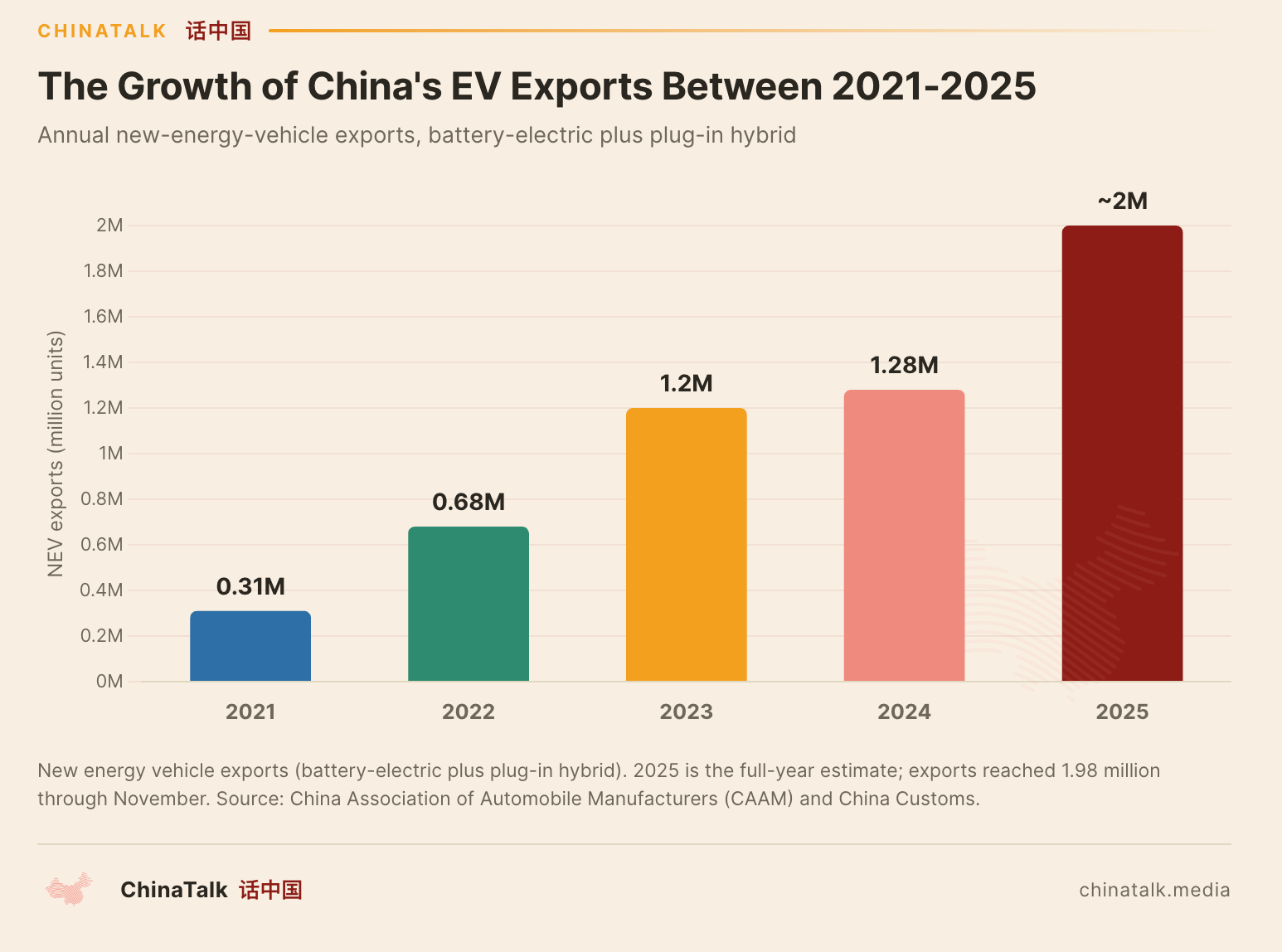
We’re beginning to see this pattern repeat in AI. The Hundred Model War cut model API costs by more than 90% and helped drive model usage on China’s public clouds to 536.7 trillion tokens in the first half of 2025, nearly five times the volume of all of 2024. Companies such as DeepSeek, Alibaba (Qwen), Moonshot AI (Kimi), Zhipu (GLM/Z.ai), MiniMax, ByteDance (Doubao), Tencent (Hunyuan), and StepFun are all now finding customers abroad. In February this year, Chinese models processed more tokens than American ones on OpenRouter for the first time. The following month, Chinese open-weight models also overtook US models on Hugging Face, accounting for roughly 41% of downloads.
Within physical AI applications, China’s manufacturing base compounds the advantage. A host of AI-enabled products have been piloted, adopted, and scaled domestically before exporting abroad. The Guangzhou-based firm WeRide now holds robotaxi permits in eight countries and operates more than 100 robotaxis in the Middle East. Gausium has deployed autonomous cleaning machines across European supermarkets, and Supcon is running AI inspection projects with Saudi Aramco.
While the level of AI exports has yet to reach the scale of EVs, if Beijing’s approach to the AI industry continues to follow that of EVs, we could see the same cycle of impatient capital causing convergence and overcapacity, ultimately leading to an export-dominant industry model.
So What Happens Next?
These dynamics explain why foreign commentary on Chinese AI tends to settle into one of two stories. In the first, China is a well-oiled industrial machine. Beijing can channel unlimited resources to priority sectors, mobilize entire industries around a common goal, and force technological advancement almost overnight. In the second, Chinese central planning produces a system that burns through enormous amounts of state funding, incentivizes companies and investors to crowd into the same sectors, and rewards political alignment over actual market value. In reality, it is both at once. The system does waste capital, and at the level of individual companies, it does look more like a bubble than a sustainable industry. It also rapidly creates world-leading industries and enables companies to compete in the global market.
China’s industrial growth model attempts to pair the selection pressures of an “effective market“ with the speed of a “capable government.”13 As a mechanism for generating returns, the system is largely inefficient. As a mechanism for industrializing a technology, it is, so far, remarkably effective. Various measures, including the U.S. outbound rule,14 may slow this process at the margin, but are unlikely to change the overall outcome. This is because they are targeting funding supply, which is not the binding constraint. Instead, if governments around the world want to materially shape the growth of Chinese AI companies, they should focus on the demand side of the equation. Domestic overcapacity means companies need customers abroad to buy their products and services. As a first step, countries can limit access to their own markets if they hope to prevent a repeat of the EV precedent.
Beijing will keep the 击鼓传花 game going as long as it continues to create a growing domestic AI industry with internationally competitive national champions. It’s up to the rest of the world to decide if these AI champions will also dominate the global market in the near future.
I spent a few weeks in China interviewing various private VCs, former state-owned enterprise (SOE) employees, financial advisors, and startup employees that invest in or work at AI companies. Much of this article was shaped by their insights, but I largely don’t refer to them to preserve their anonymity.
The 7.7 trillion yuan figure is from Zero2IPO Research Center’s 2025 report, covering investment through the end of 2024. More recent figures covering 2025 are harder to find and confirm accuracy.
The 7.7 trillion yuan ($1.07 trillion) counts committed rather than paid-in capital. It is measured by the registered capital of each fund’s corporate entity, across all 2,178 guidance funds, including public-private partnership infrastructure vehicles. Excluding PPP funds, the figure would be 6.44 trillion yuan ($895 billion) committed against a 10.39 trillion ($1.44 trillion) target from 2,023 funds.
The “Big Fund” was launched in 2014 and financed chiefly by the Ministry of Finance and the China Development Bank. Although the fund had already been around for years, when private capital dried up, it became much more important and played a larger role in the overall financing ecosystem.
To put these numbers in perspective, Phase III alone roughly matches the entire $52.7 billion the U.S. CHIPS and Science Act appropriated for semiconductors, and the three phases together approach $100 billion. However, it’s hard to make a clean comparison because while the CHIPSAct is a finite package of grants and tax credits, the Big Fund is an equity vehicle nested within the broader apparatus of subsidies, tax preferences, and state direction. Thus the Big Fund’s headline number doesn't capture the full scale.
The National AI Investment Fund is managed by the state-backed Guozhi Investment Fund in Shanghai and partially carved out of the third phase of the Big Fund.
Patient capital (耐心资本, nai xin zi ben) refers to long-horizon, high-risk-tolerance investment capital that can ride out economic cycles and absorb individual project failures. Beijing elevated the term at an April 2024 Politburo meeting that called on the state to "scale up patient capital" to fund technological innovation and "new quality productive forces."
However, even when GGF managers act as LPs via a fund-of-fund (FOF) structure, they are often much more hands-on than most Western LPs. This could include attaching strong requirements on investments, requiring GPs to run all decisions by them, or even directly vetoing and selecting companies to invest in.
State signalling of priority sectors refers to the mechanism by which Beijing designates strategic industries. This often happens through specific phrases in policy documents including Five-Year Plans and high-level meeting readouts. Phrases such as “strategic emerging industries” (战略性新兴产业) and “new quality productive forces” (新质生产力) carry weight as they are used as filtering factors for new investments.
A cap table (capitalization table) is a ledger of a company's ownership, showing each investor's equity stake and how it changes across funding rounds.
The term involution was popularized by anthropologist Clifford Geertz, whose 1963 study Agricultural Involution described Javanese agriculture that absorbed ever more labor without raising output per head, what he termed "growth without development.” It was brought into the Chinese context by historian Philip Huang’s study of China's rural economy in 1990 before breaking into everyday Chinese usage in 2020, after an interview with the anthropologist Xiang Biao reframed it as an endless cycle of zero-sum competition that participants can neither win nor exit. The phrase has since migrated into official economic discourse, where Beijing now invokes it to describe the ruinous overcapacity and price wars.
Analysts now expect that only 15 of the remaining 129 EV and hybrid brands will be financially viable by 2030.
In 2025, BYD sold 2.26 million BEVs, while Tesla sold 1.64 million. Its exports, largely to Europe, Latin America, and Southeast Asia, exceeded one million units for the first time, a increase of about 150% from its 2024 sales.
"Effective market and capable government" (有效市场和有为政府, you xiao shi chang he you wei zheng fu) is the Party's formula for reconciling market mechanisms with state direction. It pairs a market that plays the "decisive role" in allocating resources with a government that actively corrects market failures and steers strategic development. The pairing originates in economist Justin Yifu Lin's New Structural Economics and has since been elevated to official doctrine, enshrined by the 20th Central Committee's Fourth Plenum (2025) as a governing principle.
This is not to say the outbound rule is useless. The outbound rule’s objective is not only to stem the flow of capital into China, but also to cut off “certain intangible benefits that often accompany United States investments and that help companies succeed, such as enhanced standing and prominence, managerial assistance, investment and talent networks, market access, and enhanced access to additional financing.” Cutting off US AI investment still does this.
Tsinghua's Institute for AI International Governance translated and responded to my article here: https://mp.weixin.qq.com/s/k5mC15yNN_0soB2qbjl-7w
I'm responding to their response below:
I appreciate you picking this up—and the nuanced critique. I’ll give a brief response to your three points of pushback, but I’d be happy to discuss this further.
First, you call out the distinction between industrial policy creating the risk of bubbles versus the bubble itself being the policy. I agree that there is an important difference. As you note, and as I mentioned in my article, the anti-involution push (including the 2026 Government Work Report) clearly shows that policymakers recognize this as a real problem.
However, my claim is not that the government is trying to create a bubble to achieve its goals in the AI industry. Instead, I’m arguing that overcapacity and involution, while unintended side effects of the policy, can still be an important part of the causal mechanism through which China builds industries rapidly and at scale. Policymakers do not need to want the downsides of involution for these dynamics to be instrumental in accelerating industrial development, adoption, and application.
Second, you state that I oversimplify the government’s role in directing capital flows. Again, I agree. For brevity, I did leave out significant nuance. (I have a forthcoming paper that unpacks some of these details, so I am painfully aware that I didn’t unpack the complexity of how the state and the private sector interact in the capital allocation process.) However, my claim is not that the government chooses individual ventures, but that it plays an active role in shaping the ecosystem through capital allocation mechanisms. Even though the end decision-makers are often private venture capitalists, the state has a significant impact on the decisions that these private VCs make.
Third, you point out the ways in which NEVs and AI aren’t comparable. While there are significant differences between both the underlying technologies and the relevant industrial policies, I still believe there are many parallels that we can draw on. For one, while pricing doesn’t directly correlate with a corresponding uplift in competitiveness, it does have an effect.
Another point you raise is that companies don’t necessarily look for overseas customers when excess capacity emerges. Here, I disagree. While, as you note, China does have an enormous market for industrial AI applications, if domestic competition is strong enough and the barriers to entering new markets are low enough, it’s only logical for companies to go abroad. Leaving aside the government’s support for AI companies entering global markets, from a purely profit-driven perspective, companies have every incentive to seek international customers if they can make more money doing so.
Finally, I agree with your conclusion that if China wants to truly innovate at the frontier, it will need long-term capital that bears the innovation risk. However, to increase exports and push the AI+ adoption agenda, the current policy seems to be working pretty well.
Again, I appreciate you taking the time to respond. Hope to continue the conversation.
thank you for including the Chinese phrases