
Starting in October 2022, the Biden administration’s Bureau of Industry and Security (BIS) updated chip controls like clockwork, with a cadence of updates every year.
Since Trump 2.0, however, the clock has stood still. Export controls on semiconductors and semiconductor manufacturing equipment have not been substantively updated since December 2024. The Trump administration has been reticent to update controls and has even considered walking them back. Over the past year alone, there have been tiffs over allowing sales of the H20 and then the H200.
But the government has not been united in this stance, and Congress is now taking its own stab at export controls. In April, both the House and the Senate introduced versions of the Multilateral Alignment of Technology Controls on Hardware (MATCH) Act. If passed, the MATCH Act would serve as the legislative branch’s first major attempt to enshrine export control into law, a prerogative that has traditionally been the purview of the executive branch and its agencies.
The MATCH Act, which has already passed through the House’s Foreign Affairs Committee (HFAC), would carve export controls on semiconductor-manufacturing equipment (SME) into stone, meaning that America’s posture of chip controls would be almost immutable. This stands in contrast with the status quo of chip controls that can be changed at the whim of an administration. Given the MATCH Act’s potential for near permanence as an enshrined bill, it is worth exploring the bill in detail.
This article explores these questions:
What does the MATCH Act do?
What are the bill’s goals?
How likely is the bill to actually accomplish those goals?
What are the drawbacks and negative side effects of the MATCH Act?
How does the MATCH Act affect geopolitics?
I also include some lagniappe at the end where I run the eval of seeing whether Opus 4.8 could’ve done all this analysis itself.
What Does the MATCH Act Do?
The MATCH has two main goals: (1) cement the core of existing export controls on SME and (2) harmonize allies’ actions with American rules.
The MATCH Act compels the executive branch to preserve export controls — both on equipment and against specific actors (certain Chinese companies or facilities) — that are on the books today. These include advanced deposition tools, wafer handlers, EUV and DUV lithography equipment, advanced testers, etchers, and metrology tools — all the usual suspects. The specific actors blacklisted include any Chinese advanced-node facility and the companies SMIC, CXMT, and YMTC.1 The gravity of this rule is immense: if passed, no future presidential administration could unilaterally turn back the clock on these controls.
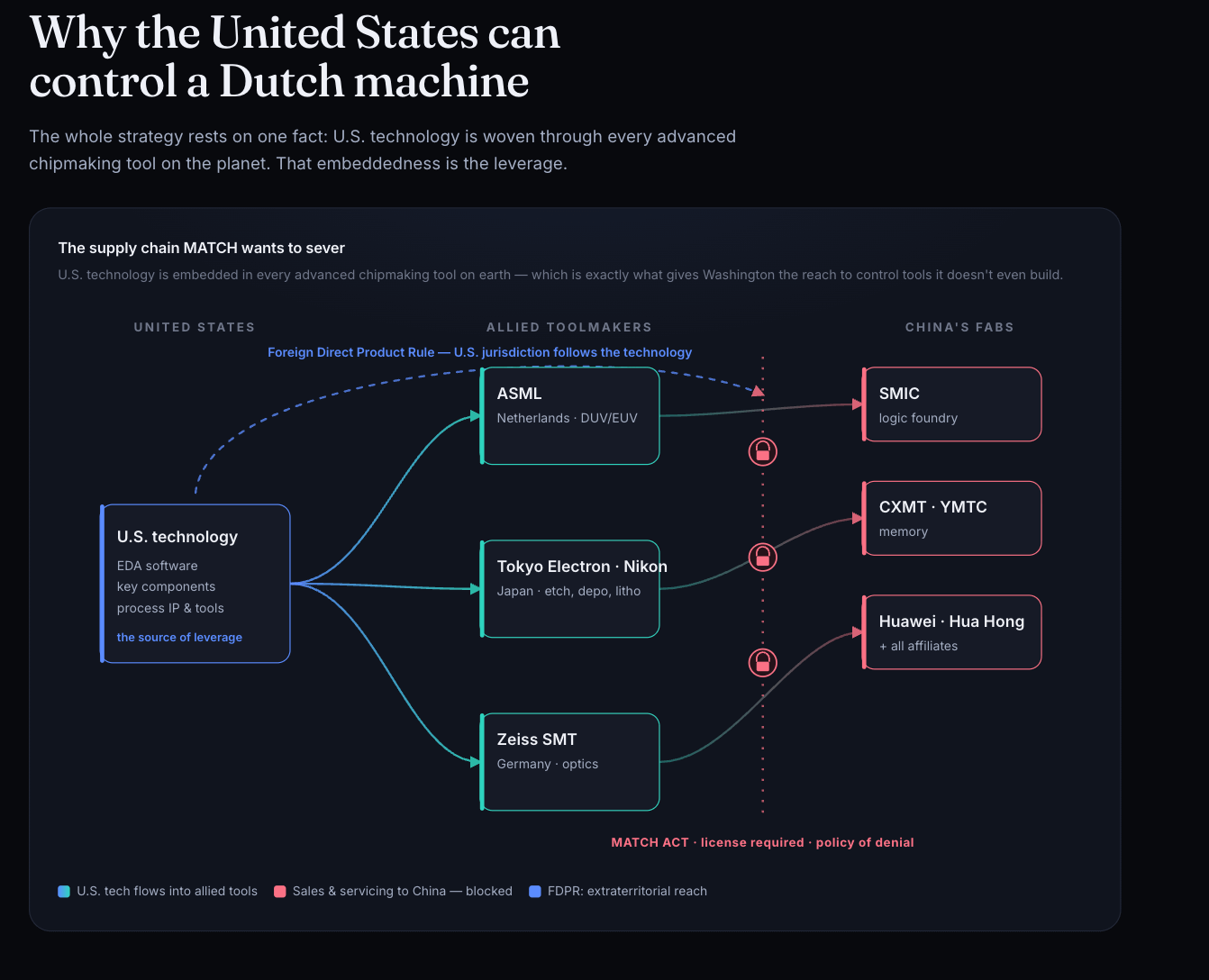
The most important part of the MATCH Act, though, is in the name: matching Dutch and Japanese export controls to American ones. The bill compels allied nations to adopt and enforce export controls with the same strictness that the U.S. does, something many in Washington feel allies have been slow to do.
The critical facet of this is the clause restricting the servicing of existing equipment in covered facilities. Currently, both the Netherlands and Japan allow their companies to service equipment in Chinese fabs, regardless of whether or not that equipment would now be considered prohibited for sale.
This is a major gap in export controls. Although American toolmakers like KLA, LAM, and Applied Materials are prohibited from such servicing, ASML and Tokyo Electron are still able to service advanced lithography, deposition, and etching tools in Chinese fabs known to be producing advanced-node semiconductors.
The U.S. has previously adopted stricter controls first and given grace to the Netherlands and Japan to synchronize controls in due time; Congress now thinks this grace period is over.
If allies do not harmonize their controls with America’s on tools and servicing within 150 days, the bill threatens to unilaterally impose such export controls via the Foreign Direct Product Rule (FDPR). Because all these tools, from ASML’s lithography machines to TEL etchers, rely on some level of American technology, the U.S. will claim the right to restrict them itself. In theory, if ASML and TEL continue to service these tools in violation of the FDPR, the U.S. reserves the right to cut these companies off from American technology, impose fines, and even seize assets.
The House and Senate versions of the MATCH Act differ slightly, with the main difference being a matter of tone. The Senate focuses more on “positive incentives” to ensure diplomatic cooperation with countries like Japan and the Netherlands, whereas the House version seems more willing to force allies’ hands on the matter of export controls. In substance, however, the two versions are identical.
Potential Benefits
If the U.S. cements its controls and ensures allies similarly adopt and enforce them, it can extend an enduring advanced chip lead over China. By clearly demarcating the line of no return, Congress is establishing the minimum expectation for SME controls. Regardless of whether we sell China advanced chips or bargain with other leverage, the tools to make those advanced chips would officially be off the table for future administrations.
The Act’s largest potential for impact comes with restricting tool servicing. Maintenance and service for advanced lithography and etching tools is not an annual checkup but rather an involved and constant process. ASML and TEL maintain full-time staff stationed at fabs to conduct preventative maintenance, tool calibration, part swapping, and more functions that the fab could not operate without. Any time the tool is not running is precious time and money down the drain, and servicing is a crucial part of keeping tools running 24/7.
In theory, without the expertise of ASML and TEL engineers to replenish parts and fix tools, China’s most advanced fabs may grind to a halt. Some experts suggest that all these tools would be inoperable within a year. As soon as these tools go down, they will not be up and running again.
Fairness is another motivator for passing the MATCH Act. While allied companies reap unfettered revenue (as much as 25% of a company’s income) from servicing tools in China, American companies have watched from the sidelines. We have handcuffed our own companies under the assumption that our allies would follow suit, but our allies have not — at least not all the way. In the interest of national security and commercial interests, we must level the playing field.
Potential Drawbacks
Good reasons also exist to believe that the MATCH Act will not achieve its mission and may even lead to unintended consequences.
Chinese Engineers Can Do the Job
In time, China may be able to service equipment themselves and simply resort to domestic alternatives for parts. For current service and maintenance, companies like TEL and ASML have offices across China. Their field service engineers (FSEs) are Chinese engineers, who will not pack their bags and leave even while their companies do. Both TEL and ASML hire candidates directly for work in China, instead of dispatching Japanese or Dutch FSEs to Chinese fabs. Hiring field service engineers as subcontractors, rather than direct employees, is also common practice in the industry, and such subcontractors would inevitably be Chinese companies.2 If TEL and ASML leave, the engineers who fixed their machines will still be around to fix them, now at a premium salary. Some engineers, particularly at ASML, may be dispatched from the Netherlands or other geographies for certain specialized maintenance, but the reality is that the fabs in China will not screech to a halt due to the MATCH Act.
Chinese Companies Can Replace (Some of) the Parts
The greatest struggle for China would likely not be maintenance, but rather replenishing parts. Lithography, deposition, and etching tools are constantly requiring part swapping because gases become expended or something breaks down. If TEL and ASML leave, how will these tools receive their parts?
My understanding of how this plays out is that no one has an understanding of how it will play out. Take an ASML DUV lithography machine for example. It is the job of at least one ASML engineer to replace an excimer laser when it is exhausted. The company that provides these excimer lasers isn’t ASML, but usually an authorized vendor like ASML-owned Cymer or Japan’s Gigaphoton. If the MATCH Act passes, will Cymer and Gigaphoton still deliver excimer lasers even if ASML isn’t able to touch the machine? The language of the bill is vague enough to leave it up for interpretation. The result would depend on the strength of new Japanese and Dutch controls or on the American executive branch’s enforcement of the bill via the FDPR. Most likely, the administration would defer to the status quo and not try to enforce beyond the bare minimum.
Even if Gigaphoton and Cymer cannot touch the machine, mainland Chinese alternatives may throw a wrench into Congress’s plans. A company like Beijing RSLaser could come to replace the machine’s light sources and excimer lasers. Along the same vein, third-party unauthorized vendors for tool parts are rampant in the semiconductor industry. Someone somewhere leaks a part design to a company that wasn’t supposed to have it, and that company can sell the part even if its competitors are prohibited from doing so.
Besides maintaining and replacing tools, though, the MATCH Act could accelerate China’s use of indigenous tools. This is more of a concern for etching and deposition tools, as Chinese capabilities are already at or near the frontier required for advanced chip production. Perhaps Chinese machines would have worse throughput, and the country would also struggle to produce enough machines to replace fleets of TEL equipment overnight, but the technical capability is there.
Where it is not is lithography machines. If ASML machines were to become inoperable in Chinese fabs, it is unclear what China would be able to do; it may be the death knell to Chinese advanced chipmaking for some years.
The Geopolitical Dimension
Geopolitical considerations complicate the bill’s merits beyond just whether or not it will “work” on the technical level. How much would relations with our allies be strained if we were to compel them to adopt measures via the FDPR? If our allies do not budge, are we actually willing to seize their assets and cut them off from our technology? This may be considered a gross level of extraterritoriality that would make our allies less likely to work with us elsewhere now and down the road.
History offers plenty of examples of the risks of dragging reluctant allies along.
In 1982, the Reagan administration attempted to unilaterally impose sanctions preventing a Soviet gas pipeline to Western Europe. All American companies — and their European subsidiaries — were ordered to halt work on the pipeline, and the order was made with little consultation with allies. European allies, although sympathetic with the tense situation in Poland that ignited Reagan’s order, were outraged by American claims to extraterritoriality. The debacle resulted in Western European nations commanding European companies to resume work, and a few months later, the Reagan administration rescinded the sanctions.

But the MATCH Act is not a swift and surprising order. Negotiations with the Netherlands and Japan have been ongoing at least since the Biden administration, and Congress is presenting the MATCH Act as the logical conclusion of allies failing to live up to commitments. In the view of Congress, collaboration has been tried, and the MATCH Act attempts to extend it a little longer, but compulsion is on the table if voluntary commitments fall short.
Further, the Netherlands and Japan already implicitly accept the argument for American extraterritoriality in the case of semiconductors. In cases where Japanese and Dutch enforcement is lacking, the countries have given the U.S. an implicit green light to prevent smuggling of banned tools in other jurisdictions on the basis of the FDPR.
The export controls attempted in the MATCH Act also do not pose a threat to allied national security but rather economic interests. During the Soviet pipeline incident, Western European leaders saw the pipeline as vital to the national interest as a means of lessening dependence on “insecure” OPEC energy. Now, however, banning sales of equipment to China does not threaten allied existence but rather threatens specific companies within the nations.
Lastly, allied relationships must be kept in perspective. Where would the exercise of the MATCH Act rank on our allies list of grievances? Will our allies blow up over this when they did not blow up over threats to annex Greenland, to withdraw from NATO, or revoking Fable access? In my view, a few lines of export control regulation are small potatoes next to those disputes.
When it comes to the strength of our allied relationships, the MATCH Act likely will not be the straw that broke the camel’s back, though that does not mean the U.S. should ride roughshod over our allies’ interests. The overbearing American attitude of “I’m blackmailing you because I love you” must cross the line at some point, even if it is for good cause.
Ultimately, while the concern for allied relations is substantive and predicated on long-term thinking, lawmakers should not overhype its importance. The purpose of allies is to collaborate on the most important issues; this may be one of those issues.
Congress Starting the Next China Fight
If passed, the MATCH Act would create a scenario not seen since Obama-era fights around Iran sanctions: Congress, not the President, escalating a foreign policy fight. In previous rounds of tariffs and action by the President, China has been swift to retaliate, allowing the country to have some leverage when the two parties meet at the negotiating table.
But this time, Xi would not be fighting with Trump; in this way, Congress would be providing convenient cover to the executive branch. Their hands are tied, and they can’t do anything to reverse it; no amount of leverage or negotiation can change that. This is not a new dynamic. Secretary Bessent thanked Congress for giving the administration cover when discussing the COINS Act:
“I want to thank you for this important piece of legislation. It is another arrow in our quiver. And I can tell you as I’m the lead negotiator with China on the economic front it is very useful for me to say, ‘Well I’m happy to refer things to the Hill.’”3
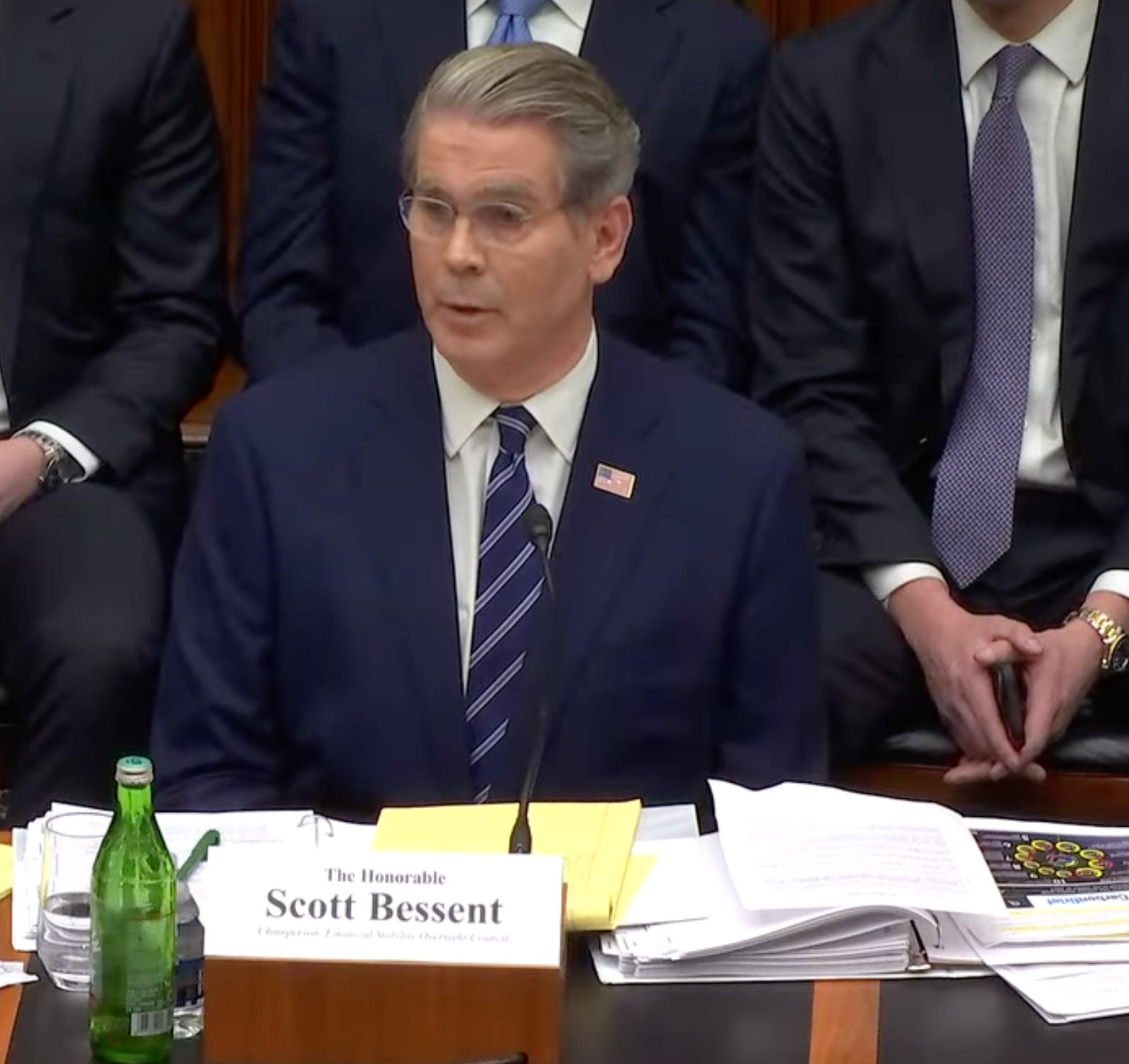
When a Chinese counterpart attempts to appeal to the Secretary to change course, he can happily throw his hands up and say, “Sorry, that’s the Hill, it’s not me.” The good-cop-bad-cop routine could help the U.S. achieve its objectives while minimizing blowback.
History provides good analogs for this dynamic as well. The Jackson-Vanik amendment to the Trade Act of 1974 denied Most Favored Nation status to non-market economies, a direct thwarting of the administration’s attempts to reach a detente with the Soviet Union. If the administration had directly undertaken such an action, U.S.-Soviet relations could have taken a nosedive. Because the act came from Congress and was out of the President’s hands, blowback was minimal.
The Taiwan Relations Act of 1979 also forms a nice parallel that involves past dealings with China. Although President Carter revoked recognition of Taiwan and maintained flexibility of relations, Congress ensured that the U.S. would maintain arms sales to Taiwan via law. If Congress had not passed such an act, arms sales could have been on the table when negotiating with the PRC; after the act, however, that chip was off the table, and negotiations around Taiwan had a floor.
Now, while the Trump administration is interacting directly with Xi and trying to come to terms on issues like AI, the MATCH Act would bind the administration’s hands for future negotiations. Otherwise, China could attempt to extract concessions from the admin on SMEs. With the MATCH Act, however, negotiations again have a floor. The context has changed, and other nations generally understand the President cannot wiggle out of it.
I don’t think the MATCH Act would be an air-tight handcuff on the administration, however, and the Trump administration’s penchant for deal-making may find some wiggle room in the confines of the MATCH Act.
Perhaps the Trump administration could negotiate with how strictly they interpret and enforce the bill. Maybe China will simply not care if it was Trump or Congress who passed the MATCH Act and impose punitive measures like rare earths sanctions anyway. Perhaps China’s reaction will differ depending on whether Trump vetoes the bill or signs it outright, or if it passes in its current form or as a rider on the NDAA. Time will tell how closely we follow historical analogs.
Verdict
Ultimately, one’s position on the MATCH Act should be predicated on their answer to the following question: Is the U.S. maintaining a maximum lead over China in semiconductor production and AI development a matter of critical national security importance?
If your answer is yes, then supporting the MATCH Act seems like a no-brainer. The Act is solidifying the current corpus of controls and applying pressure to allies to work with America. This support does not have to be under the illusion that the Act will be a silver bullet for slowing down Chinese chipmaking: it will not. But it will make a substantive impact on China’s ability to rely on banned foreign tools for its AI and advanced chip ambitions.
If your answer to the question is no, then the MATCH Act comes with some serious second-order impacts. The limited impact on Chinese chipmaking may not be worth testing important allied relationships. Opponents, however, must wrestle with the fact that cooperative negotiation has been attempted to little avail for years now. Where do we draw the line?
Lagniappe: Vibecoding MATCH Act Analysis
I am waiting — with a mix of fear and excitement — to see when AI can do my job for me. As such, I have started measuring how well models stand up to the DoAqibsJobBenchmark.
For this piece, after I had finished drafting my own version, I asked Opus 4.8 the following prompt:
“Make a folder in my user called MATCHAct. I want you to read the House and Senate versions of the MATCH Act, the most recent ones. Make a .md that is an article that discusses the pros and cons of the bill. Then, make a website on vercel that breaks down the MATCH Act in a visually appealing way. Get the subagents rolling, do deep research to understand the goals of the bill, whether or not it’ll work, the good and bad possible side effects”
The resulting policy microsite is here. Its score on the DoAqibsJobBenchmark is “okay but not great.” The actual site looks sleek and impressive, and I do believe the microsite can be a new format for disseminating policy work. My biggest complaint in design is that it is still the case that you can tell something is AI-generated. Maybe I needed to integrate Claude Design better into it, but there is a hint of boring that tinges the whole site; maybe that boringness can be interpreted as professional, though, for disseminating the site to officials or executives.
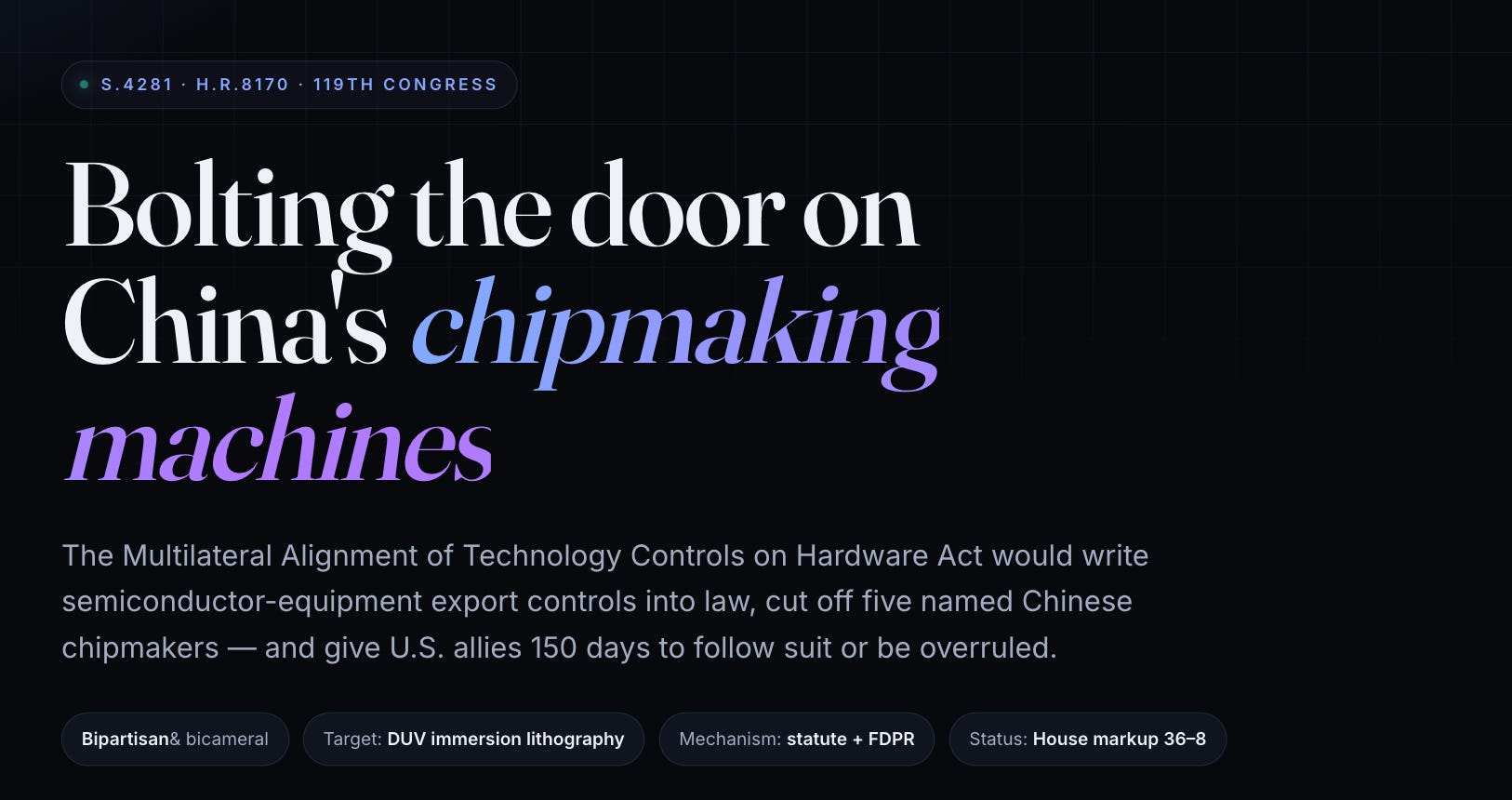
By far the greatest value-added from using AI here was visualizing differences between the House and Senate versions of the bill and explaining the FDPR. I think your eyes would glaze over reading them on a normal document.
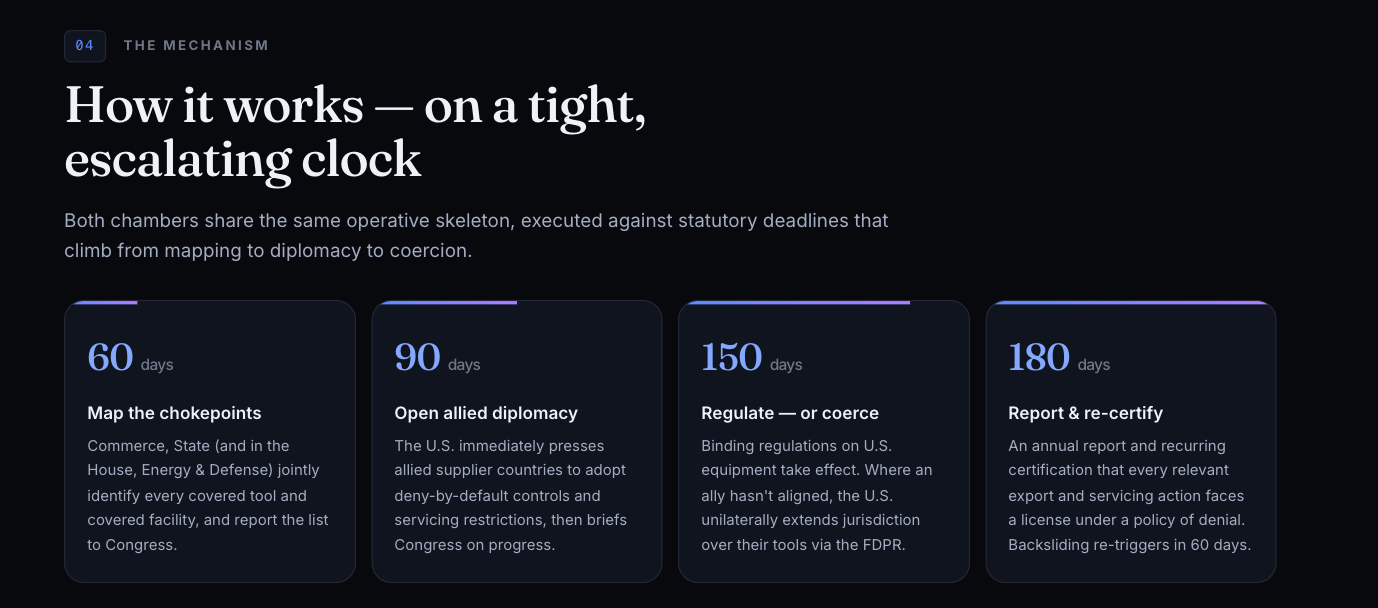
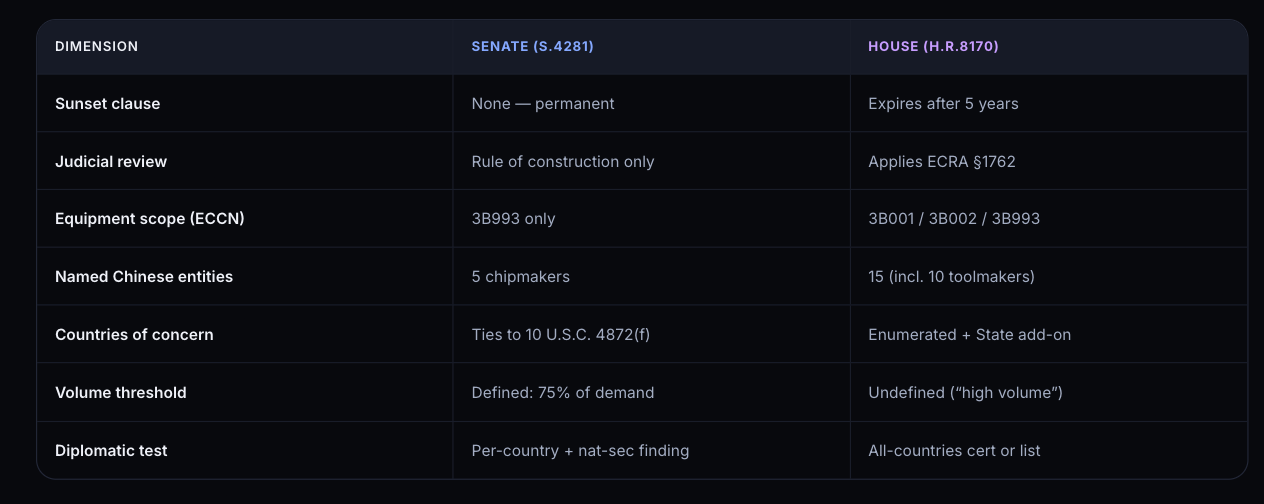
In terms of performance, the site did a good job of laying out the broad strokes pros and cons of the bill. It included perhaps not-so-obvious elements of allied backlash, potential for Chinese retaliation, and the importance of a bill that would set export controls into stone. I don’t think it crossed the bridge into “smart analyst” territory, though, because the model didn’t think too out of the box for side effects of the bill, and it didn’t exercise discernment by saying what considerations were more or less important.
For example, the site lists a fear of accelerating Chinese indigenization in equipment right alongside allied backlash, but I would like some analysis explaining that one is a bigger problem than another. Even if you reject my bias that the Chinese indigenization argument is on weak legs, the site should at least make some analysis to adjudicate among more and less important considerations.
The other reason it might not be crossing into “smart analyst” territory is simply because it’s a model without access to the real world. I had to talk to people in the government and semiconductor industry to illicit tacit knowledge on how tool servicing works, the intents of the bill, etc. The model cannot reach that by scraping the web or reasoning by itself.
The last criticism of the microsite is that it included weird reasoning that was not relevant to the MATCH Act. Claude knows I love to ask it about legacy chips and China, so it included legacy chips as a part of the MATCH Act analysis, though it felt completely disjointed from the point.
Overall, for better or for worse, I cannot be replaced by Claude yet. The analysis isn’t there, though the graphic design is, and I think I will start giving Claude my pieces to transform into microsites a lot more in the future.
According to Sec. 5949(j)(3)(A) or (B) of the FY’ 2023 NDAA.
To be fair, ASML’s posting includes this disclaimer: “This position requires access to controlled technology, as defined in the United States Export Administration Regulations (15 C.F.R. § 730, et seq.). Qualified candidates must be legally authorized to access such controlled technology prior to beginning work. Business demands may require ASML to proceed with candidates who are immediately eligible to access controlled technology.”
The question, then, is what Mandarin-speaking non-Chinese field service engineer is applying to work as a field service engineer in Shanghai? If you are one of them or know one of them, please reach out to aqib@chinatalk.media. I want to know your story.
Some more background:
In letters to the Lower House of the Dutch parliament, trade minister Sjoerdsma said the government of the Netherlands opposes the extraterritoriality of the MATCH Act, since it believes countries should be responsible for their own export controls. Apparently, Dutch diplomats and visitors have been pushing this message in DC recently, including to Congress:
https://www.scmp.com/news/china/diplomacy/article/3353452/netherlands-protests-us-proposal-further-bar-chip-giant-asml-china-market
Dutch letters:
https://www.tweedekamer.nl/kamerstukken/kamervragen/detail?id=2026Z07615&did=2026D21750
https://www.tweedekamer.nl/kamerstukken/kamervragen/detail?id=2026Z10558&did=2026D29627
I think this arguement is less about chips than it is about technological ecosystems.
Machines can be purchased. Designs can be copied. Parts can often be reverse engineered. But some forms of knowledge are much harder to duplicate. Maintenance expertise, supplier relationships, process knowledge, engineering talent, and institutional experience accumulate over decades.
That is what makes the servicing question so fascinating. The debate is not simply whether China can buy advanced equipment. It is whether access to the broader ecosystem surrounding that equipment can be restricted long enough to preserve a technological lead.
At the same time, history suggests that challengers eventually develop many of these capabilities themselves. The question is not whether that happens, but how long it takes and what strategic advantages the delay creates for the incumbent.
For me, that is what makes this such an interesting industrial policy story. It sits at the intersection of technology, manufacturing, institutions, and geopolitics.