
This is Part 2 of our Taiwan drone series!
Ethan Kessler was a 2025-2026 Boren Graduate Fellow for Mandarin Chinese in Taiwan. Before that, he was a graduate student and think tank researcher focusing on cross-Strait relations, critical technology, and defense acquisition policy.
The Politics of Industrial Policy
Two political dynamics help explain why the ability of Taiwan’s drone industrial policy to grow and innovate at a pace needed to deliver advanced military capabilities remains uncertain.
1. The “pork barrel” dynamic makes it difficult to know which industrial policy initiatives will succeed or fail at early stages.
Though Taiwan’s commitment in the past three years to grow domestic drone manufacturing capabilities is largely because President Tsai and now Lai have recognized drones’ relevance for national security, defense industry projects are still a form of domestic government spending. Taiwanese politicians at both national and lower levels thus see defense industrial spending through the lens of local development and winning elections.
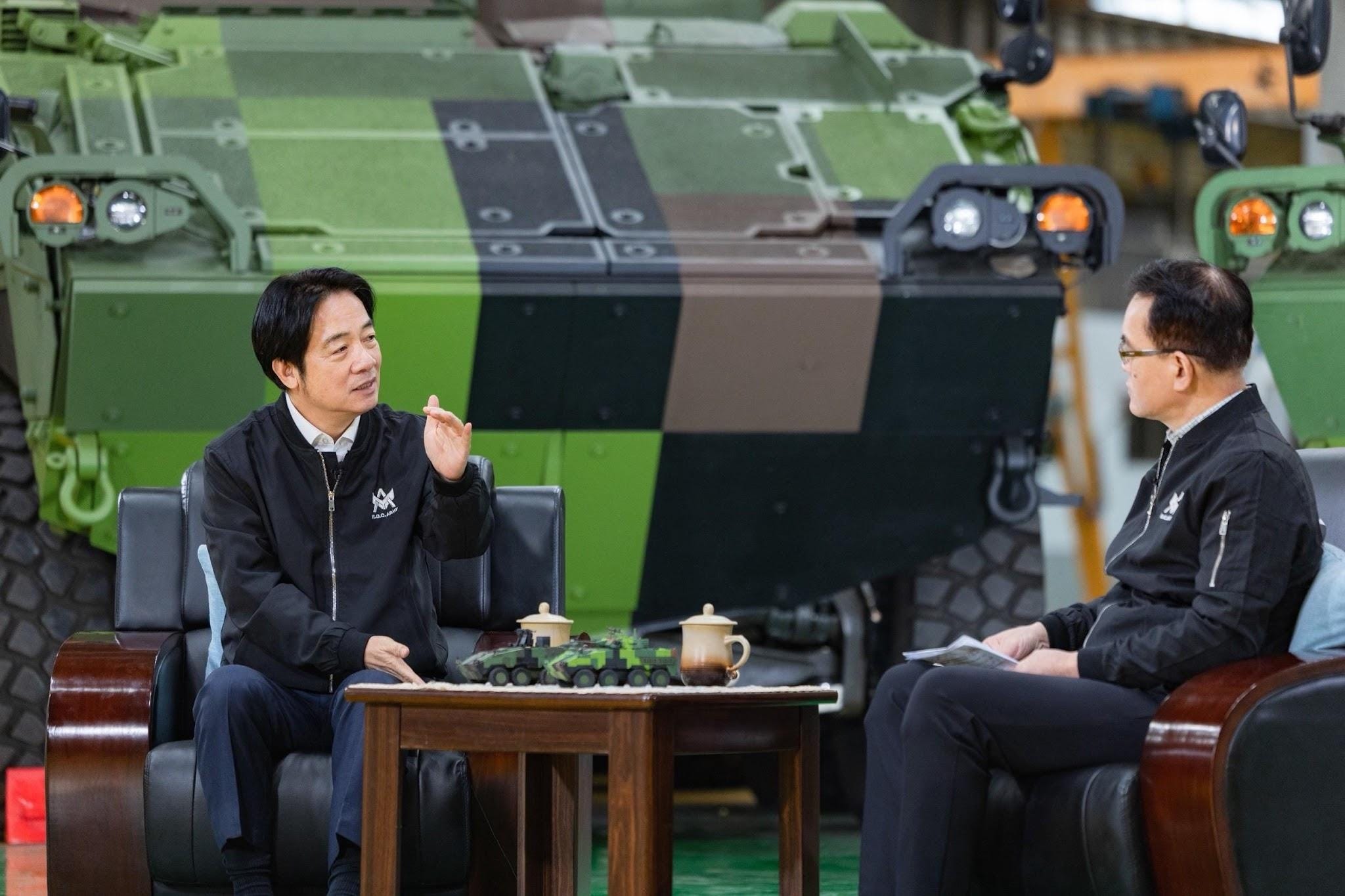
If a defense industrial program brings many jobs and thus plaudits for officials, there may be efficiency tradeoffs. This is a dynamic not limited to Taiwan. Indeed, the connection between guofang zizhu (國防自主), which roughly translates as “national defense autonomy” or “defense self-reliance,” and economic development is clearly articulated by Taiwan’s leadership. In a December 2025 televised interview at the plant that produces Taiwan’s indigenous armored personnel carrier, President Lai promised his government’s proposed special defense budget could create 90,000 jobs. And in the white papers published by the DPP’s core policy think tank before Tsai Ing-wen assumed the presidency in 2016, high priority was given to increasing indigenous defense investments, both for security and to develop Taiwan’s economy.
The political incentives to bring home the bacon causes waste, fraud, and abuse. As one recent Taiwanese opinion article argued, the government’s growing emphasis on building up Taiwan’s defense industrial base can easily produce corruption or rent-seeking by political and business interest groups. In addition to the opposition’s general criticisms of Lai’s proposed special defense budget from 2025 to 2026 as a “black box” (黑箱), KMT Organizational Development Committee Chairman Lee Che-hua 李哲華 in February 2026 pointed out the risk of defense indigenization breeding corruption, citing the well-known 1990s case of crooked ROC Navy procurement of foreign ships.
When one looks to the factions (派系) that operate within both the DPP and KMT, the bottom-up pressures to deliver local development and job growth outcomes — even at the expense of national-level efficiency — become clearer. Factions serve as patronage networks, dictating appointments in government bureaucracies and state-owned enterprises (SOEs), and provide avenues for party members to secure funds and influence in state projects such as infrastructure, irrigation, and housing build-outs.1 So, for industrial policy — drone production included — the flow of money is often correctly suspected of having more to do with short-term political needs than developing a competitive industry. One of the roles of government bodies like the National Development Council and the Industrial Technology Research Institute is disciplining that tendency, but the risk remains at an early stage that hard decisions necessary for export competitiveness — such as consolidation of multiple small firms into a few larger ones — are delayed or watered down for political reasons.
2. Right now in Taiwan, drone industrial policy is not nearly as important as scoring political points.
Since February 2024, the LY has been controlled by an opposition coalition of KMT (holding 52 seats of 113) and TPP (TPP, which holds 8 seats), while the DPP holds a minority of 51 seats. While Taiwan’s political system does not allow this to translate to much leverage across normal budgetary matters, funding special defense budgets — which is allowed for “national defense emergencies” — requires bringing new legislation out of the LY.2 Unfortunately for the Lai government, that meant its special defense budget proposed in November 2025 totaling NT$1.25 trillion (US$39.8 billion) over eight years was subject to the whims of the opposition. The KMT’s LY whip, Fu Kun-chi (傅崐萁) (Hualien County — KMT), wielded his prerogative to block the proposed defense budget in committee.
That the opposition used its majority to block the Lai government’s proposed special defense budget nine times — despite the clear U.S. support it enjoyed — illustrates how domestic politics still very much comes before expedience in debates over national security in Taiwan. That must remain so given that there will not be a new LY until the 2028 general election and that the defense spending increase Lai aims to achieve with the budget is substantial. Averaging out NT$1.25 trillion over eight years means his administration, under their previous special budget play, had to find roughly NT$156 billion, or more than a quarter of the regular 2026 MND budget (NT$561.4 billion), per year. This is a sum that even recent AI boom-delivered tax revenue windfalls cannot cover, and which thus must be left to the devices of the opposition-controlled LY in special budget deliberations.
During the haggling over drones before the passage of the broader special defense budget in May, U.S. observers and supporters of the DPP expressed frustration with the opposition’s intransigence. Minister of Defense Wellington Koo 顧立雄 criticized the KMT proposal for neglecting critical U.S. weapons systems and effectively endangering the five U.S. systems (including Anduril’s Altius-600 and Altius-700M drones), though he emphasized procurement risks for venerated high-end U.S. weapons systems, such as the M142 High Mobility Artillery Rocket System (HIMARS), which resonated more than Taiwanese drones with a U.S. audience.3
The underlying explanation is that in Taiwan, politics does not stop at the water’s edge. This has long been the case: the DPP received a boost in 2020 due to the PRC’s clampdown in Hong Kong, but both the 2022 and 2024 elections revealed that boost’s expiration date. The fading memory of those experiences, persisting economic pessimism, dissatisfaction with DPP control of the presidency for a decade, normalization of PRC military drills around Taiwan, and uncertainty over the commitment of the only nation capable of upholding Taiwan’s sovereignty in the event of war all combine to make defense spending less sacred in Taipei than Washington may think.4
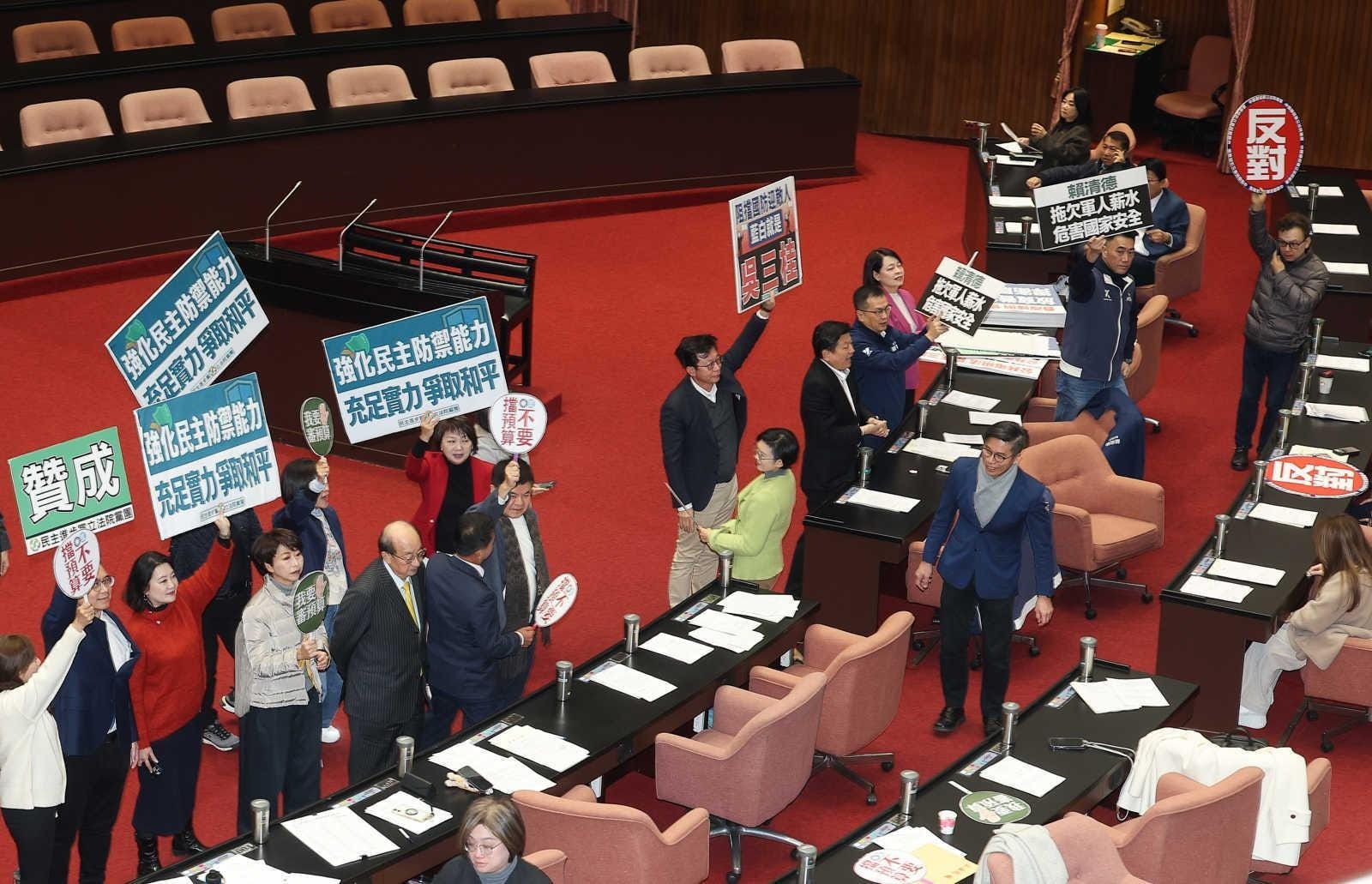
As a party with deep internal divisions on the question of cross-strait and thus defense policy, the KMT’s motivations for obstinance on the special defense budget are mixed. Deeply anti-independence elements helmed by Chairwoman Cheng Li-wun 鄭麗文 represent an older section of the KMT base receptive to calls to lower defense spending, prioritize dialogue with Beijing, and distance Taiwan from the United States. (After all, she was elected only by card-carrying KMT members.)5 The line is blurry between a genuine fiscal and foreign policy desire to clip the Lai government’s defense posture on the one hand, and the electoral incentives in a polarized system to obstruct, obstruct, obstruct on the other. Perhaps, because public opinion on key questions of national defense is still quite ambiguous (despite evidence that the public preferred the DPP’s to the KMT’s handling of the special defense budget), the opposition does not feel the need to bow to U.S. pressure to agree to Lai’s proposed spending increases.6
PRC business and political influence over the Blue camp aside, one could see the logic in hardliners like Cheng and Fu feeding U.S. skepticism of Taiwan by preventing Lai from smoothly passing defense spending increases. Such skepticism plays to a deep-Blue KMT base long suspicious of the U.S. while also positioning domestic political rivals (both the DPP and KMT reformers closer to the U.S. position on defense) to look foolish once Taipei takes heat from a Washington increasingly forward in its desire to see higher Taiwanese defense spending. Lai’s only way out would be to fund defense increases through regular instead of special budgets, requiring unpopular cuts to social spending that would just as well benefit the KMT electorally.
Cheng’s own hold over the issue is contested. She was blamed within the KMT for stripping drone funding from the May special defense budget, which helped make for a colder reception in Washington during her June visit. KMT heavyweights more aligned with Washington — namely Taichung Mayor and 2028 presidential hopeful Lu Shiow-yen 盧秀燕, who has championed government drone funding in central Taiwan — have staked out a more pro-defense position that would grow in influence should the KMT underperform in this fall’s local elections. In mid-June, Cheng told The Economist that a drone bill was unlikely to clear the LY before Xi Jinping’s planned September visit to the United States, yet the KMT caucus blew by that threat. Yet Cheng’s adamance may have served as an effective anchor or “bad cop” position for more moderate KMT politicians, who in late August got what they wanted by forcing the government to abandon its six-year special military drone budget. The funding bill that they passed, which instead requires annual reauthorization and which the premier just reportedly countersigned, affirms the KMT’s stated concerns with government excesses.7
KMT obstinacy on this issue ought to be expected in future budget cycles, despite American reprimands. Observers who think Cheng must be bluffing should recall that the KMT blocked a special defense budget for U.S. arms during the Chen Shui-bian 陳水扁 more than 50 times before Chen gave up — a precedent raised by Lai during a February press conference. Cheng’s U.S.-skeptic stance is also affirmed by President Trump’s decision to sit on a separate $14 billion arms package for Taiwan. The freeze is easily framed as a harbinger of less credible U.S. commitments and weaker U.S. capacity to help Taiwan in a crisis. Trump called arms sales a “good negotiating chip” with the PRC and one of his top military officials testified that the freeze was partly due to shortages of munitions promised to Taiwan because of operations in Iran.
How Much is Taipei Spending on Drones?
Uncertainty over military drone procurement would be less of a problem for Taiwan’s drone industrialization push if much of it were funded outside MND. But much of the drone strategy’s future appears to lie there, as Taiwan’s private market and overseas commercial footprint are both too small to scale Taiwanese drone suppliers alone.
Taipei’s demand for military drones and USVs will likely only increase given modern militaries’ enthusiasm for using them across multiple domains, as well as pointed reminders from the Russia-Ukraine war and the Iran conflict of how quickly modern operations consume drones and munitions. The U.S. military’s own growing reliance on sea drones underscores the case for investment: in June 2026, U.S. Army soldiers tested autonomous USVs alongside Philippine forces during exercises, and in July, U.S. Central Command carried out its first-ever combat strike using USVs to strike a maintenance facility in Iran. The MND reportedly increased its request for Anduril Altius systems in September 2025 after concluding that existing stores were insufficient. But Taiwan’s military budget was still under $20 billion in 2025, and only so much of that spending can go toward drones given the pressing needs of air defense, long-range strike, and anti-armor defense for which Taipei prefers to buy high-end U.S. systems. The pie is therefore already small to begin with.
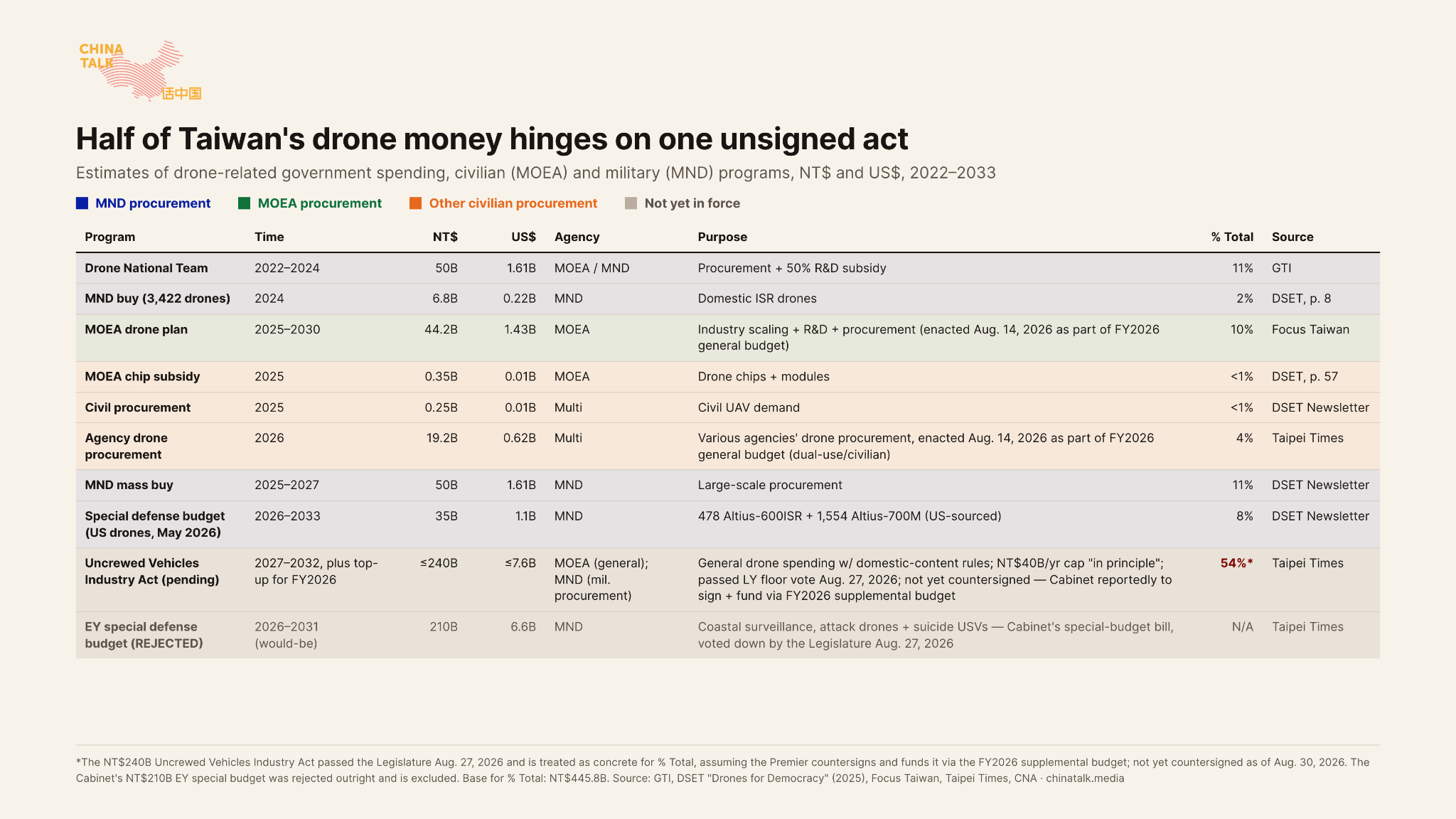
Government procurement is crucial to Taiwan’s drone policy, yet there is still no single unified accounting of drone-related government spending.8 The table below assembles what is publicly known. Excluding the Tsai-era drone national team, government procurement of drones weighs civilian (Ministry of Economic Affairs, or MOEA) and military (MND) funding roughly equally (lines 2 and 6 for MND, lines 3 and 4 for MOEA); the NT$35 billion for Anduril’s Altius line (line 7) sits apart, since it buys foreign-made hardware rather than funding domestic production. The new special defense budget focused on drones that now sits at the center of attention following the old special budget’s drone-less passage in May appears in line 8. The Executive Yuan’s version would fund roughly 211,000 UAVs and USVs at NT$210 billion through 2031, while the KMT and TPP have floated rival versions routed through the annual budget instead.
Estimates of Drone-Related Government Spending
Dethroning DJI: the red-free imperative
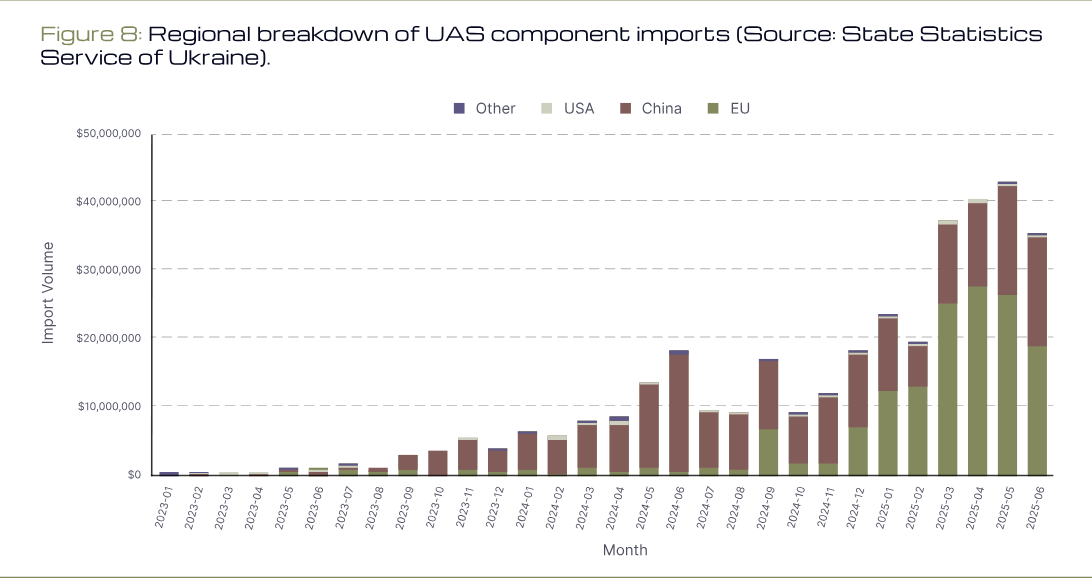
The notion of exporting drones made in Taiwan — or at least assembled in Taiwan — would not be economically viable if not for the political imperative to guard against Chinese dominance of supply chains throughout the drone stack. To varying degrees, the United States, numerous European countries, Ukraine, Japan, Taiwan, and Australia have all made “red-free” supply chains a priority in drone procurement since 2020 or later. Beijing’s restrictions on exports of long-range drones to Russia and Ukraine in June 2023, followed by restrictions on drone components over the next year, helped other actors realize their vulnerability, spurring an increase in inquiries to Taiwanese drone manufacturers and greater enthusiasm in Taipei for backing local industry in the face of global willingness to pay for “red-free” drones. These dynamics will likely only be reinforced by revelations of Chinese components in Western military drones and Beijing’s willingness to use its leverage over the world drone market to squeeze trade adversaries like the United States, which is subject to stricter review for Chinese drone exports following an August Ministry of Commerce announcement.
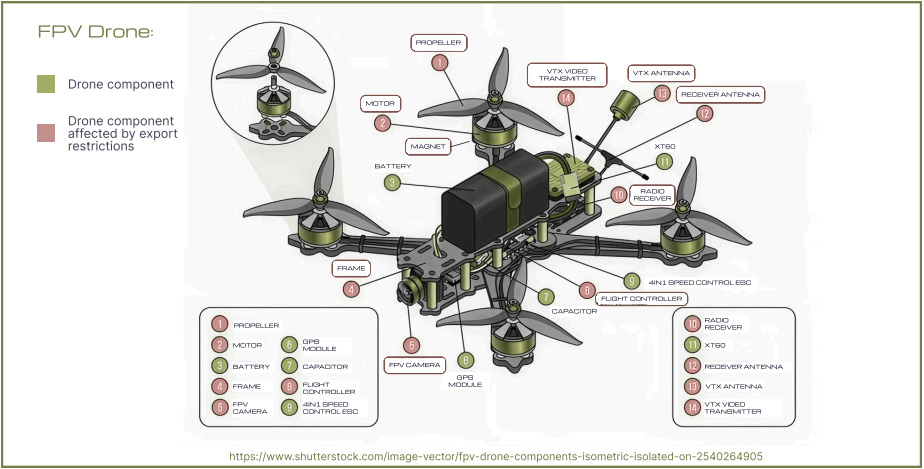
Chinese manufacturing is particularly dominant at four points in the drone stack:
Flight controllers: China’s cost-efficiency in mature semiconductors gives it a price edge in flight controllers, estimated at a quarter to 2/3rd the cost of U.S. alternatives.9 Chip packaging is also a segment in which going “red-free” has been especially challenging.
Brushless motors: Speedy UAV maneuverability demands powerful turns from motors, which in turn requires neodymium — a rare earth metal China produces around 90 percent of. Estimates for the cost of replacing Chinese motors with non-Chinese ones vary from double to a tenfold increase. The risks of dependence were illustrated by Chinese rare earth export restrictions in April 2025, which reportedly caused prices for some defense components to increase by five to 60 times. Despite U.S. investments in developing critical mineral supply chains independent of China, the consensus remains that any meaningful reduction in reliance on Chinese processing would take several years.
Sensors and gimbals: While Taiwan’s high capacity for relatively inexpensive machining gives it a competitive position in components like camera gimbals, related software remains a difficult moat (largely Chinese or American) to cross.10 Estimates of cost premiums for switching from Chinese to American drone camera sensors range from 200 to 300 percent. For now, Chinese dominance of germanium production limits the extent to which any drone requiring advanced thermal sensors can go “red-free.”
Batteries: In October 2024, U.S. drone maker Skydio experienced production delays following Chinese battery restrictions — retaliation for Skydio’s selling systems to Taiwan’s National Fire Agency. While Ukrainian drone producers appear to have made some progress in reducing dependence on Chinese batteries by importing South Korean, American, and Taiwanese battery cells, cathode minerals, raw materials, and “midstream cell manufacturing” are still concentrated in China. The lack of a dedicated subsidy program for batteries (as opposed to flight control chips and drone-related software) suggests that Taipei, and perhaps Washington, recognize that their greater comparative advantages elsewhere in the drone stack and China’s present lead in battery technology make it imprudent to focus on fully onshoring this part of the stack.11
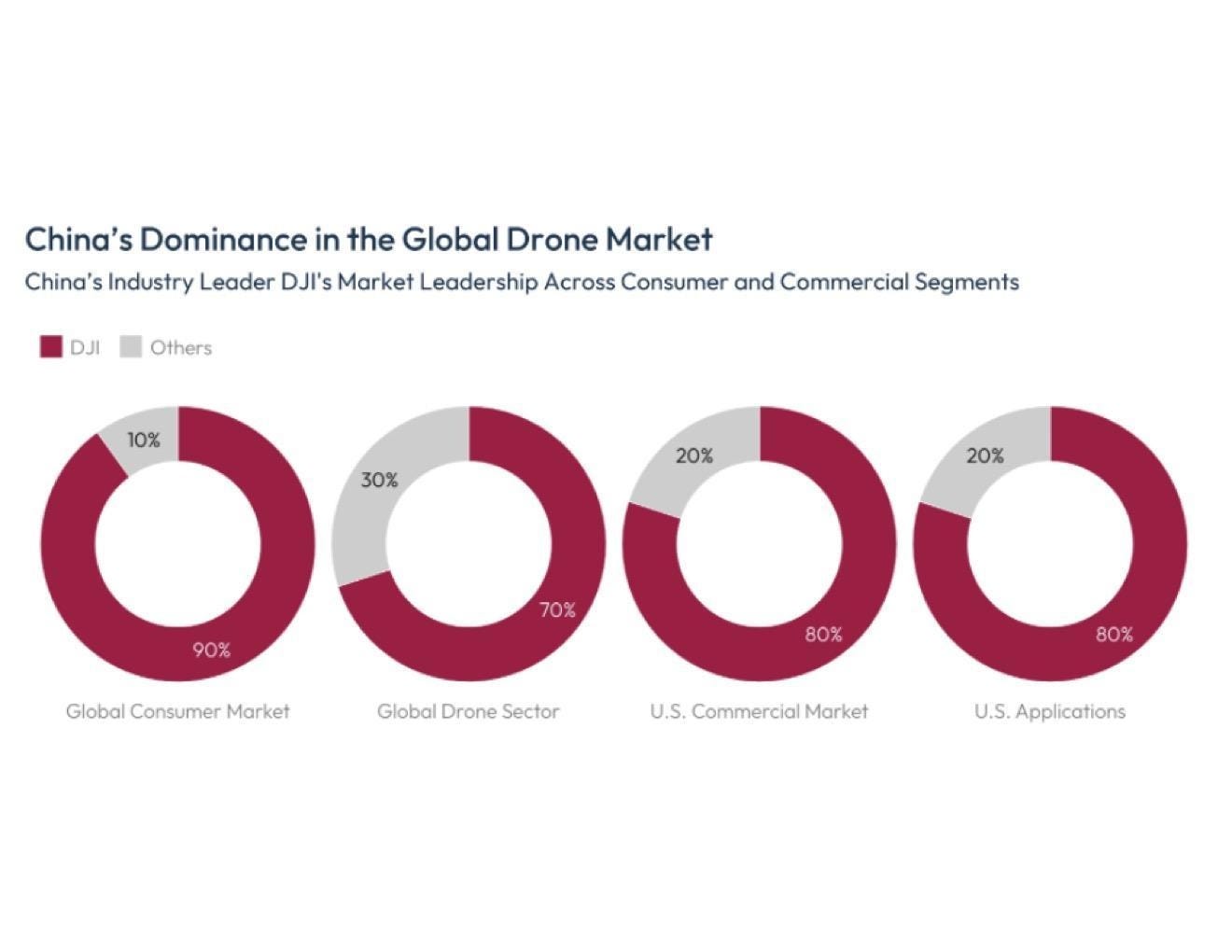
While Taiwan is now Ukraine’s third-largest drone-battery supplier — up from 24th in 2019 — and Taiwanese drone reliance on Chinese cells has fallen from 70 to 50 percent, China still controls (depending on the segment) 65 to 97 percent of the upstream cathode, precursor, and graphite materials, and non-Chinese alternatives cost 40 to 50 percent more. Displacing DJI is partly difficult because drones not only leverage the consumer electronics base that China has developed over the past four decades, but also because DJI benefits from Chinese dominance across the drone stack. The resulting cost advantage surfaces opportunities for arbitrage. In August, prosecutors unveiled charges against two employees of a drone firm that won a contract with an army drone unit in 2025 for passing off Chinese-made flight control chips and other components as “red-free” in their products.
Three Models of Sustainment
In conversations with government and industry figures, it became clear that there are three modes of survival and sustainment for firms in Taiwan’s drone industry, including both firms that sell complete drone systems and major component providers that only focus on one subsystem such as the drone’s camera or gimbal.
1. Final assembler
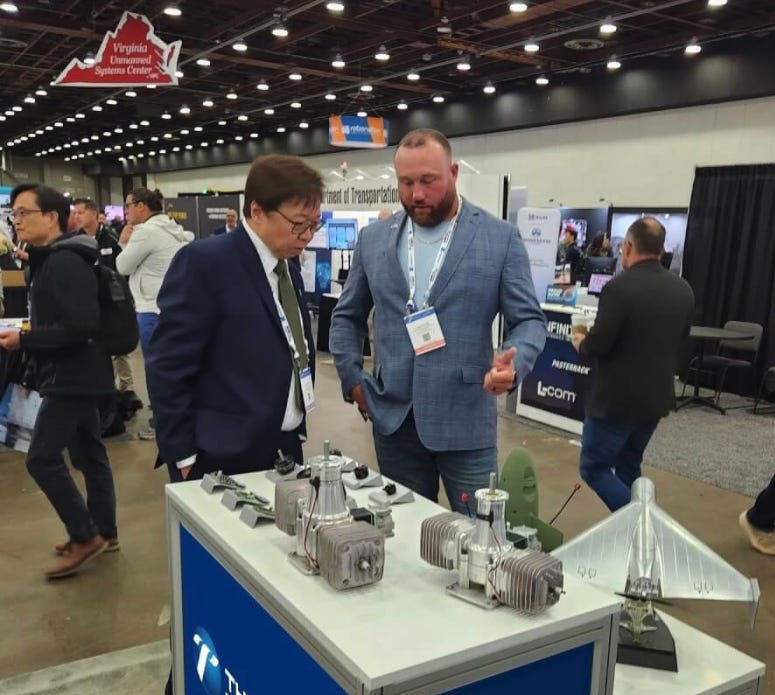
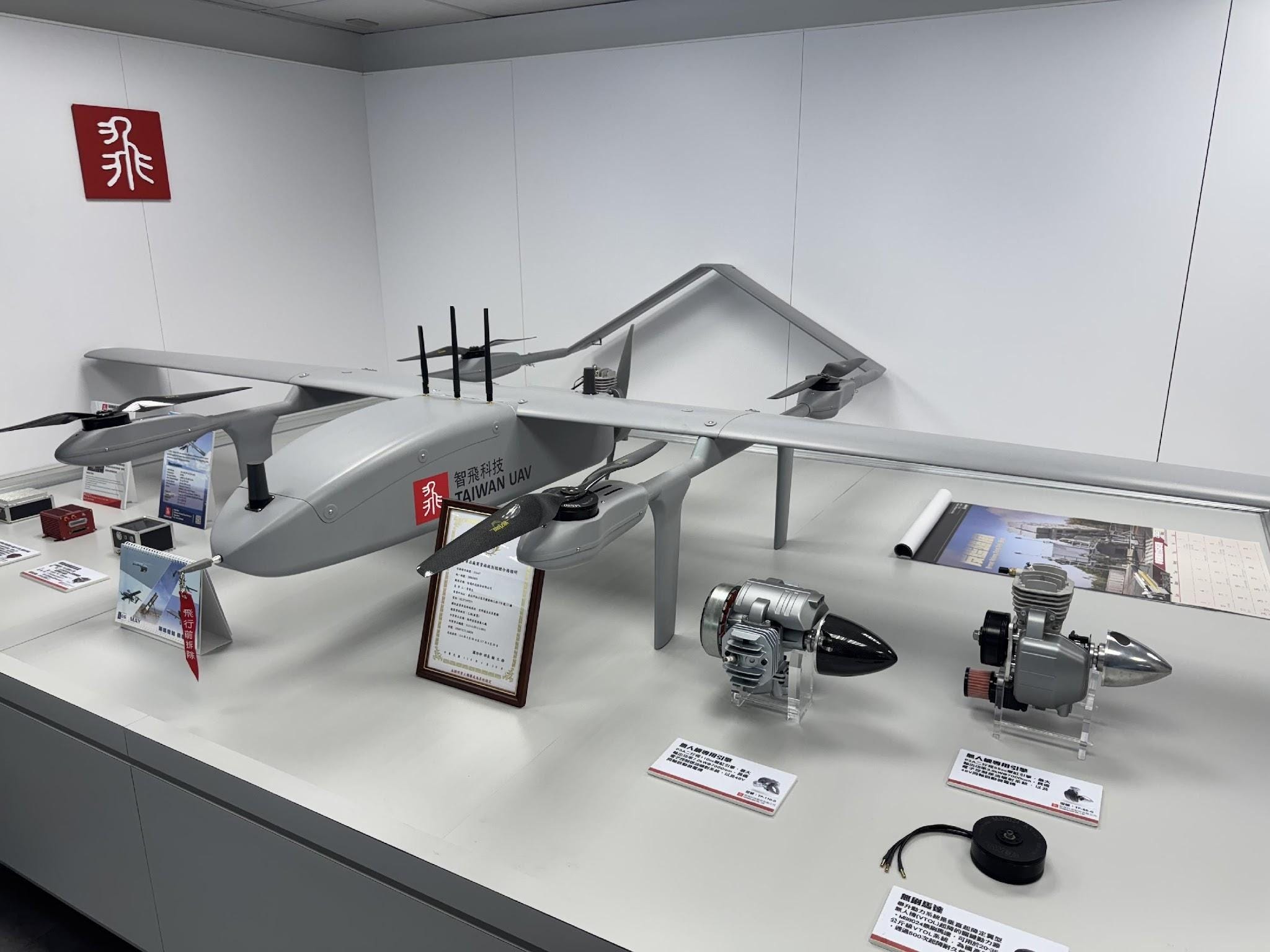
Firms in this category either have built deep in-house expertise over many years — like Taiwan UAV, one of the few Taiwanese drone makers with an in-house flight-control software team — or have acquired the capability outright, as Thunder Tiger did by acquiring a U.S. subsidiary to gain Blue UAS certification.12 The final assembler is arguably the most exposed to contraction risks given its saturation with U.S. venture capital.13
2. Subsystem supplier
Just as with final assemblers, subsystem suppliers are more likely than not to pursue exports and partnerships that can pave the way to foreign markets. Even before the May 2026 passage of the special defense budget without Lai’s proposed drone funding, Taiwanese firms knew that government-led domestic procurement was too small and uncertain to sustain growth.14 For instance, in February, Chiayi-based 7A Drones signed a deal to buy electric VTOL aircraft from Japanese manufacturer SkyDrive (presumably to develop unmanned versions for medical evacuation missions), part of a larger trend of Taiwan-Japan drone cooperation agreements.
To be sure, the subsystem supplier pathway is lower margin than software because of manufacturing costs. But it nevertheless takes advantage of rising global drone demand. As shown by South Korea’s defense indigenization during the late Cold War and the recent arrangement for Ukraine to produce the British L119 howitzer under license, subsystem production or production of relatively simple systems can build the expertise needed for more advanced systems. And a Taiwanese field mainly composed of subsystem suppliers may limit the consolidation challenge flagged earlier. If small and medium enterprises that supply subsystems have non-drone revenue streams and constitute most of elected representatives’ “drone” constituents, then consolidation among final assemblers may not be terribly difficult for Taipei.15
3. Just another department
Large, diversified conglomerates like Evergreen Aviation Technologies (part of the Evergreen Group, which also owns EVA Air) or Mitac stand up a small drone division mainly to stay in the government’s good graces — bidding for a handful of contracts while collecting the tax breaks and political goodwill that come with participating in a strategic industry.16 Among large original design manufacturers (ODM) with footprints in China—who have to be wary of crossing Beijing by openly advertising contributions to Taiwanese arms production—there is growing involvement in drone production, but few flashy press releases to cite. Last year, Pegatron Corp. 和碩聯合, which has a large consumer electronics manufacturing presence in China, financed a Taiwanese startup focusing on drone flight-control systems, and a subsidiary of iPhone assembler Foxconn 鴻海 took majority control of a small Taiwanese drone maker.17
Taiwan’s Niche: Partial Stack
Taiwan’s comparative advantage in several kinds of component manufacturing and assembly relevant for drones, combined with the partial neutralization of China’s greater cost-efficiency owing to “red-free” imperatives in the West, has allowed Taiwanese firms to emerge as competitive in a few layers of the drone stack. A high concentration of machine tooling firms and small component manufacturers in the Taichung-Changhua metro area of central Taiwan — a fixture of the country’s economy since the start of export-industrialization in the 1960s — gives firms making drones in Taiwan access to a deep network of actuator systems, transmission components, vibration reduction components, and other subsystems necessary for military-grade drones.18 All of this is available at lower cost and with much greater speed of adaptability (owing to tight, high-trust networks of small and medium enterprises) than non-China alternatives. In August, the MOEA claimed that Taiwan’s drone supply chain now comprises more than 274 firms, spanning “chips, communications, flight controls, navigation, optoelectronics, batteries, motors, materials, systems integration and application services.”
And at a September industry conference in Taipei, a Shield AI executive projected that the proportion of his firm’s bill of materials paid to Taiwanese vendors would increase to 25 percent from less than one percent in 2024 due to their cost and speed advantages.
However, gaps remain that prevent full-stack indigenization of drone manufacturing in Taiwan. The most notable gap lies in batteries. There are also the components included in the “Three Chips, Two Software” (三晶片、兩軟體) initiative of the Taiwanese government, for which Taipei wants to indigenize a greater share: flight control chips, positioning chips, communications chips, flight control software, and navigation software.19 For military-grade drones, these systems remain essential. On-edge AI solutions for “last-mile” navigation and future swarming tactics have been a focus of U.S., Ukrainian, and other Western manufacturers for a few years now given the Russia-Ukraine War, which has demonstrated the importance of autonomous guidance for reconnaissance and strike drones confronting electronic warfare. Pre-loaded terrain mapping, used in systems like the Tomahawk cruise missile or U.S. drone start-ups’ strike drones designed for Ukraine, cannot work in a maritime environment like the Taiwan Strait because of the constantly changing surface of the ocean.
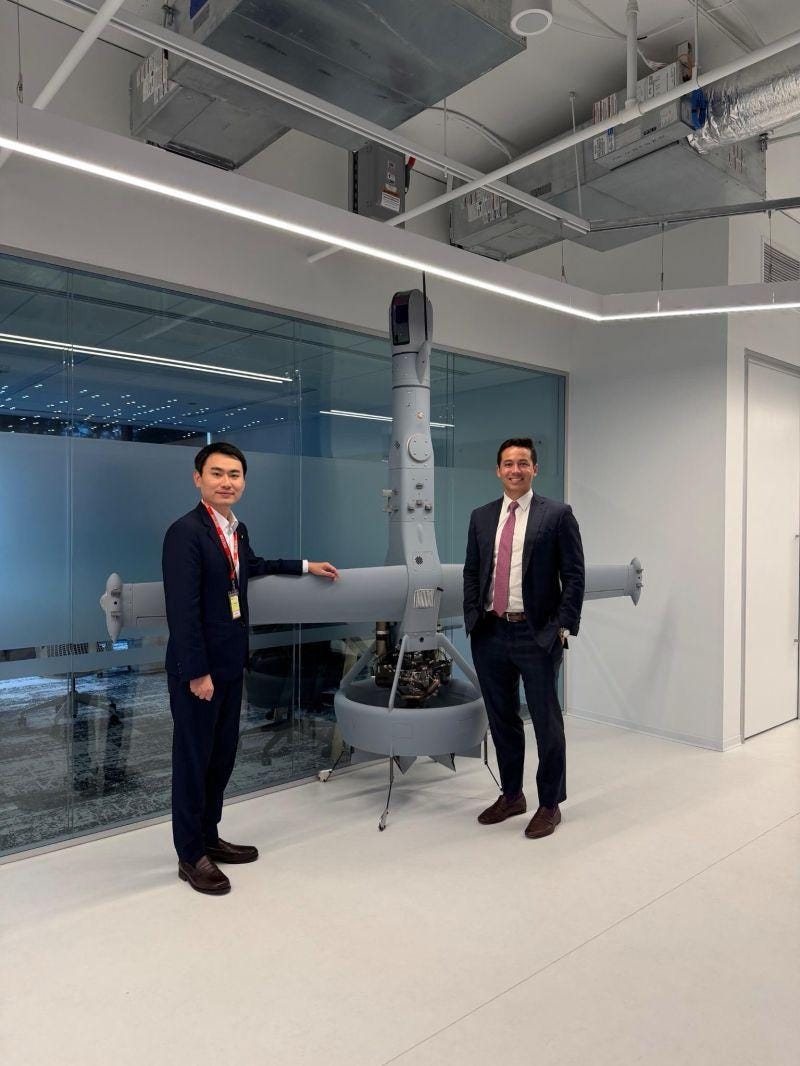
“Software is not our forte. We are more focused on hardware.” – Allan Chi, representative for Taiwanese drone firm Thunder Tiger, introducing the firm’s Shahed-style drone prototype.
Constraints on Full-Stack Production
Taiwan’s only drone firm to develop flight control systems in-house is Taiwan UAV (智飛科技股份有限公司). The company is an anomaly both for its longevity and for its focus on this part of the drone stack, having been founded in 2005 to make flight control systems. The firm’s drones were initially used for monitoring natural and environmental disasters like landslides and oil spills at sea — tasks which demand long loiter times. Most other Taiwanese original equipment manufacturers now working on drones did not exist (or did not work on drones) before the 2022 Russia-Ukraine war. Flight control is essential for drone or cruise missile autonomy, as illustrated by recent UK efforts to develop missiles for Ukraine free of reliance on the United States for components or navigation.
Meanwhile, other Taiwanese firms that have competed in MND tenders for Type A-E drones are larger firms that have been able to afford the risk of standing up a drone division, which may fail to win bids or make a profit. For instance, Wistron Corporation (緯創資通股份有限公司) — an ODM that was spun off in 2001 from computer manufacturer Acer, now one of Taiwan’s largest electronics ODMs that in 2025 collected just under $70 billion in revenue — has stood up a modest drone division alongside its core electronics business, entering government tenders without staking its future on the outcome.
Firms across all three models face the same underlying constraint: it is very hard for Taiwanese drone firms to attract top engineering talent. Higher salaries draw them either to semiconductor manufacturing in Taiwan, or to remote positions at U.S. tech firms like Google.20
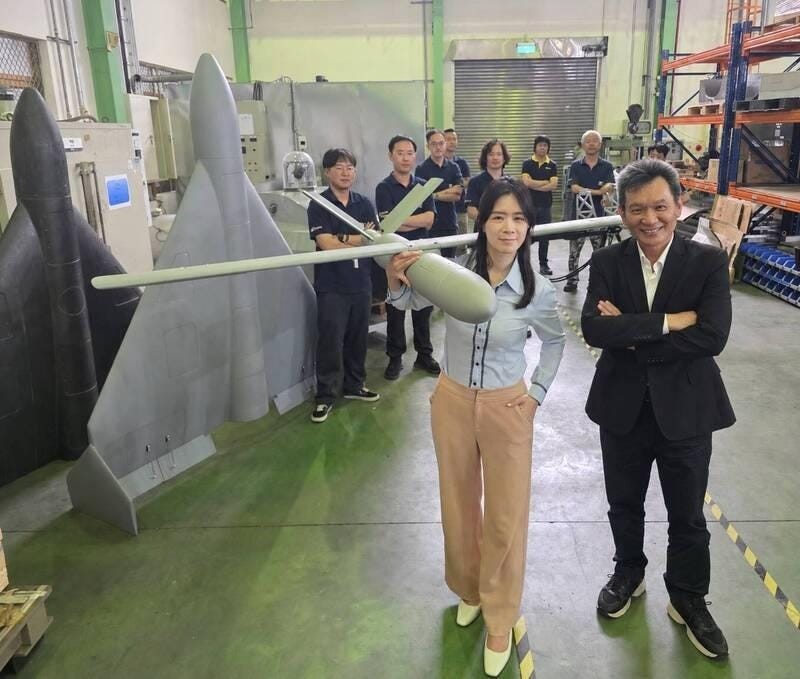
Another critical part of the drone supply chain is fuselage production. One industry representative noted in an interview that carbon fiber and 3D-printing solutions take too long, so their firm would begin expanding their facilities to allow for casting drone fuselages if anticipated orders materialized.21 However, just as Taiwan UAV demonstrates a large variance within Taiwanese industry regarding domestic production of flight control systems, Taichung-based firm Carbon-Based Technology (碳基科技股份有限公司) demonstrates a similarly large variance when it comes to airframes. That firm has specialized since 2007 in building airframes using composite materials for NCSIST and AIDC, and has now claimed its delta-wing drones (somewhat resembling Iranian Shaheds) are being exported to Japan and Southeast Asia at a clip of about 1,000 units per month.
Integration of the various component manufacturers and assemblers is, like any engineering challenge, something that requires trial and error. Policy can help speed up or slow down this process, explaining some of the contention over the recent opposition-passed military drone budget. Analysts supportive of the government’s proposed special budget for military drone spending have argued that that model would better allow for the MND to tweak requirements in response to operational feedback, speeding up integration of various elements of military-grade drone systems.
Learning the Same Lesson Elsewhere
Taiwan is not the only country discovering that a capable industrial base does not translate evenly across the drone stack. South Korea has world-leading depth in lithium-ion battery cells (Samsung SDI, LG Energy Solution, SK On) and passive electronic components (Samsung Electro-Mechanics), yet the lithium-polymer cells, lightweight motors, and flight controllers that go into small FPV drones come out of a manufacturing ecosystem heavily reliant on China — nearly nine in ten small commercial drones in Korean military service are foreign-made, mostly Chinese. Seoul’s main gaps are small drone motors and flight controllers; its response of mandating domestic core components in its 500,000-strong drone-training program mirrors the situation decisionmakers in Taipei face.
The evolution of other military drone programs shows how unsurprising many of these challenges should be given that Taiwan is not seized by wartime desperation. Iran’s indigenous drone effort began with independent tinkering and reverse-engineering of Israeli and American designs (including the now-famous, originally West German-American Shahed design) after the Iran-Iraq War cut off foreign aircraft suppliers and triggered a scramble for new ways to survey the battlefield. Ukraine scaled up from roughly 3,000 drones produced in 2022 to 4-5 million FPV drones — and 99-percent domestic assembly — by 2026. Despite the risk of war, no similar compulsion grips Taiwan. (And even still, both Iran and Ukraine remain reliant on components from China for drone production.)
The “partial stack” model further gains credibility when considering the challenges Taiwanese firms have already faced breaking into the U.S. defense market. In July, the Pentagon’s Drone Dominance Program (DDP) announced the 19 firms advancing to the second round of selection for small suicide drone procurement. None were Taiwanese. (Thunder Tiger, through procurement of a U.S.-based entity, was in the first round, and supplies a few of the other first-round participants.) Meanwhile, at least some “partial stack” arrangements appear to be progressing. According to an Anduril executive, from June 2025 to June 2026, the firm added 15 Taiwanese suppliers, raised its procurement of Taiwanese components and systems fifteenfold, and integrated the famous Lattice command-and-control system with Taiwanese systems. Viewed in this light, partnerships between NCSIST, state-backed shipbuilding corporation CSBC, and Thunder Tiger on the one hand and Shield AI (American), HavocAI (American), and Auterion (American-Swiss) on the other make sense: brains sourced from abroad, brawn sourced domestically.
Furthermore, the subsystem supplier model overlaps with the production-maintenance division of labor that already defines some of Taiwan’s conventional defense articles. For instance, British defense giant BAE Systems, which manufactures radars and 5-inch guns on Taiwan’s naval vessels as well as the M109A7 howitzers that Taiwan bought from the United States in April, signed an MOU in 2025 with a Taoyuan firm for the latter to maintain BAE equipment used by Taiwan’s military. Some of the clearest examples of this partnership-driven model emerged at September 2025’s Taipei Aerospace and Defense Technology Exhibition (TADTE), Taiwan’s largest-ever defense show, where NCSIST signed MOUs with five U.S. and Canadian drone firms, including Anduril, AV, MARTAC, and Northrop Grumman. As of 2026, MOEA subsidies continue to flow to both final assemblers and subsystem suppliers.
Foreign Markets
Given the reliance of the first two sustainment models on exports, much of Taiwan’s drone activity has been focused on partnerships and sales abroad. This dependence on exports seems likely to persist because it is a result of two enduring factors: the insufficiently-sized domestic market for Taiwanese drones, and the practicality of Western-Taiwanese partnerships given military-grade drones’ need for cutting-edge software to weather electronic warfare — a domain still dominated by Western firms, and sustained by their existing funding edge.
U.S. Regulatory Environment
When looking to large foreign markets interested in paying a markup for “red-free” drones — most notably the United States — it becomes clear that doing assembly or subcomponent supply is not just more technically feasible than exporting whole Taiwanese-made drones, but is also more economical, since Washington’s Buy America preferences make foreign-made drones — even ones largely sealed off from Chinese supply chains — a risky investment.22 In January, shortly after its December 2025 decision to ban imports of all foreign-made UAS and “UAS critical components,” the U.S. Federal Communications Commission (FCC) announced exemptions for products pre-approved by the Pentagon (i.e., on its “Blue UAS Cleared List”) or meeting the Buy American standards laid out in 48 CFR 25.101. These standards provide that compliant products must be manufactured in the United States and that domestic components must account for more than 65 percent of the total costs (75 percent for products delivered after 2028) — a necessary provision given the shock to farmers and other interest groups that a cutoff from DJI brings.
To be sure, U.S. firms have an interest in compliant partnership arrangements, evident in Anduril’s lobbying for loosening of foreign defense production regulations. But the momentum is still with protectionism. The FCC in July proposed a rule to prohibit foreign-made drones weighing over 55 pounds, containing thermal sensors, or using LiDAR imaging. The rule proposal, which sparked backlash from U.S. first responders, photographers, and hobbyists, came on the same day that the FCC postponed the main Buy American compliance deadline to 2028 from 2027 and removed deadlines for foreign-made drones that have been granted exceptions — an admission that moving the drone stack home is not feasible within the next year. And just last week, tariffs announced by the White House in August entered into force, with a rate of 100 percent for foreign-made drones over the 55-pound limit and 25 percent for those under. Taipei was positive about the development, as Taiwan was one of the favored countries whose rate for smaller drones is a lower 15 percent, but the tariff seems well-designed to undercut Chinese commercial dominance, as Vietnam — the transshipment point for many Chinese drones to the United States — is also excluded from the favored countries list. And while the “Blue Skies Act for Taiwan Act” introduced this March in the Senate shows bipartisan interest in carving out a place for Taiwan, the relatively small size of Taiwan’s drone market compared to the United States’ and the enduring dependence of Taiwanese military drones on Western subsystems give advocates for Taiwanese firms relatively little leverage.23 These firms’ gains in the U.S. market will thus likely continue only to the extent they are partnered and integrated with American firms that can fully benefit from U.S. protectionist measures.
It makes little sense for Taiwan UAV or Thunder Tiger to try and develop military-grade, AI-enabled autonomy capabilities when Anduril and Shield AI are years ahead in those fields anyway and, in the end, partnering with those firms is probably essential to selling Taiwan UAV or Thunder Tiger drones to the Pentagon.
The need for international partnerships also becomes more apparent after considering the funding disparities between the Taiwanese and U.S. markets. An MOEA-backed startup-investment platform calculated that together, Taiwanese drone firms in 2024 grew revenue by NT$442 million (US$13.8 million) and drone startups up to 2025 netted NT$3.8 billion (US$119.3 million) in paid-in capital. That private investment pales in comparison to the NT$56.8 billion (US$1.8 billion) spent by the drone national team and in the MND’s 2024 buy. Though not a perfectly apples-to-apples comparison, that state-to-private spending figure of about 15-to-1 up to 2025 is far greater than the roughly 4.6-to-1 ratio one finds in the United States (comparing DOD FY2026 requested funds for drones to private drone investment in 2025). Taiwan is not unique in that state investment remains ahead of private-sector activity, but the scale of the gap between the two suggests a difficulty in raising capital that makes deeper-pocketed partners all the more attractive.
European and Asian Drone Demand
The demand signal from foreign buyers is generally strong due to most militaries’ increasing attention to drone procurement over the last four years. Japan has allocated around $660 million this year to buy drones for a new coastal defense system, and the FY2027 Pentagon budget asks for a massive increase to more than $54 billion for the budget of the Defense Autonomous Warfare Group, meant to centralize Pentagon drone procurement. At Detroit’s Xponential 2026 trade show from May 11 to 14, Taiwanese firms signed a record NT$1.3 billion (US$41.22 million) in preliminary agreements, according to Taiwan’s MOEA.
The picture is more complex in Europe. For instance, Polish procurement rules favoring EU or NATO member state products may hamper Taiwanese entrants to that market, and — despite hopeful talk — other EU states may end up favoring Ukrainian and EU products as they build up their drone arsenals, not least because many Ukrainian products come battle-tested and Ukrainian producers will likely focus more on exports going forward. There is also the risk of Chinese backlash. China’s April sanctions on seven German, Belgian, and Czech defense firms for “collusion with Taiwan” came days after the European Parliament’s security-committee chair visited Taipei to discuss joint defense cooperation.
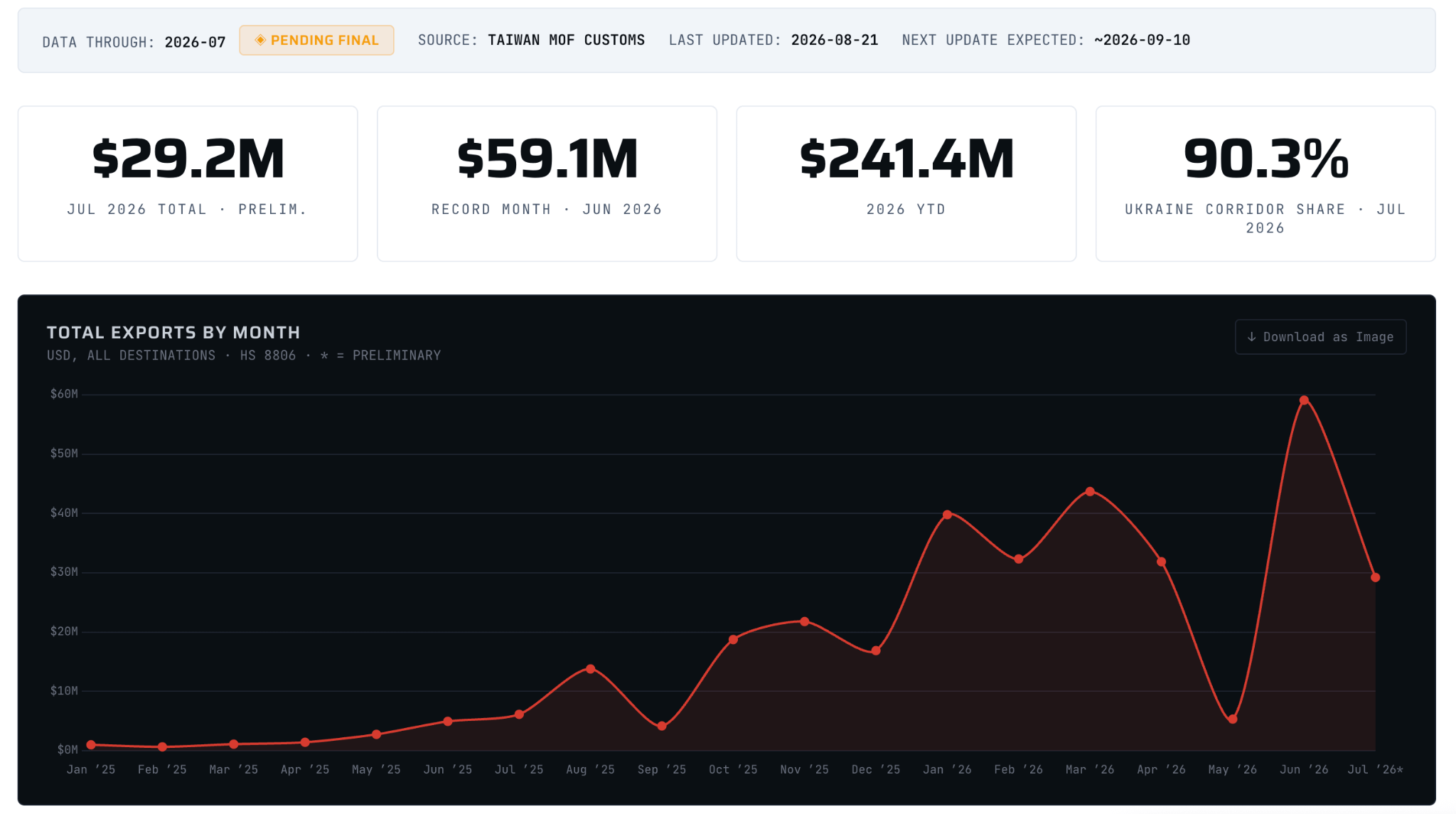
Export growth in 2026 has been impressive. DSET put Taiwan’s drone exports at roughly 139,000 units in the first quarter of 2026 alone, and MOEA reported that quarter’s export value at US$115 million — already exceeding all of 2025 — with the Czech Republic alone accounting for US$100 million of that total (largely for pass-through to Ukraine), followed by Poland (US$11.76 million) and the United States (US$2.58 million). In the second quarter of 2026, exports rose to 191,000 units. A separate DSET analysis found that Taiwan’s exports of complete drones to Europe rose from 2,574 units in 2024 to 107,433 in 2025, concentrated in the Czech Republic and Poland.
Yet beyond the aforementioned Carbon-Based Technology figure and Thunder Tiger’s Overkill FPV — which advanced to the second phase of the Pentagon’s DDP in June with an initial order of 1,520 units — contracts are hard to find publicly. State procurement by Japan, the country other than the United States most often floated as a natural drone partner, remains difficult because of mismatched certification and safety standards. However, there are signs that spending on drones will surge — Anduril is exploring buying a Japanese car plant to make drones — and June export controls levied by China on Japanese firms involved with drone production could lessen future hesitation about cooperation with Taiwanese entities.
There is a broader reason to doubt Taiwan’s ability to continue scaling up exports, at least of fully assembled drones. It is not simply that Ukrainian, Israeli, and American drones are combat-tested and Taiwan’s are not, but also that those countries’ firms have decades of experience actually selling into international markets while Taiwan’s do not.24 NCSIST’s missile lines and AIDC’s F-CK-1 Ching-kuo fighter never became global exports as Lockheed Martin’s F-16 and Patriot did, or the way Israel Aerospace Industries’ Barak, Arrow, and Harop have. Ukraine, meanwhile, has turned years of combat experience into buyer interest in drones like the Magura USV, the Liutyi UAV (now in joint production in Germany), and the F10 FPV, recently cleared for export to the United States. Taiwan has no comparable track record to draw on.
Testing and the Chiayi Challenge
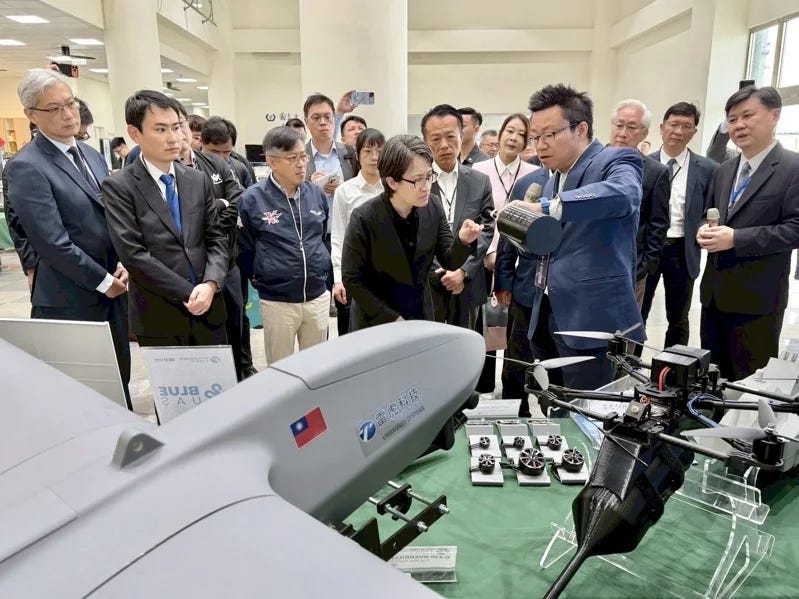
The seventh goal of Taiwan’s drone industrial policy — to set up a cluster or hub for UAVs, centered in Chiayi County on the southern end of Taiwan’s western plain — continues a tradition in Taiwan of using industrial clusters to produce faster innovation cycles and tighter supply chains, most famously with the Hsinchu Science Park in Taiwan’s north where TSMC, UMC, and other semiconductor manufacturers have operated since 1980. Indeed, just a year after its August 2022 inauguration, Chiayi County’s research and development center hosted facilities belonging to 20 drone firms.
However, according to interviews, the Chiayi drone cluster appears to have been ineffective for research and development due to Chiayi’s distance from sufficiently large testing areas. The density of commercial airline routes over Taiwan’s western plain and the inability of UAVs based there to venture too far out into the Strait without bumping into Chinese flight paths means that tests for longer-endurance UAVs can only be done from military bases near Yilan or Pingtung, in Taiwan’s northeast and south, respectively.25 Tests on these sites require multi-day treks from Chiayi County, clashing with the goal of a low-friction industrial cluster, and only allow Taiwanese nationals to participate due to the sites’ colocation with military facilities, complicating tests for firms that would prefer to use more experienced drone pilots from abroad.26
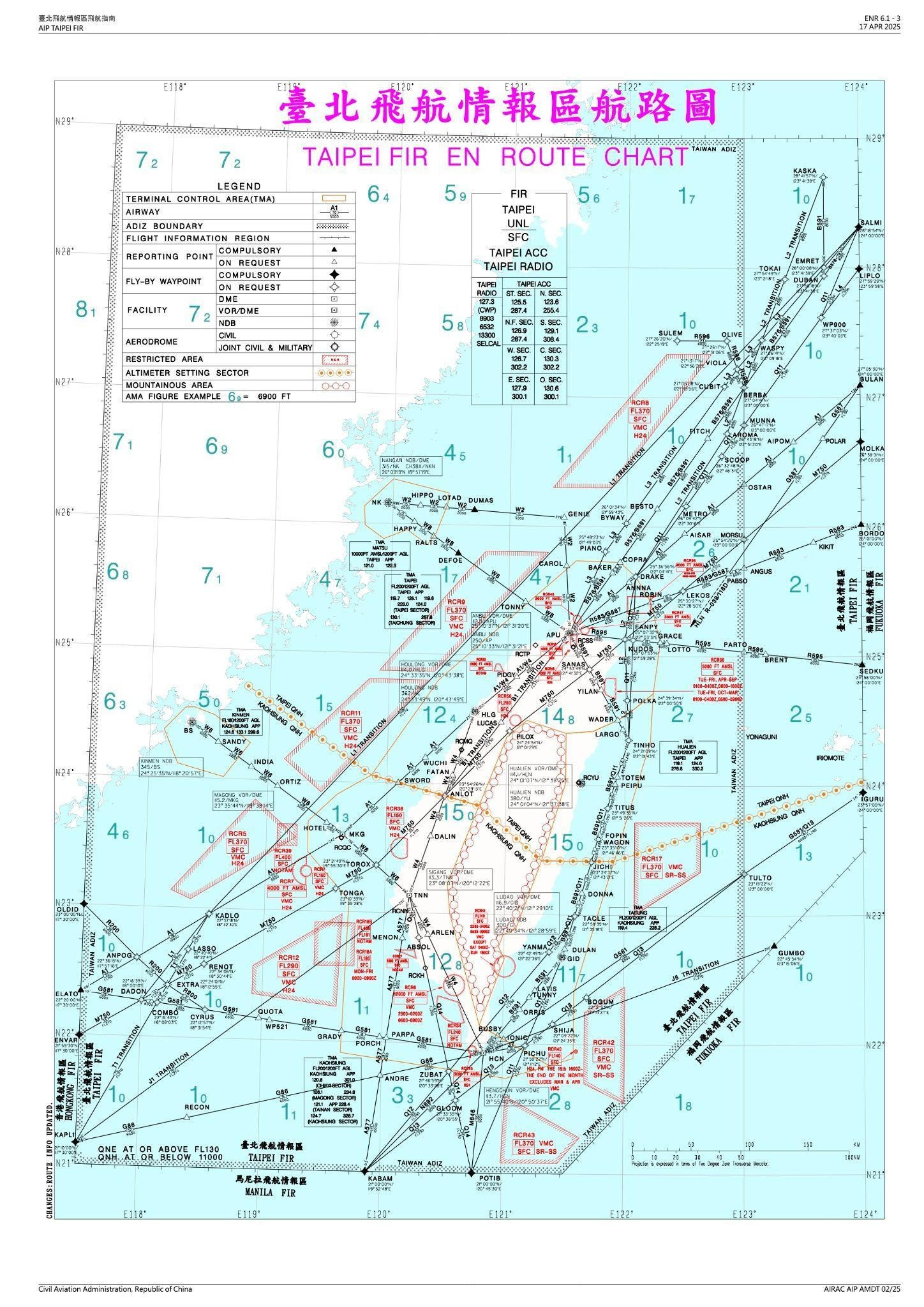
Moreover, testing in Chiayi over land does not allow manufacturers to hone radar for conditions in the Taiwan Strait or other waters around Taiwan, which create different types of clutter.27 While the legislator representing the Chiayi drone cluster, Chen Guan-ting, has spoken publicly about the need to expand testing capacity, no signs of progress are visible. One long-range drone manufacturer said that, in addition to their firm having years of experience testing in Pingtung, Chiayi County was less attractive because of its higher population density.28
These difficulties are not to say that future expansion of the Minxiong industrial park (located near the UAV R&D Center in Chiayi County) will not succeed in attracting Taiwanese drone firms to form a manufacturing cluster.29 But they should induce a healthy skepticism that a cluster hosting the majority of both testing and assembly for Taiwan’s drone industry is possible. The burdens imposed by long-range testing in a place as geographically limited as Taiwan are formidable. While no location offers everything an ideal testing site needs, Chiayi County was as much chosen as the drone cluster’s center for non-technical reasons as technical ones: Lai has continued Tsai’s emphasis on developing central and southern Taiwan and, at the time of selection, both Tainan and Kaohsiung were more focused on building out TSMC facilities.30 One drone manufacturer explained that it makes more sense for their firm to expand manufacturing facilities in the Taichung-Changhua metro area, which hosts Taiwan’s highest concentration of machine tools manufacturers and the headquarters of AIDC, Taiwan’s largest aerospace manufacturer and the coordinator of Taiwan’s drone alliance.
The difficulty of satisfying equities from multiple government agencies — most of which had no direct stake in the success of the high-level initiative at hand — reminded one former bureaucrat of the difficulties in getting Taiwan’s growing offshore wind infrastructure approved.31 While in May Taipei convened a Vice Premier-led inter-agency task force to elevate Chiayi to a national strategic project, interviewees indicated no reason to believe dramatic breakthroughs in these testing challenges are around the corner.
Looking Forward
As drones, defense tech firms, and the idea of turning Taiwan into a drone-laden “hornet’s nest” have gained traction, Taipei’s program for manufacturing finished drones and drone components has attracted support. The opening left by many countries’ desire to wean off of Chinese supply chains is large, and Taiwan has a strong small and medium enterprise base of component manufacturers to offer in response.
Yet predictions that Taiwan’s growing drone exports will cement its status among the biggest winners of surging world demand for drones, or that it will be able to use drone prowess to reduce dependency on American arms substantially, are overplayed. The relatively small scale of Taiwanese drone manufacturing is just as much an indication of China’s continued commercial drone dominance as it is a reminder that Taiwanese firms must still contend with a battery of challenges when selling their products. Domestic government demand remains uncertain because drone spending is not above politics. Foreign market barriers, certification issues, and the continued dominance of Western software for autonomous military applications make the proposition of full drone assembly and sale hard to justify. And although Taiwan has an advantageous manufacturing base and proximity to potential hot spots, its geography also makes testing difficult. In any case, drones will not be able to fill the gaps serviced by advanced Taiwanese or U.S. systems in domains like missile defense or major ground operations.
If certification challenges in the United States, Japan, and other partner countries are overcome, however, Taiwanese firms — especially those occupying the subsystem supplier niche — could solidify partnerships that help realize the Lai administration’s vision of “Red-Free” supply chains. While a far cry from the more ambitious goals of complete self-sufficiency or establishing Taiwan as central for drone development in Asia, this would still constitute an economic and national security win.
Publicly traded electronics firm Senao International’s offer to New Tide-aligned Lai Chin-lin (賴勁麟) to become the firm’s CEO after the 2016 election of Tsai is an example of how factional influence extends into the private sector. Accusations of graft against green energy entities backed or established by the government under Tsai and Lai has contributed to negative public perceptions of the DPP regarding corruption, the issue it scored worst on in a December 2025 Taiwan Public Opinion Foundation poll.
For the legislation establishing Taiwan’s balanced budget requirement (from which special budgets spending is exempted) and debt limits, see respectively the Budget Act, Article 23, and the Public Debt Act, Article 5. In March 2026, a DPP spokesman claimed the government proposed a special budget because the desired “procurements are urgent and necessary.”
However, the MND in a March 2026 press release warned that the KMT's special budget draft excludes defense autonomy (國防自主) and the building of non-red supply chains (非紅供應鏈).
An Academica Sinica survey from January 2026 found that more Taiwanese adults prefer to balance between China and the U.S. than to cooperate fully with the latter (C4); that about half of adults don’t believe in U.S. security commitments (C7) and believe that increasing defense spending won’t much affect deterrence or the likelihood of U.S. intervention in a war (C20, C21, C22); and that only about half of adults support current Taiwanese government proposals to raise defense spending (C23, C24).
The extent of Fu’s power over the KMT caucus in the LY, illustrated by open disagreement between the caucus and KMT headquarters’ on the special defense budget in March 2026, is unclear. Conversation with Taiwan politics expert, January 2026. For more on party ideology, see Shelley Rigger’s chapter in a recent edited volume.
For instance, although the DPP found that two-thirds of respondents in March 2026 supported passage of the DPP’s proposed special defense budget, the aforementioned Academica Sinica survey from January 2026 found respondents were roughly evenly split on several key questions related to U.S. commitment to Taiwan and defense spending. See above footnote for more detail.
Some sympathetic to the KMT’s preferred annual budgets argue against the multiyear procurement of the EY’s proposed special budget. While DSET has argued that multiyear procurement would enable greater flexibility and scale, supporters of the annual budget model instead emphasize that small Taiwanese drone firms dependent on domestic government spending for revenue — as opposed to more mature, viable firms — disproportionately benefit. Speech to Taiwanese government body by former Taiwanese military officer, Aug. 2026.
Lack of cross-ministerial coordination is largely a result of drone policy being both a national security project and an industrial policy initiative. The resulting MND-MOEA tension is difficult to resolve given that the MND is primarily concerned with obtaining U.S. equipment and building domestic defense capabilities, whereas the MOEA is mainly concerned with national development and private drone-related firms. See Resolution 3, “115 年度中央政府保衛國家安全及強化不對稱戰力計畫採購特別預算案審查報告.” Interview with a former chief of staff in the Tsai and Lai administrations, March 2026.
A DSET report estimated that software-defined radio transmission chips specifically could be up to ten times as expensive to import to Taiwan than the cost DJI pays for its own in-house versions. One interviewed expert claimed that research and design for flight control chips was not incentivized in Taiwan as long as exports remained small, since chip firms “typically operate at a sales scale of hundreds of thousands to millions of chips per product line.” See DSET’s “Drones for Democracy” report, the Snake Island Institute’s report on drone supply chains, and RUSI’s “Decoupling Supply Chains from China” report.
Interview with Dennis Huang, April 2026.
In response to a news report in late August that a shipment of Anduril Altius-600M drones to Taiwan did not include battery chargers because the United States had determined the original chargers had Chinese components, DPP legislator Wang Ting-yu 王定宇 positioned Taiwan as a potential future supplier for Anduril’s red-free charging needs. Wang and Taiwan’s army stated that the MND is scheduled to receive non-red chargers and will procure Taiwanese-made batteries, though this does not appear to have been verified by the EY.
Interview with Taiwanese defense executive, May 2026. This claim is corroborated by Thunder Tiger chairman Chen Kuan-ju’s own account that the certification belongs to the company’s U.S. subsidiary.
Interview with U.S. defense executive, June 2026.
Interview with Taiwanese defense executive, April 2026.
Interview with former Taiwanese government official, April 2026.
Interview with Taiwanese defense executive, May 2026.; Interview with former Taiwanese government official, April 2026.
Foxconn is notably quiet about anything drone-related. One interviewee speculated that they would soon be opening a drone production facility in New Taipei City this year, but there is no publicly available information to corroborate this. Interview with Taiwanese retired general, March 2026.
Interview with former Taiwanese government official, April 2026.
Interview with Taiwanese defense executive, April 2026.
Interview with Taiwanese defense executive, April 2026.
Interview with Taiwanese defense executive, April 2026.
Several Taiwanese firms reportedly mentioned this hurdle at a recent forum. Interview with former Taiwanese government official, March 2026.
One resolution in the review report for May’s special defense budget, attached as a non-binding rider by a legislator, highlighted this problem for Taiwan: radar systems, software, and guidance and control systems purchased from the United States generally come with restrictions on how much maintenance Taiwanese operators can do, limiting Taipei’s defense self-sufficiency and know-how. See Resolution 17, “115 年度中央政府保衛國家安全及強化不對稱戰力計畫採購特別預算案審查報告.”
Interview with Taiwanese defense manager, February 2026; Interview with U.S. defense executive, June 2026.
Interview with Taiwanese retired general, March 2026; Interview with a former chief of staff in the Tsai and Lai administrations, March 2026; Interview with Taiwanese defense executive, April 2026.
Interview with Taiwanese retired general, March 2026; Interview with Taiwanese defense executive, April 2026; Interview with Taiwanese defense executive, May 2026.
Interview with Taiwanese defense manager, February 2026.
Interview with Taiwanese defense executive, April 2026.
DSET 2026 report Europe, p.28.
Interview with a former chief of staff in the Tsai and Lai administrations, March 2026. Tsai’s 5+2 Plan for industrial policy had similar elements as Lai’s current focus on central and southern Taiwan: for instance, the smart machinery project centered around Taichung.
Interview with a former chief of staff in the Tsai and Lai administrations, March 2026.
