
Ukrainian drone manufacturing. How has the country been able to scale from thousands to millions of drones over the past four years? What dependencies does its industrial base still have on China? And what lessons does its rapid scaling offer for the US?
To discuss, we’re joined by Cat Buchatskiy, Director of Analytics at Snake Island, a military analytical group, along with Chris Miller
Our conversation covers:
How battlefield pressure forced Ukraine to build a drone war machine from scratch — from a handful of soldiers flying off-the-shelf drones to domestic assembly at a massive scale.
Ukraine’s industrial legacy and how whole-of-society mobilization repurposed its civilian tech sector into a wartime industrial base.
Why modular design, frontline reassembly, and tight feedback loops allow Ukraine to iterate faster than traditional defense systems.
The constraints of global supply chains, the impact of export controls, and how China is playing both sides of the war.
Listen now on your favorite podcast app.
Building a Drone Industry From Scratch
Jordan Schneider: Let’s start off with a very brief overview, Cat, of the accomplishments of the Ukrainian drone industrial base. What is getting pumped out on a monthly basis at the start of the war?
Cat Buchatskiy: We’re right around the time where it’s almost exactly two years of full-scale war, and the drone industrial base has been completely transformed at a pace that we really haven’t seen in basically any other country. Necessity is the mother of invention.
In February of 2022, we had about 3,000 drones total being produced in Ukraine — FPV (First-Person View), UGV (Unmanned Ground Vehicles), sea drone, anything of the sort. Ninety-nine percent of them were imported as entire systems from China.
In 2026, we basically have 99% being assembled in Ukraine. Now, just the FPV industry alone is cited to be able to produce up to 5 million FPV drones per year. That doesn’t include our massive industry of heavy bomber drones, ISR (Intelligence, Surveillance, and Reconnaissance), loitering munitions, or UGVs, which is now a booming industry in Ukraine as well.
But the most impressive thing isn’t necessarily just those numbers — we went from about 3,000 systems being made in February ’22 to 4 million FPVs alone. It’s the actual localization of that final assembly and the way that Ukraine has been able to completely transform its drone manufacturing industry. Now we’re at a point where 99% of the systems are final assembly in Ukraine with a lot of components being imported, but basically no final systems being imported from China anymore, which is a massive accomplishment.
Jordan Schneider: Let’s turn the clock back to understand the arc of industry, military, and government that made that possible. It’s February 2022 and war has broken out. If you wanted to fly a drone for Ukraine, how would you procure one?
Cat Buchatskiy: February of 2022, we actually hadn’t really seen the introduction of drones on the battlefield quite yet. If you wanted to fly a drone for Ukraine, first of all, you’d have to convince the Ukrainian military that it was even something worth exploring because it took us a little bit. It was not really until summer of 2023 that we saw the massive boom in FPV use and started seeing the pioneering of that industry.
From 2014 to 2022, there were sporadic incidents of Ukrainians toying around with Mavics. But in February 2022, if you wanted to fly a drone in Ukraine, you would probably have to bring in a DJI Mavic and get it to the front line yourself. We had essentially no homegrown drone industry whatsoever, and it was used in very small batches, basically all imported by volunteers that were buying them up in bulk from DJI.
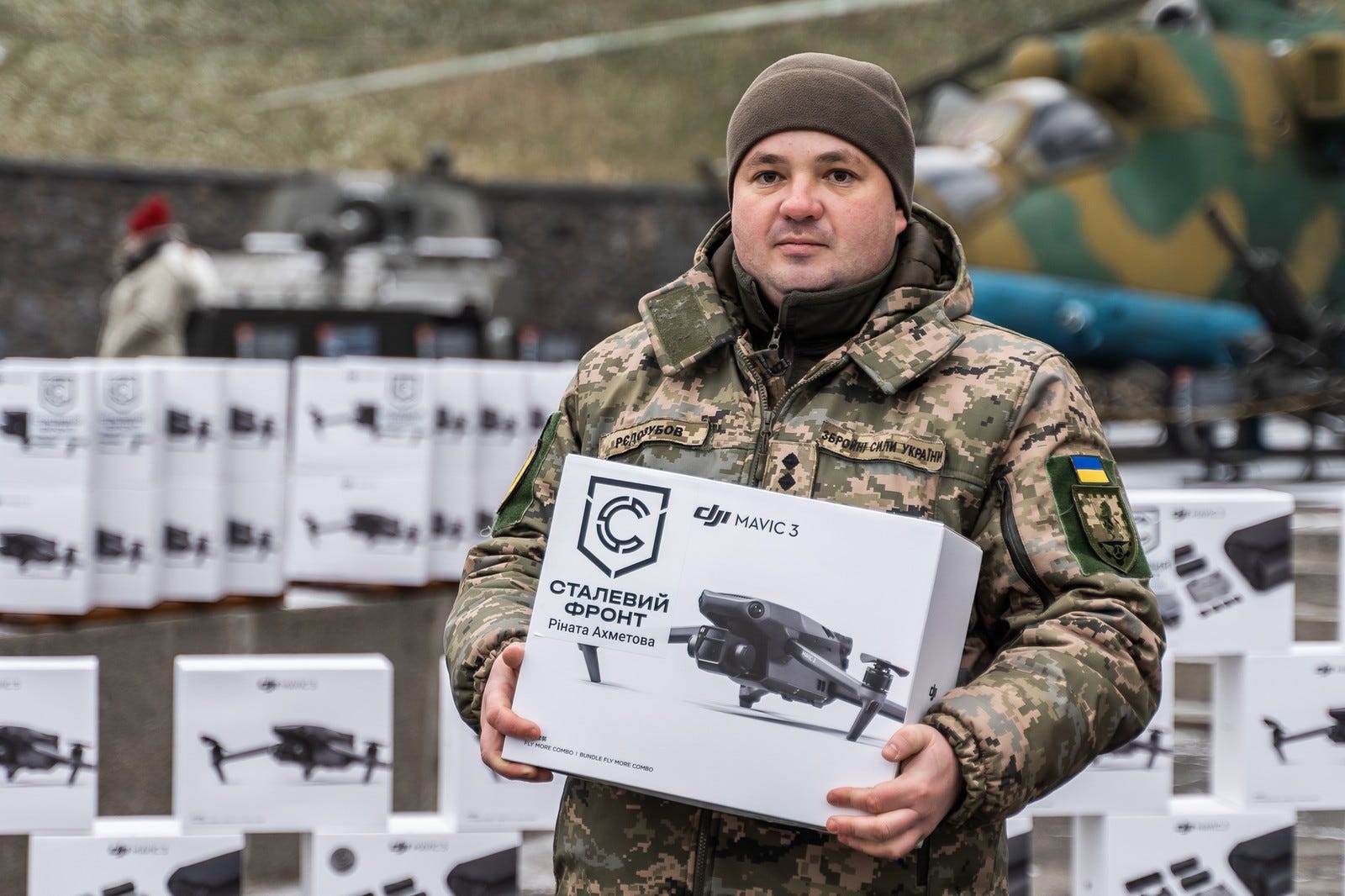
Jordan Schneider: That really is a fascinating moment in retrospect. It wasn’t necessarily that the technology didn’t exist, but that folks on both sides of the war hadn’t quite clocked into the potential of drones. Cat, can you take us back to all the light bulbs going on that this stuff actually had an enormous amount of utility?
Cat Buchatskiy: By 2023, when we were thinking about potentially another wave of counteroffensive, Ukrainian soldiers and volunteer networks started buying up more and more drones initially to perform ISR functions. Then pretty quickly — if you’re a soldier fighting in an existential battle, you’re going to do absolutely everything you can with the tools at your disposal. People realized that they could strap explosives onto these things and just fly them directly into the enemy, which was huge.
What was huge here for Ukraine was the asymmetry of using drones. First, because we were strapped for cash. The cost asymmetry of being able to put a payload and ammunition onto a drone that would only cost you a few thousand dollars was huge for a country that’s at economic disadvantage and fighting against Russia, which has one of the largest military industrial complexes and military budgets in the world.
Second, the asymmetry of being able to protect our soldiers and pilot these drones remotely was also huge because you’re never really going to be able to go person for person with the Russian army. They’re always going to have more people. In a war of attrition, which we pretty quickly realized it was going to be, we weren’t going to be able to hold the line with as many infantry and as many soldiers as Russia would. Being able to send remotely controlled tools to perform certain functions instead of putting human life at risk was another huge benefit for the Ukrainian side.
Pretty quickly we went into overdrive to produce these drones just by the sheer necessity of not having as much money to buy different systems and not wanting to put our people’s lives at risk. From 2023 to now, it was just a huge industry boom. We got to where we are today because we realized that was one of the major things keeping us in the fight — our ability to leverage unmanned systems as opposed to putting our capital and our people’s lives at risk.
Industrial Mobilization
Chris Miller: Could we dig into the industrial dynamics of that? Ukraine is fascinating in that it started the war with this pretty sizable defense industrial base — Motor Sich and others, legacy firms with really substantial capabilities. Then we’ve seen, as I understand, the last couple of years have brought this extraordinary boom in new firms emerging, first sourcing then producing the drones that Ukraine requires. Tell us about how the defense industry in Ukraine has shifted and transformed over the past couple of years.
Cat Buchatskiy: Ukraine had always had a rich industrial background, particularly during the times of the Soviet Union. It was a massive producer of jet engines. Dnipro was a huge rocket factory in Ukraine, and we had that background in place.
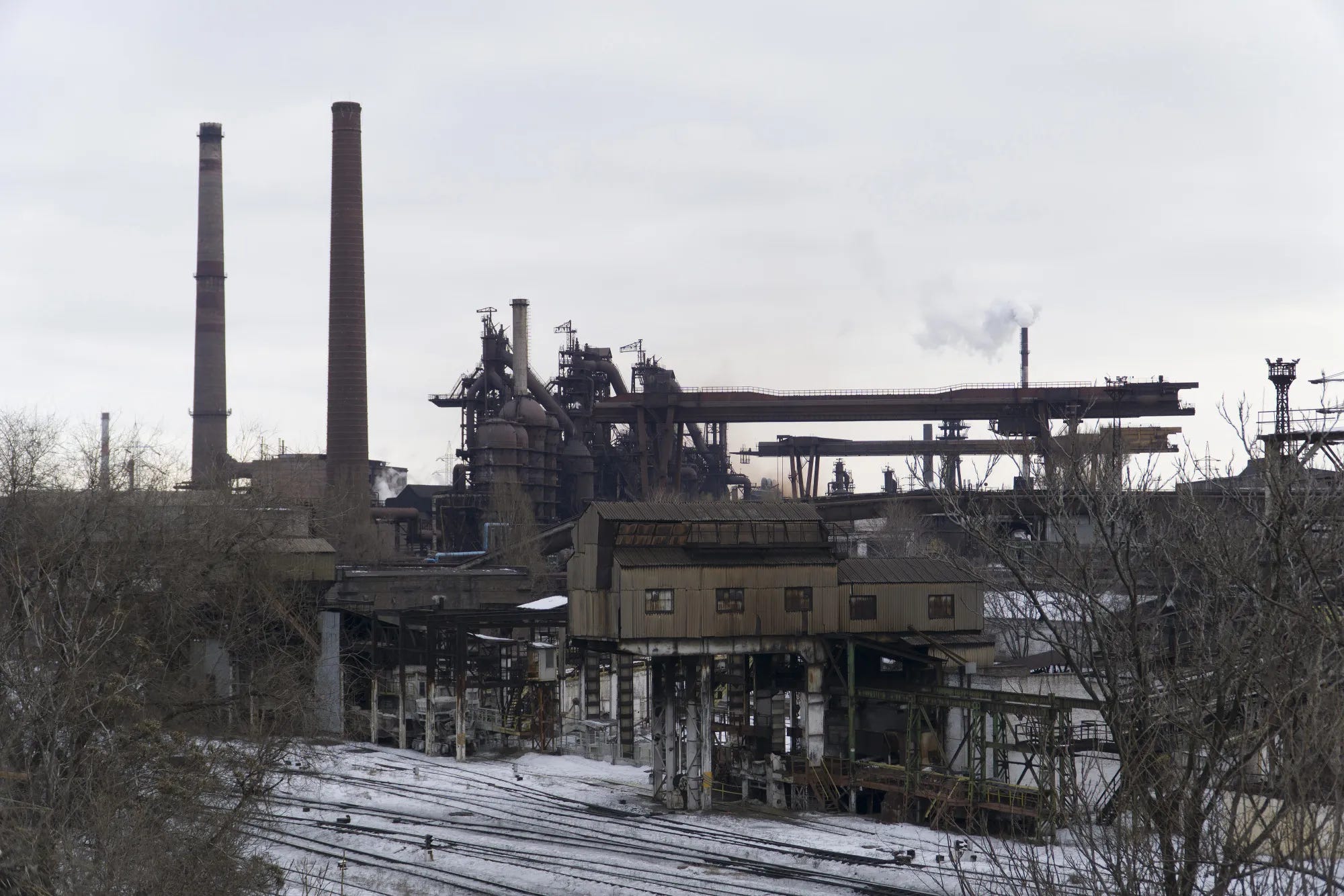
The issue was that during the time of the Soviet Union, one of our major contractors was the Russian Federation. After the collapse, without that centralized funding from the USSR, the Ukrainian government was responsible for upkeep of those manufacturing facilities and for continuing those production lines. It struggled tremendously with that because our state budget was strapped.
We quickly realized that we were going to be in a tough spot if we continued to invest in our defense industry, because Russia was not going to be happy about that. It was clear in the 2000s, after Ukraine had gained its independence, that Russia was going to put pressure on Ukraine to do everything it could to cripple its defense industrial capacity. After 2014, it became a major point of contention.
Although we had the history, and Ukraine has historically been full of engineering talent with a lot of that knowledge, the manufacturing was not maintained to the extent that it should have been. Most of our legacy exquisite systems were completely out of date, in need of repairs, and basically unusable. One of the huge reasons that we had to start using USVs and sea drones was because our fleet was in complete shambles and complete disrepair. Even though we had some ships, it just wasn’t realistic to use them in a wartime scenario at all.
A lot of the tech talent in Ukraine wasn’t actually working in the defense industrial base at the time. Ukraine was famous for its IT industry, software, and computer science. When the full-scale invasion began, harnessing civilian talent was one of the big things that kept us in this fight. Many people who were previously working in the software industry, in consumer goods and technologies, completely shifted.
It was similar to what happened in the US during World War II, where you tapped into this massive civilian talent and massive civilian production lines and directed them to contribute to the war effort. The tapping in of the civilian industries, which was supported in large part by our government and its state policies to encourage more companies to direct their efforts into defense, was what kept us afloat.
Now you have millions and millions of dollars going into this. You have dozens and dozens of different companies. I saw a stat recently — we’re releasing a report about it this week, actually — that there are over 40 component manufacturers in Ukraine, and that’s just components alone. I can’t speak to their effectiveness or the scale they’re producing at, but that’s a massive number for a country of about 30 million people in active war. The fact that there are dozens and dozens of these UAV companies for every single category speaks volumes to the amount we’ve been able to mobilize all of society and have this defense tech renaissance.
Chris Miller: This is really fascinating. In the last ChinaTalk episode I was able to join, we were discussing — in a worst-case scenario, would you rather have a Xiaomi or an Apple? In other words, a hardware company or essentially a software/supply chain company?
What you’re describing with Ukraine is not a labor force that was skilled in drone manufacturing, but a labor force that had a lot of software know-how and was able to quickly repurpose itself to build a bunch of essentially brand new drone companies in a way that I probably wouldn’t have predicted would have been nearly as successful as it actually has been.
Can you tell us about the typical entrepreneur who started up a new drone company or runs a production line? Who are these people and what makes them good at their jobs?
Cat Buchatskiy: They come from completely different backgrounds, which is super interesting. You have some people who, in their past lives, used to be top software engineers at B2B SaaS companies. You have one of the biggest defense tech VCs right now supporting the entire industry, who used to be the chief marketing officer at a workflow automation company. Some people weren’t in tech at all and became CEOs, stepping into it from working at video game companies.
The video game overlap is actually quite real — that pipeline exists. I actually used to play a lot of video games and learned drone operating from that. Many of them were working across the industry at places like Uber Ukraine or other rideshare companies. There are a few examples of that.
It became unimaginable for most people in Ukraine after February 24th to work on anything except this. It’s something that you really can’t replicate unless your country is at war — and not only at war, but in an existential one. It’s extremely difficult for any other country to imagine.
When I talk to my friends abroad about the fact that most people I know now in Ukraine follow this pipeline — you’re in high school, you’re in college, you want to do something for the army. You either want to join the army, you’re going to work on loitering munitions, or you’re going to do something else. It’s a type of society-wide mobilization that’s very hard to imagine and is only comparable to maybe Israel.
Chris Miller: I love the dual-use chief marketing officer. I wouldn’t have guessed that, but that’s an extraordinary anecdote.
The other interesting dynamic is that you had this assembly spring up very rapidly by comparison to almost anything else I could imagine. Can you walk us through what a typical drone assembly factory looks like circa 2026? We’ll probably spend some time later digging into the components, but when you get the components together, what does one of these factories look like? What is their scale? What’s the time to assemble a specific drone? What do the economics look like?
Cat Buchatskiy: I want to debunk a myth here that I see a lot in online articles and conversations about Ukraine’s supposedly “garage shop” drone industry. It’s not that. While it might have been in 2022 or early 2023, and while we still have many small startups operating that way, for the most part, these are massive manufacturing facilities.
We’re talking about warehouses spanning hundreds of thousands of square feet, multiple stories high, with many completely underground to protect against Russian strikes. You have these massive underground bunkers with production lines and hundreds of employees assembling drones by the thousands per month. One particular drone factory produces 10,000 units monthly.
While it’s not quite at DJI’s level yet — the drones don’t fly themselves to the next assembly station like in those videos — we’re getting there. It’s comparable to what you’d see at SpaceX’s Starlink production line. This is not a garage shop industry. Our prime contractors (though we don’t have traditional primes) are producing tens of thousands of units per month and generating tens of millions of dollars in revenue.
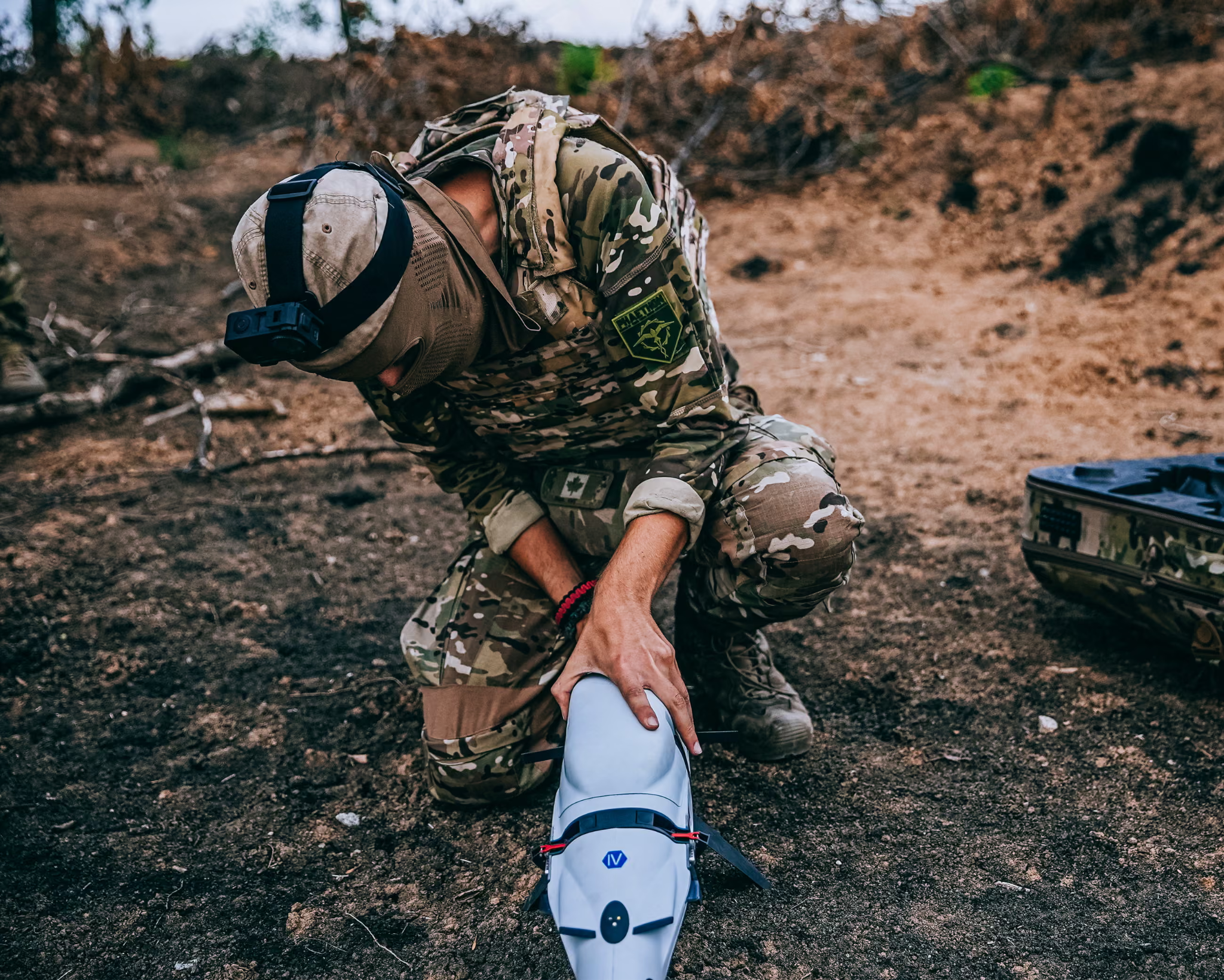
The production looks like any other assembly line — carbon fiber frames come off the line, then workers attach the motors, props, and other components before shipping. What’s interesting is our reverse cycle approach. Many manufacturers send completed systems to the front line, where units have their own assembly facilities. They actually disassemble the drones and reassemble them according to their specific battlefield needs.
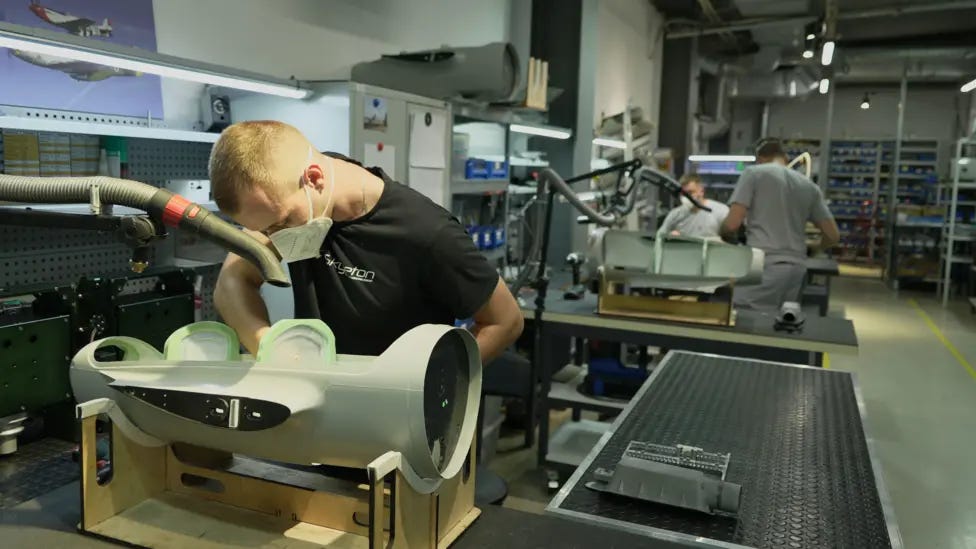
The process from parts to combat-ready drone involves assembling components in the shop, shipping to the unit, where they’re disassembled and reassembled in their own production lines before deployment. This is something many Western countries don’t comprehend — it’s almost impossible to ship a finished system that flies straight out of the box. R&D shops and assembly lines operate across locations closer to the front lines, run by the military doing their own assembly work.
Jordan Schneider: This reminds me of a past ChinaTalk episode we had with Christian Brose from Anduril a few months ago. I opened by asking him why he was building his new factory in Ohio — a state without mountains to hide factories in. It was somewhat facetious, but hearing that all Ukrainian drone manufacturing happens underground makes me worry that American drone manufacturing is just happening in open fields somewhere.
Chris Miller: If I wanted to start up a factory producing 10,000 FPVs a month, how long would that take to get up and running? What does it cost to build a factory like that? Are there specific types of machines or tools that are hard to access, or is that not really a challenge?
Cat Buchatskiy: I can’t speak to the exact cost, but in terms of estimated time to set it up, our biggest FPV primes took 2 to 3 years to get things up and running. By 2025, they were already hitting those numbers, which means it was about 3 years from the beginning of the full-scale invasion to scale production.
They achieved this without venture capital funding, which is interesting because we didn’t really have VC in Ukraine at all. It was purely state contracts and bootstrapped companies. One of the big companies that recently announced a huge joint venture with a German firm was completely bootstrapped. In 2022 and 2023, they were basically producing no systems out of their garage and almost went broke. Then they managed to pull it together and are now one of the biggest Ukrainian drone primes that just opened a factory in Germany. Their turnaround took about 2 to 3 years.
Regarding machines that are difficult to access, CNC machines are a challenge. But honestly, it’s less about the machines themselves and more about the fact that logistics are super challenging for Ukrainian companies. We’re dealing with export restrictions from China, so the actual components we’re trying to access are severely bottlenecked.
Additionally, getting logistics to a wartime country is difficult. We don’t accept direct deliveries and you can’t fly in. You have to load trucks in Poland and take them across the border, or from any other country, dealing with customs and security clearances. It’s a significant lift and heavy operation to establish. That’s why most of our companies are in Western Ukraine — it shortens the logistics cycles considerably.
These are things people don’t really think about when they consider Ukraine scaling its defense industrial base. The fact that we are in wartime, isolated from traditional shipping routes, makes our achievements all the more impressive.
Jordan Schneider: You have this line in one of your reports from late last year that “Ukrainian startups can assemble and ruggedize, but they cannot easily reproduce decades of specialized chemical material or electronic expertise.” Before we get to the second half of that statement, let’s explore the assembly and ruggedization aspect. What has that unlocked for Ukraine? Why was it important to have that domestic capacity developed in the first place?
Cat Buchatskiy: The ruggedization was crucial because Ukraine is fighting a war of attrition. Modularity is incredibly important, which is why in-house assembly matters so much.
As I mentioned earlier, when systems get built in the factory and sent to military R&D labs, they essentially disassemble and reassemble them. The reason is that manufacturers can’t predict which features the frontline will need by the time products ship out.
VTX systems are almost always switched out — it’s completely unpredictable what frequencies you’ll need to fly on. That’s never flown straight off the factory line. Soldiers always switch it out themselves. There’s also modularity in terms of payload attachments, munition requirements for specific missions, and flight conditions.
Having the actual assembly capability allows you to disassemble and reassemble according to specific mission requirements. This is huge because one downside of the massive Chinese drone imports into Ukraine is that you don’t have the same relationship with manufacturers who can react and respond to real user needs.
This is also why most Western companies fail in Ukraine — the headlines you see reflect this. They don’t have an engineering presence or assembly presence to react fast enough to soldiers’ needs. When soldiers report getting jammed and needing to swap out VTX systems, or when they need specific payloads for particular missions, these companies can’t do anything about it. They can’t phone California and ask them to fix something if they don’t have an assembly line in Ukraine to react.
This gives us tremendous mobility and leverage because we can adapt the tools to whatever mission we’re conducting. When people talk about short innovation cycles in Ukraine, this is mostly what they mean — the ability to have continuous R&D and for soldiers to get hands-on and adapt modular systems to their needs. We’ve nailed this down, and it’s been incredibly important.
China’s Calculated Neutrality
Jordan Schneider: Nice drone industry you have there — shame if some export controls were to happen to it. I want to read in full this opener from a Financial Times piece from about a month ago, which featured one of your interviewees —
“On his numerous visits to the factories of southern China, Oleksandr Yakovenko finds that his hosts increasingly plan his arrivals and departures down to minutes and seconds. They sometimes ask him to wait nearby for a while or usher him through side doors, down service corridors, or into empty conference rooms. It took the founder of TAF Industries, now one of Ukraine’s biggest drone producers, a while to realize why his arrival at the head office of a camera developer or battery maker required such opaque rituals of schedule juggling and extreme punctuality. It was because the Russians had just been there, or they were on their way, or both.
‘Our suppliers make an effort to manage the Ukrainian and Russian customers. They try to make it so we don’t have to be in the factory at the same time,’ he told the Financial Times. ‘They invite us for one time slot, but they invite the Russians for a different time. As soon as the car with the Russians drives away, the car with the Ukrainians goes in,’ he adds.”
What an unbelievable situation we’re in. It’s truly surreal. There have been other times in history where arms manufacturers sold to both sides — actually, the more I think about it, it’s not that uncommon. But the fact that we’re having this iterative technological race, as opposed to just selling some AKs to this side and some AKs to that side with a shrug, is really weird.
Cat, can you start by telling the story from the Russian side as well? How do both sides of this war have significant drone dependencies on what comes out of factories in China?
Cat Buchatskiy: It’s definitely a very bizarre scenario, especially for our manufacturers dealing with this. Both sides have a dependency because most of the critical components for the drone industry are based in China. The whole world really has this dependency. For both sides to produce the unmanned systems we need at the scale we’re going through them, it’s impossible to do without China.
Jordan Schneider: What are some historical examples? There’s this example of the British selling dreadnoughts to the Argentines, Brazilians, and Chileans all at the same time.
Chris Miller: The dynamic here isn’t just selling finished weapons — it’s this supply chain iteration. That does seem pretty unique.
The defense supply chains today look very different from those of 50 years ago. Rather than all production occurring within one country, we now have actual multinational supply chains.
There’s a book called Producing Security that discusses how defense industrial supply chains have become multinational. It’s no longer a simple matter of one country producing battleships while another produces theirs — you can’t manufacture your battleships without components from their country. We have Chinese rare earths in our fighter jets and Chinese components in our drones, while they have US AI chips in their supercomputers simulating weapons explosions. This represents a much deeper integration in defense industries than we’ve ever seen before.
Cat Buchatskiy: It’s interesting because Russia and Ukraine have two very different relationships with China when it comes to manufacturing dependency. China will absolutely sell to both sides, which is actually one of the reasons why several of our manufacturers aren’t particularly concerned about China and their supply lines.
When you ask them whether they’re worried about China, quite a few will tell you no, because it’s big business for them. The Chinese are primarily businessmen. Although China is definitely trying to tip the scales in various ways, there’s a belief among some manufacturers that China will never completely cut off Ukraine. They don’t see it as a real threat because China can’t afford to lose that business — no one else other than Russia is buying at that scale. About 30 to 40% of Ukrainian manufacturers really don’t see China as a threat, which is interesting.
One of the key differences between Russian and Ukrainian manufacturers’ relationships with China is that the Russian manufacturers are integrated at a level where they’re localizing those supply chains within Russia and moving them into special economic zones. China is allowing them to buy entire assembly lines and relocate them, which is scary because it means Russia is slowly developing a domestic industry.
They’ve already done this with the Iranian Shaheds, localizing production in the Alabuga Special Economic Zone. Sometimes, there will be assembly lines in China working on a particular component that Ukrainian manufacturers don’t have access to for a year at a time. Then they’ll come back saying, “No worries, we just finished — the Russians partially relocated it to Russia, and now we can accept orders again for what we have left.” This quote appears either in the Financial Times article or in our report.
Ukraine doesn’t have access to replicate that type of relationship. We can’t bring those assembly lines over, partially because we don’t share a border with China, and secondly, because we don’t have that special economic relationship.
This situation is going to compound over time. I’m very worried that in a few years, the Russian industrial base might be significantly less dependent on China for certain manufacturing know-how and capabilities they’re able to localize. They’re going to be able to outpace us — they already mostly outpace us in most things. It’s genuinely concerning that this is spreading beyond China and that these industrial capacities are localizing into other parts of the axis of evil. That special relationship stands out as very different from what Ukrainian manufacturers have with China.
Jordan Schneider: I want to stay on this very interesting series of decisions that Chinese central policymakers have made over the course of this war. Famously, Putin postponed the invasion of Ukraine until after the Beijing Olympics, and right before then, they declared they’re best buds with the best strategic partnership ever.
As Cat walked us through, for the first year or so of the war, drones were not the central dynamic. Everyone was talking artillery, artillery, artillery. There was still focus on infantry manpower, tanks, and fighter jets. During that time period, it would make sense that this wasn’t necessarily something front and center for Chinese policymakers. If a few drone manufacturers could make an extra 8 figures here or there, great, why not?
But as drones increasingly become critical to Ukraine’s ability to defend itself and Russia’s ability to inflict pain both on the front line and deeper into Ukraine, you have a slow creep of export controls. Clearly, this effort has not been pushed to the extreme that it would be if China were directly in conflict.
We famously have some quotes from Wang Yi from this past summer saying that if China wanted to end this war the next day by fully supporting Russia, it would. But he also said that Beijing didn’t want Russia to lose the war in Ukraine because it thought the US might then shift its focus to China and Asia.
My conspiracy question here for you — do they also not want the Ukrainians to lose? Selling drone parts to Ukraine is not a central pillar of the Chinese economy. There has to be some larger strategic calculus going on to allow this number of parts to continue to flow to the Ukrainian drone base.
Cat Buchatskiy: I don’t think that China wants Ukraine to lose. The reason being that I don’t think China and Russia are real friends, and I don’t think China minds depleting Russia’s arsenal. China doesn’t really need Russia for the most part. While there’s a lot more economic interaction with Russia now, in terms of defense and the role that Russia plays in the world, China sees it as a defeated, has-been power.
China understands that, frankly, the US also doesn’t see Russia as its greatest threat. Read the recent national security strategy — it’s barely in there. The US is all focused on China.
I don’t think Xi really cares if Ukraine is able to continue to attrit the Russian defense industry. For them, playing both sides is a win-win scenario because they keep their biggest ally dependent on them. The Chinese defense industry is going to be stronger than the Russian defense industry, and Russia is going to continue to need to buy parts from China.
Frankly, they’re exacerbating the divide. If you’re thinking about great power politics, China’s only getting stronger, Russia’s only getting weaker, and it’s not going to be a tripolar world between Russia, the US, and China. They’re going to want to make it a bipolar world, and Russia is going to be dragged into that orbit as long as Ukraine continues to weaken its global position and sanctions continue to be held.
This might be a bit of a hot take in Ukraine as well, but the fact that China did put in place export controls to both sides — technically export controls to Russia as well — and the fact that China was not extremely explicit in its support for Russia in the war and has mostly maintained an outward political neutrality means that China doesn’t really care about what happens to Russia that much. They particularly care about their standing with the United States and how they compete there.
I don’t think that China wants Ukraine to lose. It’s in their interest to keep it going.
Export Controls
Chris Miller: Could you talk about the export controls in detail? On one hand, you’ve had these controls put in place over the last couple of years, yet Ukraine’s drone industry has grown by every measure. However, your research shows that doesn’t mean controls haven’t mattered. In fact, they’ve been disruptive in several ways, and there’s been a rerouting of components. Walk us through what has actually been the impact of those restrictions.
Cat Buchatskiy: The biggest impact of the restrictions is the logistics challenge. We have difficulty with a lot of suppliers buying directly and shipping directly from China, especially when buying at scale. We’ve been forced to reroute — we can’t have mass DJI Mavic procurement from the government. We have to rely on volunteer networks.
We have a Mavic shortage on the front line right now, and we’re taking a big hit because of it. It’s widely talked about in Ukraine that we don’t have enough Mavics, and our entire ISR ecosystem is basically dependent on having a continuous, steady flow of Mavics flying on the front line. The fact that we cannot procure them at the government level at scale is quite a challenge, forcing us to rely on these spread-out volunteer networks.
Second, it can sometimes be like playing a game of whack-a-mole. We have shell companies selling to Ukraine, but once someone finds out on the other side that they’re selling to Ukraine, they have to shut down and reopen under a different name somewhere else. Russia can play this game as well, putting in reports claiming that a company is selling to Ukraine through a long chain of command. In certain high-tension political situations, this has resulted in companies no longer being able to sell to Ukrainian manufacturers.
I want to be wary of overstating this — Russia doesn’t pull that many strings. China is very much in control of this. Russia doesn’t have as much leverage as it would like to have. But our inability to work directly, particularly on the systems front, makes DJI Mavic procurement very difficult for us. We feel a significant impact when we can’t get certain components fast enough to overcome bottlenecks. This leads to less coverage and less visibility on the front line, which results in less successful strikes. It also means more deaths on our side. The impact is very tangible when we have these problems.
Chris Miller: It’s interesting to think through this situation. The US and Europe have export controls on the transfer of technology to the Russian military, and China’s got them on Ukraine’s drone industry. I wonder whose controls are more impactful. There’s plenty of leakage in both.
Cat Buchatskiy: The US and Europe have export controls to Ukraine as well. That’s something that isn’t really as well spoken about. Our manufacturers have had trouble procuring from European component suppliers because they don’t let the systems go to Ukraine.
This is another aspect of the Russia-China partnership that’s interesting. There’s a tendency in the West to worry about how much China can control Ukraine’s drone industry and how much leverage China has, without realizing that Europe could probably help Ukraine a lot more if it didn’t have certain export controls. We could get European components and decouple from China by procuring from the West, but we can’t because of ITAR and European export controls.
I don’t know if this anecdote is in the report, but we had a situation where one of our drone companies wanted to procure a certain component from the French. The French refused to let them have it because it had some sort of super-classified super glue on the component. The knife cuts both ways.
Chris Miller: Cat, you’ve helped us understand how Ukraine now assembles millions of drones per year. But as you’ve noted, while some of those components are sourced locally, many are not. Walk us through how the component supply chain has evolved over the last few years.
Cat Buchatskiy: The component supply chain has grown significantly. If in 2022, we were importing 99% of finished systems, this trend has completely reversed. As of 2025 — the last data we received — we’re now importing 99% of components instead. We’re talking about tens of millions of dollars in imports from China per year for these components alone.
The supply chain has also evolved significantly in another way. China has recognized that this is becoming a massive industry in Ukraine and that domestic production and vertical integration of unmanned systems manufacturing is now a massive priority for us. In response, China has begun manipulating policymaking to affect our supply, not only through export controls.
One of their tactics is to affect pricing, making it significantly more attractive for us to buy final components rather than the individual pieces needed to build components from scratch. They want to prevent us from learning how to source specific chemicals and parts needed for ground-up manufacturing.
Currently, the Ukrainian components industry has become quite proficient at final assembly of motors, battery packs, and similar items. We’re now focusing on mining rare earth minerals and achieving even greater vertical integration.
At the end of 2025, the Ukrainian government launched a major initiative. BRAVE-1, a mechanism by the Ukrainian Ministry of Digital Transformation, has been pivotal in stimulating the Ukrainian drone industry. They finally turned their attention to components, providing various grants and funding incentives for manufacturers to start producing components in-house.
When we pursued this direction, we quickly discovered that the price difference between buying a finished motor from China versus buying just the magnets needed to make the motor is significant. This makes establishing that supply line even more challenging. There are also many more export controls on raw materials.
The trend for the Ukrainian industry this year will be a continuation of this pattern. The Ukrainian government is pouring significant money into securing raw material supplies. I’m hoping that when we chat again in six months, I’ll be able to report that we’ve invested so much money and implemented policies that we now have actual rare earth mining and raw materials production, with help from the United States. However, I’m not yet sure what that will look like.
The main changes in the supply line are the massive intake of individual components that we simply weren’t seeing in 2022 or 2023. This has become a critical backbone of the industry, especially as it’s become more decentralized. Ukrainian R&D shops now need to source their own components, do their own assembly, and work on drone modularity.
It’s a hugely decentralized industry, which is actually part of why we’re able to navigate around export controls. With so many different buyers rather than one centralized node, people find ways to work around restrictions.
Chris Miller: We could start with the motors and dig into a couple of key components. You mentioned it’s possible to import a finished motor, and it’s also possible to try to import the parts to the motor. Pretty interesting that the parts cost more than the motor itself, if I understood you correctly, which is the opposite of what you’d expect. What’s the hardest thing to make inside of a motor, and walk us through the pathway to indigenizing that capability?
Cat Buchatskiy: The hardest thing to make inside a motor is the magnets. It’s not really something you can make — it’s a matter of whether you have that natural resource in your country. Having neodymium reserves and being able to mine them to produce magnets is a bottleneck. It’s essentially a choke point.
Ukraine actually does have the natural resources to do a lot of this. We have large reserves of lithium as well, because lithium for batteries is another bottleneck. We have many of the natural reserves, but we don’t have the know-how or the infrastructure to mine them. This is why the rare earths deal with the United States was such a huge deal for us — we’re hoping to get support from US industry and the US government to help us establish that capability.
We basically don’t have an established structure or the IP to access those raw materials. It’s quite difficult for Ukraine to do this at scale during wartime, because many of our critical minerals are in the occupied territories in eastern Ukraine. Even if we wanted to invest significant infrastructure into setting up raw materials production and processing plants, much of it resides under occupied territory. A lot of it would require pretty heavy lifting on our side that would certainly become targets for Russian attacks.
We already have a huge problem with our defense industry being crippled by Russian attacks, with production capacity getting completely wiped out. It’s a significant challenge for Ukraine to do the work needed to access neodymium for making motors ourselves or lithium for making batteries ourselves because of these myriad factors.
Chris Miller: If you dig into the sensors that are on drones too, you’ve got optical sensors, infrared sensors, and all sorts of chips managing communications. Those supply chains are heavily centered in East Asia. Is there an effort to domesticate some of that, or can you get the resilience you need by sourcing from multiple suppliers, not only Chinese ones?
Cat Buchatskiy: We’re sourcing right now. We’ve seen an uptake in sourcing from South Korea, Japan, and Taiwan. We’re obviously always looking to diversify. There’s an effort to manufacture PCBs in Ukraine.
One of the most interesting trends is that we haven’t necessarily started setting up those factories yet, because establishing a PCB plant in Ukraine that can produce at the scale we need is going to be an extreme challenge. What I have seen is that we’re starting a few steps back from that with educational programs.
Some of our major universities now have master’s degree programs in PCB manufacturing, where you can actually get a degree and learn how to do it. We’re investing in the long game. Another interesting master’s program I saw recently focuses on UAV manufacturing, design, and component design.
We’re hoping to raise this next generation of engineers who will not only know how systems work and how to design products, but will really get down to the granular level. We want to raise the next wave of engineers who can make PCBs, chips, motors, magnets — everything in between.
Get back to us in a few years and see where our industry is at. I’m hopeful that we’ll be able to build that know-how, even if we don’t have it right now. Those programs are made in collaboration with engineers from around the world. The lead engineer on one of those master’s programs is from Sweden.
We’re making a long-term investment in Ukraine’s defense industry, from the microcomponent level all the way to final systems. This will be Ukraine’s biggest leverage, our biggest brand, and our biggest export in a few years. We’re investing in making this long-term infrastructure within Ukraine.
Chris Miller: How do you guys think about cost in this context? Obviously, if China is going to sell you a finished motor for cheaper than you can buy the components separately, you’re spending more money. Over a million drones, I’m sure that starts to add up. Walk us through the trade-offs you face around cost versus indigenization and how different companies think about that.
Cat Buchatskiy: The biggest barrier to Ukraine’s component industry is the trifecta of speed, scale, and price. When you talk to manufacturers and ask why they haven’t switched from Chinese components, even if Ukrainians can nail down the speed and scale, the price remains a significant barrier.
However, this will likely change in peacetime. If we reach a ceasefire agreement and establish a recovery rebuilding mechanism where Ukraine’s budget receives more support, we might be able to focus more on investing in this area — something we aren’t considering at all right now.
During wartime, it’s basically impossible to think about making those kinds of investments. Building long-term infrastructure with those price trade-offs is really challenging because the biggest priority on the ground is immediate relief and support to the armed forces in a way that won’t wreck our budget while keeping the economy afloat.
When you’re a policymaker thinking about this, you know it’s going to pay off in the long term for a myriad of reasons. But investing several more million dollars into buying raw materials right now won’t have an immediate payoff because we don’t actually have the processing power to intake those raw materials — we haven’t done that before. We need to understand those manufacturing processes and what to do with this raw material.
Unfortunately, war is a game of immediate payoffs. You need results now, otherwise you’re putting people and lives at risk. I don’t see this being a major investment while Ukraine is still in active conflict, but I do see it as a major investment during a ceasefire scenario. That’s also why we’re investing more heavily in education — we understand that in a few years, we’ll have an educated workforce able to step into that role and focus more on the vertical integration aspect of manufacturing that we simply cannot afford to look at right now.
Jordan Schneider: Cat, what’s up with the controllers?
Cat Buchatskiy: Flight controllers are an interesting one. We’ve been slightly more successful at diversifying from Chinese sources. We’re getting quite a lot of flight controllers from Taiwan, although I’m not sure if that’s less of a supply chain risk than China, depending on what happens there.
We’ve also been able to do some local production of flight controllers, luckily. I don’t know what it is exactly about our workforce, but Ukraine’s software talent and engineering talent has seen more success in the flight controller world. Again, scale is important, which we haven’t quite nailed down yet, especially considering the millions of systems we go through. That’s going to be the next challenge. But in terms of know-how and ability to execute, it’s less of a challenge than the know-how required for motors and batteries.
Jordan Schneider: And Chris, flight controllers are legacy chips.
Chris Miller: Legacy chips and displays, printed circuit boards, and many other components are needed to put these systems together.
Jordan Schneider: Let’s zoom out and talk about broader lessons. What are your big takeaways, Cat, after watching this industry develop over the past four years?
Cat Buchatskiy: My biggest takeaway is that investing in R&D is super important because your drone or final system is never going to be stagnant in an actual wartime scenario. You have to have flexibility baked into your actual assembly process. It’s not enough to have a separate branch that works on R&D and develops separate product lines — you really have to have the flexibility and modularity to adapt to whatever the end user’s needs are at the time. This is really hard for a country that’s not at war.
The US gets a lot of flak for not having the same innovation cycles as Ukraine and not moving as fast. I empathize because it’s genuinely difficult. You’re not going to be able to have that R&D if you don’t have someone using your product every single day in real-world conditions saying, “Hey, this is the next big thing. This is how we need to change it. This is what we’re going to need next.” The US just isn’t in a conflict scenario to have to take in all of those lessons, so it’s hard to replicate.
For US defense companies looking to scale and provide real solutions to the Department of Defense, it should be a priority to form early R&D relationships with the end-user units that will be using their products. Without consistent communication and the ability to adapt — without being locked into any one particular final product — you need to ensure your products are easily assembled and disassembled. This allows you to plug and play with whatever payload, VTX, or camera a particular mission might need.
It’s hard to say one particular lesson like “you should build this thing” because in six months it could look very different. The lesson is that you should be able to build a lot of different things in a flexible, timely manner at scale. That’s probably the biggest takeaway.
Chris Miller: It’s crazy — we get back to what might seem like a facile analogy, but being customer-focused and understanding what the end user actually wants is really important. I came away from this conversation remembering that Jordan was on the side of Xiaomi, not Apple, if I’m remembering our last conversation correctly. These supply chain management and customer understanding skills end up seeming shockingly important.
Jordan Schneider: Even as long as you can get access to the parts, right? That’s the unique piece of this case — the supplier is willing to maybe not give you 100%, but give you 70 or 80% of what you need, and you can make the most of that.
There are conflicts where China wouldn’t really care if we needed a lot of drones to invade Mexico or something horrible like that. But for an Asia contingency, this dynamic isn’t necessarily the case. While the US would have a better chance of spinning up that chemical material and electronic expertise that has atrophied relative to, say, Ukraine, it’s still not a straightforward thing. There’s also a time lag that would be associated with that, which could prove decisive.
I found your research on this broader arc fascinating — building an entire core pillar of your national defense in an existential war on imported parts. I’m not entirely sure... Clearly, there are some lessons, but that fundamental dependency, which Ukraine has been able to live with over the past few years — not really just on China for drone parts, but from the rest of the world for a lot of other inputs to its defense posture — it’s different when we’re talking about World War III and Taiwan.
What’s next in the pipeline for you, Cat? What other research are you guys working on for this year?
Cat Buchatskiy: We’re about to release — very timely — in about a week, we’re about to release our big overview of Ukraine’s defense tech industry as of February 2026. We’ll have updates on what components are gaining traction, what industries are popping up.
Then we’re mainly going to be focusing on doing a little bit of work with Russia’s supply chains and Russia’s defense tech industry. As much as we talk about Ukraine and other countries being dependent on Chinese components, it’s really worth looking into and mentioning the fact that Russia uses a lot of Western components in its drones as well, which is important. They haven’t been fully export-controlled and fully sanctioned enough to cripple those supply lines for them. We might be seeing a big report soon on how Russia still sources Western components and what we can do about it.
So many insights here.
Staggering to think about the explosive growth curve from production or purchase of around 3000 drones in 2022, to producing/assembling 5 million FPV drones a year domestically.
As good as our R&D labs are, I have a hard time believing they could match what's happening here (at least not in peacetime): "As I mentioned earlier, when systems get built in the factory and sent to military R&D labs, they essentially disassemble and reassemble them. The reason is that manufacturers can’t predict which features the frontline will need by the time products ship out."
Ukraine has gone from just-in-time manufacturing, which is hard enough, to just-in-time disassembly/reassembly. Remarkable.
I've been thinking for years about what the modern-day Freedom's Forge could look like in the U.S. in the digital age. What's playing out in Ukraine seems to offer one an excellent template.
China's role in playing both sides of the drone wars is fascinating. Fully decoupling of global tech supply chains remains a goal for many, but this conversation only underscores how challenging that will be, if it's even ever possible.