
Today’s guest post was authored by Nima Khorrami, a Stockholm-based Research Associate at the Arctic Institute, Centre for Circumpolar Security Studies.
After decades of neglect, Washington has adopted a coherent and “forceful” response to China’s dominance over critical minerals. China controls an estimated 91 percent of global rare earth refining, dominates the processing of a wide range of minerals, and has demonstrated repeatedly that it is willing to weaponise that position. The United States has responded through a range of initiatives and policy packages including Executive Order 14241, the One Big Beautiful Bill Act, and Pax Silica. Add bilateral deals with Australia, Japan, the DRC, and Saudi Arabia, and the result is undeniably a more aggressive and cohesive mineral strategy than the United States has attempted in decades.
The problem is not with any of these agreements and frameworks. Instead, it is with what is systematically absent from them. The entire architecture of American mineral strategy, and indeed the EU’s parallel effort under its Critical Raw Materials Act and RESourceEU, is built around two variables: where minerals are located and who processes them. What it consistently underweights is a third variable that will most likely prove equally consequential over the medium term: who controls the technology that operates the mines themselves. This constitutes the central strategic blind spot in the West’s mineral autonomy agenda because China is not just dominant in mineral processing. Beijing is also rapidly establishing dominance in the operational technology of extraction; the autonomous systems, industrial AI, connectivity infrastructure, and integrated machine intelligence that will define how the world’s future mines will run. Today, we’ll explore China’s dominance in autonomous mining technology and what to do about it.
If that dominance goes unchecked, the US and its allies could succeed in securing access to mineral deposits across friendly jurisdictions and still find those mines dependent on Chinese operational technology to function.
The Second-Order Competition
To establish both how and why the technology of mining matters strategically, it helps to unpack how the mining landscape is actually evolving. To this end, the departing point is to acknowledge the obvious: mining has always been a risk-prone and controversial venture, with the industry’s reputation tainted by concerns ranging from worker welfare to environmental destruction. The industry therefore has ample incentives to develop alternative extraction methods to improve its image and reduce liability.
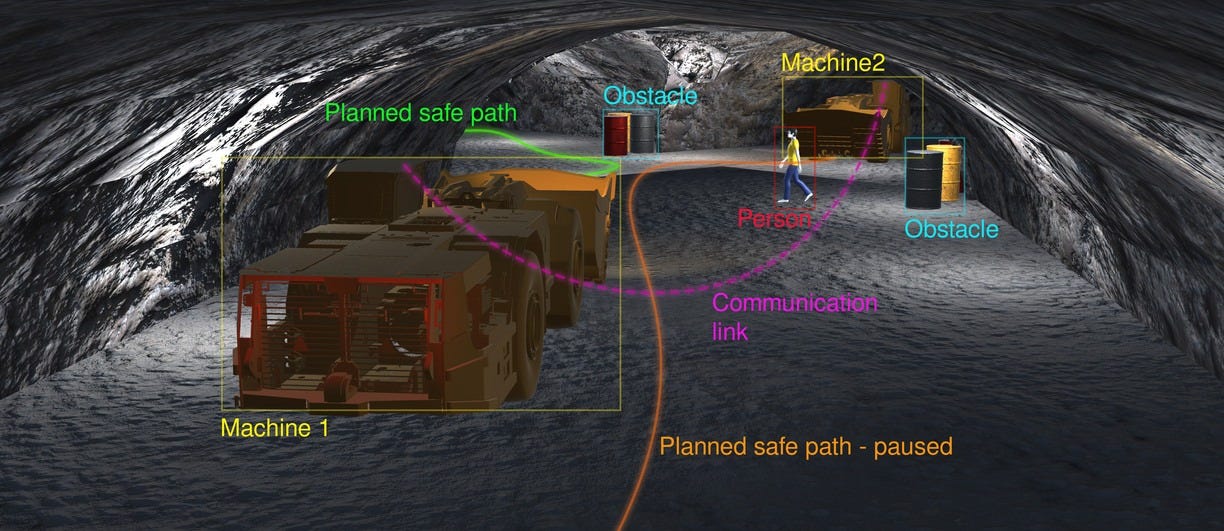
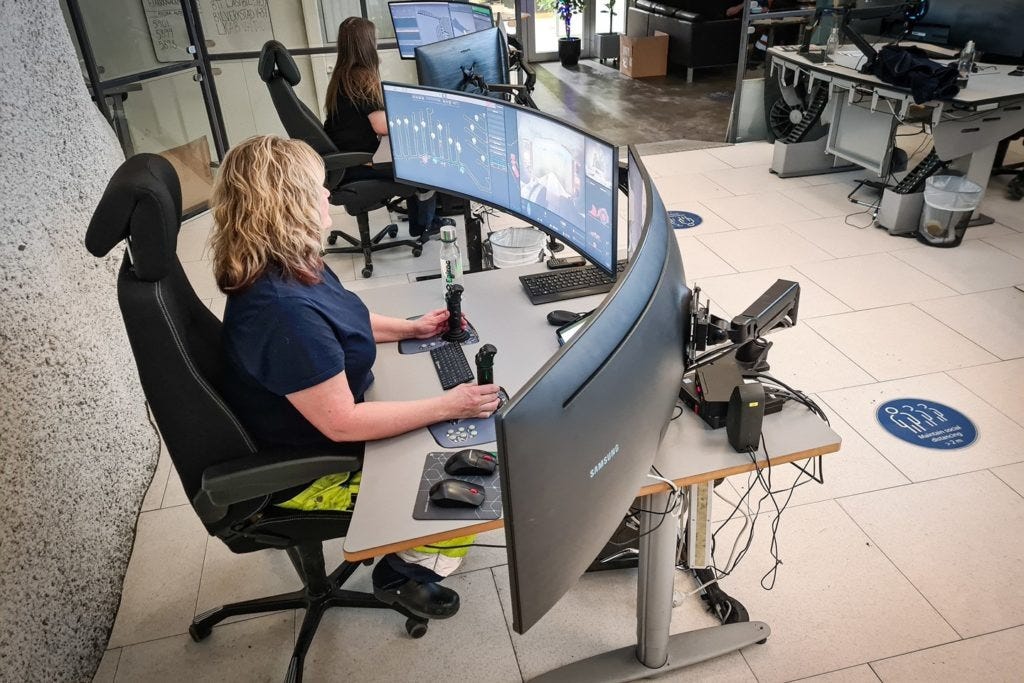
Contemporary autonomous mining goes much further than replacing single tasks with machines. It is the deployment of an integrated stack: autonomous haulage systems that navigate dynamically without human drivers; AI models that manage geological analysis, fleet routing, predictive maintenance, and slope stability monitoring simultaneously; sensor networks providing real-time environmental data; edge computing that maintains operational integrity when wide-area connectivity fails; and satellite positioning that substitutes for GPS in remote and underground environments. When this stack is fully deployed, a mine managed remotely by a small supervisory workforce can operate almost uninterruptedly in conditions that would make human presence hazardous.
The productivity gains and safety improvements are both substantial. For governments and nation states, however, the more consequential dimension is strategic; that is, the capabilities required to run a mine autonomously in harsh and remote environments are directly transferable to deep-sea operations, space, and military logistics in contested or degraded operating conditions.
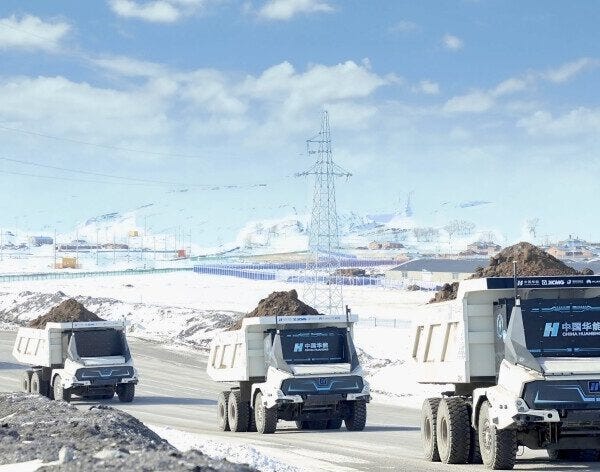
China understands this explicitly. Its Arctic and Antarctic deployments are framed in official strategic communications as technology demonstration environments since systems proven in polar conditions are, more or less, transferable to outer space and the deep sea. A case in point is the Yimin open-pit coal mine 伊敏露天矿 in Inner Mongolia, where a fleet of fully electric autonomous trucks has been operating in temperatures as low as -48 degrees Celsius.
The Yimin Benchmark
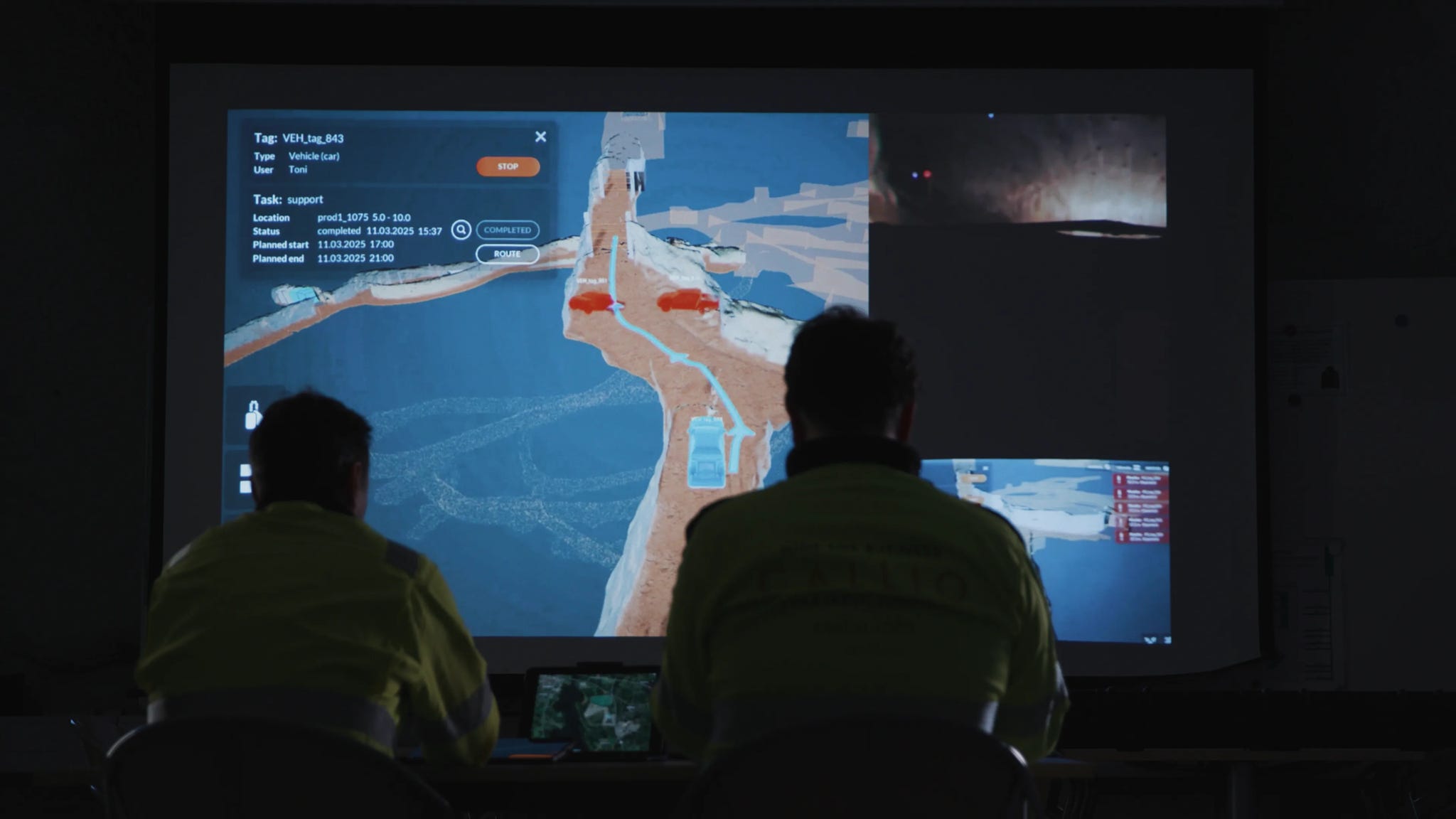
The Yimin deployment warrants a closer look because it is the clearest evidence available of where China currently stands. The fleet has been developed jointly by China Huaneng Group 中国华能集团, Huawei, XCMG 徐工集团, and State Grid Smart Internet of Vehicles 国网智慧车联网技术. Each 45-tonne truck runs on a 568 kWh lithium iron phosphate battery with the driver’s cab replaced entirely by a battery pack. Five cameras, LiDAR units, and millimetre-wave radar provide 360-degree field of vision up to 40 metres in complete darkness, dust storms, and blizzards. Automated battery-swap stations reduce downtime to approximately five minutes while eight hundred sensors monitor the site continuously. By 2024 — prior to full fleet deployment — the autonomous trucks were reportedly achieving 120 percent of human-operator productivity.
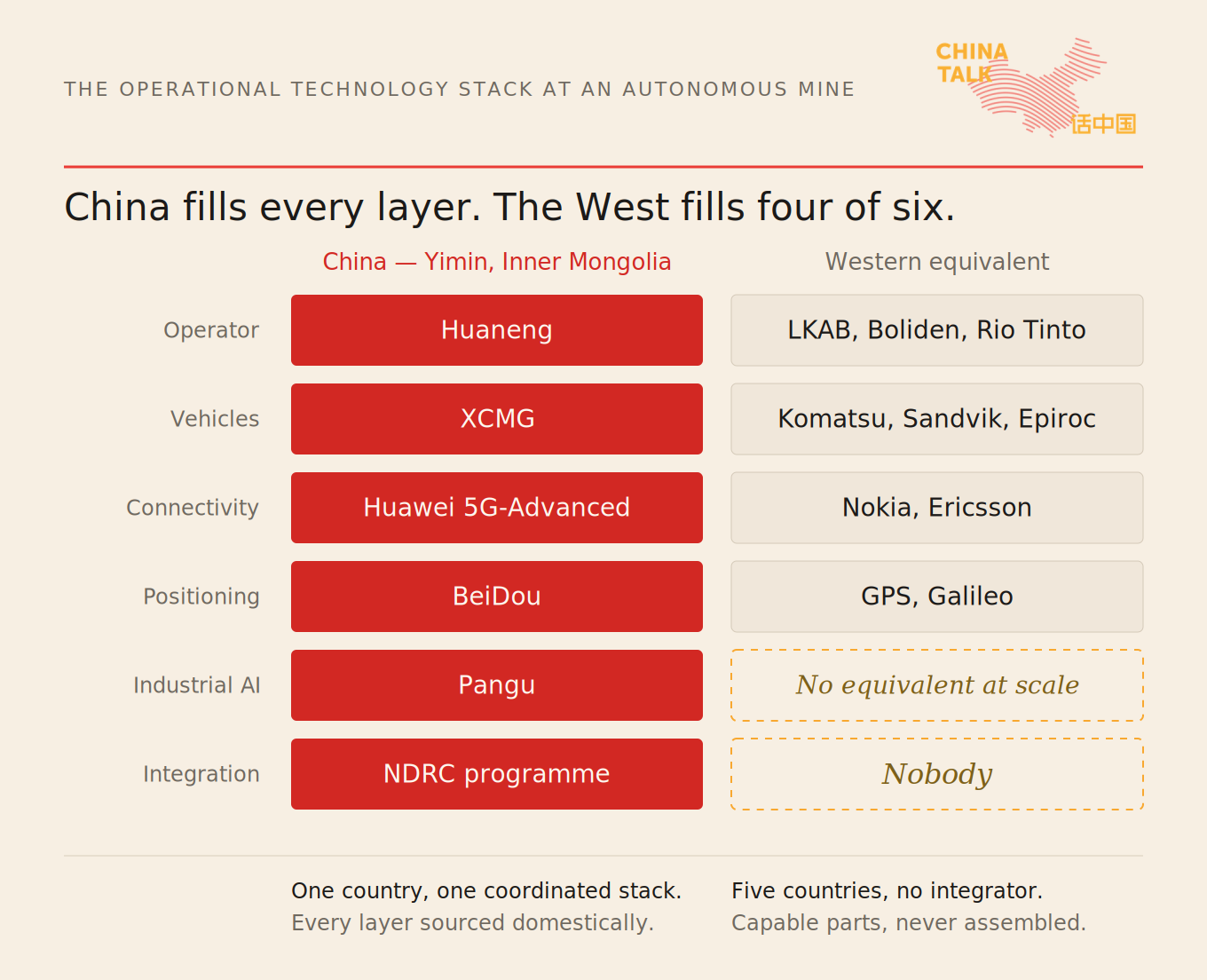
The connectivity layer is as significant as the hardware. Huawei’s 5G-Advanced network provides sub-20-millisecond latency across nearly 200 kilometres of mine routes. Huawei’s Pangu 5.5 盘古大模型 5.5 — a 718-billion-parameter industrial AI model deployed across more than 500 scenarios in over 30 industries — manages fleet coordination, geological monitoring, and predictive maintenance, while BeiDou satellite positioning 北斗卫星导航系统 substitutes for GPS.
The most important strategic revelation is that every component of the operational technology stack is Chinese. Equally significant is the fact that Pangu 5.5 is not a domestic product for Chinese mines alone; it is explicitly positioned as a global industrial AI platform. In addition, battery-powered autonomous haulage, 72% of whose global fleet currently operates in China, could likely follow the same commercialisation trajectory as Chinese electric vehicles: cost-competitive, technically capable, and backed by state subsidies that allow pricing strategies unavailable to Western competitors. As these systems become commercially available to mine operators worldwide, adoption creates operational dependency. A mine that runs on the Chinese operational technology stack and Chinese autonomous vehicle systems is not independent of China in any meaningful sense, regardless of who holds the mineral licence. And this is the competition that Washington’s current mineral strategy has neglected.
The Arctic as the Sharpest Case Study
No region makes this argument more clearly than the Arctic. The Arctic holds substantial deposits of rare earth elements, nickel, cobalt, copper, and other critical materials within the territory of NATO-aligned democracies: Sweden, Finland, Norway, and Denmark (via Greenland). The difficulty is that Arctic mineral potentials cannot be fully unlocked by the conventional mining model. Its operating constraints — extreme cold, lack of adequate infrastructure and small local workforce to draw on — make the labor-intensive extraction model that has governed the industry for generations structurally unviable. As such, it ought not to be surprising that mining operations in the region are typically much more capital intensive compared to temperate projects before accounting for the full social overhead of human presence. Greenland, to take the most prominent example, is three times the size of Texas with just 93 miles of paved road, and ports whose combined throughput would be exhausted by a single active mine at scale.
The only operational model with a high chance of making Arctic mining commercially viable is one built around autonomous operations: AI-driven systems that manage extraction with minimal continuous human presence and monitored remotely through satellite-enabled connectivity. This, to a large extent, is synonymous with the current operational logic being applied at Yimin in conditions directly comparable to much of the Arctic. And it means that unlocking the Arctic’s mineral potential — which could be central to any credible Western strategy for attaining a sufficient degree of mineral resiliency — requires mastering precisely the technology in which China currently leads. Hence, if the US and its allies do not close this technology gap, securing Arctic mineral access may become an exercise in building infrastructure that would ultimately be operated on Chinese terms.
The Arctic’s value in this framing, moreover, extends beyond terrestrial extraction alone. As the closest accessible analogue to space operating conditions, it is also the natural proving ground for the autonomous systems that US-led space mining ventures are developing for deployment beyond Earth’s atmosphere (more on this later).
US Partners Are Already Moving
For their part, European countries (specifically Sweden and Finland), are building a genuine cluster of autonomous mining technology that is among the most advanced in the Western world. These efforts, however, remain underfunded relative to the problem, poorly coordinated at the EU level, and largely invisible in the strategic debate in Washington.
Sweden’s LKAB is running one of the most ambitious underground mine automation programmes in the world. The Sustainable Underground Mining consortium, which brings together LKAB, ABB, Epiroc, Combitech, and Volvo at the Konsuln test mine in Kiruna, is explicitly targeting a new global standard for sustainable, autonomous, carbon-free underground mining. LKAB has also deployed Sandvik’s AutoMine autonomous system across a growing fleet of electric loaders at Kiruna. At Boliden’s Aitik mine, moreover, Komatsu’s FrontRunner autonomous haulage system is operating at commercial scale; the first such deployment in Europe and in an Arctic environment. These operational deployments matter because they are generating actual performance data in the specific environmental conditions that broader Arctic mineral development requires.
Finland’s latest National Mineral Strategy, on the other hand, explicitly connects technology leadership to mineral security objectives, and thus it ought not to be surprising that Helsinki has taken the lead in solving the foundational connectivity problem that autonomous Arctic mining depends on. Its 6G Flagship program is amongst the first government-funded initiatives in the world to explicitly investigate how next-generation millimetre-wave frequencies behave inside mine tunnels; a prerequisite technical problem for full underground autonomy. Equally significant, Nokia and Boldyn Networks have built an underground 5G test network at the Pyhäsalmi mine.
Australia has deployed over 927 autonomous haulage trucks across its mines backed by the world’s first regulatory Code of Practice for Safe Autonomous Mining and a federal government investment of AU$566 million in geological mapping and mining technology infrastructure. Australian operators have, arguably, more real-world operational data on autonomous large-scale mining than any non-Chinese actor.
The picture that emerges is of a concrete, distributed Western capability in autonomous mining technology; assets in the right jurisdictions generating operational knowledge in the right conditions which have not been assembled into a competitive program. Sweden and Finland are building the technology, while Australia has the largest deployment base and is pioneering a regulatory framework for autonomous mining. The United States has the financial instruments, the political leverage, and, through the Mine of the Future initiative, the beginnings of a federal research commitment. But the West still lacks a coordinating structure that would make these complementary strengths add up to a coherent challenge to China’s lead.
The Alliance Washington Has not Built but Urgently Needs
This is the new strategic argument that the current US minerals agenda is missing. Pax Silica is structured around a coalition of mineral capabilities; it pairs deposits in one jurisdiction with processing expertise and financial resources from other allies. It is, in its logic, a supply chain coalition. What’s more, the DOE’s Mine of the Future initiative, committing up to $95 million for autonomous mining technology proving grounds and national laboratory research, is a good start but insufficient on its own. The gap between what the US is currently investing in mining technology and what China’s National Development and Reform Commission (NDRC) directed programme has already deployed is wide enough that domestic investment alone will not close it on the relevant timeline. This is an area where allied coordination can become a force multiplier which the US cannot afford to forgo.
What is needed, therefore, is a techno-industrial alliance specifically focused on autonomous mining: a coordinated programme to master, standardise, and commercially scale the operational technology of next-generation extraction designed explicitly to outcompete China. Sweden and Finland bring the most advanced European capacity in underground autonomous systems, the connectivity research those systems require, and Arctic operational environments where the technology can be tested under relevant conditions. Australia brings the largest deployed autonomous fleet in the Western world, a mature regulatory framework, and demonstrated experience in scaling these systems commercially. The US brings federal research funding, the world’s largest defence-industrial complex with direct interest in the dual-use applications of these technologies, and the downstream manufacturing demand that gives the coalition its market rationale.
The structure of such a partnership, however, would need to be more than a procurement framework. It would need to coordinate research and development by marrying Finland’s 6G underground work with US national laboratory capacity, sharing operational data from Australian deployments with Swedish underground test environments, jointly developing the safety certification standards that would allow autonomous equipment to be deployed across allied jurisdictions without re-testing from scratch. It would also need a shared approach to the connectivity infrastructure that autonomous mining — especially in harsh and remote environments like the Arctic — requires. Above all, it would need to move at the speed of a technological revolution rather than a multilateral treaty formation.
Mining Technology as AI Ecosystem Strategy
Crucially, the technology of mining is also a vector for AI ecosystem expansion, and the US should be thinking about it in those terms.
When Chinese companies embed Huawei’s Pangu AI, BeiDou positioning, and 5G-Advanced connectivity in a mine in Inner Mongolia — or eventually in a mineral-rich country in Africa or Central Asia — they are integrating that mine’s operational environment into the Chinese technological ecosystem. Local engineers are trained on Chinese platforms, maintenance contracts create ongoing relationships with Chinese vendors, and the data generated by mine operations flows through Chinese systems. As such, switching to a different technology stack at a later date would amount to an operational disruption that mine operators would rationally avoid. This is the same lock-in logic that has made Chinese telecommunications infrastructure so strategically consequential in countries that have adopted it.
The inverse logic applies to US-led mining technology partnerships. If American AI systems, US-certified autonomous equipment, and allied connectivity standards become the operational backbone of mines in supplier countries, those countries’ mining sectors become embedded in the US-aligned technology ecosystem in institutionally durable ways. A mine operator whose engineers train on US autonomous systems, and whose operational data is managed by US-allied AI platforms, faces a fundamentally different calculus when Chinese vendors offer competitive pricing. Put differently, A US-led autonomous mining technology program has the potential to shape technology adoption decisions and expand the US AI ecosystem in mineral-supplying countries.
Equally important is the potential goldmine of data. Autonomous mining systems are extraordinary data generators. Every operational shift produces a continuous stream of geological readings, equipment telemetry, fleet routing decisions, slope stability measurements, and environmental indicators. The AI models that manage these systems improve — in predictive accuracy, in decision quality, in operational efficiency — proportionately to the volume and diversity of data upon which they are trained.
Through its state-coordinated intelligent mine programme, China is building what amounts to the world’s largest training corpus for mining AI. Nearly 1,000 intelligent mines, coordinated under a unified national program, are generating operational data at scale and in a form that continuously feeds back into the AI models managing them. In this context, the parallel to another strategic domain is instructive. As the National Security Commission on Emerging Biotechnology has warned with respect to biodata, the United States risks a future in which an adversary controls the data infrastructure underlying strategic industrial sectors because that adversary has built tightly integrated, state-controlled ecosystems in which AI and operational data co-evolve, while the US lacks an equivalent unified infrastructure. The warning applies with equal force to mining. Autonomous mining AI trained on Yimin’s operational data, and on the hundreds of similar deployments across China’s intelligent mine programme, will over time outperform systems trained on smaller, siloed, proprietary Western datasets. That performance gap, in turn, translates directly into adoption incentives: mine operators globally will gravitate toward the systems that work best, regardless of their origin.
The United States and its allies currently lack a mineral data commons mainly because there is a lack of recognition that mineral operational data is a strategic asset in the same category as the mines themselves. Operational data from Australia’s fleet of autonomous trucks, from Sweden’s Kiruna test mine, and from deployments across allied jurisdictions sit in proprietary silos, owned by individual mining companies with neither the incentive to share it nor a mechanism to aggregate it for AI training purposes. The raw material for building competitive AI exists but the infrastructure to convert it into model advantage does not. A techno-industrial autonomous mining alliance should therefore include a shared and secure mineral data infrastructure to enable operational data from allied mining deployments to be aggregated, standardised, and used to train Western mining AI systems.
Space Extraction as a Strategic Multiplier
The final strategic dimension here is the direct applicability of autonomous extraction capabilities to the emerging space and asteroid mining sector, and the fact that, unlike autonomous terrestrial mining where China has established a commanding lead, this sector is dominated by American companies.
Asteroids harbor the same class of metals at the heart of today’s mineral security agenda. Valued at current commodity prices, the mineral wealth of near-Earth asteroids runs into the quintillions of US dollars, and individual extraction missions could return trillions in value. The commercial logic has already generated a cohort of US-headquartered ventures developing autonomous extraction systems capable of operating in the vacuum, extreme cold, and communication constraints of space, where a continuous human workforce is not an option.
At the level of operational technology, space extraction and autonomous Arctic mining present strikingly similar challenges. For instance, both demand extraction in the absence of a continuous human workforce and impose extreme demands on robotics, power management, and autonomous systems under degraded connectivity. The Arctic is therefore the natural proving ground where space mining systems could be tested and refined before deployment beyond Earth’s atmosphere. Directing these ventures to Arctic testing environments would simultaneously accelerate their development timelines and expand the operational dataset that Western terrestrial mining systems require, generating performance data in harsh autonomous operations that benefits both sectors.
Equally significant is the fact that the talent, technology, and entrepreneurial capacity concentrated in these US companies represents a latent competitive asset in the broader autonomous extraction technology competition. China’s space mining programme remains at an early stage and lacks an equivalent cluster of commercially-driven ventures operating at pace; thus far, only one Chinese company — Origin.Space 起源太空 — is active in the field. Hence, the primary constraint is probably not a lack of technological capability, but rather the absence of an integrated policy framework that recognises the strategic synergies between the mining and space sectors.
America First Is the Wrong Gear for This Race
The technology alliance proposed here is structurally incompatible with a transactional, leverage-first approach to alliances.
Sweden and Finland are not large economies. They do not offer the strategic weight that compels attention in a framework built around bilateral leverage and deal-making. They are, however, the countries running the most advanced autonomous underground mining programmes and in Arctic conditions that are directly relevant to the Greenlandic deposits the US is reportedly eyeing to develop. Treating them primarily as junior partners in a security arrangement, or as potential targets of tariff pressure in broader trade negotiations, is precisely the wrong dynamic for the kind of deep technical collaboration, such as shared R&D, joint certification standards, open operational data, that a competitive autonomous mining programme requires.
Australia is a closer case. The existing minerals partnership establishes a basis for exactly this kind of technical cooperation, but even with Australia, the logic of “what does the US get” from a bilateral deal is the wrong frame. The question is what the coalition gets from pooling capabilities that are, individually, insufficient to match China’s scale and integration. That question requires a different kind of strategic reasoning than the one embedded in an America First approach; one that treats allied technical assets as force multipliers rather than as leverage points in a negotiation.
More broadly, coalition frameworks require predictability and institutional trust to function. Deep technical collaboration requires relationships built on something more durable than transactional benefit calculations. The allies who hold the autonomous mining capabilities that the US needs to complement its own have domestic political systems that are responsive to how they are treated. Imposing tariffs on them and simultaneously expecting them to co-develop autonomous mining AI constitutes an unwarranted contradiction that will not resolve in Washington’s favor.
The Reframing Washington Needs
The US minerals strategy has achieved important wins in a domain that was ignored for far too long. However, the overall architecture is incomplete in a way that compounds over time.
The technology of mining, the autonomous systems, industrial AI, connectivity infrastructure, and the operational data those systems generate are strategic domains as consequential as processing capacity. Not only do they carry dual-use applications across deep-sea, space, and defence logistics, but their development through allied partnerships is also a mechanism for AI ecosystem expansion; that is, for embedding US-aligned technology and data standards in the operational infrastructure of the countries that supply tomorrow’s critical materials. None of these dimensions are captured by the US’s current framework.
What is missing from Washington’s agenda is an explicit techno-industrial alliance for autonomous mining; a programme that would pair US research investment and downstream demand with Europe’s evolving underground automation expertise, Australia’s experimentation with large-scale autonomous mining, a shared mineral data commons for AI training, and a joint commitment to the regulatory and technical standards that the next generation of mining will run on. This techno-industrial alliance should also be designed to bridge the mining and space sectors by directing US companies developing space-mining technologies towards Arctic deployment while integrating the autonomous extraction expertise concentrated in American space ventures into the alliance’s core capabilities. Failure to do so would most probably lead to a minerals strategy that secures access to mining sites and loses the machines. That, in turn, is not a strategy for mineral autonomy but simply a more expensive form of the same dependency on China.
Check out Nima’s previous guest post on ChinaTalk here:
China's Arctic Leverage

Trump claims the US needs Greenland to counter Chinese presence in the Arctic, but in fact, Beijing’s Arctic strategy appears to prioritize encroaching on Russia’s sphere of influence, not Denmark’s. Today’s guest post was authored by Nima Khorrami, a Stockholm-based Research Associate at the Arctic Institute, Centre for Circumpolar Security Studies.
This is a genuinely interesting argument, but the level of anxiety could be too excessive.
First, the share of electric mining trucks cannot be used as evidence that China has already established a monopoly in autonomous mining technology. According to GlobalData, 278 of the 387 battery-powered haul trucks currently operating in open-pit mines worldwide(around 72%)are deployed in China. But these vehicles are electric, which does not mean that all of them are fully autonomous, nor does this figure represent the entire autonomous-haulage market.
The Yimin mine is certainly advanced. Yet overburden transport at a coal mine is not directly comparable with the full operating systems required at large copper, iron-ore and gold mines, which include drilling, blasting, crushing, loading, beneficiation and ultra-class haulage. Payload figures for the Yimin trucks range from 45 to 90 tonnes, while mature ultra-class mining applications commonly involve trucks with payloads of 230, 300 tonnes or more. Nevada Gold Mines in the United States, for example, is already automating 230-tonne and 300-tonne haul trucks.
Nor is BeiDou quite as powerful as the article implies. BeiDou, GPS and other GNSS signals cannot penetrate rock formations inside underground mines. Underground autonomous navigation typically depends on LiDAR, inertial navigation, SLAM, UWB base stations, local wireless networks and pre-mapped mine environments.
The necessity of autonomous mining in the Arctic is also overstated. The Red Dog zinc mine north of the Arctic Circle in Alaska, the Raglan nickel mine in Nunavik, Canada, and the Kiruna iron-ore mine in northern Sweden have all operated for many years. Automation can improve safety and economics, but it is hardly the sole condition for Arctic mining. Mineral rights, environmental opposition, infrastructure, project economics and downstream processing capacity are often more decisive.
Of course China is moving rapidly ahead in new deployments of autonomous mining equipment and in the electrification of mine transport. But Western, Japanese and Australian mining systems remain extremely strong in ultra-class equipment, accumulated operating experience, complex mining environments and global service networks. Having the largest number of deployed vehicles is not the same as possessing a technological monopoly.
In the ultra-class autonomous haul-truck segment used by major iron-ore, copper and gold mines, Komatsu and Caterpillar still possess deep technical expertise and decades of operational experience. By April 2026, Komatsu had delivered its 1,000th ultra-class autonomous haul truck, including more than 500 units from the 930E series alone. Caterpillar’s MineStar autonomous-haulage system had moved more than 8.6 billion tonnes of material without drivers by 2024.
Thank you. A well thought out article. In addition to directing attention to the importance of autonomous mining operations - another main question missing from this equation is “What is the cost to the environment?” The minerals are not a renewable source and AI needs large amounts of water to cool its systems. Seems short-sighted to me to be racing ahead at the cost of just making our destruction “faster.” But thank you for this thought provoking and well researched article.