
Trump claims the US needs Greenland to counter Chinese presence in the Arctic, but in fact, Beijing’s Arctic strategy appears to prioritize encroaching on Russia’s sphere of influence, not Denmark’s. Today’s guest post was authored by Nima Khorrami, a Stockholm-based Research Associate at the Arctic Institute, Centre for Circumpolar Security Studies.
The Arctic has re-emerged as a central arena in global geopolitics; not only as the shortest strategic corridor between the United States and Russia but also as a rapidly militarising frontier where intensified great-power rivalry meets accelerating climate transformation. The accession of Finland and Sweden to NATO has sharpened the Alliance’s northern posture, while Russia’s expansive military footprint and China’s expanding scientific and economic presence further internationalise what was once thought to be a ‘zone of peace’. At the same time, global forces, ranging from population growth and the demand for critical resources to technological innovation, are integrating the region more deeply into global systems of trade, energy, and communication.
The economic and technological stakes are particularly significant. The Northern Sea Route (NSR) offers a potential alternative to both Eurasian land corridors and the Suez Canal, cutting transit times between Asia and Europe by nearly half and thus holding major implications for global logistics. The Arctic is also home to vast reserves of oil and gas alongside critical minerals such as nickel, cobalt, and titanium. Realising this potential, however, depends on two infrastructural pillars: icebreakers and small modular reactors (SMRs). Icebreakers are indispensable for maintaining year-round navigation along the NSR, while SMRs offer scalable and affordable energy solutions for remote settlements and resource extraction. Together, they underpin both the material and symbolic dimensions of Arctic power.
Yet, an increasingly overlooked dynamic in discussions of Sino-Russian cooperation in the Arctic is the trajectory of Russia’s icebreaking industry — and the implications this holds for the ‘balance of leverage’ between Moscow and Beijing. The conventional view assumes that China’s Arctic ambitions remain conditioned by Russia’s willingness to grant access, with Moscow acting as the gatekeeper to the Northern Sea Route (NSR).
Yet this assumption is becoming increasingly tenuous. Russia’s shipbuilding sector faces deepening structural constraints: sanctions, labour shortages, cost overruns, and the accelerating obsolescence of its fleet. Projections to 2035 suggest that Russia’s operational icebreaker fleet — currently standing at around 45 vessels — could contract to between 25 and 35 as retirements outpace new deliveries. Flagship projects are delayed, and major shipyards such as Zvezda (Звезда) and the Baltic Shipyard are financially strained and technologically dependent on sanctioned foreign components. Even under favourable scenarios, the outcome looks more like stagnation than renewal. This erosion of capability calls into question Russia’s ability to independently sustain year-round NSR operations at a time when the Kremlin is tying the Arctic ever more tightly to its great-power identity and future economic strategy.
The effects of sanctions, however, extend beyond immediate access to Western equipment. They disrupt complex supply chains of high-grade steel, propulsion systems, control electronics, and precision engineering tools, which cannot be rapidly substituted by domestic production. Financing pressures compound these difficulties. Russian banks face higher borrowing costs and limited access to foreign credit lines, constraining large-scale investment in long-lead infrastructure projects. Moreover, the departure of European engineering firms has left gaps in certification, safety testing, and design integration that Russia’s domestic industry struggles to fill. These interlocking industrial bottlenecks resemble systemic weaknesses that inflict other sectors of the Russian economy, including semiconductors and drones, where external isolation and insufficient domestic innovation capacity reinforce one another.
China, by contrast, is quietly moving in the opposite direction. Its fleet remains modest in absolute terms but is steadily expanding, with two icebreakers already operational and several heavier vessels under construction. The progress is gradual, yet the determination is clear: Beijing is building technical competence in polar operations, just as Russia struggles to preserve its existing capacity. Although China is unlikely to surpass Russia in fleet numbers before 2035, its relative trajectory grants it increasing leverage in shaping the terms of its Arctic cooperation with Moscow.
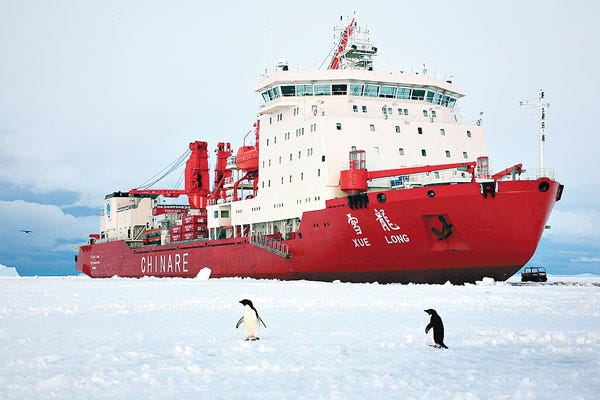
These diverging trends make some form of functional cooperation increasingly likely and, for Moscow, perhaps unavoidable. Russia’s desire to maintain year-round NSR operations collides with the limits of its industrial base, while China seeks opportunities to gain experience and influence without challenging Russian sovereignty outright. Such cooperation, in turn, could take several forms. Jointly operated or co-developed icebreakers may be deployed along the NSR, nominally under Russian command but incorporating Chinese financing, technology, or crew. Joint shipbuilding projects — whether at Zvezda, the Baltic Shipyard, or in Chinese yards — could accelerate production and fill critical component gaps. The key point is not that Russia will one day lease Chinese vessels to patrol its Arctic waters, but rather that the two sides will converge around joint ventures and technical partnerships as the only feasible means of sustaining capability.
This emerging interdependence, moreover, is likely not confined to the icebreaking sector; it may also extend into other strategic domains where Russia’s industrial constraints meet China’s growing technological capacity. Small modular reactors (SMRs) exemplify this broader pattern. They are central to Russia’s Arctic vision, offering scalable and continuous power for remote settlements, critical infrastructure, and energy-intensive extractive projects such as mining. Russia currently operates the world’s first floating SMR, the KLT-40S, and is constructing its first land-based unit in Yakutia to supply both local communities and nearby mining operations.
The International Atomic Energy Agency (IAEA) notes that eighteen countries are currently developing SMR designs, but Russia and China dominate the field. As of mid-2025, only two SMRs are commercially operational — one Russian and one Chinese. Yet the same sanctions, supply-chain disruptions, and financing pressures that hamper Russia’s shipbuilding sector also threaten its ability to manufacture and deploy SMRs at scale. China, meanwhile, brought its first land-based SMR online in December 2023, outpacing Russia and other competitors. Should these trends persist, Russia may find itself relying on Chinese technology, components, and investment to advance its Arctic nuclear projects, just as it increasingly does in shipbuilding.
By sustaining Russia’s symbolic strength while deepening its material dependence, Beijing gains influence at minimal political cost. Joint ventures in icebreaker construction and SMR deployment allow China to accumulate operational experience, Arctic know-how, and infrastructural leverage without openly challenging Russian sovereignty. The result is a quiet hybrid dependency: Moscow retains formal control while China increasingly provides the technological and financial backbone. For Moscow, this evolving dependency is both a source of unease and a pragmatic necessity. Russian analysts acknowledge that China’s growing financial and technological role carries latent risks of overreliance, yet they also stress that current geopolitical isolation leaves few viable alternatives. The prevailing view is that partnership with China must continue, but within clearly delineated boundaries that preserve control over strategic assets such as ports, nuclear facilities, and resource extraction zones. In practice, this means balancing rhetorical assertions of sovereignty with quiet efforts to diversify partners, indigenise technologies, and craft legal safeguards that prevent a gradual erosion of decision-making autonomy. Russia’s approach thus blends cautious accommodation with latent anxiety — a recognition that sustaining Arctic ambitions increasingly depends on the very partner whose influence it seeks to contain.
Seen this way, it is reasonable to assert that the balance of leverage in the context of Sino-Russo Arctic partnership is quietly yet decisively shifting in China’s favour; a dynamic now formalised through joint NSR governance mechanisms such as the 2025 Rosatom–Chinese Ministry of Transport agreement, which enshrines cooperation while entrenching material asymmetry beneath the surface of parity. In this sense, the evolving Arctic relationship mirrors the logic of Sino-Russian engagement in Central Asia, where China has become the dominant economic actor while carefully avoiding direct intrusion into defence and security affairs. The Arctic may soon follow a similar path: symbolic parity concealing a growing asymmetry.
For Western policymakers, this dynamic suggests that expecting China to act as a counterweight to Russian Arctic ambitions is misguided. Beijing’s strategic interest lies in maintaining Russia’s façade of sovereignty while quietly embedding itself within the material fabric of Russia’s Arctic infrastructure. For Russia, this arrangement masks reliance beneath the rhetoric of partnership, preserving the narrative of Arctic sovereignty even as the material basis for that sovereignty erodes. For China, the partnership represents an opportunity to build leverage over Moscow while expanding its influence in the far north.
This is a strong material analysis, but it’s still framed geopolitically.
What’s actually shifting isn’t just leverage between states, it’s the separation of symbolic sovereignty from operational capability.
Russia retains the flag, the law, and the narrative. China increasingly supplies the systems that make Arctic activity function at all.
That’s not a partnership problem, it’s a governance transition, where control migrates to whoever maintains the infrastructure the system depends on.
Good piece re-highlighting the importance of the Arctic - but more importantly, access to the Arctic via icebreakers. Russia currently leads in this sub-sphere, but China’s shipbuilding capabilities continue to grow. Another example of the Pillars of Power in action..
From our related Arctic piece from last March:
“These new trade routes and other exploratory activities are forged by nuclear-powered icebreakers – and Russia happens to be the only country in the World to have a fleet (another Technology/Energy Pillar overlap).”
Link to piece: https://aquavis.substack.com/p/pop-the-arctic-and-its-rising-importance
Link to companion materials: https://aquavis.substack.com/p/pop-the-arctic-and-its-rising-importance-46a