
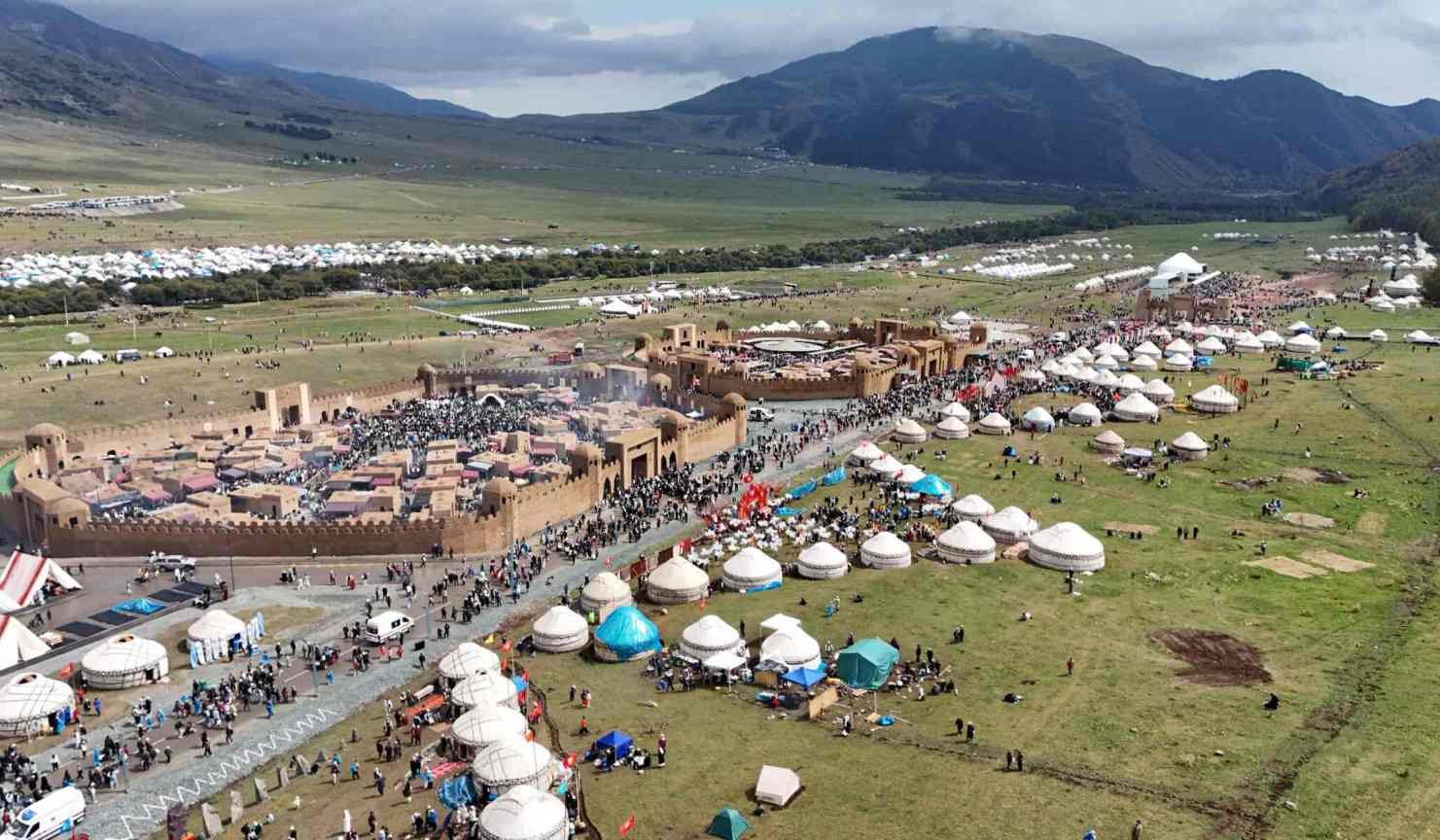
On a rainy day at the beginning of September, I found myself standing under the giant sky at the foot of the mountains in rural Kyrgyzstan, shouting “add oil! (加油) from the sidelines of a horseback archery track. I was back in Central Asia for the World Nomad Games, an Olympics-style celebration of traditional sports where China reluctantly lets some of its minorities compete.
As if that weren’t justification enough for a reporting trip, the Shanghai Cooperation Organization’s annual summit was happening in Bishkek, with the Games designated as a partner event open to the delegates. Putin, Modi, and nine other heads of state flew in to discuss new infrastructure megaprojects, drugs and nuclear material trafficking, market integration, and more.
When I went to Kyrgyzstan last August in search of Chinese influence, the country captivated me with its friendly people, rapidly growing economy, and a nomadic way of life still practiced by many in the countryside. And now, on the 35th anniversary of Kyrgyzstan’s independence from the Soviet Union, I was honored to bear witness to the country’s moment on the world stage.
Today, I’ll take you along on my journey. This piece is part travelogue and part geopolitics, and it covers a lot of ground: the massive infrastructure buildout, the Kyrgyz president’s Chinamaxxing, the muzzled Inner Mongolian athletes representing China, the lessons China hasn’t learned about sports diplomacy and inter-ethnic harmony, and what this all means for Central Asia’s future.
Arriving in Bishkek
The World Nomad Games were first conceived in Kyrgyzstan in 2014 and are held every two years.1 After being hosted by Türkiye in 2022 and Kazakhstan in 2024, the Games have finally returned home to the mountains of Kyrgyzstan. And these were the largest Games ever, with 200,000+ visitors piling into Kyrchyn Gorge, one of the Games’ six venues, by the third day of the Games to watch 3,000+ athletes from 109 countries (compared to 583 athletes from 19 countries in 2014).
I flew into Bishkek from Tashkent on a beautifully clear day, and I spent the entire 75 minutes in the air gazing at the picturesque Tian Shan mountains (yes, that name is of Chinese origin).2 I arrived a few days before the opening ceremony, hoping to sneak a peek at the SCO action in the capital before heading out to the shores of Lake Issyk-kul for the Games.
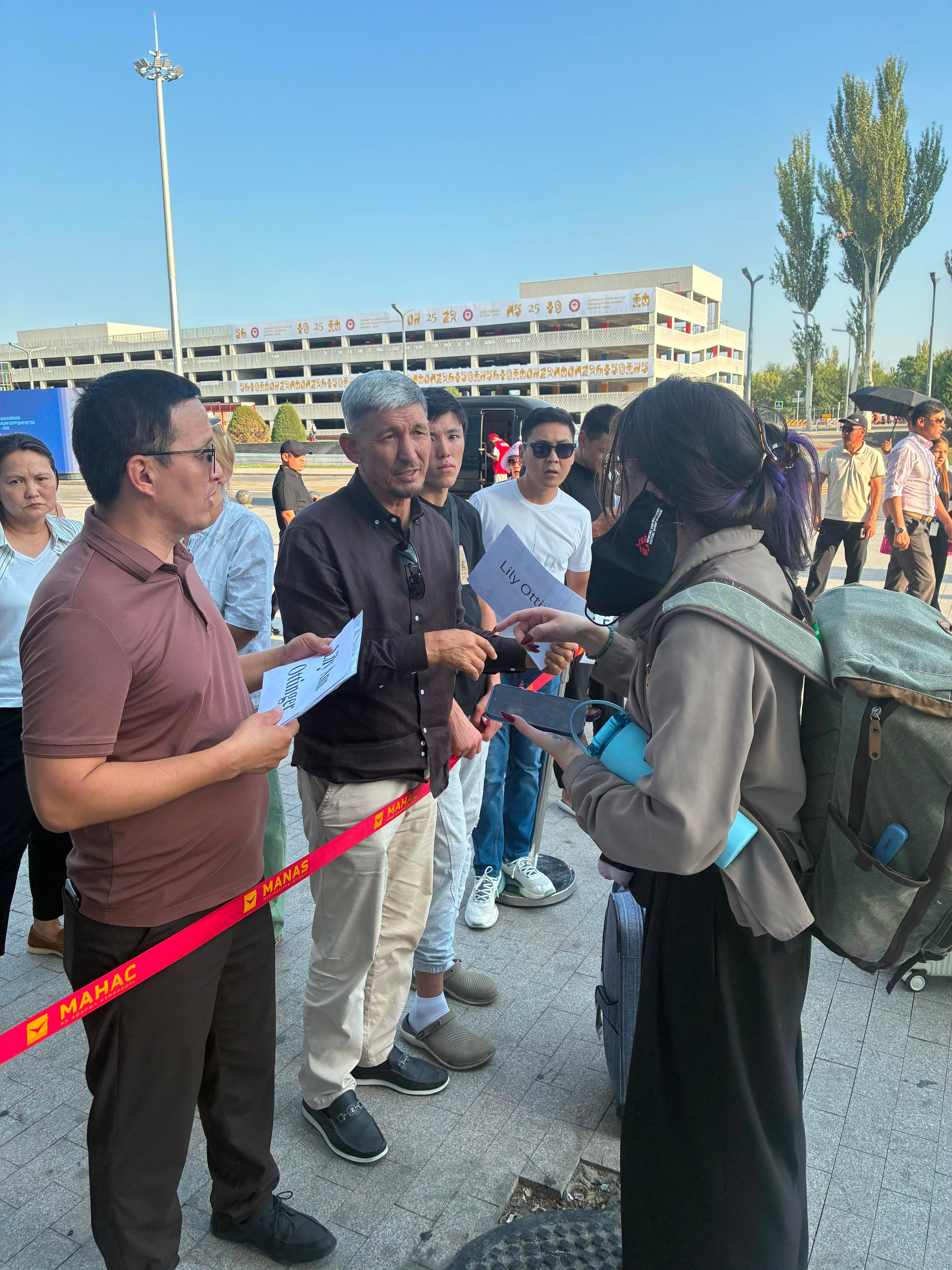
With some help from the China Road and Bridge Corporation (中国路桥), Bishkek’s airport had been completely remodeled in preparation for the international arrivals. I stepped outside to find an organizer from the Games holding a sign bearing my name.
The organizer explained that I needed to go with him to register for my press pass, and then get on a bus to the resort where the journalists were staying… an hour and a half outside the capital. This was probably because of the SCO — the Kyrgyz government had even recommended/requested that Bishkek residents leave the city for the weekend of the summit. But this made me all the more curious about what was going on in Bishkek. I knew I couldn’t go rogue immediately, so I followed the organizer back into the airport to get a Journalists’ Merit Badge.
The official World Nomad Games reception area was tucked inside a secluded corner that smelled of fresh paint and black tea, awash with young Kyrgyz people wearing red vests emblazoned with the word “VOLUNTEER.” Everyone was so excited, and no one had any idea if it was a hard rule that I needed to go to the resort rather than to the capital. I made myself some tea and was escorted to a Soviet-style minibus tasked with shuttling the international press to the resort. The organizer who was waiting for me with the sign sat shotgun next to the driver, and the only other passenger, I soon learned, was Afzal Reza, a bureau chief of the Iranian state media organization IRNA. I began negotiating in Russian with the organizer and driver, and Afzal sprang to life. “Oh my goodness, you speak Russian!” I helped him translate for a bit before he succumbed to jet lag, and then continued negotiating with the organizer. “I have a hiking trip planned for tomorrow, and I’d really like to go shopping in Dordoi market” (all true). I handed him one of my Russian business cards. “You can add me on WhatsApp, and I’ll tell you when I arrive at the resort tomorrow night.”
He studied my business card and turned it over. “You are from Kansas, USA?” he asked with intrigue. “I know it from The Wizard of Oz! You are also from the steppe then, like the Kazakhs!”
And with that, he agreed to take me to Bishkek.
Afzal thanked me for my kindness as I stepped off the bus. “Maybe I’ll see you tomorrow at the resort,” I said in response, “Khodahafez!”
And here’s what I saw in the center of the capital:
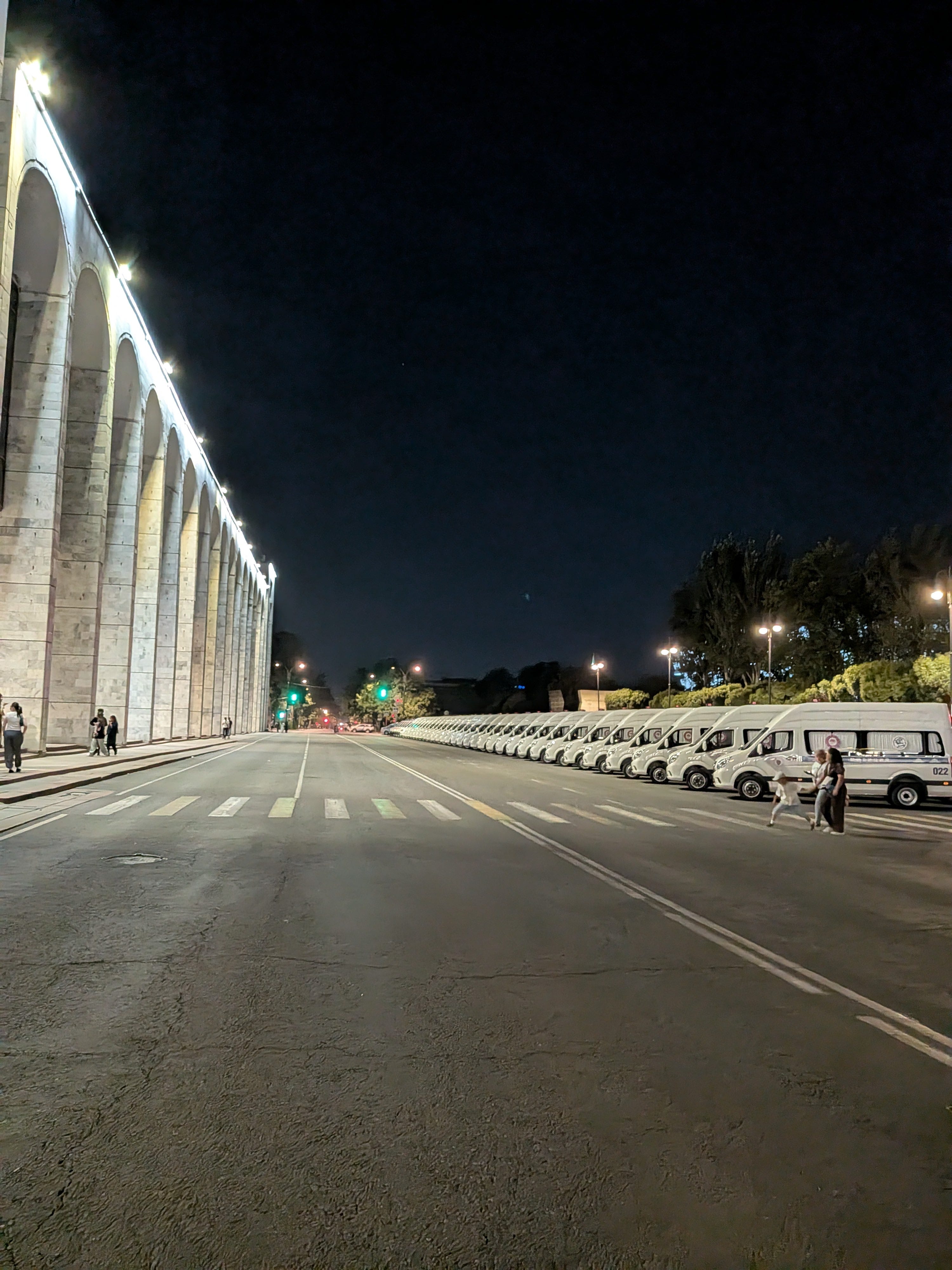


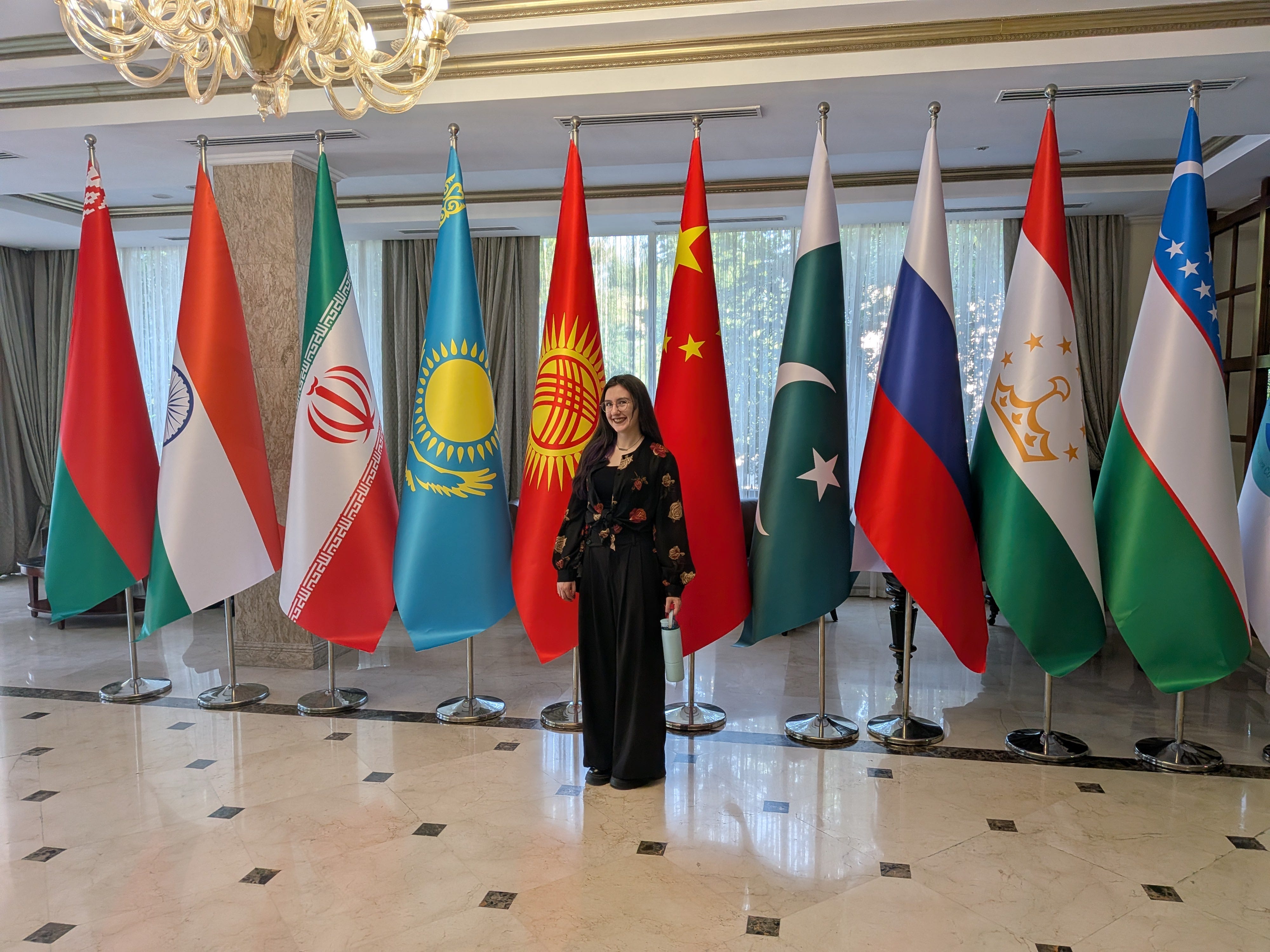
What precipitated such a grand welcoming committee?
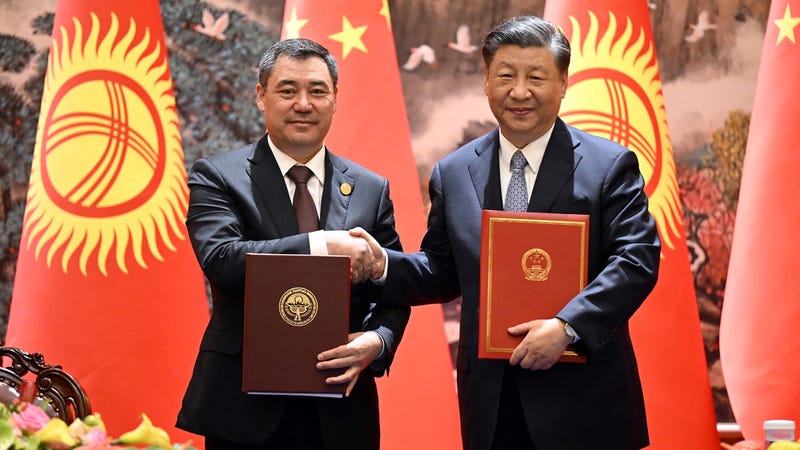
During the Soviet collectivization and dekulakization campaign, Kyrgyz President Sadyr Japarov’s family fled to China. Japarov’s parents were both born in China and grew up in Kyrgyz-speaking communities in Xinjiang. After getting married in 1962, they moved back to their ancestral home in Kyrgyzstan on the shores of Lake Issyk-kul.
Now, Japarov is arguably the most pro-China leader in the region. “When Xi comes to Kyrgyzstan, he always brings gifts,” as Kyrgyz researcher Adina Masalbekova told me. Beijing is now building a new $4.7 billion railway line that will traverse Kyrgyzstan to connect China with Uzbekistan. And the SCO — a multilateral organization that originally integrated China with Central Asia before expanding to include the likes of India, Russia, and Iran — is a key delivery system for these gifts.
Of course, all of Central Asia’s leaders accept Chinese investment and BRI infrastructure, but that is usually part of a deliberate balancing strategy that includes cooperation with and investment from Russia, the Gulf, Türkiye, and the West. But Japarov, according to Masalbekova, is exceptional for his sincere fondness for the Chinese development model and Xi Jinping personally.
Meanwhile, Chinese infrastructure projects, including the new railway line, have not been immune to controversy. President Japarov has lambasted Kyrgyzstan’s China skeptics and attributes their suspicions to the influence of “external forces.”
In a new interview, Japarov appears incredulous about the public’s concerns, because cooperation with China has legitimately brought a lot of material value to Kyrgyzstan. A notable example is the Chinese-built waste incineration plant outside of Bishkek, which has made incredible headway against the city’s trash problem while generating 30 megawatts of power. Here’s an excerpt from Japarov’s interview:
[E]very state on earth is making eyes at China — “If only I could work with them, get their investment, bring their technology home and build in my own country.” And we, sitting right next door — next door! — can’t make use of that? Let’s use it, for heaven’s sake. Our border with China is settled — not one square meter of disputed land. We have no international dispute with them, no quarrel. Let’s use that.
…
If the railway doesn’t get finished, then for ages to come every Kyrgyz — all seven and a half million of us — will mourn it for thousands of years. Why? Because right now we live in a dead-end country, a landlocked country. When the railway is finished, we become a transit country — we come out into the world. By rail we reach the ocean; we reach the sea. Our sensible citizens must not be taken in by those types.[3]
With Xi Jinping en route to Bishkek, nothing was going to stop Kyrgyzstan from putting on a great show.
The Opening Ceremony
Bishkek Arena was hooked up to the electrical grid just a week before the opening ceremony of the World Nomad Games. The brand-new 51,000-seat stadium, now the largest in Central Asia, is designed to look like a yurt. It was constructed with the help of at least three Chinese companies: China Construction Second Engineering Bureau Installation Company (中建二局安装工程), an SOE which worked on the exterior structure and also trained local Kyrgyz people to work on the project; Hangxiao Steel Structure (杭萧钢构) for the steel; and Avant Sports (领先体育), which manufactured the seats.4
The opening ceremony was attended by Putin, Modi, and several other heads of state alongside their teams of SCO diplomats. Xi was supposed to attend after the SCO, but decided at the last minute to fly back to China to address recent floods in Tibet.
The show was absolutely incredible — singing, dancing, horses, costumes, AI-assisted animations, lights, pyrotechnics, holograms, fireworks. Putin and Modi had special box seats, and kept appearing on the jumbotron. When Putin appeared on the screen to welcome Team Russia, the crowd went wild with applause.5 The closing act of the night was the Pussycat Dolls.
Why did Kyrgyzstan decide to tie the SCO and World Nomad Games together? I asked Aiym Tlepbergen, a traditional archer awarded Kazakhstan’s Master of Sport title and a judge at the Sixth World Nomad Games. She told me that, “[The SCO representatives] got to see just how important these Games are, and how much this atmosphere brings people together. I think it is a kind of message from the Kyrgyz government: look at how capable we are at coming together and how much we have in common.”
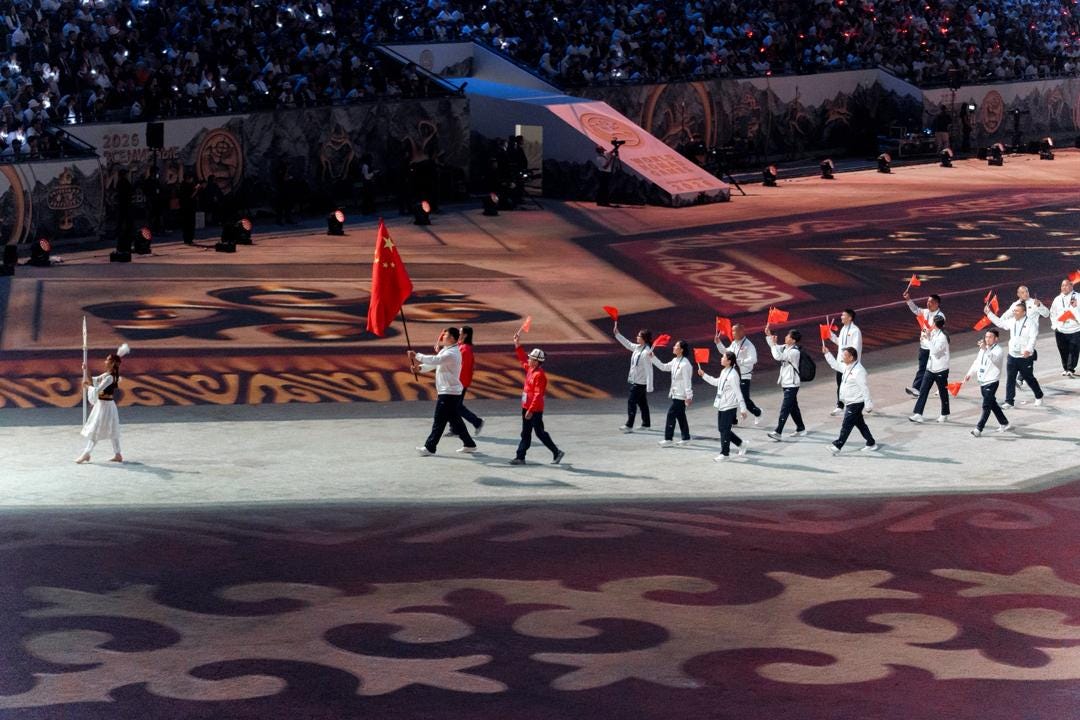
The Elusive Team China
After the first day of the games, I hadn’t found a single Chinese athlete. The Games were spread across several venues north of Issyk-Kul, but without some concrete leads, I was worried I’d never be in the right place at the right time. I had been texting with Team China’s Kyrgyz manager on WhatsApp about getting a list of the athletes’ names and their events, but she needed some time to secure the team’s permission before she could release it to me. I had already met Joy Dou, the single Chinese national with a press pass, at the opening ceremony, but she didn’t have much information on Team China either.
My first lead materialized while I was in line for the bathroom in Kyrchyn Gorge. As I stood in an almost-queue behind the adobe structure housing the toilets, I suddenly overheard some almost-queuing aunties speaking Mandarin. I immediately began chatting them up.
They told me they were part of a tour group, and, according to the rumors they’d heard, Team China included some horseback archers and even a falcon hunter. (I learned later that there was no such Chinese falcon hunter, but that’s certainly something I’d love to see in future years!). After paying 20 som6 to use the bathroom, I speed-walked across the grassy steppe to the horse archery track, where I learned that the Chinese team had already finished for the day and gone home.
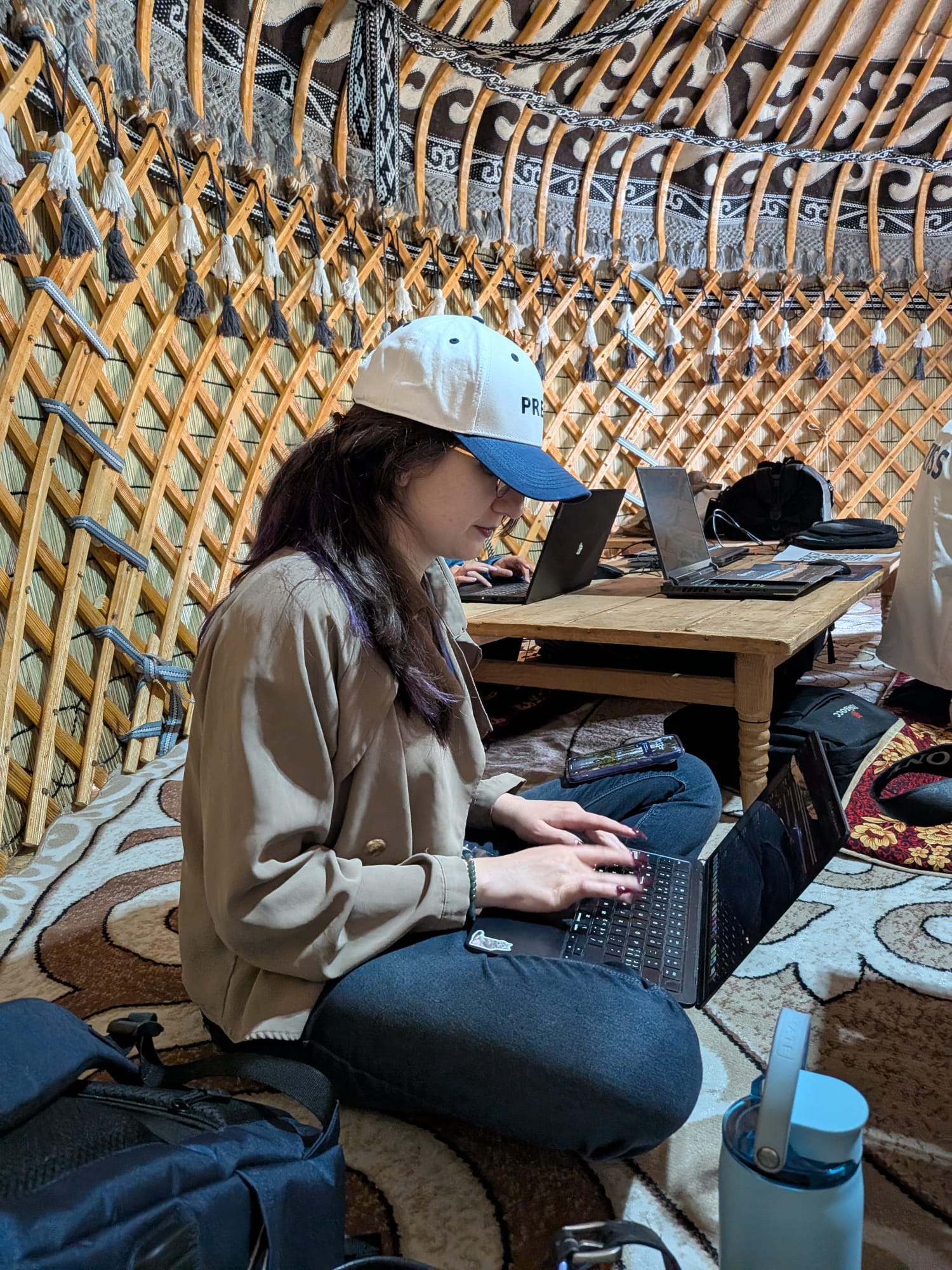
The ping of dejection I felt was quickly sidelined once I started watching some other sports.7 I did some interviews in Russian with Timour Ducarme, a Belgian freelancer whom I’d met at the journalists’ resort,8 before heading to the press yurt for lunch.
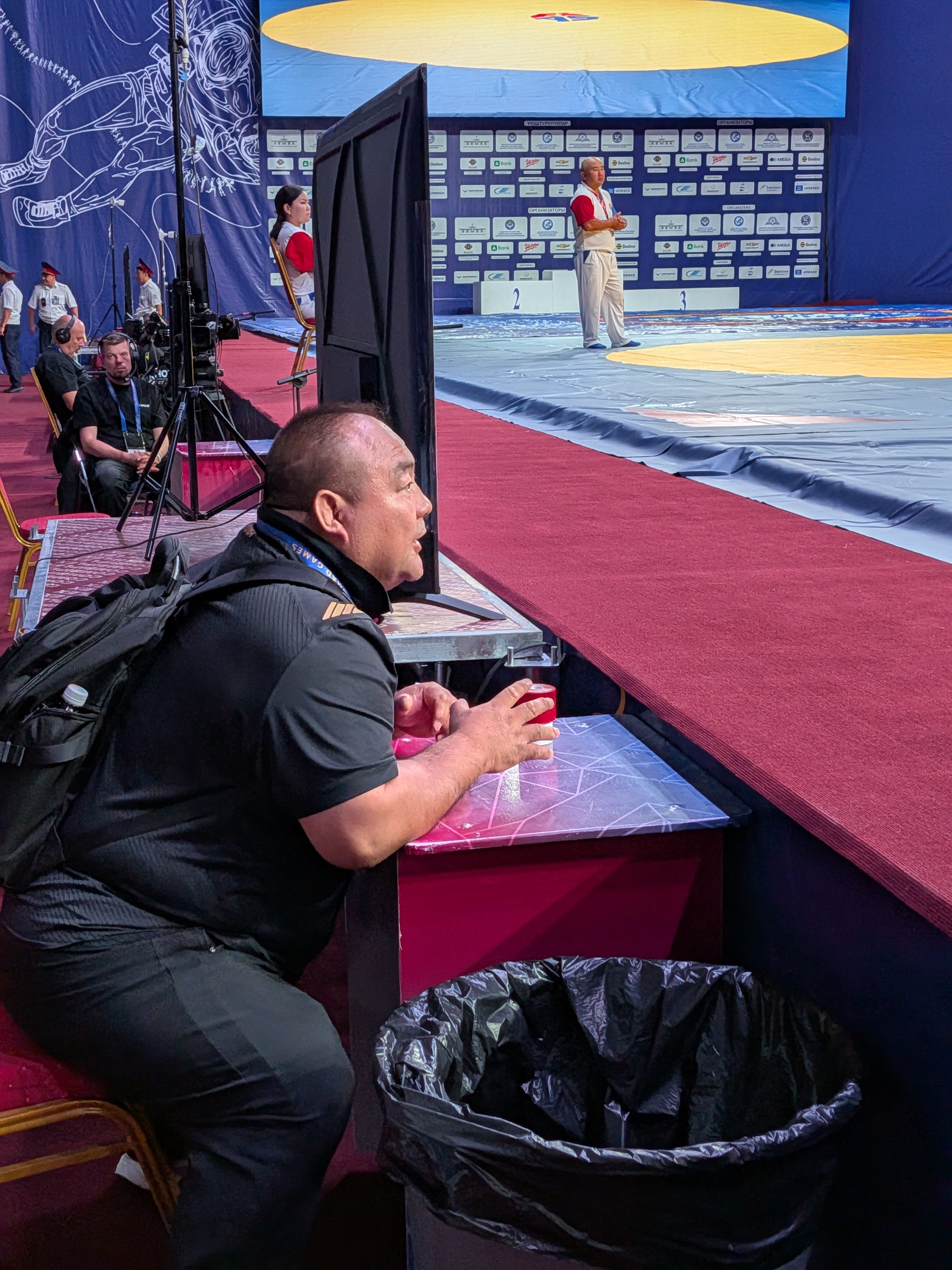
As I ate my buckwheat bento, another new friend from the press resort, a German polyglot named Dénes Jäger, texted me a photo of a wrestling match. The caption read, “Chinese guy getting thrashed at Alysh.” He was at the Gazprom Sports Complex, an hour away from Kyrchyn in the lakeside town of Cholpon-Ata. Wrestling would be over by the time I could make it there.
I went to Cholpon-Ata anyway, and watched a team of American cowboys take on Kyrgyzstan in kök-börü, a type of Central Asian horse polo that uses a goat carcass as the ball.9 As I stood up against the railings of the enormous field of horses in the center of the hippodrome, I just knew that tomorrow would be an even better day than today. And that’s when the roster of Chinese athletes hit my inbox.
Wurinile 乌日尼勒 is a wrestler from Inner Mongolia. The 2026 World Nomad Games were his first time representing China at an international competition, and he took home a silver medal. His event is Sambo, a martial art developed by the Soviets in the 1920s as a method of training the army’s hand-to-hand combat abilities.10
I watched him over the course of three wrestling matches, first against Georgia, then against France, during which blood began spurting from his ear after a particularly vicious blow from his opponent. He returned to the ring with bandages wrapped around his head, and flipped the Frenchman on his back to secure another victory. Finally, I watched him handily beat Iran as his opponent’s coach frantically yelled in Persian from the sidelines.
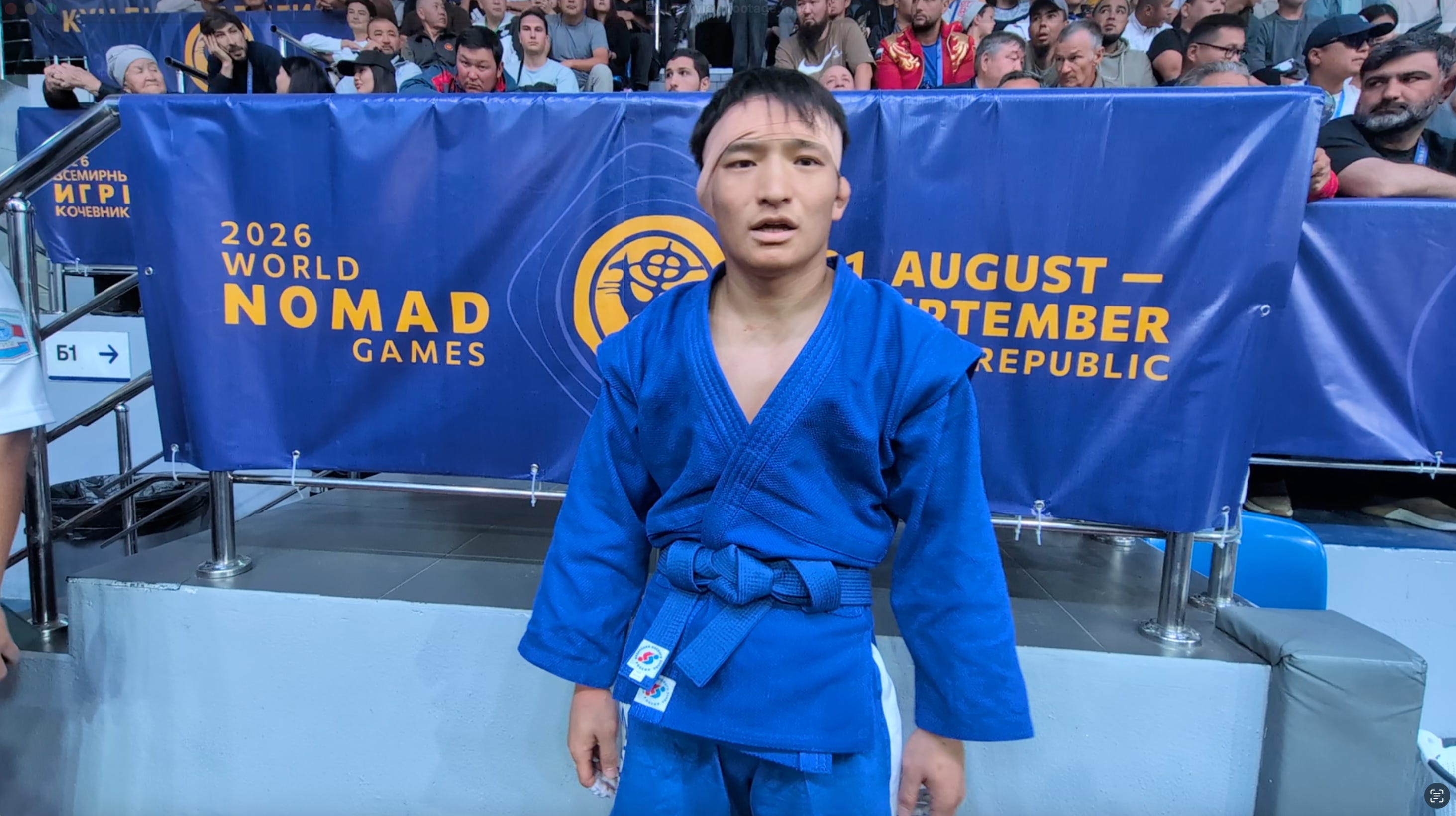


(A note on names: many Inner Mongolians have only given names and no surnames, which is not the case in Mongolia proper.11 In this article, athlete names without spaces signify Mongolian given names accompanied by their Mandarin transliterations, while the names with spaces are Han Chinese names, although the athletes with these names are still ethnically Inner Mongolian.)
China sent 19 athletes to the Sixth World Nomad Games, all from Inner Mongolia, a territory which Xi Jinping has called “the model autonomous region” (“模范自治区”). 13 of those athletes were wrestlers, and the remaining six were horseback archers. There was no opportunity for Uyghur athletes to compete at the World Nomad Games,12 because the Chinese delegation was not formed through a nationwide selection process. Rather, China’s General Administration of Sport appointed the Sports Bureau of Inner Mongolia to assemble Team China. Uyghurs are closely related to Uzbeks (who excel at wrestling and horse racing), and more distantly related to Kyrgyz and Kazakhs, so this was a serious missed opportunity to build rapport with the people of Central Asia.
After Wurinile’s match against the Islamic Republic, one of the wrestlers from the Chinese team agreed to speak with me on the record.
“What’s your secret?”
“Courage, I guess (勇气吧).”
“And what does the word ‘nomadic (游牧)’ mean to you?”
“Well, I’m an ethnic Mongol from Inner Mongolia in China, so my ethnic group is also a nomadic people. Coming here makes me feel a very strong sense of familiarity and connection (我来到这里,感到特别亲切).”
As mild as it is, I still cannot believe I even got this quote. I was rejected again and again trying to interview Team China’s athletes, and this wrestler was the only one who agreed to speak with me on record. He didn’t ask me to quote him anonymously, but I decided to omit his name because I was worried about getting him in trouble. In a few cases, Chinese athletes initially said yes to an interview, only to change their minds in the face of disapproving looks from their handlers.
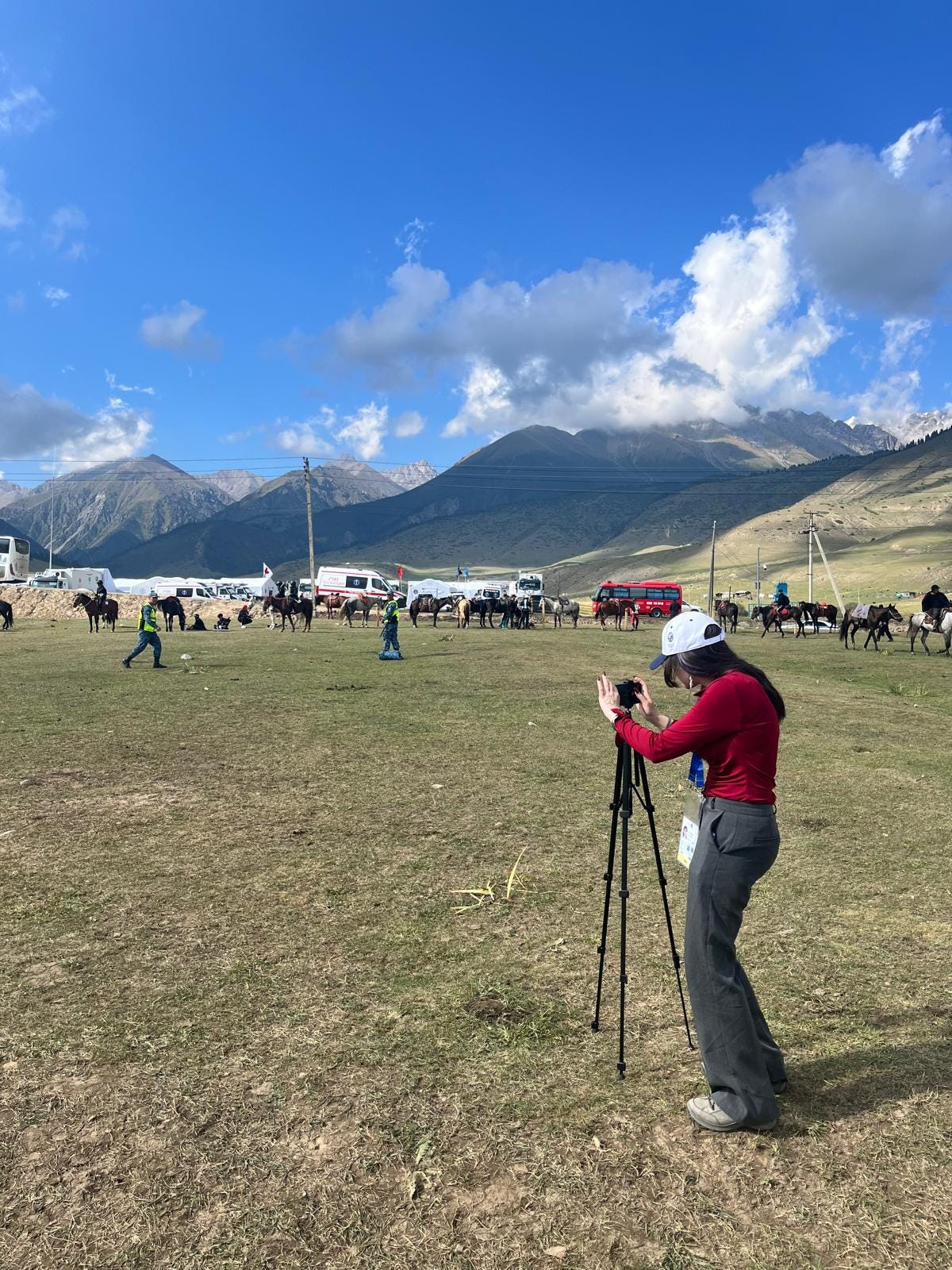
Over the course of the next couple of days, I was able to spend some time with China’s horseback archery team. I watched both the men and women shoot, discussed horse logistics,13 and ate Chinese sweet bread with them after they generously let me shelter from the rain in their tent.
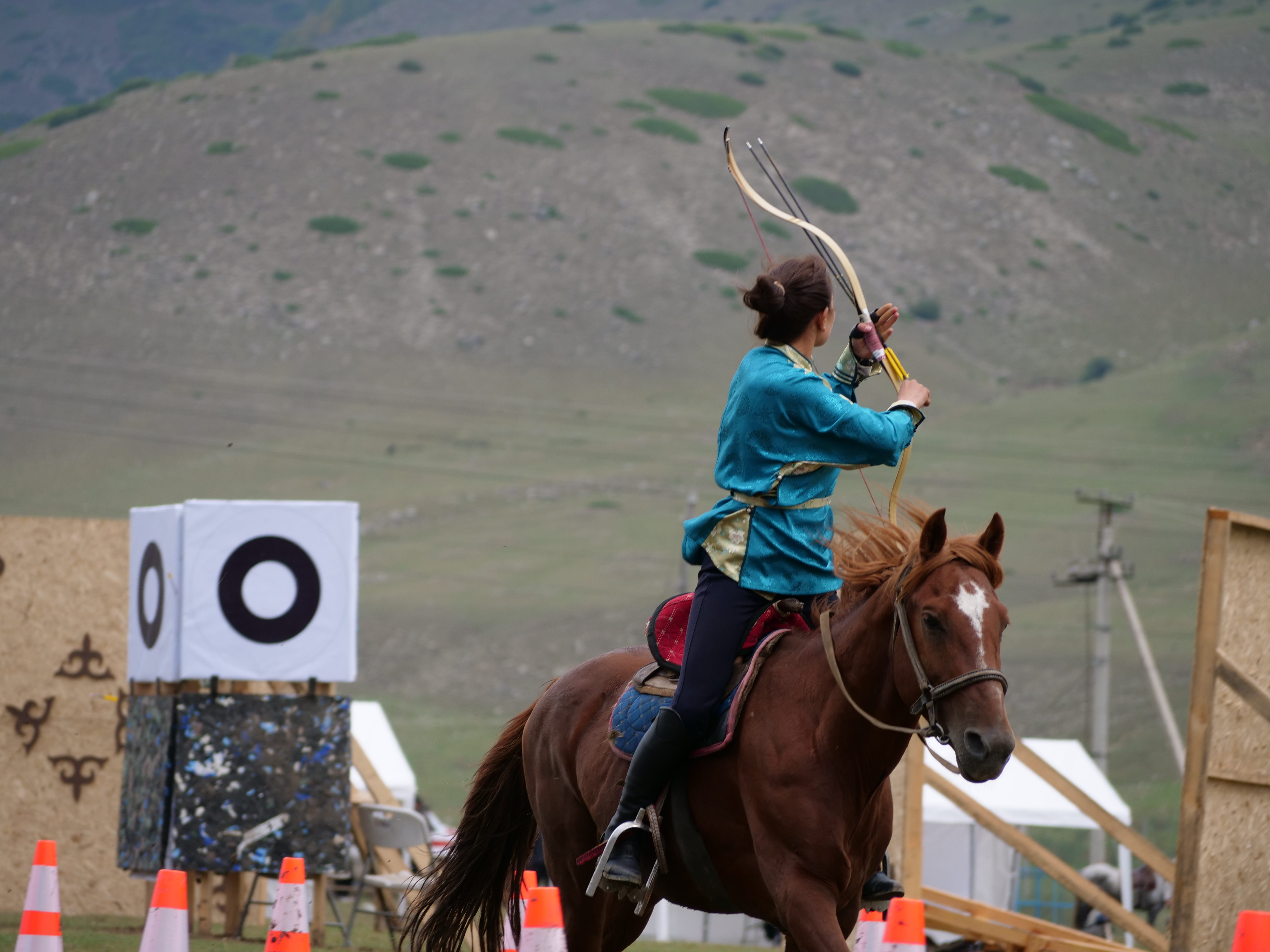


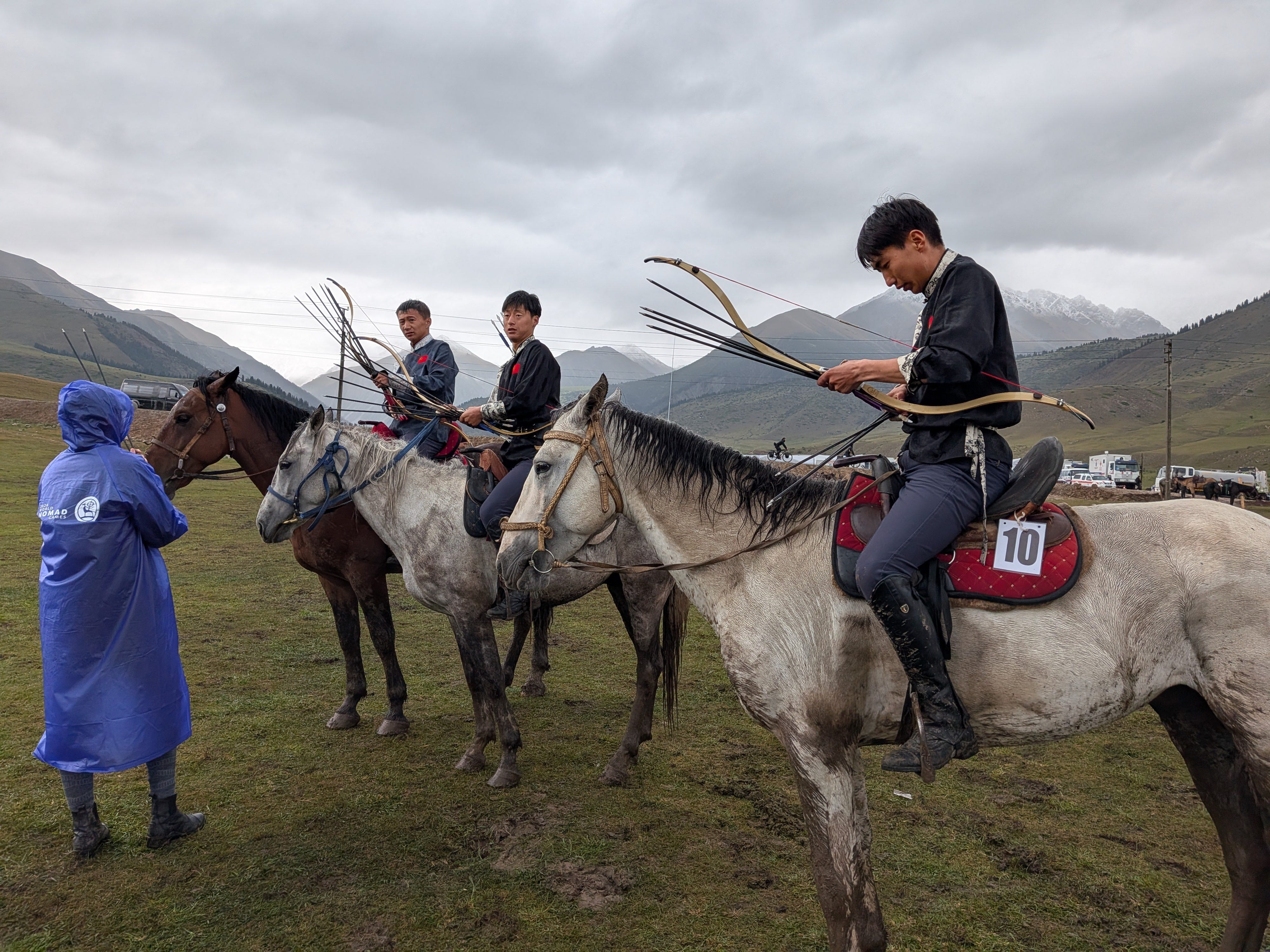
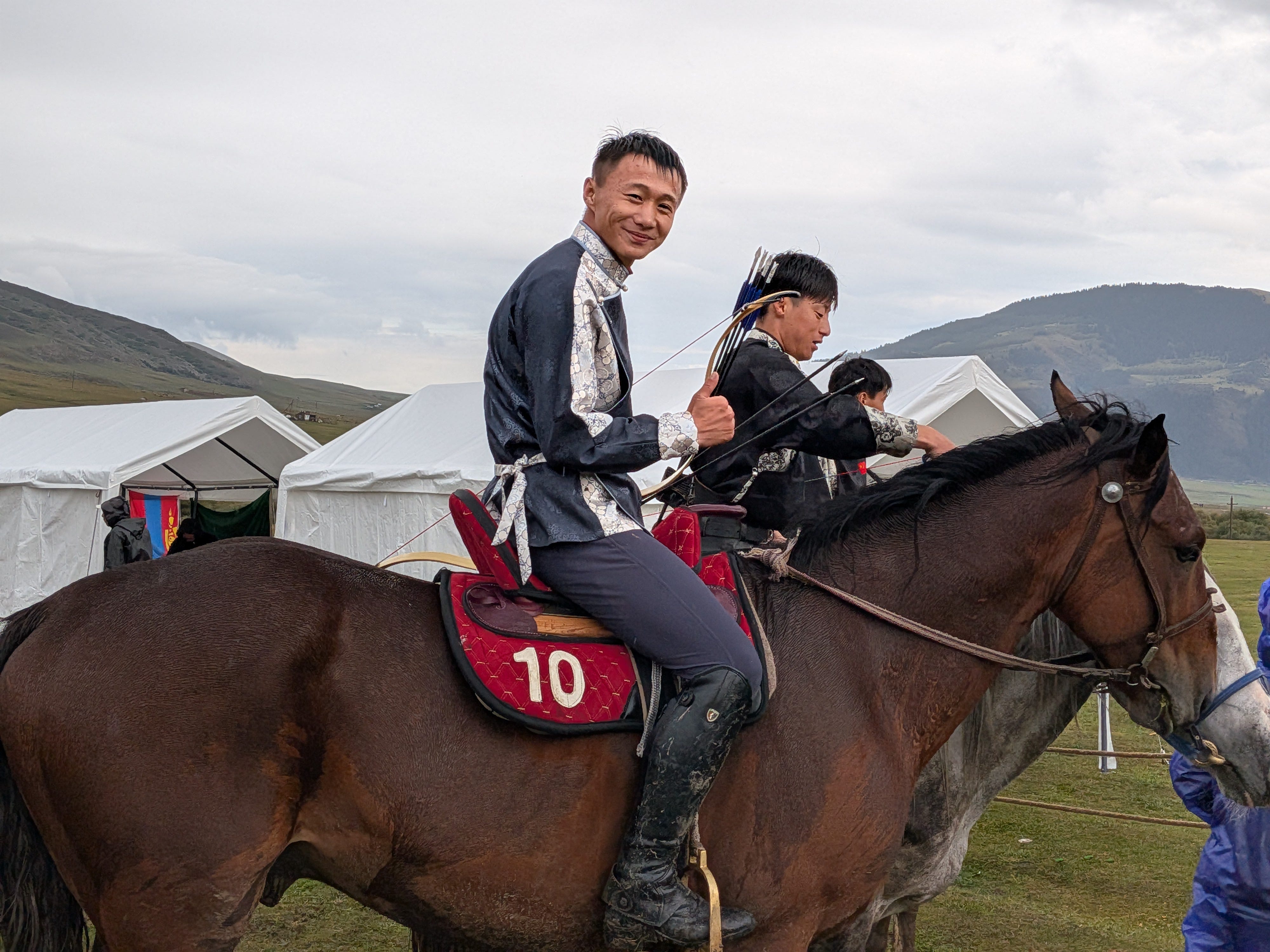
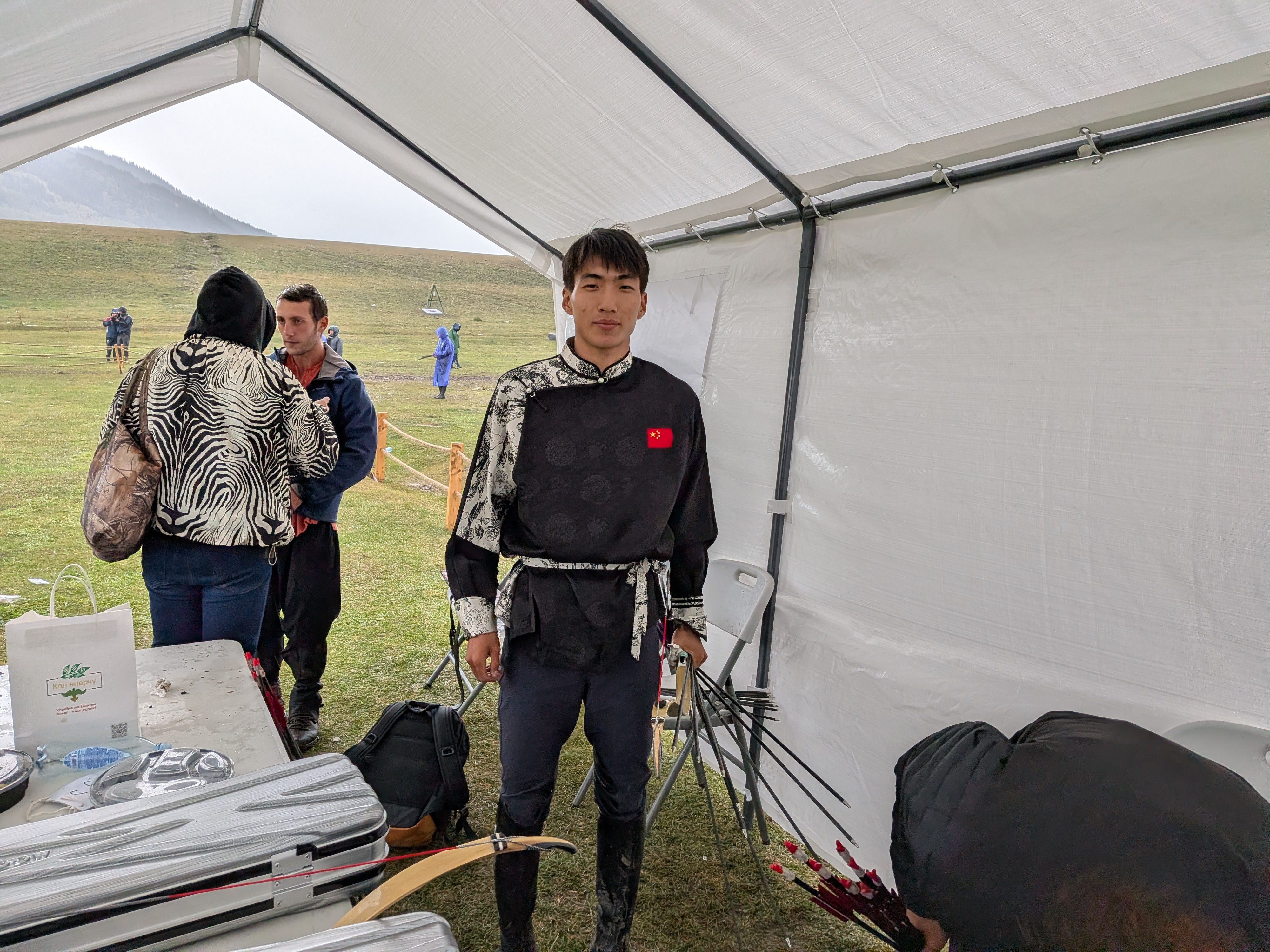


The handler of the Inner Mongolian horse archers was a man named Zhang Yang 张扬, a Han Chinese official from the Sports Bureau whose badge labeled him as a “coach” even though he admitted to me that he could barely ride a horse. The athletes often spoke Mongolian to one another, but only spoke Mandarin when Zhang was around.
I am glad that (some of) China’s practitioners of traditional sports have the opportunity to compete at an international tournament like this. But when the handlers act like the ethnic minorities on their team are loose cannons in possession of terrible secrets, it undermines their message about how wonderful it is to be a minority in China. This is the distinction between sports diplomacy and sportswashing that Chinese cadres don’t appear to recognize. At the 2022 Olympics in Beijing, Uyghur athlete Dilnigar Ilhamjan was chosen as one of the torchbearers. This was the same year the UN’s OHCHR released its assessment of the human rights situation in Xinjiang. As far as I can tell, Ilhamjan has never done an interview with an international media outlet.
This is a story of KPIs, as is the case for many things in China. The goal is to minimize risk to China’s image, not to build a positive narrative. If a colorful quote makes its way to the international media, someone’s job is on the line, so the system ends up forfeiting soft-power layups like these.
What would have made Zhang’s boss very happy, he told me, was if the archers had walked away with a gold medal. But the World Nomad Games could be so much more than that for China — they are an opportunity to show the world that China respects and admires nomadic culture and that it encourages its ethnic minorities to carry on their traditions. It would be a chance to show Central Asians that China respects them as a civilization, and that their goal is not to colonize or extract but rather to share the fruits of what the Chinese system has built. Capitalizing on this would require more minorities — not just Inner Mongolians — to be eligible to represent China. And it would require a media policy that encourages openness as opposed to treating the athletes like liabilities. But the gold medal KPI indicates to me that the Sports Bureau just isn’t thinking big enough yet.
I said that all of Team China’s athletes were Inner Mongolian, and this is technically true apart from one hiccup. There was also an ethnically Kyrgyz athlete, Turdukul Abdyrakhmanov, who won a silver medal in horseback wrestling (er enish). In the official results, his silver medal is attributed to China, and announcers during the Games labelled him as representing China as well. But during his match, he didn’t bring out the Chinese flag — or any flag for that matter — and he wasn’t listed on the roster of Team China athletes I was sent. He was listed on Team Kyrgyzstan’s er enish roster before the Games began. My best guess is that he is an ethnic Kyrgyz living in China14 who wasn’t allowed to compete by the Sports Bureau or preferred to compete on Kyrgyzstan’s team, and was only claimed by Team China once he took matters into his own hands to compete.


And perhaps, this kind of split allegiance between ethnicity and national affiliation is exactly China’s concern with letting Turkic minorities compete. But excluding athletes from representing Team China because they aren’t the right kind of ethnic minority is a sure path to deepening this split. I wonder if the Sports Bureau cadres included Abdyrakhmanov’s silver medal in their reports to the higher-ups.
I asked Zhang if China would ever host the World Nomad Games. He told me it was possible, and that China would of course excel at managing the logistics and building infrastructure for such an event. It doesn’t seem out of the question to me. The State Council has emphasized the practice of traditional sports to show that local culture is protected in Xinjiang, and this State Council white paper even highlights holiday matches of kök-börü as an example. But as much as I would love to see China host the Games, I’m skeptical that will ever happen, thanks to the combination of low risk tolerance and willingness to accept meager payoffs baked into the bureaucracy responsible for such decisions.
The next World Nomad Games in 2028 will be hosted by Russia, in the city of Kazan in the Tatarstan region. To me, this seems like a transparent bid to stay relevant in a region that is increasingly eschewing the language of its former colonizer. Chinese decisionmakers, by contrast, don’t seem convinced that they need to put on a show to be relevant in Central Asia. After all, Chinese investment money, infrastructure projects, and manufactured goods have already deeply penetrated the economies of these nations, and Beijing seems to believe these deliverables speak for themselves.
The Kyrgyz president still has to win elections, and China has had mixed results winning hearts and minds despite Japarov’s personal affinity for Beijing. Japarov’s government has successively increased the annual cap on foreign workers in Kyrgyzstan over the course of his tenure, from 16,610 in 2021 to 100,000 in 2026, with about 60% of those visas now going to Chinese workers. As I wrote last year, there have been some anti-China protests in Kyrgyzstan as well, and the lead-up to the Games and SCO summit saw a wave of anti-Chinese posts on Kyrgyz social media. And 62% of Kyrgyz people polled by Central Asia Barometer were somewhat or very concerned about China’s treatment of Uyghurs, according to their most recent data from November 2022.15
A less paranoid posture at the World Nomad Games would be an incredibly cheap way to address this. As much as Xi Jinping-thought prioritizes concrete results over intangibles like software and good PR, this is a human problem with a human solution. And China would be wise to take it seriously.
As I saw at the Games this year, free competition unites people, no matter what language they speak or what passport they carry. Tlepbergen, the Kazakh archery judge, spoke about this beautifully:
The ancestors of practically every people used bows. Everyone had bows and arrows. It is one of the oldest tools and weapons used by humanity. And today, through traditional sport, we are reviving that sense of unity that connects us. …
I think that at this moment, when the political system is so turbulent, we need to come together. People everywhere need to unite and remember that we have shared roots. This is our history. …
Although they are called the World Nomad Games, these are really Games that bring people together. All people who think of themselves as free nomads, who understand that this world belongs to all of us and that we all live beneath the same sky and the same sun — all of us are responsible for this world and for making sure that things are good in it.
Perhaps in four or six years admirers of the nomadic spirit — from Belgium to South Africa, from Utah to Tajikistan — will be welcomed to Inner Mongolia with a flood of shiny new stadiums, hotels, an additional metro line and a dedicated bus system. And if that day comes, you can bet that I will be there, DJI mics in hand, to ask the Central Asian athletes about their impressions of China.
With the exception of 2020.
A diary entry from my flight from Tashkent: I have the window seat with two Russian girls at my side. “Excuse me,” I say in Russian as I squeeze past them to take my seat. They are unsmiley, as is characteristic. We take off. I get lost staring at the mountains out the window, and one of the Russian girls, wearing a white dress with light blue flowers, taps me on the shoulder to alert me to the stewardess coming by with drinks. I order tomato juice and the stewardess doesn’t understand, so I say “tomato” in Russian. The Uzbekistan Airways flight attendant hands me my beverage, and I notice that the Russian girl next to me is also drinking tomato juice. I suddenly remember how to turn the word “tomato” into an adjective, as is necessary to say the full name of my drink with proper grammar, and feel a bit silly. We enjoy our beverages slowly, and I get lost looking out the window once more. Suddenly, the stewardess is coming by again to collect the used napkins and paper cups. The Russian girl and I slam our tomato juices, and as we put our cups down in tandem she smiles at me — a rare prize. We realize that the stewardess has already passed us by and we are stuck with our trash, so we giggle together again.
A note on translation: the original interview is in Kyrgyz, so I transcribed it with ElevenLabs and translated it to English with Claude.
These last two are both privately owned.
Iran’s team also got a huge positive reaction from the crowd.
In USD, this is like 23¢
My favorite was an event called mas wrestling, where two opponents sit facing each other with their feet separated by a wooden board and their hands gripping a shared wooden dowel in the middle. When the referee gives the signal, the competitors use all their strength to either wrestle the dowel from their opponent or use it to pull them over the board.
Here’s Kazakhstan’s Takhmina Gozhamberdiyeva taking on Iran:
Timour has a YouTube channel where he’ll be uploading some of these interviews as part of his upcoming video on the Games. His channel is in French but English subtitles are available on all of his videos (not auto-generated — he does them himself). Timour makes excellent content, and he also helped me photograph Team China’s horseback archers with his nice camera, so consider subscribing to help me say thank you!
Team USA has been quite bad at the sport in the past, but this year, the American athletes had an actual Kyrgyz coach on their side, which is why they were able to score SEVEN GOALS even though they did not win.
The name “Sambo” is a contraction of the Russian phrase “самозащита без оружия,” meaning “self-defense without weapons.”
In Mongolia proper, patronymics are used and clan names were reintroduced after the fall of communism. The communist government of Mongolia abolished clan names in the 1920s because they were primarily markers of status rather than being useful for record keeping. In Inner Mongolia, the Qing got rid of clan names and reshuffled the Mongolian population into new administrative units under the league-banner system (盟旗), with each banner having an independent relationship to the emperor and movement between banners restricted so that the Inner Mongolians couldn’t form clan-based confederations.
Though Kazakh athletes from Xinjiang appear to have attended in past years.
A note on horse logistics: most athletes at the World Nomad Games are riding locally-provided horses — there are some exceptions, such as Kazakhstan’s kök-börü and kokpar teams which ride their own horses, but those are rare. The horseback archers instead had a lottery to determine which locally-reared horse they would ride, and rotated horses after each round of shooting for fairness. I learned from my conversation with the Chinese team that, when you shoot from your own horse, the horse learns to adjust its gait to be smoother and more stable for the benefit of its rider. I asked a Chinese horse archery enthusiast who had traveled to watch the team compete if she thought the horses back home understood what their riders were trying to do, to which she responded, “Absolutely.”
This 2023 profile on Abdyrakhmanov indicates that he is from the Osh region of Kyrgyzstan, and I can’t find any info about his ties to China. But the fact that he didn’t carry a flag into his er enish match (as is customary) or correct the announcers when they said he was representing China makes me think this is more than just a clerical error.
CAB’s earlier spring 2022 poll also put this number at 63%. This spring 2023 poll asked about the treatment of muslims in general in China, and also found that 63% of respondents were at least somewhat concerned. More recent data is not available because CAB has not been able to conduct polling since 2024.
Welcoming Chinese investment while resisting Chinese workers isn’t necessarily a contradiction.
Roads, factories, and goods can increase local resources and opportunities. Chinese workers can be seen as competing for local jobs. The same “China” enters different parts of people’s lives, and produces different judgments.
People may not decide first whether they like or dislike a country. Often, something concrete enters their lives first. What does it bring? What does it take away? Does it change their position?
Attitudes grow from there.
Lily went to Kyrgyzstan looking for the failure of Chinese soft power—and kept running into the success of Chinese hard economic power.
China may be bad at telling Central Asians why they should like China. But it is becoming remarkably good at giving Central Asian governments reasons to need China: railways, power plants, infrastructure, trade, and capital.
That distinction may matter far more than whether Beijing is good at public diplomacy.