
With the world scrambling to diffuse China’s rare earth weapon, Chinese regulators have apparently been tasked with identifying alternative sources of potential leverage. MOFCOM’s recent work created legal mechanisms to restrict the flow of a curious collection of products: tunnel boring machines, dredging components, solar manufacturing equipment, biotechnology, and drones.
At first glance, this seems like an eclectic list, but these technologies are connected beyond the fact that they are all made in China. Today, we’re unpacking the geopolitical incentives that made them MOFCOM’s business.
This is part two of our series on MOFCOM’s October 2026 regulatory drops. In part one, we analyzed the October 16th proposals for regulating AI technologies. Today’s installment tackles the October 16th proposals for biotech and solar and the mixed bag from October 19th. We explore:
Why parsing China’s trade policy requires looking beyond the US-China rivalry to Beijing’s bilateral relations with other capitals — and why India in particular is under fire;
How tunnel boring machines and dredgers help us understand China’s ambitions as a regional power;
Beijing’s playbook for keeping foreign countries dependent on its solar provisions;
And, what biotech and drones tell us about China’s approach to intellectual property.
Tunnel boring machines (Irene)
Tunnel boring machines are not boring! For a start, they look very cool. This is the CREC 1459, the largest-diameter shield tunneling machine ever exported by China. Manufactured by China Railway Engineering Equipment Group (CREG), it will be used to dig road tunnels under the Sydney Harbour seabed in Australia:
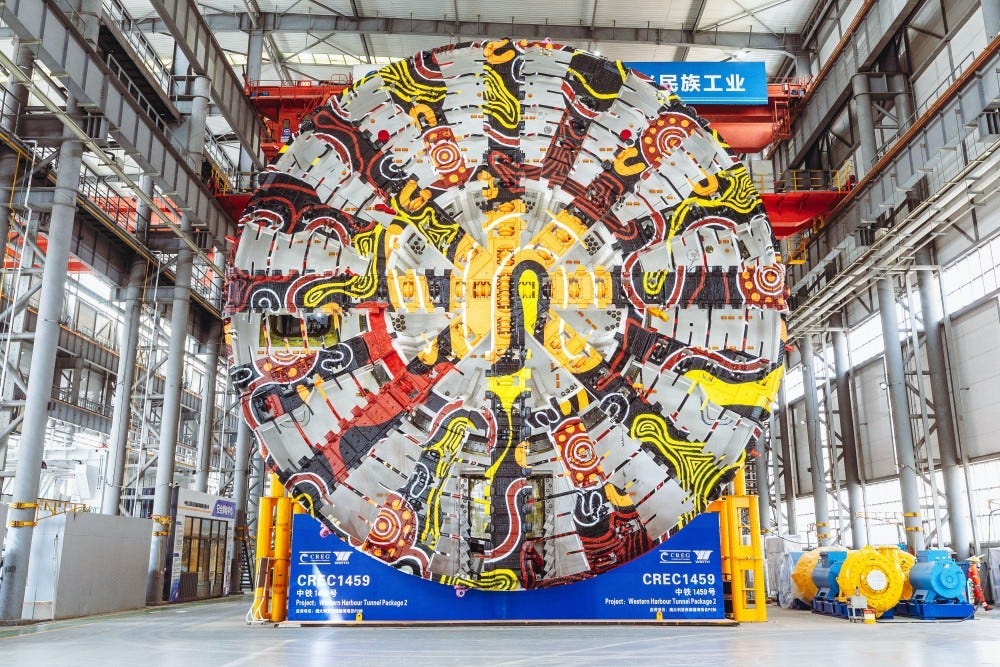
The first Chinese-made tunnel boring machine (TBM) came online in 2008. By 2022, local manufacturers owned more than 95% of China’s domestic market share, as well as two-thirds internationally. This rapid ascent can be attributed to industrial policy programs like the 863 and 973 Projects, as well as foreign acquisitions and technology transfers — subjects for a later article.
There is no consistently tracked global data for TBM market shares. Zhejiang University claimed in 2024 that Chinese makers take up more than 70% of the global TBM market. Major German TBM maker Herrenknecht, however, claimed in a report from the same year that neutral competitive analyses are unavailable for the TBM market, so they could not attach a number to their global market share. Herrenknecht is the strongest non-Chinese player in TBMs and likely commands substantial market share, as it counts major clients in the US, France, Switzerland, Italy, and India. (For Bay Area readers: a Herrenknecht TBM will bore the BART Phase II tunnel in Santa Clara!)
TBMs are basically super-strong, engine-powered cutterheads that automate tunnel construction. They cut into mountains, seabeds, and all kinds of landscapes, remove waste, and line the excavated surface with premade concrete slabs. They are the reason we don’t need to dig up roads to build underground subways anymore. Each TBM is custom-built for the project it’s taking on, and many are partially abandoned after a project is done. While efforts have been made to reuse TBMs, oftentimes only some parts can be salvaged for refurbishing.
Proposed Chinese export controls on TBMs, therefore, affect everyone, since every country needs tunnels of some sort. But one country gets hit the hardest: India. Skirmishes from 2020 to 2021 along the Sino-Indian border — specifically around Ladakh, Sikkim, and Tibet — led to an Indian building spree along the mountainous Line of Actual Control (LAC). China, subsequently, slowed down customs clearance for TBMs bound for India, believing that they are being used for tunneling in the disputed region.
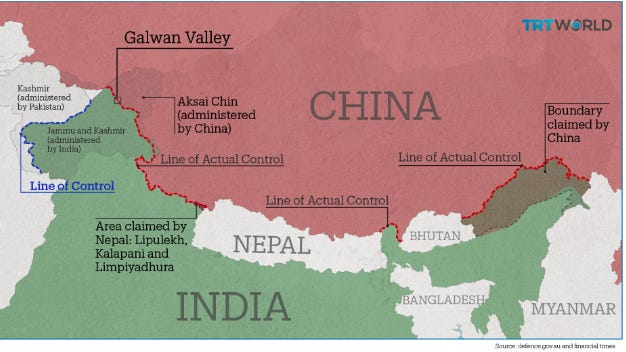
The controls MOFCOM placed on TBMs, their key parts, remanufacturing technology, and a few other associated machines on October 19th are most stringent for “sensitive countries and regions that have disputes with China.” The language here is intentionally vague: disputes in question could include territorial ones, like India’s, as well as non-territorial ones. Exports to countries in this category require direct licenses from MOFCOM. Exports to other countries are permitted if the exporter submits documentation and receives a license. Both the Chinese exporter and the foreign buyer must attest that they will not transfer the item to disputed countries and regions, though the regulation offers no details on how MOFCOM plans to enforce this abroad.
Restrictions on exports would hurt Chinese TBM makers at a time when they are already struggling with weakened domestic demand. China is long past the peak of its infrastructural buildout: CREG’s parent firm, China Railway Hi-tech Industry Corp Ltd (中铁工业), saw domestic tunnelling-related revenue decline by 30.3% from 2023 to 2024. (The company stopped disclosing the domestic-overseas split of its tunnelling-related revenue in 2025.) So far, there is no evidence that China plans to use this chokepoint against countries other than India. Major legacy manufacturers in Germany and Japan, as well as smaller makers around the world (and even Elon Musk’s The Boring Company), all make TBMs. China also still relies on foreign suppliers for a few key TBM components (such as main bearings), so Beijing would be unwise to jeopardize critical infrastructure for kneejerk geopolitical gains.
Dredgers (Lily)
Announcement 51 outlined new controls on dredging components1 on the basis of national security, as MOFCOM classifies dredging technologies as dual-use. Dredgers (literally “mud-digging boats” 挖泥船 in Mandarin) excavate material underwater, and they are used in the construction of dams, wharfs, ports, and artificial islands. Existing ports can be dredged to increase their depth such that higher-tonnage ships can dock. Many major rivers in Asia must be dredged periodically in order to stay navigable — including the Ganges and Brahmaputra in India, the Yangtze and Pearl in China, and the Kapuas and Musi in Indonesia.
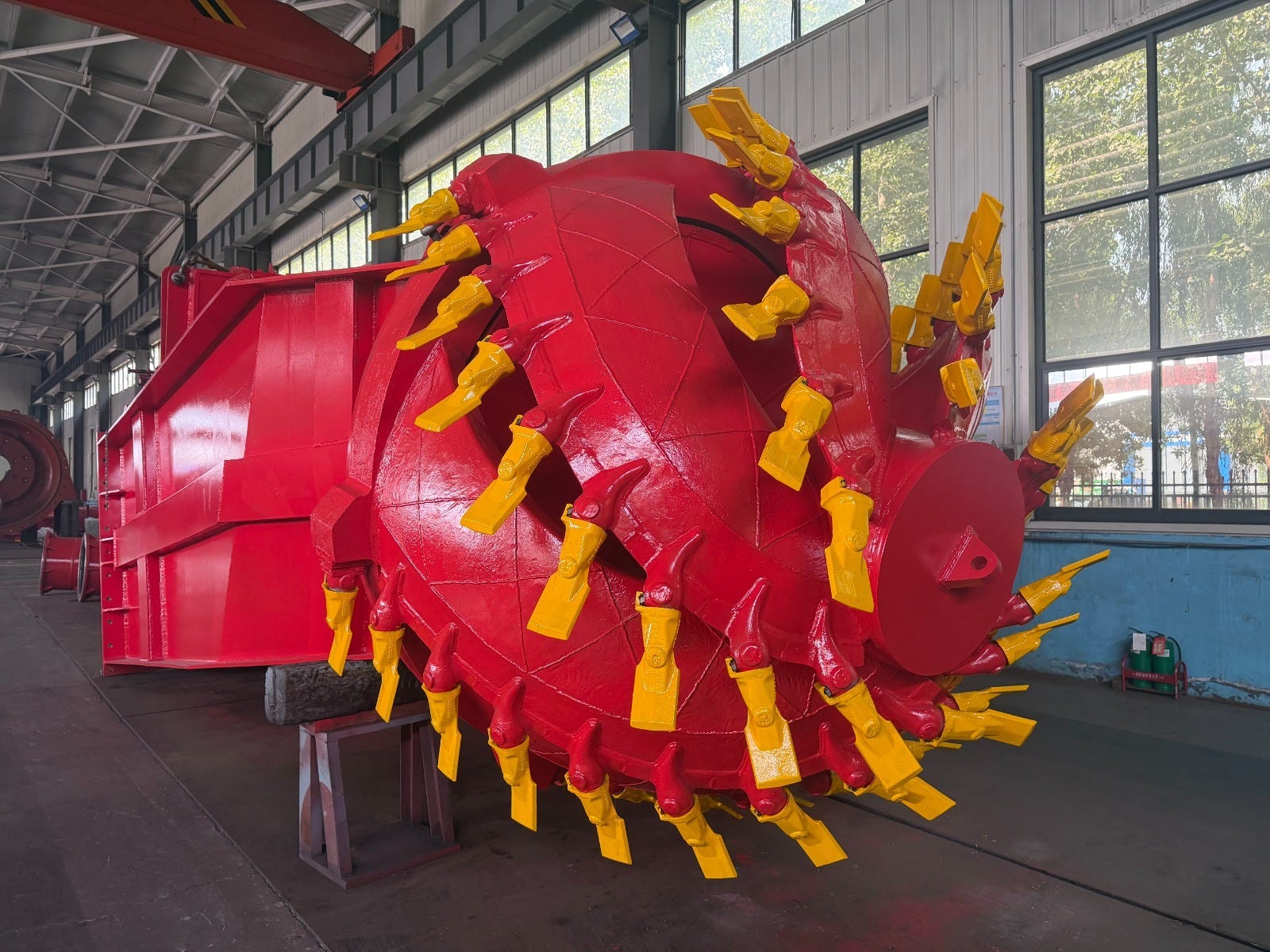
Whole dredgers have been subject to Chinese export controls since 2017.2 Announcement 51 only covers components — specifically, cutter heads (which break up hard earth underwater), drag heads (which scrape up and collect sediment), and slurry pumps (which pump slurry). This is not a draft, and the controls will take effect on November 18th.
China does not have a monopoly in the production of high-quality dredgers — the Netherlands, being a country where 26% of the land lies below sea level, dominated the production of dredgers until China went on a campaign to indigenize dredging technology in the 2000s. Cooperation with established players in the West was critical to China’s success here:
In 2002, a Chinese team went to Germany to design what would become China’s largest dredger up until that point, the Shen Hua 神华号, in conjunction with a German team. This industrial learning resulted in a “qualitative leap” (“一次质的飞跃”) in Chinese design capacity, and influenced the subsequent development of the Xin Hai Hu 新海虎 in 2007. Cooperation between German and Chinese shipbuilders appears to have continued through the late 2000s.
In 2008, the Dutch company IHC entered into a joint venture with a Chinese shipyard in Dalian in 2008 to build dredgers in China.
Also in 2008, Hohai University began a formal academic collaboration program for dredging technology with TU Delft in the Netherlands.
Warman slurry pumps were initially licensed from Australia in the 1980s, and Kingda Pump Group 强大泵业集团, “was made responsible for digesting and manufacturing them, which greatly improved the technical performance of domestic pumps” (“交由强大泵业负责消化、制造,从而使国产泵的技术性能有了很大的提高”). Kingda now controls 85% of the Chinese market for slurry pumps.
But why are dredgers important to national security?
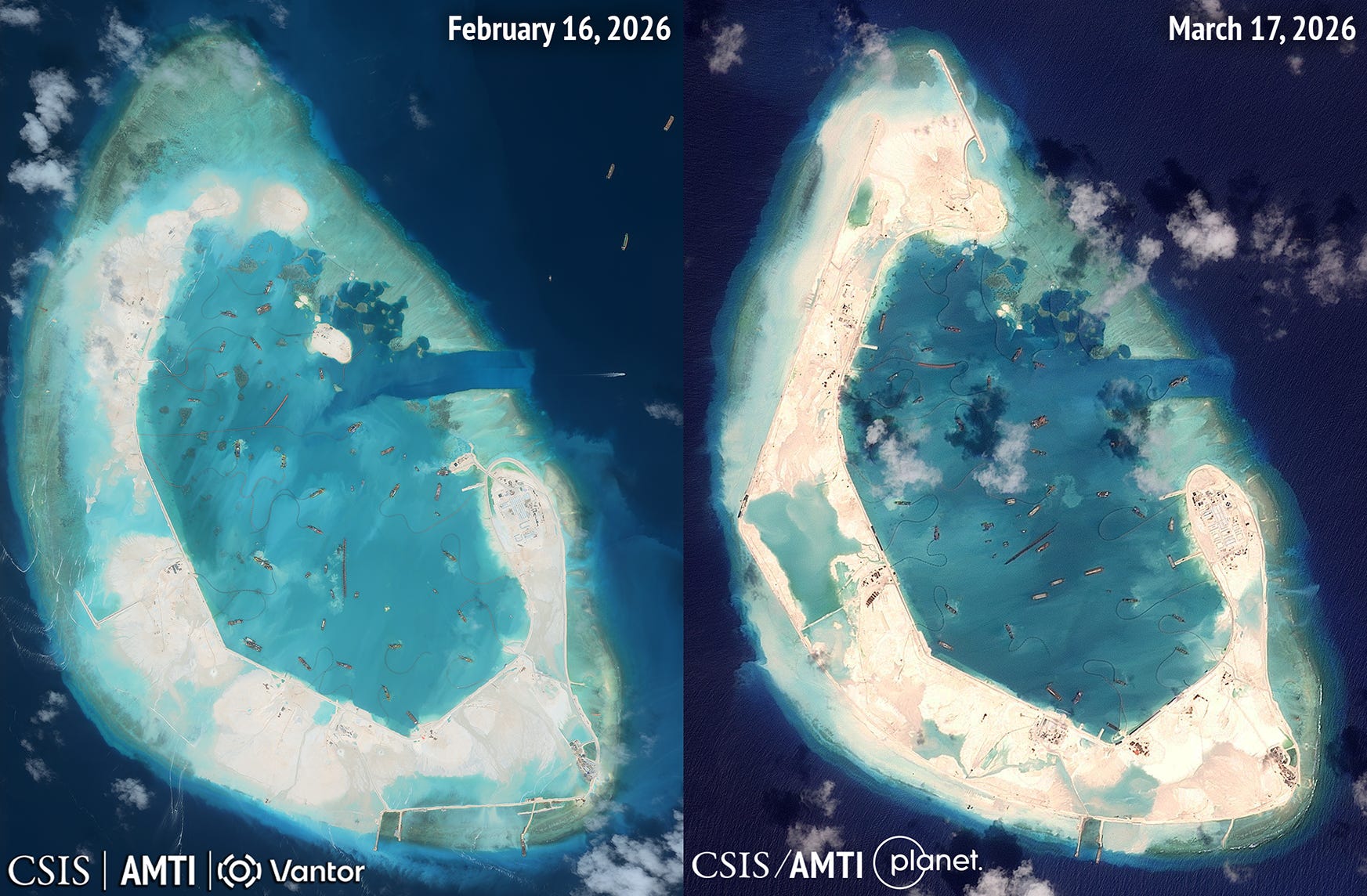
In October 2025, China began dredging for the construction of a new artificial island on Antelope Reef (羚羊礁). This is China’s first major island-building campaign in the SCS since 2017 (the same year dredgers were placed on the export control list).
As of August 2026, land reclamation had brought Antelope Reef’s area up to 1,458 acres, making it China’s largest asset in the Paracels (西沙群岛). By comparison, the next largest Chinese outpost in the Paracels is Woody Island (永兴岛, literally, “Eternal Prosperity Island”3), which is only 890 acres and hosts an air and naval base; Mischief Reef (美济礁) in the Spratlys (南沙群岛), China’s largest asset in the entire South China Sea, sits at 1,504 acres.
China is far from the only country doing strategic land reclamation here; Vietnam in particular has reclaimed about 2,771 acres for its outposts in the Spratlys. Publicly available evidence points to Vietnam using a fleet of mostly Dutch dredgers, which are much more expensive than Chinese ones (a Chinese Sinosail ZHD CSD-650 retails for about US$1.38 million, while a Dutch Royal IHC Beaver 65 with slightly better specs was sold to India for US$5.1 million in 2025.
MOFCOM’s new rule can be used to prevent Chinese components from being exported to service or upgrade foreign dredgers (there are, of course, Chinese companies making replacement parts that are specifically advertised as being compatible with European- and American-made dredgers), and to service Chinese dredgers that were purchased before or in spite of the 2017 controls.

Of course, the South China Sea is not mentioned explicitly in any of MOFCOM’s dredging controls. But an English FAQ from Zhenjiang Yanyang Engineering Co. 镇江焱阳工程有限公司 — a Jiangsu-based manufacturer/exporter of controlled dredgers — states that, based on their experience trying to acquire export licenses for their customers, MOFCOM’s controls were specifically designed to restrict the island-building capabilities of rival claimants in the SCS. Yanyang names the Philippines as a “restricted destination,” and explains that countries with a high propensity for re-exporting controlled goods can also have difficulty obtaining dredger licenses.
MOFCOM’s whole-dredger restrictions impacted the United States far less than they probably should have. The Jones Act requires vessels excavating material in US navigable waters to be made in the United States (even though American shipyards altogether have delivered a total of six seagoing hopper dredgers in the last decade), and environmental review has caused land reclamation in the US to fall off a cliff.
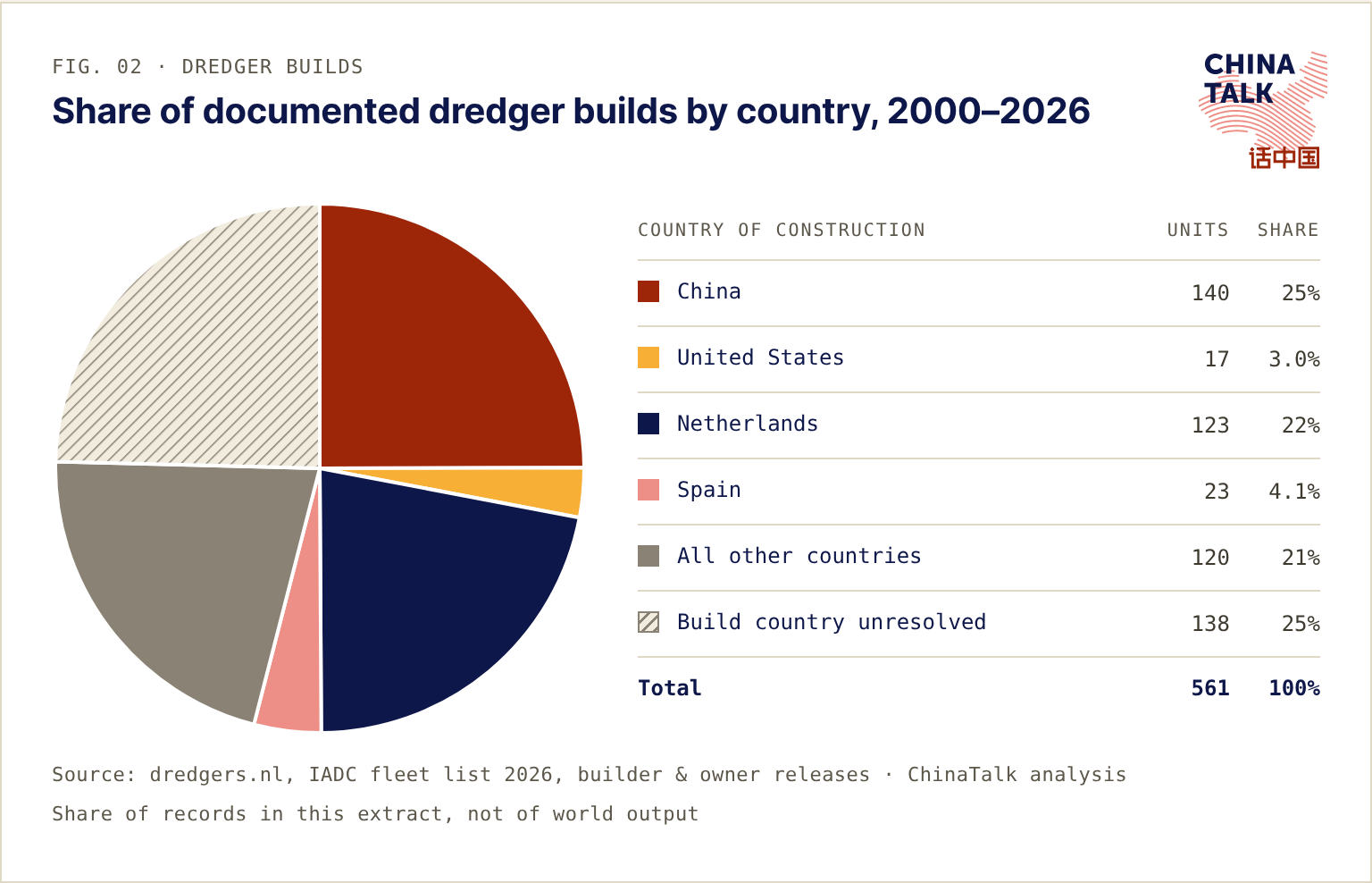
US shipyards, however, do use Chinese-made components — Chinese producers of soon-to-be-controlled components often highlight this fact on their websites. The new controls could be activated to block those transactions, but their announcement coming alongside renewed island-building in the SCS probably means that Washington is not the primary target. Indian analysts have also expressed concern about how the controls could impede New Delhi’s campaign to modernize ports and waterways under the Sagarmala Programme.
I asked a seller of export-controlled dredging components about how difficult it would be to import a cutter head to the US, posing as a buyer working on dredging Port Houston with an American-made Ellicott dredger. Here’s the response I got:
[Q]uite a number of our customers fit our cutter heads on Ellicott dredgers. We have matched the dimensions and connection structure to suit this type of dredger, and we can also customize based on your working conditions.
…
For a pure civilian port dredging project in Houston, TX, the chance of approval is moderate.
The US is not automatically denied, but it is a higher-risk destination compared with Southeast Asia, the Middle East and many other regions.
The core review focus is the end-user and end-use. We need your formal signed End-User & End-Use Statement, confirming it will only be used for this port dredging work, no re-transfer and no military-related usage.
There is no fixed list of countries that will definitely be rejected. Applications are assessed case by case. Requests involving military entities, sensitive locations or potential diversion risks are very likely to be turned down.
These controls are about scale rather than IP. China doesn’t necessarily make the best dredgers or dredging components, but they do crank them out in incredible quantities at unbeatable prices. That combination translates to leverage over budget-constrained rivals eager to get their hands dirty with industrial policy.
Solar (Quinn)
For the last two decades, China has dominated the solar industry, but recent pushes towards domestic manufacturing in countries like the US and India threaten that position. And now, with utility-scale solar the cheapest source of new electricity generation in the history of the world,4 Beijing has positioned itself to decide who is able to manufacture solar for the foreseeable future.
On October 16, China moved to place an export control on the solar stack for the first time (a 2022 draft’s wafer items were dropped before addition). MOFCOM’s Announcement 48 includes proposed controls on the export of 12 photovoltaic (PV) technologies, naming a set of 17 machines as “carriers” of the technology.
MOFCOM has not touched panels, cells, or wafers — products for which export controls would only hurt domestic champions eager to offload subsidized overcapacity on power-hungry foreign grids. But by controlling only the technology and process knowledge, Beijing ensures continued dependence on cheap Chinese PV.
In designing these controls, MOFCOM has tailored them exactly to where Beijing controls the PV stack:
The production of polysilicon, the raw material, is capital-intensive and while major producers exist outside of China, Chinese companies have won on scale and cost. There is no hope of maintaining exclusive access, so Beijing has sought to protect its cost lead, and the proposed rule would cover all systems with polysilicon capacities at or above the level of China’s current best plant — i.e., only targeting future competitors big enough to bite.
In this supply chain, China’s greatest lever is wafer production. 97% of all wafers and almost all of wafer manufacturing equipment are made in China. The machinery to grow the silicon crystals and slice them into wafers is not complicated, but the designs, recipes, and controls are difficult to perfect, and China has built their process knowledge over a decade of dominance. For this kind of mature technology, innovation is slow, so companies will compete at the current mainstream for years. Thus, the bar for the proposed controls sits at the current industry standard, only leaving older generations of wafers license-free.
The technology to turn wafers into cells evolves rapidly, with a number of toolmakers inside and outside China. If MOFCOM were to place the bar at the levels of current tools, customers would simply switch vendors and China would lose sales and gain nothing. Beijing is instead placing a bet that they can dominate the next generation of cell production, protecting Chinese IP at the frontier and allowing toolmakers to still profit off of the current market in the meantime.
Where alternatives exist, Beijing is protecting the cutting edge-tier, laying the groundwork to dominate the next generation of polysilicon and cell production to the same degree it does current wafer production. Where China is the only supplier and controls the know-how, the thresholds are lower, capturing more of present production. Foreign companies, now limited in their ability to buy the tools they need to grow and slice their own wafers, are pushed to directly buy the wafers from China.
This is perhaps the greatest leverage of this control. Announcement 48 directly collides with foreign pushes to onshore their solar manufacturing, most notably India’s 2028 domestic-wafer mandate and US rules rewarding domestic content and penalizing Chinese involvement.
This new announcement, however, only serves to formalize much of what Beijing has already tacitly done, and the best evidence of how the licensing system will be used comes from the pre-rule period.
Since at least March, Beijing has reportedly controlled the export of PV tools without any rule on paper. In hindsight, the evidence points to Beijing employing a firm-by-firm and discretionary valve to control tool exports while it worked towards a formal rule. In March, on the same day that Reuters reported that Tesla was in talks with firms including Suzhou Maxwell Technologies (迈为股份) to buy $2.9 billion of Chinese solar tools, Shanghai-based business outlet Jiemian (界面) reported that all exports of semiconductor-like PV tools would require filing and approval (备案审批). Per The Paper (澎湃), by early April, after provincial NDRCs urgently met (约谈) with local toolmakers to survey their exports and issue policy guidance, MOFCOM summoned PV tool and material companies for consultation on bringing PV equipment under control, though firms deny receiving any explicit document. The New York Times and Washington Post later reported that Beijing had blocked the export of Maxwell’s tools to Tesla and told it to halt talks. In late July, Reuters alleged that China was curbing equipment, technology and technical support for India’s cell plants. The trade data to verify this claim has now been released.5
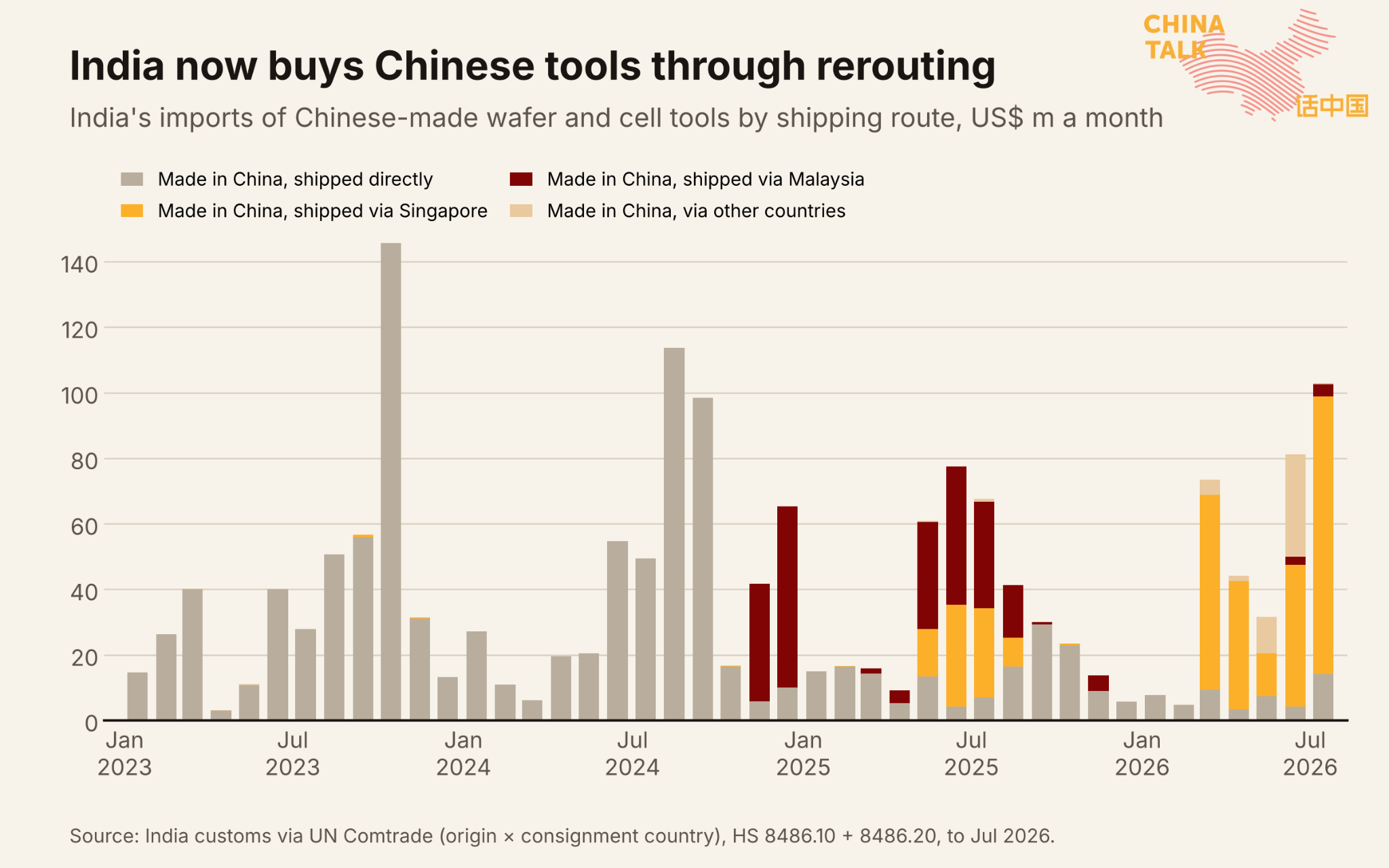
In the last four years of building its solar manufacturing, India has continuously bought Chinese wafer and cell tools, but recently the majority of these tools have arrived indirectly. While there was a relatively steady flow of cell tools and pullers from China to India in 2023 and most of 2024, starting in November 2024, the bulk of Chinese tools arriving in India were rerouted through Malaysia, Singapore, and other entrepots. This pattern is consistent with the curbing that Reuters described. An informal attempt to stem the flow of solar manufacturing equipment to India appears to have merely led to systematic rerouting, arranged by either the buyer or the vendor. The Chinese outbound ledger shows only the immediate destinations, leaving Beijing blind to where the tools eventually end up. This is precisely what Announcement 48 is designed to fix. By first requiring exporters of covered technologies to list on the interim registry the foreign recipient and end use before the draft is finalized, MOFCOM can build an exact map of where their current, informal controls are leaking, allowing Beijing to craft a license system that directs flows where they wish.
Within weeks of Reuters’ July 23 report of China curbing equipment for India’s cell plants, the flow of solar tool exports rerouted through Singapore reduced to a trickle. Where July 2026 saw a peak of $134 million of cell tools shipped from Guangdong to Singapore, this same route dropped to just $600,000 in August. Indeed, in August, every India-bound flow of cell tools, both direct and through intermediates, fell by at least 75% compared to the February to July average. This drop was limited to solar tools. In the same period, 36 other machinery series travelling the same routes stayed roughly steady. Even spare parts for solar manufacturing stayed fairly constant, as the drop hit new production lines, rather than the upkeep of existing ones.
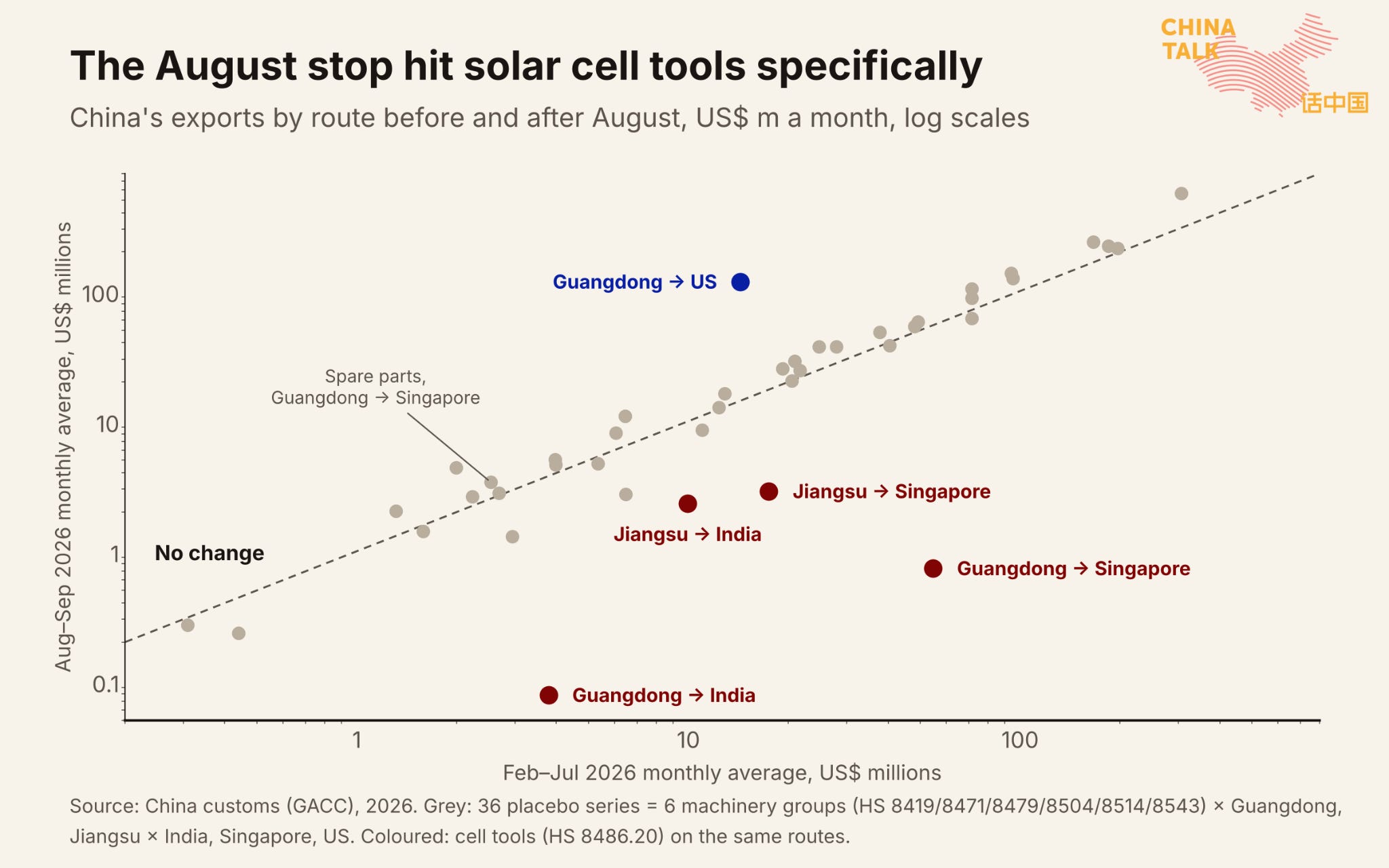
This period also saw a shift in the export of cell tools to the US, but in the opposite direction. From July to September, roughly $1.2 billion of Chinese wafer and cell tools left for the US. Whatever informal control system Beijing used to stem the flow to India, it was selective by destination. Where Guangdong’s shipments of cell tools to India by way of Singapore fell 99%, the export of cell tools from Guangdong to the US rose eightfold. In these three months, China shipped 1,730 crystal pullers to the US, which is consistent with Tesla’s reported order and roughly enough for 30 to 40 GW of wafer capacity. Indeed, in August, 81% of all US puller imports came from China. This surge in exports to the US came before the proposed Chinese controls and seems to have been allowed by the informal restrictions. The proposed export licensing system only increases Beijing’s ability to suddenly decide that the next shipment to the US should be blocked.
Through trade restrictions, the US has reduced its direct dependence on Chinese solar, but China’s dominance over the tool supply chain means that every country’s solar stack is ultimately reliant on China. The US and India cannot build domestic solar manufacturing without Chinese tools, and with Announcement 48, Beijing has formalized its mechanism for control.
Biotech (Nick)
Beijing has also put limits on what its pharmaceutical companies can and can’t hand over to foreign buyers. These moves seem to be about preemptively protecting promising new biotech coming out of China.
The biomedical (生物医药) section indicates that there are five technologies split into two categories. Prohibited means the technology cannot be exported at all, with no license available. Restricted means export is allowed, but only with a government license. (We won’t get into the specifics, but for a fuller technical breakdown you can read this.)
The two big technologies mentioned are cell and gene therapy (CGT) and siRNA. CGT treats disease by altering cells/genes rather than administering a molecule, either by delivering a corrected gene into cells via a modified virus or by extracting a patient’s cells, reprogramming them, and returning them. CAR-T is the most famous CGT application.6 siRNA uses short RNA strands to destroy the messenger copy of a disease-causing gene before the protein is ever made.7 Both are already commercial, and both are fields where China is trying to restrict the “technological and process-based platforms” (技术工艺平台) while still licensing the tech itself. This is an attempt to strike a balance between keeping the capability onshore and not strangling its export business, which brought in a purported $120 billion in out-licensing value this year.

Caption: How CAR-T cell therapy works. Source.
The official framing is about preventing what Chinese commentary calls “root-pulling” transfers (拔根式转让), where a foreign buyer walks away with the thing that produces the drugs rather than one drug.
In practice, a Chinese biotech company is still allowed to license a CGT/siRNA candidate to a foreign pharmaceutical company, which develops and sells it while the Chinese firm takes upfront payments and royalties. But a foreign company cannot, by default, acquire the platform itself and start developing multiple drugs without further reliance on the Chinese firm. An imperfect (but potentially helpful) analogy is how a Chinese company might sell people cars, but they won’t necessarily show them the blueprints or how to set up the factory — which means the next model still has to come from China.
A misread of this document, however, would then be to assume CGT and siRNA are sectors that China dominates, and therefore sectors where China is trying to protect their lead. Rather, it appears to be more about areas where their technology shows promise and might not want to prematurely give away their advantages, which seems in line with the vibe of many of the other technologies in this announcement — “not yet at the frontier, but could be one day, and we want to be prepared when it is”.
All that being said, at least one entry in these regulations focuses on biosafety rather than industry. The rules propose export restrictions on artificial genetic modification and directed passaging of pathogenic microorganisms (病原微生物人工基因改造与定向传代增益技术) — in plainer terms, the know-how for making a pathogen more dangerous. The downside here does not appear to be commercial, but about making sure a deadly future pandemic created through dangerous gain-of-function research does not originate from exported Chinese technology.
This proposed rule is also part of a bigger geopolitical dance around biotechnology. Six days after the announcement, the US Treasury proposed adding biotechnology to outbound investment screening under the COINS Act, an action that has been hotly debated throughout the year. The MOFCOM/MOST announcement bars foreigners from acquiring Chinese platforms but permits licensing. Treasury bars Americans from taking equity stakes in Chinese biotech but permits licensing. This shows both sides have been mulling over similar things and seem to be arriving at a shared equilibrium: letting the drugs move back and forth while freezing the ownership and underlying technology in place.
Lucas Fluegel, a biotech expert at the Carnegie Endowment for International Peace, sums it up for us:
“Both sides seem to be trying to prevent their firms from leaking foundational biotech innovations while preserving the mutually beneficial drug licensing pipeline. The proposed rules are relatively narrow, but they may well be the first step in a substantial expansion of biotech protectionism.”
Drones (Irene)
Announcement 49 revises export restrictions on unmanned aerial vehicles (UAVs). At first glance, the announcement looks like a relatively technical list of adjustments to various existing thresholds. As early as 2015, MOFCOM has had export controls in place for UAVs. Over the past decade they have been updated as the technology improved, and in 2020 UAVs were added to the Catalogue.
While US defense contractors continue to lead in military drone production, Chinese players now dominate the commercial landscape for UAVs worldwide. They have driven prices down so significantly that retail buyers have been able to purchase increasingly advanced drones year after year. Beijing does not seek to curb Chinese players’ advantage in this arena. These new rules, in fact, allow some shorter-endurance drones to be auto-licensed for export upon registration. It also raises thresholds for endurance and aerosol-dispersal capacity higher for commercial drones. The latter is particularly important for agricultural spraying drones, which China also leads the world in deployment and exports.
Other aspects of Announcement 49 would tighten some restrictions on UAV exports. Most notably, the proposed rule goes up the supply chain to regulate exports of drone parts, software, and know-how. Brushless motors, electronic speed controllers and carbon-fiber propeller blades all received thresholds above which exports will require licenses. So do flight-control, autonomous navigation, sense-and-avoid, and overall aircraft design technologies, as well as a few other aspects of drone design and manufacturing know-how. These could have interesting implications for DJI’s plant in Malaysia and Autel Robotics’ Vietnam factory.
In a separate announcement back in August, MOFCOM already specifically tightened export reviews for UAVs, key parts, and related technologies bound for the US. These new rules, then, are not entirely about competing with the US. Rather, as with other technologies described above, Beijing increasingly sees the process knowledge accumulated in its advanced manufacturing industries as strategically important, and is using policy tools to protect key technological information while also trying to maintain advantageous market positions.
Specifically, Announcement 51 covers the following components (technical notes are from the original source page):
“I. 8A901.f.1. Items related to dredger slurry pumps
(1) 8A901.f.1.a. Dredger slurry pumps having both of the following characteristics (reference customs commodity codes: 8413709120, 8413709980):
1. Suction-inlet internal diameter greater than or equal to 0.55 m;
2. Maximum pump rotational speed less than or equal to 400 rpm (r/min).
(2) 8A901.f.1.b. Key components specially designed for items controlled under 8A901.f.1.a:
1. Dredger slurry-pump casings with an internal diameter greater than or equal to 1.3 m, including inner and outer pump casings (reference customs commodity code: 8413910010);
2. Dredger slurry-pump impellers with a diameter greater than or equal to 1.3 m (reference customs commodity code: 8413910010).
Technical Notes: “Suction inlet” means the opening through which fluid or other media enter the slurry pump during operation. “Pump-casing internal diameter” means the diameter of the internal bore of the pump casing. “Impeller diameter” means the outside diameter of the impeller shroud.
II. 8A901.f.2. Dredger dragheads
Dragheads for trailing-suction hopper dredgers with a suction-pipe diameter greater than or equal to 0.55 m (reference customs commodity code: 8479109010).
Technical Note: “Suction-pipe diameter” means the internal bore diameter of the draghead’s discharge outlet.
III. 8A901.f.3. Dredger cutter heads
Cutter heads for cutter-suction dredgers with a cutter-ring outside diameter greater than or equal to 2.1 m (reference customs commodity code: 8479109010).
Technical Note: “Cutter-ring outside diameter” means the outside diameter of the cutter-head base.”
The 2017 controls are quite restrictive and kick in at comparatively low capability thresholds, e.g. applying to all vessels with a dredging depth greater than 15 meters.
In 1884, Charles Fritts installed the world’s first rooftop solar array on a building in New York City, and in 1954, a team at Bell Labs invented the first practical silicon photovoltaic (PV) cell, which was soon licensed by Hoffman Electronics — the first commercial cells. Initial costs were astronomical, but with manufacturing innovation, subsidies, and oil crises, by the 1990s and 2000s, European, Japanese, and American companies had ramped production and reduced cost to below five dollars per watt, driving commercial and consumer demand.
And here, like so many other manufacturing stories of this century, is where we turn to China. Capitalizing on growing Western demand, Chinese companies leveraged state-backed loans to build massive manufacturing hubs, centralizing the entire supply chain from refining the raw materials to the production of manufacturing equipment itself. This vertical integration dropped prices to just cents per watt, triggering widespread solar adoption worldwide and driving many legacy American and European manufacturers out of business.
All of the following trade data comes from the Comtrade and GACC APIs.
CAR-T takes a patient’s own T-cells, the immune cells that kill infected or damaged cells, and adds a receptor that makes them recognize a specific cancer marker. The reprogrammed cells go back into the patient and hunt the tumor.
Conventional drugs mostly work by blocking a protein after it exists, which means the protein needs a pocket a small molecule can bind to. Most do not. siRNA sidesteps the problem by stopping production upstream, which opens up targets the industry had written off as undruggable.