
The following is a cross-post from 葬AI / FuneralAI, an uproariously funny Chinese blog about the ups and downs of the AI industry. Check out their many other articles on Substack and WeChat Public Accounts!
Translation by Fable 5.1 and checked by Irene. Footnotes added to explain some historical references.
These days, the situation is excellent with Chinese models, and new releases take turns to farm Opus 5 like a boss monster.1 But we still have to see the situation clearly and should not deceive ourselves
A theory of quick victory and a theory of defeat are two sides of the same coin, and both are very bad actions.
We have to first get the sequence straight. In early June, the evil Anthropic released the powerful Fable 5. Only then did many domestic models with benchmark scores approaching Fable 5 appear.
The basic picture, in which OpenAI and Anthropic hold a large lead, has not changed. The premise is that our large models still lag behind; only then can we debate whether the gap is six months or four.
Whether from the viewpoint of model performance or parameter count, K3 and Qwen 3.8 Max are still a full major generation behind Fable 5, and with GPT 6 about to be released, the gap may widen further.
The progress of the past two months shows up mainly in how much faster domestic models are following up. With the successive releases of GLM 5.2, K3, and Qwen 3.8 Max, we can confirm one basic fact: domestic large models are improving at an accelerating pace, and the gap between open-source and closed-source models is, for now, narrowing.
The most critical variable here is open source.
Open source has terminated the logic of the theory of defeat. It has replaced “America encircles Chinese AI” with a protracted war in which open source encircles closed source.2
The logic of the theory of defeat is very simple. America has the largest amount of the most advanced compute, plus OpenAI’s first-mover advantage, and large models are a business where, once the technical path has been proven, things mostly come down to piling on compute and scaling up data.
In terms of compute, Nvidia GPUs shipped to China inevitably suffer losses along the way. In terms of data, the US was also first to build out high-end human annotation. Synthetic data, like using transfer stations to hit the Claude API and grind benchmarks, is bound to be lossy too. As long as we respect the law of conservation of energy, Chinese large models cannot possibly catch up to America.
That logical sequence is all correct. But if everything ran on logic, there would be no such thing as entrepreneurship, and everyone would just clock day in and day out to tighten screws.
I put together a timeline of the major open-weight releases of large models.
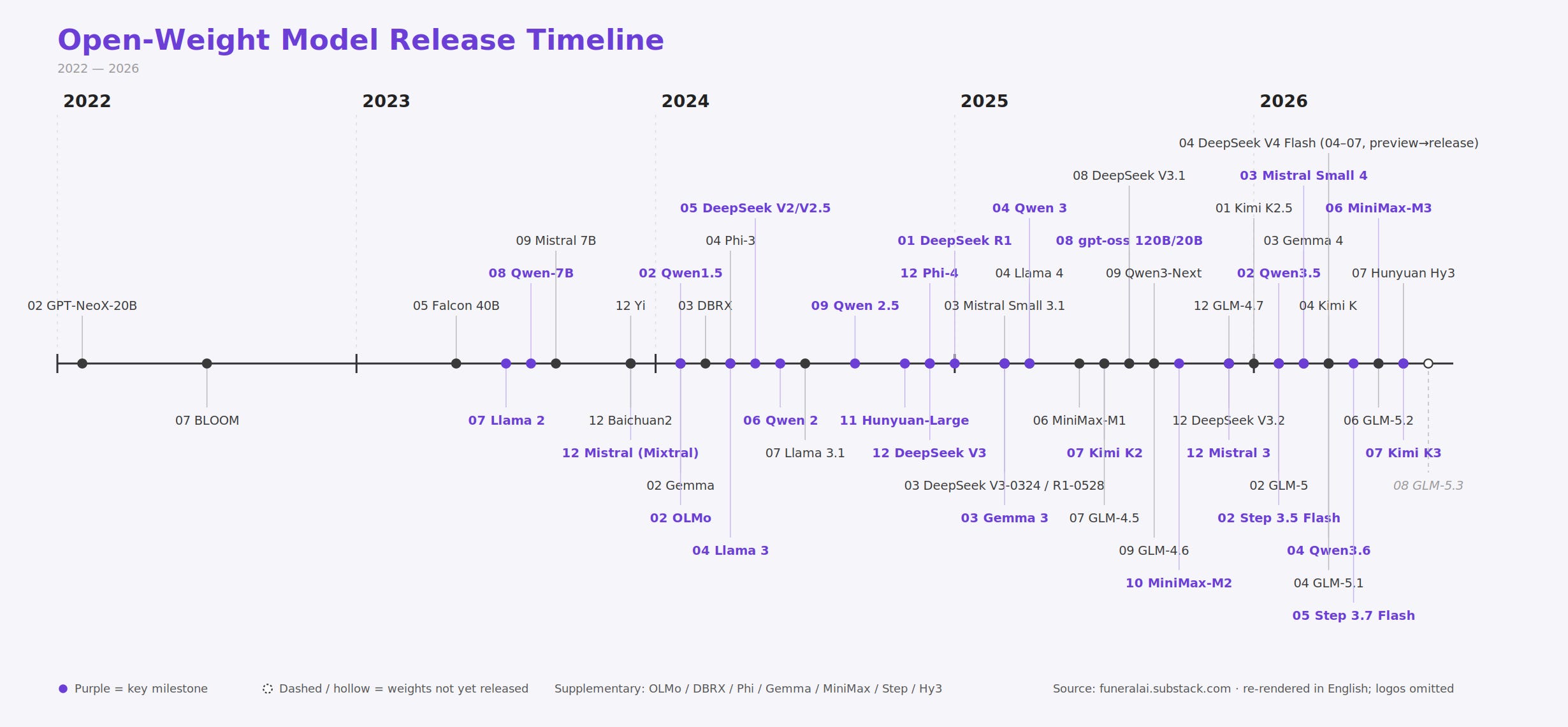
It is obvious at a glance: open-source models have gone from being mostly small experimental models in the early days to, recently, three open-sourced models approaching Opus 5. Open-source performance is closing in on top closed-source models faster and faster.
Chinese-vendor-led open-sourcing of large models has changed the balance of power between the two sides. Open source has enlarged the base of the AI industry and consolidated every AI team outside the closed-source labs into a united front.
The most recent example: the release of K3 triggered a knee-jerk reaction from the US government, which planned to restrict American companies from deploying open-source models. More than 270 tech companies and organizations, including Nvidia and Microsoft, published an open letter supporting open-source models, and then, for now, nothing happened. K3 was not banned.
Clearly, if K3 were a closed-source model, this many companies would not have come to its defense; at most Jensen would say a few words to sell GPUs. The whole world under heaven has suffered under Anthropic for a long time. Acting in their own interest, commercial companies will inevitably back open-source models against the evil Italian, to stop the latter from swallowing everything.
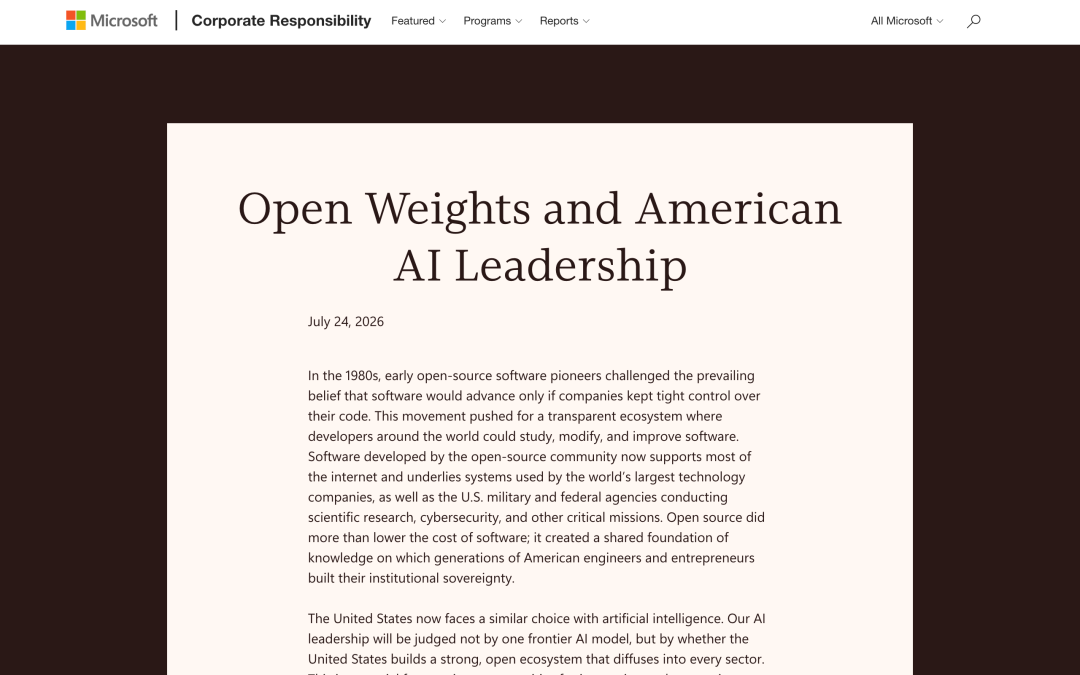
We can already see this trend today. Fable 5 is so expensive that even tech giants cannot open it up for unrestricted use by all employees. Everyone uses Fable 5 for a handful of complex jobs, and the vast majority of tasks are done by relatively cheap models. The latter is a ready-made ecological niche for every open-source model.
What will inevitably happen in the future is that the vast majority of token demand will be served by open-source models, and only a tiny number of complex scenarios will require expensive, strictly moderated closed-source models.
Small open-source models in particular have dramatically changed the meta of the game.
Open-source models fully clearing the usability bar and reaching somewhere between Opus 4.6 and 4.8 is something that happened around GLM 5.2. And just two months later, the small Qwen 3.8 model, with only 27B parameters, has also reached Opus 4.6 level, matching the strongest model of six months ago.
Qwen 3.8 27B is a crazy model. We know Zhipu likes to talk about its high “intelligence density,” reaching performance close to K3 with 744B parameters. From this came the debate over whether large models must chase large parameter counts, and how to measure the intelligence-to-efficiency ratio.
First, if you read Uncle Tang Jie’s full tweet, you will find he did not actually land on a verdict. He only said that at this stage Zhipu has chosen to keep improving base-model performance through post-training, and that in the future they will also try pre-training and all sorts of other things. It works whichever way you read it.

Second, by this logic, the poster child of intelligence density is not Zhipu, but old-timer Alibaba. Qwen 3.8 27B has only 1/28 of Zhipu’s parameter count, leading its peers in density by an order of magnitude, and it is still far ahead even if you count by active parameters.
So here is the question. GLM 5.2 was the post-training king of the last meta. Should Qwen 3.8 27B be the pre-training king of the new meta, or the post-training king, or should we just call this thing number one in intelligence density?
So intelligence density is a concept that does not survive close scrutiny. Enjoy the noise and move on. The ticket into the new season is still building a large model of around 2T parameters.
Where Qwen 3.8 27B changes the meta is that a model fully surpassing human coding ability has become a true public good. Even DeepSeek V4 Flash is hard for an individual to deploy, whereas Qwen 3.8 27B is a model that can be run entirely on consumer-grade GPUs.
I have seen the hardware nerds having a great time these past few days, digging out Mac minis and 4090s to deploy all kinds of quantized versions; one guy even did it on a modded 3080, running 27B for a bit over 3,000 yuan. A scene as beautiful as the great lobster renaissance.
All I can say is: vigorous life, all things striving forth. 27B versus 744B, the advantage is mine.
My main point is that Qwen 3.8 27B has accelerated the trend of intelligence becoming as cheap as cabbage.
My imagination is limited; I do not know what happens once intelligence is cabbage-cheap. I can only lean on one fun case: Xiaozhi AI 小智AI, the AI hardware device that’s shipped over a million units, was born because its developer, Brother Xia, happened to have a few 4090s on hand.
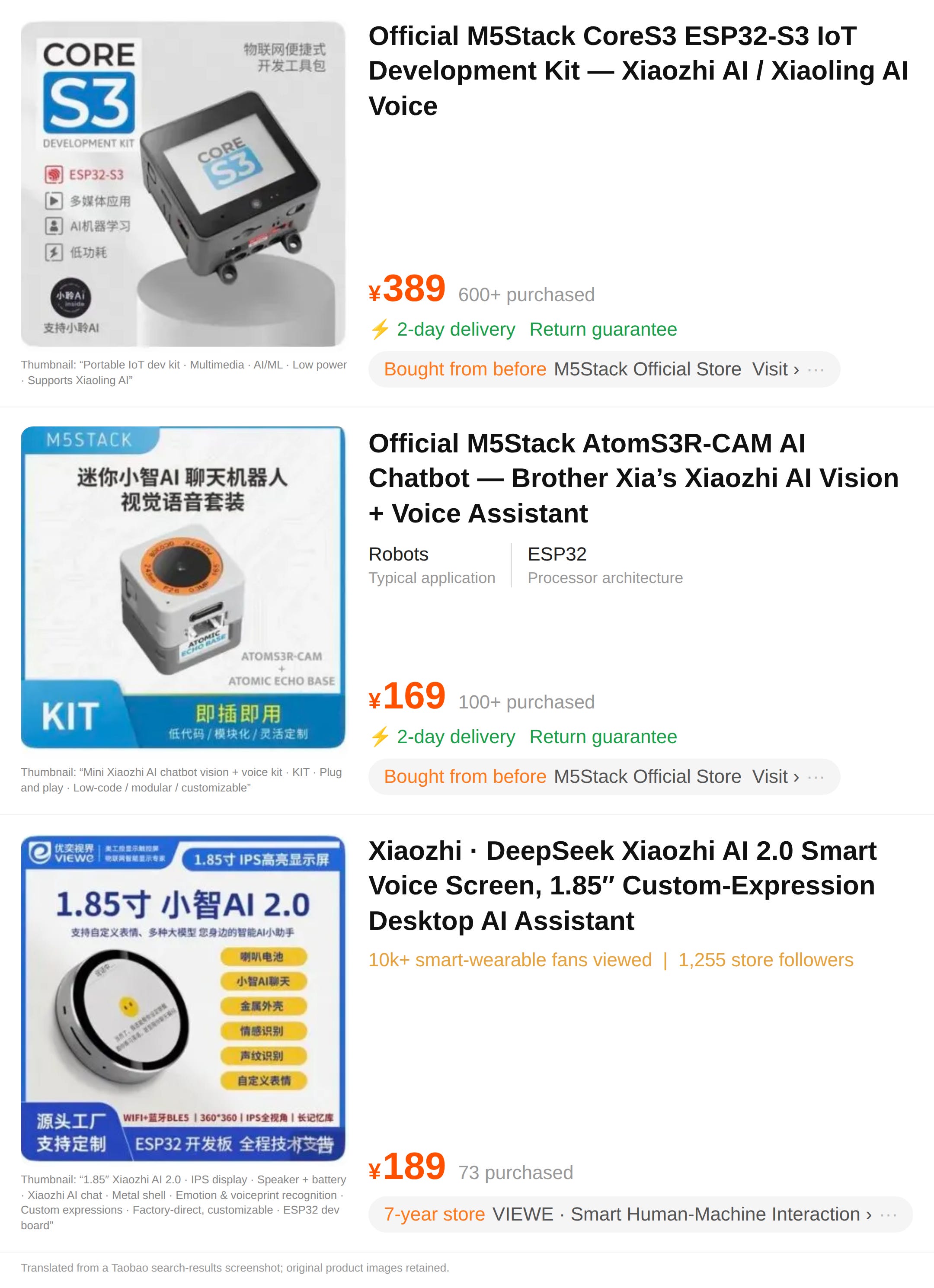
Qwen 2.5 happened to be open-sourced, and after deploying it locally, Brother Xia tinkered his way to an open-source chatbot solution beloved by hardware nerds. Most AI chat hardware today still uses Xiaozhi’s open-source design.
Frankly, once Opus 4.6-level models are fully cabbage-cheap, someone will pull off something far wilder than Xiaozhi. It just needs a bit of time to arrive.
I’ve spilled so much ink on Qwen 3.8 27B because it is a model born entirely for open source. Open source is good not as a moral slogan, but because open source has actually accelerated the improvement of large-model capabilities.
Originally, Chinese large models were certain to lose to American ones; the logic of the theory of defeat held. Open source changed the meta of the game. From then on it has been open-source models competing against closed-source models, each side entangled in the other.
“Entangled” meaning: when American tech companies deploy K3 and Qwen 3.8 Max, they also pay Kimi and Alibaba. Open source not only guards against bans, it also drops gold coins.
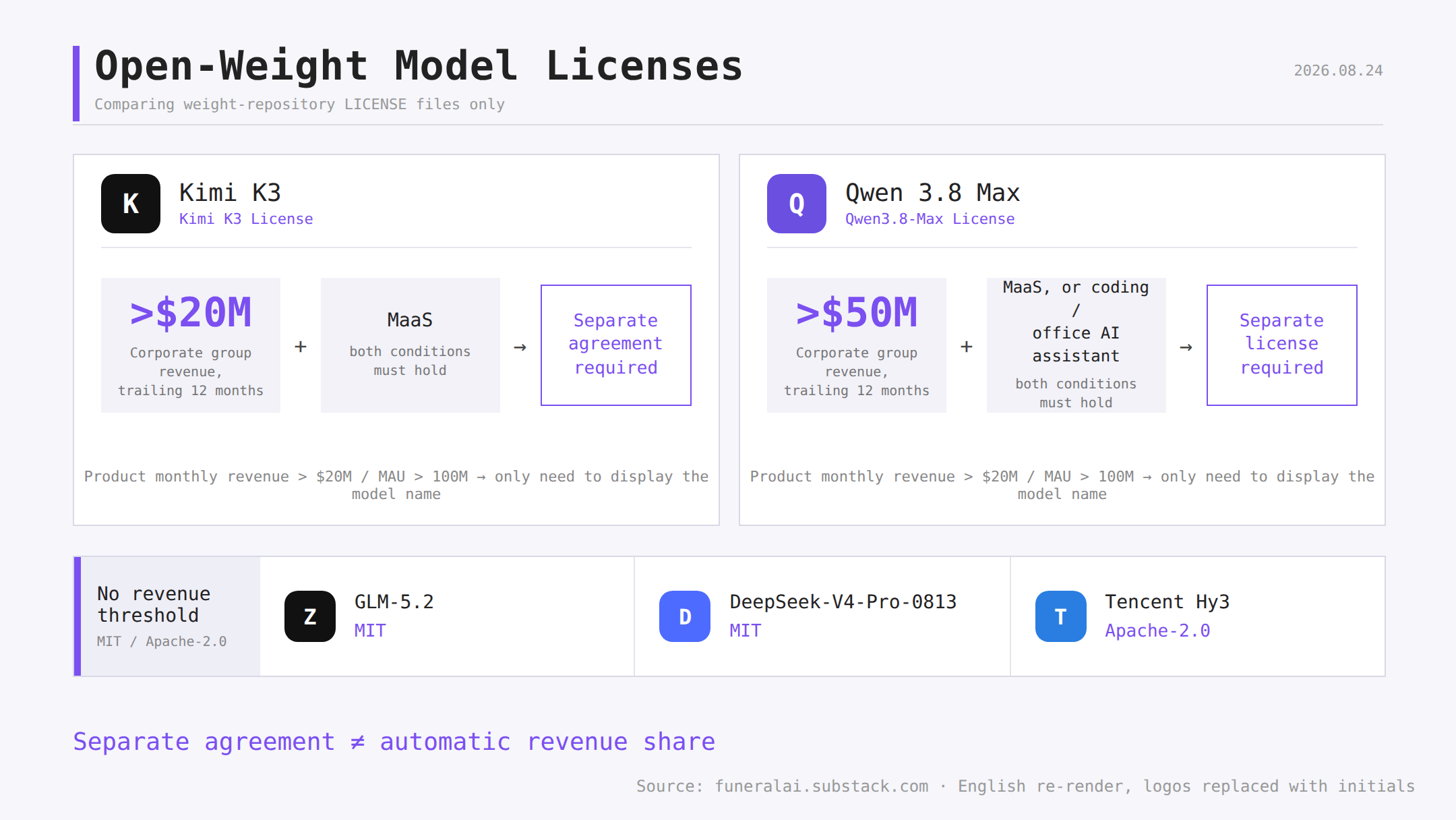
Trade space for time, and closed-source models will always have a chance to fall behind. The phase of large-model competition has thus shifted from the theory of defeat to protracted war.
What is bound to happen is that in the future 90% of tokens will be served by relatively small-parameter models, enough to handle the vast majority of agent tasks, and only the remaining 10% will be supplied by ever more expensive, ever larger SOTA models.
This trend is positively correlated with the spread of agent products. Caring about model version numbers is a very niche need; ordinary users only need to pick a model tier inside the product and do not need the strongest, most expensive coding model.
LLMs are basically a kind of manufacturing, and in manufacturing efficiency is everything. A small-parameter model whose performance is fully usable is obviously more efficient than Fable 5.
This is the meaning of protracted war. No quick victory is possible, nor will there be a quick defeat. Instead, in the stage of strategic stalemate, we wait to see what variable emerges that raises one side’s efficiency and lowers the other’s, until the tipping point arrives and one side collapses first.
Of course, I am not saying open source makes domestic models invincible. You can see closed-source models accelerating too, and St. Musk’s Grok, so desperate to improve, happens to be the control group.
Grok is a case of a closed-source model with ample compute and ample data. From St. Musk’s flailing micromanagement to dutifully training on Cursor data, Grok’s performance has actually improved very quickly. Grok 4.6 is itself a 2T-parameter model, on par with K3 in performance, faster and cheaper, and currently the most cost-effective third-best model in the world.
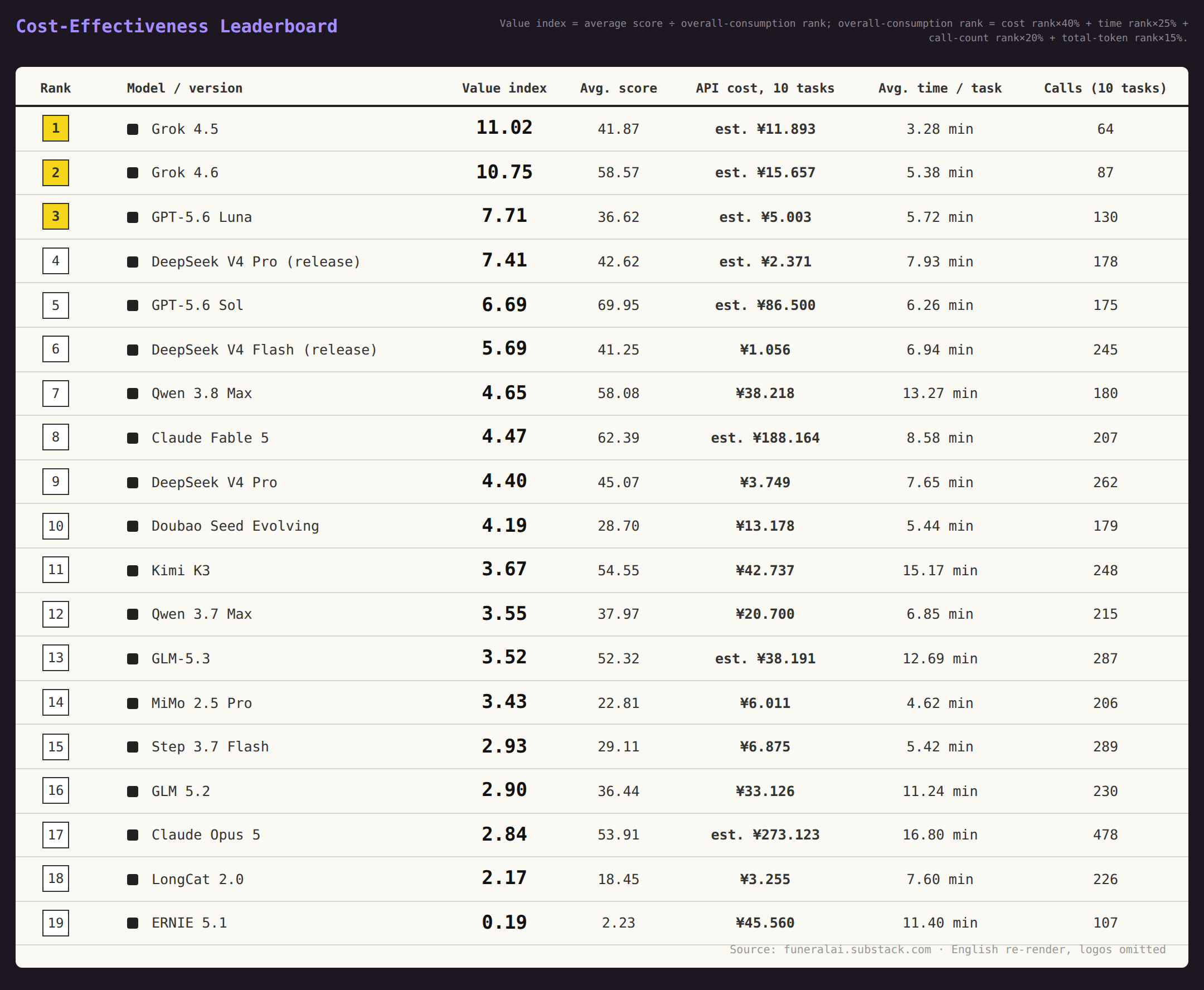
Moreover, Grok is also shipping a minor version every month, and its momentum in chasing Gemini is no slower than Kimi, Qwen, or GLM. There is a high probability that the next version of Grok significantly surpasses this generation of domestic models.
The pace of progress of the open-source camp as a whole is not necessarily faster than closed source.
Right now is the protracted-war period for open-source models, and also the most difficult period. The folks at the model labs are burning through their lives; open Twitter at night and Gemini and Grok are updating constantly too. The competition never ends; there are only small wins, no big win.
The other key tenet of protracted war is building base areas.3 Translated into large-model industry terms, that means domesticizing compute.
This is why, although Meituan’s LongCat is a second-and-a-half-tier domestic model that cannot even beat Tencent’s Hunyuan 3 in the free-token race, I still feel great warmth toward it.
Because LongCat is the first model to complete the entire training-and-inference pipeline on domestic chips. Although its performance is not there yet, and although it most likely used domestic cards throughout because it lacked resources, it was the first to close the loop between domestic models and domestic compute. That is building a base area.
As long as there is a base area, you can always grow slowly and become strong.
Open-source SOTA models like K3 and Qwen 3.8 Max can all run inference on domestic chips already in mass production. Just a couple of days ago, Wu Yongming said that Alibaba’s second-generation supernode, which begins tape-out and production in the second half of the year, can fully substitute for large-scale model training.
It seems that, alongside pushing the ceiling, everyone lending a hand to help domestic chips achieve integrated training and inference is not out of the question either.
This fundamentally undercuts the logic of the theory of defeat. It is not the case that we must forever rely on Nvidia chips. Once the entire large-model chain closes the loop and efficiency gradually improves, there is no reason what happened in solar and new energy will not repeat in AI.
My main takeaway is that the big companies are truly resilient. While Meituan and Alibaba slug it out in a war of attrition, they still manage to do AI with flair. Even [Meituan’s] Xiaoxiang Supermarket is pretty good: when I wanted fruit and milk and whatnot at 10 p.m., [Alibaba’s supermarket brand] Freshippo and Sam’s Club couldn’t deliver, but Xiaoxiang could 👍
Maybe these two companies have reached a game-theoretic equilibrium where they have to fight a war of attrition to do AI well. If the food-delivery war ended one day, the bosses would look at all that extra free cash flow, not know what to do with it, draw their swords and stare blankly in every direction, and that might actually hurt large-model training.
The future of open-source models is bright.
Because open source has real interests and the people’s hearts on its side. In the words of the Great Leader: “Weapons are an important factor in war, but not the decisive factor; it is people, not things, that are decisive. The contest of strength is not only a contest of military and economic power, but also a contest of human power and morale.”
But the road for open-source models is arduous and winding.
Another line from the Great Leader: “The united front must be maintained; only by maintaining the united front can we keep up the war; only by maintaining the united front and keeping up the war can we achieve final victory.”
(Cover image generated by ChatGPT; text written entirely by a human.)
This is a tongue-in-cheek reference to Mao Zedong’s theory of protracted war.
Another Maoist historical reference. this one about revolutionary base areas.
Open-model races are a capital-cycle story. Comparing this boom to prior bubbles helps separate durable infrastructure from brochure narratives.
https://paretoinvestor.substack.com/p/how-the-ai-bubble-compares-to-history