
ChinaTalk is currently running two contests! See below for details:
$50k prize pool for creative ideas, proposals, and writing pitches broadly related to the China-AI beat, which double as our recruiting drive for new staff researchers/writers. Deadline is August 23rd; learn more here;
$25k prize pool for evaluation protocols that help foreign policy and national security users learn about AI models’ capabilities, limitations, and what these tools are useful for in diplomatic and strategic contexts. Deadline is September 1st; learn more here.
ChinaTalk writer Irene Zhang went to Indonesia in July. These are her notes from the trip.
Part 1: It’s So Big
A few hours before I fly to Jakarta, my friend in Singapore sends me off over durian. “Indonesia will be a military dictatorship soon. It’s so over for Southeast Asia[n democracy].”
The next morning, I put my backpack on a baggage scanner at the entrance to Grand Indonesia, a glitzy mall in central Jakarta. The security guards’ metallic breast badges flashed past my bleary eyes. It occurred to me that the last time I did this at a place of commerce was in China during Covid.
Some time in 2024, I typed “what is the easiest major language to learn” into Google. The answer, according to the internet’s polyglot hivemind, was bahasa Indonesia, a standardized form of Malay that now unites 288 million diverse peoples across the archipelago. The spelling is consistent, the phonology relatively straightforward for English speakers, and basic grammar can be grokked in a week.
Two years, a whole Duolingo course, and many iTalki lessons later, I landed at Soekarno-Hatta International Airport and managed a terima kasih to the customs officer. With more than 32 million residents spread across its metropolitan area (including the satellite cities of Bogor, Depok, Tangerang, and Bekasi — together known as Jabodetabek), Jakarta is the most populated city on Mother Earth. Indonesia is sometimes referred to as the “invisible giant.” It is the world’s fourth-largest country by population, has the world’s largest number of Muslims, and is Southeast Asia’s largest economy.
Invisibly, to much of the rest of the world, it is troubled at the moment. The Indonesian rupiah weakened around 10% against the USD over the past twelve months. MSCI considered downgrading Indonesia, an upper-middle-income nation, from Emerging Market status down to “Frontier,” alongside the likes of Burkina Faso and Oman. The war in Iran made fuel prices soar, pulling the rug out from under an economy reliant on raw materials extraction. And last year saw violent anti-government protests across the country over corruption and inequality. People threw Molotov cocktails, stormed luxury hotels, and burned down government buildings in Makassar and Bandung, leaving 11 people dead.
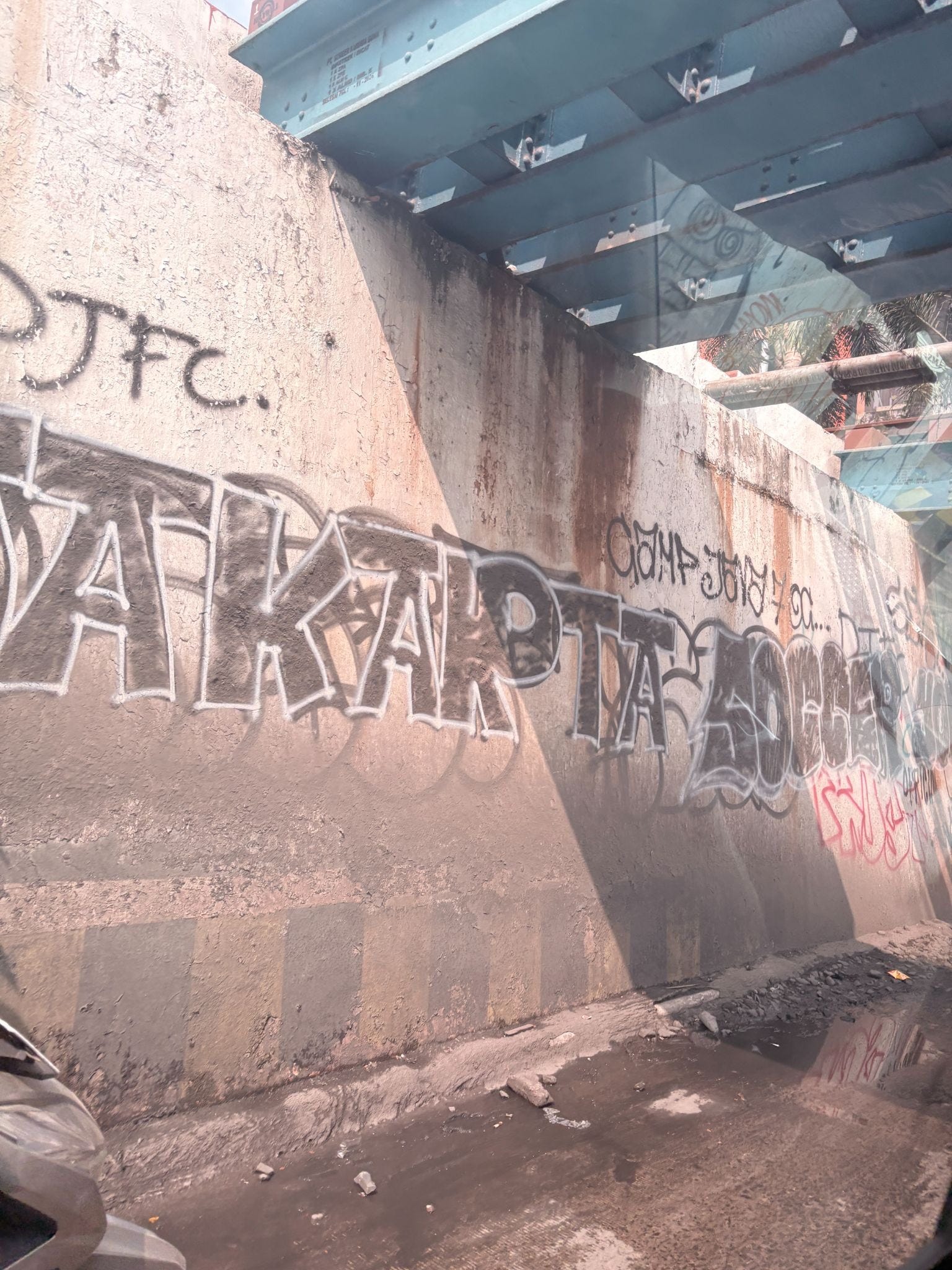
My taxi passes Medan Merdeka — one of the largest squares in the world at the heart of the biggest city on earth — and I imagine it filled with people, arm after arm stretching to the end of the darkening horizon.
Part 2: The Coffee Quota
Jakarta has every kind of people in abundance except tourists. Over the course of a week, I managed to check out quite a few tourist-oriented spots: the old colonial town (Kota Tua), National Monument, Glodok Chinatown, and Masjid Istiqlal, the biggest mosque in Southeast Asia. There is the odd European backpacker and Chinese businessperson, and I catch Singaporean accents in restaurants and malls. But I did not see a single foreign tour group all week.
As it is an active site of worship, Masjid Istiqlal can only be visited by joining twice-hourly ad hoc tour groups at the entrance and borrowing appropriate clothing. When I made it there one afternoon, my eyes were burning from air pollution and caffeine intake. My group consisted of two Chinese businessmen working in Indonesia whose families were visiting, a Canadian medical student on summer holiday, two Japanese men, one Japan Airlines flight attendant enjoying a day off, and me.
Istiqlal is Arabic for independence. Sukarno, Indonesia’s first president, insisted that the national mosque be built next to Jakarta Cathedral as a symbol of religious tolerance. Indonesia requires all citizens to register as members of one of six official religions (Islam, Protestantism, Catholicism, Hinduism, Buddhism, and Confucianism) on their identity cards; atheism and interfaith marriage are effectively prohibited.1 My fellow Canadian and I exchanged an uncertain look as we filled out the registration form and identified ourselves as followers of the Buddha.
The great mosque, designed by a Lutheran, speaks the architectural language of the future as it looked like in 1978. Its interior is cool, metallic, and direct, eschewing the soft curvatures stereotypically associated with Islamic architecture. A sanctuary of stainless steel that opens into the city and seems to siphon the world.
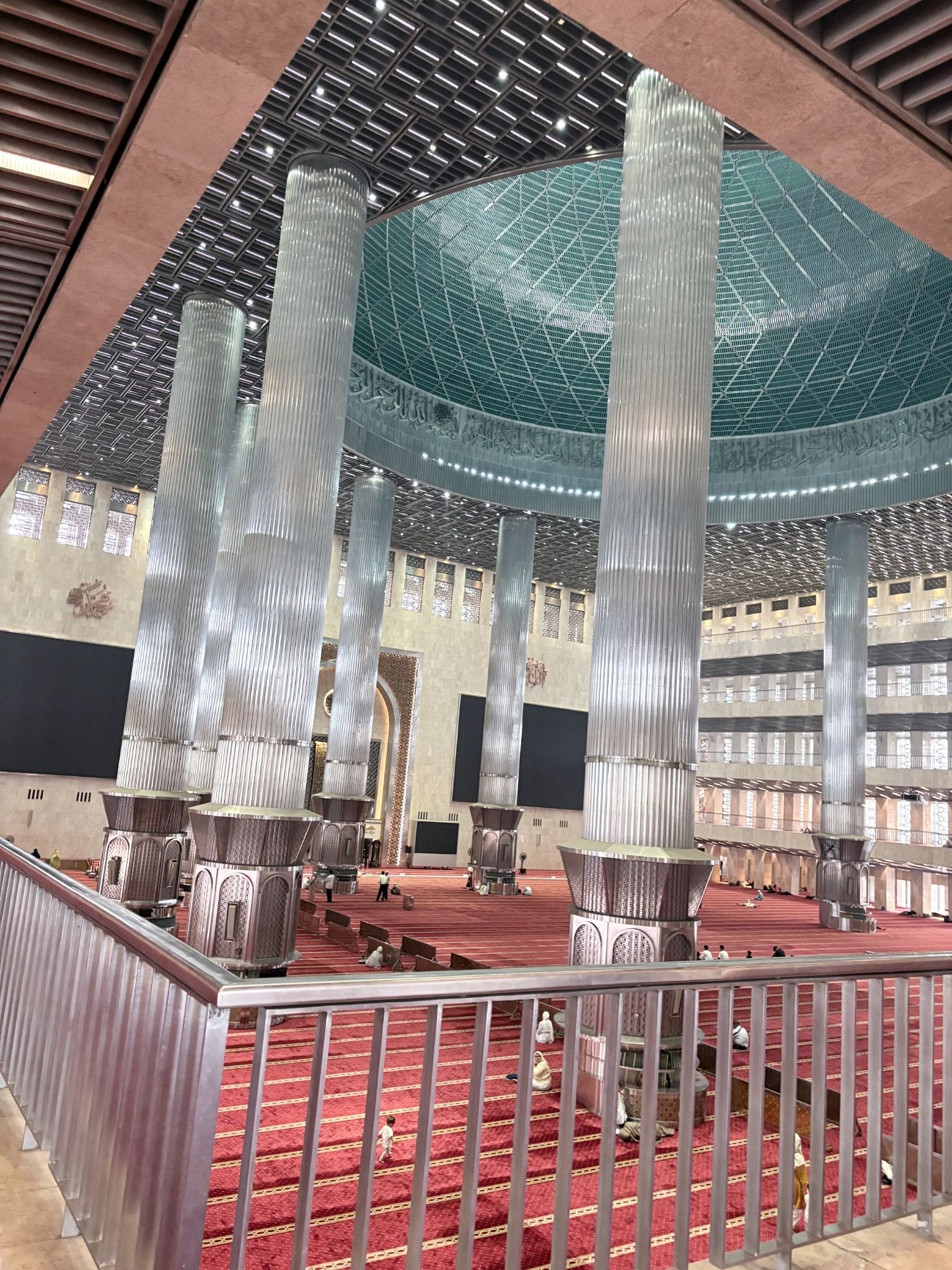
There were signs forbidding sleeping all around the mosque, but underneath those very signs were people resting on makeshift cardboard mats.
Just one more cup, I told myself; you won’t be back in caffeine heaven for quite a while. I enjoyed the best V60 pour over of my life in a shop next to Jakarta Cathedral at 4PM. The Dutch East Indies Company (VOC) brought coffee to Java in the 17th century and broke the Arabian monopoly on bitter bean juice. Robusta replaced Arabica as the dominant variety after a disease outbreak. Today, any independent café in Jakarta seems to have single-origin menus more extensive than places charging $10 a cup in San Francisco.
When I strolled around residential Setiabudi that night, I couldn’t tell if my heart was pounding from the heat, caffeine, anxiety, or the existential terror of Jakartan motorcycle traffic.
Part 3: Visibly Chinese
Basically every Grab driver I had started our conversation by asking, “Are you Chinese?”
Being “visibly Chinese” in Indonesia felt quite different from being visibly “Asian” back in North America. The latter places you into one neat bucket within the continent’s racial logic; the former is specific and economically rolecast. “Are you Chinese?”, almost always, is followed by, “Here for business?”
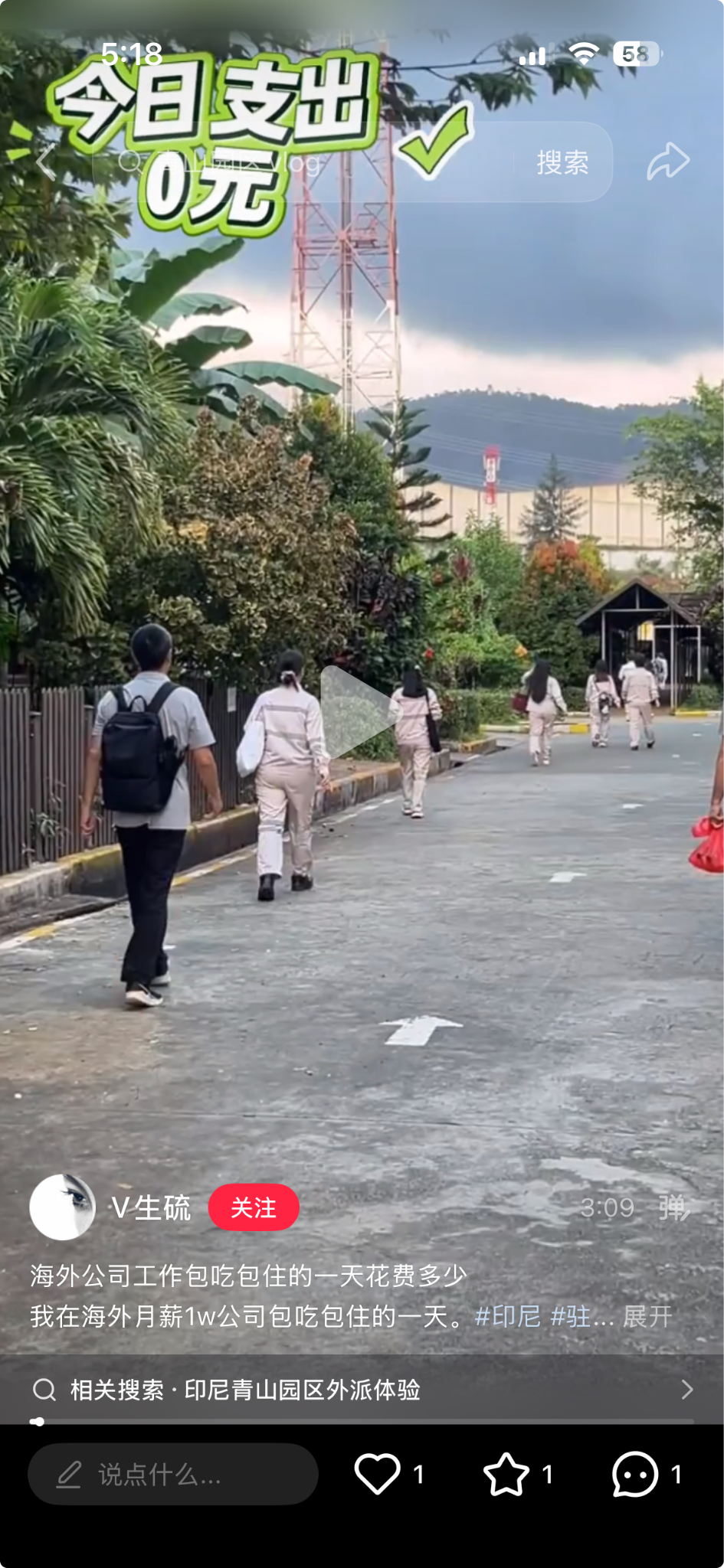
By Day 2, my Xiaohongshu algorithm had detected my IP address and begun filling my feed with videos of mining compounds. Over the past decade, more than $65 billion in investments flowed from China into the archipelago in pursuit of nickel. The metal is used for making batteries, and breakthroughs in those very batteries powered China’s electric-vehicle revolution. Tsingshan Group 青山控股, a Wenzhou-based private conglomerate, entered Indonesia in 2009 and is now the world’s biggest nickel producer. I developed a temporary obsession with vlogs made by its Chinese employees in remote Morowali, on the island of Sulawesi. In exchange for living the most unstimulating lifestyle imaginable on a corporate compound (and suffering under dangerous conditions and brutal labor repression, if they work in blue-collar roles), they are paid double or triple what they might earn back home and enjoy lovely tropical views on the way to work.2
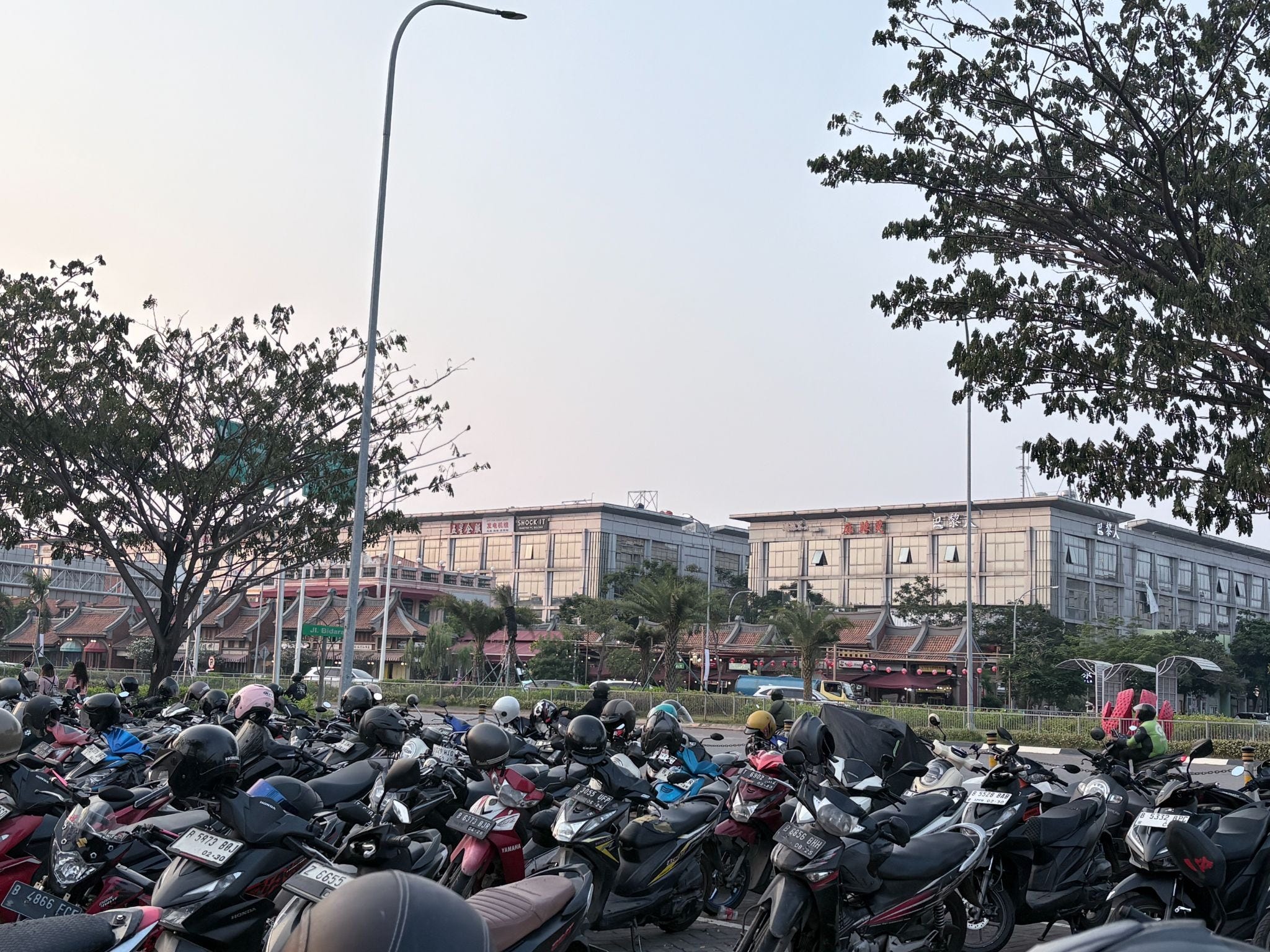
The business-oriented Chinese of Jakarta, as far as I could tell, seemed to coalesce around two main areas. There is SCBD, a high-end business district in South Jakarta, where malls contain familiar offerings like Pop Mart, sauerkraut fish, and Haidilao. And then there is PIK.
PIK stands for Pantai Indah Kapuk (roughly “Kapuk Beautiful Beach,” Kapuk being the name of a nearby neighborhood). It is a stretch of land reclaimed from Jakarta’s northern coast, separated from the city by a slim canal and nearly impossible to reach on foot. Residents live in perfectly geometric compounds of beige townhouses that would not look out-of-place in California, surrounded on the outside by both strip malls and actual malls. My Grab ride dropped me off on “Golf Island.” With no pedestrian pathway anywhere in sight, I swallowed my heart into my stomach and crossed eight lanes of busy traffic to get to the other side.
PIK is generational trauma manifested as manmade landform. In May 1998, nativist rioters massacred more than 1,000 ethnic-Chinese Indonesians and enacted sexual violence against hundreds of women and girls across Medan, Jakarta, Solo, Palembang, and Surabaya. Longstanding prejudice rooted in the Dutch-colonial economic system cast “Chindos,” who constitute merely three percent of the archipelago’s population, as conniving outsiders that robbed the indigenous of wealth, and the US-backed New Order regime falsely suspected the Chinese of communist sympathies.
Today, Chinese Indonesians occupy a social position that seems truly bizarre from the outside. By some estimates, more than half of Indonesia’s private-sector wealth is held in corporations headed by ethnic Chinese, who dominate rankings of Indonesia’s wealthiest people year after year. But they are nearly completely shut out from state power, have little hope of attaining high political office, and cultural and religious discrimination persists. The plight of Chinese Indonesians continues to cast a shadow on PRC-Indonesia relations today, even as Chinese investment pours into the country.
At the center of “Golf Island” are five Chinese-style pavilions that light up at night, attracting groups of locals who pose for social media. To my old-country-Chinese eyes, they are a bit garish. And then I remind myself that those very Chinese characters adorning the archway were illegal a generation ago. It was not until 2000 that Indonesia re-legalized teaching the Chinese language.
Part 4: The Dream
“Whoosh” is the name of the high-speed railway (HSR) line between Jakarta and Bandung. Indonesia’s first, it was financed by a joint venture between China Railway Group and four Indonesian state-owned firms. A fifty-minute economy ride costs 295,000 rupiah (around 17 USD). That’s more than the amount the average Jakartan earns in a day.
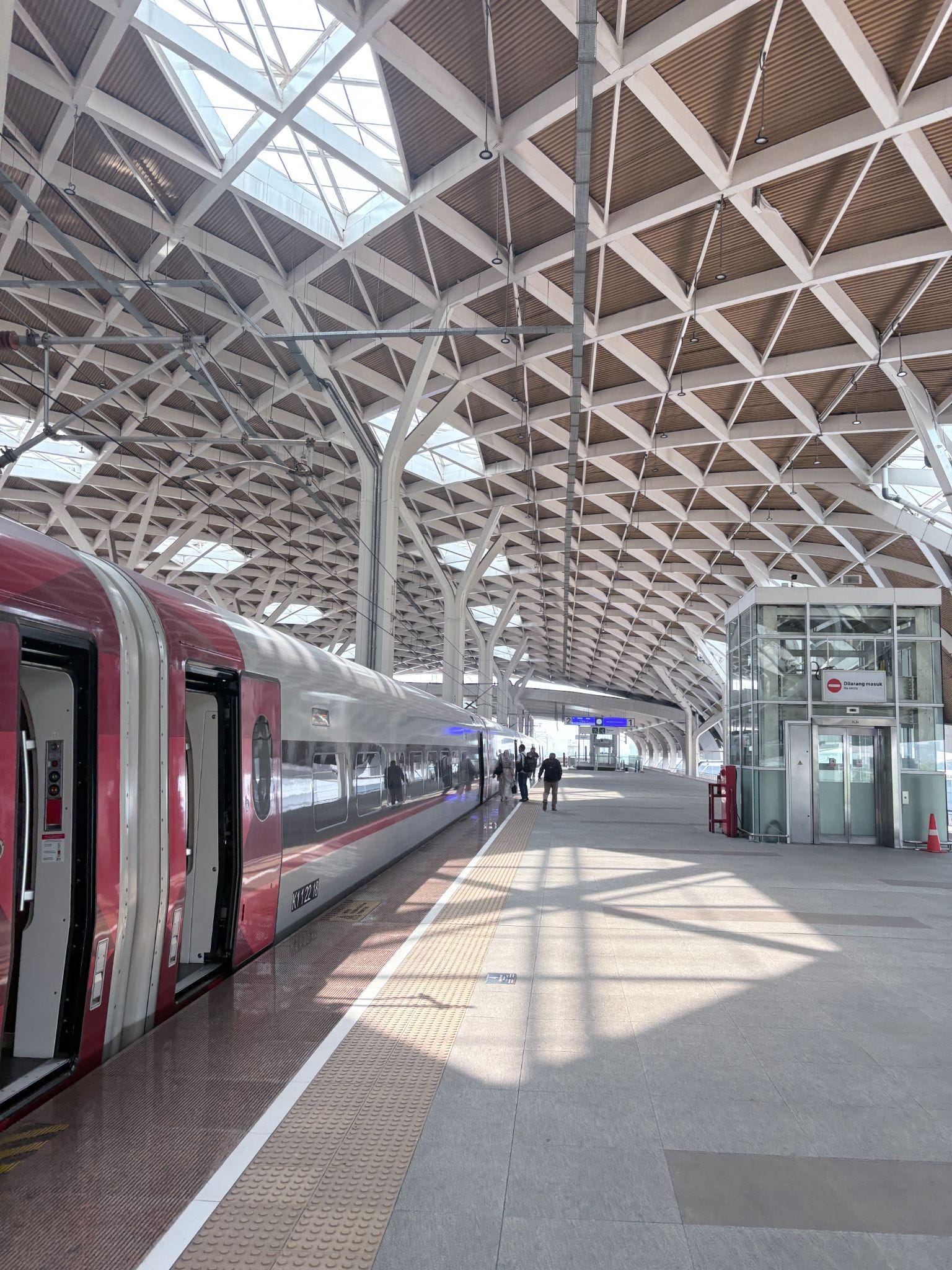
Whoosh is supposed to eventually connect Jakarta with Surabaya on the eastern end of Java. Surabaya is Indonesia’s second-largest metropolitan area; Bandung, for all its college-town cool, is a resort city built by the Dutch. (Imagine building California’s first high-speed rail line only to Bakersfield… Oh, wait.) An Indonesian friend in the US tells me that her compatriots have little faith in Whoosh’s complete vision being realized. It’s drowning in debt to the China Development Bank, underutilized by locals, and too connected to the previous president Joko Widodo’s political legacy.
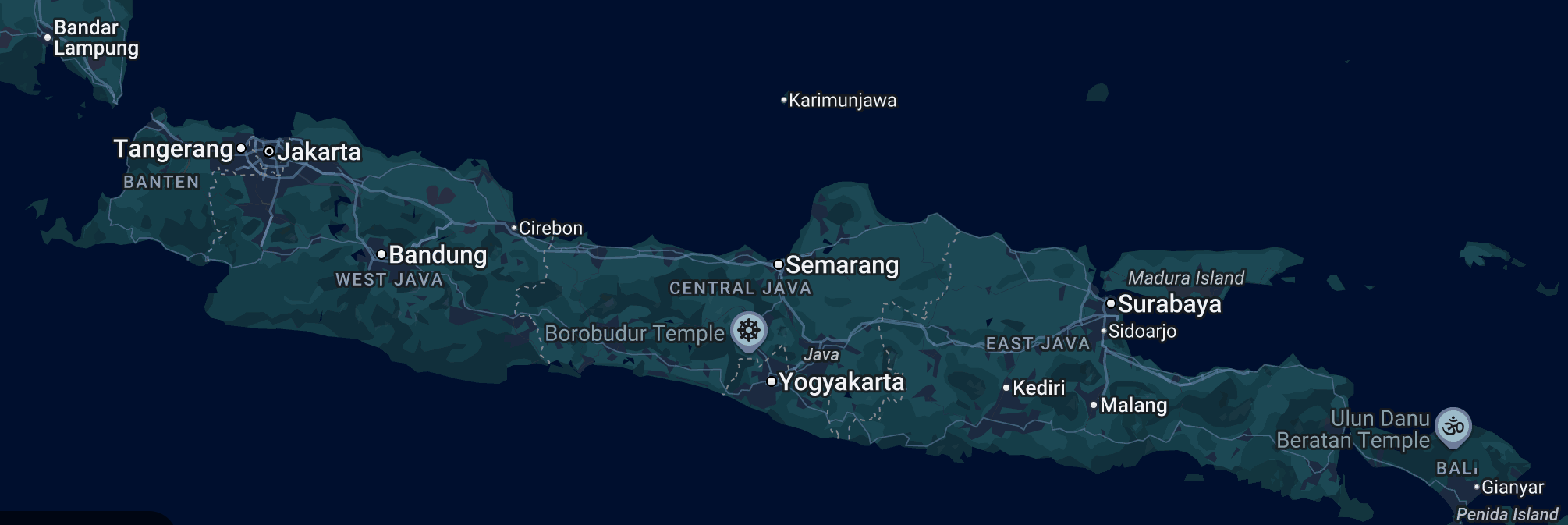
The experience of taking Whoosh is uncannily similar to that of taking HSR in China. Even the seats are exactly the same level of plush. My carriage was 60% empty on a Friday morning, and I was in a great mood as the train whooshed past greenery I hadn’t seen in days since arriving in Jakarta. And just like Chinese HSR, the stop is quite far from the city proper. Travellers must get off at either Padalarang or Tegalluar and transfer to a (free) feeder train in order to actually arrive at Bandung Station.
Cold War fans know Bandung as the host of the 1955 Asia-Africa Conference. Representatives from 29 countries, most of them newly independent, gathered in the West Javan city and drafted a ten-point declaration whose principles eventually birthed the Non-Aligned Movement. Merdeka Building, where the Conference took place, remains standing today. Its exhibit materials are unfortunately thin, but you can still hear a recording of Sukarno’s voice ringing down the very hallways where delegates mapped out a world order after colonialism.
African-American writer Richard Wright travelled to Bandung in 1955 to report on the Asia-Africa Conference. His notes were published a year later as The Color Curtain: A Report on the Bandung Conference. The work gives us perspective on just how wide-ranging the outcomes of the conference seemed, even before its commencement:
Rumours were sorted out, accepted, abandoned. Was it true that the Japanese were going to offer a public apology for their role in World War II? Was Sir John of Ceylon going to carry the ball for the West? Was a Peking-Delhi-Cairo Axis forming? Were the Moroccans and the Tunisians and the Algerians uniting as a bloc against France? Would anyone from South Africa be at the conference to report on the racial tensions there? Would Red China launch an attempt to capture the offshore islands during the conference? What the hell did Nehru think he was doing flirting with Communist China’s Chou En-lai?
Wright, a sensitive chronicler of Black politics back home, picked up on tensions that Bandung’s ideals could not overshadow. The postcolonial developing world had hierarchies and antagonisms independent from their shared international disposition. Industrialization, manufacturing, and technology allowed some countries to climb up the ladder of economic opportunity at lightning speed, while others missed out. More than seventy years later, one of their own is now a superpower, and it — like every other superpower that has ever existed — wants others to pick sides.
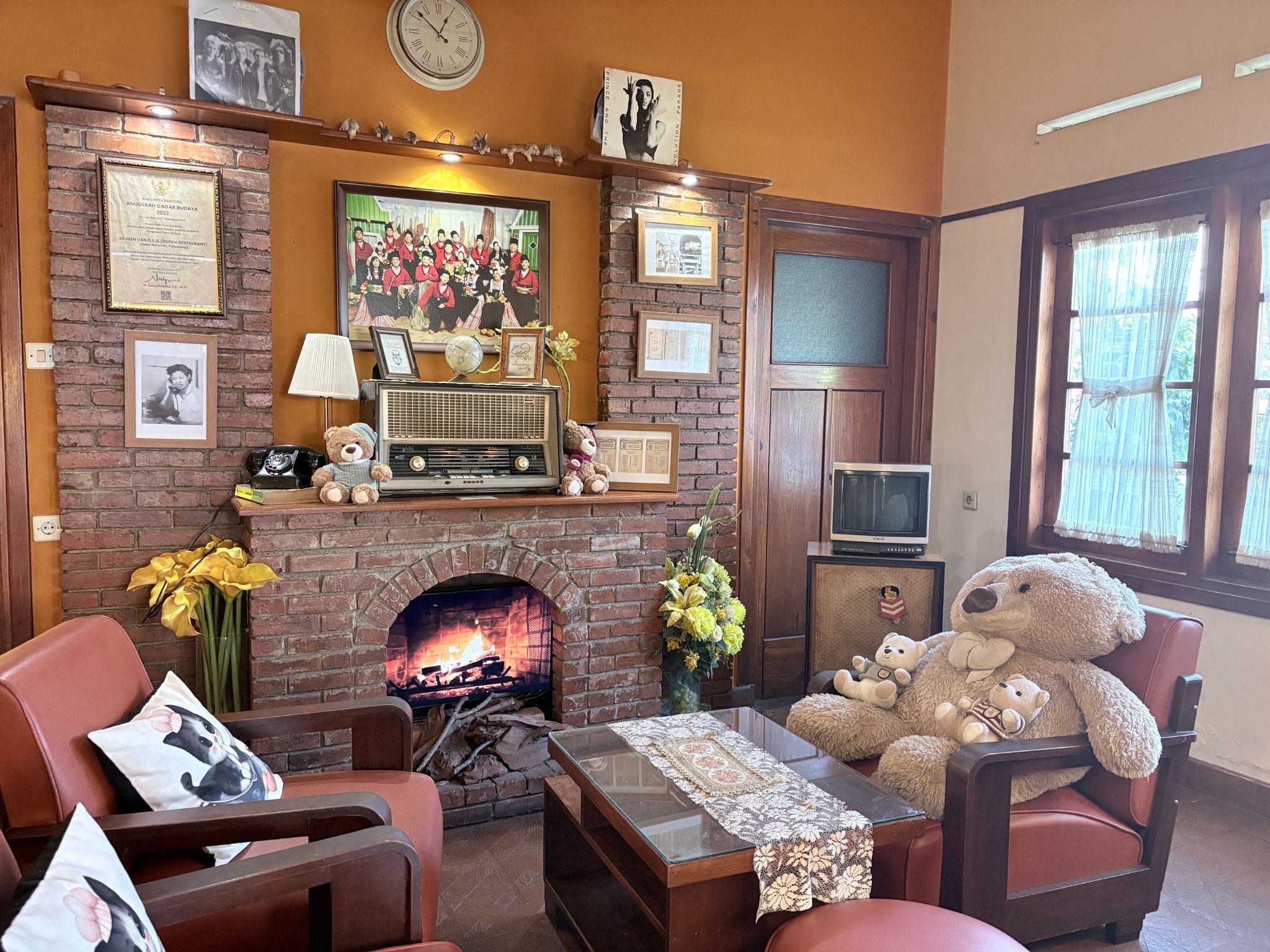
Bandung’s tree-lined streets are easy on the eyes (if no more walkable than Jakarta’s), and I obstinately wandered around while mulling over whether the dream of the Asia-Africa Conference is dead.
Part 5: The Colonies
Indonesians are busy being upset over many things, most of which have nothing to do with their country’s place in modern political history. Their currency is weak, and President Prabowo tried to dismiss the problem by saying that “villagers don’t use the US dollar.” Prabowo’s signature domestic policy, a massive free-school-meals program, is mired in corruption allegations, and the meals keep giving kids food poisoning. He’s starting a new university for civil servants instead of investing in Indonesia’s underfunded public education system. Minorities face particular forms of repression: in May, authorities tried to ban a documentary film about how state-backed bioethanol projects are deforesting Papua, Indonesia’s easternmost territory inhabited by indigenous Melanesians. And last October, Jakarta’s national defense policy declared that one of the main non-military threats facing Indonesia was “the spread of LGBTQ culture.” For what it’s worth, not a single Grab driver I talked to was a fan of the current government.
When I asked a policy researcher at a Jakarta-based think tank whether newfangled AI investments in Indonesia benefit average people, I got a laugh out of him. “You have to remember that many elites are corrupt,” he remarked, “and our internet is not very good.” Batam, an Indonesian island close to Singapore, is a growing hub for data centers, with both American and Chinese companies investing heavily in hyperscaler construction. In July, Indonesia signed on to be a founding member of the World Artificial Intelligence Cooperation Organisation (WAICO) in Shanghai. Dozens of think tank papers pore over the world’s fourth-largest country’s AI policy, development, and prospects. With pretty language and prettier graphs, most of them politely sidestep the possibility that in the short term, this might not benefit most Indonesians whatsoever.
Consider one definition of digitization: making a society, a culture, and/or a polity readable for machines, and then continuing to build that society/culture/polity around the logic of such machines. It’s a process that is largely complete in the developed world, but is still an ongoing, contested process in most other places. And then consider a proposition: the extent of productivity growth possible via AI adoption is a function of the extent to which an economy is accessible for computers. This hypothesis is not the only theory that makes sense, but it is a potential future — and it is one that could undo the path to prosperity that industrialization promised to the developing world.3
Nearly 60% of Indonesia’s workforce is engaged in informal employment. Their daily work is unprotected by labor laws, and their tasks are frequently not documented as the kind of data that computers can use. In developing Asia — exemplified, most recently, by Vietnam’s meteoric rise — the path to high income still largely runs through manufacturing. Barriers to growth are old, familiar ones: weak institutions, brain drain, and exploitation by foreign powers in the name of investment. Does AI change any of that? And if not, how do you convince societies like Indonesia’s that it might matter for their future? The researchers I talked to in Jakarta tell me that frontier models are so bad at Indonesian — a relatively easy language for many humans to learn, and the official lingua franca of 288 million people — it doesn’t even cross their minds to write prompts in Indonesian when they use AI for research.4
Things could go more badly if AI evangelists’ dreams come true. Should productivity really take off in the rich world, there will be ire from people in developing nations who gave up land, electricity, and water for a nonexistent slice of the pie. The charge Silicon Valley will face then will be worse than steamrolling local democracy in small-town Wisconsin: it will be neocolonialism.
In 1879, Thomas Edison invented a long-lasting lightbulb. Today, at least 1.18 billion people still do not have meaningful access to electricity. ARPANET celebrates its 57th anniversary this year, with three quarters of humanity connected online. Only around 16% of the world has used a generative AI tool so far. How long will everyone else wait this time?
Miscellaneous Recommendations
Best food I tried: “Real” satay. Completely different from anything I’ve had in Southeast Asian restaurants elsewhere and every bit as gloriously smokey as one might imagine. Bakmi, Soto Betawi, and Sundanese cuisine get honorable mentions.
Best coffee shop I went to: Filosofi Kopi.
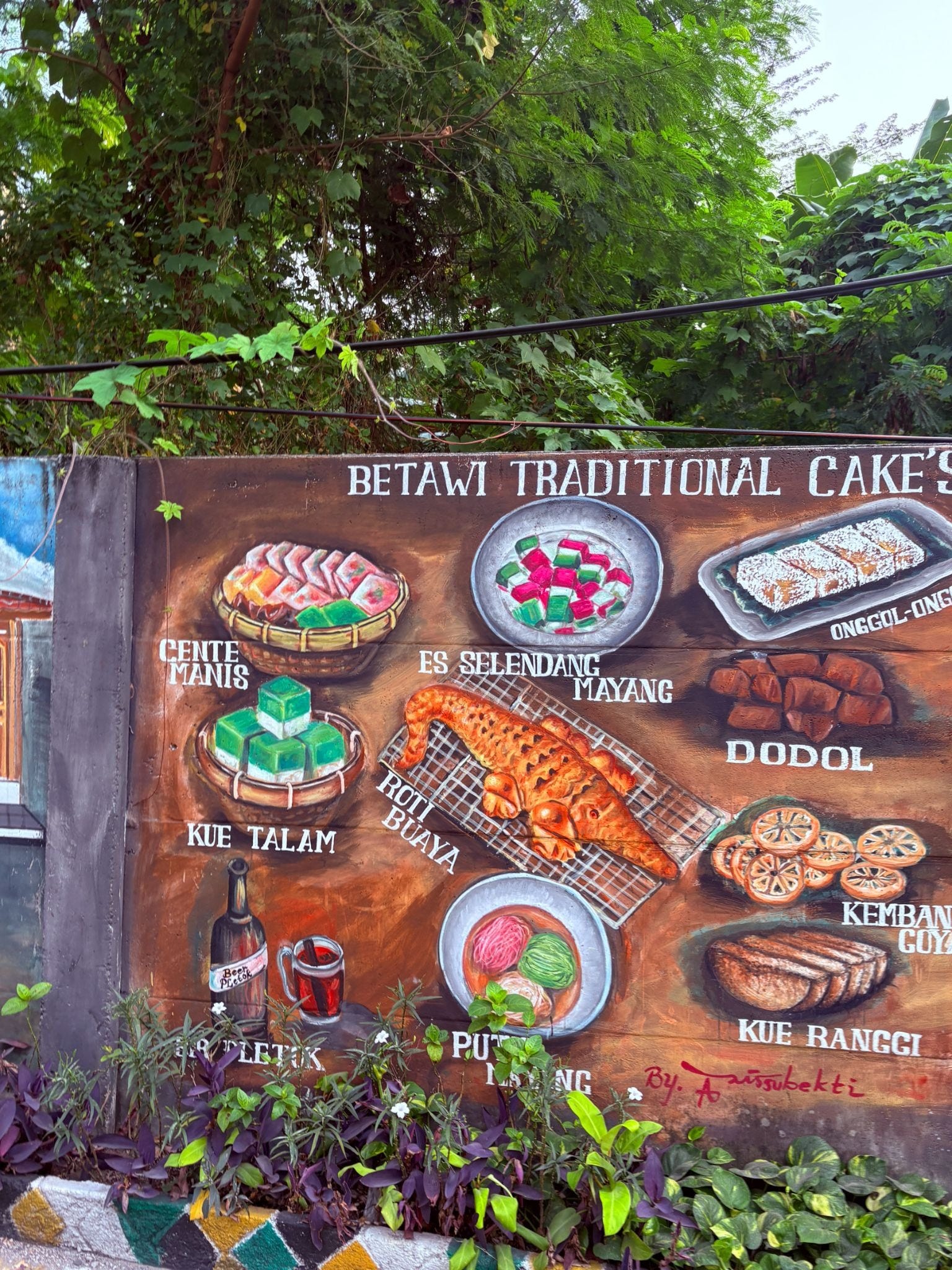
Best unexpected thing: Jakarta’s street art! Here’s one about cake:
Thank you to G, Z, Y, F, J, and all the Indonesian and Southeast Asian friends whose perspectives informed this little blog post. In no way can I do your beautiful region justice, but I hope it’s fun to read a foreigner’s earnest impressions!
Indonesia’s founding state ideology, Pancasila, leads with “Belief in the One and Only God” (Ketuhanan yang Maha Esa), which is broadly understood as a mandate of monotheism. Indonesian law considers a marriage legitimate if it has been “performed according to the laws of the respective religions and beliefs of the parties concerned.” Despite repeated challenges by plaintiffs — the most recent case reached the country’s top court in February 2026 — judges continue to interpret the clause as an effective prohibition of interfaith marriage.
For a deeply-researched perspective on labor conditions in Morowali and Indonesia’s nickel industry writ large, see this article by Indonesian scholar Alfian Al-Ayubby in Asian Labour Review.
I’m drawing on a medley of ideas here, mainly coming from James Scott (Seeing Like A State), Shoshanna Zuboff (In the Age of the Smart Machine), and Nick Couldry and Ulises Mejias (The Costs of Connection). There is also the International Monetary Fund’s report last year, The Global Impact of AI: Mind the Gap. For a counterargument, the World Bank has a new report that makes an optimistic case.
I found this article to be highly informing and interesting. I can't recall the last time I read anything on Indonesia because it is a reporting rarity in the NYT or WSJ
Inni is a fascinating place and people. It is indeed a nation of superlatives (population, Muslims, vast archipelago, and more) that is invisible to most of the world. My first wife was Indonesian-Chinese. The reality of the Chinese in Indonesia (those who have long settled there) is always on edge beneath the surface.