
Zilan Qian is a research associate at the Oxford China Policy Lab and holds a Master’s degree in Social Science of the Internet from the University of Oxford.
The lifecycle of AI, from training to output, has tangled itself around the lives of Chinese illustrators in ways that run in opposite directions.1 The machine was fed their work, learned their expressions, and is now displacing them. And in the process, it has forced them to answer a question that no one expected to become that urgent a few years ago: how do you prove you are human?
The answer, so far, involves courtrooms, livestreams, and job markets. It involves regulatory regimes that strictly govern AI outputs but stay lenient on the inputs, a community that hunts for signs of AI in each other’s work and demands live drawing sessions as proof of humanity, and an education system that trained illustrators to produce exactly the kind of consistent, replicable output that AI does better and cheaper. Ultimately, the question may be less about how to prove you are human than about why that proof has become so hard to give. The answer, I will argue, lies less in what AI learned from humans than in what humans built long before it arrived: an exam system that trains young artists through standardized metrics and repetitive practice, which looks unsettlingly like an AI training pipeline. In the end, behind Chinese illustrators’ attempt to combat AI lies the broader educational infrastructure that makes humans indistinguishable from machines. So what type of expression emerging from that system, if any, would be untokenizable?
This is a story about Chinese illustrators. It is also a story about what we built before AI arrived, and what we are finding out about ourselves now that it has.
Feeding
In December 2023, the first Chinese case addressing whether AI training constitutes copyright infringement was filed by four illustrators against Xiaohongshu to the Beijing Internet Court. Xiaohongshu had been developing its own AI drawing service, Trik AI, which was launched in April 2023 to allow users to “create artworks” by uploading a photo. Four creators discovered that some artwork created by Trik AI looked extremely similar to what they had produced in the past. The illustrators claimed that unauthorized use of their work to train Trik’s model violated their reproduction rights. “All the brushes I used in my art, the way that I portray flowers, they are all from me and with my individual characteristics. But you can see from its art the traits of my art,” said one artist.
Xiaohongshu, on the other hand, argued this was “fair use” under Chinese Copyright Law. As of the available evidence, no judgment has been published. Xiaohongshu removed Trik AI shortly after the case went big, but it has not stopped more and more AI artwork-generating services and platforms from emerging.
Chinese legal scholars argue that China is taking a regulatory approach of “moderate leniency,” emphasizing control over downstream AI-generated content (AIGC) while adopting a more permissive stance toward upstream training. The structure has double meaning for illustrators: not only do they have little legal recourse against their work being fed into the machine, but, as the next story shows, the downstream controls designed to catch AI can end up catching them instead.
Witchhunting
On October 29, 2025, an unusual drawing livestream happened. Rather than showing fans how a work is produced and chatting with them, as normal drawing livestreams in China would, this livestream is a bet-on agreement — betting whether the illustrator who initiated the livestream can replicate their work in real time without using AI.
The illustrator, who goes by “Angel from Mercury” 来自水星的天使 (abbreviated to 水星 Shuixing), had published a commissioned work on Xiaohongshu, which the platform flagged as “may contain AI.” Under AI labelling provisions that came into force in September 2025, platforms are required to auto-detect and flag suspected AIGC (More details on China’s AI labelling system can be found in the explainer piece: Labelling AI-Generated Content in China), but both machine and human reviewers struggled to land on a verdict.2
To dissuade doubts, Shuixing signed a bet with another illustrator, and the two livestreamed themselves drawing to prove their humanity. On the stream, Shuixing did complete a full illustration, but the accuser remained unconvinced without giving further evidence. The whole bet died down unresolved. But this is not a unique case.

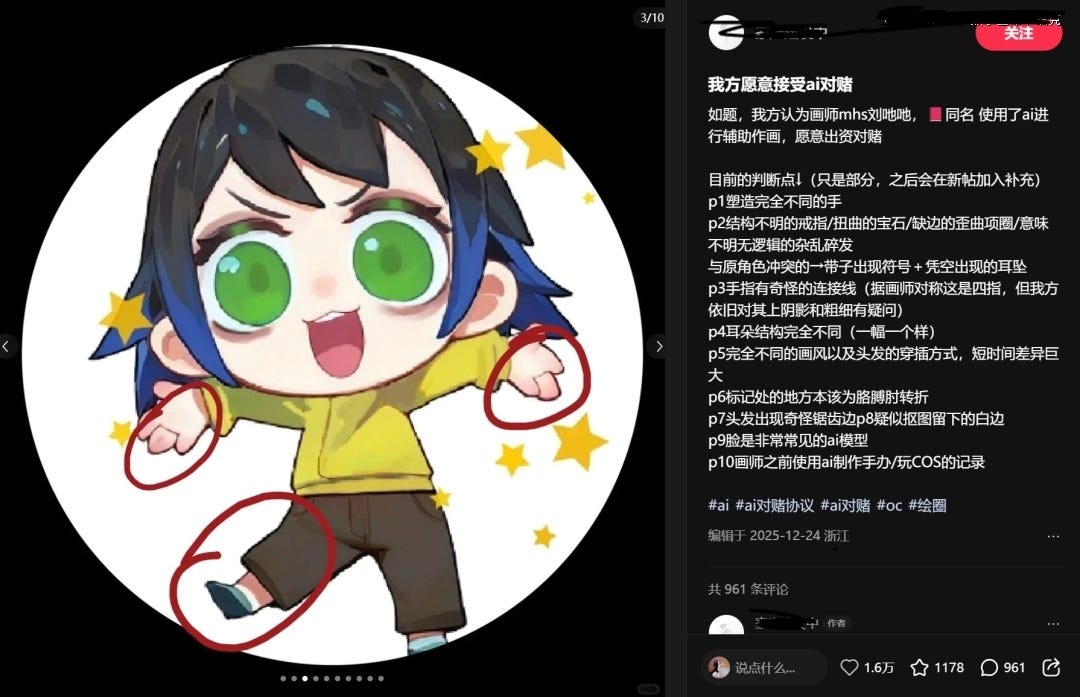
As early as 2022, differentiating AIGC vs. human drawing has become a topic in the illustrator community. Because generative AI relies entirely on the non-consensual harvesting of human art, using the technology carries a heavy social stigma. Under this backdrop, the community started what some describe as a “witch hunt,” which resulted in many big and small bet-on agreements and consequent livestreaming drawing sessions to prove authenticity. “Proving you are a human” has become a norm among illustrators, and showing the process of human hands drawing a picture line by line seems to be the last piece of evidence that humans can use to prove themselves as human.
Displacing
If AI-made art is indistinguishable from human work, whether something is AI or not becomes just one side of the coin. The witch hunt’s uncomfortable flip side is: who needs human labor if AI can do the same?
In May 2023, China Economic Weekly 中国经济周刊 reported on “the first wave of people who got laid off because of AI,” featuring illustrators as an occupation. The article kept a cautiously pessimistic tone. It features several illustrators whose careers were negatively affected by AIGC. At that time, Stable Diffusion and Midjourney had become popular in China, good enough to carry out specific tasks like image generation but not capable of executing other design work end-to-end. Most people were speculating that the status quo capabilities of AI would gradually eat into the workflows of illustrators, both those who were already in the field and students in art academies. “I guess now teachers from academies of arts can not figure out whether they should still select students based on how well they sketch,” said one interviewee. This has increasingly been reflected in changing major options at universities. Chinese universities have been axing majors rapidly — 12,000 were eliminated from 2021 to 2025, with the majority being humanities and arts. Among the 16 majors cancelled by the Communication University of China 中国传媒大学 (CUC) in 2025 are photography, visual communication design, and illustration, the last of which was long considered one of CUC’s flagship programs.
And this is a displacement encouraged by the state. Since 2021, the state has been aggressively pushing “AIGC creation” — including launching various campaigns, competitions, and conferences to encourage people to create films, videos, and pictures using AI — positioning AI as a new creative frontier rather than a threat. Even before calling for diffusing AI in every aspect of every industry in 2025, many businesses have embraced AIGC, which results in job loss for mid-level and junior illustrators. Southern Daily 南方日报 reported that by 2023, many art design positions at game companies had started disappearing. Illustrators used to be very popular among second-tier game companies, but increasingly faced massive layoffs. For years, tech firms have been training specialized AI for game design. And that was 2023: an AI-generated Will Smith could barely finish his spaghetti without eating the fork and his finger.
Some are more optimistic about the future and argue that AI is not an opponent but a tool — humans won’t be displaced by AI, but by other humans who can use AI. In fact, with the state encouraging AIGC, a community of “AIGC artists” has emerged. Some have no arts background and see AI as a democratizing tool that empowers them to create art even without going through the dreadful training needed to graduate from art school. Some other creators who have accumulated years of experience have also switched to AI as a novel method to explore, with some prominent examples like the AI short film by celebrated auteur Jia Zhangke (贾樟柯) and AI-generated “Multimodal Art” exhibition by Jia Hongjun (贾鸿君), a veteran ink painter and professor at the Central Academy of Fine Arts 中央美术学院.
The “Proofs” of Humans
Whether resisting or embracing, feeding or being fed on, all creators are searching for the same thing: a proof of humanity — evidence that being human still means something, and protection against being rendered indistinguishable from AI. Much of what illustrators in China experienced is specific to their context: particular legal regimes, community ideologies, and art education systems. But the struggle of seeking that proof is shared. Are these three common responses — regulation, stigmatization, embracing — as used by the Chinese illustrators in the stories above, enough to “AI-proof” humans?
Regulations
Some argue — and indeed demand — that regulation become the proof protecting humans from AI. Policy is unavoidably helpful, but it is not the proof.
In an ideal world, policy would have acted early enough so that the vast amount of data on the internet — much of which, like illustrators’ artwork and style, should be copyrighted — would not end up in AI training data. But most places, whether China, the US, or the EU, acted too late, or even still have yet to act. Moreover, while copyright seems like the natural candidate as it exists to protect human originality, it in fact protects specific expressions from being copied, rather than the art style itself, which more often is a way of seeing, a visual language, a distinctive aesthetic. And even that narrower protection has limits, as the early US district court rulings have mostly favored AI developers when training data was legally acquired.
In a similarly utopian world, policy could help us differentiate AI output from human output, so that human-made art would not be wrongly flagged by platforms as AI and people would not accuse one another. In reality, however, governing AI outputs is not easy even when regulations are in place. China has built one of the world’s most elaborate AIGC labeling regimes — and as this piece and the other explainer show, the result is a system that suppresses stylistically-consistent human work alongside AI spam, turns proving your humanity into a public performance, and generates evasion markets that are illegal but structurally inevitable. So long as the regulator cannot find a technical solution that is 100% perfect at discerning human vs. AI output — which is increasingly impossible for digital art and writing, where humans may increasingly internalize the style of AI output and vice versa, to say nothing of human-AI co-creation — the public will be stuck forever questioning whether something is AI or not.
Stigmatization
If policy cannot protect us from being fed into AI or distinguish us from it, should we rely on community efforts? Much like the Chinese illustrator community, many other creativity-adjacent spaces, such as Substack writers, have been intensely debating the “AI-like” output. One of the mainstream views on writing, very similar to how Chinese illustrators witch-hunt their peers, is that writing that is perceived to be AI-generated needs to be stigmatized. To quote Substacker-extraordinaire Sam Kriss, “I can tell. I can always tell. You think I won’t notice, but I will. There’s no hiding from me. If you let AI do your writing I will find out, and I will kill you.” The logic behind underappreciating AI outputs sounds valid, especially for human creators. Part of it is that AI output is “nonsense,” as it is viewed as a lack of genuine ideas and thinking process; part of it is that AI itself is bad for creators because it is fed by their works without consent. Regardless of the reason for the stigmatization of AI, the methods are imperfect and dangerous. “I can tell” relies on a very unique human instinct that most reliably lies in native speakers who have interacted with AI for a while — which, although it seems large for certain communities, remains a very small fraction of the world that uses English to write. More ironically, still, is that to avoid being judged as AI, humans start to change their naturally human creative process — avoiding em dashes in writing for now, and maybe changing drawing and filming techniques in the future — which ironically invalidates what they hold as humans having genuinely and inherently different judgment from AI. The witch hunt was supposed to defend a boundary of human vs. AI, but ends up forcing humans to write less like themselves so they won’t be mistaken for the machines they are trying to distinguish themselves from. [Note from editor Lily: you will have to claw the em dash from my cold, dead hands —and if ChinaTalk’s use of the em dash bothers you, you can take it up with Truman Capote.]
Embracing
At the opposite of the regulation and stigmatization that try to prevent AI from coming to humans stands the attitude to embrace the technology. When AI becomes so capable after being trained on human work and resembles human capabilities, using AI, and upgrading yourself, appear to be the very few ways to not be displaced at an individual level. By embracing AI in content creation, Chinese illustrators and other artists can create new genres of art and make themselves more competitive in the market.
This statement of ‘embrace AI’ is vague enough to sound valid. Embrace what, exactly? China is embracing AI by drastically reforming its university programs: cutting 12,000 and adding 10,200 new ones. It seems to equip itself for an AI future by replacing “useless” majors like arts and humanities with AI and robotics, but it is an open question of how AI as a major can itself survive AI progress. Today’s lesson on scaffolding may soon be outdated tomorrow, while suddenly the “outdated” aesthetic taste becomes more important when the world is flooded with “vibe-code-y” websites with beige over-polished user interfaces. It is hard to go all-in on something whose shape no one can yet see: where AI capability will go, what skill it will develop next, or which profession it will kill, and we individuals are just left exploring in the dark and fearing the unknown.
The deeper problem with embracing is the same one that undermines stigmatization: both end up being processes of humans frantically reorganizing themselves around AI, changing behavior in response to a target that keeps moving, and panicking without purpose.
The real problem, in both cases, is what the philosopher Günther Anders called “Promethean shame”: the feeling of inferiority humans develop before their own flawless, replicable machines, and the urge to remake themselves in the machines’ image. Whether we resist AI or embrace it, the underlying process is the same: an internalization of the machine as the reference point. Even those who try to “preserve human distinctiveness” by discriminating against what they perceive as “AI creation” have already let AI define them, as they are no longer creating as themselves but the opposite of a machine.
That “shame,” driving extreme hate or extreme frenzy, makes us purposelessly predict and prepare to change as AI changes. When AI starts to use en-dashes instead of em-dashes, or when the next fashionable job is no longer “harness engineer,” we change accordingly, without asking why — and we end up controlled by AI. Not in the sense that AI outsmarts humans and rules humanity, nor that a US AI or a China AI ends up ruling the world, but that the unpredictability of AI progress (what it will be able to do, how good it will be, when its capabilities will diffuse) and the anxiety it produces control what we learn and how we act. We lose our agency to our own human fear before we lose it to any superhuman AI.
The Mechanization of Humans
But why can we so easily lose our agency to fear — fear of being utilized, resembled, and displaced? Are we on an irreversible trajectory to be consumed by, merged with, and gradually displaced by the technology we built? The reason for the failure of these three methods has less to do with their rigor and more with the false binary of “human vs. machine” upon which they were built. They do not work precisely because the binary is dissolving, and had been dissolving even before AI. Before AI speaks, writes, and draws like humans, humans have already trained themselves to speak, write, and draw like machines, which again can be exemplified by the Chinese illustrators’ journey.
In China, learning drawing is seldom a rosy story of child prodigies embracing free exploration and flying with their creativity. Instead, the pipeline of arts graduates is not that different from the AI pipeline. Like elite STEM students who may be preparing for the International Maths Olympiad (IMO) and gaokao at the same time, most art students walk two tracks: gaokao and yikao (艺考, short for 艺术类专业招生统一考试, the joint exam for artistic majors enrollment) combined determine whether they can be admitted into good academies of arts, with a lower gaokao performance offset by a stronger yikao score.
Just like gaokao, the yikao leaves little room for creativity and ties everything up by metrics. For drawing, the exam is composed of three parts (sketching, charcoal drawing, and color), each guided by a very specific prompt like “draw an old man in a jacket sitting still” and graded against very specific metrics. Many students rely on tutoring organizations with guidebooks and intensive crash courses (美术艺考集训班), some of which have students drawing 14 hours a day for months alongside their gaokao study. Most of that training is repetitive work to refine skills rather than free-flow creation, which is exactly what AI is good at displacing. Very similar to how other students prepare for the gaokao, yikao students wake up at 6:20 and go to the studio, take 10-minute breaks each for breakfast, lunch, and dinner, and spend the rest of their time switching between the three subjects tested in the exams until finishing the last class at 22:30. Some continue to draw in dorms before they sleep.
But not everyone walking this pipeline wants to be an artist. Whether a stereotype or reality, a fair number of students choose the arts simply because they see no future in doing gaokao. As a teacher of sculpture at China Academy of Art (CAA) in Hangzhou, one of the two top academies of art in China, observed: “Lots of people are actually gifted in art; their talents have just caused them to drift away from the measurement standards in the academic system.”
Moreover, this is a system that builds upon a very specific version of meritocracy, where efforts are graded under extremely standardizable metrics, which in turn cultivates extremely automatable skills. The grading involves four rounds, with the first pass through tens of thousands of papers being graded through zouma guanhua “走马观花” — glancing something very quickly without enough care — as teachers sort drawings into qualified and unqualified based on immediate visual impact: whether the light-dark contrast reads from a distance, or whether the composition snaps into legibility. After the first pass, four rounds of iterative re-ranking follow, where papers are sorted into score bands and then repeatedly reviewed, with those that seem too high getting moved down one band, and those that seem too low getting moved up one. The process continues until every paper has settled into a score that a majority of examiners agree on.
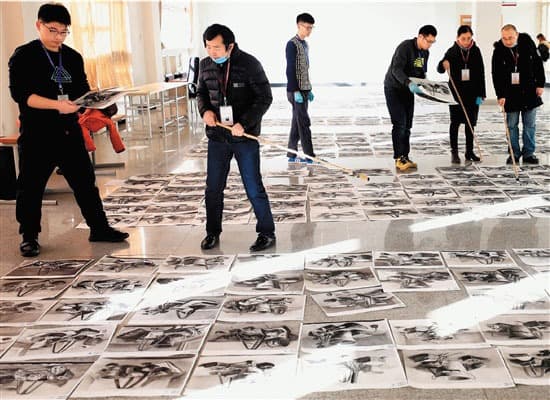
When the system needs to select from the masses and present itself as fair, metrics become a benchmark, people become “skills,” and the purpose of life becomes utility to society. Students are trained on past exams to predict the next one; exam scores become the benchmarks; a good university degree is the reward of doing things correctly, and ultimately, one becomes useful because they possess certain skills. Everything sounds scarily similar to how you train an AI, even the grading of the yikao artworks: a fast first pass filters for general legibility is not unlike how pre-training data is culled for quality at scale; the rounds of iterative human re-ranking converging on consensus scores look similar to multi-pass annotation with inter-rater calibration; and the highest scores go to yikao students who have most precisely internalised what the system rewards, which is the same for AI models.
Back in 1967, American historian Lewis Mumford argued that the first machines were made not of metal but of humans, with armies, labor gangs, and bureaucracies that organized people into standardized, interchangeable parts. Calling it “megamachine”, he pointed out that the structure existed as early as the pyramid age, long before the machine as a concept concretized. The art exam system in China is one megamachine: students are trained to operate “as a single mechanical unit of specialized, subdivided, interlocking parts” — a skilled sketcher or a practiced illustrator, who operates rather than creates. As the famous Mao-era propaganda phrase went — “be a screw” (做一颗螺丝钉). And a human screw can be displaced by a real screw.
Thus, what enables AI to displace humans is not AI itself — it is a process of mechanization that long preceded it. We built governance regimes that protect output over process. We judge content based on tractable traits rather than originality. We designed education systems that train replicable skills over genuine creative vision. Long before AI arrived, we were already valuing output over process, evaluating humans against standardized benchmarks, and rewarding the kind of consistency that machines would one day do better and cheaper. We trained humans like we train AI. It should not be surprising, then, that telling them apart is becoming so hard — or that the machines, having learned from us, are now teaching us what we valued all along.
Subscribe to Zilan’s Substack!!
Acknowledgements:
Zilan is grateful to Conor McGlynn, Afra Wang, Amber Hu, and Kayla Blomquist for their feedback on earlier drafts.
The author acknowledges the use of LLMs for brainstorming and copy-editing, and hopes the readers don’t mind em dashes that are genuinely typed by humans.
Illustrators (插画师) are a young profession, scaled by the emergence of the internet, mobile networks, and social media. Game studios commission character art and key visuals; web-novel and light-novel publishers need covers at speed; and anime and manga studios need illustrations for building IP. There is also a creator economy on Xiaohongshu, Bilibili, and Weibo, where individual illustrators built followings of hundreds of thousands, selling commissioned work directly to fans. Most work freelance or on short contracts.
Many platforms use AI to detect AI-generated content. But as AI gets better and better at resembling humans, and humans adapt more AI-generated raw materials in their creations, it is now increasingly harder for even AI to differentiate what output is itself versus humans.

Very good article, Zilan! The yikao process is viciously intense, and it's no less dehumanizing or creativity-stifling than the standard gaokao. I'm glad you shone a light on that. Because even before AI, art students and illustrators were "mass-produced," with most creating "replicated" work. I could go on about the lack of originality in China's overall entertainment industry, where 99% of these illustrators end up. AI has basically torn down the last bit of the facade maintaining that fragile stability. Real food for thought. Love your work!
Great post and subscribed to Zilan! Really enjoy guest posts like these that give a flavor of some of the societal debates in China.