
On November 16, BIS finally issued its long-delayed rule on rental compute, a rule the policy community has been clamoring for in the past year. The interim final rule (IFR) has some rough patches and minor issues that will hopefully be fixed in the coming weeks, but it is important to stress that this is a landmark rule that will significantly alter the trajectory of China’s AI progress. By cracking down on compute that Chinese labs access in overseas data centers, particularly in Southeast Asia, China’s overall compute supply can be significantly constrained — that is, if Commerce actually enforces it. Treasury and the National Security Council gave Commerce a strong tool, but one week later, Trump has successfully pressured Nvidia’s board to reinstate Jensen Huang, who stepped down amidst a diversion and espionage scandal that still has yet to be resolved. Whether Commerce enforces this rule is now up in the air.
In today’s article, we’ll walk through the rule’s impact by discussing:
What the rule actually does,
How much China currently depends on remote access,
How many months of compute lead the rule buys the US,
Why Xi might not mind,
And what needs to happen for the rule to achieve its desired goals.
A brief overview of the rule
The Nvidia debacle has brought fresh attention to Commerce, particularly Howard Lutnick,1 who is accused of stalling a crackdown on chip diversion. With Commerce under pressure to enforce, on November 16, BIS finally issued its long-delayed rule on rental compute (effective November 19), though the rule was “written by and at the direction of the Department of Treasury and the National Security Council.”
The rule requires a license to supply chips to any data center abroad that gives Chinese companies access to more than a very small cluster’s worth of compute (roughly equivalent to 760 H100s).2 Covering both Hopper- and Blackwell-class chips, the rule counts firms whose ultimate parents are Chinese, as well as intermediaries knowingly serving them. Any data center that does not answer know-your-customer (KYC) questions is treated as potentially in violation. Currently the rule does not cover data centers located inside the US, so a Chinese firm renting in Virginia is not covered, but we expect this to be clarified.
Existing providers must obtain licenses within ninety days or face future export restrictions. BIS expects about a hundred more license applications each year, all of which will be reviewed on a case-by-case basis, with no stated factors. The rule also requires licenses for any advanced AI chips shipped to Indonesia, Malaysia, Singapore, Thailand, or Brazil in an attempt to limit chip diversion. Shipments to buyers headquartered in the US are exempted from this requirement if the exporter reports them monthly. The Commerce rule also closes the Foundry Due-Diligence (FDD) loophole, a self-certification route that lets foundries and packagers clear advanced chips for Chinese designers without a license.
One-fifth of China’s AI compute comes from remote access
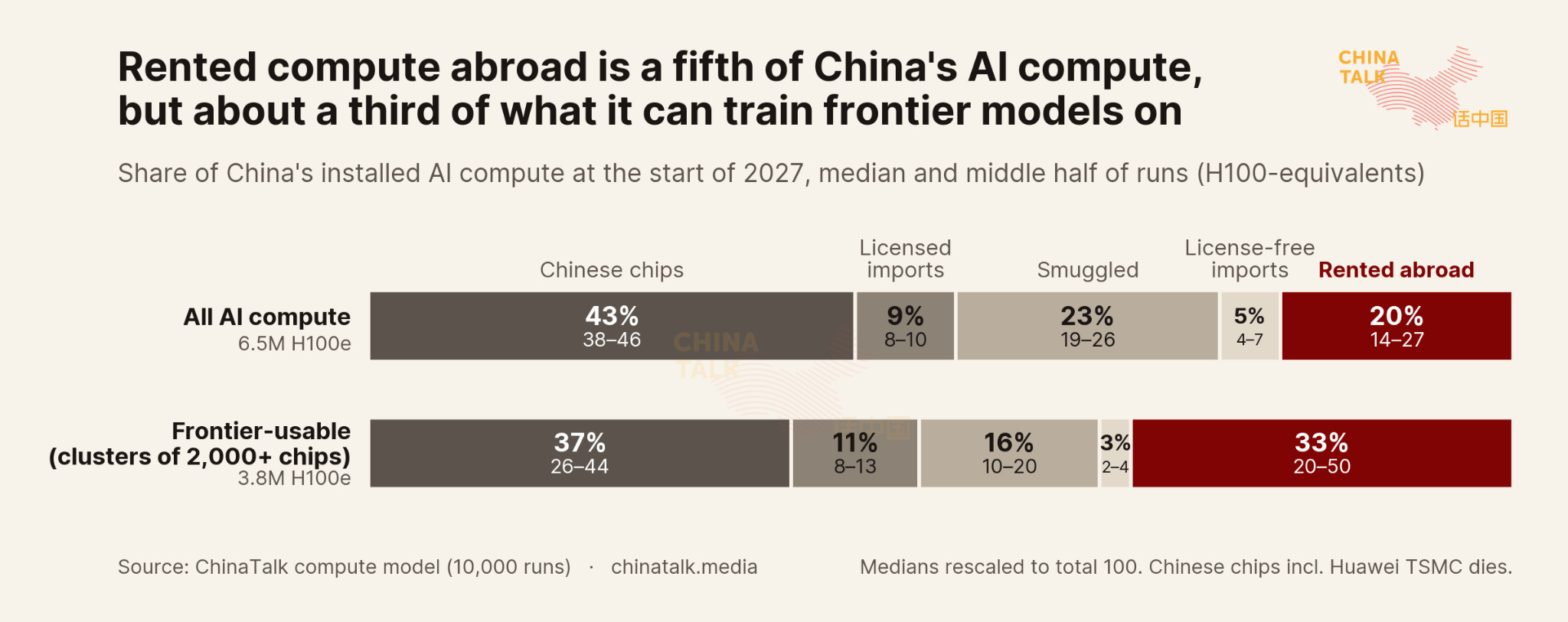
In April, we estimated remote access to be more than a third of all of China’s compute. With our new model of Chinese compute, we estimate that remote access accounts for roughly a fifth of China’s compute supply as of November 2026.3
The rental compute rule targets the compute that Chinese labs are already using for frontier work; a new analysis by Will DePue, formerly of OpenAI, suggests that six leading models from four Chinese labs carry the fingerprint of Blackwell chips, which they can only rent or smuggle. Likewise, rented chips exist within much larger clusters than domestic output does. When we restrict our focus to just the compute that China can use to train the most advanced models, rented clusters rise to a third of China’s frontier-usable compute by our model estimates, the equivalent of roughly 1.2 million Nvidia H100 chips. For some perspective, that amount of compute is roughly the amount of compute Anthropic was using by the end of 2025. These numbers should be taken as illustrative, not gospel, but it is undeniable that remote access is not a token amount of Chinese compute.
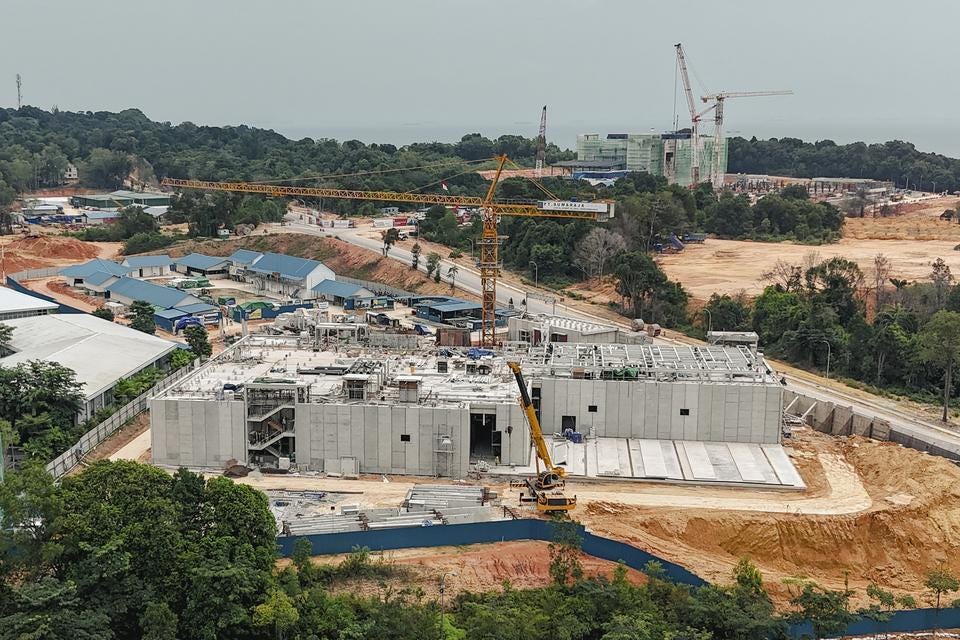
By our count of Epoch’s data, the Johor and Batam sites that Epoch links to Chinese tenants added about 0.7M H100-equivalents from January to October of this year. Johor is by far the most important location in the Chinese rented compute story. Roughly 94% of the overseas compute that Epoch tracks at sites linked to Chinese tenants is in three Johor sites: DayOne’s Nusajaya and Kempas centers and Bain Capital-backed Bridge Data Centres’ MY06. Most of the rest is Oracle’s Batam site in Indonesia.
After US officials expressed concerns, Oracle cancelled a reported five-year lease of 100,000 chips to Tencent in early November. Before the release of this new rule, SemiAnalysis had predicted that overseas leasing by Chinese hyperscalers would double by 2029, reaching nearly 4GW, which is still small compared to the 56GW of expected data center capacity in the US by the end of 2026. The November 19 House disclosure revealed that ByteDance and Alibaba applied for 1.12M H200s for their own data centers in Malaysia, Indonesia, and Thailand, but BIS returned all applications without action. Had these applications been approved, they would have added roughly as much compute as China’s entire rented pool.
The impact of eliminating the FDD loophole is harder to measure than the remote access rule, and our model does not attempt to quantify it. It is unclear to whom BIS will grant licenses when OSATs and fabs apply for approval; however, it is clear that some chips will be delayed if not entirely denied. According to the Financial Times, TSMC and Samsung have both begun to pause shipments of chips to ByteDance, Baidu, and phonemakers like Xiaomi (which has had Washington lobbyists on retainer since it sued its way off the Pentagon’s 1260H list of Chinese military companies in 2021 and recently added former Trump adviser Bryan Lanza to their ranks). While we imagine that phone chips will eventually be approved for the most part, BIS has a track record of being remarkably slow, with license processing time rising precipitously in the last few years — a risk in itself for China’s smartphone supply chain. The jury is still out on Chinese data center chips. We may also get more clarity in the coming months on the extent to which the FDD loophole was being exploited, as fabs and OSATs conduct due diligence and uncover potential Chinese end-customers.
It will be interesting to see how Chinese labs attempt to make up for this lost compute in the immediate aftermath. Will they start to rent compute en masse from Virginia data centers? Will efforts to steal model weights or gain information on algorithmic progress from American labs intensify? It remains to be seen, but by using the compute lever, the need for good opsec at American labs has only increased!
What the rule buys the US
While the rental rule applies to roughly a third of the compute that Chinese labs can train on, the question is how much this actually extends the US compute lead. We measure this via months of compute delay — how much later the compute available to Chinese firms reaches a given level than it would have without the rule. For example, a three-month delay would mean that China takes until June to reach the level of frontier compute that it otherwise would have reached in March. This counts installed compute (including rentals abroad) in clusters of more than 2,000 chips, as frontier training requires large clusters.4 Our model reflects only compute and not capability — the gap in model capability is likely narrower than that in compute due to the second-mover advantage, distillation, and the potential for stolen weights. However, even deploying distilled or stolen models at scale requires compute, and the rule’s threshold is low enough to catch large inference deployments too.
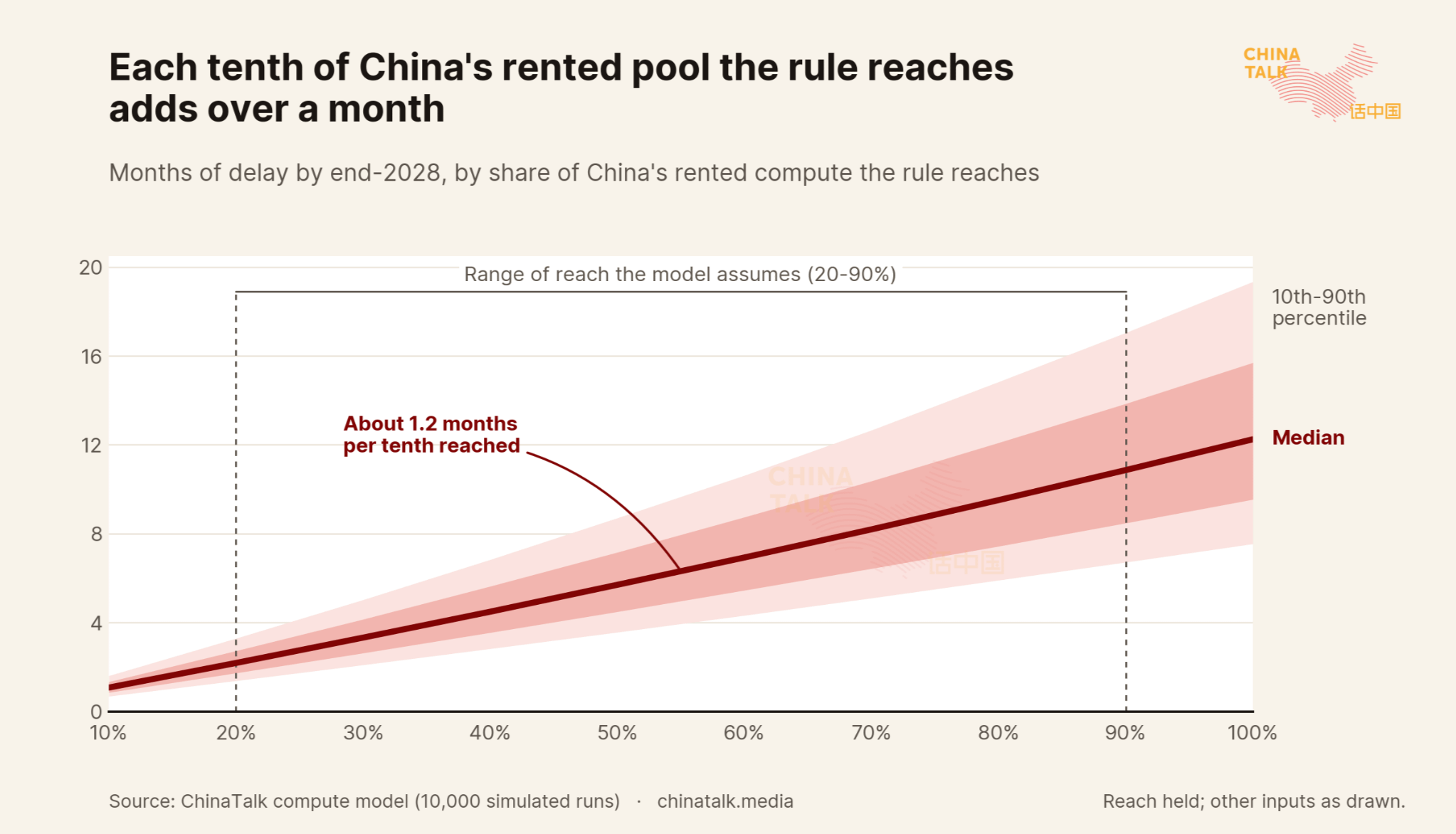
The effectiveness of the rule is deeply dependent on its reach, which is the largest unknown in the model. This explains about half the spread in the results. As modelled, for every additional 10 percentage points of China’s rented compute that the rental rule actually stops, it delays China’s frontier compute by a bit more than a month by the end of 2028. Effective reach is a function of the rule’s scope, the approval rate, and the leakage.
We estimate that the rule’s legal scope covers nearly all of the visible Chinese rented frontier compute, (and again, the bar is set low enough to even catch large inference deployments).5 The rule does come with a specific carve-out, requiring no license if the compute is used exclusively for “commercial recommender systems.” DayOne runs the two largest Johor sites, and 69% of its revenue comes from “a global technology company with a leading short-form video platform” — likely ByteDance in our view. While the carve-out is clarified to include only compute used to rank, filter, or suggest rather than generate, the interpretation and verification of this wording is entirely up to BIS. This is one of the main ways that implementation could fall to the low end of our range. As Chris McGuire said on last week’s emergency podcast, “if that’s implemented broadly, it could become a loophole you can drive a Mack truck through.”

A second problem is leakage. The recent revelations about Megaspeed have made abundantly clear that the same channels that this rule will police already leak, and capacity reaches Chinese firms through seemingly innocuous intermediaries. Commerce and the Justice Department have confirmed a criminal probe of Megaspeed, which has reportedly bought at least $7.5 billion of Nvidia chips and was at one point slated to rent 68.4 MW of capacity in Malaysia from Bridge. Separately, a New York Times investigation revealed that Aivres, the US arm of Chinese server maker Inspur, had sent more than $5 billion of US technology to data centers in Southeast Asia that serve Alibaba and ByteDance. The H200 application list released on November 19 by the House Foreign Affairs Committee showed that every application, filed by Nvidia and AMD, marked a “low” risk of diversion despite public reports flagging several of the installers as probable violators — two of which committee chair Brian Mast called “fake companies.”
The president, however, does not seem to think that diversion through intermediaries is the seller’s problem. On CNBC, Trump said that if Nvidia chips sold to Megaspeed reached China, it “wouldn’t be Jensen’s fault,” despite the fact that Mr. Huang’s paramour was a Megaspeed executive in contact with the Chinese Ministry of State Security. Trump seems to care little for export controls. As he put it, Nvidia is “in the business of selling chips, and if he sells them to somebody else and they go out and sell, that’s a problem that they may have into the future. Who knows?”
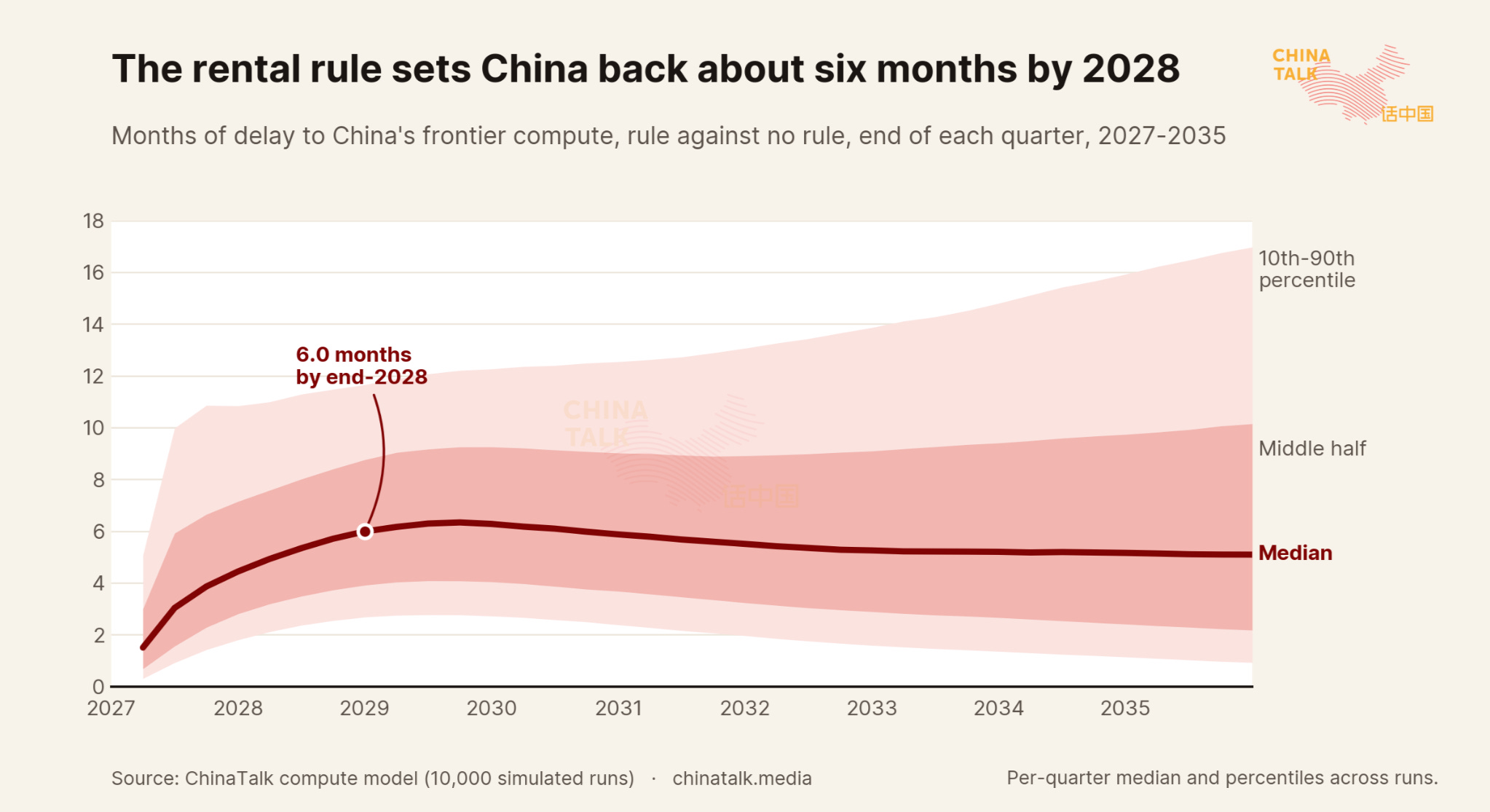
If Commerce actually enforces this rule — and this is a big “if” — our central estimate of the rule’s effective reach is roughly 55%, which assumes that BIS predominantly rejects license applications in the case-by-case reviews. At that reach, the median run sets back modeled Chinese frontier compute about six months by the end of 2028, and the middle half of runs ranges from four to nine months.6 If you are AGI-pilled and think that recursive self-improvement is coming soon, the rental rule works on the timeframe that matters the most to you.
Costs
While some have argued that a rental rule will cost US cloud providers revenue, this is probably a relatively temporary and modest problem. Chris McGuire said on our podcast last week that the day the rule dropped, “multiple AI labs contacted me this morning asking who is most affected by this so they can call them and get access to the compute. There’s that much demand.”
When the October 2023 rule cut off a fifth to a quarter of Nvidia’s data center sales, other buyers more than made up for that gap within three months. After a Malaysian operator dropped Megaspeed following a US probe into suspected chip smuggling, it re-let all 68.4 MW to another firm, Zenlayer. The market is tight right now. H100 rental costs have risen about 55% since December 2025, so freed clusters should be re-let within a few months. If the market turns to glut, it could potentially take longer, though this seems unlikely given the current trend. This idle time before a new tenant, the discount offered to new tenants, and the small percentage of hardware that never re-lets would mean that US operators forgo around $1.5 billion a year by our own estimates, and foreign operators lose out on a bit more, but lenders have already pushed operators in this direction. Since late 2025, bankers have been backing away from deals that give Chinese users remote access to US chips.
The argument that a rental compute rule will drive Chinese labs to innovate more on domestic chips also falls flat. China’s momentum does run in that direction — domestic chips accounted for 41% of China’s AI accelerators in 2025, up from under 17% in 2023 on a separate analyst’s estimate. But this domestic volume is capped by fab capacity, yields, and high-bandwidth memory far more than willingness. China had more than enough motivation to build domestic compute long before this rule came to be. Roughly 600,000 H200s are reportedly sitting in warehouses in Hong Kong because Beijing has blocked their import, partly to push buyers to domestic chips. Demand for domestically-fabbed chips jumped in 2026, and Huawei and its rivals raised prices by a fifth to a half. Production volume also rose, but not nearly enough to compensate. By our reading, total volumes shipped increased from under a million Ascends a year to perhaps a million and a half — still far short of what Chinese labs wanted. Domestic share is definitionally a ratio (domestic/total), and when Nvidia access was cut, the numerator increased slightly, but much of the increase in the ratio was driven by the denominator shrinking.
How will China respond?
Most of the agreed-upon easing of the Chinese controls in the Busan truce have been formally extended to January 10, 2027, but the suspension of the gallium, germanium, and antimony ban to the US is still set to lapse on November 27, 2026 unless MOFCOM renews it beforehand. Trump and Xi met at APEC in Shenzhen on November 19, the day Commerce’s new rule took effect, but Xinhua’s readout does not mention chips. Beijing’s Foreign Ministry Spokesperson Guo Jiakun 郭嘉昆 called the rule “a classic example of economic coercion and long-arm jurisdiction” 典型的经济胁迫和“长臂管辖”, and warned that China would take necessary measures to resolutely safeguard its legitimate rights and interests. MOFCOM went as far as to say that the measures depart from the important consensus reached by the two heads of state 背离两国元首达成的重要共识 and that China will take countermeasures if the US insists on going its own way 若美方一意孤行.
It is unclear how China will respond to these new restrictions. Chinese firms are already stating the rules will slow them down significantly, but they don’t make the ultimate call. Beijing has generally preferred its companies to prioritize domestic chip usage, going as far as to withhold approval for hundreds of thousands of Nvidia chips in Hong Kong warehouses. The new Commerce rule may actually just settle the argument within the Chinese government in favor of the self-sufficiency hardliners who are willing to stomach a short-term slowdown in algorithmic progress and economic pain in the interest of full semiconductor independence.
However, the actual enforcement of the rule may change the calculus for China’s leaders. Huawei’s 950DT prices are up 20-50% due to HBM shortages, and SMIC’s fabs were running at 97% utilization in Q3 2026. Chinese model-maker stocks have already tanked, and if restricting remote access begins to obviously widen the gap between Chinese and increasingly powerful American models, the government may realize that self-sufficiency is a fool’s errand in the short term. Xi may change his tune and allow the Hong Kong chips in — or consider retaliation to get the rules reversed and/or slow down America’s AI buildout. The US government must consider the measures at China’s disposal, including restrictions on rare earths, batteries, optical interconnects, PCBs, and other server components.
If you are in the US government and would like to speak with us about our modelling of Chinese retaliation on American compute buildout, please reach out to quinn@chinatalk.media.
Will BIS actually do anything?
This is a monumental rule that can drastically advance America’s lead in AI over China. However, a rule is just a piece of paper; BIS needs muscle to translate the policy into action. Enforcement officers and license reviewers are few, and the new rule also invites a flurry of licensing applications from chipmakers to chip buyers. To keep up with the pace of applications and accurately enforce the rule, Congress needs to grant BIS more funding. The budget request for next year includes a near-doubling of BIS’s budget to $450 million total; that budget can accommodate nearly 290 more officials to conduct enforcement, find leads, and review license applications. This budget seemingly has the approval of the House, but the Senate lowered its recommendation to around $415 million. Still a big leap from last year’s $235 million!
Besides money, BIS needs to find the courage to deny worrisome license applications and go after violators. The House Foreign Affairs Committee recently released instances of BIS approving applications for hundreds of thousands of high-end AI chips to companies like Alibaba, Tencent, and Baidu.
Since the rule dropped, signals from the administration have been discouraging. On November 23, Nvidia’s board reinstated Huang just six days after claiming that it had no intention of doing so. In its announcement, the board cited “input from senior levels of the United States government.” This input appears to have been Donald himself — he told CNBC that he convinced the board himself and described Huang as “exonerated,” though the Justice Department has said nothing publicly. When asked if Nvidia’s stock drop had influenced him, Trump replied, “Probably so.”
Commerce did not write this rule. Treasury and the National Security Council did. The New York Times reported that Lutnick had pushed for a much narrower version that would have ultimately spared a Malaysian data center developed by a client of his family’s financial services firm. That version of the rule would have focused only on future shipments to a set of seven countries and required only notification rather than licenses. Per Axios, Lutnick stalled in adding Megaspeed to the Entity List three times even after Trump approved it, though Commerce denies this point. Despite all this, Lutnick appears to be here to stay, especially after he donated $25 million to Trump’s presidential library fund.
Lutnick, and the president to whom he answers, control how BIS enforces this rule — if it does at all. He can choose how generously Commerce reads “exclusively” in the recommender carve-out and how readily it approves case-by-case licenses. Commerce now has a tool to limit China’s access to AI compute. Whether Howard Lutnick and Donald Trump decide to use it is an entirely different question.
Lutnick agreed to testify before the Senate Banking Committee on December 10, and Reuters reported on November 12 that the White House was discussing his exit, but Trump said on November 16 that he would keep him.
Our estimate for H100e based on the rule’s threshold of 12M aggregate TPP.
The main revisions to the calculation include a better smuggling estimate guided by Epoch’s work, a deeper analysis of Chinese domestic chip production, and a recalculation of the ByteDance-Johor cluster based on IFP’s work. At its core, this model is a stock-and-flow simulation of the installed AI compute in China and the West. The simulation steps forward through time at quarterly granularity and is not a game-theoretic model. A quarter’s stocks is calculated from the previous quarter’s stocks and the flows. We run the simulation across 36 quarters, from 2027Q1 to 2035Q4. Neither the future, nor much of our understanding of the present is defined by fixed values. Thus we use a Monte Carlo method. To learn more about the ChinaTalk compute model, reach out to quinn@chinatalk.media.
Basis: Rule against no rule with 10k runs, not factoring in retaliation. The model starts in 2027Q1 (the quarter in which the 90-day window ends), so it does not include any new leases that BIS blocks in late 2026. The model’s gap estimate is thus slightly conservative.
This could potentially be a problem in and of itself. Wider scopes often mean greater leakage, though we do not factor this into the model.
If we count every chip, rather than just frontier clusters, our central estimate drops to roughly 3.5 months.