
Welcome to ChinaTalk, Odyssey edition. Justin and I had so much fun with Roel, an Oxford Ancient Greek war professor, last week that we’re back for part two. We review Christopher Nolan’s The Odyssey and discuss:
What works in Nolan’s Odyssey and what doesn’t, and why it succeeds, even where it departs from Homer.
What modern adaptations get wrong about ancient Greek morality, from heroic violence to hospitality.
Why the Trojan War was not about trade routes, and the problem with trying to “rationalize” myth.
How Greek cities actually fell in war — from Trojan Horse–style deception to historical siege tactics.
Whether ancient soldiers suffered PTSD, why the Sea Peoples didn’t cause the Bronze Age collapse, and what an archaeologically faithful Odyssey would look like.
Plus, why Roel keeps defending Troy (including the case for Brad Pitt as Achilles) and the Homer adaptations we'd make ourselves.
Listen now on your favorite podcast app.
Nolan’s Odyssey and Homer’s Morality
Jordan Schneider: Roel, what did you think of the movie?
Roel Konijnendijk: The poem is 12,000 lines — way too long to be one movie — so you have to make choices about what to keep and what to leave out, and those choices have to be sensitive to what the story is trying to say. On the one hand, Nolan was keen to preserve some of the original tone, beats, scenes, and set pieces, and all of those set pieces are at the very least competently done — in some cases really memorably done. But he also had to make changes, and the way he did that was often quite effective. The adaptation choices worked, including the way they changed the themes of the story. There’s a core message to the whole movie that is not Homeric in any sense, but that does work with the material.
In that sense, it’s similar to The Return, the movie that came out two years ago with Ralph Fiennes and Juliette Binoche — a much more low-key, down-to-earth, low-budget version of this story. It’s very stripped back, but it also tells the story with a much more modern morality, drawing on the material in a very effective way. It shows that this poem can still accommodate totally new readings of what it’s about. I really liked that part of this movie as well — the way they made it about the idea that Odysseus doesn’t want to go home. Why is that? What is he running away from? What makes him feel like maybe he’s not a good man ready for a triumphal return? That’s a really interesting theme they overlaid on the story.
Jordan Schneider: Let’s start there — this idea of a modern morality versus an ancient morality, which is where a lot of the discourse has centered over the past two weeks. What do you mean by that? And to what extent are we just — well, Thucydides says humans are the same always, right?
Roel Konijnendijk: Yes, but human society and human values are not always the same. Thucydides gives some great examples when he criticizes Homer for the things he got wrong. Ideas change about how people are supposed to behave. One thing I didn’t really like — Emily Wilson also pointed this out — is that these characters have been modernized in a lot of ways. Their morality has been modernized. This is a weird thing to say, but I really liked it when they threw a puppy off the cliff at the beginning. That one brief moment illustrates that this is not a world like ours — the morality here is different. They treat the world around them differently. But that idea wasn’t followed through. The movie didn’t stick with the notion that these people think differently about what it means to be a good person, about how to respond to the world around them.
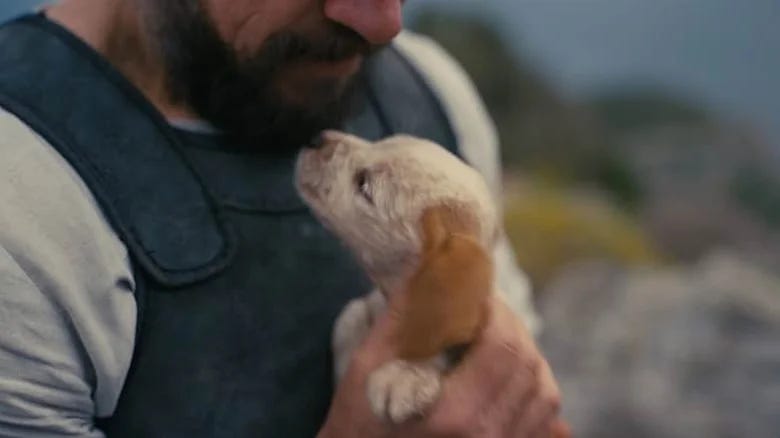
In the original story, no one ever questions that Odysseus did a glorious thing. He sacked Troy, which is the source of his great glory and renown. The Greeks went home with massive spoils, and that is why they’re glorified in their home communities. They succeeded, they won, they brought back the spoils, they affirmed their status — they are the biggest, baddest people in the land. In Homer, that is unequivocally good. That’s what you’re supposed to do as a Homeric hero. For us, that obviously feels really unpalatable. What this movie tries to do — like other retellings of the Odyssey — is give these heroes much more reflection on what they’ve actually done: the violence and misery of war, and the question of whether destroying another community, wiping out an entire city, and enslaving its population actually benefits anyone — including Odysseus himself, who isn’t left with anything when he gets home. He doesn’t even have the spoils anymore. He’s lost all of his crew and all of his possessions. In that version of the story, you can legitimately ask: what have you done? How has this benefited anyone?
Justin McIntosh: I liked the treatment of the morality too — for instance, the inclusion of Sinon, who comes from Virgil’s poem, but presented in a more modern take. In Dante’s Inferno, Sinon is a betrayer — he’s in the eighth circle of hell. Fast forward to this version, which says: no, if he betrayed anyone, it was not his sin to carry — the sin came from the design of the attack itself. How much ownership must a commander take over a decision that forces other people into morally gray settings? I enjoyed that addition, and the choice of having Sinon rather than Achilles come speak to Odysseus — tying together strands of the many stories that have spun off the Odyssey and bringing them into a more modern morality.
Roel Konijnendijk: Odysseus is being forced to confront the question: if you deceive the people around you in order to get what you want — including the people who look up to you, like Sinon and his own troops — you’re still deceiving them. It comes out when he’s going through Scylla and Charybdis, where he says, “I told you to do this because I knew you would do the opposite, and that’s what I actually wanted you to do.” Eurylochus is standing there saying: but you just lied to me — you’re outright telling me you manipulated me. I like that they confront him with it: does this leadership style make you a good leader? Do you deserve people’s trust? Do you deserve people following you and looking up to you? That’s a more compelling way of looking at how Odysseus achieves things than the poem, which straightforwardly says, “that’s just how he is. He lies to people almost compulsively.”
There’s actually a scene when he arrives back on Ithaca and Athena shows up in disguise and tries to interrogate him. Because he’s suspicious of basically everyone, he spins a whole story, and Athena is quietly laughing — obviously she knows best; she’s not going to be deceived. She calls him out: you always have to spin a story. You can’t be straightforward about anything.
Jordan Schneider: But she also says: this is why I love you. This is why you’re my favorite.
Roel Konijnendijk: That’s why he’s her hero, her champion. But it is worth interrogating. As I said last time, the Odyssey asks you to ask questions: do you think this is right? Do you think this is worthy? The movie did that to some extent — it raised questions, and not only the ones already in the poem, but other questions besides that are also relevant and interesting.
Jordan Schneider: Let’s come back to the question of feeling bad about being a Homeric hero. We talked about the similes in the Iliad in particular, and how fun and awesome they make crushing skulls seem. Is there anything in the corpus that has people feeling bad about sacking towns and killing enemies and women and children?
Roel Konijnendijk: Absolutely. It’s baked in, right there from the beginning, and it’s one of the things we always have to reckon with in Greek sources. On the one hand, they glorify victory in war and the capacity to sack cities — the epithet “sacker of cities” is applied to heroes in a clearly positive sense. But at the same time, already in Homer, there’s a recognition that war brings endless suffering, both to the people fighting and to their surviving relatives — their wives, children, and parents. The empathy is right there, throughout. Homer will constantly tell you simultaneously that heroes are great and wonderful people for how well they commit violence, and that violence is horrible and war should not happen. Those two ideas always exist side by side.
Later playwrights from fifth-century BC Athens explore this in a lot of detail. Plays like The Phoenician Women and The Trojan Women deliberately put the suffering of the victims of war front and center — they tell you just how horrible it must have been for the surviving women after all their men were slaughtered and they were violently enslaved. In some cases we know what was inflicted on them, because it’s part of the myth: Cassandra is raped at the altar of Athena, which is why Ajax the Younger doesn’t make it home — he offended the gods in doing that. But fundamentally, he’s the only one who gets punished for the kind of behavior that is generally inflicted on these populations.
All of the people who told this story were aware that it’s a story about massive suffering inflicted on the Trojans, and they were able to perceive the Trojans as stand-ins for people they knew — potentially their own people. Some of these plays were produced in an atmosphere where Athens was committing similar atrocities against other communities, and it’s clearly the Athenians reflecting on what they had done by talking about the Trojans.
Justin McIntosh: That’s what I thought too. It wasn’t in the Odyssey or the Iliad, but there was definitely a tradition. Look at the trials and tribulations written into the plays. Even Antigone, which we talked about on the last show, deals not only with the horrors of death but with the horrors of being denied the proper rites and burials. Even if someone rose up against a king — was in some ways a traitor to the crown — he still deserved to be treated a certain way, and Creon was willing to kill his own daughter-in-law to punish the body of his nephew. The movie acknowledging some of that isn’t a wholly modern reinterpretation. These ideas existed in the ancient Greek world — maybe not in Homer’s poems, though we also don’t know, because there are seven other books of the Epic Cycle between the Iliad and the Odyssey that don’t survive. I appreciated that there were at least allusions to some of that.
Roel Konijnendijk: It’s because this is a reality. People tend to go too far and say ancient moralities were different — and absolutely they were. I would have liked that to be more present in these movies. But it’s not that they didn’t care about life or didn’t love their kids, which is an assumption people make when they take it too far. We have very strong evidence that they loved their kids, even though infant mortality was through the roof. They’re still human. Throughout these texts there is a lot of empathy alongside the glorification of violence. Those two things are obviously in conflict, obviously dissonant — but the Greeks affirmed both all the time.
One example: in the early fifth century BC, the Greeks were still writing tragedies about historical events, which they stopped doing very quickly — the only one that survives is Aeschylus’s Persians. But there was another, now lost, about the Persian sack of Miletus during the Ionian Revolt in the 490s BC. [The playwright Phrynichus] wrote it, they staged it, and the Athenians found it so distressing that they fined him for writing it and forbade it from ever being performed again. It’s a story about the sack of a city far away, but it hurt them so much because they could relate — they could sense this kind of thing perhaps coming for them too. There’s an awareness that to be victorious in war is glorious and brings all these benefits, and that to dominate others is great — but the flip side of that coin is always there, and they never forget it.
Jordan Schneider: Is now the time for the contrast with American Sniper?
Justin McIntosh: You know my stance on watching Navy SEAL movies — I don’t do it, so anything I said would be complete supposition. But a good comparison is Thucydides in The Melian Dialogue: “Why can’t you honor that which is hard? Why do you have to honor that which is soft?” The entire point is to show that despotism — the weak suffering what they must — is actually not the morally just thing. That’s in direct contrast to what you’d expect if everything were based on this Homeric impulse of might makes right and noble warrior kings. Even Thucydides was saying: no, we were wrong. We should not have done what we did at Melos, because it was tyrannical.
Roel Konijnendijk: There’s a fantastic scene in Xenophon’s Hellenica when the Athenians receive the report of the Battle of Aegospotami, where their fleet is finally destroyed and they have no chance of recovering from the defeat. They know the Spartans are coming for them — they’ve lost the war, but it hasn’t ended yet, which makes for a horrific moment when the news arrives in Piraeus on the official ship. Xenophon describes people in the middle of the night literally turning to each other in the street and shouting the news, which travels like a wave of sound from Piraeus through the Long Walls to the city. You can follow the sound of the wailing as people gradually learn from their neighbors what has happened. In that moment, he says, they all remembered what they had done to all the other Greek states — because it meant they expected nothing less from the Spartans now that they were at their mercy.
You can commit atrocities all you want in your moment of power and ascendancy, but the bill is being recorded. Eventually there’s going to be a reckoning. The Athenians absolutely expected their community would be wiped out. They narrowly escaped that fate, for complex reasons we won’t get into here — but they fully expected it.
The Real Reason Behind the Trojan War
Jordan Schneider: Should we do a little Odysseus–Menelaus contrast?
Roel Konijnendijk: Do we want Menelaus in this movie, or Menelaus in the Odyssey?
Justin McIntosh: He wasn’t the joyful, tear-in-his-eye, a-cup-for-everyone-who-comes-to-his-house, red-haired, happy-go-lucky guy they depict in the Odyssey, that’s for sure, when Telemachus shows up. He’s a pretty dark and brooding figure.
Roel Konijnendijk: The Menelaus they were drawing on is Sophocles’s Menelaus. Sophocles was writing during the Peloponnesian War — Athens at war with Sparta — so the Spartan character obviously gets turned into a brutish warlord. In those later tragedies he becomes this really violent, angry man. That’s the Menelaus they gave to Jon Bernthal. Reading the Odyssey, you would never cast Jon Bernthal. The Menelaus there is slightly dorky, a bit dumb, but fine — a nice guy who just wants everybody to have a good time at his palace. He gives you all sorts of things you don’t need. Telemachus has to tell him, “I have no use for horses — I live on an island.” It’s really different. They’re projecting back from the later versions of those stories.
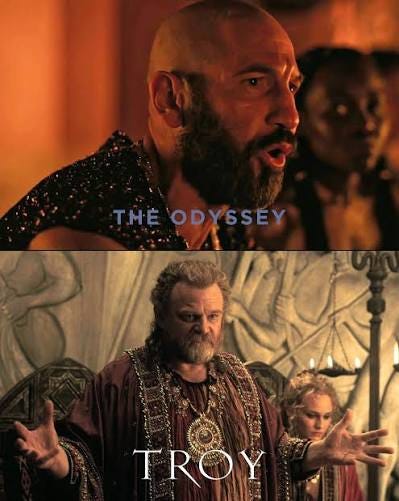
They did the same thing with Clytemnestra, using the Aeschylus Clytemnestra rather than the one in the Odyssey, who is merely an instrument of Aegisthus’s rise to power — she’s not even the one who kills Agamemnon in the Odyssey. In the later tradition she’s front and center, because it’s a lot more interesting: she’s the one who actually suffered the loss of her child, so the story gets told from the perspective of the wronged mother. But that’s not the Odyssey version — that’s the fifth-century BC version.
Justin McIntosh: The scene with Menelaus that stuck with me is the whole “it was never about me — it was always about trade routes,” and his dark, glib comment: “Well, maybe now it’s only 500 ships.”
Roel Konijnendijk: First of all, that line is Marlowe — Christopher Marlowe, “the face that launched a thousand ships.” It’s a modern line they put in the movie because everybody knows it. But let’s not treat this as arithmetic — she’s worth only 500 ships now because she’s slightly scarred? What is that? We’re not expressing her price in oxen. The original line is an expression of just how compelling she is. It’s weird to me that there’s been so much comment on that aspect of the casting, when I have no question that she is absolutely beautiful and compelling as a person — in her limited screen time she has real presence. I really don’t mean to diminish that.
But I don’t like the idea that all of these modern movies like to do this. Troy did it; the Helen of Troy TV show from many years ago with Sienna Guillory did it. All these modern versions want to rationalize the Trojan War. Helen gets shunted into the background by this line — which is in the Nolan movie as well — that she’s just Agamemnon’s excuse, because what he really wants is access to trade through the Hellespont. This is a modern fantasy. We now find it difficult to accept the idea that you would go to war to get a woman back. We want states to behave out of strategic interests, and we can understand access to the Hellespont — hell, we have the Gallipoli campaign and all sorts of wars over access to the Hellespont. Troy sits in about the right place to control that access, so let’s say the war was about trade routes.
The fact is that not a single ancient source ever suggests this war is about anything other than recovering Helen. That is the entire reason the war happens. That’s the entire reason Agamemnon is involved. Nobody has ulterior motives. This isn’t about trade. I get very upset about this precisely because rationalizing the war takes away something of what makes the story interesting and compelling — it makes the story less different, less historical, because it refuses to acknowledge the story’s own terms. It rejects the idea that this war could have been about what it says it’s about, and just invents other reasons: “I’m not satisfied with the Helen story, so I’m going to make up something else.” Don’t do that. I wish they hadn’t put that line in.
Troy did this massively — it made the whole thing about imperialism. Agamemnon becomes an expansionist warlord who wants Troy, and everything else is just an excuse, his foot in the door. The whole movie is built that way, which fits the early-2000s political environment — that was the kind of message people found instinctively understandable. We don’t need to do that now. We see people go to war for idiotic reasons.
Jordan Schneider: There’s a layer on this. We’ve talked about dueling culture and the early years of the US Navy, where someone says your shoe isn’t shined well enough and suddenly you have to shoot them to prove you’re brave. With Helen, there’s some offense — but layered on top of it is this glory-hero sacking culture where like, it’s summer camp, we’re going to play the hits and do our thing, because what else is there to live for besides sheep?
Roel Konijnendijk: Some very nice sweet wine, apparently, according to the Odyssey. There are all sorts of things these people possess that they think are worth having — luxury imports from all over the world; they can get all sorts of things from the Phoenicians just by maintaining peaceful relations. There are plenty of ways to live well. What they want is to make a name for themselves. They want renown. That is one of the big motivating factors for the people involved. On the one hand, they swore an oath — they have to uphold the sanctity of the marriage of Menelaus and Helen, so they’re obliged to go. But they go because they want to be there. For all its faults, Troy actually articulated this — that movie hews quite closely to the Homeric value of “this is going to be the biggest war ever, and you’ve got to be there.” If you weren’t there, you’re going to have FOMO for the rest of your life. That’s closer to the spirit of what these heroes would say. If they missed the opportunity to gain wealth and renown, why would anyone believe they merit sitting in their palaces drinking fine wines?
It’s also very interesting that Herodotus, who traces back the origin of the idea of wars between Europe and Asia — that’s how he simplifies it: Greeks and barbarians, Europe and Asia — says there were conflicts going all the way back into mythological times, but the escalation came with the Trojan War. Initially it was just raiding back and forth, people stealing women from each other. But the one time the people from Asia — the Trojans — stole a woman from the Greeks, the Greeks actually decided to invade, go to war, and destroy Troy. He says the Persian sages, the Persian logioi — if they even knew this story, but that’s the story he tells — hold the Greeks responsible for all of it, for the Persian Wars and everything else, because the Greeks escalated first. They went from tit-for-tat raiding to all-out war, and that was a massive overreaction.
So there was discourse — and I’m not saying this literally happened — among the Greeks about whether going to war over this was a proportional response. Some really horrible victim-blaming goes into the argument: “Helen probably wanted to go — why would you even bother?” But fundamentally, the debate implies there was no discourse whatsoever suggesting any other cause for the war. Everybody knew the Trojan War happened because Helen was abducted — or perhaps absconded with Paris — but that’s it. No one ever says, “Actually, let’s be real, that wasn’t why this happened.” That was the reason, and everybody who went along with it just wanted part of the action.
Justin McIntosh: In Renaissance America, we’ll call it — during the founding, when you had all these men who had read the Enlightenment books and were still dueling — that message would have landed: an overreaction to your honor being dragged through the dirt is something people could have gotten behind. It doesn’t necessarily register with a modern viewer who hasn’t read those works. There has developed, at least in American culture, real skepticism toward honor-based arguments — a belief in machinations within government, that there’s always another cause. It’s never as simple as “Iraq has weapons of mass destruction”; it’s actually about owning the oil fields. So I do see a reason for giving the war a bigger rationale.
Trojan Horses in Real Greek Warfare
Jordan Schneider: My favorite scene was the men inside the Trojan horse, which I thought was brilliantly conceived, shot, and executed. Who knows if it happened — but are there other tricks as outrageous as this that were actually pulled over the course of Greek history?
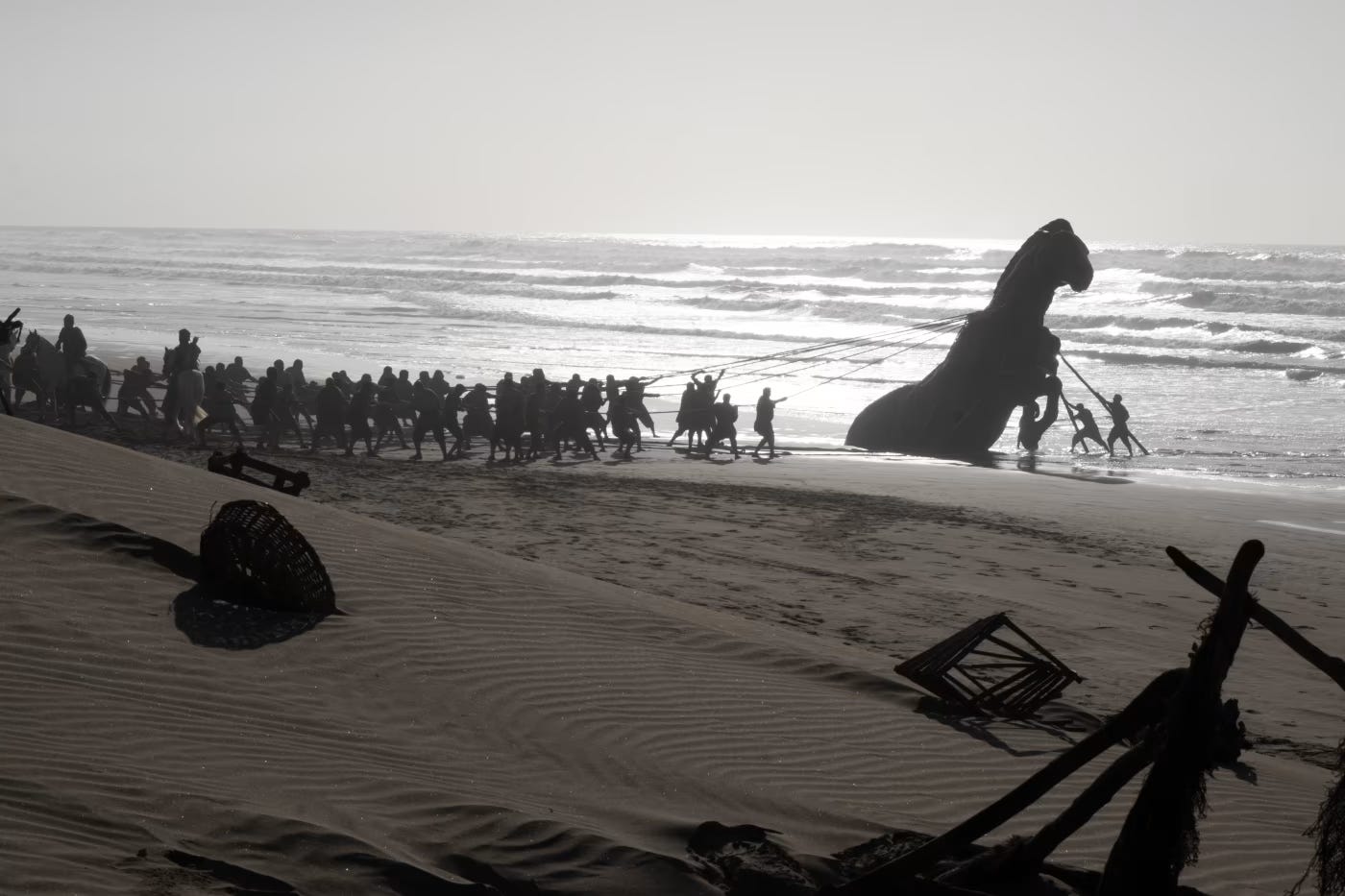
Roel Konijnendijk: Of course. Besieging a city is very difficult under any circumstances — especially for Greek cities, which had limited economic means to keep an army in the field for long, and limited means to develop machinery and tools to overcome strong fortifications. By far the most common way for a city to fall was treachery from within: somebody opens the gates to you. The second most common way, I would guess, is infiltration — you find some way to get in without being noticed. The Trojan Horse story is really quite elaborate, difficult, and risky; that’s just the version that happens in the story. The closest parallel comes from the Peloponnesian War, when at one point people hide under a boat and sneak in that way.
Most of the time, you find a place that’s less well defended, often because it’s very difficult to approach, sneak a couple of guys in that way, and either use them to open the gates or cause such a shock that the garrison surrenders. That has happened on many occasions. Famously, it’s how the Persians took the great fortress at Sardis from the Lydians — basically offering rewards: “You see that giant cliff face? There are no guards up there, because they think you can’t climb it. Prove them wrong, and I’ll give you loads of money.” Alexander pulled the exact same trick numerous times, telling men, “I’ll bury you in gold if you make it up there.” Some people died trying — we have reports of men falling all the way back down — but usually, once they get up there, it’s game over.
Jordan Schneider: Can you talk about the Roman award where, if you were verified as the first one up on the wall, you got some class upgrade? I’ll look it up.
Roel Konijnendijk: Usually it’s a monetary reward — you can also get promoted, though I’m not sure about the exact parameters of that one. But “first upon the walls” is one of those feats that gets a specific award. The idea is that if you’re first, you’re most likely to encounter the strongest resistance, but also the first to achieve what the entire army is trying to achieve — so there’s a specific reward to get people to take that risk, to put themselves in front. On various occasions — at the Siege of Tyre, and at one of the cities he took from the Mallians in what is now Pakistan — Alexander himself was first up and over the wall, precisely because he led by example. That was his leadership style: do what he asked others to do.
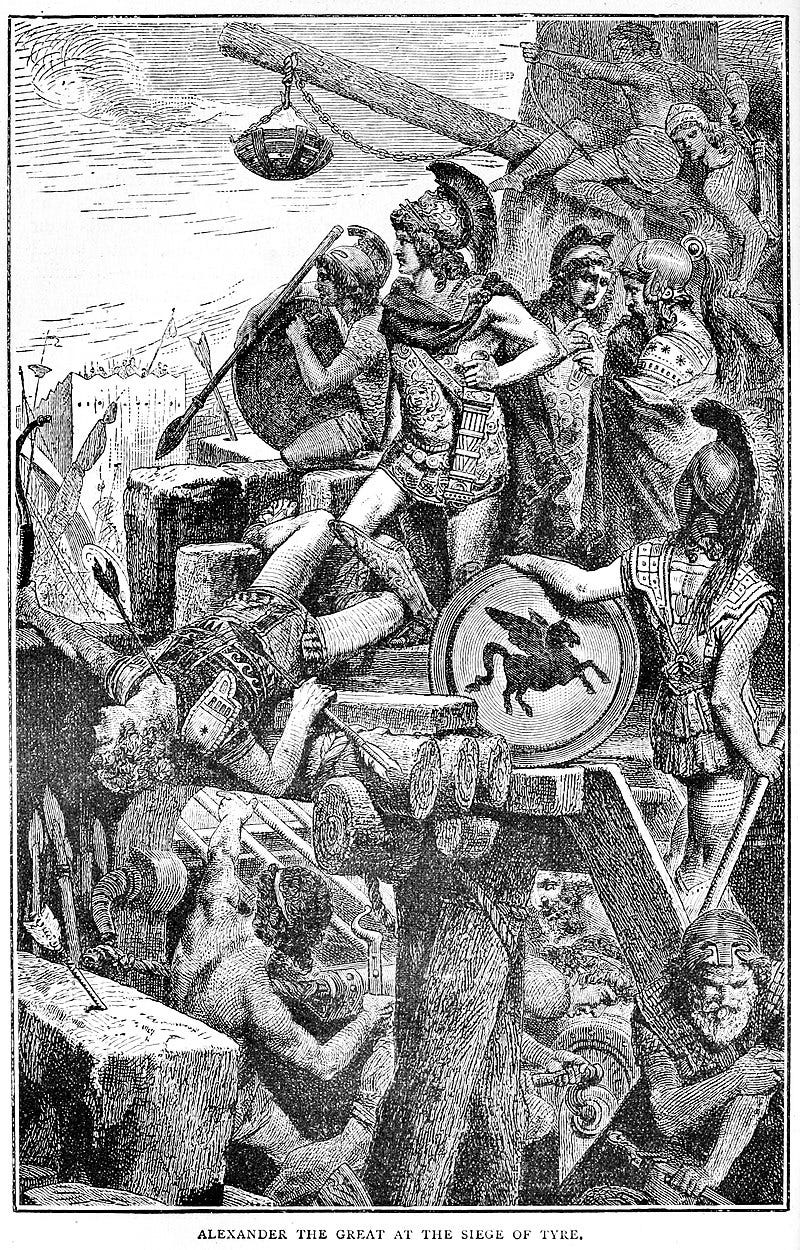
But that’s not a trick — that’s just assault. The point I’m making is that most of the time these walls are not conquered by brute force. They are conquered by infiltration or treachery from within. The Trojan Horse is the ultimate example of that, the most famous from the Greek tradition. It’s not literally repeated, partly because everybody knew the story — if you showed up in a wooden rabbit, Holy Grail–style, they would probably not fall for it. But the underlying ideas are very similar: how do you get through a wall? You try not to be seen doing it, or you get someone on the inside to help you.
Justin McIntosh: A very direct analogue is the Gallipoli campaign. Very early on, the British were having a hard time gaining a good foothold, and the idea emerged of running what would look like a derelict ship onto the shore, so that men could pop out of it by surprise in the midst of the Turkish lines. Of course, what happens is that this derelict-looking ship loses its rudder, hits the shore, and the Turks turn all their guns on it and just hammer it. Everybody is pinned down; they can’t be extricated until night falls and they’re finally pulled back. That’s clearly an attempt at a Trojan ship — and you see how difficult something like that is.
It shows the acme of Odysseus’s plan: his ability to think through the deception and convince other people it was real. That ties back into why he’s wracked with such guilt — it shouldn’t have been possible. It shouldn’t have worked. The Trojans should have seen through it, but he layered it so that it worked: having the soldier say it was a gift, Sinon losing his life, all the things that led to it actually getting inside the walls.
Roel Konijnendijk: There’s the other version of that as well, where the priest Laocoön tells them not to take the horse, and the gods intervene — they send snakes to seize him and his sons, which leads to that famous statue of them writhing among the serpents. The gods at this point are basically fed up with the war; it was determined long ago that Troy would fall, so we’re just trying to get to that point, and they intervene on behalf of Odysseus to make sure his plan works. That in itself is another example of how intricate this plan has to be — how many different steps have to occur before the Trojans are convinced. They read the snakes as a sign that resisting the horse is a bad idea. None of that is in the Odyssey’s very short account of the Trojan Horse. Those elaborations on the story show that people were already a little unwilling to accept that it was that easy — so they kept adding safeguards to the plan.
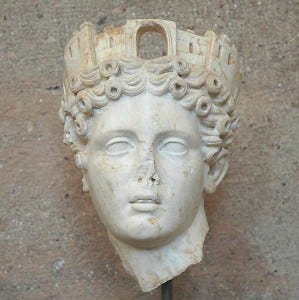
Jordan Schneider: Found it — it’s called the corona muralis, and you literally got a golden crown shaped like a castle wall. Medal of Honor, eat your heart out.
Justin McIntosh: I would take it. I’m guessing they didn’t give many of those out to the living — they were probably mostly posthumous awards.
Jordan Schneider: No, you only get it if you’re alive. And apparently one time two guys each thought they had earned it, and they almost had a little civil war in the camp. Polybius — everyone go dig that up.
Roel Konijnendijk: There are a number of occasions, at least in Greek warfare, where once the wall is breached — once it’s clear the enemy is in a position to overcome the defense — the defense just breaks immediately. You don’t have the forlorn-hope tradition where being first through the breach means you’re probably dead. There’s more of a sense that if you’re first through the breach, you might actually be the first to survive. But it depends on the situation: in a lot of other cases the defense becomes extremely stubborn at that point, and there are known cases where the attackers, having breached the walls, are driven back out again — sometimes several times in a row. Some of these defenses are really tenacious.
Set It in the Archaic Period
Justin McIntosh: I want to know — what’s the Roel three-hour adaptation? What are you spotlighting?
Roel Konijnendijk: An interesting question. One of the things I really didn’t like was the film’s attempt to be relevant to Bronze Age history — which it isn’t, and shouldn’t have been. They shouldn’t have put that in there. This is not meant to be a historical story, and trying to make it a historical story about the Bronze Age is misguided, because the poem doesn’t describe the Bronze Age. It describes the early Archaic period. If I had my druthers, I would set it firmly in the Archaic period. Compared to the Late Bronze Age — and to the world of states and kingdoms generally — this is a world of much lower complexity, organization, and wealth, only just emerging from a long period of disruption, upheaval, and recovery. We’re talking about very small communities.
The heroes of this story are not kings in the sense we understand — living in palaces, ruling kingdoms. They’re petty lords, and often there are several of them. Ithaca doesn’t have a single king; it has loads of people calling themselves kings. Odysseus is only the wealthiest among them. He isn’t crowned, doesn’t sit on a throne, doesn’t live in a palace — he’s just a guy with more wealth, more power, more retainers, more flocks, and more wine in his storeroom than the others. That’s how you distinguish yourself in this world: a hierarchy of wealth in which some men get to call themselves lords.
Because of that, there’s no institutionalization, no formal procedure of power. Power is much more brittle — it belongs to those who can affirm it and take it. That is why the suitors are such a problem. That is why Telemachus can’t just say, “Everybody out — I’m king.” He has no institutional backing, no law that says he should be in charge. It’s a much more might-makes-right world, and much more modest in its means and material realities. You can much more easily imagine how chaotic and disorderly these heroes actually are, and how much it matters to them to sack a city in order to steal a couple of goblets, or to enslave some people — because that is the entire basis of their status in society. There’s much more potential to make this story make sense if you just set it in that archaic world.
I’m always pointing this out: you have to stop putting Odysseus in a palace on Ithaca. If you read the actual text — okay, there are some upstairs rooms, fair enough — but most of the “palaces” Homer describes have three rooms: a main room, a back room, and a portico. That is the entire space of a Homeric palace. These are small, two- or three-room houses. Why? Because if you look at the archaeology of the eighth and seventh centuries BC, there are no bigger houses in the Greek world. That is the house they knew. Even the biggest man in these small cluster communities lived in a slightly larger version of the same house. There are no palaces, no expansive mansions or villas in the Roman style. You have to imagine this world as infinitely smaller, simpler, and poorer than the world of kingdoms we picture.

I would set the whole story in a world like that, because then you can see why it matters that these suitors — practically kings in their own right — vie for the hand of Penelope to affirm the status they already have, and why their family members are a real problem for Odysseus. They also have weapons and retainers; they can muster an army and come take his things. If he antagonizes them, there is civil war, which he will lose — he’s one man with his retainers against all these other men with theirs. This is not a world in which the questions of power are settled. That could make for a very compelling version of the story.
As for which elements to include — I’m very glad the movie talked about xenia, hospitality. That is the absolute core theme of the Odyssey. This is a song about hospitality — about what it’s like to be a good guest and a good host. That is all Telemachus needs to learn, what the suitors need to learn, what Odysseus needs to understand about the world. I like that they kept it as a theme, although they twisted it a little — they made it into a general moral code, which pushes it too far.
They were quite pragmatic about what they included and what they didn’t. It would have been nice to have Scheria in there — the Phaeacians, Nausicaä. But I can see why they didn’t want that extra stop on the way — the whole rise-and-fall-again arc. It makes sense from a this-has-to-be-a-three-hour-film perspective.
I also really liked what they did with the Lotus Eaters, which is about six lines in the Odyssey — almost nothing. Odysseus never touches the stuff; two of his men try it. It’s an irrelevant little episode, but everybody knows it. Transposing it to Calypso’s island and making it something Odysseus takes because he wants to forget — that’s really elegant. It turns this trivial story about forgetting everything and living in bliss until you disappear into nothingness into something he actually wants, something he actively does to himself rather than something done to him. That makes sense within the way they’ve rewritten the themes of the story.
It keeps coming back to the same thing: I like some of what the movie did and some of the ways it changed the story. Some changes I would push further; others I would keep. But fundamentally, I would have set it in the early Archaic period and been honest about the difference of this world, of how far removed it is from our understanding of political order.
Gods, Achilles, and AI Iliads
Jordan Schneider: The best compliment I can give Christopher Nolan is that I walked out saying, “I need to write my own adaptation of the Odyssey” — not because he did a bad job, but because it’s such an interesting intellectual exercise. You’re operating under real constraints, you have to cut material, and the ways you can remix it are just really cool. The one thing I’d change: he basically took out the gods, which is fine, but I wonder what a god-maxed version of the Odyssey looks like. It always struck me that these gods are just playing, and they don’t really care — you’re just a pet insect to them.
Justin McIntosh: Doesn’t that become that bad Clash of the Titans movie, though? That was so bad. The problem is that a movie like that ruins the whole approach.
Roel Konijnendijk: It’s also very Percy Jackson — the gods as actors in the actual world. Can you do that in a way that’s compelling? One really small moment in this movie landed for me: when Odysseus finally leaves Calypso’s island and drifts off on the raft, she tells him, you’ve got to take your punishment — Poseidon is going to batter you, but Zeus won’t let him kill you. By that point in the story, we’ve become so persuaded that this world is infinitely dangerous — full of threats too big even for Odysseus, forces too powerful for him to confront, at whose mercy he lives — that to be told at least one of these gods is not only looking after you but is more powerful than the other forces really works. At that point you think, okay, I’m not worried for him. Even though he’s being committed to the sea again, he will be fine.
Even though the gods are not in the story, the film manages to convince you — and this is to the full credit of the score and the mood of these episodes — that there are powers in the world we cannot control, vastly more powerful than us, and that this doesn’t mean we’re helpless. It can also mean they’re helping us — that they’re on our side.
My favorite example of this has always been Sunshine, the Danny Boyle sci-fi movie from 2007. It opens with a scene on a spaceship flying toward the sun. Someone is testing how far down he can set the filter on the screen through which he’s viewing the sun, and the ship’s computer warns him: beyond about four percent penetration, your eyes will burn away. He sets it as close as possible to that point — and the music kicks in, and visually you are persuaded of the immense power of this formless thing in front of you. Then you’re told: that’s the thing at four percent. That’s how the movie establishes its antagonist because the sun is the antagonist; they’re essentially trying to fight the sun. It’s so powerful because, right from the beginning, the film manages your understanding of what you’re up against: you personally, physically cannot withstand four percent of the power of this thing. You will die.
That is how you convince an audience of the existence of powers greater than us and put us in awe of the people brave enough to confront a world that has those powers in it. The Odyssey does that to some extent. It’s a much more effective way of doing the gods than having them appear in a toga and talk to you. In a lot of ways, that’s what you want those gods to be: forces in the world for which you are, as you say, a toy — something of no consequence, no value, and no persistence whatsoever.
Jordan Schneider: Speaking of gods — there was some critique of Nolan for putting Christian morality into all of this. What I found interesting is that there’s enough in the soup of 3,000 years ago that we have parallel myths going on — Odysseus on a raft and Jonah. There are enough story beats where the two story ecosystems talk to each other that it seems fair to look at these characters through the lens of what Christ would have thought of them.
Roel Konijnendijk: What you can accuse this story of that is not Greek at all is turning hospitality into a general moral code. They take the idea that you have to be a good guest and a good host and turn it into the Golden Rule — treat others the way you’d like to be treated. That is much more general than any Greek would ever articulate it. It’s not an ancient Greek moral code; that doesn’t exist. But it’s not just Christian, either — lots of religious traditions have the Golden Rule; it’s also Buddhist. You can accuse Nolan of introducing Christian thought, but it’s more that he’s drawing on a much more general idea of what it is to be a good person. Unfortunately, not an ancient Greek idea — and that is legitimate criticism, which I’ve now raised several times. He’s not really willing to confront the notion that people simply had a radically different morality from ours, except in tiny moments — the unwanted puppy chucked off a cliff. Generally he doesn’t want to confront that, which is fine — it’s a modern adaptation. It makes the film a little less Greek, but a little more universal to modern audiences.
Jordan Schneider: Justin, what’s your Odyssey adaptation — or Iliad?
Justin McIntosh: I would redo the Iliad. Troy was such a terrible movie, both in the story and in the way they told it. I want to see the god-kings actually out fighting — Hector pushing the Greeks all the way back to their ships, out in front, laying waste to the Argives as he drives them into the sea. Then the turn, and Achilles’s reentry into the war. In Troy, they killed Menelaus and had Hector become this weirdly compassionate person toward Paris — nothing in the poem suggests he would react that way. Throughout the entire poem, Hector berates his brother and blames him for everything. I’d much rather have that, because there’s a lot more there that has never actually been put on screen. The late-’60s version of Achilles at least tried to start the way the poem does — with the argument inside Agamemnon’s tent — but the rest of that movie is terrible. Charlton Heston–era stuff.
Roel Konijnendijk: I have notoriously stood up for Troy a few times — it does do certain things right. And for all the merits of Nolan’s cinematography and direction, his scene of the actual sack of Troy did not improve on Petersen’s. There’s a gorgeous moment in Troy when the gates are opened and, from the dark plain, you see this massive Greek army converging on the gate in silence, emerging from the shadows as if out of thin air, funneling through the gates. Then the camera swoops down and follows them as the noise swells — the roaring of the soldiers and the screaming of their victims. That is such a good moment. In Nolan’s version, there’s a bit of floating around Aït Benhaddou, where they filmed it — a couple of fires, some people being killed in the background, and you follow Odysseus around. I didn’t feel it built on or improved on Petersen, or made you feel it was necessary to do this again. The collapse of the towers was pretty cool. And the moment the gate opens with Agamemnon standing there — that’s a cool moment.
Jordan Schneider: It’s like a WWE walk-on.
Roel Konijnendijk: You can definitely hear the dun-dun-dun. But in that particular scene, Troy is just the better movie — it sweeps you along and makes you feel the almost unnatural horror of this army descending on the city. I don’t mean that about the whole film; I’m glad we have both movies. And I have to say, my absolute favorite line from Nolan’s movie is when he says, “What if he saw ten years of hate poured into the city in one night?” That is so beautiful — a really effective way to convey what happened. It’s not from the poem; that’s just writing for the movie. But the scene that accompanies it does not match Petersen for cinematic brilliance.
Justin McIntosh: The one thing I’ll say is that Nolan told a much more personal version of the battle. It’s centered on Odysseus, whereas Petersen’s was societal — you were watching this huge event unfold. In Nolan’s film, the perspective is basically Odysseus’s own; there’s a little third person, but much of the walkthrough is meant to feel like you’re there, looking around, so you get a very narrow view of what’s shown. Maybe the thought was: I can’t recreate this because it was already done, so I’ll do something slightly different.
But I still hold that if I were going to recreate one of the Homeric poems, it would be the Iliad. Honestly, the end of Troy is the best part of Troy. The rest — even the way they introduce Achilles, the fast sprinter, but he’s going against a giant of a man and he kills him in one blow. The whole point of the poems is that Achilles is supposed to be this humongous man, first among equals — Ajax is the only one supposed to be bigger. When you read the way Homer lays out the descriptions, Achilles is the most powerful and the fastest — he’s supposed to catch you off guard. Whereas you watch Brad Pitt play him and you think: that’s Brad Pitt.
Roel Konijnendijk: I actually like him in that role — apparently because he really didn’t like doing it. He didn’t want to make the movie and hated working on it, but he brings a surliness to the role that fits Achilles, who is — to say it as nicely as I can — a very flawed character. I don’t think you’re supposed to sympathize with Achilles at any point in any of these stories. Pitt combines the ultimate-warrior figure with the surly teenager, and it’s perfect. He’s a petulant, annoying man you don’t want to work with and he doesn’t want to work with you either. Obviously he’s not the definitive Achilles — please keep doing different versions of Achilles. I love David Gyasi in Troy: Fall of a City, the BBC series — he did a really convincing job as the angry ultimate-warrior figure. But I quite liked Brad Pitt as Achilles precisely because he didn’t seem to enjoy himself at all.
Justin McIntosh: What about Brian Cox — was he the wrong casting for Agamemnon? He’s an amazing actor, but age-wise, I don’t know if he was the right person to play the role.
Roel Konijnendijk: Brian Cox is perfect. You cannot possibly say anything against Brian Cox. He understood the assignment — he was just chewing the scenery. Troy is my ultimate example of a movie that’s so bad it’s good: a movie that is not good, but is extremely watchable, with everybody in it having a great time — except Brad Pitt, apparently. Brian Cox completely understood that. I enjoy every second of him on screen — old-school hamming it up in the extreme, not giving a shit. The lines are terrible. It’s wonderful. And he gets to quote the poem a few times. In that opening scene you mentioned, where Achilles fights Boagrius, he says this line to Nestor: “Of all the warlords loved by the gods, I hate him the most” — a line from Homer, straight out of the Iliad. Let’s have him chew the scenery with lines from Homer, please. More of that.
In Nolan’s Odyssey, the scene where Odysseus goes to the underworld — where he talks at length with Sinon, and meets Tiresias the seer — also has him talk to Agamemnon, and that is one of the bits most faithful to the poem. Agamemnon is the one who warns him, don’t just walk into your house assuming you’ll be welcome — look at what happened to me. It’s a plot-crucial warning: approach this indirectly, because you never know what’s waiting — especially whether your wife is still faithful. Test the waters before you march in. Unfortunately, it comes with some classical Greek-style misogyny layered on top — “you can’t trust a woman.” But it’s a really nice demonstration that Nolan actually likes, appreciates, and understands the source material.
Justin McIntosh: What’s yours, Jordan? Your remake?
Jordan Schneider: Well, nobody liked my gods idea. I think the female-forward versions could be cool — we got just a little bit of Circe, a little bit of Calypso.
Roel Konijnendijk: Not enough Penelope either.
Justin McIntosh: You could make Madeline Miller’s Circe into a really good one — and then you get [Tennyson’s] “Ulysses,” where he goes stir-crazy at the end, and that whole final scene. A different take on Odysseus.
Jordan Schneider: You could also center Telemachus — he has a whole arc. The fighting in the temple was sort of weird, and just watching him mature — you know what, I’m going to cut that. I don’t really want to see a Telemachus movie.
Justin McIntosh: You don’t want to see Tom Holland?
Roel Konijnendijk: The final scene of the Odyssey — one of the last moments of the poem — is Odysseus, his father Laertes, and his son Telemachus gathered together as the army of the suitors’ families comes for them. The suitors have been killed; now their kin want revenge. There’s this beautiful moment where Telemachus and Odysseus are vying with each other: “I’ll kill the first man.” “No, I’ll handle it.” And Laertes just stands there beaming with pride, because his son and his grandson are competing for the honor of being the best warrior. That is intensely Homeric. We find it very difficult to relate to that morality, but it tells you so much about this society: all Laertes wants, in possibly his final moments on this earth — and he has waited so long; he’s so old by this point — is to see his son and his grandson standing with him in a battle line as brave warriors. This is the Homeric world of heroes in a nutshell.
Justin McIntosh: I do love the story, when they first come to fetch Odysseus and he decides to feign madness — out sowing a beach with salt, driving an ass and a horse yoked together. They ask what’s wrong; he says, “I’m crazy — look at me.” And they say, oh yeah, you are crazy — except for the one man who walks over, takes the infant Telemachus, and sets him in front of the plow: let’s see how crazy. And Odysseus says, “You got me. I guess I’ll go to war.”
Roel Konijnendijk: I don’t remember whether that’s anywhere in the epics, but it’s definitely part of the wider knowledge of the story — it comes up all the time.
Justin McIntoch: He was the one hero who actually tried to get out of going to the war, and he was seen as different from all the other heroes.
Roel Konijnendijk: Achilles too — he hides and dresses up as a girl to avoid being called up, or at least his mother dresses him up as a girl to hide him. Then Odysseus gets sent to find him out. It’s a fun catalyst. They don’t actually need Odysseus to come along — they need Odysseus to get Achilles to come along.
Jordan Schneider: The whole idea of dreaming up adaptations is not as crazy as it was even five years ago, because you can just have AI make movies for you. We’re going to have a lot of Iliads.
Justin McIntosh: We are. We’re going to get the Grok one.
Jordan Schneider: There are far more ideas for classical-literature adaptations than there are Hollywood budgets, so there’s something to look forward to with this technology. It’s good to dream.
Did Ancient Warriors Get PTSD?
Roel Konijnendijk: I don’t know if you wanted to talk about ancient PTSD, because we haven’t covered that.
Jordan Schneider: Let’s close on that.
Justin McIntosh: Close on PTSD — my favorite subject.
Roel Konijnendijk: We get this question all the time on AskHistorians — it used to be one of our most frequently asked: did people in ancient or pre-modern warfare get PTSD? It’s a weird, narrow way of asking the question, because we now know that post-traumatic stress disorder doesn’t relate only to war trauma. It can result from domestic violence, sexual abuse, witnessing crime — any traumatic experience. But in public discourse, the most common context is military veterans, so the question has been: is this a universal experience for people coming back from war, or something that only affects people who fought in modern wars?
That framing partly reflects the fact that PTSD was only defined as a diagnosis during — really after — the Vietnam War, and it has often been associated with earlier diagnoses like shell shock or trench fatigue. Before the twentieth century, this was essentially not a defined condition. We can’t say people were being diagnosed with it, because there was no such diagnosis. That has been a persistent question in both scholarship and public curiosity.
Justin McIntosh: It at least predates the twentieth century. There are discussions from the Civil War and the Revolutionary War of battle fatigue and of veterans coming back haunted by the things they had seen — clear allusions in both literature and the historical record. It would be very difficult to believe it didn’t exist in ancient times, if Thucydides is right and men don’t change.
Roel Konijnendijk: The problem is, where do we find it? Something that isn’t recognized as a well-defined disorder affecting a specific group of people might simply go unnoticed, because no one is looking for it. There’s no clear, unambiguous testimony that people who had been through these experiences were expected to display these symptoms. So scholars have been mining ancient sources for potential cases, and a couple keep coming up.
One is a veteran of the Battle of Marathon who supposedly suffered hysterical blindness. He wasn’t harmed at all during the fighting, but he couldn’t see for the rest of his life. The story he told — recorded in Herodotus — is that he saw a soldier coming at him, a very large hoplite with a beard covering his shield, a scary, giant figure — who instead passed him by and killed the man next to him. From that moment, he went blind and never saw again. People have often taken this as exactly the kind of case we’re looking for. But first, he reports no other symptoms — literally just the blindness — and a modern psychiatrist wouldn’t make a diagnosis on the basis of a single symptom; that’s not how psychological disorders work. Second, the social reaction was very different from what veterans now often experience — separation and detachment from their families and loved ones, ostracism, difficulty reintegrating. Epizelus, by contrast, was a hero. He told everybody this story, and everybody loved him — granddaddy was at Marathon, telling this wonderful, spectacular tale. That’s why Herodotus recorded it.
So the question has been whether we can really call this what we’re looking for — both because of the lack of diagnostic detail, and because the reception from society was radically different. One acknowledged feature of PTSD is that what makes it so much worse is the way it alienates you from the people around you, and the way society doesn’t know how to deal with it. That is why it has so often been debilitating. Whereas here, the way they dealt with a veteran who was obviously harmed in non-physical ways was radically different.
Justin McIntosh: Is there something to the fact that hoplite armies were composed of the citizens of the city-states, so there was more societal understanding of what happens in war? We have the issue in the US and Britain of the all-volunteer force, where a very small percentage of the population serves. If it were a much higher percentage, conceivably there would be a much greater understanding of what happens and of how society can reintegrate these people.
Roel Konijnendijk: That is the argument made by Jason Crowley, a scholar in Manchester who has written a book on precisely this question. His argument has always been that because you’re going to war with your neighbors, your relatives, and your friends, there isn’t as much separation between home life and warfare — not as much of a sense that you are leaving your society and then having to reintegrate into it. More recently, Owen Rees and other scholars have qualified this somewhat, but fundamentally it’s true that you’re not separated from your normal life the way you would be in a modern all-volunteer, all-professional force. That would make integration easier, simply because everyone you know has gone through the same experience. They know what it’s like — they were there with you, and when you go home, they’re still there with you. To that extent, these societies may have found it easier to absorb the consequences.
But traumatic experiences do change personalities. One example scholars cite is the Spartan commander Clearchus, who was murdered while in mercenary service in the Persian Empire. Xenophon, who knew him, gives a little postmortem of what he was like. He describes him specifically as somebody so obsessed with war that he couldn’t let it go — a war-lover, philopolemos, a very rare word in Greek. He devoted himself singularly to warfare. Normal people have hobbies — they spend money on pretty boys, or festivals, or drink. This man spent everything he had on war. He was doing war constantly, and it was the only time he was happy. His character was therefore very hard to deal with: very good in a crisis, but otherwise unlikable — too hard, too harsh, too unkind, too single-minded.
A lot of people have read this as a mind twisted by PTSD — someone who could only function in the same context in which he was traumatized, who was only happy in the environment that felt relatively safe to him, which was an environment of danger. That reading has more legs, in that it tries to understand a holistic picture of a person. But it was still not recognized in that context as a disorder — that was just his personality. And you could almost imagine that a Spartan upbringing produced that personality quite frequently. People who go through that training program from childhood may well end up traumatized by default — it’s almost built into the Spartan system; they were constantly abused as a normal part of their upbringing. In this case we actually have a description, so we can do something with it. And again — in Spartan society, just as in the Athens we described, it may have been easier for society to give that a place, simply because all the adult male citizens had gone through it.
Jordan Schneider: This is a tough place to end.
Why Ancient Historians Are Mad at Nolan
Jordan Schneider: Is it chance or is it circumstance? The Sea Peoples will rise again. Do the Sea Peoples have PTSD?
Roel Konijnendijk: Definitely.
Jordan Schneider: Did they feel bad about their raiding?
Roel Konijnendijk: That’s why they went raiding. The story of the Sea Peoples — we know them only from one or two Egyptian inscriptions. They were not the reason for the collapse of the various Bronze Age kingdoms; that’s a discredited modern theory. And they certainly had nothing to do with the Trojan War. But that is how Nolan wanted to roll together a couple of things he knew about the Bronze Age with a couple of things he knew about Homer, and that’s what we’re stuck with now. I’m going to be facing endless questions: were the veterans of Troy the Sea Peoples? We have a list of names — we know they were from Palestine, from Lycia, possibly from Mycenaean Greece; there’s a list of peoples in the inscriptions. We don’t have to wonder who the Sea Peoples were. They’re just not the reason for the Bronze Age collapse, guys. We can set that aside. Can we please stop talking about the Sea Peoples?
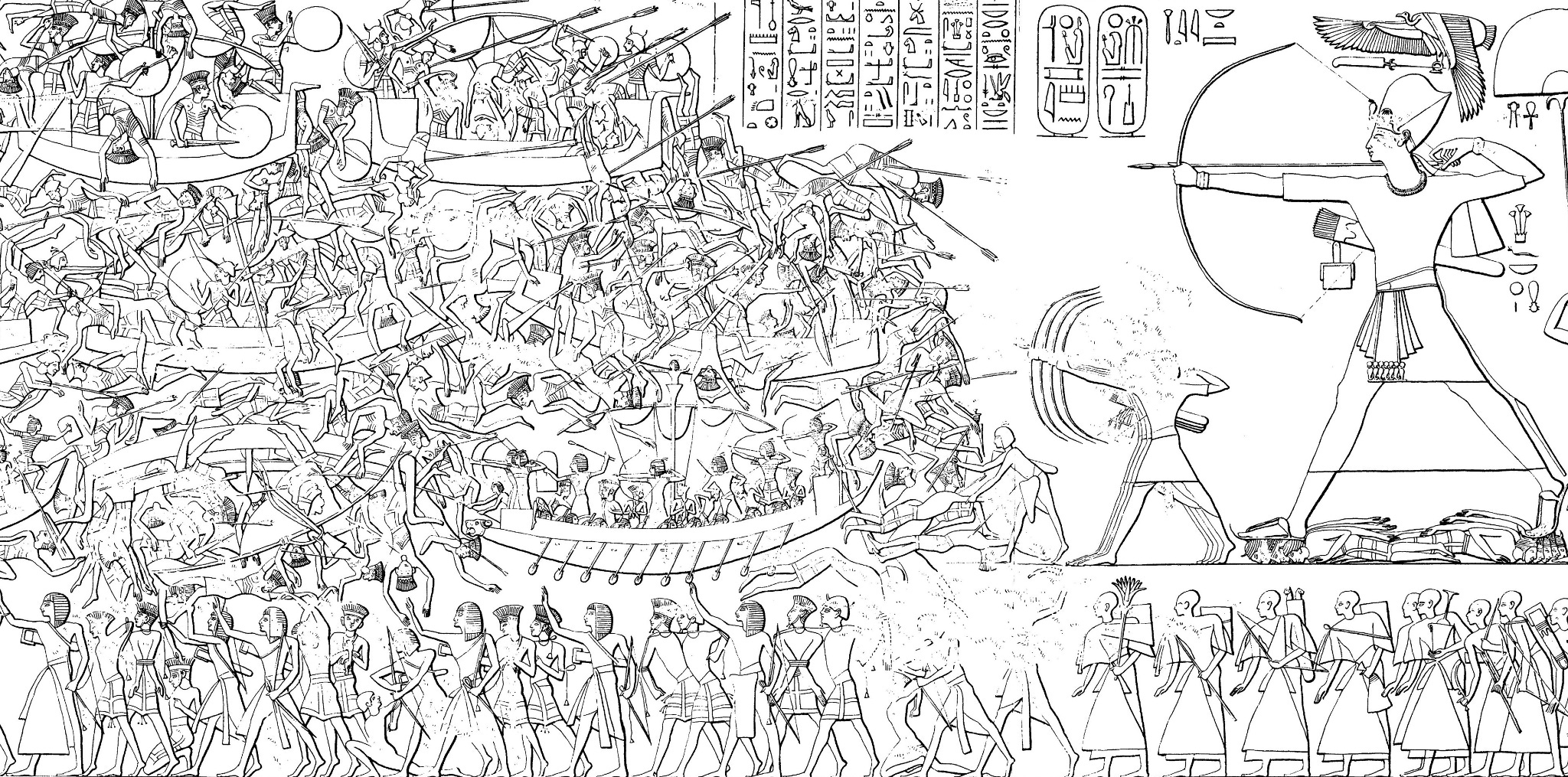

Justin McIntosh: There’s good reason for ancient historians to be mad at Nolan — they have to answer this question all over again when it has been fundamentally answered.
Roel Konijnendijk: He put it front and center in his understanding of the Trojan War. Very sad.
Justin McIntosh: At the end of Emily Wilson’s write-up, she said, at least it’ll bring more people to the books. It has — sales of the Odyssey are up 76 percent from this time last year.
Jordan Schneider: That seems really low — it’s got to be higher than that. My last question: can we talk about the Landmark series for a second? It’s just the coolest thing. Pitch these books.
Roel Konijnendijk: The Landmark translations are a series of books — privately funded, I believe; somebody just wanted these editions to exist. They get scholars to update existing translations or write new ones, then illustrate them with a massive array of maps and add appendices explaining various aspects of the source. They tend to be fantastic first introductions to these texts, because they don’t just give you the words — they make sure everything is fully contextualized in the world in which it takes place. I really love the Landmarks. They’re great for Xenophon’s Hellenica and for Thucydides, but you can get them for a lot of other texts too.
Jordan Schneider: We’ve got Herodotus, Thucydides, the Hellenica, Arrian, the Anabasis — and Caesar.
Roel Konijnendijk: Oh, they’re doing the Anabasis. Cool.
Jordan Schneider: What’s the addition you want to make, Roel — if the editors are listening?
Roel Konijnendijk: A Landmark Cyropaedia would be really interesting. They’re already doing Xenophon’s Hellenica, and now the Anabasis. But Xenophon also wrote what is essentially a historical-fiction novel about the rise of Cyrus the Great. It’s a fictionalized version, but it has grounding in real history, and it’s set all over the Persian Empire. It would make a great parallel piece to Xenophon’s Anabasis and to Arrian’s as well. It’s also due a new translation — the Loeb “Little Green Book” translation of the Cyropaedia that I have is a bit of a mess.
Jordan Schneider: It’s like being handed — who did that Thucydides?
Roel Konijnendijk: Hobbes did.
Jordan Schneider: Hobbes, yes. It’s just impenetrable. You don’t know where the places are or where people are going. I’m not blaming him — but giving someone in the twenty-first century a text without maps and diagrams and photos of what the armor looked like — there are just ways to make this so much more engaging.
Roel Konijnendijk: The Oxford World’s Classics Hammond translation of Thucydides is really accessible — I always recommend it as an easy way in. It’s not necessarily the best version of everything, but it’s cheap and it has your maps and everything else. Otherwise, the Landmark Thucydides has all the maps you could ever want, plus a lot of extra contextualization in the notes and appendices. Go for that if you’re willing to shell out for one of these big tomes.
Jordan Schneider: In the Agora Museum there’s a shield from a raid the Athenians went on — Pylos, I think — with an etched inscription: we stole this from these guys, at this battle. They thought it was so cool they had to etch it in.
Roel Konijnendijk: It’s because it became a dedication. They dedicated these spoils to the gods and put them on display, and to make it a proper dedication you inscribe the context — where you took it. It’s just a few words: “from the Lacedaemonians at Pylos.” We took this from the Spartan forces that fought us at Pylos.
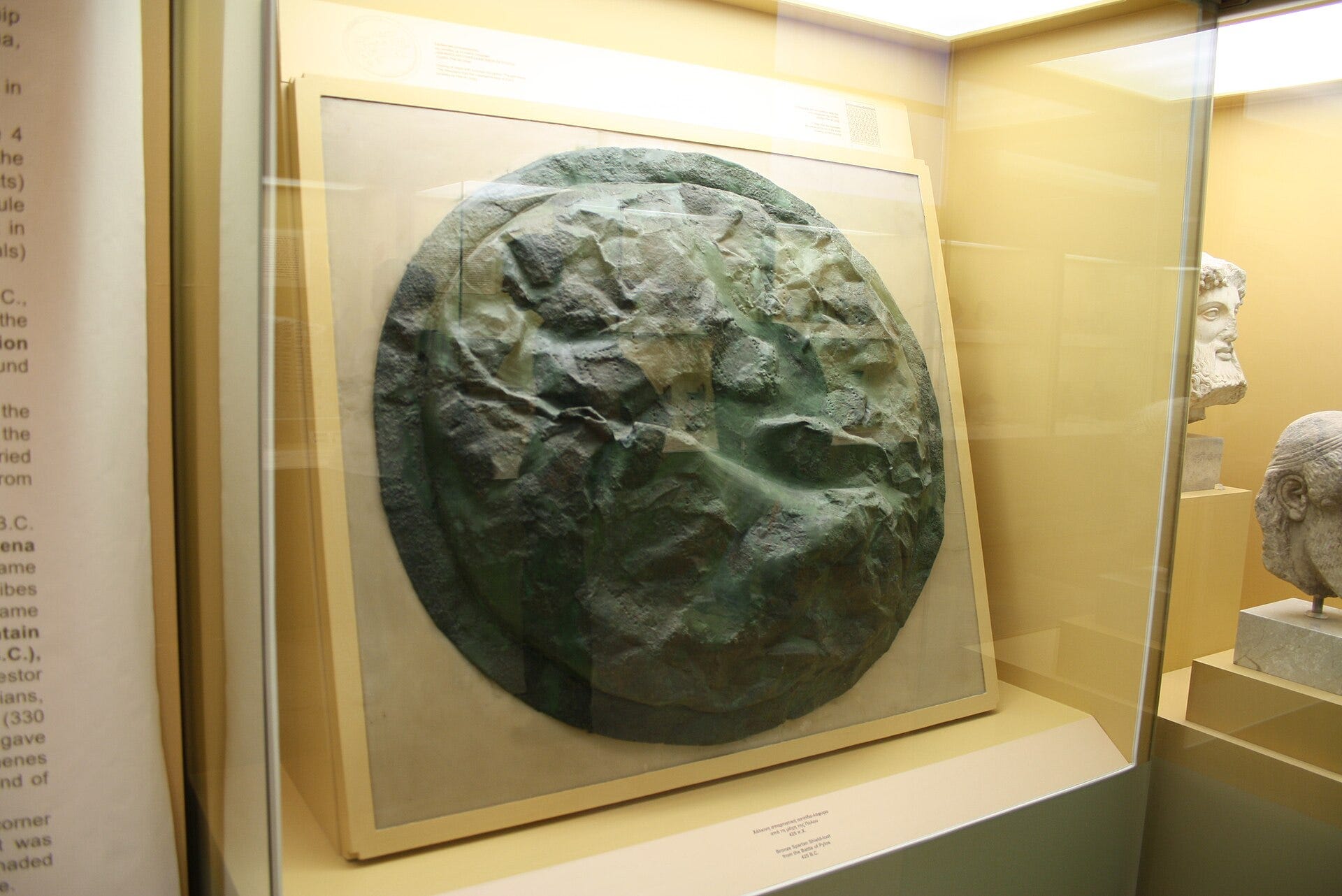

The Odyssey connection is that part of the movie was filmed right where that battle happened. The cave of Polyphemus, the Cyclops — that’s Nestor’s Cave on the rock at Pylos, a few hundred meters from where that shield was captured. That is the Battle of Pylos and Sphacteria during the Peloponnesian War, 425 BC, in which the Spartans were not only defeated — a number of them were captured. They surrendered, which is not something Spartans are supposed to do, and it genuinely affected the course of the war. It’s wonderful that we have a physical token, found in a well in the Agora, that confirms the narratives we get from literary sources.
Jordan Schneider: I love the idea of the Spartans coming into Athens, seeing this, and just throwing it down a well. Don’t you dare celebrate our defeat — we’re going to memory-hole you.
Roel Konijnendijk: They’ve got to respect it — it’s dedicated to the gods. But the Spartans did the same thing. Their temple to Athena on the acropolis at Sparta was known as the temple of Athena of the Bronze House. There are two accounts of the name: one, that the interior of the temple was plated in bronze; the other, that it was so covered in dedications that from the outside it looked like it was made of bronze. They were also celebrating their victories by putting spoils on display.
Jordan Schneider: All right, we’re going to call it here — leave them wanting more. Roel, thank you so much for being a two-part, twice-in-ten-days ChinaTalk guest — a first in our history.
Roel Konijnendijk: Very glad to be here. This was a lot of fun. Thanks for having me.
[Outro song]
Hollered out my own name across the water like a fool / Cost me ten more years and every man I knew / Man of many hooks, let’s go / Nobody came back with me, nobody came back with me / Everybody who believed in me is in that wide dark sea / Only one that made it home, with nobody
Built a horse out of a lie, put a kingdom in the ground / Walked up in a man’s cave, ate his food without a sound / First rule there is, and I broke it like it wasn’t nothing / Blinded him and left him standing in the dark with nothing / He asked me who it was, told him “Nobody” — that’s who, Nobody / Holler “Nobody’s killing me,” and every giant went back to sleep on cue / We was gone, we was clean, we was already free / But free ain’t enough when don’t nobody know me / So I stood up on that deck and let them know: I’m Odysseus, son of Laertes / They know my tricks everywhere I go, and my fame go all the way to heaven, don’t you know / Then he prayed on me: let him come home late, let him come alone in another man’s boat, and let him find trouble waiting at his own gate / His daddy heard it, his daddy answered / I wanted them to know it was me, I wanted them to know it was me
Nobody came back with me, nobody came back with me / Said it out loud one time, now I can’t say it at all / Twenty years of my life for the sound of my own name called
King of the winds at your back, they don’t know / Got close enough to see the smoke off my island, then they cut it open / Come up on my island, gone again / They ain’t never trust me ’cause I ain’t never let them in / Fed six men to them rocks and never told them they was chose / Eurylochus, you was right about me / Told you go left ’cause I knew you’d go right — ain’t no way you couldn’t see / Every call I made was smart, every one of y’all still died / Nobody came back with me / Learned all they names and I buried them all at sea
Asked Achilles in the dark, was the glory worth it / Said he’d rather work a landless man’s dirt than be a king over all of the dead / That’s the best of all of us, wishing he was poor and breathing instead / Reached for my mama and my arms went straight on through her / She said it was longing for me that took her / Then the goddess held out forever, said stay and never die / I said give me my home, give me a wife that’s gonna get old, give me something that can end
King in the dark said don’t walk in your door with your chest out / Said he came home like a hero in his own house — laid him out / So they loud his name on the wall, and I knock like a stranger at the gate / Beggar rags, beggar name, twenty years late / Men in my hall eating twenty years of hurt, calling theyself guests / Not one of them thought to ask a beggar his name — that’s how you fail the test / Dog wagged his tail one time and dropped his ears down low / Ain’t had the strength to come to me, but he the first one to know / A woman washing my feet felt the scar and said my name / Twenty years I’ve been dying for somebody to say that name / Now it’ll kill me if she do — had to hold her mouth and take the blame / Strung my bow in a room of men who couldn’t lift it off the floor / And it got real quiet in there, nobody talking no more
Nobody came back with me, nobody came back with me
Three years she wove a dead man’s burial cloth in the daylight / And pulled every thread of it back out at night / Held off a hundred men with a loom and ain’t told a soul / Twenty years and she still ain’t believe me / Told her move the bed just to hear what I would say / I said ain’t nobody move that bed — I cut it from an olive tree, still rooted in the ground / That’s when she broke / The song say she cried like a man come up out the water when he finally see the shore / Then the goddess held the sun down under the world so we could stay up talking / They call me sacker of cities, they call me the one who endures / Only one of them ever got me anything, and she the one who really endures / Nobody came back with me, but somebody was still here
Wealthiest man on a rock in the sea / Which on this island means eleven more of me / No crown, no throne, no law, no gate / Just jars on the shelf and the flocks on the hill / Three rooms and a portico — three rooms, that’s a palace where I’m from / No marble, no dome, no walls that hold / Just more wine than you — that’s all a king is, that’s all a king is / Sacked a city for a cup and I carried the cup home / That cup is the only reason anybody calls me lord / Suitors in my hall eating twenty years of hurt / That’s not bad manners, that’s a takeover / Boy runs the seat, but the seat isn’t real — who enforces it? Nobody’s coming / Power’s not a title, power’s who shows up / Storms deep, walls thin / One bad season from a man who used to be the lord
My main takeaway from this (awesome and lively) discussion is that I need to pre-order Jordan’s original rendition of the Odyssey ;)
"It always struck me that these gods are just playing, and they don’t really care — you’re just a pet insect to them" King Lear, Gloucester: "As flies to wanton boys are we to the gods, they kill us for their sport".