
Anon contributor “Soon Kueh” occasionally writes about China and delights in bureaucracy. Editor Lily Ottinger provides the voiceover, and welcomes feedback on her delivery!
How do Chinese people complain to the government? Most foreigners assume that showing dissatisfaction towards the Chinese government would be very difficult, if not dangerous. In 2012, there were reports of petitioners being intercepted en route to Beijing and thrown into “black jails 黑监狱”; interceptors were also paid 200 yuan/day for every petitioner withheld back in 2012. However, this high risk only applies to complaints that threaten powerful local officials and party stability. For complaints that pose a lower threat to domestic stability, there are robust complaint mechanisms embedded within China’s authoritarian structure to maintain domestic stability.
Who is Shenzhen Ruler Guy?
I was first exposed to the possibility of thriving Chinese Karens when Shenzhen Ruler Guy 深圳“卷尺哥” appeared on my Instagram feed, tape measure in hand. Ruler Man’s charm lies in his precise critiques quantified with his trusty tape measure. In one video, he uses his bendy ruler to poke through a pothole, lamenting that it is way too deep. A classic Karen who holds incredible sway, his posts expose public infrastructure defects and prompt authorities to fix them quickly. Almost every single critique he has made so far has been heeded by the Shenzhen authorities. His virality has also sparked a national trend of Ruler Guys in cities such as Handan 邯郸 and Fuzhou 福州, although some netizens have criticized them as “Leaders of the Busybody Agency 多管局局长.”


What’s interesting is not Shenzhen Ruler Guy’s Karen-ness per se, but the speedy proactiveness of Shenzhen authorities in fixing these small-potato issues. This story led me into the deep rabbit hole of the Kafkaesque ecosystem of Chinese public service feedback apps and the emerging role of AI in managing them. But before we get into that, we have to start from the beginning and understand why it’s worth fixing these minute defects in the first place.
Why fix it if it ain’t broken?
Media pressure obviously plays a huge role, but the eagerness of Shenzhen officials reveals an underlying desire for containment that is neatly encapsulated by their latest mantra: “Fix it before there’s a complaint” 未诉先修. According to the People’s Daily, a sprawling inter-agency task force has been established to address the complaints of Shenzhen residents: the previous 537 communication channels that residents used for grievances have been streamlined into one unified channel known as “Shenzhen Express Service for Public Feedback 深圳民意速办”. To ensure that all requests can be efficiently categorized to avoid bureaucratic standstills, the task force abides by three key principles. Firstly, all complaints are sorted into 18 main categories with >4,000 sub-categories. Secondly, tasks are delegated to agencies based on the smallest operational granularity. Lastly, the agency responsible for delegating the task must also prepare its own operational report to ensure accountability.
Karen Performance Indicators
While this sounds like a bureaucratic hellscape with endless paperwork, it is consistent with China’s fondness for cutthroat KPIs that are easy to implement and calculate, especially in performance evaluations for local officials. Gao Jie’s prior research showed that local officials adopted gaming strategies to meet their targets and increase their chances of securing promotions. It is not uncommon for local officials to falsify or manipulate GDP data or other relevant statistics to furnish their portfolios.
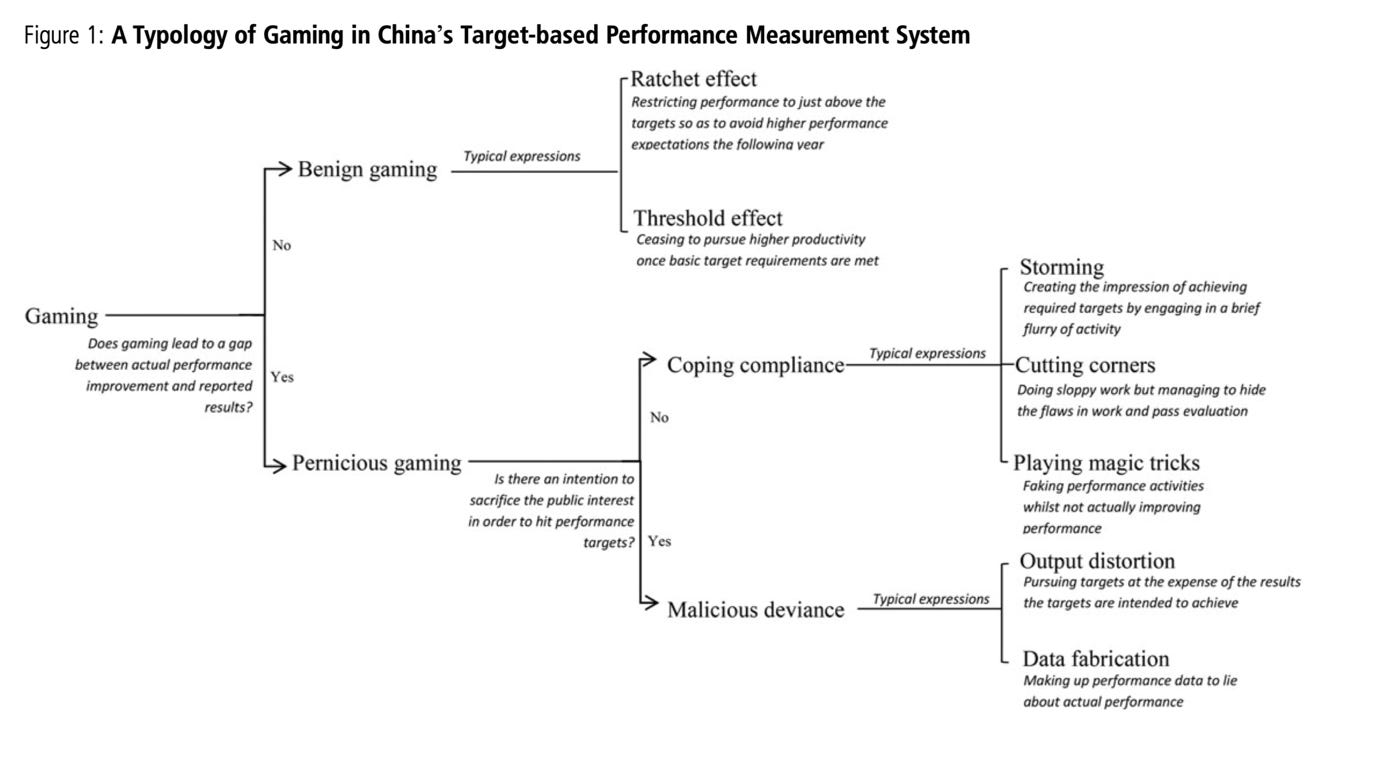
It thus makes perfect sense for this excessive emphasis on KPI to be integrated into the Karen world of minute complaints. As the proverb goes, Rome wasn’t built in a day 冰冻三尺非一日之寒. It’s better to nip small complaints in the bud before they become larger headaches for local officials, as the consequences are much higher for local governments if they do escalate. Social stability is a significant component in the performance evaluation portfolio of local officials — it is not uncommon for local officials to hire thugs to suppress protests or harass grassroots leaders to stifle unrest, according to Cai’s research in 2023. His research also highlights that officials use the legal system to their advantage by accusing protestors of “attack[ing] state agencies” or attempting to “disrupt the social order.” Failing to suppress social unrest would not only result in intervention by senior officials (or worse, the central government), but is also a fireable offense. Such was the case in the 2011 Wukan protest over land expropriation. The extraordinarily high-profile protest was only resolved after intervention by senior Guangdong officials, and many of the local officials involved were punished.
Shenzhen’s centralized platform is thus a smart solution that neatly addresses the concerns of everyone involved. Firstly, residents can efficiently file their complaints. Secondly, local officials can address and prioritise these concerns effectively to lower the risk of escalation. Lastly, local officials can use data from this feedback channel as evidence of fulfilled KPIs in reports to the central government and provincial higher-ups.
The Fengqiao Experience 枫桥经验
While the speedy fix-it mantra of 未诉先修 has been recently popularized by Shenzhen Ruler Guy, Shenzhen is not solely responsible for coining this term. In fact, a cursory search online reveals that various cities such as Xining 西宁市 and Shanghai have long used this term to describe their earnest grassroots efforts, way before Shenzhen Ruler Guy went viral. A further spiral into the bureaucratic rabbit hole reveals a few interesting tidbits. Firstly, the mantra of “Fix it before there’s a complaint 未诉先办” was preceded by “Receive the complaint and immediately fix it 接诉即办.” Here’s where it gets the most interesting. The great originator of these pro-Karen slogans ultimately traces back to the Fengqiao Experience 枫桥经验, a term coined in the early 1960s that was recently resurrected by Xi Jinping.
The Fengqiao Experience refers to a four-pillar ideology of local officials in Fengqiao County, Zhejiang: 1) mobilizing and relying on the masses; 2) settling conflicts immediately and preventing the higher-ups from getting involved; 3) reducing incarceration rates; and finally, 4) improving public security. 发动和依靠群众,坚持矛盾不上交,就地解决。实现捕人少之安好. Although the term has been used by Xi on and off since 2013, the Fengqiao Experience was in fashion again when Xi reiterated its importance during the 2024 Central Agricultural Working Committee Meeting 中央农村工作会议.
In the present day, the direct face-to-face complaints of the 1960s have been replaced with online submission platforms. Based on my own research, all the feedback service platforms are available on WeChat as mini apps. Currently, the official feedback service platform in China is known as “12345.” Just as the name implies, calling “12345” on your mobile phone allows you to immediately get in touch with personnel who can help with your complaint. A quick search on WeChat shows that these feedback service platforms operate in a decentralized manner.

While it appears that there is a 12345 local platform for every city, not every province has a platform. For instance, Ningxia Hui Autonomous Region has a “Yinchuan 12345,” but does not have a provincial-level “Ningxia 12345.” On the other hand, Shaanxi 陕西 has a provincial-level 12345 platform, alongside its city-level platforms. In general, it is more common for cities to service these public feedback platforms, although there are occasionally county- and provincial-level channels. Interestingly, the highly venerated Shenzhen fix-it-platform 民意诉办 is not a 12345 platform but appears to be a uniquely Shenzhen app that provides two key services: 1) addressing citizens’ concerns 民意诉办 and 2) tackling enterprise-related concerns 企业诉办.
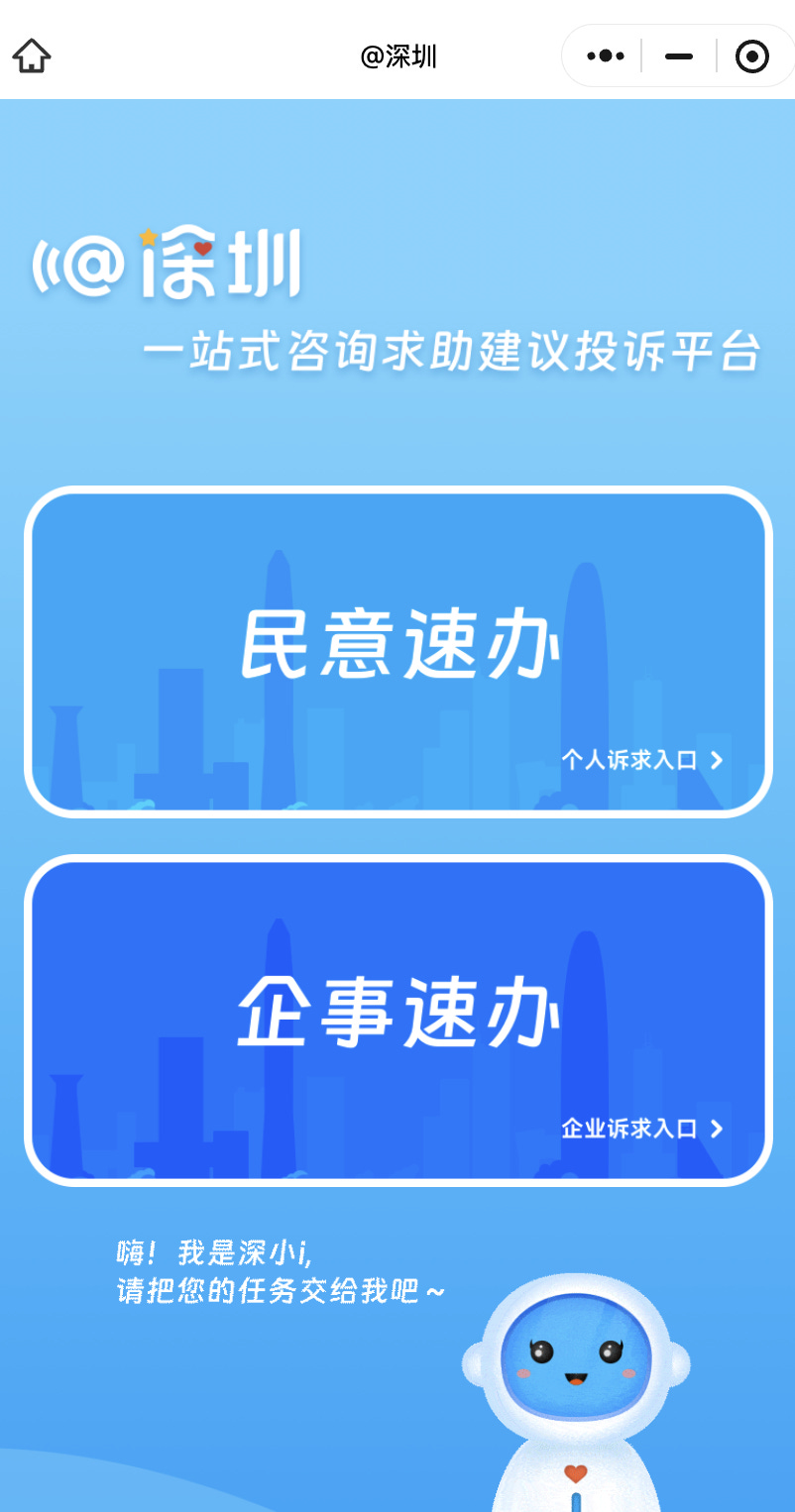
Apart from the 12345 feedback service platform, there is a whole cornucopia of feedback service platforms for different purposes. For example:
12315 caters to consumer-related complaints,
12333 caters to social security 社保,
12123 caters to traffic control 交管 (i.e. DMV-type matters),
12366 caters to tax-related matters,
12348 caters to legal matters.
For an ordinary Chinese citizen, this can be extremely disorienting because there are so many channels that serve different functions. This is when the mother of all public service platforms comes to the rescue — the PRC Government Service Platform 中国政务服务平台 promises to unify all of these pesky channels into one. The platform is a powerful mini app that encompasses 45 departments, 31 provinces, and a whopping 1,391 administrative duties. According to its website, it has responded to a grand total of 5,212,308 administrative inquiries and 1,367,215,177 complaint cases to date. This number makes sense given the broad scale of issues the platform covers: gaokao 高考, fertility 生育, intellectual property rights 知识产权, trans-provincial matters 跨省通办, and more.
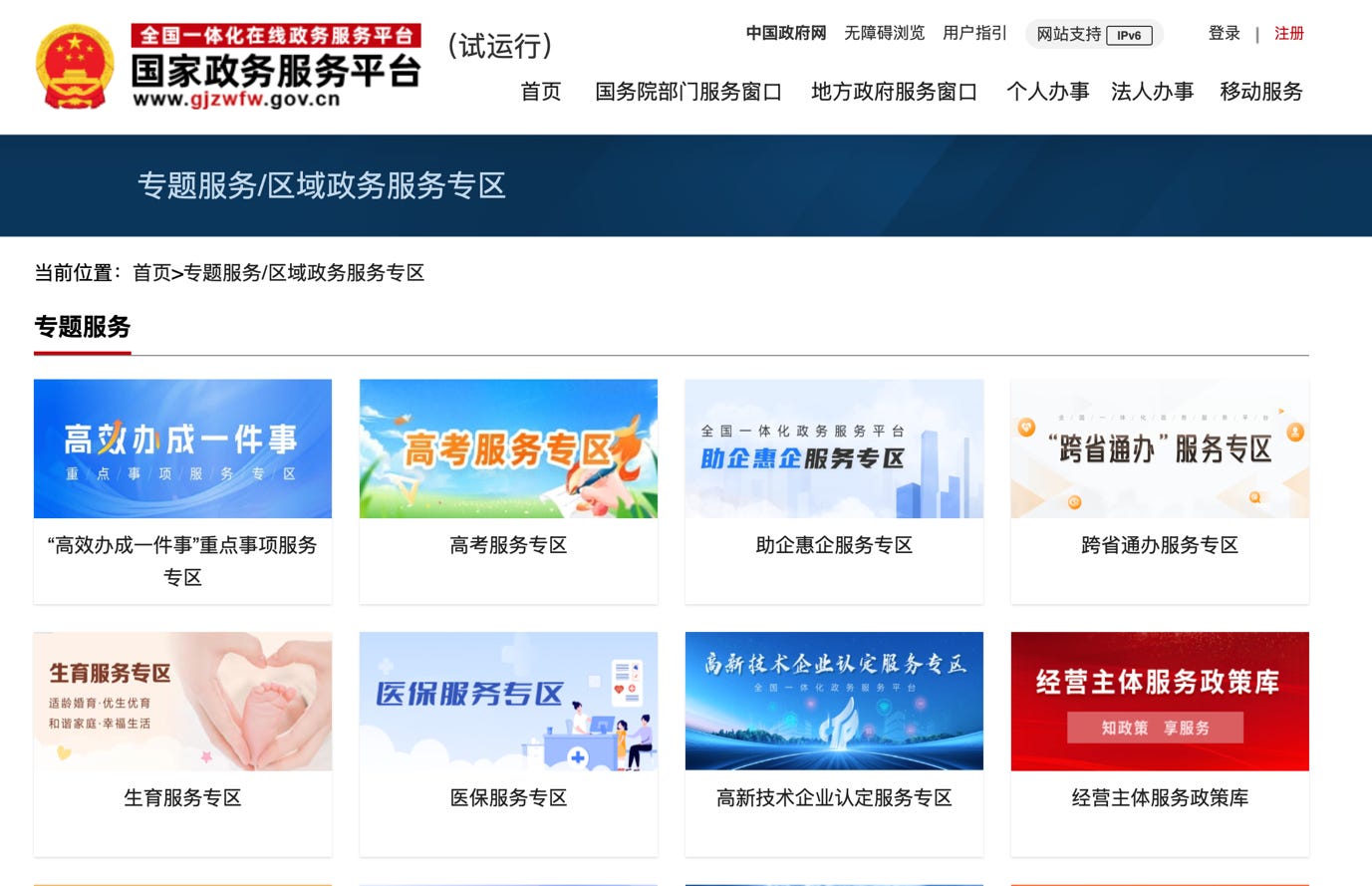
However, more is not necessarily better. In fact, it is easy to get overwhelmed by this cornucopia of apps. In response, Chinese netizens have created various videos sharing their top tips on getting immediate feedback. One suggested directly contacting the State Council’s WeChat account and sending detailed feedback via their service platform. While 12345 is considered the most general platform, it seems generally better to contact specific hotlines for specific issues. Another user even suggested creating a detailed complaint report and mailing a physical hardcopy to the local office in addition to submitting it via 12345. In fact, he suggested that it would be even better to go in person to submit the physical report at the local office to ensure accountability. He instructs viewers to provide explicit instructions in the report, including clear expectations as to when the problem should be resolved by (e.g. “I expect this noise problem, which has been affecting my son’s gaokao revision, to be resolved by 5 January 2026.”)
If anything, these videos show that the Kafkaesque bureaucracy has not been streamlined but merely digitalized. Having access to a plethora of public service platforms is not the same as making sure that your concerns are heard, given how complicated Chinese bureaucracy is.
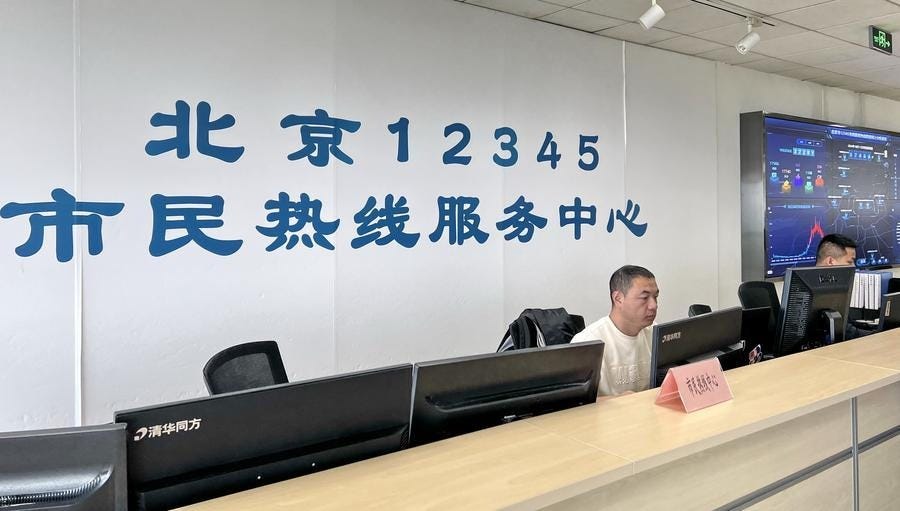
Moreover, as digitalized as these platforms are, their backend management is still extremely labor-intensive. For instance, Beijing’s 12345 office has a 750-seat capacity and 1700 staff to man the hotline. Apart from listening to complaints, staff must record important information and mobilize relevant personnel while patiently ensuring that callers feel listened to. In 2023, the Beijing office received an average of 40,000 to 50,000 calls per day, with each staff member accepting a few hundred calls daily. Shifts are incredibly long, ranging from 9.5 to 13 hours. There is even a 24h shift team consisting of 119 members. With its ambitious promise to resolve inquiries within 48 hours, it is unsurprising that Beijing’s staff members are swamped.
DeepSeek: 12345’s New Best Friend
Given that 12345 platforms promise to handle everything from noise pollution to scams under immense time pressure, it is unsurprising that localities are turning to AI. Since early 2025, DeepSeek has been gradually integrated into various cities’ 12345 platforms, and feedback has been largely positive. Kunshan City 昆山市 has reported that DeepSeek has been assisting in filing claims, providing appropriate recommendations, and mobilizing relevant personnel. As a result, ticket processing times 制单受理时间 have dropped by 30% and accurate policy response rates 政策直接解答率 have increased by 10%. In Guangdong province, the introduction of an AI-powered ticket dispatch system reportedly increased efficiency from 85% to 95% compared to the traditional system.
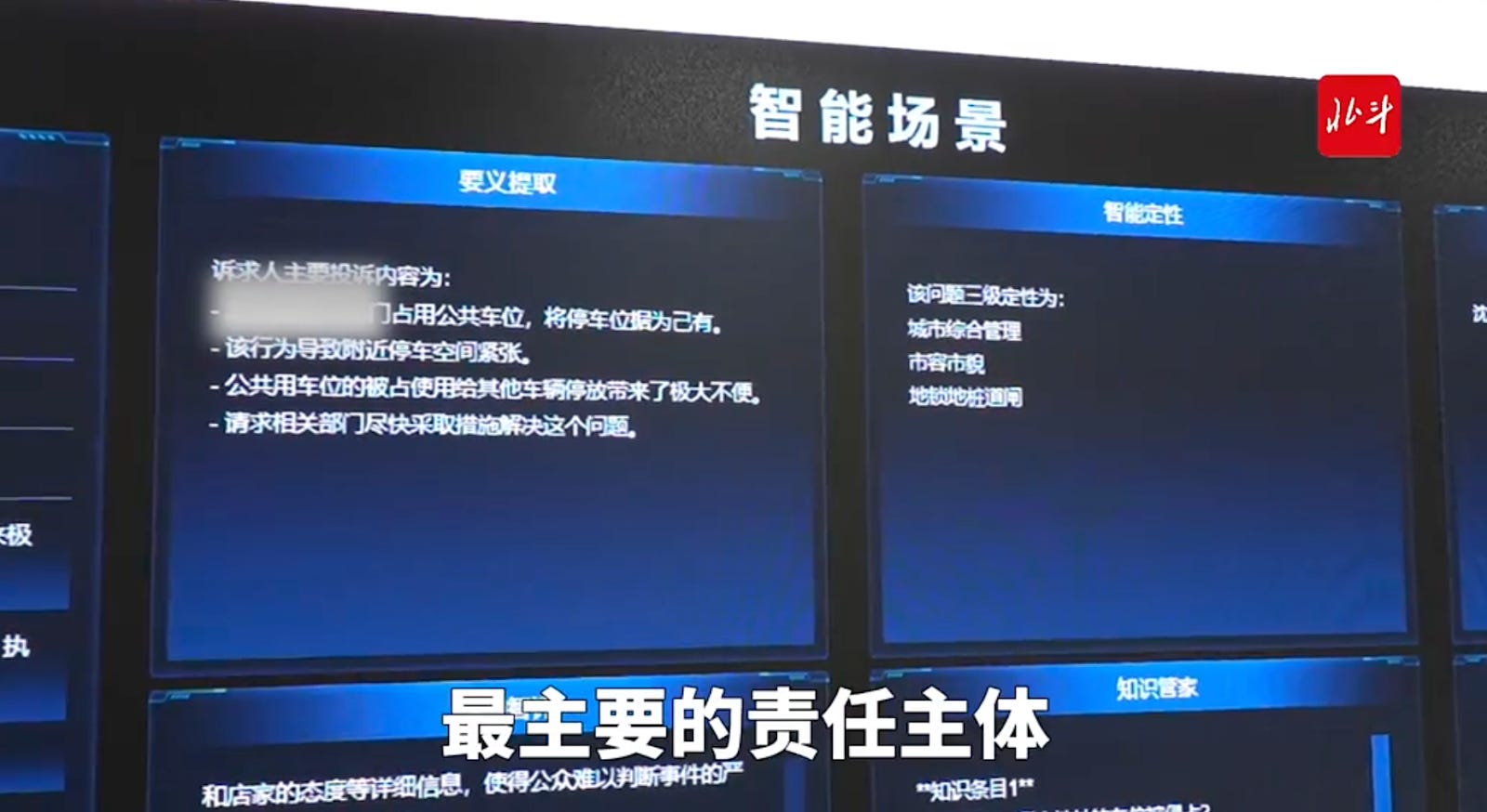
The Technology Chief of Liaoning’s 12345 platform shared in an interview that the introduction of DeepSeek greatly shortened ticket dispatch timings from 10 minutes to a few seconds. Within a few seconds, it is able to do four things: 1) receive the ticket; 2) understand the key essentials; 3) intelligently identify the category of the ticket; and finally 4) dispatch the ticket to the relevant departments. However, he clarified that DeepSeek is not intended to replace workers, but assist them in improving their quality of service.
With the proliferation of DeepSeek usage, 12345 platforms can now run 24/7 with fewer human resources. Nonetheless, the quality of DeepSeek model deployments across all 12345 platforms varies greatly. In Zhongshan University’s 中山大学 report on the rollout, researchers acknowledge that while DeepSeek’s integration into 12345 platforms is in its “in-depth developmental phase 纵深发展阶段中,” there is still room for improvement. Currently, the problem-solving capabilities of DeepSeek are lacking and contribute to a poor user experience. More fine-tuning is needed to improve response times, tailor responses, and coordinate with human staff.
In their study that covered 36 key cities comprising direct-administered municipalities 直辖市, sub-provincial cities 副省级城市, and prefecture-level cities 地级市, only 14 out of the 36 key cities (40%) provide AI-powered services on their websites. Moreover, out of these 14 cities, while all their models can provide support in customer service, only 35.71% are able to file claims, and 21.43% are capable of intelligent call transfers. The number of cities that can provide AI-powered services on their apps is much lower. Out of the 28 cities that have 12345 apps available, only 9 of them provide AI-powered assistance (32.14%). Only 33.33% of these models can file claims and 11.11% are capable of intelligent call transfers, both of which are statistically lower than that of the models available on the websites.
From this research, it appears that the speedy efficiency of Shenzhen, Guangzhou, and Beijing’s 12345 platforms is an exceptional anomaly. This is not surprising, since richer cities have more resources to improve their public service feedback platforms. With every local government being responsible for designing its own 12345 platform, the results are bound to vary. Considering Shenzhen’s reputation as a tech hub, it would be more surprising if its models weren’t performing better than average. Moreover, wealthier and resourceful cities are also able to leverage existing institutional networks to speed up development — for example, Guangzhou’s “Digital Innovation Lab” 数字广州创新实验室 is collaborating with 17 administrative departments to streamline the city’s workflows using DeepSeek.
In short, multiple disparities emerge from DeepSeek’s lateral development across 12345 platforms. While uneven inter-provincial development is certainly a concern, even cities in the same province may be using different models and exacerbating the disparity. Within this disparity is also the issue of uneven digital platform development, where more resources are currently being channelled towards DeepSeek integration on websites instead of mobile platforms and apps.
For now, it appears that DeepSeek is the preferred AI model for most localities (barring the rogue Youjiang District 右江区 in Baise 百色, Guangxi that uses Qwen3). Since localities are already laterally developing their own models, it is more practical for them to adopt the same LLM so that they can conveniently engage in future resource sharing. Considering China’s fondness for using domestic competition to weed out the weak (as in the case of BYD’s success), it is also possible that the lateral development of DeepSeek in 12345 platforms across localities is intentional, in order to encourage innovation and competition in localities before one best model is unilaterally adopted nationwide. Apart from pragmatic considerations, it is also likely that DeepSeek is favoured because of its image as a national champion in China, paving the way for Chinese tech innovation.
In one of the more offbeat crossovers so far, DeepSeek is now emerging as a promising asset in maintaining authoritarian resilience and improving citizens’ quality of life. While content creators such as Shenzhen Ruler Guy may get a bad rep for being frivolous Karens, it is undeniable that the continuous improvement of China’s 12345 platforms helps create a crucial space for local concerns to be heard — a process that is already challenging in itself.
Don't see that "Karen" is the appropriate term for these people, nor is "busybody". They're not pushing against other citizens, they're pushing against infrastructure or government failings. The effort looks admirable from here, and government response to actually address the problems using AI is also for the good.
Good pronunciation, great explanation, though I'd say it's less about appeasing Karens and more about maintaining a level of relationship with the populace that retains control. In economic terms, between government "supply" and populace "demand", CCP is targeting the sociopolitical profit-maximizing point while branding it as a somewhat socially optimal point.