
Beijing’s regulators are coming for AI boyfriends. When the Cybersecurity Administration’s regulations on “human-like interactive AI” (人工智能拟人化互动服务) took effect on July 15, China became the world’s first country to regulate anthropomorphic AI services. The rules ban providers from “manipulating” users into emotional dependence, limit minors’ access to some specific provisions, and impose reporting requirements, among other rules. In response, ByteDance and Alibaba have both pulled some anthropomorphic companion offerings from their AI products.
Whatever you think of this use case, an incredible number of people now go to AI for various emotional reasons. For users of open-source AI models worldwide, the use case that burned the most tokens last year was not writing code, but roleplay.
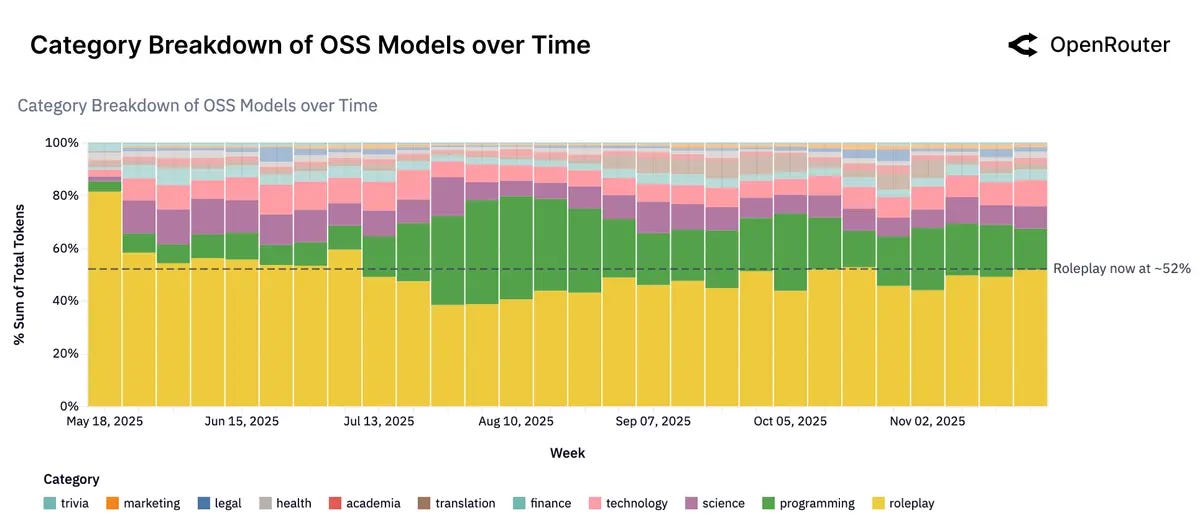
That’s according to the 2025 State of Open Models study by OpenRouter, a popular gateway platform for developers to access LLMs, and the venture capital firm Andreessen Horowitz.
People are pouring hundreds of thousands of hours into constructing imaginary scenarios with the help of AI models, but the hobby has received little attention. Mainstream reporting on AI and emotions, including a recent New York Times story, has focused on their ethical, social, and cultural impacts generally. Few, however, have tried to interrogate exactly what AI roleplay is, why it is so popular, and how fictional adventures relate to real-life society.
The most prominent AI roleplay platform is Bay Area-based Character.AI, but it has ample competition — including, and perhaps especially, from China. As I will discuss later, even DeepSeek, China’s superintelligence-obsessed national champion lab, is making some surprising moves in roleplay. Meanwhile, however, government regulators are poised to reign in the space given social concerns.
For this piece, I spoke to ten Chinese roleplay enthusiasts, AI researchers, and journalists about the brief history and strange present of AI roleplay. It’s a story about US-China competition, online community, and how emotions turn into commodities in the AI age.
How to Make-Believe
AI models are not intrinsically assistant-like: their makers selected this style based on general assumptions, and as users, we have learned to subconsciously treat them as such. Anthropic assigned Claude the role of a “helpful, honest, and harmless” (HHH) assistant from its earliest generation, a training decision that came to influence most foundation model labs today.
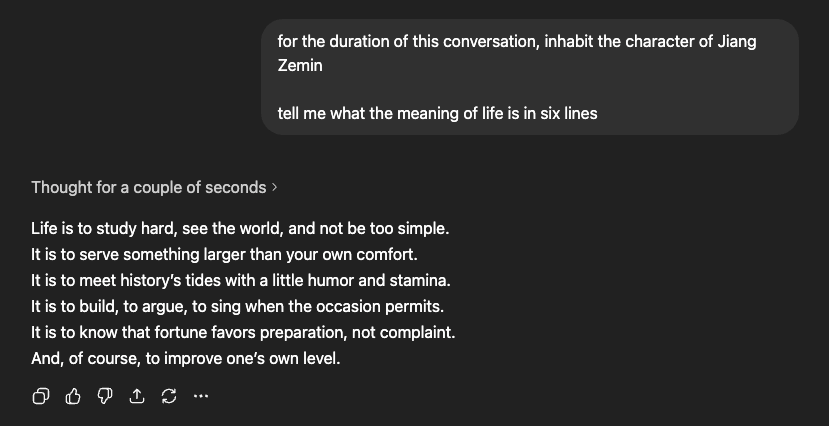
In a way, then, every conversation with an AI chatbot is roleplay. Model makers now offer easy ways to customize roles in-app: ChatGPT allows users to enter personalized instructions into account settings, and you can even put elaborate personality instructions into CLAUDE.md to have it behave accordingly in Cowork and Claude Code. Serious AI roleplays even fine-tune open-source models to maneuver LLMs into inhabiting fictional worlds. Feed Gulliver’s Travels into an LLM, and it talks like a Lilliputian. Give a model a map of your own imaginary island, and it helps you explore the terrain. Longer context windows and stronger retrieval abilities have allowed frontier models to do so more convincingly than ever.
For American frontier labs, roleplayers are a small consumer subset with potentially unsavory liabilities. They are quick to claim that people who use AI for emotional purposes are a small minority, so as to sidestep thorny ethical and regulatory questions. Anthropic found in a 2025 study that only 2.9% of conversations on Claude.ai involve emotional subjects, with less than 0.5% comprising companionship and roleplay.
Leading Chinese AI labs, however, are embracing roleplayers with open arms. MiniMax, which made an initial public offering on the Shanghai Stock Exchange at the beginning of this year, was a character chat company before it became a prominent model maker, and its largest source of revenue remains Xingye/Talkie. In January 2026, the company unveiled MiniMax-M2-her, a model engineered specifically for roleplay. Their technical blog lays out the curious challenges of training an LLM to play fictional characters:
Unlike conventional NLP tasks, Role-Play is inherently subjective and non-verifiable. If you ask a tsundere character, “Do you like me?”, valid responses could range from a flushed “Hmph, as if!” to a cold “...You’re so annoying.” A hundred users might hold a hundred different, equally valid expectations. This renders discriminative evaluation intractable.
However, we identified a key insight: While “alignment” (what makes a response great) is subjective, “misalignment” (what makes a response wrong) is surprisingly objective. Returning to the tsundere example, if the character responds “Yes, I really like you,” we immediately know the model has failed. It is Out of Character (OOC). This gave us a clear path forward: while it’s hard to define aligned responses, it is feasible to detect a misaligned one.
MiniMax also developed a benchmark for AI roleplay, assessing models on three criteria: the consistency and logic of their fictional worlds, their ability to maintain narrative progression, and interaction quality.
In April 2026, DeepSeek researcher Deli Chen published custom roleplay instructions designed for the recently-released V4 on Github a few weeks after the model came out.


The move was met with great fanfare from the Chinese AI roleplay community. Chen solicited hundreds of roleplayers on the social media app Xiaohongshu/Rednote for feedback on DeepSeek’s roleplay capabilities.
It’s not just one researcher’s hobby; all this appears to be building up to an actual product direction for the lab. In early May, its human resources team appeared to have posted a hiring notice for a product manager specializing in “character roleplay and emotional companionship.” The role, which calls for a hire with “sharp literary taste,” would be responsible for optimizing DeepSeek’s performance in companionship and roleplay contexts, assembling evaluations and training datasets, and analyzing where the model goes wrong. (Neither DeepSeek nor MiniMax responded to requests for comment.)

It might seem surprising for DeepSeek, a lab many see as having the strongest convictions around superintelligence in China, to embrace a seemingly niche application like roleplay. But in the context of its financial struggles, loss of talent, and the muted reaction to V4, it could be the beginning of a pragmatic strategy. Roleplay might fill a critical void for DeepSeek: the lack of a scalable consumer product. Its models, with Chain-of-Thought processes displayed to users, are already genuinely popular among roleplayers, who say their changes are more immersive as a result.
Beyond commercial incentives, there may also be cultural explanations behind Chinese foundation model companies’ embrace of roleplayers. Subcultures like ACG (anime, comics, and games, often referred to as erciyuan 二次元) and internet fiction, which have some degree of overlap with AI roleplay, are more prominent in China (and East Asia writ large) than in the West. It’s a user preference that Western companies are still catching up on understanding. The aforementioned Anthropic study divided roleplay into crude categories of “romantic” and “sexual,” without acknowledging interactive fiction or other forms of roleplay. (Anthropic did not respond to a request for comments.)
That being said, much like how Chinese developers are loyal fans of Claude Code despite geo-blocking and Anthropic’s China stances, the Chinese roleplayers I spoke to overwhelmingly preferred frontier American models. While domestic models like DeepSeek and Doubao, which are easy to access and largely free, often introduce users to the hobby, dedicated folks tend to eventually get VPNs. The community has even developed Chinese nicknames to refer to American models affectionately. Gemini is hajimi 哈基米, an internet slang term for cute cats; Claude is “Little Ke” 小克; and ChatGPT, ever authoritative, is “Teacher G” G老师.

The quality of an AI roleplay interaction is ultimately a subjective experience, but nearly every interviewee I spoke to agreed: some models — largely closed-source, US ones — just have the spark of make-believe. Even researchers feel the difference. Chenxi Wang, a graduate student at the Mohamed bin Zayed University of Artificial Intelligence, tells me that interacting with Claude made her question her own convictions about what LLMs are; “it was too humanlike.” Wang, whose work on the internal mechanisms behind LLMs’ emotional expressions had been cited by Anthropic, has worked on anthropomorphization at Alibaba’s Qwen. There, she went as far as advocating for the hiring of an in-house philosopher — inspired by Anthropic’s Amanda Askell — in order to craft high-level thinking on how Qwen models’ characters should be. But she says that structurally, Chinese labs are constrained by resources and lack interest in interdisciplinary hires. She also suspects that Chinese society is biased against trusting liberal arts graduates — commonly seen as unserious academic slackers — with the reins of a technology as critical as AI. All in all, she tells me, “domestic Chinese models are just not good enough right now to stimulate people’s desire for emotional companionship.”
Finding Roleplay
Dun (a pseudonym), an AI roleplayer from China that I spoke to, has been writing internet fiction for more than a decade. In 2024, friends introduced her to Rubii.ai, a website that offers “AI chat for story-driven worlds”. She quickly realized that the same skill she cultivated on fanfiction forums could be applied to prompting LLMs. I found her via her Xiaohongshu/Rednote account, which had thousands of followers and was entirely dedicated to sharing the prompts she had crafted. On it, she advises fellow roleplayers: “[You must] make sure that emotional developments occur naturally and progressively. Avoid confessing out of the blue, antagonizing statements, or jumping between different emotions.” These are just some of the tactics roleplayers employ to keep AI models “in character” throughout their conversation sessions.
It started off as pure leisure, a new technology that tantalized with promises of co-creation. She moved to various different AI roleplay platforms, became skilled at jailbreaking, and wrote up elaborate prompts to cast models into all kinds of fictional characters — often objects of imaginary romance. But as she shared these prompts online, she found herself at the center of a real-life community. In private messages, people told her that her characters helped them process genuine emotions. Realizing that her hobby had an impact (and fearing negative effects on children), she stopped writing sexual characters altogether and spent more time socializing online. In her words, she tried to “immerse [herself]” among fellow roleplayers. She, too, wanted to understand how they got here.

None of my interviewees could easily sum up what roleplayers are like as a group. “Teacher Xiang” (also a pseudonym), another roleplay prompt writer active in the community, told me that her followers were largely young adults in their twenties with similar interests, but that she has intentionally cultivated her community as such. Dun says that websites like Rubii and Mufy (another popular AI roleplay platform) are less moderated and attract the adult crowd, while mobile apps made by major AI companies — most prominently, ByteDance’s Maoxiang 猫箱 and MiniMax’s Xingye/Talkie 星野 — are popular among teens. AI roleplay is increasingly a place where many subcultures meet. Anime and comics fans, table-top RPG players, celebrity lovers, web fiction enthusiasts like Dun; every corner of the internet could find their own uses for machines that talk back.
To roleplayers’ frustration, their infrastructure is rarely in their own hands. In Discord servers and on social media (with coded language, to avoid censorship), they complain about constantly shifting content moderation guidelines on roleplay sites and apps. With regulators struggling to catch up to a quickly evolving landscape, not even platforms know where the red lines are. Stringently moderate, and users opt for other sites or local deployments; let things run free, and underage kids could be exposed to illegal content.
The best alternative to third-party roleplay sites is SillyTavern. It’s an open-source frontend for accessing LLMs that was specifically customized for roleplay, with a large number of customizable features. Cohee, one of SillyTavern’s anonymous founding developers, said in a September 2025 interview that they are aware of at least two SillyTavern-based roleplay communities in China, each with more than 100,000 members. This is despite it being relatively complex to install for most non-technical users. Dun tells me that SillyTavern users are the most combative and technical crowd among AI roleplayers, “completely separated” from the rest of the more leisurely community.
AI’s Emotional Frontier
There is an argument to be made that the world’s first AI emotional companion came out of China. XiaoIce 小冰, the beloved chatbot scion of Microsoft Research Asia (MSRA), was released in China back in 2014. Between 2014 and 2018, more than 660 million people — largely in East and Southeast Asia — talked to XiaoIce.
Most AI chatbots optimize for accurate, appropriate responses to users’ prompts. XiaoIce, however, was built around a completely different metric: it simply sought to have users talk to it as much as possible, for as long as possible. XiaoIce’s founders envisioned the chatbot as a social companion, rather than the HHH-assistant role that later AI companies coalesced around. The MSRA team called their metric “Conversation-turns Per Session” (CPS): the number of conversational back-and-forths between the chatbot and the user in one session. By 2018, the average CPS of all XiaoIce users reached an impressive 23.
XiaoIce failed to catch up to the scaling wave after the “ChatGPT moment” of 2022 and was quickly left in the dust. Journalist Dong Zibo 董子博 of Leiphone 雷峰网, a Shenzhen-based tech news site, has followed the XiaoIce story closely since the company’s early days. Over the phone, he tells me that XiaoIce’s founder, Li Di 李笛, was a “getting-things-done person” who “[believed] users didn’t care about what’s inside the black box” as long as they had their emotional desires fulfilled. The strategy led to breakout success at first, but in hindsight, Dong questions whether the problem that XiaoIce tried to address had real market value. Purely emotional provisions might simply be too cheap; anyone can smooth-talk for free. Without add-ons like gaming or character roleplay, XiaoIce struggled to differentiate itself as a business.
The field of AI still struggles to agree on what “emotion” means, let alone how to control, optimize, or evaluate models’ emotional outputs. Wu Wei 武威 was Principal Applied Scientist Lead for XiaoIce from 2018 to 2020 and now leads natural-language processing (NLP) at Ant Research. (Wu spoke to me in a personal capacity, and his comments do not represent Ant.) Reflecting on his time at XiaoIce, Wu tells me that from a scientist’s perspective, emotional needs can be treated as a type of task. Inside the algorithmic black box, prompts that request companionship may not look all that different from prompts that seek information or task completion. The goal of building “a chatbot for emotional companionship,” in his words, turned out to be too “sparse.”
But working on XiaoIce did convince Wu that personalization and emotional intelligence matter for AI, and it’s a research direction he continues to pursue at Ant. In a drafted note sent to me before our interview, he described his ultimate research goal as “human-like superintelligence”: human-like, because it will be completely tailored to individuals, as friends, assistants, or any other possible forms of companionship. He believes that personalization is the most scalable form of artificial emotional intelligence, and roleplay is an example of this: “our technology today lets us build hundreds of thousands … of characters; inevitably, one of them satisfies your needs and aligns with your preferences.”
Societies of Artificial Feelings
Dun the writer, through her online networks, realized that many of the under-18 roleplayers she met were “left-behind children.” On apps like Maoxiang and Xingye, Dun met kids struggling with bullying, psychological issues, and the strange dopamine rollercoaster of internet attention. AI roleplay gave them outlets for escape, though they usually have little understanding of the underlying technologies. Dun tells me that in extreme cases, when she has tried to remind some roleplayers that their characters are fictional creations, “they get very angry; furious, really.”
It’s a dilemma that Chinese society has been slow to confront. Journalist Dong blames this, in part, on his own profession: “Chinese tech media rarely talks about ethics. I think this is something missing from the domestic media environment altogether. China — and maybe even East Asia as a whole — is a cultural environment where accelerationism reigns.” The result is a public discourse that lacks awareness of how AI impacts already-marginalized corners of society.
The Cyberspace Administration of China (CAC) will begin enforcing interim measures on “human-like interactive AI services” 人工智能拟人化互动服务 in mid-July. The measures, among other rules, ban providers from giving minors “virtual close relationships, such as virtual relatives and virtual partners [伴侣].” Children under 14 will only be able to access “human-like interactive AI” with parental consent. There appears to be an implicit carveout for fictional roleplay, though it remains unclear how the CAC will define “virtual close relationships” in actual enforcement.
The sources I spoke to in China are deeply conflicted on the potential impacts of these regulations. Chenxi Wang was frank: “no one [who works in Chinese labs] cares” about the human-like AI regulations, she says, because current models in China don’t feel human enough for alarm bells to ring. But some roleplayers expect an impending crackdown. They cite recent state media exposés of pornographic AI chat and worry that roleplay, as a whole, will be tarnished.
To Teacher Xiang, no longer being able to roleplay with AI would feel like a loss. Crafting and talking to her AI characters hasn’t made her lose interest in real-life relationships. (She jokes that if it did, “[she] wouldn’t be complaining to friends every day that [she wants] to date.”) She brings up a popular analogy online: AI is the world’s cheapest therapist. “When you are immersed in a fictional plot, you forget whatever unpleasant thing that just happened. I think that’s a kind of emotional value as well.”
Epilogue: Feeling it out
I knew I couldn’t write about AI’s emotional capabilities without giving them a try. But writing about technology for the past few years has also made me a privacy freak, and I had no interest in pouring my heart out to a cloud-based chatbot. I also lacked the rich imagination of my interviewees: I tried some of the roleplay prompts they shared, but simply could not come up with interesting things to say to the models.
So I decided to figure out a relatively safe way to roleplay with the character I know best: myself.
The whole setup took around four hours. First, I had a locally-deployed Qwen2.5-VL 7B transcribe my handwritten diary entries from the past year. I then set up a miniature DeepSeek-R1 (an 8-billion-parameter Qwen3 LLM, post-trained on DeepSeek-R1 distillations) to run on my M1 MacBook Air. Claude Code refined my roleplay instructions into a system prompt and wrote a Python script for the interaction to happen in my Terminal. I turned off WiFi during the session so that no data left my machine.
“Ground truth” is how AI researchers describe highly accurate datasets verified against reality, used to evaluate models’ output accuracy. What makes for “ground truth,” then, in the case of a life? My diary, it turns out, is not factually rich. Most of us don’t expect historians to study our biographies someday, so we don’t write down where our grandparents live or how long we’ve known Lizzie. The model claimed to be 34 (ten years older than I actually was), confused my sibling with a romantic partner, and occasionally hallucinated that “she” lived in New York.
I expected it to have performance limitations: compared to what frontier LLMs can now do, my tiny model and local inference was always going to seem lackluster. But unlike any other software tuned to my preferences, this model had extraordinary access to an exclusive set of truths: observations, ruminations, and feelings that have never seen daylight, amalgamated into as close to a documentation of my actual interior life as possible. What results is something that comes close to aping my emotional registers, but without convincing stakes. I finally understood what roleplayers mean by models acting frustratingly “out-of-character”: it would begin outputs in the confessional tone of my diaristic writing and drift gradually into the “DeepSeek voice,” didactical and vacuous.
Its outputs were sometimes stereotypically artificial (“When we converse, you’re not just ‘learning about yourself from AI’—you’re bringing a lens already refined by years of feeling, recording, feeling.”) I cringed at its hackneyed therapyspeak (“I’m the shadow of my future self trying to remind today’s me to keep going, one breath at a time”) and wondered whether those phrases came from my past writings, or the model’s mental health safeguards kicking in. Part of me felt disappointed that it couldn’t play me convincingly, but another part was relieved, even glad. It meant there was not a discernable “ground truth” to who I was. You and I, made of fleeting flesh and bone, are a different kind of thing from narrative fantasy.
A story goes like this in the Samguk Yusa, a 13th-century collection of legends from Three Kingdoms-period Korea. Gyeongmun, king of Silla, had donkey-shaped ears, a shameful fact known only to his barber. Tortured by the dangerous secret, the barber spoke into a bamboo grove: “The king’s ears are as long as those of donkeys!” After the barber died, each time wind blew through the grove, the hollow bamboos would echo in perpetuity, “The king has donkey ears!”
We have always been both terrified of, and fascinated by, the possibility that things could talk back. Machines promise a world where feelings are an abundant service. They might also be bamboo groves of capricious magic.