
Earlier this year we launched an economic security contest, judged by the likes of:
Jake Sullivan, former NSA now at the Harvard Kennedy School
Chris Miller, Chip Wars author and belt-holder for most ChinaTalk appearances
Dan Kim, former Chief Economist for the Chips Program Office
Dan Wang, author of Breakneck
We had two prompts:
What are the most important high level KPIs that policy should aim for? What is the analogy of the Fed’s ‘2% inflation and full employment’ target for economic security?
Where today would you put $10-50bn to get the most for your investment in economic security? Feel free to propose both defensive and offensive ideas, and either a portfolio of ideas or the one large idea you think will deliver the most value.
We had a literal four-way tie for first place as each judge gave one of these essays their first-place designation. We will be running the contributions from our winners in the next two weeks.
The first essay comes from Jahara Matisek, a Lieutenant Colonel in the U.S. Air Force, a Fellow at the U.S. Naval War College, and a Senior Fellow at the Payne Institute for Public Policy.
Disclaimer: The views of Lt Col Matisek are his own, and not those of the U.S. Air Force, Department of War, or U.S. Government.
Economic security is frequently invoked but is the least disciplined policy concept. It now justifies subsidies, export controls, stockpiles, reshoring, and strategic deals. What has emerged is a kind of “China-light” strategy in Washington, where activity is everywhere but coherence is not. Government money is committed and facilities are built, yet the U.S. defense industrial base remains a “Black Box” to policymakers and Pentagon officials. Key senior leaders still struggle to answer a basic question: which parts of the American industrial ecosystem can actually withstand disruption and which will fail first under pressure? That uncertainty extends well beyond the defense industrial base. It touches semiconductors, energy systems, critical minerals, logistics networks, machine tools, and the enabling infrastructure behind Artificial Intelligence (AI) and advanced manufacturing. The deeper question is not if the United States can keep peace with China in peacetime. It is whether the American economy can surge fast enough, recover fast enough, and keep producing when coercion sets in.
This question matters because strategic competition is reshaping the global economy. Deglobalization and selective decoupling are unfolding through policies meant to reduce dependence on China and minimize the risks of economic coercion. Yet coercion is not an abstract threat. It is a practical strategy aimed at supply chains, production systems, and the nodes that support them; something Washington let atrophy after the Cold War ended. Beijing’s advantage does not rest only on scale or innovation. It lies in its position across time-intensive, tooling-intensive, and capital-intensive parts of the industrial ecosystem that are difficult to replace once disrupted. Pressure at those nodes usually does not cause a collapse. It produces delays, shortages, and missed output targets that give strategic leverage to an adversary.
Recent events illustrate how different types of shocks reveal critical vulnerabilities. Direct coercion is the most obvious threat. Since 2023, China has imposed export controls on antimony, gallium, germanium, graphite, and heavy rare-earth elements, creating upstream bottlenecks, leading to over 300 F-35s being delivered without its new AN/APG-85 radar due to a lack of gallium. But vulnerabilities are also exposed by indirect shocks and internal failures. The 2022 neon gas shortage, a consequence of Russia’s invasion of Ukraine, showed that requalifying new sources for key semiconductor inputs can take over a year. Likewise, the U.S. Army’s struggle to scale 155 mm artillery production highlighted domestic bottlenecks with energetics and tooling. Similarly, instability in Mozambique led to suspension of graphite mining, disrupting supply chains for batteries. The 2026 Iran War only further reinforces the point because precision guided munitions are being expended at an unsustainable rate, while materials like helium and sulfur are unable to be transported out of the Gulf causing economic shocks and undermining the defense industrial base. Different shocks reveal the same problem: what matters most is not the source of disruption, but how long it takes to recover from it.
The popularization of the “small yard, high fence” approach was an important shift, correctly moving the focus from broad decoupling to specific chokepoints. However, its theoretical elegance has been challenged by its messy reality, leading some to claim the need to move beyond the concept. This is because a fence is useless if the factory behind it can’t operate, especially when a peer competitor like China has cultivated an “engineering state” capable of building its own capacity with unusual speed. The hard truth is that even a perfect fence cannot solve for domestic industrial weakness, as capital investment alone cannot erase long lead times. Real chokepoints extend well beyond chips to include energetics, chemicals, and tooling. Therefore, speed in reconstitution is the enabler, and capital must target the real constraints on output under stress.
This logic aligns with the theory of weaponized interdependence, which explains how asymmetric control over centralized nodes in global economic networks allows states to turn interdependence itself into a coercive instrument. In that world, diversification is sometimes useful, but it is not a cure-all. If upstream chokepoints remain concentrated and slow to replace, vulnerability persists beneath the appearance of redundancy. The task of economic security policy is therefore not to eliminate interdependence altogether, but to identify which nodes are most susceptible to weaponization and to harden them accordingly.
Seen this way, economic security is best understood as endurance under coercion.
It is the ability to sustain national power over time when disruption is deliberate and recovery is contested. The defense industrial base provides the sharpest stress test of this problem because wartime demand exposes bottlenecks quickly and brutally, but the underlying logic extends across the broader industrial ecosystem. Markets alone will not solve it. They reward efficiency, discount tail risk, and rarely invest in idle capacity, redundant tooling, or costly resilience without strong incentives to do so.
Washington has begun to recognize this reality. Industrial policy has returned as a tool of statecraft. But without a clear standard for success, these efforts risk becoming fragmented, episodic, and politically fragile. Economic security needs the equivalent of a dual mandate: a disciplined way to distinguish between activity and capability, between announced investments and real industrial endurance.
I contend that economic security should be organized around a coercion-endurance mandate centered on sustained production under pressure. From that mandate flows a small set of high-level indicators designed to capture where industrial systems break first and how they can be strengthened. The point is not to outbuild China across every sector. It is to create an American industrial ecosystem that is difficult to interrupt, slow to degrade, and costly to coerce.
That is the standard that matters. And it is one that can be measured.
Why Existing Economic Security Frameworks Fail Measurement
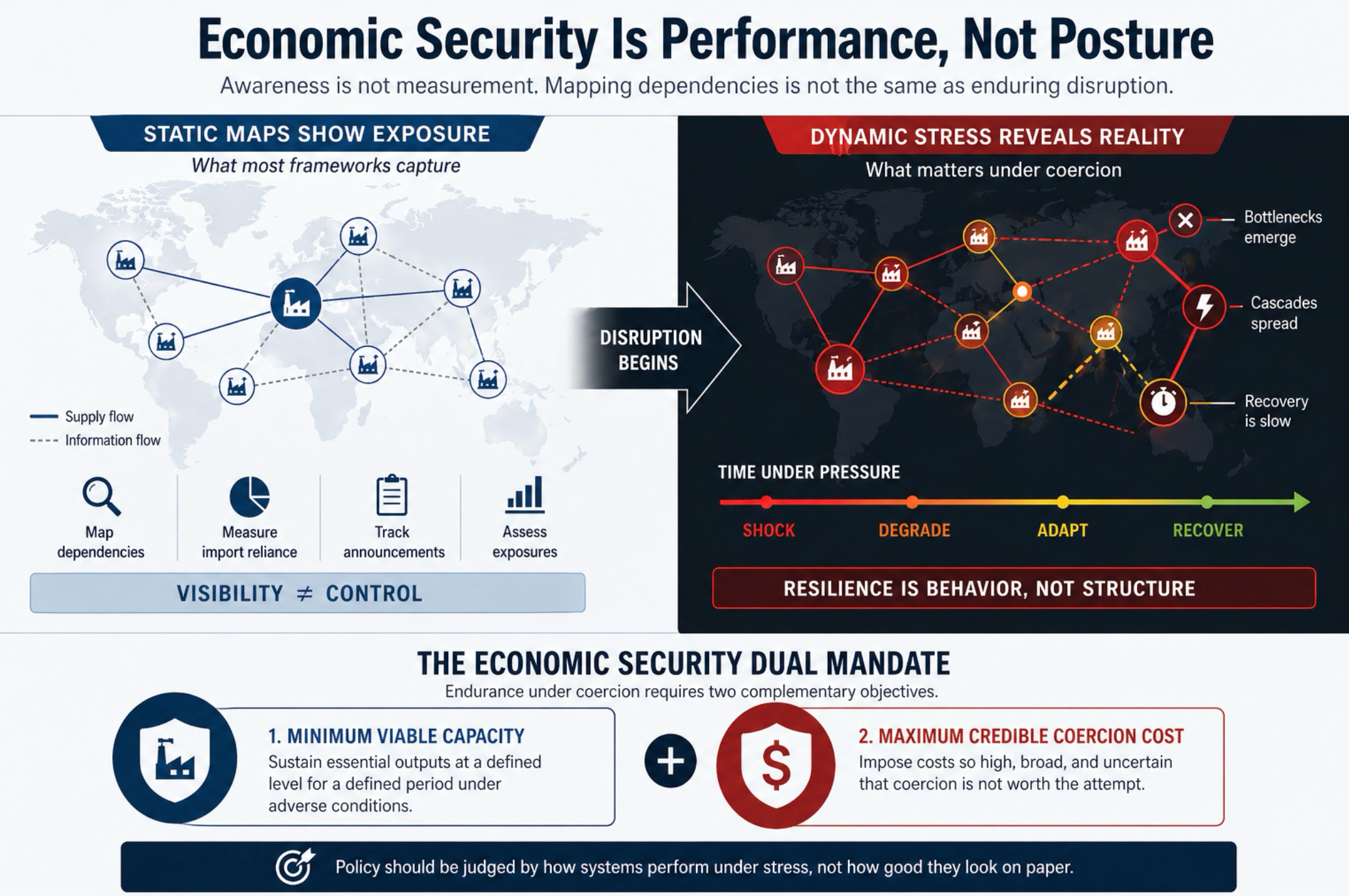
The turn to economic security has yielded frameworks and diagnostic tools that map supply chains and dependencies. While these improve situational awareness, awareness is not measurement; description does not equal control under pressure. Knowing where inputs originate does not reveal whether production can be sustained once disruption begins. Mapping dependencies does not show how systems behave when time, cash flow, bottlenecks, and recovery capacity become binding. Economic coercion exploits dynamics, while most current metrics remain static.
A central weakness is that many existing frameworks measure peacetime structure, not performance under stress. Indicators like import reliance describe a world without crisis, but are blind to how a system actually degrades or recovers when a critical node fails. The goal of economic coercion is rarely total destruction. History has shown, from the bombing of the Schweinfurt ball-bearing plants onward, that completely destroying an industrial node is nearly impossible. Instead, the modern objective is attrition: pushing output below a threshold long enough that it undermines operational abilities that shape of desired strategic outcome. Frameworks that fixate on static exposure while ignoring recovery speed are just fighting the last war. It means misunderstanding the mechanism through which externally imposed pressure works.
Another common error is the assumption that diversification automatically yields security. Spreading production across more locations can reduce exposure to a single supplier, but it does little to address constraints that are global in nature. Tooling, specialized labor, certification timelines, and precursor chemicals often remain concentrated even as final assembly disperses. Under stress, these upstream constraints reassert themselves quickly. Diversification without fixing reconstitution can create the appearance of resilience while leaving industrial endurance largely unchanged.
Current approaches also mistake announcements for achievement, overemphasizing paper capacity rather than usable output. While celebrating CHIPS Act investments is politically useful industrial reality is far harsher. The lesson becomes not so much that major industrial investments are misguided, but that physical construction is only one part of capability. TSMC’s Arizona project is best understood in these terms. Its early delays and operational frictions do not invalidate this major domestic effort. They reveal the difficulty of transplanting advanced production into a new ecosystem where skilled labor, supplier networks, water, power, and tacit organizational know-how all matter. The larger point is that industrial capability is not created by capital expenditure alone. It must be built, staffed, supplied, and sustained. That lesson extends beyond semiconductors to AI infrastructure, advanced manufacturing, and other sectors whose growth depends on fragile enabling systems.
An equally important issue lies below the prime contractor level. Industrial systems fail from the bottom up. Tier-2 and Tier-3 suppliers operate on thin margins, depend on steady cash flow, and often lack access to emergency credit. When shocks occur, these firms fail first. Payment delays or input disruptions cascade upward, halting production regardless of demand or funding at the prime level. Frameworks that do not measure sub-tier financial resilience are missing one of the most common ways in which economic pressure becomes systemic failure.
The cumulative result is that we end up having a policy environment rich in inputs but poor in outcomes. Economic security initiatives remain politically fragile and strategically ambiguous when they cannot distinguish between visibility and control, diversification and resilience, or announced investment and actual performance. What is needed is a shift from descriptive risk mapping to the measurement of industrial behavior under stress. Economic security requires indicators that capture how quickly systems recover, how far they can surge, where pressure concentrates, and how long production can be sustained once disruption begins. Only then can policymakers distinguish between industrial activity and industrial power.
The Economic Security Dual Mandate
If economic security is endurance under coercion, then it requires a governing logic that privileges performance over posture and outcomes over activity. Without such logic, policy fragments into disconnected programs that are difficult to evaluate and easy to politicize. Economic security needs an organizing principle that disciplines decision-making across institutions and administrations. Monetary policy offers a useful template. The Federal Reserve’s dual mandate translates abstract goals into durable targets that anchor expectations and guide action. Economic security requires a similar level of clarity. It needs a mandate that defines what success looks like under pressure.
I propose an Economic Security Dual Mandate built around two complementary objectives: (1) Minimum Viable Capacity and (2) Maximum Credible Coercion Cost.
Minimum Viable Capacity: The ability to sustain production of essential military, industrial, and technological outputs at a defined level for a defined period under adverse conditions. It is not about peak performance or global dominance; it is about the floor of output that must be maintained when disruption occurs. This logic reflects how practitioners have already begun to approach the problem. At the CHIPS Program Office, for instance, economic security was framed through interrelated dimensions of capacity, capability, competition, and criticality. In practice, however, the binding constraint repeatedly surfaced as recovery time. The central issue is not paper capacity, but how quickly production resumes after disruption. Minimum Viable Capacity formalizes time to recovery as a strategic variable.
Maximum Credible Coercion Cost: Capturing the flip side of the mandate, this reflects how expensive, slow, and uncertain it is for an adversary to disrupt U.S. production through targeted pressure. The higher the cost and the longer the timeline, the less effective coercion becomes as a strategic tool.
Together, these two objectives define economic security as a contest over endurance. Capacity without a coercion cost just invites pressure from an adversary. Coercion cost without capacity yields hollow resilience. Only when both are present does an industrial system become strategically resilient. The mandate also clarifies the role of the state. Minimum capacity and coercion cost are public goods. They require coordinated investment, long time horizons, and a tolerance for redundancy that markets alone rarely provide. The point of the mandate is not to prescribe a single industrial policy. It is to create a standard against which policies can be judged.
The challenge, of course, is measurement. Abstract mandates only matter if they can be translated into indicators that track real performance under stress. That does not require perfect precision at the outset, but it does require repeatable methods. Some indicators can be estimated through supplier mapping, sector-level concentration data, and confidential firm reporting. Others would require stress tests, red-team exercises, trial production runs, or disruption simulations conducted jointly by government and industry. A flawless dashboard cannot be created on day one. However, time and intentional policies are needed to build the institutional machinery needed to measure recoverability, surge potential, bottleneck concentration, and financial resilience in a consistent way over time.
Five KPIs for Determining Economic Security under Coercion
A mandate without measurement is rhetoric. American economic security can only be achieved through endurance under coercion. This means having indicators that capture how industrial systems perform when pressure is applied. Static measures of exposure or announced capacity won’t work. Time matters, as does throughput, concentration, and financial resilience.
The five indicators below translate the Economic Security Dual Mandate into a usable scoreboard. They focus on where systems break, how quickly they recover, and where coercion delivers leverage at lowest cost.
1. Time to Reconstitute
This measures how long it takes to restore meaningful production after a critical disruption. It is the most important indicator of endurance because time is the currency of coercion. In practice, reconstitution timelines are governed less by capital availability than by industrial physics. Semiconductor process-node requalification after a supplier loss often take 6 to 18 months. Rare-earth separation and magnet manufacturing lines have historically taken 3 to 7 years from permitting to full output. Machine-tool rebuilds after a chokepoint failure can exceed 18 months due to specialized castings and skilled labor. Systems with long reconstitution timelines remain vulnerable even when diversified on paper. Measuring this KPI forces policymakers to distinguish between theoretical substitutability and operational reality.
Target: About 6 to 12 months for any Tier-1 critical input, validated by red teaming supply chains.
2. Surge Ratio
This captures the maximum sustainable increase in output relative to peacetime baseline production over a defined period. It answers a simple question: how much more can be produced, and for how long, before the system breaks? Before the 2022 Russo-Ukraine War, U.S. production of 155 mm artillery shells averaged roughly 14,000 rounds per month. Despite ambitious targets to produce 100,000 rounds per month, production has stalled due to issues of sourcing energetics, fuzes, tooling, and skilled labor. Even a wartime demand — with a $6 billion infusion from the Pentagon — did not generate industrial willpower to meet surge goals, as the U.S. Army is only able to produce 56,000 shells a month as of February 2026. Achieving high surge ratios requires pre-positioned idle lines, redundant tooling, and cross-trained labor.
Target: Sustaining 3 to 5 times peacetime output for 12 to 18 months without cascading failures.
3. Chokepoint Concentration Index
We also need to measure how much control a supplier actually has over a non-substitutable input resides with the top one or three suppliers. Unlike traditional concentration metrics, this KPI focuses only on nodes that cannot be bypassed. The leverage embedded in such nodes is substantial. China controls basically 90% of global rare-earth refining and 90% of permanent-magnet production. Disruption at a single node, can undermine the U.S. economy and military, because both are so heavily reliant on these inputs to produce precision motors, guidance systems, and actuators. This KPI aligns directly with weaponized interdependence logic. It identifies where network topology creates coercive leverage and where investment most directly raises the cost of disruption.
Method: A Herfindahl-style index applied only to non-substitutable nodes, weighting supplier share by the degree to which inputs lack viable alternatives, so that concentration reflects true coercive leverage rather than nominal market diversity.
4. Sub Tier Supplier Liquidity Coverage
This measures how long critical Tier-2 and Tier-3 suppliers can continue operating under stress. It captures how financial shocks propagate through the industrial base. Recent assessments repeatedly show sub-tier suppliers operating on thin margins with limited access to emergency credit. When disruptions occur and payments slow, these firms fail first, triggering production stoppages that cascade upward.
Target: About 90 to 180 days of assured liquidity for priority suppliers, supported through guaranteed credit lines or accelerated payments.
5. Assured Inputs Stockpile Days
This measures how long production can continue using secure inventories of irreplaceable inputs. These are materials and precursors that cannot be substituted or sourced at scale under duress. Current stockpiles of critical energetics precursors and magnet alloys often cover a few weeks or months of wartime consumption. Operationally meaningful reserves must be sized to production rates rather than abstract tonnage. For example, stockpiles should be calibrated to sustain guidance-system production for key munitions.
Target: Approximately 12 to 18 months of sustained production for critical systems.
KPI Summary
Taken together, these five KPIs operationalize the Economic Security Dual Mandate. They shift attention from exposure to performance, from announcements to outcomes. They also explain why many well-intentioned policies fail to improve endurance. If investment does not move these indicators, economic security remains aspirational. Measurement, however, is only half the problem. Progress will only be made by allocating useful capital to shift these KPIs in meaningful ways. That is where economic security requires intentional investments to ensure a resilient industrial base.
Why Capital Allocation Determines Economic Security Outcomes
Measurement identifies where industrial systems fail. Capital allocation determines whether those failures persist. Without disciplined investment to overcome chokepoints, even the best KPI framework is just more policy pontification. Economic security is achieved by where the money goes, when it goes there, and what it is allowed to buy.
This distinction matters because much of today’s economic security spending still treats capital as a signaling device rather than a constraint-solving tool. Funds are often dispersed to demonstrate commitment, attract private investment, or spread benefits geographically. Those goals may be politically useful, but they do little to improve endurance under coercion unless they target the factors that actually govern output when the system is disrupted. The relevant question is not whether investment is large, but whether it measurably improves recoverability, surge potential, and resilience at critical nodes.
Industrial systems are shaped by irreversibility. Tooling, facilities, workforce pipelines, and qualification processes lock in production patterns for years or decades. Once these structures are set, they are slow to change regardless of demand signals downstream. Capital that arrives after a constraint is revealed cannot be repurposed quickly when conditions deteriorate. By the time disruption exposes where the system is weakest, it is already too late to build around those weaknesses.
This is why economic security investment must be evaluated differently from growth or innovation spending. The objective is not to maximize returns or accelerate diffusion. It is to raise the floor of output and steepen the recovery curve after disruption. That requires a bias toward assets with long lead times, high fixed costs, and limited substitutability. These are precisely the areas where private capital is least willing to invest without help from The Entrepreneurial State.
Capital discipline also matters because economic security spending competes with itself. When resources are spread thinly across too many initiatives, no single constraint is meaningfully relaxed. The result is a portfolio that looks comprehensive but delivers marginal gains everywhere. Endurance improves only when investment is concentrated at anticipated points of failure. Public capital is not meant to replace markets or permanently subsidize production. State-involvement is just meant to shape industrial structure in ways that markets alone will not, such as the Pentagon deal with MP Materials to source domestically produced magnets with guaranteed price floors. Once endurance is built into the system, private actors can compete within those bounds; meaning this framework makes investment options clearer.
A $50 Billion Endurance Build for a China-Proofed Industrial Base
Capital improves economic security only when it is used to solve binding constraints. The purpose of a $50 billion investment is not to chase technological primacy or replicate China’s scale across every sector. It is to illustrate how public and private capital might be concentrated against the highest-leverage vulnerabilities in the American industrial ecosystem. The allocation below is therefore best understood as a stylized portfolio, not a full national industrial strategy. Its logic is simple: prioritize sectors where lead times are long, substitutability is low, spillovers are high, and coercion vulnerability is acute.
The four pillars below reflect those criteria. Together, they target bottlenecks that would matter not only to the defense industrial base, but also to semiconductors, energy systems, logistics networks, and advanced manufacturing more broadly.
Pillar One: Energetics and Munitions Throughput ($15 Billion)
Sustained mass and fires, not exquisite platforms, are vital for warfighting during a prolonged conflict. Energetics, propellants, explosives, and their upstream chemical precursors govern what weapon systems can be employed at scale. Unfortunately, these production lines are capital intensive, environmentally constrained, and slow to expand. Despite billions being committed to ramp up munition and missile production, industry has struggled to match demand.
A $15 billion investment focused upstream would fund redundant precursor plants, idle surge lines maintained for crisis activation, and workforce pipelines for energetics chemists and technicians. These investments directly impact KPIs for: increasing Surge Ratio, shorten Time to Reconstitute, and extend Assured Inputs Stockpile Days.
Pillar Two: Midstream Processing and Magnet Production ($15 Billion)
Economic coercion is applied most efficiently in the middle of supply chains, where raw materials are converted into usable industrial inputs. Rare-earth magnets illustrate the problem, such as Chinese sourced magnets ending up in American-made F-35s. American mining doesn’t help because it takes 29 years to get a mine up and running — and it still takes 16 years elsewhere for a new mine. Even worse, separation, refining, alloying, and magnet manufacturing are what determine usable output across the industrial base, which is also dominated by China. U.S. and allied efforts are meaningful but will not reach a useful industrial scale until the early 2030s.
A $15 billion commitment would accelerate heavy-rare-earth separation and magnet facilities enough to get China out of the Western supply chain. Moreover, such investment would support qualification and offtake agreements and enable stockpiling of inventories in industrially usable forms. For the KPI, it directly reduces the Chokepoint Concentration Index and extends Assured Inputs Stockpile Days.
Pillar Three: Sub Tier Industrial Finance as a Security Instrument ($10 Billion)
Industrial systems fail from the bottom up. Tier-2 and Tier-3 suppliers absorb shocks first and recover last, yet remain largely invisible in industrial policy debates. That invisibility is dangerous because these firms often sit at the exact points where localized disruption becomes systemic failure. Besides small suppliers being fragile, the structure of defense and advanced manufacturing supply chains often leaves them exposed to cash-flow shocks even when prime contractors remain insulated. For instance, sub-tier firms usually contract through major integrators rather than directly with government, which means they often do not benefit from the favorable financing terms available to primes. The same reporting also shows a shrinking supplier base, with more than 17,000 firms leaving the defense sector in recent years and small-business participation down sharply.
A $10 billion sub-tier industrial finance facility would therefore function as a standing shock absorber rather than a subsidy program. Revolving credit, rapid-payment guarantees, government-backed liquidity lines, and resilience-linked contracting for priority suppliers would stabilize the firms most likely to fail first in crisis. This directly improves Sub-Tier Liquidity Coverage and helps prevent payment delays or input disruptions from cascading into system-wide failure. Because many of these firms also support aerospace, automotive, electronics, and energy systems, stronger sub-tier finance improves resilience across the wider economy, not just defense production.
Pillar Four: Machine Tools and the Industrial Commons ($10 Billion)
The ability to make the tools that make everything else is foundational to endurance. Machine tools, advanced manufacturing equipment, and specialized components underpin every industrial sector, yet domestic capacity has eroded. China commands around 33% of global machine tool production. Specialized components, precision castings, and skilled labor pipelines take years to rebuild.
A $10 billion investment in the industrial commons would combine tax credits, purchase commitments, and targeted R&D for next-generation automated machining tools, additive manufacturing equipment, and the supplier networks needed to sustain them. These investments shorten Time to Reconstitute across sectors and reduce chokepoint concentration in the tooling base itself. Machine tools underpin semiconductor fabrication, aerospace production, automotive manufacturing, and energy infrastructure. Rebuilding “industrial commons” improves recoverability across the entire economy.
How the Endurance Build Moves the KPIs
The value of this portfolio lies in its ability to move the indicators that actually define economic security performance. Investments in energetics, midstream processing, sub-tier finance, and the industrial commons collectively raise surge capacity, shorten recovery timelines, reduce chokepoint concentration, stabilize supplier liquidity, and extend assured inputs coverage.
These effects reinforce one another. Surge is hollow if sub-tier firms fail first. Stockpiles buy little time if tooling cannot be replaced. Reduced chokepoint concentration matters only if alternative capacity can be staffed, financed, and brought online quickly. By explicitly linking capital allocation to KPI movement, the endurance build turns economic security from a collection of programs into a coherent, measurable strategy.
Designing an American Economy that cannot be stopped
Economic security debates often gravitate toward scale, speed, or technological edge. Those attributes matter, but they are not decisive on their own. The more fundamental question is: Can the United States sustain production when pressure is applied deliberately and continuously? If the answer is unclear, economic security is a slogan.
Endurance under coercion must be a governing strategy that offers a clearer organizing principle. It shifts attention away from peacetime efficiency and toward performance under stress. It also clarifies why geography alone is an insufficient proxy for security and why market forces, left to themselves, rarely preserve the redundancy, recoverability, and slack that continuity under disruption requires.
My proposed Economic Security Dual Mandate strives to provide that discipline. Minimum Viable Capacity defines the floor of output that must be sustained under adverse conditions. Maximum Credible Coercion Cost defines how difficult it is for an adversary to interrupt that output. Together, they turn economic security into a testable proposition.
The five KPIs operationalize that mandate. Time to Reconstitute, Surge Ratio, Chokepoint Concentration, Sub-Tier Liquidity Coverage, and Assured Inputs Stockpile Days capture the mechanisms through which coercion actually works. They reveal where industrial systems break first, where resilience is real rather than assumed, and where investment can generate the greatest strategic return. Just as importantly, they offer a common language for distinguishing between industrial activity and industrial power.
Capital allocation is the bridge between diagnosis and capability. Economic security is strengthened by concentrating investment where lead times are long, substitutability is low, spillovers are high, and failure would be strategically costly. The endurance build outlined here is not a complete industrial strategy. It is an illustration of how public and private capital can be aligned to strengthen the industrial ecosystem where coercion would otherwise bite hardest.
That broader ecosystem matters. The defense industrial base is the most visible and unforgiving stress test, because wartime demand exposes bottlenecks quickly. But the same logic applies to semiconductors, energy systems, logistics networks, machine tools, and the enabling infrastructure behind advanced manufacturing and AI. A serious economic security framework must therefore extend beyond any single sector while still recognizing that some sectors reveal the problem more clearly than others.
This approach also offers political durability. A KPI-driven framework anchors debate around shared outcomes rather than changing rhetoric, reducing the temptation to relitigate economic security with every change in administration. That continuity is itself a strategic advantage.
The goal of economic security is not autarky. It is minimizing time to recovery while preserving competition, capability, and continuity across critical sectors. Endurance is what converts economic capacity into strategic power. If economic security is to move beyond slogans and into strategy, it must be judged by a simple test: how quickly production recovers, how long it sustains, and how costly it is for an adversary to interfere. That is the standard that matters. And it is one that can be measured.
This is a great essay and follows a lot of the thinking for software system design principles for with regards to fault tolerance (ex. uptime/downtime, consistency vs availability, etc.)
American policy elites increasingly understand where the problem lies. But the issue is not that the United States has no state capacity. The issue is that the structure of American state capacity does not match the kind of industrial-system construction Jahara Matisek is calling for.
The United States remains extraordinarily good at frontier innovation, financial mobilization, technology controls, military alliances, crisis appropriations, and targeted breakthroughs. But building an industrial base that can keep producing under Chinese pressure or other external shocks, recover quickly, and resist coercion requires a very different kind of capacity. It requires something less glamorous, more continuous, and more institutionalized: the ability to bind fiscal policy, procurement, permitting, labor formation, supply-chain finance, inventories, infrastructure, and corporate investment expectations into a durable long-term system.
These capabilities include deep visibility into lower-tier supply chains, a decade-long execution architecture, a thicker midstream and lower-tier industrial ecosystem, and the hard constraints most often underestimated in American industrial policy: permitting, local politics, infrastructure, and workforce formation. Rare earths and permanent magnets show that the hardest capability for the United States to rebuild is often not resource ownership, but midstream processing capacity. TSMC Arizona shows that America can build flagship factories, but a full industrial ecosystem is not the same thing as a single plant. The difficulty of scaling 155mm artillery shell production shows that even when money, demand, and crisis urgency are all present, the United States still struggles with the speed, stability, and repeatability of industrial expansion.
This is the structural difference between the United States and China. The United States can still force major breakthroughs under pressure. It can mobilize capital, attract leading firms, fund strategic facilities, and create key nodes. But it has much more difficulty connecting those nodes into a long-term, executable, replicable, coercion-resistant industrial system. That is the deeper question raised by Jahara Matisek’s essay: America’s problem is no longer merely the design of industrial policy. It is the form of state capacity itself.