
Altman, Amodei, Hassabis, and a long list of AI and biosecurity figures on both the right and left actually agree on something. In a June open letter, they argued that the US should require nucleic acid synthesis companies to screen DNA and RNA orders before fulfilling them.
AI will make it easier to design dangerous pathogens, but those designs still need to pass through the physical world. Nucleic acid synthesis providers are one of the few chokepoints between digital biological know-how and actual biological capability, as we’ll see in the next section.
If policymakers are looking for a concrete way to reduce AI-enabled bio risk, screening these orders is a good place to start.
Washington has already half-promised to act. Last year, the Trump administration nixed the Biden-era nucleic-acid synthesis screening framework, promising to replace it with something even bigger and more enforceable. Then biosecurity largely fell off their radar. But after the Fable ban (and then un-ban), as well as the OpenAI–Hugging Face fiasco, there is a growing recognition that frontier AI risks — including biological risks — may not be purely theoretical after all.
Cotton (R) and Klobuchar (D) also have a bill working its way through the Senate that would force Commerce and OSTP to act on synthesis screening, and there is a narrower House bill from Pfluger (R) and Houlahan (D).1
The US needs to follow through on this. But America is only one node in a global biotech supply chain.
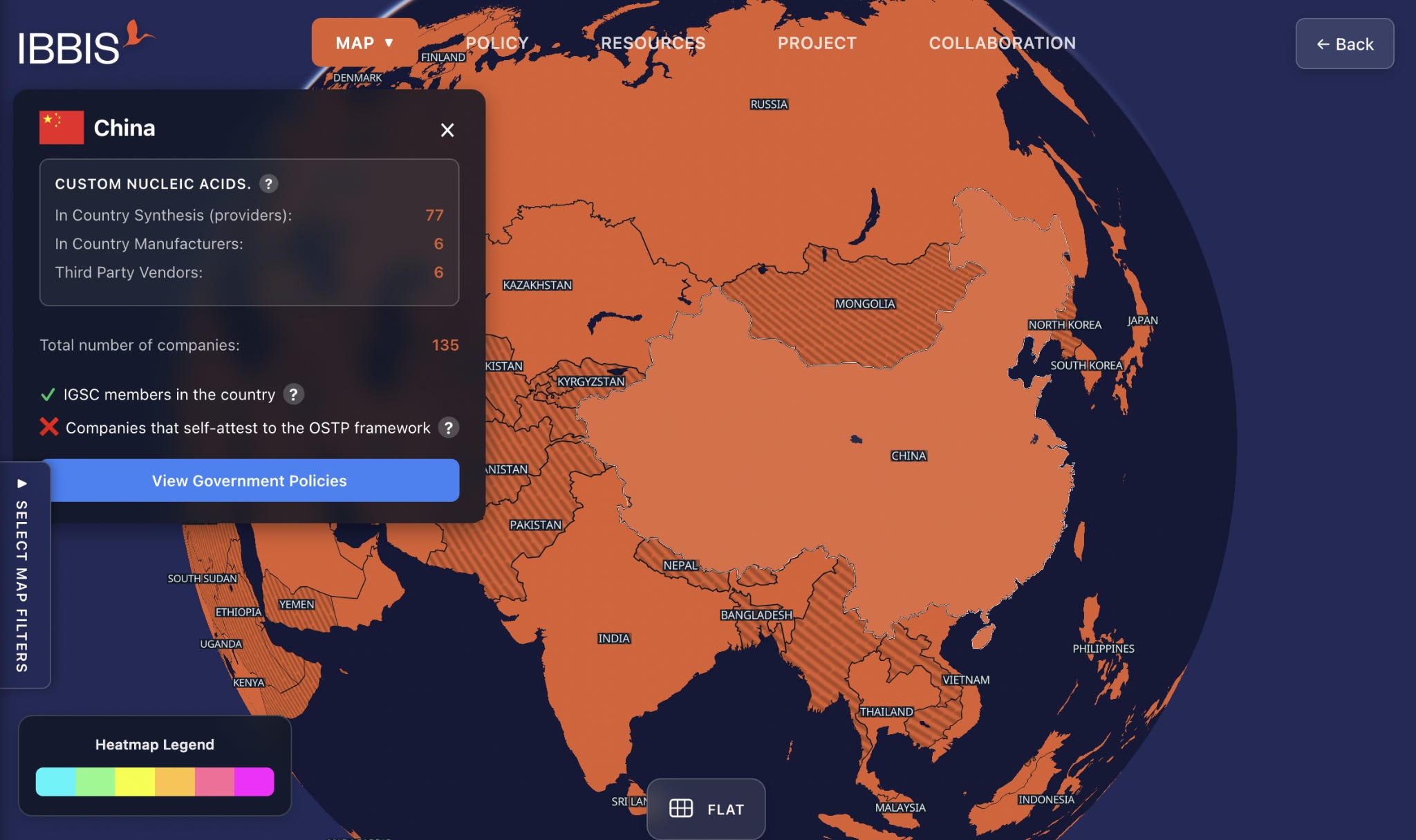
China accounts for ~34% of the world’s DNA synthesis providers. Its AI ecosystem is more open-source and thus harder to govern through model-level safeguards. And it has done a worse job at ensuring its AI models don’t spit out biorisks. An America-only screening regime would reduce risk, but it would not eliminate it if customers could simply route orders through providers in more permissive jurisdictions.
Synthesis screening belongs on the agenda of the upcoming US-China AI talks.
Synthesis screening is narrow, relatively verifiable, and plausibly a win for both sides. It also imposes little cost on AI development itself, since the burden falls primarily on synthesis providers rather than model developers. Rather than asking Washington and Beijing to sacrifice core interests or verify each other’s promises, it asks them to adopt a safeguard that neither country has very strong reasons to oppose.
Nucleic Acid Synthesis Screening, Explained
Nucleic acid synthesis screening is essentially a security check for custom DNA and RNA orders. When someone orders a sequence, the provider compares it against databases of dangerous pathogens and toxins, checks whether the customer is suspicious, and decides whether to fulfill, delay, or reject the order. The goal is not to review every biology experiment, but to stop dangerous genetic material from being shipped without scrutiny.
Imagine a researcher wants to synthesize a protein from the smallpox virus, one of history’s deadliest pathogens. The relevant genetic sequence has already been published, so they could copy the DNA code corresponding to that protein and send it to a synthesis company. And as AI-enabled biological design improves, the concern is not just that users could copy or tweak known pathogens, but that they may increasingly be able to design new biological sequences optimized for lethality or transmissibility.
The fact that we don’t already regulate this is pretty wild and is why many of the major synthesis companies screen voluntarily. But not every provider participates, it’s hard to actually enforce since these providers have limited resources and compulsion, and a single underregulated supplier can become the loophole that defeats it for everyone.

Biosecurity is asymmetric in a way many other safety problems are not. A system can work well 99.9% of the time and still fail catastrophically if one competent bad actor finds the gap, or if one legitimate lab makes a serious mistake. The many harmless orders do not cancel out the one dangerous one. And past reporting has exposed suppliers willing to ship dangerous pathogen fragments with embarrassingly little scrutiny.
AI model safeguards help, but they are easy to get around, and can force labs like Anthropic into blunt fixes like automatically routing users to weaker models (which made researching this piece much more annoying). Screening the synthesis providers instead targets the supply chain before a sequence becomes a shipped product.
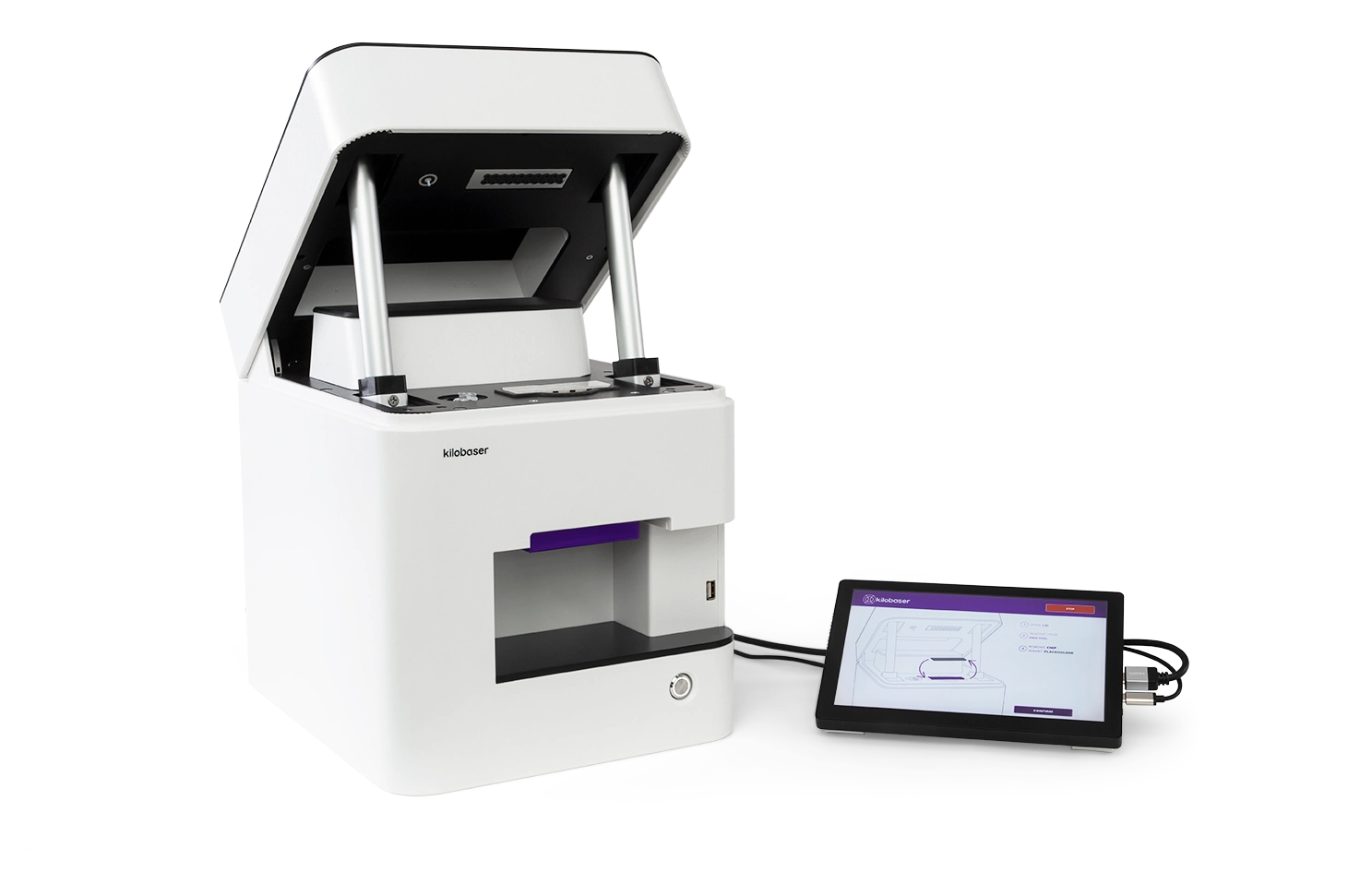
But screening is not a panacea. Benchtop synthesizers (personal synthesis machines small enough to fit on a lab benchtop), fragmented orders, and overseas suppliers can weaken the system. But benchtop synthesizers, for instance, are not yet magic pathogen printers, and other workarounds are limited by cost, sequence length, and the economies of scale that help set the main synthesis providers apart. Screening commercial synthesis orders will not close every route from screen to lab bench, but it can close one of the easiest ones.
Is China Down for Synthesis Screening?
China, like the US, does not have a mandatory national order-screening regime yet, but it is not starting from zero. Some of the biggest China-linked synthesis providers already participate in voluntary screening systems. The International Gene Synthesis Consortium (IGSC) is a great (albeit limited2) industry group whose members commit to screening gene orders and customers. It added BGI Bio-Solutions 华大基因 in 2017, and GenScript 金斯瑞 is also a member. Chinese companies/experts have also worked with the International Biosecurity and Biosafety Initiative for Science (IBBIS), a biosecurity nonprofit trying to make synthesis screening easier and more standardized across countries.
Synthesis screening is also a topic Chinese researchers have been raising more frequently.
The AI case for screening may be even more compelling for China than the US. Chinese frontier models are comparable with leading Western models on dual-use biocapability benchmarks but ship with significantly less effective safeguards against misuse. And China’s AI ecosystem is more open-source, which makes bio-concerns harder to govern — once the weights are released, users can modify, jailbreak, or run them locally without the original lab’s safety filters. China is pushing hard on both open-source models and biotechnology, which could be a recipe for disaster. This gives them even more reason to strengthen the downstream chokepoint where digital sequences become physical DNA.
On practical implementation, China may also have an advantage. The hardest part of synthesis screening isn’t the sequence check but verifying that customers are trustworthy, and China already runs something close to KYC on most of its population.
And let’s not forget the most obvious point: Xi does not want COVID 2.0 coming out of China! Because of this, as I discussed in a previous article, China has taken recent steps to increase its pandemic preparedness, such as the Biosecurity Law (生物安全法), which has a few sections that could plausibly be interpreted as calling for screening.3
Screening Doesn’t Slow Biotech
Some will worry that synthesis screening could slow biotech progress, and that if the US tightened its rules while China did not, Chinese firms would pull ahead. But I don’t think this is actually much of a concern.
Nucleic acid synthesis is one tiny step in a much longer pipeline. Ordering DNA takes days, whereas developing a drug takes years. The real bottlenecks are things like failed constructs, cell work, animal studies, clinical trials, manufacturing, and regulatory review.
Screening itself is also getting cheaper. The software already exists. IBBIS’s Common Mechanism gives providers a baseline tool for sequence screening. Customer screening costs more, but even that is dropping fast. As IFP argues, AI-assisted KYC could push those costs down enough that customer checks become a small fraction of a normal gene-length order’s price.
Firms representing roughly 80% of global synthesis capacity already screen voluntarily. If screening were a serious competitive drag, the companies with the most to lose would be the ones avoiding it, not signing on. Making screening mandatory mostly raises the floor for the remaining 20%, which arguably helps the major providers by adding stability to the market dynamics, since today they can be undercut by smaller, less scrupulous suppliers who skip screening.
Finally, the cost of screening is trivial to the cost of getting this wrong. At its peak, COVID was burning through the US economy at roughly $26 billion a day. Every day a vaccine arrived sooner was worth tens of billions of dollars. (The Centre for Long-Term Resilience put numbers on this for the UK and found every £1 spent on screening returns £3.50 in averted losses.) Any intervention that lowers the odds of another pandemic, even slightly, pays for itself many times over — to say nothing of the ethical imperative of saving millions of lives!
A Way of Thinking About Cooperation
The US and China cooperating on anything is difficult. Part of the problem is that many proposed forms of cooperation require mutual verification. If one side upholds its end of the bargain while the other cheats, it can end up at a disadvantage.
That is why, when thinking about US-China AI cooperation, I find it useful to distinguish between contingent cooperation and demonstrated cooperation.
Contingent cooperation only works if both sides act simultaneously. In arms control agreements, for instance, if one side limits itself while the other secretly defects, the cooperator ends up weaker while its rival gains a military advantage. Demonstrated cooperation consists of each side independently taking actions that advance a shared objective (one they want to pursue anyway) while providing evidence of its commitment to that objective. Over time, both countries gradually accumulate trust through repeated acts of demonstrated cooperation that could establish a foundation for progressively solving harder — more contingent — problems.
Matt Sheehan articulates something similar in this post:
“I believe that (at least for now) the most important actions on AI governance and safety will be domestic actions that the U.S. and China take — not international or bilateral agreements. There may be some level of light touch coordination, but it’s unlikely to be “We do X because you’ve promised to do it too.””
Synthesis screening strikes me as an opportunity ripe for demonstrated coordination. Both countries independently don’t want a Covid-like pandemic emerging from within their borders. Cooperating doesn’t detract from this goal; it supplements it. It gives both governments something they can do independently.
The US can require American providers to screen orders; China can require Chinese providers to do the same; both can point to domestic signals as evidence that they are taking AI-bio risk seriously.
This framing also avoids one of the usual traps in AI safety politics. Safety is often cast as a brake on progress; why should China/US accept rules that might lock in the other side’s AI advantages? Synthesis screening does not fit that frame, since it is not about making models weaker or slowing AI labs down. Rather, it is about securing the physical supply chain that turns biological designs into biological material. And as explained in the previous section, it won’t meaningfully slow biotech either.
For a US-China AI safety agenda that will otherwise be full of abstractions, nucleic acid synthesis screening is tantalizingly practical.
How to Actually Do It
The first step would not need to be a grand US-China biosecurity treaty. It could be a shared baseline — relatively minimal — clarifying which kinds of DNA and RNA orders should be screened, what sequence lengths count, what categories of pathogen or toxin sequences trigger review, and what customer information providers need to verify.
Some of these measurement questions could be tricky. For example, should the metric they report to each other be measured by the share of providers that have passed third-party verification, or by the share of orders that are actually screened? The latter may be the more accurate measurement [like how counting FLOPS is better than counting chips for estimating compute capacity], but many private companies are reluctant to disclose order-level data. The former is easier to report, but it can be statistically distorted by the behavior of numerous small providers. Neither metric is perfect. But the important point is that modest differences over questions like these would not be the end of the world, so long as each side reported enough for the other to recognize that meaningful action had actually been taken.
Tools like IBBIS’s Common Mechanism could also help make this less abstract by giving providers a common technical starting point rather than asking every company to invent its own screening system.
The second step would be talking to each other, ideally starting with Track 1 happening in a few weeks! Both countries could report how many orders their providers screen each year, how much of the market is covered, or how many orders are escalated for human review. My kind of arms race is one where each side competes to prove it is screening more thoroughly than the other.
The harder part would involve sharing information about dangerous orders that are actually flagged. That would be more useful, but also more politically sensitive. No one likes to brag about how many potential bioterrorists they have in their country, and China in particular has an MO of trying to sweep biosecurity blunders under the rug. So the realistic starting point may be the understanding that each country is dealing with their flagged customers privately.
Trusted intermediaries could help. Organizations already involved in this work, such as SecureDNA and IBBIS (both Swiss and therefore relatively neutral) as well as IGSC, NTI, and SAIF, can help develop standards, host technical dialogues, and build confidence before the issue becomes too politicized. And new players like Carnegie or Brookings could leverage their existing dialogue networks to begin feeling out the vibes with the Chinese players.
What not to do
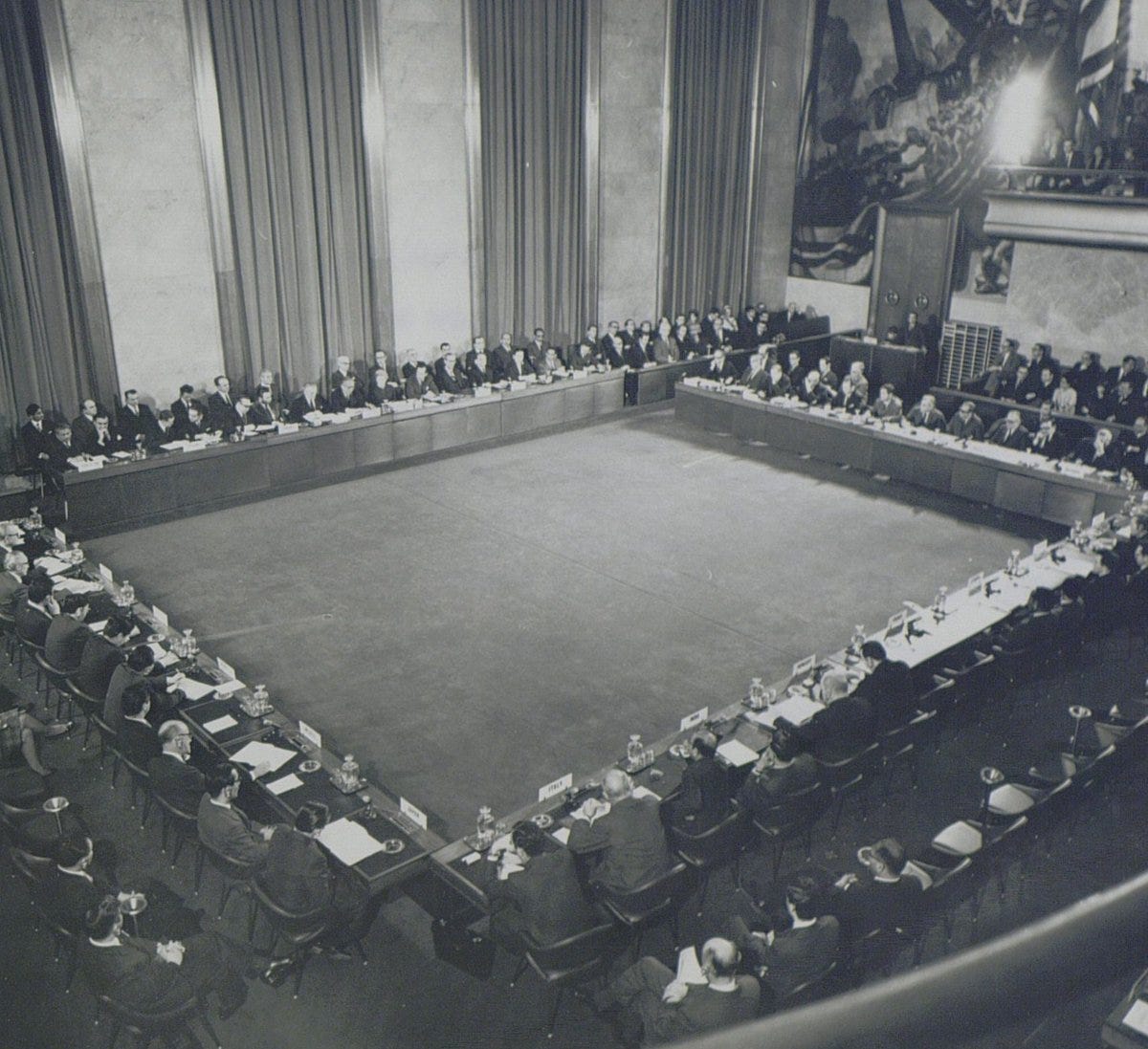
What I don’t think it would be wise to do is route the whole thing through the BWC, WHO, or other official international bodies. Those bodies tend to make cooperation more contingent and more politically fraught. For instance, if nucleic acid synthesis screening is immediately turned into a BWC-style treaty-process question, it is at risk of inheriting all the hard problems of verification, sovereignty, accusations of cheating, and disputes over who gets to inspect whom that have pushed both the US and China away — especially since China is not exactly eager to report sensitive biosecurity problems to international institutions. Starting with something bilateral seems better.
None of this eliminates the need for harder, more contingent cooperation. One obvious problem is split ordering: a bad actor could try to evade screening by ordering different fragments from different providers, possibly in different countries. Solving that may eventually require more direct information-sharing. The same goes for regulating benchtop synthesizers. But I believe we need to first build the habit of parallel demonstrated action. Prove that both sides can screen orders, verify customers, and report aggregate progress. Then, over time, work toward the harder cases.
The main Senate proposal is the bipartisan Biosecurity Modernization and Innovation Act (S. 3741), introduced by Senators Tom Cotton and Amy Klobuchar. It would require covered nucleic-acid synthesis providers to screen orders and customers, establish a federal list of sequences of concern, create a NIST biotechnology-governance sandbox, and give OSTP 90 days to assess gaps in federal biosecurity oversight and develop a streamlining plan. The bill has attracted support from NTI, FAS, the National Security Commission on Emerging Biotechnology, Johns Hopkins' Center for Health Security, and industry players including Twist Bioscience, IDT, and Ginkgo Bioworks. The narrower House version, introduced by Reps. August Pfluger and Chrissy Houlahan in August, retains mandatory synthesis screening and the federal sequence list but omits the NIST sandbox and OSTP-wide governance review.
The IGSC runs on member dues and goodwill, not a funded regulator with investigative or enforcement capacity. It can’t really compel non-members to screen, audit compliance, or penalize evasion.
Article 63 of the Biosecurity Law: “Based on their duties and division of labor, the relevant departments of the State Council and related military organs are to strengthen the monitoring and investigation of activities such as cross-the border, importing or exporting, obtaining, creating, transferring or placement of organisms, biotoxins, equipment or technologies that can be used for bioterrorist activities or production of biological weapons, and are to take all necessary preventative and disposal measures.”
Hi Nick, I'd be very interested in your view on how Xi's planned visit to the U. S. in September might affect the rare-earth sector. Do you see a risk that Trump could use rhetoric about Xi's visit, China policy, or rare-earth supply chains to generate volatility in critical-minerals stocks-creating opportunities for allies, insiders, or related business interests to profit? Could you write an article about this topic? Thank you.
US–China biorisk cooperation sounding possible is the least boring headline in a while.
https://paretoinvestor.substack.com/p/south-of-the-consensus