
We built an interactive microsite for this story! Check it out here and let us know if you’d like to see more ChinaTalk reports in this format.
From time to time, people come to us hoping to pitch a story on “Eastern Data, Western Compute” 东数西算, the government initiative to route more of China’s data center and computing buildout away from the crowded eastern seaboard and toward national compute hubs in the country’s interior. In theory, western China has land, energy, cooler climates, and underdeveloped regions in need of a growth model. Connect the two, and voilà…a national compute grid for the AI age.
Your humble authors, Irene and Nick, have likewise been lured in by the siren call of a Chinese megaproject in which every province slots neatly into a national AI strategy, Guizhou stores the data, Shanghai and Hangzhou spin up the applications, Shenzhen adds the robots, and the whole country hums along as one vertically integrated socialist cloud.

But, like Odysseus’s sirens, the call is deceptive. The more we looked, the more “Eastern Data, Western Compute” seemed less like a radically new geography of Chinese AI infrastructure than the same pattern you’d find in other places. Some of that pushes capacity westwards, but most of it pushes capacity to the exurbs and industrial hinterlands of already-rich and technically-savvy eastern metros.
Beyond merely being illusory, poorer western provinces, swooned into building data centers on a shaky reading of the market signal, may be the policy’s biggest losers.
Where Are the Chips?
The China Academy of Information and Communications Technology (CAICT), a research institute subordinate to China’s Ministry of Industry and Information Technology, published data about the country’s data center distribution in 2025. When we look at where China’s chips are actually located, the top provinces and municipalities are not a roll call of the remote west.
Hebei
Guangdong
Jiangsu
Guizhou
Inner Mongolia
Shanghai
Zhejiang
Beijing
Shanxi
Shandong
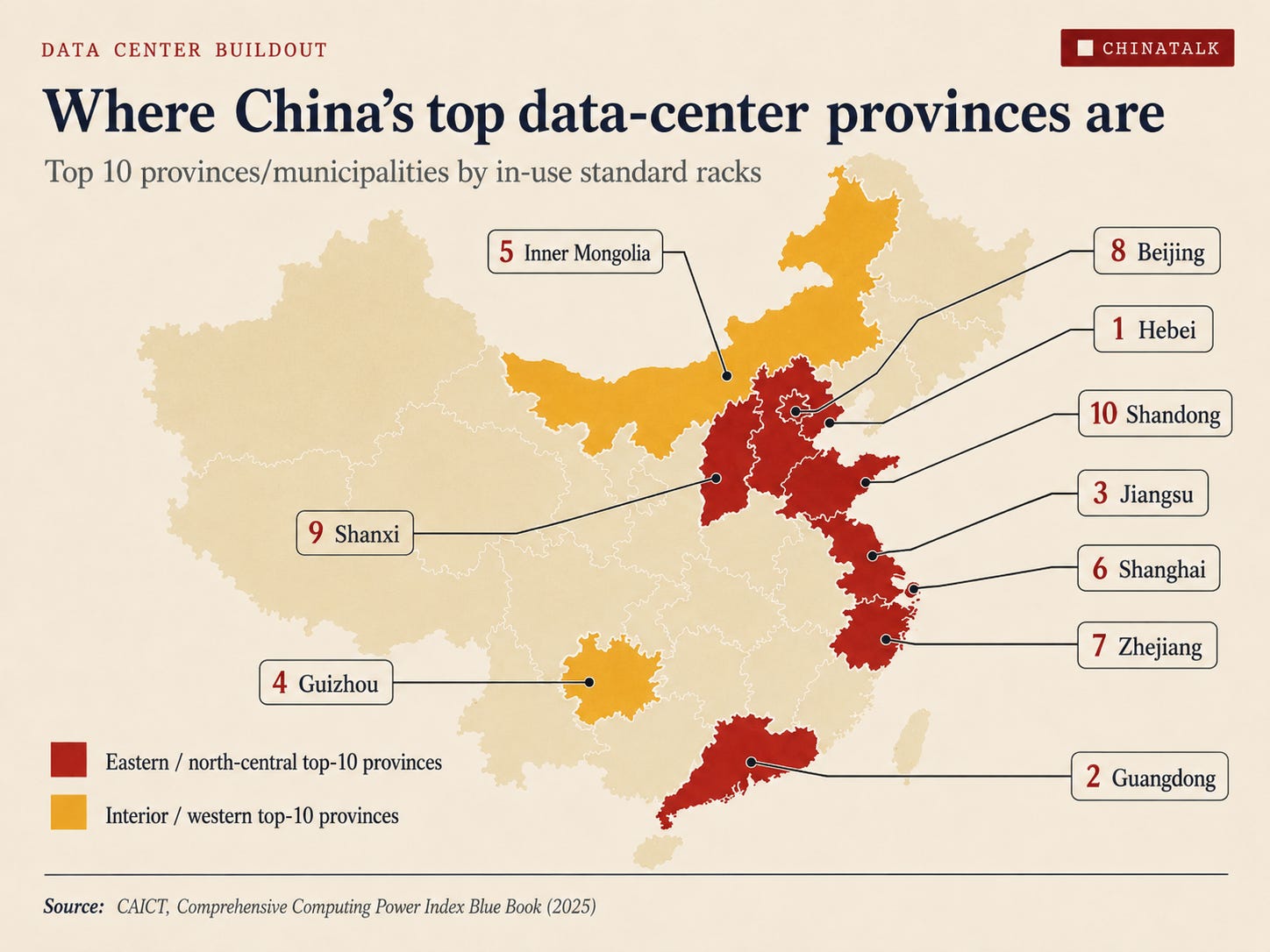
There are certainly western and interior provinces on the list (shout out to Guizhou and Inner Mongolia). But the overall map doesn’t suggest China has moved compute to the west. It suggests China has placed a handful of data centers out west to serve the inference needs of a more sparsely populated region.
That CAICT report takes this to mean China is still falling short of the original dream to unlock the West’s AI potential. But the deeper point may be that officials know that Eastern Data, Western Compute was never quite the right model in the first place. The slogan was born before the practical geography of AI-era data centers had fully come into view, and now they have to walk it back.
Why Did They Start the Slogan?
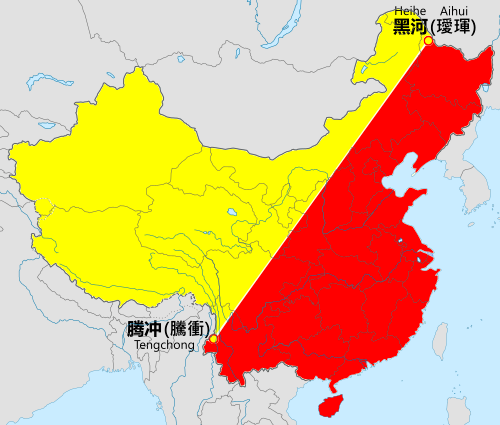
Energy was the obvious starting point. Western China has more land, more wind and solar, more coal in some regions, cooler climates, and local governments eager to offer favorable power arrangements. In 2022, 80% of China’s compute was in the east, while 70% of renewable energy was in the west. According to Zhao Xiaofang, a chief engineer at the Chinese Academy of Sciences:
“... [moving computing facilities to the west] not only guarantees the computing power demand of the eastern digital economy development, but also cultivates a new digital industrial track in the west.”
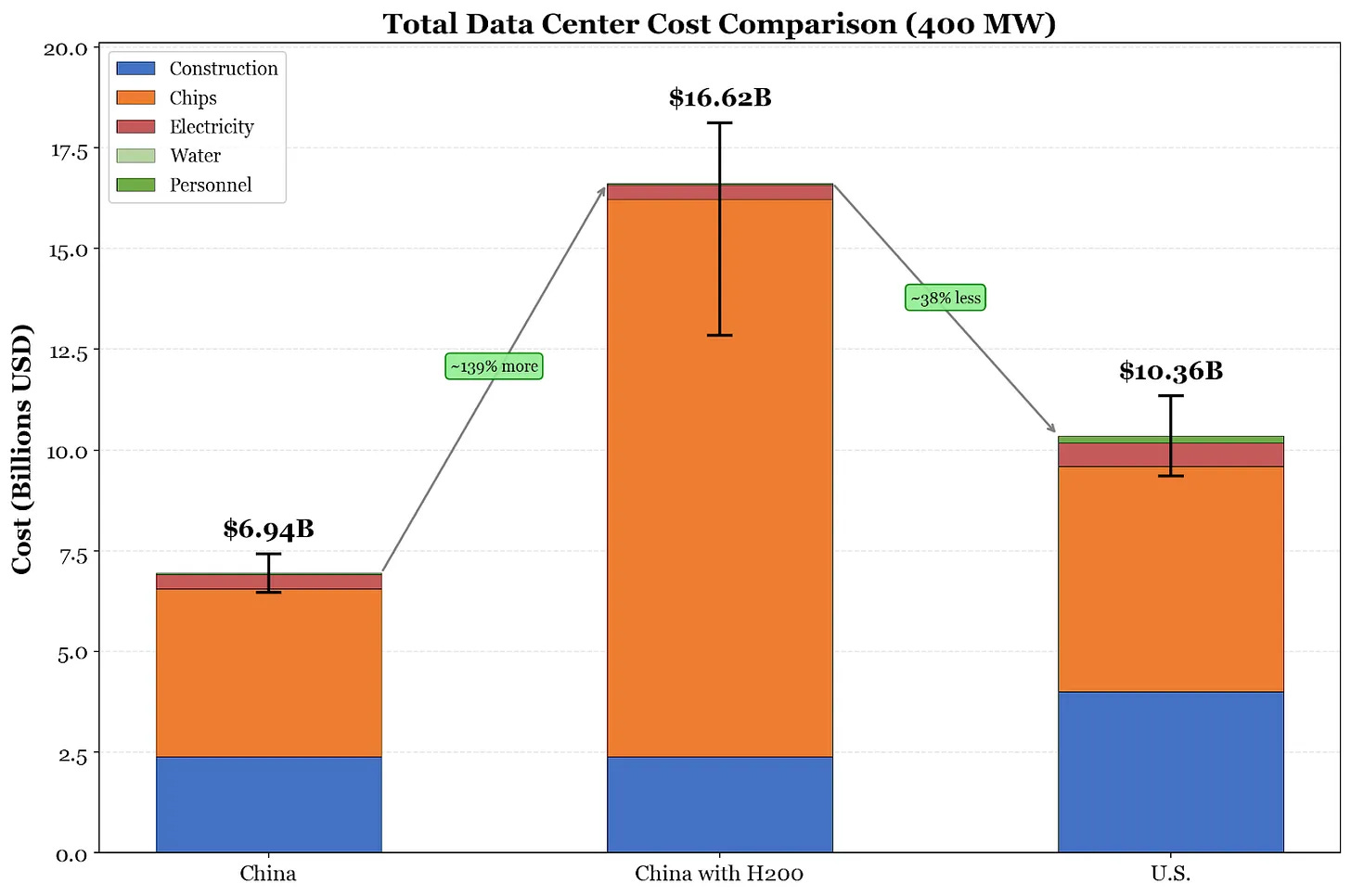
But cheaper electricity is not destiny. EDWC seems to have been built around an incomplete theory of data center economics. The National Development and Reform Commission (NDRC) justified EDWC by saying electricity can account for 70% of a data center’s operating costs. But as ChinaTalk’s Aqib Zakaria has clarified, operating costs should not be confused with the real cost of AI infrastructure, which is dominated by construction and chips. For a 400 MW facility, he estimates electricity is only about 5% of the total three-year cost.
The energy advantages are overblown.
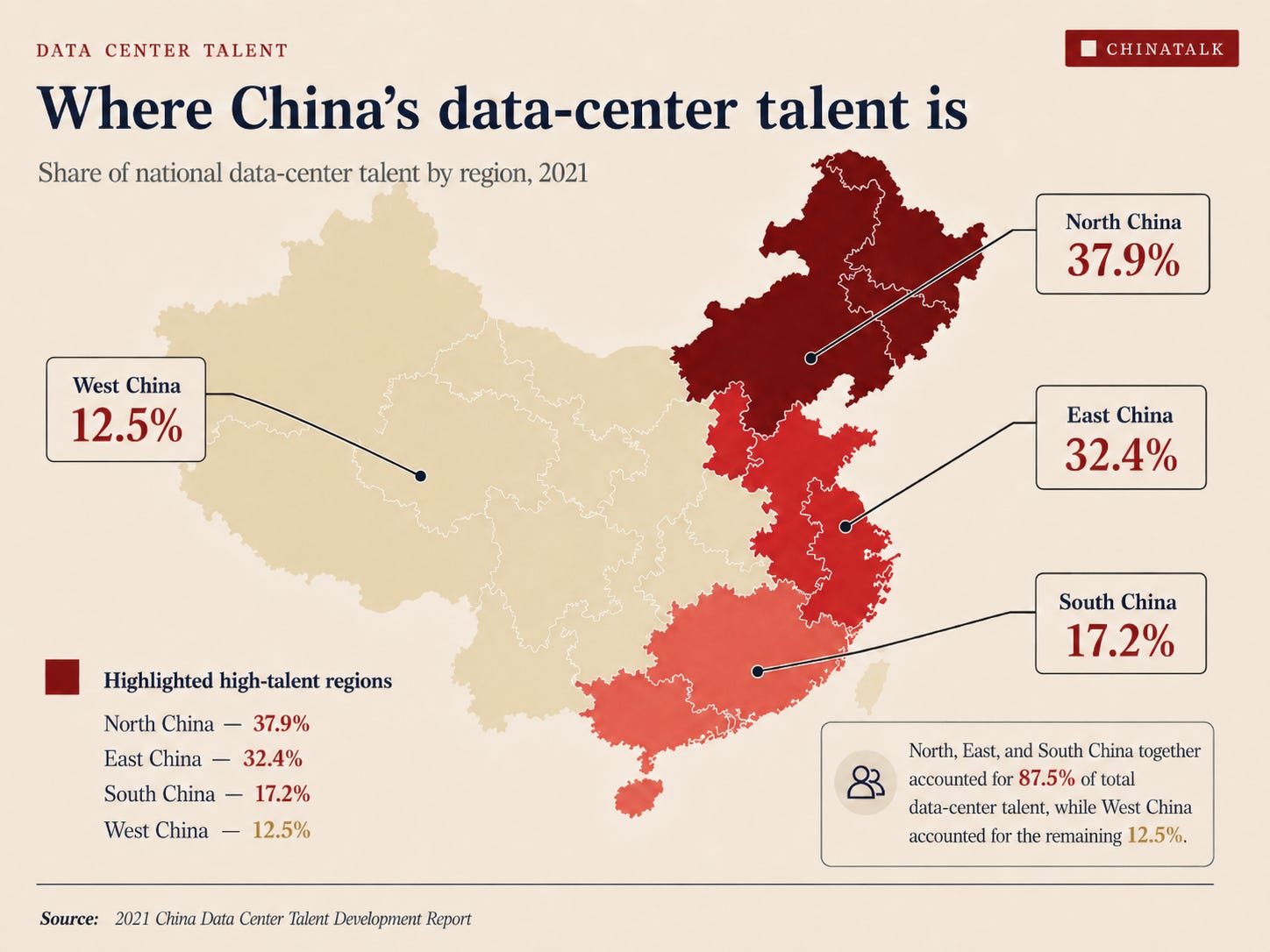
Nor are data centers just land plus electricity. They need electricians, HVAC technicians, network engineers, hardware staff, cooling specialists, emergency vendors, and experienced facilities managers — a skilled labor ecosystem that is already unevenly distributed. According to a 2021 Data Center Talent Development Report (2021中国数据中心人才发展报告), data center talent was concentrated in North China, East China, and South China, which together accounted for 87.5% of the total. In the US, these are good middle- and upper-middle-income technical jobs, and hyperscalers are already spending heavily to train more of them because the labor is scarce (e.g. Meta’s $115 million training program). That should make us skeptical that remote western hubs can simply conjure the same operations ecosystem found around Beijing or Shanghai.
China’s land system also makes it easier to build data centers where convenient compared to the US, as we covered here.
The meta is not “go as far west as possible.” It is exurban. Beijing spills into Hebei; The Yangtze River Delta spills into nearby Jiangsu, Zhejiang, and Anhui; The Pearl River Delta spills into cheaper Guangdong hinterlands. Perhaps the slogan should not be “Eastern Data, Western Compute,” but “Eastern Data, 45 Minutes Outside the City Compute.”
This is literally validated by how the NDRC, China’s top economic planning body, characterized the EDWC buildout back in 2022. It mapped out 8 “nexus points” 枢纽节点 for data center construction, three of which are megacity hinterlands in the East:
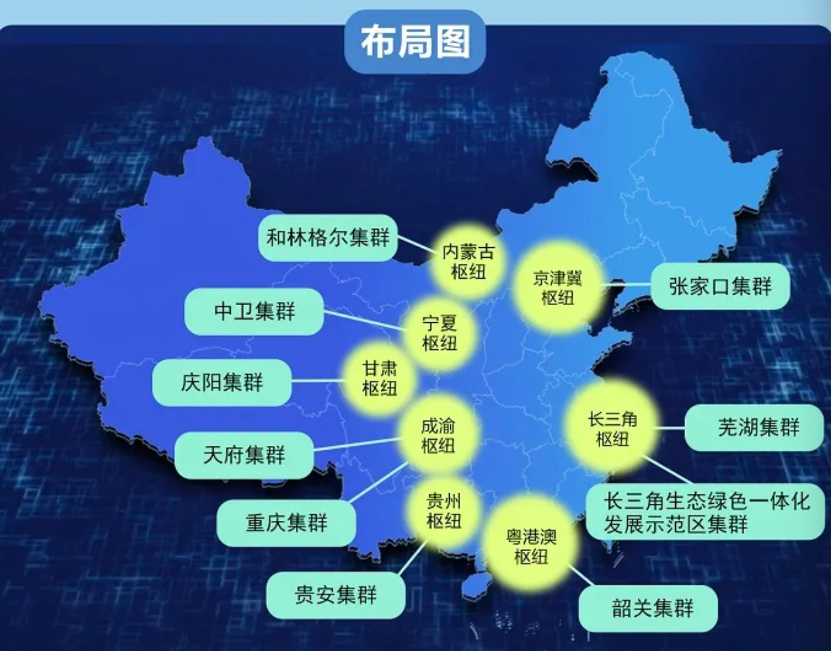
The 8 nexus points are:
The Beijing-Tianjin-Hebei nexus, covering the capital region;
The Yangtze River Delta nexus, covering Shanghai, Hangzhou, Suzhou, and many other cities;
The Guangdong-Hong Kong-Macau nexus, covering the two Special Economic Zones as well as Guangzhou and Shenzhen;
The Chengdu-Chongqing nexus, covering Western China’s two biggest cities — more than 50 million people in total;
Guizhou;
Gansu;
Ningxia;
And Inner Mongolia.
Only four of these can reasonably be framed as remote. From the start, EDWC was meant to augment the geography of China’s digital economy, rather than transform it. Even perfect top-down coordination would not be able to outrun basic market logic — and Beijing’s coordination of provinces and regions is far from perfect. A March 2026 report by Communications Weekly 通信产业报, a newspaper directly under China’s Ministry of Industry and Information Technology, identified three “bottlenecks” for the continued development of EDWC. These are quite obvious:
Coordination issues: the report notes that “..some western hub nodes still consist primarily of general-purpose computing power,” rather than specifically servicing AI training or inference;
Latency: having data cross hundreds of miles of transmission lines introduces inefficiency, so “many eastern enterprises balk at migrating their computing workloads westward.”
Hardware chokepoints and talent shortages: simply put, racks are useless without chips, and not all compute is equal. Semiconductor export controls remain the main hurdle preventing China from realizing its hyperscaler dreams. The report also notes that China has a “shortage of high-end computing talent and operations/management personnel,” resulting in insufficient tapping of western compute resources.
On Hope
A more troubling possibility is not just that EDWC misdescribes where China’s compute actually goes, but rather that the slogan gives poorer interior and western provinces a seductive theory of development that sends them further into debt.
At its onset, the NDRC explicitly framed the project as a way to narrow regional digital-economy gaps, arguing that data flows from east to west would help pull capital, talent, technology, and industry westward. As we have explained above, that is not quite what happened.
Instead, China Economic Weekly 中国经济周刊 found in February 2025 that regions from Ningxia to Xinjiang, Guizhou, and Inner Mongolia rushed to build intelligent-compute parks, sometimes treating them with the same inflated, Field of Dreams logic they used for real estate: “build it, and they will come.”

Science and Technology Daily 科技日报, another state-run newspaper, described one western city’s intelligent-compute center, built more than 20 kilometers outside town to take advantage of cool weather, cheap land, and clean energy. Its rack-up rate was reportedly below 50%; even the servers already installed had actual utilization below 30%; meanwhile, annual operating costs exceeded RMB 30 million (around $4.44 million). The same article said China had nearly 150 operating intelligent-compute-center projects by late 2024. Nearly 400 more were either under construction or being planned, creating “blindly constructed systems divorced from actual needs” (脱离实际需求的盲目建设).
That is the injustice buried inside the slogan of “Eastern Data, Western Compute.” It promised poorer provinces that they could be more than resource suppliers; they could become meaningful contributors to the AI economy and meaningful beneficiaries from its gains. Perhaps some will — the likes of Guizhou or Inner Mongolia. But many may discover that their data centers are the next installment of ghost buildings rather than tickets into the AI boom.
We built an interactive microsite for this story! Check it out here. It is pretty cool.
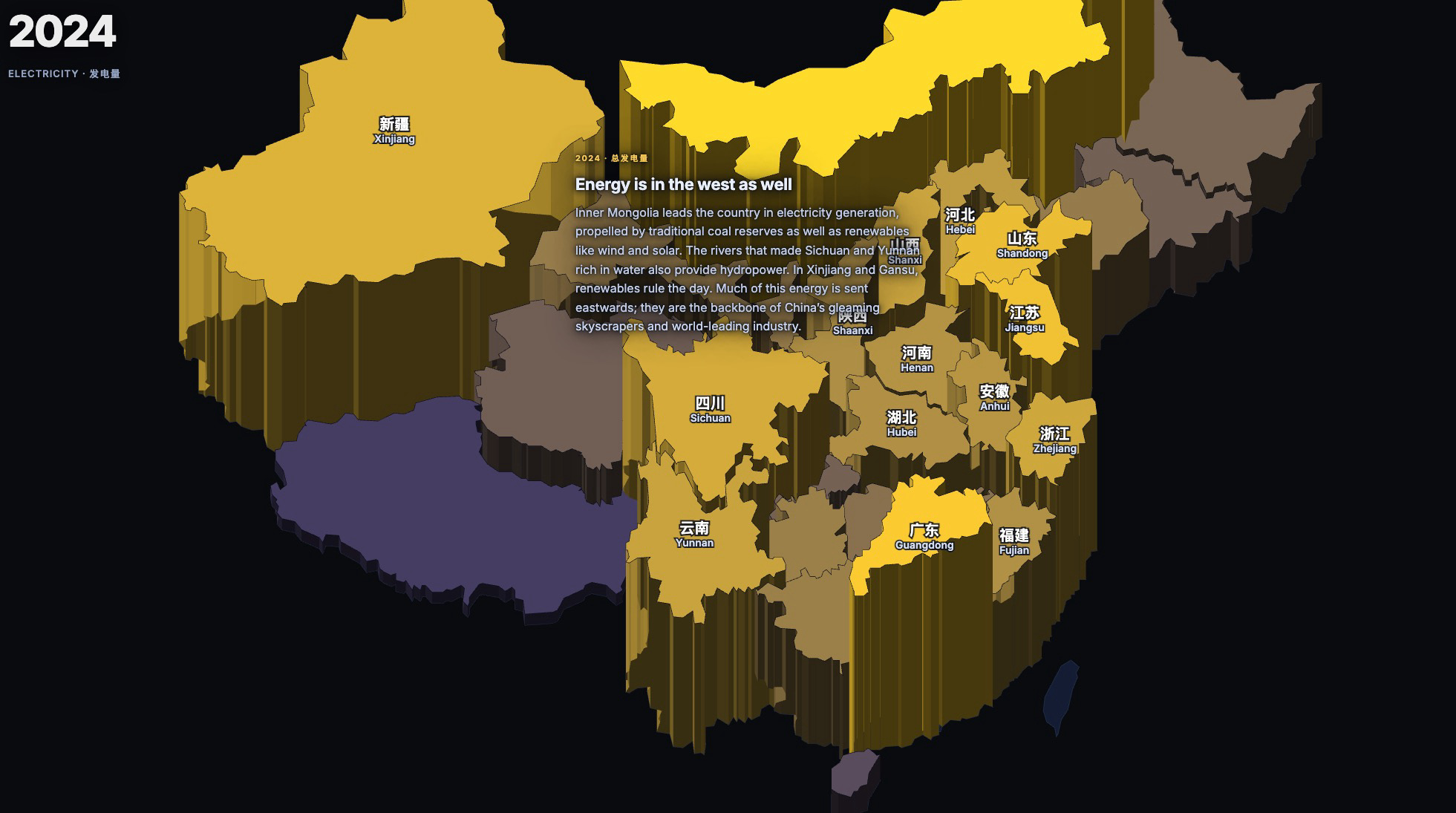
I like the interactive microsite, great maps!
That NDRC justification is the tell: electricity billed as 70% of operating costs, when construction and chips dominate the real bill. It's the same reason US data centers cluster in the exurbs next to big metros instead of out where power is cheapest. The technicians and the fiber matter more than the electrons.